Archive
Forever Marilyn: Gail Levin’s new film frames the “Monroe doctrine”

Image via Wikipedia
Marilyn Monroe has been the subject of countless articles, books, and films, and filmmaker Gail Levin, like so many other artists, has long been fascinated by the pop culture icon’s hold on us all these years. Levin made a documentary a few years ago about the Monroe mystique, examining still images of the actress as a way of taking stock of how the starlet and a handful of photographers she posed for over and over again were complicit in creating the intoxicating sex symbol she epitomized then and continues to represent today. I must say that even as a young boy I was completely taken by the Monroe package — her looks, her voice, her manner, her everything. For better or worse, I am still enthralled today. In fact, as I write these words a Marilyn poster hanging on my office wall fetchingly looms over me, her abundant bosom straining against the decolletage of a slinky evening dress, one strap having fallen down, and she lost in the reverie of anointing her porcelain skin with perfume. Marilyn, sweet Marilyn, the embodiment of innocence and carnality that has universal appeal. My story for The Reader (www.thereader.com) about Levin’s film is unavoidably also about Marilyn, a subject I don’t mind revisiting again, although I do tire of all the prurient conspiracy theories swirling about her untimely death. I think the truth is she died just as she lived – messily.
Forever Marilyn: Gail Levin’s new film frames the “Monroe doctrine”
©by Leo Adam Biga
Originally appeared in The Reader (www.thereader.com)
Filmmaker Gail Levin is at it again. Only a year after the Emmy Award-winning Omaha native’s documentary on James Dean premiered on PBS as part of the American Masters series, she has a new Masters film set to debut on July 19 that tackles another, larger screen legend — Marilyn Monroe.
Another Monroe treatise? That cynical reaction is precisely what the New York-based Levin, a Central High School graduate, hopes to overturn with her new documentary Marilyn Monroe: Still Life, premiering next Wednesday at 8 p.m on Nebraska Educational Television.
Instead of yet another biopic approach to this much revisited subject, Levin’s “gentle film” examines the persistence of Marilyn’s image in pop culture as filtered through the canon of still photographs taken of her, photos that largely account for the potency of her sex goddess status 44 years after her death.
Long intrigued by how MM and the photogs who shot her crafted an image with such currency as to cast a spell decades later, Levin committed to the film after hearing Marilyn would have turned 80 this year; reason enough to delve into the ageless Marilyn forever fixed in our collective consciousness. The filmmaker dealt once before with MM — for her 2003 doc Making the Misfits, which looks at the intrigue behind the 1961 Monroe feature vehicle The Misfits, penned by her then-husband playwright Arthur Miller.
On a recent Omaha visit to see family and friends, Levin spoke to the Jewish Press about her new project and the Monroe mystique that still beguiles us. She said MM is a much-referenced figure all these years later “not because of the movies” but “because of all the photographs” — photos the image makers and the icon used to their own ends.
“She made herself quite available to photographers and the list is just endless. We sort of picked a path through this huge archive of photographs,” said Levin. In addition to being “perhaps the most photographed woman of the 20th century,” there are MM-inspired books, articles, songs, videos, “and I was interested in what motivates all of that,” Levin said. “The masters part of this American Masters is as much these great photographers as it is her. It’s kind of book-ended by the great Eve Arnold and the great Arnold Newman. These are two giants of 20th century photography.”
Not just noted photographers contributed to her image. The film includes pics by Ben Ross, “whom none of us had ever heard of before,” Levin said. “He was one of these itinerant photographers from the 1950s and his photographs of her are stunning.” At least one of the artists whose images of MM are featured, Andre De Dienes, was also her lover. “He really knew her from the time she was probably about 20 to the time she died, and shot her all that time, and had a big romance with her,” Levin said. “There’s some very beautiful young stuff with her.”
There’s the ubiquitous Andy Warhol take on Marilyn in the film. Some images are quite familiar but others are new, at least to a general viewing audience and, Levin predicts, some images will even be new to Marilyn and photography aficionados.
Besides interviews with top photographers who helped shape MM’s image, Levin’s film features comments from Norman Mailer, Gloria Steinem and Hugh Hefner. There are even audio excerpts from the last interview Marilyn gave.
Levin said former Redbook editor Robert Stein provided a key insight into MM when he told her “she was an odd combination of innocence and guile.” As Levin has come to find, “I think a transcendent aspect with her is this real genuineness. I think she was completely approachable and accessible…You could be no one and talk to her and you could get into her bed. I think there’s something about her that is completely open, completely accepting. Burt Stern’s assistant was 22-years-old when Stern took photos of her and he said, ‘I was at the bottom of the totem pole and yet she was so kind to me and so sweet to me.’ And people say that across the board about her. Marilyn Monroe was not an imperious bitch. She was not a diva. That’s not who she was. She was a very real person. She was an Everywoman. She really was.”
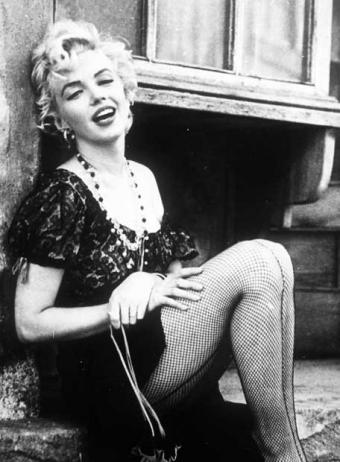
The invention of her image did not happen by chance. Nor did she play a passive role in its creation. She owned her image and, if not the negatives, then what they conveyed. “This was very deliberate. This wasn’t an accident,” Levin said. “She got it and she had it and she made it and she knew it. She was not guileless because she was not stupid. She manufactured this image brilliantly. It was a calculated image, but with good heart, with good intent, with good will.”
Levin feels it’s wrong to apply a feminist prism in viewing Marilyn as a victim of misogyny or unenlightened ambition. “This was a guy’s woman. She liked guys. It was not against her will,” Levin said. “I don’t think she felt victimized at all. I think she exploited it in every way.”
The story of the famous calendar nudes she posed for as an unknown, later published in Playboy at the height of her stardom, reveal an MM in charge of her own image. “Hefner makes the remark that nude photos in those days could take you down. But when they came out she stood right up to it,” Levin said. “Her whole attitude toward it was, This is life. She wasn’t ashamed of any aspect of her body or her being.”
Ironically, Levin was forced to pixilate the nipples and other body parts in the wake of the Janet Jackson breast flash, even though, as Levin argues, the MM nudes are “not pornographic, they’re not slutty, they’re absolutely beautiful. They’ve been made ugly by other people.”
What transpired with the nudes, which made others rich while MM never got a residual dime over the $50 modeling fee, mirrored her life in the spotlight, Levin said. “I think people were rather cruel to her and I think she was hurt. But I also think she was defiant in the face of it. She was courageous. I think the soul of her was terribly resilient.”
Much of the film refers to the sessions that produced the images that still transfix us today, including The Seven Year Itch shoot. In these settings MM willingly gave herself over to the camera. She projected a playful woman-child persona, both real and acted, as she also asserted influence over what final images would see the light of day. Perhaps nothing else gave her such a sense of self-determination.

“You see that she loved it. It was her best relationship, really. It was really the place where she was most comfortable and had the most control,” Levin said. “She very much had control of her contact sheets. She would edit them. She was notorious for Xing out photos in red lipstick or marker. Eve Arnold says in the very beginning of the film, ‘This was her way of working and even though I was free to do what I wanted, she really controlled the image.’”
As Marilyn evolved from aspiring actress to star “she understood what it was she wanted” and she pursued specific photographers she knew “could do her justice,” Levin said, “and got herself in front of those people and, of course, those people wanted to photograph her. They considered her a great subject. It was the perfect metier” for a photographer-subject to play in.
A model must make love to the camera for the images to last. MM invested her photos with rarely seen rapture. “Eve Arnold comments there were a lot of four-letter words used to describe the way she seduced a camera. She loved to do it and she did it great,” Levin said. “Marilyn’s take, which I think is the critical take, is she just thought it was great to be thought of as sexual and beautiful. And why not? I think any woman would want to look like that for five minutes of her life.”
For Levin, one particular image encapsulates Monroe in all her complexity.
“We open the film with a dark room sequence in which we print a photograph of her,” Levin said. “It was taken by Roy Schatt during the time she was in the Actors Studio in New York. Her face is completely open. No makeup. You see that sort of Norma Jeane plainness, really. There’s some pictures of her, like this one, that when you look at them you think, Whatever gave her the idea she could pull this off? She’s OK. She has a cute, sweet face, but hers was not a remarkable face. At the same time you see right through that to the whole iconography of Marilyn Monroe. I chose this picture because I thought it emblematic of the whole of her being.”
Like any fine actress, and Levin ranks MM “a great comedienne,” she could summon her public persona on demand. As Levin tells it, “There’s a known story of her walking down a New York street incognito and saying to her friend, ‘Do you want to see her?’” Meaning Marilyn Monroe, superstar sex symbol. The shape shift only took a subtle change — to a more free, less uptight bearing. The power of it bemused and bothered her. “I think she lived in that schism.”
Taking on as familiar a figure as Monroe and all that “we bring to her” scared Levin. “It’s the hardest film I’ve ever made. This material has been so manipulated in so many ways. The challenge and the task is how do I take this and make this something you feel is completely fresh?” In the end, she feels she’s captured the essential Monroe. “We started out liking her and we ended up loving her. We tried not to take anything from her. She looks so beautiful in this film.”
Levin’s Marilyn will have multiple showings, along with her James Dean, the last two weeks of July. Check local NET1 and NET2 listings for dates/times.
With two movie icon subjects behind her, one might expect Levin to tackle another, but her next film may key off a documentary she worked on last fall. From Shtetl to Swing deals with the great migration of Jews from Russia and Eastern Europe to America and their development, with African-Americans, of the music style known as swing. Slated for Great Performances, the film was delivered in less than airable condition, causing series officials to call in Levin to do some “doctoring.” Her work helped the film get “the highest ratings in New York in years for a Great Performances. One of the things I’m planning on next is something similar to that, but on Latin music and how it’s transmorgified into the culture.”
American Masters is produced for PBS by Thirteen/WNET New York. Susan Lacy is executive producer of the acclaimed series.
Related articles
- The Best Marilyn Monroe Shots You’ve Never Seen (stylecrave.com)
- Marilyn Monroe’s Famous White Dress Sold for $5.6 Million! (news.instyle.com)
- Michelle Williams Begins Her Week With Marilyn Monroe and Dominic Cooper (popsugar.com)
- My Marilyn Monroe Moment (comingeast.com)

Omaha’s Grand Old Lady, The Orpheum Theater
Most cities of any size that have at least some semblance of sensitivity for historic preservation still have an Orpheum Theater. My hometown of Omaha, Neb. is one such city, although the Orpheum here came perilously close to being razed at one point. Omaha’s track record for historic preservation is rather spotty, although it’s gotten somewhat better over time. I wrote the following article shortly after the local Orpheum was renovated for the second or third time and had come under new management. I will soon post a second piece I did around this same time, for another publication, that takes a different angle at the Orpheum and its opulent place among the city’s entertainment venues. For the first half of my life I only knew the Orpheum by catching occasional glimpses of its exterior during downtown shopping excursions with my mom or dad. Mainly though I heard about it through reminiscences by my mother and aunts, who frequented the theater as girls and young women, when it was still a movie palace. They made it sound so grand and special that I was always enthralled by their descriptions. I was actually well into my 20s before I first stepped foot inside. Right out of college my first job, albeit it a part-time gig, was as a gofer for a now defunct arts presentation group, whose programs were held at the Orpheum. I was supposed to be doing PR work but all I ever seemed to do, much to my frustration, was to fetch coffee for the haute woman in charge, or pick up poster orders or transport visiting artists, et cetera. But there were perks, particularly getting to see a string of world class performances, including Marcel Marceau, Twyla Tharpe, and the Guthrie Theatre. I’ve gone on to catch dozens of programs there — touring Broadway shows, operas, ballets, movies, you name it. I try to convey some of that wide-eyed excitement in my story, which originally appeared in the New Horizons.
Omaha’s Grand Old Lady, The Orpheum Theater
©by Leo Adam Biga
Originally appeared in The Reader (www.thereader.com)
More stars than there are in the heavens.
That’s how the great lion of Hollywood movie studios, Metro-Goldwyn-Mayer, described the galaxy of stars under contact to MGM during cinema’s Golden Age. Omaha may be far removed from the bright lights of Tinseltown but for 75 years now one enchanted place — the Orpheum Theater — has been a magnet for some of the brightest stars of the big screen, Broadway, the concert circuit and the recording industry.
This grand old lady, fresh from a $10 million facelift applied last summer, opened in 1927 to a varied program featuring comedian Phil Silvers, violinist Babe Egan and her Hollywood Redheads and the silent film, The Fighting Eagle, starring matinee idol Rod La Rocque. From the start, the opulent Orpheum has seduced us with its eclectic attractions and extravagant motifs. The French Renaissance Revival style theater is a monument to Old World craftsmanship in such decorative flourishes as gold leaf glazings, marble finishes, velvet coverings, framed mirrors, crystal chandeliers and ornate Venetian brocatelle and damask-adorned chairs. The grand foyer is dominated by a circular French Travertine marble stairway that winds its way to the mezzanine and balcony levels.
The City of Omaha-owned theater, saved from an uncertain future in the early 1970s before undergoing a major overhaul, is now under the purview of the Omaha Performing Arts Society, a non-profit headed by Omaha World-Herald publisher John Gottschalk. The society, which will also manage the Omaha Performing Arts Center to be built across from the Gene Leahy Mall, has signed a 50-year lease with the city for the Orpheum’s use and will share, with the city, in any operating losses the next 10 years. Money for this most recent renovation came from private donations culled together by Heritage Services, a fundraising organization headed by Walter Scott, Jr. and other corporate heavyweights. These new developments are the latest efforts to reinvent the Orpheum over the past 107 years.
The present theater is actually forged from the facade and foundation of an earlier building on the very same spot. What began as the Creighton Theater in 1895 became the Creighton Orpheum Theater when it joined the famed Orpheum Theater Circuit in 1898. The original Orpheum operated until 1925. Then, when Orpheum officials decided a grander edifice was needed to support a growing Omaha, $2 million was spent extensively enlarging, altering and gentrifying the site.
Matching the Orpheum’s lavish decor, is a rich lineage of legendary performers who have appeared there, including many identifiable by only one name. From Crosby to Sinatra, crooners have made fans swoon and sway there. From Ella to Leontyne, divas have held court there. From Channing to Goulet, luminaries from the Great White Way have made grand entrances there. From Lucy and Dezi to Hope and Benny to Cosby and Carlin, comedians have made audiences titter with laughter. Magicians, from Blackstone to Henning to Copperfield, have bedazzled patrons with their wizardry. Classical musicians, from Stern to Pehrlman, have moved crowds with their sublime playing. Big band leaders, from Kaye and Kayser to Dorsey and James, have got the place jumping.
The Orpheum has been the home to the symphony, opera and ballet, the place where Broadway touring productions play and the eclectic venue-of-choice for everything from school graduations to Berkshire Hathaway stockholder meetings to movie premieres to appearances by top orchestras, renowned repertory theater companies and elite dance troupes.
The plush theater has been adaptable to changing tastes, beginning as a vaudeville house, evolving into a movie palace and lately functioning as a performing arts hall. During the Depression and war years theaters like the Orpheum were great escapes for people just wanting a break from the real world or just to find relief from extreme weather. In the vaudeville era several shows played daily, from noon to midnight.
When movies lit up the marquee, a typical program included a line of girls, a pit band, a newsreel and a first-run feature film. The theater’s Wurlitzer organ was a staple for sing-a-longs and silent movie accompaniment. When the big band craze hit, live music moved from the pit to the stage. If a hot band packed the house, it became the main attraction. If a big movie drew long lines at the box office, it took center stage. Trying a little something of everything, the Orpheum even ran closed circuit TV broadcasts of championship fights.
In its heyday its flamboyant manager, Bill Miskell, was known as “a show doctor” and “master of ballyhoo” whose advice could help a sick act get well and turn a sow’s ear into silk. Under Miskell, the Orpheum ran grandiose promotions — like the time the lobby was dressed as a railroad station for the 1939 world premiere of Cecil B. De Mille’s epic Union Pacific. In 1953, it became the first Midwest theater to project a Cinemascope picture — the religious extravaganza The Robe. From the 1950s through the ‘60s, the theater operated almost solely as a movie house.
Ruth Fox, a veteran usher and backstage volunteer, said the theater has a one-of-a-kind appeal. “It’s elegant. It commands dressing up. It makes you feel like putting on a long gown. What could be more regal?” Patron Mark Brown said, “I’m amazed by the splendor of the grand architecture and the acoustics. I don’t think it can be matched today.” Al Brown, a former on-site Orpheum manager, calls it “the crown jewel of the Midwest. It’s majestic.”
Former Omaha Public Events Manager Terry Forsberg, goes even further by describing it as “the cathedral of the performing arts as far as Omaha is concerned.” Indeed, the sheer grandeur of the place sets it apart.
Impresario Dick Walter, presenter of hundreds of shows there over the years, said, “Visually and mentally, you have to be moved when you see the size of the lobby and the theater. It takes your breath away a little. It’s like going into any of those grand palaces in London or Vienna or Berlin. And there’s an aura when you walk in the same space that so many scores of great performers of the past performed in. It’s the implicit tradition and the magic of the theater with its history. I don’t want to sound religious, but it’s semi-sacred.”
The Orpheum evokes many memories. Omaha musician Preston Love recalls getting his groove on there to the swinging sounds of jazz greats Louis Armstrong, Duke Ellington and Cab Calloway, all idols for the then-aspiring sideman. “All the big names who toured theaters played the Orpheum,” he said. “Suffice to say…the Orpheum was top stuff, man. It was unbelievable.” He saw Count Basie there in ‘43, and three weeks later he auditioned for and won a seat in the band and ended up playing the Orpheum with Basie in ‘45 and ‘46, as family and friends cheered this favorite son’s every lick on the saxophone. He noted that a rolling stage utilized then carried featured acts to the lip of the stage. If it was a band, like Basie’s, those jamming cats really cut loose when they made it out front. “Boy, you started rolling down in front and that band would just be on fire,” Love said.

Dick Walter has a long relationship with the theater, first as a child lapping-up the antics of vintage comedy teams like Olsen and Johnson, than as a young man spellbound by big name entertainers and later as a presenter of performing arts programs, including everything from Camelot to The National Chinese Opera Theater. “When I was going to Omaha University I enjoyed cutting the Friday afternoon class to go down and see the first show of that week’s vaudeville show,” Walter said. Among the performers he caught then was the magician The Great Blackstone.
Decades later, in a “remarkable” bit of fate, Walter found himself presenting the famed illusionist’s son, Harry Blackstone, Jr., a great illusionist in his own right, in performance at the Orpheum. From the 1970s through the ‘90s, this local showman brought a diverse array of acts to the Orpheum, including scores of Broadway road shows. “Although I made a lot of money and I had great pleasure in presenting big-time musicals with big-time stars, I also enjoyed bringing the off-beat. I had some successes I certainly didn’t deserve and I had some failures I certainly didn’t deserve. Fortunately, I guessed right most of the time.” Although officially retired, he still dabbles in show business by presenting his long-running travel film series at Joslyn Art Museum and bringing occasional shows, such as “A Celebration of World Dance” and the Russian State Chorus, to Joslyn this fall.
As Walter can attest, show business is a series of highs and lows. For all the standing ovations and packed houses, he can’t forget the times when things went a cropper. “The biggest glitch ever was when I was presenting Hello Dolly with Carol Channing,” he said. “We had played a week when about a half-hour before the Saturday matinee show the entire electrical system went out. The emergency system came on, but it was too dim to do a show. It was a sold-out house, all of which had to be refunded. Miss Channing was really upset because she had never missed a performance. I said, ‘What are you worried about? This performance is missing you — you’re not missing it.’”
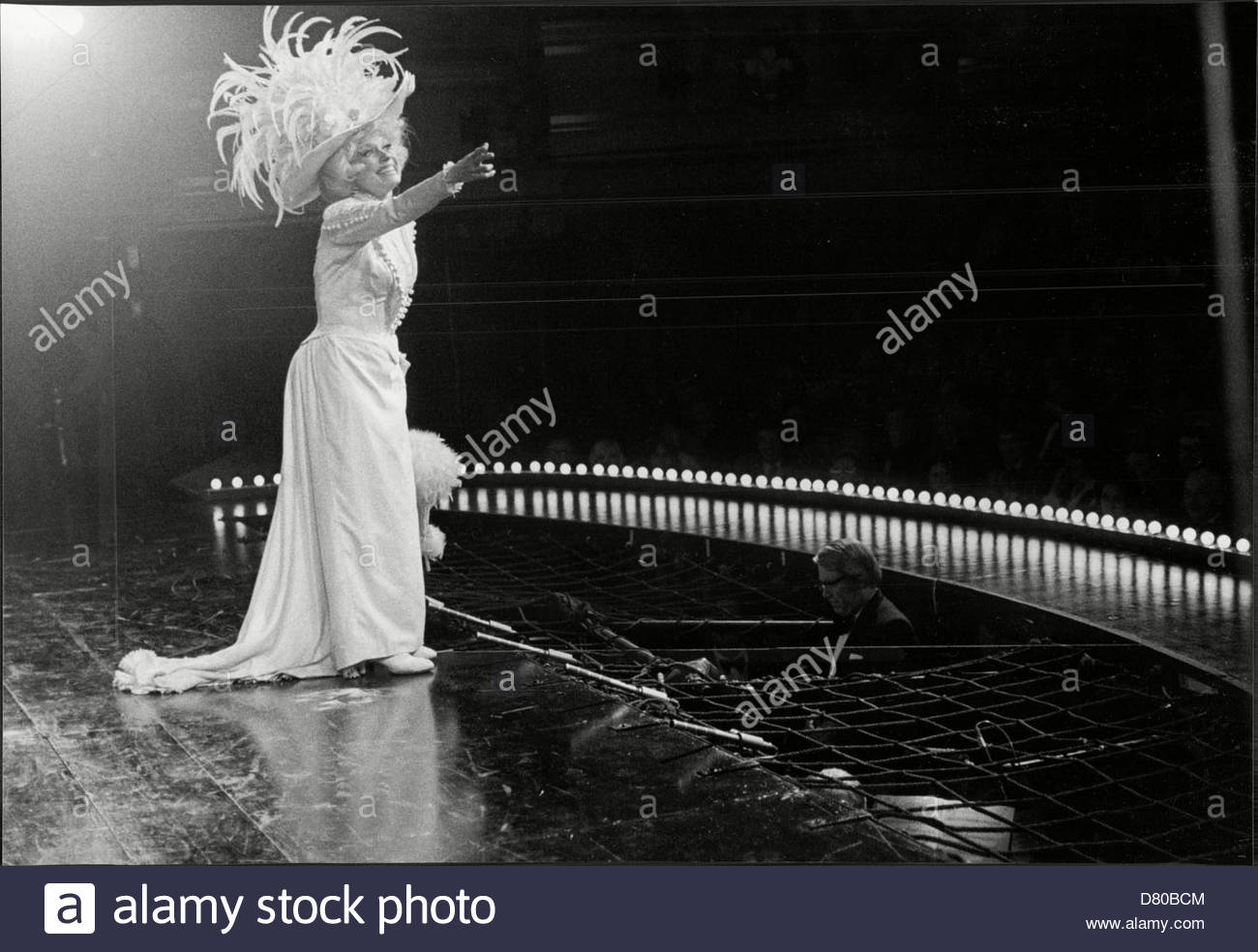
Carol Channing
With Channing mollified and the power restored, the second show went on without a hitch. In his many dealings with stars, Walter has found most to be generous. However, as “they’re pestered a lot,” he said, “all of the big people build a wall around them. They have no private life. Now, when you brought some of them in a few times, the wall broke down and the next thing you knew you were out eating dinner together after the show. A lot of them were wonderful with people coming up to them for autographs…and they should be — that’s part of their job. On the other hand, if people were a little pushy, they didn’t like that.” Among his favorites, he said, were comic musician Victor Borge, conductor Arthur Fielder, band leader Fred Waring and actor Hans Conried. “These people were special.”
Regarding Waring, Walter recalls, “The last time I had him was his ‘Eighth Annual Farewell Tour.’ I used to kid him about that. He just kept going on as long as he could. That last time we had him he gave a wonderful show and, when he came off, he was literally so exhausted he just fell into my wife’s arms backstage, catching his breath. But seconds later he was back on stage thanking everyone. That’s show business. That makes a performer.” When it came to Conried, who headlined a straight dramatic play for Walter, the actor so enjoyed a repast at the Bohemian Cafe that whenever he hit the road again “he’d drive up, give me a ring and say, ‘Let’s go to the Bohemian.’ He thought this was heaven.”
Ruth Fox recalls going as a little girl with her mother to the Orpheum and being awe-struck by the great hall. “I was so impressed with the mirrors and the chandeliers.” she said. “Oh, that was something to behold.” A lifelong theater-lover, Fox began ushering and working backstage at the Orpheum in the 1970s. “I started to usher for the symphony, the opera, Broadway touring productions and whatever else came.” It’s something she continues today. She enjoys being around theater people and the hubbub surrounding them.
“I find it thrilling.” As an opera guild member, she joins other ladies running a backstage concession for cast and crew. “We fix homemade food. Matzo balls, deviled eggs. You name it, we have it. We have a real thing going. We spend time with the performers. We take care of their needs…and they’re so nice to us. Once in a while you get a stinker, but most are wonderful.” She takes great pride in her role as an usher, too. “We, who usher, really are ambassadors to the city. There are so many people who come from out of town who have never been to the Orpheum before. It’s their introduction, you might say, to Omaha…and we have to make a good impression.”
Despite the theater’s prominence, its future was once uncertain. By the end of the ‘60’s it languished amidst a dying downtown. Ownership changed hands — from the Orpheum Circuit to several movie theater chains. As business declined, the theater fell into disrepair and, following an April 29, 1971 screening of Disney’s The Barefoot Executive that played to a nearly empty house, the place closed. At first, there was no guarantee the theater would not follow the fate of another prominent building in Omaha, the old post office, and be razed. Its prospects improved when the Knights of Ak-Sar-Ben bought the theater and donated it to the city, which agreed to steward it.
The city formed the Omaha Performing Arts Society Corp. (no relation to the current management group) for raising revenue bonds to underwrite a renovation. Local barons of commerce contributed more dollars. Everything was on the fast-track to preservation until the city learned it had inherited a $1,000 a month lease for use of the lobby from the City National Bank Building, which the Orpheum abuts. With the rental issue gumming-up the works, the theater — then lacking any protective historic status — became a white elephant and, some say, a likely candidate for the wrecking ball. It was saved when the Omaha Symphony bought out the lease and deeded the lobby to the city.
A multi-million dollar renovation ensued — removing years of grime, repairing damage caused by a leaky roof and restoring deteriorated plaster and paint — before the Orpheum reopened as Omaha’s performing arts center in 1975, with Red Skelton headlining a glitzy gala. Later, it was designated an Omaha landmark and a National Register of Historic Places site. Over the next 27 years, the theater thrived but not without complaints about acoustics, amenities and overbookings. The theater also operated at a loss for many years.
Two men who know every inch of the theater and have spent more time there than perhaps anyone else are Al and Jeff Brown, a father and son who have made managing the Orpheum a family enterprise. Al, a tattooed Korean war vet, was on-site manager there from 1974 to 1996, during which time he saw the theater enjoy a renaissance. When Al retired, his son Jeff, who worked at the Orpheum as a stagehand like his dad before him, followed in his footsteps to assume responsibility for the day-to-day operation and maintenance of this heavily-used old building in need of faithful attention.
The hours on the job can be so long that Jeff, like Al did, sometimes sleeps overnight on a cot in the office. Jeff feels the work done to the theater this past summer, which tackled some longstanding problems, will be appreciated by performers and patrons alike. “The big thing is to keep both of them happy,” he said. “I feel with this renovation we’re going to better realize that goal because of the areas we’ve addressed…improved seating, enlarged and added dressing rooms, added women’s restrooms, a new heating-air conditioning system. Before, we did the best we could with what we had, but now it’s going to be much more user-friendly.” Keeping show people happy, whether local arts matrons or visiting world-class artists, means making sure everything behind-the-scenes “has to be the way they want it,” Al said. “Touring performers come into town and they’re tired. It’s a drag. Anything you can do to alleviate some of that, they appreciate it.”
He said temperamental stars become pussycats if a manager and crew are prepared and have gone the extra mile. Echoing his father, Jeff added. “If you do your homework before the show and you make sure that everything is clean and you have everything they ask for, they’re very pleasant to work with.” Something Jeff learned from his old man is “treating every show the same — it doesn’t matter whether it’s a school graduation or a dance recital or a big Broadway show. We do whatever we can to make sure they have the best show they can have.”
Jeff said the theater’s new management structure bodes well for the facility. “I feel it’s better because our budget isn’t affected by what happens at Rosenblatt or at the Auditorium. We’re our own separate entity now. We’re on our own and we know we have to make it on our own. It will be a challenge, but I think it will be good.”
The Orpheum, saddled with recent annual operating losses in the half-million dollar range, will more aggressively seek and promote high stature events and market the theater as a destination place. An Orpheum web site is in the works. It also means Orpheum performance seasons — complete with public subscriptions — may be in the offing. It’s all been tried before. But the performing arts society may be in a better position to pull it off than financially-strapped city government.
Terry Forsberg said, “Now that you have a private group and the financial backing of the business community, it can be done. The question will be how much of a profit they will have to show in order to keep it operating.” According to John Gottschalk, “The Orpheum will have an endowment, but we’re certainly in no position to absorb half-million dollar losses every year. So, we’ll need to operate effectively and efficiently. The best way to end the…losses is to have a diversity of performances and to have bigger houses more frequently…and we will be heavily employed to make sure this place is full and active.”
Everyone, it seems, holds the Orpheum in high esteem. For Gottschalk, its rich legacy makes it a vital touchstone. “In the first place, it’s an incredibly old symbol,” he said. “There’s been an Orpheum Theater here since the turn of the century. Its longevity is what makes it such an integral part of the fabric of the community.”
Showman Walter said “it’s great to be part of this theater and it’s wonderful heritage.” Omaha Performing Arts Society president Joan Squires calls it a real treasure for the city.” Theatergoer Marjorie Schuck describes it as “a very big asset for Omaha culturally,” adding, “It’s a highlight coming to the Orpheum…it’s been here a long time, it’s still here, it’s still going, and we expect it to continue.”
Perhaps thinking of the effect the planned downtown performing arts center may have on the Orpheum, volunteer Ruth Fox said, “I just pray they will not tear it down or change it.”
Pray not, indeed, for that would be too much to bear. As a program for the Orpheum’s 1927 opening noted, the theater “is a continuation not only of a place of amusement, but also a veritable civic institution.”
Related Articles
- Ghost Hunting at the Orpheum (tdhurst.com)
- Musical Theatre Shows in Chicago (north-american-musical-theatre.suite101.com)
- Omaha Arts-Culture Scene All Grown Up and Looking Fabulous (leoadambiga.wordpress.com)
- Quiana Smith’s Dream Time (leoadambiga.wordpress.com)
- Re:Take: The Orpheum Will Rise Again (seattlest.com)
- Great Plains Theatre Conference Grows in New Directions (leoadambiga.wordpress.com)
- Kevyn Morrow’s Homecoming (leoadambiga.wordpress.com)
- Shakespeare on the Green, A Summertime Staple in Omaha (leoadambiga.wordpress.com)
- Great Plains Theatre Conference Ushers in New Era of Omaha Theater (leoadambiga.wordpress.com)
Ron Hull’s magical mystery journey through life, history and public television
For years I only knew Ron Hull through the prism of television. He was an affable, erudite executive and sometime host on the PBS affiliate in my state, Nebraska Educational Television. I knew that he was a friend of Dick Cavett‘s and over the years I prevailed upon Hull more than once for his help in contacting Cavett for various projects I was working on. But it wasn’t until a couple years ago I finally met Hull, who proved as amiable and generous in person as he was by phone. I long wanted to profile him but had never quite gotten around to it. Then a couple things happened: In the course of interviewing Cavett, the former talk-show host mentioned some things about his longtime friend Hull that peaked my interest even more; and then I read a local newspaper story about Hull that hinted at some colorful origins I wanted to flesh out in more detail. That’s exactly what I do in the following profile, which originally appeared in the New Horizons. By the way, this blog site also contains some of the articles I’ve written about Cavett and at least one of those pieces references Hull.
Ron Hull’s magical mystery journey through life, history and public television
©by Leo Adam Biga
Originally published in the New Horizons
Only recently has Nebraska Educational Television pioneer Ron Hull, 77, come to appreciate the remarkable arc of his life, one that’s literally gone from bastard child of a bordello to chairing the board room.
“I went from that situation to this situation. It’s incredible when you think about it,” Hull said from his NET office in Lincoln.
His journey’s taken him around the world, introduced him to legends, given him access to inner circles of power and allowed him to indulge his love for the arts, the humanities and history. Perhaps none of it would have happened if not for the kindly madam, Dora DuFran, whose house of ill repute he began life in.
He’s come a long way from that dubious start in a Rapid City, S.D. den of inequity. He never knew his real parents. His adoptive parents, who got him as an infant, gave him a good home in town. His father was a mechanic and his mother, a former country school teacher, a realtor. His dad opened his own garage and used car lot. His folks made extra money buying old properties and renovating them for resell.
“There was never any doubt about how much they thought about me. I couldn’t have had better parents,” Hull said. “Coming out of the Depression my parents had nothing except each other and lots of integrity. But they really worked hard. They were very industrious people and they gave me every opportunity. I’m very lucky.”
From such modest roots, he’s forged a substantial public television career here and in the nation’s capitol. The Nebraska Broadcasters Association Hall of Fame inductee helped build the statewide NET network, considered one of the best in the PBS chain, and once wielded major influence in Washington, D.C.
In the course of his work he’s developed friendships with notables from the worlds of stage, screen, literature, media and politics. Talk show host Dick Cavett is a pal.
His much-traveled life has taken him from the Black Hills to Hollywood to New York City and back to the Midwest. Except when he worked back east as an executive with the Corporation for Public Broadcasting and with the Public Broadcasting System, Nebraska is where he’s made his home since 1955. There have also been extended stays as a guest lecturer in international broadcasting in Taiwan and as a television advisor to the government of South Vietnam during the Vietnam War.
The Lincoln, Neb. resident is still very much a citizen of the world. He’s as likely to be visiting favorite haunts in Manhattan or Los Angeles or off on some adventure in Asia, Europe or Africa as he is to be at home. He has friends all over the world.
After 52 years in public TV he’s still in the game. He serves as a special advisor at NET, where keeps a hand in programming, archiving, fundraising and just about anything he cares to involve himself in. He also teaches international broadcasting at the University of Nebraska-Lincoln, where he’s a professor emeritus.
History, though, remains a top priority for the man who helped initiate The American Experience, the acclaimed documentary series that remains a PBS staple. He pushed for the series while director of the CPB Program Fund, a $42 million annual kitty he controlled and doled out to producers from 1982 to 1988.
His D.C. stint taught him the vagaries of power and politics. Producers seeking funding for their projects schmoozed him. He had to separate what was real from what wasn’t. “Every morning I’d get out of bed the first thing I’d say to myself was, ‘It’s the money they like.’ That really kept me on a pretty even keel.” The CPB board he reported to was comprised of Presidential appointees who displayed their partisan colors. As conservative Republicans exerted more influence, he left.
Back home he’s nurtured NET’s film production unit, whose Oregon Trail, Willa Cather, Standing Bear and Monkey Trial documentaries have aired nationally. He’s the founder and director of the Nebraska Video Heritage Library, an archive of thousands of programs that touch on life in the state over the past half-century. Among these gems are interviews with Nebraska writers John G. Neihardt, Mari Sandoz and Wright Morris, actress Sandy Dennis and entertainer Dick Cavett as well as coverage of legislative sessions, political campaign debates, et cetera. Hull’s enlisted Cavett’s interviewing-vocal talents for many NET and UNL projects.

The history bug first bit when Hull produced the NET series, Your Nebraska History, which led to an association with Sandoz, whom he convinced to do several shows. He’s headed the Sandoz Society. He’s served on the board of the Willa Cather Pioneer Memorial in Red Cloud. Then there’s his decades-long work with the Neihardt Center in Bancroft. He emcees the annual Neihardt Days. Neihardt was another key figure in the early life of NET, he said, as the poet’s appearances lent credence to public TV as a prime cultural source. Hull also led the Lewis & Clark Bicentennial Commemoration committee for seven years.
Hull’s made it his mission as a broadcaster to satisfy what he says is a basic human desire for people “to know who they are” and “where they come from.” He often refers to something Cather noted. “She said, ‘The history of every country begins in the heart of a man or a woman.’” These questions and concepts have taken on personal import for Hull ever since learning at age 15 that he’s adopted.
“I discovered it by accident…I found a birth announcement in my grandmother’s house. Of course she disavowed that. I’m sure she was so embarrassed. I have to hand it to all the relatives. Nobody ever talked. Nobody ever told me. Not my grandparents. Not my aunt who lived nearby. Nobody. They had to of known.”
He didn’t broach the subject with his folks right away.
“I didn’t have the nerve to ask my parents,” he said. “It was about a year later I went down to the courthouse to check the birth records because I knew I was born in Pennington County. I took my best friend. We said were on a school assignment and had to see our birth records.
“They looked up my friend’s. ‘Yep, here you are,’ the clerk said. Then my turn came. ‘You’re not here.’ I said, ‘Well, I have to be. I know I was born in this county. If I was born in this county and I’m not listed here, why not?’ The clerk said, ‘Well, I’m sure this isn’t your case, but illegitimate children aren’t listed in the county of their birth, those records are at the state capitol in Pierre.’”
The disclosure, Hall said, was “a big clue.” As those records were under seal, his search was stymied for a long time. Unable to keep silent anymore, he confronted his mother. She admitted the truth. “She told me as much as she could. She didn’t know much,” he said. “She had a friend, Mrs. Benjamin, who ran the social agency and she told her they’d like to adopt. She liked my mother” and an arrangement was reached to contact the Halls should a child come available.
From the time of these revelations Hull’s life’s been all about seeking answers. His search intensified over time. In 2002 he obtained a court order to unseal his birth records. The discovery of his true identity and the unusual circumstances that led to his adoption made his journey from townie to sophisticate all the more unlikely.
The brothel he entered the world in was owned and operated by one of the American West’s best-known madams, Dora DuFran. “She’s a colorful character. I’ve done a lot of research into her,” he said. DuFran got her start in the sex trade in Deadwood, S.D., that infamous frontier outpost of wild and woolly goings on.
A late 19th century immigrant from England, DuFran settled in Nebraska before making her way north to Deadwood, a gold rush town she cleaned up in. She expanded to run stables of sporting girls at brothels in Sturgis, Rapid City and Belle Fourche. Like many a successful madam she cultivated strong allies in the form of her gambling magnate husband, Joseph DuFran, and local authorities, whose ranks no doubt included regular customers.

It was in Deadwood DuFran befriended Calamity Jane, a former scout under William F. Cody, aka Buffalo Bill, whose Wild West Show she performed in. Renowned for her horsemanship, shooting and rowdy ways, Calamity knew iconic gunman-turned-lawman Wild Bill Hickok. A young Calamity once worked for DuFran and when down- and-out near the end of her life DuFran took her in. Hull’s link to the notorious DuFran and her historical cohorts is more than passing. Among other things she was a midwife and, yes, it turns out she delivered Hull. On his birth certificate the word physician is crossed out. Written over it is “midwife” and “Dora DuFran.”
“And I only know this because my mother told me,” Hull said, “but Dora DuFran carried me herself down to the Alex Johnson Hotel where the social office was and gave me to Mrs. Benjamin. Mrs. Benjamin called my mother up and said, ‘Come and get him,’ and that was me. So, anyway, I owe Dora DuFran a lot.”
As a teen Hull worked as a bell hop summers at the Alex Johnson. He didn’t know then his connection to it. “I always wondered what brought me to apply there, but I never figured it out,” he said.
DuFran’s Rapid City house also served as a popular speakeasy during Prohibition. Upon her death in 1934 the Black Hills Pioneer referred to her as “a noted social worker.” Her grave in Mount Moriah Cemetery in Deadwood, which Hull’s visited, is near Calamity’s and Wild Bill’s plots. DuFran’s grave features four urns, each adorned with grinning imps in recognition of her four houses of pleasure. She authored a 1932 book entitled Low Down on Calamity Jane that contained her recollections of “the untamed woman of the wild, wild west.”
What Hull’s learned about DuFran, he likes.
“She was that proverbial madam,” he said, referring to her reputed heart of gold. “The sheriff, the police — everybody loved her. She’d be down at the railroad station on Thanksgiving bringing hoboes and bums back to her place to feed them Thanksgiving dinner. She was a midwife, she was a lot of things. And I was born in Dora DuFran’s house of prostitution in Rapid City. She had nine girls working for her at one time. It was a thriving business.”
This “back story” of unwanted pregnancy, abandonment and adoption has given Hull an inkling as to why he’s felt compelled to continually prove himself and why he’s rushed off to faraway places in search of some larger meaning.
“I can tell you one thing, I’m very sympathetic to anybody that’s adopted because if they’re like me you eternally wonder why somebody didn’t want you,” he said. “You could couch it another way. You can intellectualize it. She couldn’t take care of you, she couldn’t afford you, look how lucky you are…You can do all that, but the bottom line is — why didn’t they want me? And it hurts.
“It’s just something every adopted kid has to deal with…On the positive side, it’s a very powerful motivation to measure up. Am I going to be good enough? You always feel like you have to prove yourself. I decided I’d show ‘em.”
He feels strongly enough about giving lost children a home that he and his wife Naomi adopted their first child, Kevin. The couple added three children “the hard way.” Their son Brandon and his wife Linda continued the family tradition of adopting by flying off to China to bring home a baby girl, Eliza.
Hull continues trying to piece together his own pedigree. He knows the name of his birth mother, Jeanne May Ramsey, but doesn’t know if she worked as a prostitute at DuFran’s house or if she went there for help as “a girl in trouble.” He’s learned the name of his biological father, Paul Vaughn. Again, he’s unsure if he was a john or boyfriend or one night stand. He’s found his given name at birth was Theodore Vaughn Ramsey. Once adopted, his parents named him Kenneth, which he was called for a year or so, before they changed his name to Ronald.
However, he’s been unable to track down any more about his birth parents. “I have had no luck finding either parent,” he said. “I’ve really searched.” He just knows they weren’t married, which explains why his birth certificate has a box checked ‘No’ under the heading ‘Legitimate.’ He said the law changed at some point to remove “the stigma” of illegitimacy on birth records.
The intrigue of his own roots reminds Hull of life’s rich tapestry and how his work as a producer, director and programmer has tried to capture that richness.
He’s found a niche for himself in television, where he’s nurtured a lifelong love for the humanities, yet he fell into the field by happenstance. Still everything he did as a young man prepared him for his career.
Growing up in Rapid City his passion for the arts made him an odd duck. “I had certain proclivities for music,” he said. “I took piano. I loved theater.” He loved to read. His parents, meanwhile, “were not cultured people. They loved to dance, they loved to play cards. They had a lot of friends. They were very social. But I had the tickets to the concert series, to the Broadway theater league, they didn’t. All those things, from the time I was in the 7th grade, they saw to it I had them. You just have to say I was cut out of a different piece of cloth, and they knew that.”
He was delighted to move with his parents to North Hollywood, Calif. for his junior year of high school. “They always saw that as the end of the rainbow,” he said. “While I was perfectly happy out there my parents weren’t. It was just too hard for them to sever all the friendships, ties and everything. They realized they’d made a mistake.” He moved back with his folks for his senior year in Rapid City. It wasn’t long before he returned to Calif. — this time to study theater at the then-College of the Pacific. He gained valuable experience on stage in high school and college.
Hull once again went home, this time to please his strong Methodist parents by completing his theater studies at Dakota Wesleyan, a church-affiliated school in Mitchell, S.D. He and Naomi met there. Upon graduating Hull heeded the call many young people feel — to make it in the Big Apple. The military draft was hanging over his head and he, Naomi and friends opted to try their luck in New York.
“I just knew we had to get Manhattan under our belt. I knew an educated person had to have an appreciation for New York City — that’s the Acropolis of our culture. We all got jobs. Our intent was to see every play on Broadway and if we really saved our money — the Starlight Roof at the Waldorf Astoria.”
He also hoped to break into the New York theater world. “Yeah, that was always in the back of my head,” he said. Then, just as he feared, he got drafted. He wound up at Fort Sill, Okla., assigned to Special Services. He worked as a recreation equipment clerk — “…the most boring job in the world,” he recalled.
One day a sergeant came by and changed his life forever. A check of Hull’s file showed his theater background, which was enough for the young private to be offered a new job producing a TV show on Fort Sill for the post’s commander. Sensing a golden opportunity, Hull fibbed when he told the sergeant he knew something about TV when, in fact, “I didn’t know anything.”
Given only days to prepare a script, he went right to the base library to learn the basics. He spoke to a director at a local station to learn what cameras do. Before he knew it he was lining up members of the 89th Army Band to play music and signing up the wife of a major to sing in the studio. That just left interviews with soldiers coming back from or going off to Korea.
Producing-directing-writing-emceeing all came naturally to the then-22 year-old, which he chalks up to the fact that “I had a lot of experience in plays by then in summer theater.” He did 95 weekly TV shows before his hitch was over, enough experience to convince him he wanted a career in television.
“I thought, This is pretty good for me because, you know, television combines any aspect of life you want. I mean, there’s music, drama, culture, news, public affairs, documentary. It’s the whole thing.”
He used the GI Bill to study television at what’s now known as Syracuse University’s Newhouse School of Public Communications, where he earned a master’s degree. He’s since been invited back to speak as one of its distinguished alums. Naomi was with him at SU, working in the speech department. “That was a wonderful time in Syracuse. We loved it,” he said.
Hull assumed he would go into commercial broadcasting but while at SU he heard about this newfangled educational television “where you might do something, like Pollyanna, to improve people’s lives, and that really attracted me. Everybody said, ‘Well, you don’t want to go into that because you don’t make any money.’ They were certainly right about that,” he said, smiling.
He hit the road in search of a job, traversing the Midwest and South on a Greyhound Bus. “California was my goal — that golden green place out there,” he said. Except he didn’t go there. Instead, he stopped in Denver, Amarillo, Oklahoma City, Memphis, Atlanta and Chicago, leaving his resume everywhere he went, getting interviews here and there. Mostly he applied at commercial stations. Then he heard about an opening at the fledgling educational station in Lincoln, Neb.
“By this time I’d been on the road for about two weeks,” he said. “I was exhausted from the bus, from everything.”
He interviewed with Jack McBride, the father of NET and the man Hull considers his best friend. The final interview was with the university’s crusty old PR man, George Round. Hull, who had other offers, was noncommittal. Finally, Hull said, an impatient Round bluntly asked, Listen, do you want the job or not? Well, yeah, OK, Hull replied. “And I took the job,” he said. “I didn’t plan to stay here.” But Hull fell in love with Nebraska and its people. He’s remained loyal to his adopted state. He’s always returned to live here, even after extended stays abroad and back East.
“I don’t know if this place has claimed me but I certainly have claimed this place. It’s just who I am, you know. It’s where I established my family. It’s the values of the Midwest I revere. I think the people out here know how to work really hard and are basically honest. You can trust them.”
Among the first people he and Naomi met here were the parents of Dick Cavett. The Hulls, Cavetts and some other couples formed a social-cultural club called the CAs or Critics Anonymous, whose motto was, We criticize everything. A young Dick joined in on some of the activities. Hull and Cavett became close.
Upon accepting the state’s 2000 Sower Award for Humanities, Hull articulated the symbiosis he feels with Nebraskans. “We’re talking about relationships when we talk about the humanities,” he said “To me, relationships are the essence of our lives, the relationships that we have with each other…how fortunate I am, how thankful I am to have the privilege of being a part of you…in this state.”
In a real sense Hull feels he’s a steward for the state’s culture and history, not surprising when you realize he was there nearly from the start of what became NET. He arrived in October 1955. KUON had gone on the air only the previous November — the ninth public TV station to transmit. It was a humble launch.
“There’s nothing like starting at the beginning,” he said. “There were four of us. I was a producer-director, I wrote the continuity…You did everything. We were completely live. We had to be because we had no videotape, we had no network. We shared a studio with KOLN Channel 10. Our signal’s radius was maybe 35 miles.”
Live TV offered a visceral, ephemeral, enervating experience unlike any other.
“I really miss the live shows,” he said. “It makes such a demand on the people in front of the camera and behind the camera that you get a level of energy going all around. Every nerve ending is alive. It’s electrical. You can sense it, you can feel it. We used to say, ‘Poof in the night.’ You can’t replicate those experiences.”
On the down side, he said, “we made some terrible gaffes. You’ve got to be grateful there’s nobody to play those back.” A memorable one he recalled came when, “while introducing a travel film ‘live,’ our host, smiling into the camera, said, ‘Today we visit Hawaii — those lovely islands of beautiful beaches and flat sandy women.’”
Hull said video-digital technology not only eliminates the possibility of most mistakes, it “serves the viewer in the long run” by affording repeats. But he said live TV “was a little more honest” than today’s canned version.
He recalled an example of spontaneity that could never happen now.
“I was directing an interview with (Neb. Gov.) Frank Morrison, a big, lanky wonderful man. I’m sitting at the counsel (control booth) and the phone rang. ‘Hello.’ The voice at the other end said, ‘Ron, this is Maxine.’ ‘Oh, yes, Mrs. Morrison.’ ‘Tell Frank to sit up!’ ‘Yes, Ma’am.’ So I told the floor manager, ‘Make a big sign saying, Frank, sit up! — Maxine. I can still him going, Ohhhh…rolling his eyes and sitting up. Well, that’s live, interactive. It’s a different level of communication.”
“To me, one of the important things about public broadcasting is never to lose that local connection with local Nebraska people,” Hull said. “They own the station. So you’ve got to be in communication with them at every level you can be by listening to what they say and providing the things you think are useful to them and their lives. And we’ve always run this place based upon that.”
Legislative support for NET “has been wonderful,” he said. “They’ve provided us state-of-the-art equipment — millions of dollars worth. They believe in it.” Despite budget-staff cuts, NET boasts fine facilities, adequate resources and top talent.
Even as the Internet threatens TV’s hold on mass communication, the medium still reaches huge audiences and affords the possibility of informed public commerce.
“We’re trying and I think we’re getting closer and closer to make public broadcasting the central meeting place, the town hall where the issues are debated, where people have a say. I don’t detract from what commercial television does but we are the last vestige of local programming and documentaries.”
Where commercial TV once considered news-public affairs a higher calling, distinct from entertainment, he said it’s now part of the profit line along with situation comedies and reality shows. Networks and local stations don’t produce documentaries the way “they used to,” he said. “Those are expensive and nobody spends that money anymore. But you look at our schedule and we spend 600,000 bucks on Willa Cather: The Road is All documentary. That takes two years to produce but what you get is something that is worth people’s time to watch.”
Hull’s belief in the public service potential of TV remains undiminished.
“Television affects how people think. It goes right into their heads,” he said. “It is a terribly, terribly powerful instrument of persuasion that has the potential to be used for the good of the common man. I always identified with that from the beginning. The measure’s always been — Is this going to enhance somebody’s life?”
That doesn’t mean skirting hard realities or controversial subjects, he said, “because you have to show the other side of things and people have to be able to make up their own mind about things. But basically I have believed from the beginning we have an opportunity to make people’s lives better, to give people a perspective on the world and their place in it they can’t get any other way.”
He points to NOVA, Frontline, The News Hours, American Experience, American Masters and Great Performances as TV at its best. “To me, those series are the most thought-provoking, serious programs available to the American public.” Hull is proud, too, of public TV’s noyed work in children’s programming, led by Sesame Street, and how PBS has carried fare its commercial counterparts do not, such as American Playhouse, Meeting of the Minds, Steambath and Anyone for Tennyson?
New York producer Bill Perry had pitched his concept for Tennyson — mini-dramas bringing to life history’s great poets and their poems — to no avail until he approached Hull. “I liked the idea,” Hull said and the two put the series together at NET, enlisting such “brilliant actors” as Henry Fonda, Jack Lemmon, Claire Bloom, Irene Worth, Ruby Dee and Vincent Price. Hull became close friends with the show’s “first-class director,” the late Marshall Jamison. Hull, who calls the show “my favorite,” said it may have had a small audience but it made a big impact.
“I’ve never ever believed in measuring our success by the number of people who watch,” he said. “Rather you measure your success by what effect you had on people. It’s really hard to measure, but I prefer to believe there are people out there who learned from these programs.”
Similarly, he believes the programming he did in Vietnam made a difference. His experience trying “to win the hearts and minds” of its people gave him a new outlook on public service. Desiring an overseas adventure he parlayed state department contacts to get assigned a foreign service post as a TV advisor to South Vietnam. He was there in ‘66-67 and periodically the next few years to oversee construction and operation of stations in Saigon and outlying cities. Programming centered on public health and education — from potable water to immunizations.
The war raged around Saigon and casualties did not exclude those in the TV ranks.
“During the (1968) Tet Offensive all of our American engineers working at the Hue station were marched off and shot. I wasn’t in-country at the time,” he said.
He arrived in Vietnam a supporter of U.S. policy there but left convinced America “had made one of the major blunders in our country’s history.” He found distasteful the role that he and other Westerners played as outsiders looking in.
At the fancy Caravel Hotel in Saigon he and other noncombatants from the Free World bent their elbows at the rooftop Romeo and Juliet Bar. A frequent drinking companion was correspondent Peter Arnett. “We would look down at those streets to the Saigon River, the area beyond all controlled by the VC (Viet Cong). We would watch planes fly in and see the tracers any night of the week. The flares lit up the countryside. And we’re sitting there — who the hell are we? — drinking our little wine…I’m not proud of that,” he said. “But that’s the position we were in.
“Everybody who was there has to deal with the fact they were part of that war — I don’t care who you were or what your job was.”
Hull returned to Vietnam in 1999, in part to see the fruits of his labors there. Before going he was advised by foreign service veterans not to expect too much in the way of visible, tangible progress from the project he’d led.
He went to the very station in Saigon, now Ho Chi Minh City, he’d officed in decades earlier. He met with the station manager, a reserved man in a military uniform. The man answered Hull’s questions without any elaboration. Anxious to know more, Hull confided, “I was here teaching your people how to run this station in 1971-72. Where were you?” Hull said the manager “looked at me and said, ‘I was in Tay Ninh Province in the People’s Revolutionary Army. Mr. Hull, you and I were not on the same side.’ And then I knew where he was coming from. I said, ‘I knew what your people wanted. They wanted one Vietnam, one country. I am really happy you have your country.’ With that, his defenses went down. He showed me everything.”
What Hull saw impressed him. “My gosh, they had the news in French, Vietmanese, English. There was a ballet going on in one studio and the news being set up in another studio. The place was vibrant, alive and kicking, fabulous. I walked out of there with a happy heart. They’ve taken what we did and they’ve thrived.”
Asia is one of his favorite regions of the world. He occasionally visits China, where he stays with friends. On his last trip there he traveled via the Trans-Mongolian Railway from China to Russia, where he continued his trek on the Trans-Siberian Railway into Moscow. “It’s a fabulous trip. The cultures are fascinating,” he said. He continued on to Copenhagen to visit more friends. “I love travel,” he said.
An annual international broadcasting convention he attends takes him to exotic places. The next is set for Johannesburg, South Africa. He’s anxious to go — ever curious, ever eager to seek out new experiences.
“One of the secrets to having a good career is having a good time,” he said. “I always tell my kids, ‘If you’re not having a good time, you’re doing something wrong.’ It’s how I’ve lived. That’s the only way you stay healthy…”
Still, never far from his thoughts are nagging questions that may never find answers.
“I did find my niche in life, although I am forever this insecure, why-did-they-throw-me-away person who is still searching for Shangrila.”
Related Articles
- PBS chooses Bellingham to show sustainable economy (seattletimes.nwsource.com)
- PBS Ombudsman Criticizes Shultz Series (mediadecoder.blogs.nytimes.com)
- PBS fund searching for Explorer-friendly pitches – RealScreen (countercultureprodco.com)
Author, humorist, folklorist Roger Welsch tells the stories of the American soul and soil

Image via Wikipedia
Roger Welsch is a born storyteller and there’s nothing he enjoys more than holding sway with his spoken or written words, drawing the audience or reader in, with each inflection, each permutation, each turn of phrase. He’s a master at tone or nuance. New Horizons editor Jeff Reinhardt and I visited Welsch at his rural abode, and then into town at the local pub/greasy spoon, where we scarfed down great burgers and homemade root beer. All the while, Welsch kept his variously transfixed and in stitches with his tales.
On this blog you’ll find Welsch commenting about his longtime friend and former Lincoln High classmate Dick Cavett in my piece, “Homecoming is Always Sweet for Dick Cavett.” Welsch shares some humorous (naturally) anecdotes about the talk show host’s penchant for showing up unannounced and getting lost in those rural byways that Welsch lovingly describes in his writing.
Author, humorist, folklorist Roger Welsch tells the stories of the American soul and soil
©by Leo Adam Biga
Originally appeared in the New Horizons
It’s been years since Roger Welsch, the author, humorist and folklorist, filed his last Postcard from Nebraska feature for CBS’s Sunday Morning program. Every other week the overalls-clad sage celebrated, in his Will Rogersesque manner, the absurd, quixotic, ironic, sublime and poetic aspects of rural life.
That doesn’t mean this former college prof, who’s still a teacher at heart, hasn’t been staying busy since his Postcard days ended. He’s continued his musings in a stream of books (34 published thus far), articles, essays, talks and public television appearances that mark him as one of the state’s most prolific writers and speakers.
In 2006 alone he has three new books slated to be out. Each displays facets of his eclectic interests and witty observations. Country Livin’ is a “guide to rural life for city pukes.” Weed ‘Em and Reap: A Weed Eater Reader is “a narrative about my interest in wild foods, a kind of introduction to lawn grazing and a generous supply of reasons to avoid lawn care,” he said. My Nebraska is his “very personal” love song to the state. “I believe in Nebraska. I love this place for what it is and not for what people think it ought to be,” he said. “I hate it when the DED (Department of Economic Development) tries to fill people full of bullshit about Nebraska. Nebraska’s great as it is. You don’t have to make up anything. You don’t have to put up an arch across the highway to charm people.”
In the tradition of Mark Twain and William Faulkner, Welsch mines an authentic slice of rural American life, namely the central Nebraska village of Dannebrog that he and artist wife Linda moved to 20 years ago, to inform his fictional Bleaker County. Drawing from his experiences there, he reveals the unique, yet universal character of this rural enclave’s people, dialect, humor, rituals and obsessions.
He’s also stayed true to his own quirky sensibilities, which have seen him: advocate for the benefits of a weed diet; fall in love with a tractor; preserve, by telling whenever he can, the tall tales of settlers; wax nostalgic over sod houses; serve as friend and adopted member of Indian tribes; and obsess over Greenland.
The only child of a working class family in Lincoln, Neb., he followed a career path as a college academician. His folklore research took him around the Midwest to unearth tales from descendants of Eastern European pioneers and Plains Indians. He lived in a series of college towns. By the early ‘70s he held tenure at the University of Nebraska-Lincoln. Then, he turned his back on a “cushy” career and lifestyle to follow his heart. To write from a tree farm on the Middle Loup River outside Dannebrog. To be a pundit and observer. People thought he was nuts.
“I walked away from an awfully good job at the university. People work all their lives to get a full professorship with tenure and…nobody could believe it when I said I’m leaving. ‘Are you crazy? For what?’ And, it’s true, I had nothing out here,” he said from an overstuffed shed that serves as an office on the farm he and Linda share with their menagerie of pets. “I was just going to live on my good looks, as I said, and then everybody laughed. That was before CBS came along.”
Before the late Charles Kuralt, the famed On the Road correspondent, enlisted Welsch to offer his sardonic stories about country life in Nebraska, things were looking bleak down on the farm. “We weren’t making it out here,” Welsch said. “I told Linda, ‘The bad news is, we’re not making it, and the even worse news is I’m still not going back.’ And about that point, Kuralt came along.”
No matter how rough things got, Welsch was prepared to stick it out. Of course, the CBS gig and some well-received books helped. But even without the nice paydays, he was adamant about avoiding city life and the halls of academia at all costs. What was so bad about the urban-institutional scene? In one sense, the nonconformist Welsch saw the counterculture of the ’60s he loved coming to an end. And that bummed him out. He also didn’t like being hemmed in by bureaucratic rules and group-think ideas that said things had to be a certain way.
His chafing at mindless authority extended to the libertarian way he ran his classroom at UNL and the free range front lawn he cultivated in suburbia.
“I was a hippie in the ‘60s and I really got excited teaching hippies because they didn’t give a didly damn what the bottomline was. They just wanted to learn whatever was interesting. You didn’t have to explain anything. I never took attendance. I’d have people coming in to sit in on class who weren’t enrolled, and I loved that. I hated grades. Because I figured, you’re paying your money. I’m collecting the money and I deliver. Now, what you do with that, why should I care? It’s none of my business,” he said. “The guy at the grocery store doesn’t say, Now I’ll sell you this cabbage, but I want to know what you’re going to do with it.”
Welsch said the feedback he got from students made him realize how passionate he was about teaching. On an evaluation a student noted, “‘Being in Welsch’s class isn’t like being in a class at all. It’s like being in an audience.’ I asked a friend, ‘Is that an insult or a compliment?’ ‘Well, Rog, actually being in your class isn’t like being in a class or in an audience. It’s like being in a congregation.’ And I thought, Oh, man, that’s it — I’m a preacher, not a teacher. It really is evangelism for me.”
“By the ‘80s they (university officials) wanted to know how they were going to make money out of the popular classes I taught. I said, ‘I have no idea. It’s not my problem. All I’m doing is telling them (students) what I know.’ So, there was that.”
Then there was the matter of UNL selling out, as he saw it, its academic integrity to feed the ravenous and untouchable football program, which he calls “a cancer.”
“I was and still am extremely disillusioned with the university becoming essentially an athletic department. Everything else is in support of the athletic department. And that breaks my heart, because I love the university. There was that.”
But what really set him off on his rural idyll was the 1974 impulse purchase he made of his 60-acre farm. He bought it even as it lay buried under snow.
“So, I bought it without ever really seeing the ground, but it was exactly what I wanted. I loved the river. I loved the frontage on the river. Then spring came and the more the snow melted…it was better than I thought….There are wetlands and lots of willow islands. The wildlife is just incredible. We’ve had a (mountain) lion down here and wolves just north of here.”

He used the place as a retreat from the city for several years. Each visit to the farm, with its original log cabin house, evoked the romantic in him, stirring thoughts of the people that lived there and worked the land. “That’s what I love about old lumber…the ghosts.” By the mid-’80s, he couldn’t stand just visiting. He wanted to stay. “I told Linda, ‘One of these days you’re going to have to send the highway patrol out, because I won’t come home. I can’t spend the rest of my life wanting to be here and living in Lincoln.’” Their move to the farm “really wasn’t so much getting away from anything as it was wanting to get out here.”
Then, too, it’s easier to be a bohemian in isolation as opposed to civilization.
“My life is a series of stories, so I have to tell you a story,” he said. “In my hippie days, I really got interested in wild plants and wild foods. As part of my close association with Native Americans, I was spending a lot of time with the Omahas up in Macy (Neb.). I was learning a lot of things from the Indians and, well, I was bringing home a lot of plants that I wanted to see grow, mature, go to seed and become edible. Milkweed and arrowhead and calimus. I got more and more into it. I loved the sounds and flowers and foods coming from my yard.
“One day, I come home to find a notice on my door that my lawn’s been condemned and I have six days to remove all ‘worthless vegetation.’ So, I invite the city weed inspector over to show me what’s worthless. He said, ‘OK, what about that white stuff over there?’ He didn’t even know the names of the plants. And I said, ‘Well, we had that for lunch.’ ‘How ‘bout that?’ ‘That’s supper.”
Welsch said, “As I started looking at this, I found out people were nuts. Anything over six inches high in Lincoln was a weed. The county weed board was spraying both sides of all county roads with diesel fuel and 24D. That’s essentially Agent Orange. They were laying waste to everything. Strawberries, arrowhead, cattails. So, I ran for the weed board on a pro-weed ticket. About this same time, Kuralt was coming through Nebraska. He asked somebody if anything going on in Nebraska might make a good story for his On the Road series. And whoever he asked, God bless ‘em, said, ‘Yeah, there’s a crackpot in Lincoln…’ So, Kuralt called me up and came over to the house with his van and his crew, which eventually became my crew. We sat down and had a huge weed salad and walked around and talked about weeds. And he had me on his On the Road. Well, then over the years every time he came through Nebraska he stopped. I kept a file of any stories I thought were interesting that he might use. That was my way of luring him to Lincoln.”

Charles Kuralt
The two men became fast friends and colleagues.
“We always went out to eat and drink. He loved to drink and I do, too. We would just have a good time. He used me for six more On the Road programs, for one thing or another. I tried to then steer him to other things — the jackalope in Wyoming and stuff like that. We got to be really good friends. When he started hosting Sunday Morning, he asked me to watch the show. He called me up and told me he wanted to bring the culture of New York City to towns like Dannebrog.”.
By the time Kuralt next passed through Nebraska to see Welsch, the author was giving a talk before a gathering of the West Point, Neb. chamber of commerce. What Kuralt heard helped him change the course of Sunday Morning and Welsch’s career. “He walked in the back of the room and listened to the program. We drove back to my place and he said, ‘You know, you said about 13 things we could use on Sunday Morning. What we need to do is to take the culture of a little town like Dannebrog and show it to New York City. So, that’s essentially how we got together. He originally thought about doing Postcards from America, where he had somebody (reporting) in every state. It got to be too expensive. I had six or seven years all by myself (with Postcards from Nebraska) before they added Maine. Then, by the time he went off the road, he gave me his old crew. They were like family. It was a great 13 years I was on that show. We had an awful lot of fun.”
Two years into Postcard, Welsch said Kuralt confided, “I thought we’d be lucky to get six stories out of Nebraska.” Ultimately, Welsch said, “we did over 200.”
What Welsch found in the course of, as he describes it, “my rural education,” and what he continues discovering and sharing with others, is a rich vein of human experience tied to the land, to the weather and to community. He’s often written and spoken about his love affair with the people and the place.
When friend and fellow Lincoln High classmate Dick Cavett asked him on national television — Why do you live in a small town? — Welsch replied: “In Lincoln academic circles everybody around me is the same. They’re all professors. In suburbia, everybody pretty much has the same income. But in Dannebrog, I sit down for breakfast and converse with the banker, the town drunk, the most honest man in town, a farmer, a carpenter and my best friend.” What Cavett and viewers didn’t know is Welsch was talking about his best friend Eric, who’s “been all those things. That private joke aside,” Welsch added, “the spirit of what I said is the truth.”
In his book It’s Not the End of the Earth, But You Can See it from Here, Welsch opines: “I like so many writers…have come to appreciate the power of what seems at first blush to be some pretty ordinary folks doing some pretty ordinary things. There is a widespread perception that small town life moves without color, without variety, without interest…but that has certainly not been my experience. My little town is like an extended family. There are my favorite uncles. A mean cousin or two. Some kin I barely see and do not miss. And some I can never get enough of.” It took leaving the city for the small town to find “the variety I love so much. The American small town seethes with ideas and humor, with friendship and contention, with wit and warmth, with silliness and depravity.”
He finds among the people there an inexhaustible store of knowledge to draw from, both individually and collectively, whether in the stories they tell or in the jokes they crack or in the observations they make. “It amazes me how much people out here know,” he said. “I came to love the land and its river so much. I was drawn inexorably to this rural countryside. But the land was the least of it. The real attraction…is the people. As I got to know the people in town, it just really blew me away. I love the people. It’s a cast of characters.”
“When I did It’s Not the End of the Earth I got mail from everywhere, with people saying, ‘I know what town you’re talking about…I live there in Pennsylvania,’ or, ‘I was in that same Texas town you write about.’ It’s the same cast of characters everywhere.” His characters may be fictional, but they’re extracted from real life. “There is no CeCe, no Slick, no Woodrow, no Lunchbox…and yet, I hope you will recognize them because they are not only people I have known, they are people you have known…In fact, if you are at all like me, they are people you have been.”
As he found out long ago in his folklore studies, there is a beauty, a charm and a value in the common or typical, which, as it turns out, is not common or typical at all. Like any storyteller, his joy is in the surprises he finds and gives to others.
“It’s not just me being surprised, but the pleasure I take in surprising other people,” he said. “I like to tell them, ‘Hey, guess what?’ And there are so many surprises. Every week out here when we turn on television to listen to the weather, there’s a new record set — record highs, record lows, record change, record snowfall, record draught. That means we don’t know anything yet. We haven’t the foggiest notion what this place is like. We still don’t know what the parameters are of this place. And as long as it keeps amazing me like that…”
The amazing stories he compiles keep coming. Like the woman who left an elegant life behind in Copenhagen to keep house for two bachelor farmers in their dirt-floor dug-out. Or the American Indian who witnessed the Wounded Knee massacre. Or the children that perished on their way home from school in the Blizzard of ‘88.
By now, Welsch is not quite the oddity he was when he first arrived in Dannebrog, an historical Danish settlement of about 265 today. Ensconced at a table in the Whisky River Bar and Grill, he’s just that loud, funny fella who cultivates stories.
“Up here at the bar, whenever people start to tell stories, I start doing like this,” he said, gesturing for a pen and napkin, “because they know I’m going to jot them down. Eric, who used to run the bar, said, ‘Welsch, everybody hears these stories, but you’re the only one who writes them down, takes them home and sells them.’” Welsch likes to tell the story of the time he and Linda were bellying up at the bar with a couple locals, when they asked, “‘How do you make a living writing?’ And I said, ‘Well, Successful Farmer pays me for the article and Essence pays me $2 a word…’ And one of them said, ‘You mean, each time you say — the — they pay you $2? And Linda said, ‘Well, he can use the same words over and over, but he has to put them in a different order every time.’” That’s when it dawned on Welsch, “Oh, God, that’s all I’m doing. Same damn words — different order.”
He remains a suspect figure all these years later. “To a lot of people in town, I’m still the professor, writer, outsider, eccentric. There’s still people that say, ‘Is that all he does is write?’” He’s used to it by now. This son of a factory worker and grandson of sugar beat farmers long ago set himself apart.

His initiation as country dweller was complete once he fell head over heels for a tractor. A 1937 Allis Chalmers WC to be precise. Many vintage models sit in a shed on his farm. He tinkers, toils and cusses, refurbishing engines and discovering stories. Always, stories. He’s penned several books about his tractor fetish.
“On an Allis, there’s a piece of braided cloth between the framework and gas tank to prevent friction and wear. I was taking apart a tractor and it was obvious somebody soldered the gas tank before and hadn’t put back the cloth. What they had done was take a piece of harness and put it in there. What that meant was a farmer working on it looked on the barn wall and made a decision: ‘I’m not going to use that harness again; horses are done; you’re now in the tractor age.’ To me, it said a world of things, and tractors are that way. I’ve still got the harness.”
Welsch feels he only gained the respect of some townies when he “admitted total ignorance” as a tractor hack. “No longer was I Professor-Smart-Ass. I was the dumb guy who didn’t know shit. I’d bring in my welding. I’d ask how to adjust a magneto. They were showing the professor…the guy from the city. That put me in touch with people here in town I never would have known. There was a connection…”
Perhaps no connections he’s made for his work mean more to him than do his ties with the Omaha, Pawnee and Lakota tribes. He said his experiences with them have “changed my life. What amazes me is that the culture is still alive. They’ve maintained it in the face of unbelievable pressure and deliberate efforts to destroy it, and yet it’s still there and they’re still willing to share it. That, to me, is astonishing. It’s being able to go to another country and another world within striking distance of Omaha that has different ideas about what property is and what time is and what generosity is and what family is.” His adoption by members of the Omaha and Lakota tribes has given him large extended tribal families. He treasures “the brotherhood and the closeness of it. Maybe because I was an only child.”
A trip to Greenland gave him a similar appreciation for the Innuits. He hopes one day to write a book about his “love” for the Arctic country and its people. It used to be he wrote books on contract. Not anymore. “You’re really obligated then to write the book the publisher wants. The books I’m doing now are so idiosyncratic and so personal that I want to write the book I want.” Besides, he said, “everybody loves to hear stories,” and he’s got a million of them.
Welsch knows how rare and lucky he is to be doing “exactly what I want to do. So much of my life is just unbelievable fortune. My daughter Antonia said I belong to The Church of Something’s Going On. I really believe there is. That’s about as close as I come to dogma.”
Related Articles
- Review: The Language of Trees (bookingmama.blogspot.com)
- Do Not Miss Get Low (observer.com)
- Folktexts: A library of folktales, folklore, fairy tales, and mythology, page 1 (pitt.edu)
- Monowi, Nebraska, USA (presurfer.blogspot.com)
After whirlwind tenure as Poet Laureate, Ted Kooser goes gently back to the prairie, to where the wild plums grow

Image by ShaharEvron via Flickr
This is the second story I wrote about poet Ted Kooser. It followed the first one I did on him by several months. That earlier story is also posted on this site. This second profile appeared in The Reader (www.thereader.com) and nearer the completion of his duties as U.S. Poet Laureate. He’d enjoyed the position and the opportunities it afforded to spread the art of poetry around the nation, but as the article makes clear, he was also relieved he would soon be leaving that very public post and returning to his quiet, secluded life and the sanctuary of home.
After whirlwind tenure as Poet Laureate, Ted Kooser goes gently back to the prairie, to where the wild plums grow
©by Leo Adam Biga
Originally published in The Reader (www.thereader.com)
Late spring in Seward County will find the wild plums Ted Kooser’s so fond of in full bloom again. If he has his way, the county’s most famous resident will be well ensconced in the quiet solitude he enjoys. Once his second term as U.S. Poet Laureate is over at the end of May, he returns to the country home he and his wife share just outside the south-central village of Garland, Neb., tucked away in his beloved “Bohemian Alps.” It’s served him well as a refuge. But as a historical personage now, he’s obscure no more, his hideaway not so isolated. It makes him wonder if he can ever go back again to just being the odd old duck who carefully observes and writes about “the holy ordinary.”
When named the nation’s 13th Poet Laureate, the first from the Great Plains states, his selection took many by surprise. He wasn’t a member of the Eastern literary elite. His accessible poems about every day lives and ordinary things lacked the cache of modern poetry’s trend toward the weird or the unwieldy.
“I knew in advance there would be a lot of discontent on the east coast that this had happened. I mean — Who’s he? — and all that sort of thing,” he said. “If it had been given to me and I had failed it would have really been hard. So I felt not necessarily I have to do it better than anyone else but that I really needed to work on working it. It’s really been seven-days-a-week for 20 months now. And I think I have had a remarkable tenure.”
The fact he pledged to do “a better job than anyone had ever done before” as Laureate, said partly out of a pique of regional pride, set him up for failure. By all accounts, though, he’s been a smashing success, taking The Word with him on an evangelical tour that’s brought him to hundreds of schools, libraries, museums, book clubs, writing conferences and educational conventions.
No less an observer than Librarian of Congress James Billington, Kooser said, told him he’s “probably been in front of more people than any other Laureate, at least during his tenure. So, that counts for something.”

Kooser wanted to connect with a public too long separated from the written word. To reverse the drift of poetry away from the literay elite and return it to The People. Swimming against the tide, he’s managed to do just that with the stoic reserve and grim resolve of a true Midwesterner. No figurehead Laureate, he’s a working man’s Poet, sticking to an itinerary that’s seen him on the road more than at home for nearly two years. “I can’t remember where I’ve been and when,” he said recently.
For a shy man who “really prefers to be at home,” the thought of coming out of his shell to make the rounds as Laureate seized him with panic.
“At first, I didn’t think I could do it. Looking down the line right after it happened I thought, No way are you going to be able to be that public a person. I’ve always been kind of an introvert and it’s always been very difficult for me to get up in front of groups of people,” he said. “But I decided I would throw myself into it and make myself do it. I learned how to do that and I’m much more comfortable now after doing hundreds of things, although I’m still nervous.”
He estimates he’s appeared before some 30,000 people as the Laureate.
Much as a post-Sideways Alexander Payne expressed a desire to immerse himself in the unseen depths of a new film, a process he likens to “scuba diving,” Kooser craves a time when he can once more lose himself on the road less traveled.
“Now of course my impulse is, as of the end of May, to start retreating back into that very comfortable introversion that I’ve always loved,” he said.
His 2004 Laureate appointment and 2005 Pulitzer Prize for Poetry brought the world to his quiet country home, if not literally to the doorstep, then virtually there via requests for interviews, readings and appearances of one kind or another. He still gets them. The fact he’s obliged many of these entreaties says much about the man and his avowed mission to bring poetry to the masses.
“My principal goal is to show as many people as I can who are not now reading poetry that they’re missing out on something,” he’s said.
His honest, pinched, Presbyterian face, set in the detached, bemused gaze of a portrait subject, is familiar as a result of his weekly newspaper column, “My American Poetry.” The column, the primary vehicle he chose to promote poetry, appears in hundreds of papers with a combined readership of some 11 million. Not that the townies in and around Garland didn’t already recognize him. He’s only reminded of his celebrity when he puts on a tie for some fancy event or is spotted in a public place, which happens in Omaha, Lincoln or more distant spots, like Washington, D.C., the home of the Laureate’s seat, the Library of Congress, where a 3rd floor office is reserved for him. Not that he uses it much.
Besides the phone calls, e-mails and letters he wades through, there’s the more mundane perhaps but still necessary chores to be done around his acreage. Fallen branches to pick up. Dead trees to bring down. Repairs to make. Dogs to feed and water. Distractions aplenty. It’s why he must get away to get any writing done. Yes, there’s sweet irony in having to find an escape from his own would-be sanctuary.
“We have a lovely place and all that, but the problem’s always been that when I’m sitting there in my chair at home with my notebook I’m constantly noticing all the things that need to be done” he said. “So getting away from that is going to be nice. I’ve bought an old store building in Dwight (Neb.). It’s about 10 miles from where we live. It’s a thousand square feet. One story. It’s been a grocery store and various things and I’m fixing it up as a sort of office. In the front room I have a desk and bookshelves and in the second room I have a little painting studio set-up.
“Nobody in Dwight’s going to bother me. I’m really going to try and figure out having a work day where I would go up there at eight in the morning and stay till five and see what happens. Paint, write, read books. And then go back.”

The demands of his self-imposed strict Laureate schedule have seriously cut into his writing life. With a few weeks left before he can cut the strings to the office and its duties, he’s resigned to the fact his writing output will suffer “for awhile” yet, but confident his return to productivity “is gradually going to come about.”
He’s already whetting his appetite with the outlines of a new project in his head. “I’ve been thinking about a little prose book I might like to do in which I would go to my building in Dwight and sit there in the middle of that little town of 150 or 200 people and read travel literature and write about armchair travel all over the world from Dwight, Neb. It’d be a book like Local Wonders (his 2000 work of prose), but I’d be sitting there daydreaming about Andalusia, you know. I don’t like to travel, but that might be a sort of fun way of doing it…learning about the world.”
He may also keep busy as general editor of an anthology of poems about American folklore to be published by the Library of Congress. Kooser originally broached the project with the Library soon after being installed as Laureate.
Then there’s his ongoing column, which he’s arranged to have continue even after he’s out of office. The column, offered free to newspapers, supports his strong belief poetry should be inclusive, not exclusive. He hit upon the idea for it along with his wife, Lincoln Journal Star editor Kathleen Rutledge.
“Kathy and I talked for years and years about the fact poetry used to be in newspapers and how do you get it back,” he said.
A column made sense for a poet who describes himself as “an advocate for a kind of poetry newspaper readers could understand.” Making it a free feature got papers to sign on. He said the number of papers carrying “My American Poetry” is “always growing” and one paper that dropped it was pressured to resume it after readers complained. He’s most pleased that so many rural papers run the column and that perhaps schools there and elsewhere use the poems as teaching tools.
 |
|
Karl Shapiro, center, with students in Nebraska nearly a half century ago. Left is Poet Ted Kooser .(Reprinted with permission from Reports of My Death by Karl Shapiro, published by Algonquin Books of Chapel Hill, a division of Workman Publishing.) |
Besides the feedback he gets from readers, the poets whose work he features also get responses. “And, of course, the poets are tremendously excited. They’re in front of more readers than they’ve ever been in front of in their lives,” he said. It’s all part of breaking down barriers around poetry.
“The work that is most celebrated today is that work that needs explaining…that’s challenging. The poetry of the last century, the 20th century, was the first poetry ever that had to be taught. That had to be explained to people,” he said in an April 24 keynote address before the Magnet Schools of America conference at Qwest Center Omaha. It began “when the great Hiroshima and Nagasaki bombs of contemporary poetry fell upon poetry in the persons of Ezra Pound and T.S. Eliot.”
This drift toward a literary poetry of “ever-more difficulty” and “elitism” continues to this day, limiting its appeal to a select circle of poets, academics and intellectuals. “The public gets left out,” he said. He has a different audience in mind. “I’m more interested in reaching a broad, general audience. I’m in the train of those poets (in the tradition of William Carlos Williams) who always believed in wanting to write things that people could understand.” Rather than a focus on form, he said, “I believe in work that has social worth.”
As a missionary for a common poetry that really speaks to people, his newspaper column amounts to The Ted Kooser Primer for Poetry Appreciation. “I have felt like a teacher all through it,” said Kooser, a poetry instructor for select graduate students at the University of Nebraska-Lincoln. “Basically with the column I’m doing what a teacher would do. I’m trying to teach by example…what poetry can offer.”
He realizes his insistence on realism and clarity rankles the established order.
“I try pretty hard to make it understandable,” he’s said of his own work. “That sort of thing runs against the grain in poetry right now. I’m very interested in trying to convince people that poetry isn’t something we have to struggle with.”
Kooser harbors no allusions about making a sea change on the poetry scene.
“I think by the time I’m done at the end of May, when my term as Poet Laureate is over, I will have shifted American poetry about that far,” he said, his clamped hands moving ever so slightly to mimic those of a clock. “And the minute I’m out of office there’ll be a tremendous effort to get back where it was.”
It’s all about making converts. “Yeah, and, you know, they’re only one at a time. but for the one person that comes up there are others in the audience that are feeling the same way,” he said. “I don’t know that it’s my poetry that’s making the difference. This is not something I’m doing intentionally, but in looking at myself from over on the side I think have de-mystified the process. You know, it’s really about working hard and learning to write. There’s no magical thing I have that nobody else has. It’s just the fact I’ve been writing poetry for 50 years and I’ve gotten pretty good at it. And I think people like to hear there’s nothing really mysterious about it.”
Part of the exclusion people feel about poetry, he said, stems from how it’s taught in schools. It’s why soon after getting the Laureate he made a point of speaking at the National Conference of Teachers of English, “an organization on the front line for expanding the audience for poetry,” yet one ignored by his predecessors.
“I wanted to go there because I thought, Here are the people who have all the experience teaching poetry and usually where poetry goes wrong is in the public schools. It’s taught poorly. It discourages people, and so they never know to read it. And so I figured these teachers are really the prime teachers — any teacher who will pay his or her own way to a convention is pretty serious about teaching — and would have the really good ideas about how to teach poetry. And, as a matter of fact, there were a lot of ideas that came out of it. Mostly enthusiasm, really, and encouragement and that sort of thing.”

He never underestimates the power of “a great big dose of encouragement, no matter how bad the students’ work is, because I was one of those students,” he said. Growing up in his native Ames, Iowa, his earliest champion was his mother, the woman who taught him to see and to appreciate the world around him — the local wonders so to speak, and to not take these things for granted. Another early influence was an English teacher named Marian McNally. In college, teachers Will Jumper and Karl Shapiro, the noted poet, inspired him.
As Laureate Kooser’s embraced diversity in poetry. A 2005 program he organized in Kearney, Neb. saw him share the stage with an aspiring poet, a cowboy poet, a romantic poet, a performance poet and a fellow literary poet. Whatever the form or style, he said, poetry provides a framework for “expressing feelings,” for gaining “enlightenment,” for “celebrating life” and for “preserving the past.”
When he battled cancer eight years ago he didn’t much feel like celebrating anything. “And then…I remembered why I was a writer. That you can find some order and make some sense of a very chaotic world by writing a little poem. People need to be reminded there are these things out there that they can enjoy and learn from — and there might be something remarkable in their own backyard — if they would just slow down and look at them. To really look at things you have to shut out the thinking part and look and just see what’s there. It’s reseeing things”
True to his openness to new ideas, he’s agreed to let Opera Omaha commission a staged cantata based on his book The Blizzard Voices, a collection of poems inspired by real-life stories from the 1888 blizzard that killed hundreds of children in Nebraska, Iowa and Kansas. Adapting his work is composer Paul Moravec, winner of the 2005 Pulitzer for Music. The March 2008 production will premiere at the Holland Performing Arts Center and then tour. Recording rights are being sought.
For Kooser, who once adapted his Blizzard poems for a Lincoln Community Playhouse show, the possibilities are exciting. “I met with him (Moravec) and I liked him immensely and so I decided I would trust him to do anything he wanted to do. I think the idea of a blizzard and the kind of noise you could associate with it could be really interesting.”
Music-poetry ties have long fascinated Kooser, who hosted a program with folk musician John Prine. The March 9, 2005 program “A Literary Evening with John Prine and Ted Kooser,” was presented by the Poetry and Literature Center at the Library of Congress in D.C. The program included a lively discussion between the songwriter and the poet as they compared and contrasted the emotional appeal of the lyrics of popular songs with the appeal of contemporary poetry.
“I’ve been following John Prine’s music since his first album came out and have always been struck by his marvelous writing: its originality, its playful inventiveness, its poignancy, its ability to capture our times,” Kooser said. “For example, he did a better job of holding up the mirror of art to the ’60s and ’70s than any of our official literary poets. And none of our poets wrote anything better about Viet Nam than Prine’s ‘Sam Stone.’ If I could write a poem that somebody could sing and make better for being sung, that would be great.”
In anticipation of the Opera Omaha cantata, the University of Nebraska Press has reprinted Kooser’s Blizzard Voices in paperback.
Whoever’s named the next Laureate will get a letter from Kooser. If his successor asks for advice he will say to be sure to avoid talking politics. If Kooser had responded to a national reporter’s question two years ago about who he voted for in the presidential race, he’s sure he’d still be dogged by that admission now. “Instead,” he said, “I’ve gotten to talk about poetry…the job I was hired to do.”
Related Articles
- Author Wins National Poetry Award (nebraskapress.typepad.com)
- Poetry Pairing | August 19, 2010 (learning.blogs.nytimes.com)
- Poet Laureate Announced: William S. Merwin Named 17th U.S. Poet Laureate (huffingtonpost.com)
- Billy Collins: Horoscopes For the Dead (everydayfeatsofcourage.com)
- Off the Shelf: Valentines by Ted Kooser (nebraskapress.typepad.com)
Keeper of the Flame: Poet Laureate and Pulitzer Prize winner Ted Kooser

Ted Kooser was already well into his term as U.S. Poet Laureate and had recently been awarded the Pulitzer Prize when I wrote two stories about him. This is the first. It appeared in the New Horizons, and it ‘s based on an interview I did with him at his home in Garland, Neb. Whenever I interview and profile a writer, particularly one as skilled as Kooser, I feel added pressure to get things right. He helped make me feel comfortable with his amiable, homespun way, although I never once forgot I was speaking to a master. The subsequent piece I did on him is also posted on this site.
Keeper of the Flame: Poet Laureate and Pulitzer Prize winner Ted Kooser
©by Leo Adam Biga
Originally published in the New Horizons
Forget for the moment Ted Kooser is the reigning U.S. Poet Laureate or a 2005 Pulitzer Prize winner. Imagine he’s one of those quixotic Nebraska figures you read about. A bespectacled, bookish fellow living on a spread in the middle of nowhere, dutifully plying his well-honed craft in near obscurity for many years. Only, fame has lately found this venerable artist, who despite his recent celebrity and the rounds of interviews and public appearances it brings, still maintains his long-held schedule of writing each morning at 4:30. Away from the hurly-burly grind, the writer’s life unfolds in quiet, well-measured paces at his acreage home recessed below a dirt road outside Garland, Neb. There, the placid Kooser, an actual rebel at heart, pens acclaimed poetry about the extraordinariness of ordinary things.
Once you get off I-80 onto US 34, it’s all sky and field. Wild flowers, weeds and tall grasses encroach on the shoulders and provide variety to the patches of corn and soy bean sprawled flat to the horizon. The occasional farm house looms up in stark relief, shielded by a wind break of trees. The power lines strung between wooden poles every-so-many-yards are guideposts to what civilization lies out here.
Kooser’s off-the-beaten-track, tucked-away place is just the sort of retreat you’d envision for an intellectual whose finely rendered thoughts and words require the concentration only solitude can provide. More than that, this sanctuary is situated right in the thicket of the every day life he celebrates, which the title of his book, Local Wonders, so aptly captures. In his elegies to nature, to ritual, to work, and to all things taken for granted, his close observations and precise descriptions elevate the seemingly prosaic to high art or a state of grace.
The acreage he shares with his wife Kathy Rutledge includes a modest house, a red barn, a corn crib, a gazebo he built and a series of tin-roofed sheds variously containing a shop for his handyman work, an artist’s studio for his painting and a reading salon for raiding bookcases brimming with volumes of poetry and literature.
The pond at the bottom of the property is stocked with bluegill and bass.
His dogs are the first to greet you. Their insistent barking is what passes for an alarm system in these rural digs. Kooser, 66, comes out of the house to greet his visitors, looking just like his picture. He’s a small, exact man with a large head and an Alfred E. Newman face that is honest, wise and ironic. He has the reserved, amiable, put-on-no-airs manner of a native Midwesterner, which the Ames-Iowa born and raised Kooser most certainly is.
Comfortably and crisply outfitted in blue jeans, white shirt and brown shoes, he leads us to his shed-turned-library and slides into a chair to talk poetry in his cracklebarrel manner. A pot-bellied stove divides the single-room structure. The first thing you note is how he doesn’t play off the lofty honors and titles that have come his way the last two years. He is down to earth. Sitting with him on that June afternoon you almost forget he’s this country’s preeminent poet. That is until he begins talking about the form, his answers revealing the inner workings of a genuine American original and master.
Kooser, who teaches a graduate-level tutorial class in poetry at the University of Nebraska-Lincoln, patiently responds to his visitors’ questions like the generous teacher he is. His well-articulated passion for his medium and for his work, a quality that makes him a superb advocate for his art, are evident throughout a two-hour conversation that ranges from the nature of poetry to his own creative process.

So, what is poetry?
“I like to think it is the record of a discovery. And the discovery can either be something in your environment or something you discover in the process of writing, like in new language. You basically record that discovery and then give it to the reader. And then the reader discovers something from it,” he said. “There’s a kind of kaleidoscope called a taleidoscope. It doesn’t have the glass chips on the end. It has a lens and I turn it on you and however ordinary the thing is it becomes quite magical because of the mirrors. And that’s the device of the poem. The poet turns it on something and makes it special and gives it — the image — to the reader.”
There is a tradition in poetry, he said, of examining even the smallest thing in meticulous detail, thereby ennobling the subject to some aesthetic-philosophical-spiritual height. It’s one of the distinguishing features of his own work.
“The short lyric poem very often addresses one thing and looks at it very carefully. That’s very common. I guess I’m well known for writing poems about very ordinary things. There’s a poem in my latest book about a spiral notebook. Every drug store in the state has a pile of them. Nothing more ordinary than that. I’ve written poems about leaky faucets and about the sound a furnace makes when it comes on and the reflections in a door knob. They’re all celebrations in some sense. Praise” for the beauty and even the divine bound up in the ordinary.
His Henry David Thoreau-like existence, complete with his own Walden’s Pond, feeds his muse and gives him a never-ending gallery to ponder and to convey.
“I like it out here. I like being removed from town. I like it because it’s quiet. For instance, I have a poem in my book Weather Central about sitting here and watching a Great Blue Heron out here on the pond. And there are many poems like that. There’s another one in that same book called A Hatch of Flies about being down in the barn one morning very early in the spring and seeing a whole bunch of flies that had recently hatched behind a window.”
The rhythms of country living complement his unhurried approach to life and work. He waits for inspiration to come in its own good time. When an idea surfaces, he extracts all he can from it by finding purity in the music and meaning of language. Words become notes, chords and lyrics in a kind of song raised on high.
“I never really have an idea for a poem,” he said. “I’ll stumble upon something and it kind of triggers a little something and then I just sort of follow it and see where it goes. I always carry a little notebook. If I see something during the course of the day I want to write about, I make a note of it.”
Another element identifying Kooser’s work is the precision of his language and his exhaustion of every possible metaphor in describing something. The rigor of poetry and of distilling subjects and words down to their truest essence appeals to him.
“I think there’s a kind of polish on my metaphors. I’m extremely careful and precise in the way I use comparisons. I wrote about that in my Poetry Repair Manual. How you really work with a metaphor. You just don’t throw it in a poem and let it go. You develop it and take everything out of it you can. With a poem, once it’s finished or it’s as finished as best as I can finish it, there isn’t anything that can be moved around. You can’t substitute a word for its pseudonym or its synonym. You can’t change a punctuation mark or anything like that without diminishing the effect,” he said. “Whereas, with prose, you can move a word around or change the sentence structure and it really doesn’t have that much of an effect on the overall piece. I like the fact poetry has to be that orderly and that close to perfect. I tend to be a kind of orderly type guy.”
Getting his work as close to perfection as possible takes much time and effort.
“I spend a lot of time revising my poems and trying to get them just right. A short poem will go through as many as 30 or 40 revisions before it’s done. Easily. I’m always trying to make the poems look as if they’re incredibly simple when they’re finished. I want them to look as if I just dashed them off. That takes revision itself. I’m always revising away from difficulty toward clarity and simplicity.”
So, how does he know when a poem is done?
“I think what happens is eventually you sort of abandon the poem. There’s nothing more you can do to make it better. You just give up. Rarely do you get one you think is really perfect. But that blush of success doesn’t usually last very long.”
A serious poet since his late teens, Kooser has refined his style and technique over a half-century of experimentation and dogged work.
“We learn art by imitation — painters, musicians, writers, everybody — by imitating others. So, the more widely you read, the more opportunities there are to imitate different forms and different approaches, and I tried everything I suppose,” he said. “You learn from the bad, unsuccessful poems as much as you learn from the good ones. You see where they fail. You see where they succeed. I’ve written the most formal of forms — sonnets and sestinas and ballads and so on, just trying them out, as you’d try on a suit of clothes.”
“I’ve come to my current style, which feels very natural to me,” through this process of trial and error and searching for a singular voice and meter and tone. “Somebody glancing at it would say, ‘Well, this is free verse.’ But it really is not free verse at all. I take a tremendous amount of care thinking about the number of syllables and accents in the lines. I might not have three accents in every lines, but the only reason I wouldn’t add another accent to a line of two is that it would seem excessive or redundant in a way.
“So, I never let the form dominate the poem. It’s all sort of one thing. And I think poems proceed from someplace and then they find their own form as they’re written. You let them develop. You let them fill their own form.”
Being open to the permutations and rhythms of any given poem is essential and Kooser said his routine of predawn writing, which he got in the habit of while working a regular office job, feeds his creativity and receptivity. “It’s a very good time for me to write. It’s quiet. You mind is refreshed. I’m a poet very much devoted to metaphor and rather complex associations,” he said, “and they tend to rise up at that time of day. I think what happens is as you come out of sleep your mind is trying make connections and sometimes some really marvelous metaphors will arise. By the end of the day, your head is all full of newspaper junk and stuff.”
All that sounds highly romantic, but the reality and discipline of writing every day is far from idyllic. Yet that’s what it takes to become an artist, which reminds Kooser of a story that, not surprisingly, he tells through metaphor.
“A friend of mine had an uncle who was the tri-state horse shoe pitching champion three years running and I asked — ‘How’d he get so good at it? — and my friend said, ‘Son, you’ve got to pitch a hundred shoes a day.’ And that’s really what you have to do to get good at anything. And I tell my students that, too: ‘You’ve got to be in there pitching those hundred shoes every day.’ Often times, in the process of writing, the really good things happen. That’s why you have to write every day. You have to be there, as the hunters say, ‘when the geese come flying in.’”
As most writers do, Kooser came to his art as an eager reader. He grew up in a Cold War-era home where books were abundant. He became a fixture at the local public library in Ames. His mother, who had some college and was a voracious reader, encouraged young Ted. But what really drove him, more than the Robert Louis Stevenson books he devoured, was his sense of being an outsider. He was a puny kid who didn’t mesh with the cliques at school. But in writing he found something of his own. A key book in his early formation as an aspiring writer was Robert McCloskey’s novel Lentil.
“It’s about a boy in a small town who doesn’t fit it very well. He’s not an athlete. He can’t sing. Then he teaches himself to play the harmonica. When a very important person from the town returns home, the band is all assembled at the depot, the banners are all hung out and a parade is planned down main street. But the guest has an enemy who gets up on the depot roof with a lemon, and when the band gets ready to play, he slurps this lemon and the band can’t blow their horns. But Lentil can play his harmonica and by saving the day he gets to ride with the special guest in the parade. The last line of the poem is, ‘So you never know what will happen when you learn to play the harmonica. And that really is a seminal story for me. I identified with that kid. And this poetry business is really like the harmonica. This was my thing to do. And so, for me, the lesson was, You never know what will happen when you learn to write poetry.”
Besides writing, Kooser was “into hot rods.” He built one car himself and built another one with a friend. It was inevitable he would combine both passions.
“I was writing these Robert Service-type ballads about auto races. I wrote a long one about a race and some of my friends sent it to a slick teen magazine called Dig. It was nothing I would have ever done myself. I never was one to really put myself forward in any way. But they sent it in, and it was published, much to my surprise.”

Between the buzz of his first published story, the strokes his teachers gave him and the emerging Beat Poetry scene he embraced, Kooser was sold on the idea of being a poet despite and, indeed, because of the fact it was so far afield from his proletarian roots. Making his mark and defying convention appealed to the non-conformist in Kooser. It was his way of standing apart and being cool.
“I wanted to be a poet right from the time I was 17 or 18. That was really my driving force. It was the idea of being different and interesting. I wanted to be on the outside looking in. It had a lot to do with girls, frankly. I came from an extremely plain, ordinary, middle class background and I wanted to set myself apart from that. Who knows how that works psychologically? My mother was very devoted to me and had very conventional ideas, and it may have been my attempt to separate myself from her. And to this day, when I become sort of reabsorbed into the establishment, as if I had ascended in class to some other level, I feel slightly uncomfortable and rebellious. I think that to be successful as an artist you have to be on the outside of the general order — observing it.”
In his wife, Kathy Rutledge, whom he met in the ‘70s, he’s found a kindred spirit. A child of the ‘60s, she was caught up in the fervor of the times. Now the editor of the Lincoln Journal Star, she shares his love of writing and is his gentle reader.
“She helps me with my writing. She’s a very good reader of my work. She’s a brilliant woman. She knows terms for the English language I don’t understand.”
He finds it ironic a pair of iconoclasts have ended up in such mainstream waters. She as a daily newspaper editor and he as “a celebrated poet” speaking to Kiwanis and Rotary Club meetings and giving college commencement addresses.
Besides his poetry and his insurance job, which he retired from a few years ago, Kooser’s been on the periphery of the academic circle. He’s taught night classes for years at the University of Nebraska-Lincoln, where he earned his master’s.
Growing up in a college town, he gravitated almost as a matter of course to local Iowa State University, where he studied architecture before the math did him in. His literary aspirations led him into an English program that earned him a high school teaching certificate. He taught one year before moving onto UNL for grad studies. He was drawn by the presence of former U.S. Poet Laureate and Pulitzer Prize-winner Karl Shapiro, under whom he studied. When Kooser spent more time hanging out with Shapiro than working on his thesis, he lost his grad assistantship and was forced to take a real job. He entered the insurance game as a stop-gap and ended up making it a second career. It was all a means to an end, however.
“I worked 35 years in the life insurance business, but it was only to support myself to write. It was an OK job and I performed well enough that they kept promoting me. But writing was the important thing to me and I did it every morning, day in and day out. Writing was always with me. I’ve never not been writing.”
While his 9 to 5 job gave him scant satisfaction beyond making ends meet, it proved useful in providing the general, non-academic audience for his work he sought.
“The people I worked with influenced my poetry,” he said. “We all write toward a perceived community, I think, and I was writing for people in that kind of a setting. I had a secretary in the last years I was there, a young woman who’d read poems in high school but had no higher education, and I often showed her my work. I’d say, ‘Did it make any sense to you?’ and she’d say, ‘No, it didn’t.’ And I’d go home and work on it, until it did because I wanted that kind of audience. I would not refer to anything that would drive anybody to stop in the middle of the poem to go look it up in the encyclopedia. The experience of the poem shouldn’t be interrupted like that. I have a very broad general audience. I get mail from readers every day.”
A less obvious benefit of working as a medical underwriter, which saw Kooser reading medical reports filled with people’s illnesses, was gleaning “a keen sense of mortality.” “Poetry, to really work,” he said, “has to have the shadow of mortality carried with it, because that darkness is what makes the affirmation of life flower.”
These days, Kooser is working hard to help poetry bloom in America, where he feels “it’s really thriving” between the literary-academic, cowboy, hip hop and spoken word poets. “It’s so important to do a good job as Poet Laureate, as far as extending the reach of poetry, that I’ve largely set my own writing aside for now.” His post, which he sees as “a public relations job for the sponsoring Library of Congress and for poetry,” has him promoting the art form as a speaker, judge and columnist. His syndicated Everyday Poetry column is perhaps his most visible outreach program. He’s considering doing an anthology of poems about American folklore. He’s also collaborating with educators to distill their ideas for teaching poetry into a public forum, such as a website. “The teachers are really on the front line here. They’re the people who make or break poetry,” he said.
Then, as if reassuring his visitors he’s no elitist, he excuses himself with, “I’ve got to run up to the house — I’ve got a pheasant in the oven.” Yes, even the Poet Laureate must eat.
Related Articles
- Author Wins National Poetry Award (nebraskapress.typepad.com)
- Poetry Pairing | August 19, 2010 (learning.blogs.nytimes.com)
- Poet Laureate Announced: William S. Merwin Named 17th U.S. Poet Laureate (huffingtonpost.com)
- “Librarian of Congress James H. Billington today announced the appointment of WS Merwin as the Library’s 17th Poet Laureate Consultant in Poetry for 2010-2011.” and related posts (resourceshelf.com)
- Off the Shelf: Valentines by Ted Kooser (nebraskapress.typepad.com)
- Poetry Pairing | March 31, 2011 (learning.blogs.nytimes.com)
- After Years, Ted Kooser (objetsdevertu.wordpress.com)
- Billy Collins “Introduction to Poetry” (thenightlypoem.com)
When We Were Kings, A Vintage Pro Wrestling Story

Image by The Library of Congress via Flickr
All right, enough with the boxing stories for now. Keeping with the martial arts theme, however, try this pro wrestling story on for size. Growing up, my brothers and I religiously watched the televised pro wrestling matches from our living room’s ringside seats in front of the old Zenith. Omaha pro wrestling cards had the usual lineup of villains and heroes and their cheap theatrics. We loved the bravado and silliness of it all, right down to the animated pitch man hawking elixirs between matches. About 10 years ago I finally caught up with a few of the wrestling stars I used to gawk at on TV, including villain extraordinaire Maurice “Mad Dog” Vachon, for the following story I did for the now defunct Omaha Weekly. I had great fun working on this piece, which I think comes out in the writing.

Maurice “Mad Dog” Vachon giving an opponent the business
When We Were Kings, A Vintage Pro Wrestling Story
©by Leo Adam Biga
Originally published in the Omaha Weekly
“Like with any performer, we fed off the crowd and they fed off us. There’s nothing more difficult than wrestling in front of empty bleachers. But if it’s packed, it’s easy. The people do the work for you. They either love you or hate you,” said former profesional wrestling king Maurice Vachon, better known by his stage name — Mad Dog.
There was a time when Mad Dog and his old cohorts inside the ring lorded over the pro wrestling world.
For decades Omaha was a wrestling hotbed where matchmakers Max Clayton and Joe Dusek annually staged dozens of live cards featuring stars with monikers like Butcher, Bruiser, Crusher, Killer. Omaha produced wrestling greats of its own in The Baron, Dr. X, The Dirty Duseks, Iron Mike DiBiase and Jumpin’ Joe Scarpello. Rabid fans came out in droves. Locally televised All-Star Wrestling matches further stoked the fire of fans for upcoming arena bouts. It was a simple, grassroots thing. Then it all changed, and a way of wrestling passed with it.
Combining the comic mayhem of Jackie Chan, the pop flamboyance of Little Richard and the dynamic derring-do of the Flying Wallendas, pro wrestling today rules as the new Greatest Show on Earth. Long an over-the-top attraction, it has in recent years assumed a whole new theatricality courtesy of the World Wrestling Federation and its flashy costumes, inflated muscles, martial arts moves, elaborate sets, suggestive routines and intricate storylines. Depending on who you talk to, it is either a vulgar spectacle or a colorful romp. However you feel, there is no denying it is plugged into this era’s in-excess culture. “Sports and entertainment have become more extreme products. Like it or not, that’s the way it is. And the WWF has embraced and perfected that,” said lifelong wrestling fan Ray Whebbe, Jr. of Minneapolis, MN, where he is a veteran wrestling promoter, manager and agent.
Extreme has not always been part of the scene, however. Before the WWF became The Bomb, pro wrestling operated via regional promoters whose old school product, while wilder and woollier than its amateur counterpart, remained far tamer than today’s heavily scripted showpieces. Wrestlers of yesteryear were showmen too, just not cartoon action figures. Bouts were calculated for dramatic effect, just not off the charts crazy. In short, it was a lot of corn, just not borderline porn. It was a grittier, less-adorned brand of action in which the primal physical challenge of the ring, pitting heroes and villains in classic good versus evil duels, took center stage. Strip away the pay-per-view hype and that is still the essence of this popular sport-entertainment hybrid.
Whebbe, who admires the contributions made by wrestlers from the past, agrees the sport used to be “a lot less contrived and a lot more reality-based,” but adds, “it was also a lot more boring. There were fewer charismatic performers.” For fans like him, the Golden Age of pro wrestling is passe. Old time wrestlers, meanwhile, consider today’s new age product a travesty and dismiss it as coarse, brazen, rude, artificial. They rue the decline of their halcyon days, when they commanded huge, enthusiastic crowds with a mix of good old fashioned hand-to-hand combat and theater. These legends remind us they too were once wrestling kings.
Maurice “Mad Dog” Vachon was the prince of villains in the old American Wrestling Association (AWA), a Midwest federation run by Vachon’s main ring rival — clean cut Mr. Good Guy Verne Gagne. The man who made the sleeper hold famous, Gagne was among the few wrestlers of his era to cash-in as both a performer and an entrepreneur. After a stellar amateur career in his native Canada, including competing on the Canadian national team as a 174-pound freestyle wrestler in the 1948 Olympics, Vachon wrestled pro from 1951 to 1986. His early years in the business were a struggle. Before becoming Mad Dog, he had no real niche, no catchy nickname, no signature hold to establish himself. He was just another rough guy leading a gypsy-like existence from one bout to the next.
His breakthrough came during a stint on the Pacific Northwest circuit when a Portland, Ore. promoter suggested the short but stocky Vachon do a makeover emphasizing his fierce, dark looks. The plan was for him to act the bit of “a wild man from Algeria.” The promoter added, “And you better do something loud, otherwise you’re going to be hard to put over.” Vachon took the advice to heart.
“I knew I had to do something different, so five minutes before my first match I got the idea of attacking my opponent before the bell sounded. I was supposed to be this wild Algerian and I wanted to show the image I was trying to project. As soon as my opponent showed up I jumped on him and gave him a couple of body slams and then threw him out of the ring. The referee came over and I did the same to him. Then I dropped down out of the ring and gave them both a body slam on the floor. A police officer showed up and I threw him in the third row. Everybody thought I was crazy. The referee disqualified me and I got fined and suspended for two weeks,” said Vachon, a gentle, cultured man away from the mat.
“When I got back to the dressing room the promoter said, ‘You look just like a mad dog.’ And I said, ‘You know what? That sounds good.’ There’d never been a wrestler with the name Mad Dog and I took advantage of it. I would have been crazy not to. Plus, it fit my image. I had quite a few teeth missing, complements of my opponents, which made me look like I had fangs. My (guttural) voice was courtesy of injuries to my vocal chords and larynx. And I was born with hair on my chest. So, I looked like the Mad Dog, and when I was in the ring I acted like one.”
As part of his transformation Vachon perfected the snarling bad guy routine, complete with mean catch phrases (“It’s a dog eat dog world”) and dastardly maneuvers (like the pile driver). His publicity photos captured him straining to break free of chains wrapped round his hairy torso. One thing Vachon did not have to act was being tough. He grew up fighting in a Montreal ghetto. Before going pro he worked as a nightclub bouncer and punched-out more than his share of challengers. He said during his pro career he often had to prove himself off the mat, as his rep followed him wherever he went — like a gunslinger.
“I had to live it inside the ring and outside the ring. It was hard, but I was prepared for it. I could really wrestle. I had a lot of dog in me. Believe me. I had to do it. I had to do it for real. I had to be the Mad Dog to survive.”
For Omaha native Jim Raschke, a former collegiate wrestler and school teacher, the conversion from his normally mild-mannered self into the fearsome Baron Von Raschke, applicator of the dreaded Claw hold, was life-changing. “I started out life as a very shy, introverted person and when I became the Baron it kind of opened up doors for me. I could be what I wanted to be. Even if it was obnoxious, it was better than what I was. I enjoyed that part of it — letting my alter ego go,” said Raschke, who typically ended interviews with his enigmatic “That’s all the people need to know” declaration. His career floundered until he teamed up with Mad Dog, who convinced the imposing Raschke to discard his vanilla persona for the imperious Baron.

Baron Von Raschke
The tag team pair first made a splash in Quebec, where fans had never seen anything like them before. According to Raschke the two did not set out to be bad guys — it just worked out that way. “We walked out to the ring and the crowd started hissing and booing. It was just because of our physical appearance — a big ugly guy and a little ugly guy. It wasn’t anything we’d done. Neither of us had appeared in that area for awhile. Well, when they reacted that way we just reacted back and by the end of that first night we were made as villains. Our reputation spread throughout the province. We just went with it.”
Raschke said what helped keep the grind of wrestling fresh for him was the excitement generated by the fans and, in turn, playing to them. “The more excited they got, the more excited you got. That’s where a lot of the energy came from. It was the crowd’s response that determined what we did. It was always changing. That was part of the fun of it. You were always improvising.”
Raucous crowds worked into a frenzy are a hallmark of pro wrestling. Vachon recalls being spat on, punched and hit by beer bottles from overzealous fans. George Murphy, a former broadcaster who worked as ring announcer and timekeeper at Omaha Civic Auditorium matches, said of the fans, “They were passionate. They would throw things, they would stomp their feet, they would shout profanities, they would choose sides. Fans came there to get involved. I think that’s part of it. We had regulars, too. There was an older lady who sat in the same spot every week. She cursed and banged a beat-up umbrella on the floor. She wanted a piece of those wrestlers for some reason.” Verne Gagne recalls Omaha fans as generally knowledgeable — “they appreciated the wrestling side of it, not just the hammering” — which is not to say the town didn’t have its nuts too. Once, a crazed fan scaled the chain-link fence around the ring to enter the fray: “Jerry Blackwell, a mountain of a man, was waiting for his match to start one night when a little fella from the audience jumped over the fence and came after him,” Murphy said. “Wrong thing to do. Blackwell just grabbed him by the hair and punched him in the face. The police tried grabbing the guy by the legs to pull him out and Blackwell just kept hitting him. It took six police to put the guy out.”
The mayhem was not always confined to fans and performers. Murphy said he sometimes became an unwitting part of the act. “I never worked from a script. Whatever happened, happened. Once we had a Battle Royal where Mad Dog threw his opponent over the top rope and, as the ring announcer, I said, ‘Mad Dog Vachon is out of the match,’ and he hauled off and hit me right in the jaw. He was the only wrestler who ever hit him, and he was a friend. I didn’t know it was going to happen. If I did, I would have nixed it right away. Another time, The Crazy Polock carried one of his mother’s homemade sausages in the ring and shoved it in my mouth. I could either choke on it or eat it, so I ate it.” Then there was the time Murphy was prepping for a TV interview with wrestler Chris Markoff. “I said to him, ‘I’m going to say the way you won that match was terrible, Then I want you to get upset with me.’ He said, ‘Okay, George, I do that.’ So, we’re doing the interview and I begin, ‘Chris, the way you won that match was terrible…’ and he gave me a shove and I sailed about 15 feet. The director said, ‘Cut, we’re going to do it again,’ and I said, ‘No, we’re not.’”
Gimmicks, Vachon said, have always been part of pro wrestling, which traces its roots back to when carnivals still featured “freaks.” One tent invariably housed a ring inside which a burly, well-trained grappler took on locals sufficiently goaded by a barker to test their manhood. When this sideshow curiosity turned legitimate arena attraction it pitted genuine combatants in competitive matches long on technique but short on action. A few wrestlers, like Ed “Strangler” Lewis, became celebrities with their colorful nicknames, mysterious holds and exotic alter egos. Wrestling, once sanctioned by state sports authorities, began operating without restraints when it dropped all pretense of being real. Midgets, females, tag teams, cage matches and tantrums were added to the mix. The arrival of TV only loosened the reins more on wrestling, which embraced the medium with an over-the-top style that made instant stars of some performers. As Vachon said, “If you wanted to make it, you had to know how to talk when the mike was turned on.”
Among the most image-conscious performers then was Gorgeous George, who rose to stardom on the strength of his pretty boy image, complete with coiffured hair, flowing robe, vanity mirror and valet. “He was 40 years ahead of his time,” Vachon said. Indeed, many wrestlers in the ‘50s and ‘60s anticipated the personalities seen today. “It’s all been done before,” Whebbe said. “It’s just done differently now — a little more dramatically and with a little more depth of character.”
The men calling the shots behind the scenes then were a disparate band of independent promoters whose territories formed a loose circuit nationwide. Ruling their territories like czars, the promoters directed everything — from marketing campaigns to payouts to schedules. There were no standards for things like performance fees, although the general rule was each wrestler got paid based on the size of the gate. “Everybody had a reputation,” Vachon said. “Some were good, honest pay off men and some were crooks. The promoters paid you what they wanted. If they didn’t pay you right, you didn’t wrestle for them again. It was to their advantage that you were an attraction and that they treated you right.”
Still, wrestlers had little recourse or protection. They had no labor agreement, no arbitration board, no insurance. They still don’t. Vachon said he and his brother Paul (who wrestled as The Butcher) once led a bid to organize the ranks, but got no where due to fear of reprisals. “We called a meeting in Chicago and maybe only a dozen wrestlers showed up. The others were scared to death. They were afraid for their jobs. The promoters told them if they came they would never wrestle for them again. They wanted nothing to do with it. We tried, but it didn’t work out.”
Nebraska was considered “a hot territory” and its main promoter from 1957 until the late ‘70s-early ‘80s, the late Joe Dusek, enjoyed stature as one of the best payoff men in the business. Joanne Dusek, who kept books for her father, said, “People didn’t have to have a contract with him. If he told you something, you’d shake on it and that’s the way it was going to be.” Verne Gagne said, “Joe Dusek was one of the most honest guys I ever met. It was a delight always to work with him.” Jim Raschke said Dusek brought “the top stars of the time” here: “They would make more money in one night here than they would the rest of the week.”
During wrestling’s peak in Omaha, Joanne Dusek said her father held as many as 30 shows a year at the auditorium. Most, she said, were near sell-outs. “For those Saturday night shows we averaged 8,000 to 9,000 people, which for a town the size of Omaha was great. I think we had as many as 11,000 there once.” Crowds filled even bigger arenas in other cities, with overflow fans watching matches on closed circuit TV. In the summers before the Omaha auditorium was air conditioned, outdoor shows commenced at Rosenblatt Stadium. In two of the most famous matches wrestled there Verne Gagne won the AWA heavyweight title from Edouard Carpentier and beat the mysterious masked Dr. X, whose mask was removed to reveal he was none other than Dr. Bill Miller of Omaha. Then there was the stadium show that a heavy rainstorm halted only to see the entire program moved to the auditorium thanks to the foresight of its late manager, Charlie Mancuso, who had rigged the arena for wrestling in the event of just such an occurrence. “Everybody marched from the stadium down to the auditorium. We held up the show until they got there. And, by golly, they all went. It was really something,” Joanne said.

Verne Gagne
Besides Nebraska, Joe Dusek also handled parts of Iowa, Kansas and South Dakota. Before turning promoter he wrestled professionally with three of his brothers (Rudy, Ernie, Emil). Billed as the Dirty Duseks for their unruly demeanor in the ring, they often performed together — forming a wrestling dynasty. Joanne said the Duseks first hit it big on the east coast, where all four were often on the same card, and later “drew big crowds in Omaha” too.
The Duseks, said Vachon, “were legends.” As a boy, he saw two of his idols perform during their prime. “Ernie and Emil were the first tag team ever to come to the Montreal Forum. They came with their brush cuts and big cauliflower ears and stubby hands. They looked like the dirty, rowdy Duseks. When things went wrong in the ring they started fighting each other. It was no act, believe me.” The ornery brothers grew up on the banks of the Missouri River south of downtown Omaha. Their father was a commercial fisherman and employed his boys in hauling huge catches of catfish and carp. The oldest brother, Rudy, was the first and probably the best wrestler of the bunch. A former YMCA champ, he came under the tutelage of the renowned wrestler Farmer Burns. “Rudy built a ring on the river bank and Farmer Burns would bring his pupils down there. He’d lecture and Rudy would demonstrate the holds,” Joanne said.
Rudy turned pro in 1922, Joe followed him in 1932. Ernie and Emil came later. The Duseks long association with pro wrestling spanned most of its evolution in America. Rudy was the epitome of “scientific wrestling,” which emphasized technique over showmanship. “Back in those days everything was very scientific,” Joanne said. “They didn’t move around and have all the action like they did later. They might get a hold and lay on the mat for several minutes. I’m told one of Rudy’s matches lasted five hours.” As wrestling morphed into more of a no-holds-barred show, the brothers adapted with it and played their feisty, roughhouse roles to a tee.
Veteran Omaha sportscaster Joe Patrick, who worked with Joe Dusek on local wrestling telecasts and promotions, said, “You know, Joe swore there was nothing fake about it. He would always say, ‘This is all legit.’” As if to prove the point, Patrick said, Dusek once “invited anyone from the crowd to come up in the ring and wrestle one of the guys. A big kid who’d been a pretty tough college wrestler came up one night and the pro he wrestled almost crippled him. Afterwards, Joe said, ‘Well, the guy wanted to show the audience he could handle some of these pros but it didn’t turn out that way.’ Dusek was a throwback to the original tough guy. He used to say, ‘I’m one tough Bohonk,’ and, boy, he was.” But there was a kind side to the man, too. Patrick has fond memories of fishing with him. Jim Raschke recalls how Dusek “would pamper wrestlers. He’d sometimes drive us in his car to the next match. He’d feed us on the way up and on the way back. He was a big rugged guy but he was a real teddy bear of a man. A real sweetheart.”
The Duseks
Long after wrestling became a TV staple, the industry remained defensive whenever someone questioned its authenticity. In an infamous incident, ABC reporter John Stossel got rudely cuffed on the ear when he challenged wrestler David Schults with, “It’s all fake, isn’t it?” According to Whebbe, “At the time, David Schults did the right thing. He protected the business. It was pounded in people’s heads — you’ve got to protect the business.” Then, a funny thing happened. The old promoters were pushed aside in the mid to late 1980s by aggressive upstarts like Vince McMahon, Jr., who ignored the territorial fiefdoms to raid talent pools, buy TV time and exploit wrestling for all its dramatic worth. As the industry became a franchise, it started “letting people in on the joke.” Whebbe explained, “It’s an unusual business practice when you’re trying to trick the fans into believing you’re something you’re not. Everybody knows it’s fake — to a certain extent. It’s a pre-rehearsed match. In the end, the business bloomed a lot more when nobody worried about protecting the business and instead just sold the damn show.”
Asked what Joe Dusek would make of today’s product, Whebbe said, “He would be repulsed by it.” Joanne confirmed as much. Vachon and Raschke dislike what they see too. Vachon said, “It’s garbage. Indecent.” In Raschke’s view, “It’s gotten to be one of the lower forms of entertainment. It’s not wholesome. They should expurgate the name wrestling from what they do now because they do very little of what even looks like wrestling in those productions. I don’t have much respect for the business anymore.” In Gagne’s opinion, “There are hardly any real wrestlers in wrestling anymore. It’s just showbiz. Glitz.” However they feel now, Vachon and Raschke have participated in WWF events honoring their legends status.
More than the presentation of wrestling has changed, though. The whole way the business operates today is bigger, louder, more extreme than before. As Joe Patrick said, “It was a whole different atmosphere then.” Indeed, where today’s top wrestlers travel first class as part of huge entourages, the old time stars usually drove themselves by car. Vachon said, “We were on our own. We provided our own transportation. Always by car. For over 20 years I probably traveled 100,000 miles a year by car. People talk about how tough professional wrestling is. Never mind that. The traveling alone would kill the average human.” As Raschke said, “It was grueling all the time. We traveled every day.” Both men averaged 250 to 300 matches a year, forcing extended separations from their families. Vachon, who is married to his third wife, saw his first two marriages end in divorce. And where star wrestlers today may have agents, managers, handlers and personal trainers, old timers did it all themselves. “Everybody was a free agent,” Vachon said, adding the difficulties of that life had him “close to quitting” many times.
TV made celebrities of some wrestlers, but most languished in obscurity. “Mad Dog and I were among the lucky ones,” Raschke said. “We made a good living, but it wasn’t a fabulous living. We weren’t living the lifestyle of a rock star or anything like that. I’m sure it’s the same way today as it was then. There’s a handful of stars or featured wrestlers making the majority of the money and the rest are hanging on and probably not even making a living at it. In our time, there were a lot of part-timers. They were never going to make it. They just liked being around it.”
Despite hardships, including myriad injuries that still bother them, the old time wrestling kings cherish their glory days. They would not change a thing. “It was a wonderful life. I got to see the world. It was my ticket to freedom,” said Vachon, whose wrestling career took him to many far-off places (Japan, Europe, South America, Alaska) he dreamed of traveling to as a starry-eyed boy collecting stamps. “If I had to do it all over again, I would.” For Raschke, too, “it was a great experience that can never be duplicated. I met a lot of great people from all over the world. It was just fun.” By the end of their careers these two arch-villains became beloved figures, which they remain today. They are recognized wherever they go. Vachon, an icon in Quebec, enjoys the attention. “I’ve met so many nice people all over the world who tell me they grew up watching me wrestle.” For a wrestling king, the adulation never grows old. “We didn’t really do it for the money, you know. We did it for the applause,” said Vachon.
Related Articles
- Pro Wrestling Overload: Are We Being Hit With Too Much Wreslting? (bleacherreport.com)
- Pro Wrestling: How It Has Survived Over 100 Years (bleacherreport.com)
- The Fabulous Freebirds: The Greatest Tag Team In Pro Wrestling History (bleacherreport.com)
- The Diary of a Pro Wrestling Fan (Ch. 1): Getting Interested in Pro Wrestling (bleacherreport.com)
- Event to Honor Pro Wrestling Legend Boris Malenko (your-story.org)
Preston Love’s Voice Will Not Be Stilled (short version)
The following story about fabled Omaha jazz man Preston Love Sr., who died in 2004, originally appeared in American Visions magazine. The piece was culled together from a couple earlier stories I had written about Love, both of which can be found on this site: “Mr. Saturday Night “and a much longer version of “Preston Love’s Voice Will Not Be Stilled.” There are yet more Love stories on the blog. He was forever fascinating.
|

Preston Love’s Voice Will Not Be Stilled (short version)
©By Leo Adam Biga
Originally published in American Visions
While Kansas City and Chicago were the undisputed centers for the Midwest’s burgeoning jazz scene in the 1920s and ’30s, Omaha, Neb., was a key launching pad for musicians of the time. “It was like the Triple A of baseball for black music,” recalls Omaha native and Count Basie alumnus Preston Love. “The next stop was the big leagues.”
The flutist-saxophonist grew up the youngest of nine children in a ramshackle house, jokingly called “the mansion,” in a predominantly black North Omaha neighborhood. He listened to his idols (especially Earle Warren) on the family radio and phonograph, taught himself to play the sax his brother “Dude” had brought home, and learned Warren’s solos note for note, laying recordings over and over again.

At Omaha’s fabled but now defunct Dreamland Ballroom, he saw his idols in person, imagining himself on the bandstand, too–the very embodiment of black success. “All of the great black geniuses of my time played that ballroom–Count Basic, Earl Fatha Hines, Dizzy Gillespie, Charlie Parker,” he recalls. “We’d get to see the glamour of Duke Ellington and Louis Armstrong‘ Jazz was all-black then, and here were people you read about in magazines and heard on radio coast to coast and admired and worshipped, and now you were standing 2 feet from them and could talk to them and hear their artistry. I dreamed of someday making it …, of going to New York to play the Cotton Club and of playing the Grand Terrace in Chicago.”
With Warren as his inspiration, Love made himself an acccomplished player. “I had the natural gift for sound–a good tone, which is important. Some people never have it. I was self-motivated. No one had to make me practice. And being good at mathematics, I was able to read music with the very least instruction.” His first paying gig came in 1936, at age 15, as a last-minute fill-in on drums with Warren Webb and His Spiders at the Aeroplane Inn in Honey Creek, Iowa. Soon, he was touring with prewar territory bands.
His breakthrough came in 1943, when Warren recommended Love as his replacement in the Basie band. Love auditioned at the Dreamland and won the job. It was his entry into the big time. “I was ready,” he says. “I knew I belonged.” It was the first of two tours of duty with Basie. In storybook fashion, Love played the very sites where his dreams were first inspired: the Dreamland and the famous, glittering big city clubs he’d envisioned.
Love enjoyed the spotlight, playing with Basie and the bands of Lucky Millinder, Lloyd Hunter, Nat Towles and Johnny Otis. “Touring was fun,” he says. “You played the top ballrooms, you dressed beautifully, you stayed in fine hotels. Big crowds. Autographs. It was glamorous.” The road suited him and his wife, Betty, whom he had married in 1941. And it still does. “The itinerant thing is what I love. The checking in the hotels and motels. The newness of each town. The geography of this country. The South, with those black restaurants with that flavorful, wonderful food and those colorful hotels. It’s my culture, my people,” he rhapsodizes.
Life was good, and Love, who formed his own band, enjoyed fat times in the ’50s. Then things went sour. Faced with financial setbacks, he moved his family to Los Angeles in 1962, where he worked a series of jobs outside of music. His career rebounded when he found work as a studio musician and as Motown Record Corporation‘s West Coast backup band leader.
He returned to Omaha in 1972, only to find the once booming North 24th Street he so loved a wasteland and the music once heard from every street corner, bar, restaurant and club silenced altogether or replaced by discordant new sounds.

Today, the 76-year-old who earned rave reviews playing prestigious jazz festivals (Monterey Montreaux, Berlin); toured Europe to acclaim; cut thousands of recordings; worked with everyone from Basie and Billie Holiday to Aretha Franklin, Ray Charles and Stevie Wonder; and taught university courses on the history of jazz and the social implications of black music–and who still earns applause at the trendy Bistro supper club in Omaha with his richly textured tone and sweetly bended notes–has written his autobiography. While A Thousand Honey Creeks Later (Wesleyan University Press, 1997) recounts a lifetime of itinerant musicianship, it also serves as a passionate defense of jazz and the blues as rich, expressive, singularly African-American art forms and cultural inheritances.
“It’s written in protest,” Love explains. “I’m an angry man. I started my autobiography to a large degree in dissatisfaction with what has transpired in America in the music business and, of course, with the racial thing that’s still very prevalent. Blacks have almost been eliminated from their own art because the people presenting it know nothing about it. We’ve seen our jazz become nonexistent. Suddenly, the image is no longer black. Nearly all the people playing rhythm and blues, blues and jazz … are white. That’s unreal. False. Fraudulent.”
When Love gets on a roll like this, his intense speaking style belongs both to the bandstand and to the pulpit. His dulcet voice carries the rhythmic inflection and intonation of an improvisational riff and the bravura of an evangelical sermon, rising in a brimstone tirade one moment and falling to a confessional whisper the next.
While Love concedes the music is free for anyone to assimilate, he demands that reverence be paid to its origins. In his mind, jazz is separate from fusion and other hybrid musical styles that incorporate jazz elements. For Love, either you have the gift for jazz or you don’t. All the studying, technique and best intentions in the world won’t cut it, without the gift. And while he doesn’t assert that only blacks can excel at jazz, he always returns to the fact that it is, at its core, indigenous black music, an expression of soul: “To hear the harmony of those black musicians, with that sorrowful, plaintive thing that only blacks have. That pain in their playing. That blue note. That’s what jazz is. The Benny Goodmans and those guys never got it. They were tremendous instrumentalists in their own way, but that indefinable, elusive blue note–that’s black.”
Love feels that the music is diluted and distorted by university music departments, where jazz is taught in sterile isolation from its rich street and club origins, and he bristles at the notion that he’s a “moldy fig,” the term boppers coined to describe older musicians mired in the past and resistant to change.
“As far as being a moldy fig, that’s bull—-,” he says. “I’m as alert and aware of what’s going on in music now as I was 60 years ago. I hear quite a few young guys today who I admire. I’m still capable of great idol worship. I am eternally vital. I play my instruments as modern as anybody alive … and better than I’ve ever played them.”
Related Articles
- No one captured the passion and spontaneity of jazz like photographer Herman Leonard. (slate.com)
- A Jazz Colossus Steps Out (online.wsj.com)
- Minton’s closes, Great Night in Harlem (harlemworldblog.wordpress.com)
The Smooth Jazz Stylings of Mr. Saturday Night, Preston Love Sr.
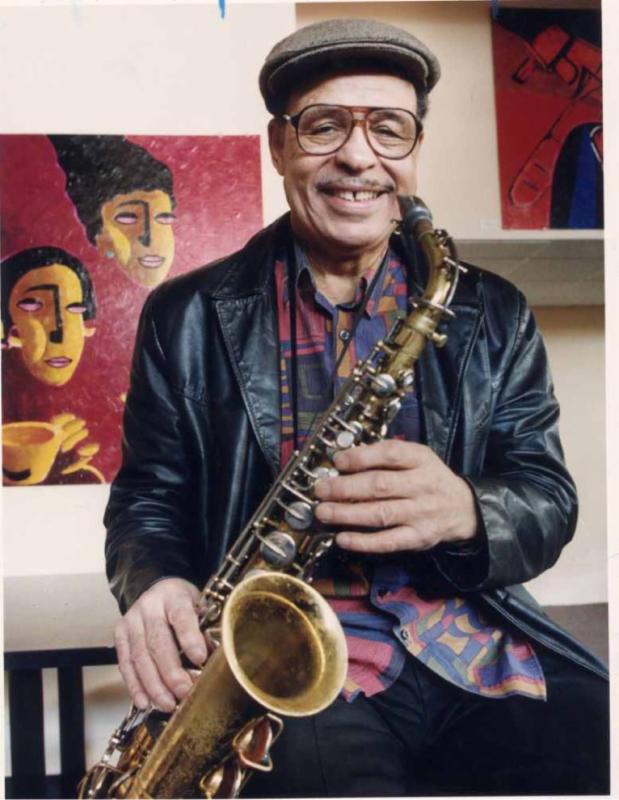
An unforgettable person came into my life in the late 1990s in the form of the late Preston Love Sr. He was an old-line jazz and blues player and band leader who was the self-appointed historian and protector of a musical legacy, his own and that of other African American musicians, that he felt did not receive its full due. Love was a live-life-to-its-fullest, larger-than-life figure whose way with words almost matched his musicianship. As I began reporting on aspects of Omaha’s African American community, he became a valuable source for me. He led me to some fascinating individuals and stories, including his good friend Billy Melton, who in turn became my good friend. But there was no one else who could compare to Preston and his irrepressible spirit.

I ended up writing five stories about Preston. The one that follows is probably my favorite of the bunch, at least in terms of it capturing the essence of the man as I came to know him. The piece originally appeared in the New Horizons. Aspects of this piece and another that I wrote for The Reader, which you can also find on this site, ended up informing a profile on Preston I did for a now defunct national magazine, American Visions. Links to that American Visions story can still be found on The Web. I fondly remember how touched I was listening to the rhapsodic praise Preston had for my writing in messages he left on my answering machine after the first few stories were published. After basking in his praise I would call him back to thank him, and he would go off again on a riff of adulation that boosted my ego to no end.
I believe he responded so strongly to my work because I really did get him and his story. Also, I really captured his voice and pesonality. And this man who craved validation and recognition appreciated my giving him his due.
Near the end of his life Preston hired me to write some PR copy for a new CD release, and I approached the job as I would writing an article. I’ve posted that, too.
The last story I wrote about Preston was bittersweet because it was an in memoriam piece written shortly after his death. It was a chance to put this complex man and his singular career in perspective one more time as a kind of tribute to him. A few years after his death I got to interview and write about a daughter of his he had out of wedlock, Laura Love, who is a fine musician herself. Her story can also be found on this site.
The Smooth Jazz Stylings of Mr. Saturday Night, Preston Love Sr.,
©by Leo Adam Biga
Originally published in the New Horizons
An early January evening at the Bistro finds diners luxuriating in the richly textured tone and sweetly bended notes of flutist-saxophonist Preston Love, Sr., the eternal Omaha hipster who headlines with his band at the Old Market supper club Friday and Saturday nights.
By eleven, the crowd’s thinned out, but the 75-year-old Love jams on, holding the night owls there with his masterful playing and magnetic personality. His tight four-piece ensemble expertly interprets classic jazz, swing and blues tunes Love helped immortalize as a Golden Era lead alto sax player and band leader.
Love lives for moments like these, when his band really grooves and the crowd really digs it: “There’s no fulfillment…like playing in a great musical environment,” he said. “It’s spiritual. It’s everything. Anything less than that is unacceptable. If you strike that responsive chord in an audience, they’ll get it too – with that beat and that feeling and that rhythm. Those vibes are in turn transmitted to the band, and inspire the band.”
His passion for music is shared by his wife Betty, 73, the couple’s daughter, Portia, who sings with her father’s band Saturdays at the Bistro and sons, Norman and Richie, who are musicians, and Preston Jr.
While the Bistro’s another of the countless gigs Love’s had since 1936 and the repertoire includes standards he’s played time and again, he brings a spontaneity to performing that’s pure magic. For him, music never gets tired, never grows old. More than a livelihood, it’s his means of self-expression. His life. His calling.
Music has sustained him, if not always financially, than creatively during an amazingly varied career that’s seen him: Play as a sideman for top territory bands in the late ‘30s and early ‘40s; star as a lead alto saxophonist with the great Count Basie Orchestra and other name acts of the ‘40s; lead his own highly successful Omaha touring troupe in the ‘50s; and head the celebrated west coast Motown band in the ‘60s and early ‘70s.
He’s earned rave reviews playing prestigious jazz festivals (Monterey, Montreux, Berlin). Toured Europe to great acclaim. Cut thousands of recordings, including classics re-released today as part of anthology series. Worked with a who’s-who list of stars as a studio musician and band leader, from Billie Holiday to Aretha Franklin and Ray Charles to Stevie Wonder. Performed on network television and radio. Played such legendary live music haunts as the Savoy and Apollo Theater.
After 61 years in the business, Love knows how to work a room, any room, with aplomb. Whether rapping with the audience in his slightly barbed, anecdotal way or soaring on one of his fluid sax solos, this vibrant man and consummate musician is totally at home on stage. Music keeps him youthful. Truly, he’s no “moldy fig,” the term boppers coined to describe musicians out-of-step with the times.
“As far as being a ‘moldy fig’…that’ll never happen. And if it does, then I’ll quit. I refuse to be an ancient fossil or an anachronism,” said Love. “I am eternally vital. I am energetic, indefatigable, It’s just my credo and the way I am as a person. I play my instruments as modern as anybody alive and…better than I’ve ever played them.”
Acclaimed rhythm and blues artist and longtime friend, Johnny Otis, concurs, saying of Love: “He has impeccable musicianship. He has a beautiful tone, especially on solo ballads, which is rare today, if it exists at all. He’s one of the leading lead alto sax players of our era.”
Otis, who lives in Sebastopol, Calif., is white. Love is black. The fact they’ve been close friends since 1941 shouldn’t take people aback, they say, but it does. “Racism is woven so deeply into the fabric of our country that people are surprised that a black and a white can be brothers,” Otis said. “That’s life in these United States.”

Love’s let-it-all-hang-out performing persona is matched by the tell-it-like-it-is style he employs as a recognized music authority who demands jazz and the blues be viewed as significant, distinctly African-American art forms. He feels much of the live jazz and blues presented locally is “spurious” and “synthetic” because its most authentic interpreters – blacks – are largely excluded in favor of whites.
“My people gave this great art form for posterity and I’m not going to watch my people and our music sold down the road,” he said. “I will fight for my people’s music and its presentation.”
Otis admires Love’s outspokenness. “He’s dedicated to getting that message out. He’s persistent. He’s sure he’s right, and I know he’s right.”
Love’s candor can ruffle feathers, but he presses on anyway. “No man’s a prophet in his hometown,” Love said. “Sometimes you have to be abrasive and caustic to get your point over.”
Orville Johnson, Love’s keyboardist, values Love’s tenacity in setting the record straight. “He’s a man that I admire quite a bit because of his ethics and honesty.”
Love has championed black music as a columnist with the Omaha World-Herald, host of his own radio programs and guest lecturer, teacher and artist-in-residence at colleges and universities.
With the scheduled fall publication of his autobiography, “A Thousand Honey Creeks Later,” by Wesleyan University Press, Love will have his largest forum yet. Love began the book in 1965 while living in Los Angeles (where he moved his family in 1962 during a lean period), and revised it through a succession of editors and publishers. He sees it as a career capstone.
“It’s my story and it’s my legacy to my progeny,” he said. “They’ll know what I’m like and about by the way I said things, if nothing more.”

He started the book at the urging of a friend, who typed the manuscript from his handwritten scrawl. After Love and his family returned to Omaha in 1972, he “totally rewrote” it, adding chapters on his Motown years (1966-1972) and on Omaha. “I did a lot of it at that desk in there,” he said, indicating his cubbyhole office at the Omaha Star, where he is advertising manager. Helping him shape the book over the years has been noted jazz authority Stanley Dance and, more recently, Wesleyan contributing editor George Lipsitz, who wrote its glowing introduction.
Love long ago rejected the idea of a ghost writer. “It’s no longer you then,” he said. “Even if I wasn’t articulate enough or didn’t have the literary background to write it, I wanted to reflect Preston. And it sure and the hell does, for better or worse.” As a veteran writer and avid reader, he does feel on solid ground as an author. He said ideas for the book consumed him. “All the time, ideas raged in my brain. And now I’ve said ‘em, and according to Wesleyan, I’ve said them very well.”
An outside reviewer commissioned by Wesleyan described Love’s book as more “than an account of a musician’s career,” but also an important document on “African-American social history, the history of the music business and institutional racism in American popular culture.”
Love is flattered by the praise. “I’m very proud of it,” he said. “Before the editorial staff acts on your book, they always bring in an outside reader, and what that person has to say has a big bearing on what’s going to happen. It had a big bearing on the contract I signed several weeks ago.”
Love feels his far-flung experience has uniquely qualified him to tell his story against the backdrop of the black music scene in America. “The fact that mine’s been a different, unlikely and multifaceted career is why publishers became interested in my book.”
To appreciate just how full a life he’s led and how far he’s come, one must look back to his start. He grew up the youngest of Mexie and Thomas Love’s nine children in a “dilapidated” house, jokingly called “the mansion,” at 1610 North 28th Street. His auto mechanic father died in Love’s infancy. Although poor in possessions, the family was rich in love.
“My mother did the best she could,” he recalls. “There was no welfare in those days. No ADC. This brave little woman went out and did day work for 40 cents an hour, and we survived. There were no luxuries. “But it was a loving, wonderful atmosphere. Our house was the center of that area. Naturally, guys courted my sweet, beautiful sisters and girls pursued my gorgeous brothers.”
He was steeped in music from a young age. He heard the period’s great black performers on the family radio and phonograph and hung-out on then teeming North 24th Street to catch a glimpse, and an autograph or two, of visiting artists playing the fabled Dreamland Ballroom and staying at nearby rooming houses and hotels.
“Twenty-fourth street was the total hub of the black neighborhood here. This street abounded with great players of this art form.”
By his teens, he was old enough to see his idols perform at the Orpheum and Dreamland. He recalls the Dreamland with great affection:
“All of the great black geniuses of my time played that ballroom. Jazz was all black then, number one, and here were people you admired and worshiped, and now you were standing two feet from them and could talk to them and hear their artistry. To hear the harmony of those black musicians, with that sorrowful, plaintive thing that only blacks have. That pain in their playing. That indefinable, elusive blue note. That’s what jazz is.”

He’d rush home after a night there to play the sax his brother “Dude” had saved up for and bought. “Dude” eventually joined a touring band and passed the sax onto his brothers. Love taught himself to play, picking up pointers from veteran musicians and from the masters whose recordings he listened to “over and over again.”
He began seeing music as a way out. “There was no escape for blacks from poverty and obscurity except through show business,” Love said. “I’d listen to the radio’s late night coast-to-coast broadcasts of those great bands and I’d go to sleep and just dream of going to New York to play the Cotton Club and dream of playing the Grand Terrace in Chicago. I dreamed of someday making it – and I did make it. Everything else in my life would be anticlimactic, because I realized my dream.”
He traces the spark for his dream and its fulfillment to an August night in 1938 at the Dreamland, when, at 17, he met his main idol – Earle Warren – Basie’s lead alto sax man. Warren later became Love’s mentor.
“That was the beginning of my total dedication and my fanaticism for this thing called jazz. He was the whole inspiration for my life.”
With Warren as his inspiration, Love made himself an accomplished musician. “I had the natural gift for sound – a good tone – which is important. Some people never have it. I was self-motivated. No one had to make me practice. I did it all on my own. And being good at mathematics, I was able to read music with the very least instruction.”
His ability to sight read was rare among blacks then and became his “forte.” His first paying gig came in 1936, at 15, as a last-minute fill-in on drums with Warren Webb and His Spiders at the Aeroplane Inn in Honey Creek, Iowa. The North High graduate eventually played scores of other small towns just like Honey Creek, hence the title of his book.
His breakthrough came in 1943, when Warren recommended Love as his replacement in the Basie band. Love auditioned at the Dreamland and won the job. It was his entry into the big time. “I was ready,” he said. “I knew I belonged.” It was the first of two tours of duty with Basie. In storybook fashion, Love returned to play the very sites where his dreams were first fired – the Dreamland and Orpheum. He went on to play many of the famous, glittering big city clubs he’d envisioned.
Love enjoyed the spotlight playing with Basie and the bands of Lucky Millinder, Lloyd Hunter, Nat Towles and Johnny Otis. “Touring was fun,” he said. “You played the top ballrooms, you dressed beautifully, you stayed in finer hotels. Big crowds. Autographs. It was glamorous.” Life on the road agreed with he and Betty, whom he married in 1941. “The itinerant thing is what I love. The checking in the hotels and motels. The newness of each town. The geography of this country. The South, with those black restaurants with that flavorful, wonderful food and those colorful hotels. It was my culture, my people.”
His book vividly describes it all. Including the difficulties of being black in America and the reversals of fortune he’s experienced. He has some harsh things to say about Omaha, where he’s witnessed the Dreamland’s, demise, North 24th Street’s decline and the black music scene dry up.
He’s left his hometown many times, but has always come back. Back to where his dream first took flight and came true. Back to the mistress – music – that still holds him enthralled. To be our conscience, guide, our inspiration.
That January night at the Bistro, a beaming Love, gold horn slung over one shoulder, tells his audience, “I love this. I look forward coming to work. Preston Love’s an alto player, and you want to hear him play alto, right? Listen to this.” Supplying the downbeat, he fills the room with the golden strain of “Mr. Saturday Night.” Play on, Mr. Saturday Night, play on.
Related Articles
- Swinging the Paddle With a Jazz Beat (cityroom.blogs.nytimes.com)
- Popcast: Seattle Jazz and Ade Blackburn of the British Band Clinic (artsbeat.blogs.nytimes.com)
- Ralph A. Miriello: Wynton Marsalis and Eric Clapton Play the Blues (huffingtonpost.com)
- Music Review: Jazz Evangelists Borrow Some of Stevie Wonder’s Cool (nytimes.com)
King Crawford: Omaha’s very own movie mogul

Image via Wikipedia
I go back with Bruce Crawford 30 years. We met for the first time when I was a film programmer/publicist at the University of Nebraska at Omaha and he was a wide-eyed film enthusiast. He specifically approached me about wanting to share his passion for the great film composer Bernard Herrmann, whom he had struck up a correspondence with late in the composer’s life. I had a screening of Taxi Driver scheduled and Bruce asked if he could make a presentation about Herrmann and the composer’s scoring of that film. We didn’t normally have speakers as part of our campus film program but something about Bruce’s magnificent obsession and tenacity convinced me to agree. Flash forward about 15 years, when I was a fledgling freelance journalist and Bruce was first making a name for himself with the radio documentaries he did, including one on Herrmann, and with the revival screenings he staged of film classics.
The following is the first of many stories I’ve written about Bruce and his work as a film historian and impresario. It appeared in The Reader (www.thereader.com). He’s since put on dozens more film events.
King Crawford: Omaha’s very own movie mogul
©by Leo Adam Biga
Originally appeared in The Reader (www.thereader.com)
There’s a bit of Elmer Gantry in Bruce Crawford, the dynamic Omaha film historian/promoter whose sold-out screening of the original 1933 classic King Kong unreels Saturday, May 30 at the Indian Hills Theater.
With his boyish good looks, magnetic presence and penchant for hyperbole he exudes the charisma of a consummate huckster and the passion of a confirmed zealot. An evangelist for that old time religion called the movies, he often describes his devotion in missionary terms and pays homage to Hollywood’s Golden Age through gala events and elaborate documentaries full of his characteristic verve and adoration.
And with its rich, delirious mix of mythology and metaphor, Kong is an apt choice for cinephile celebration and reverence. This ultimate escapist film combines still impressive visual effects with an outrageous Beauty and the Beast fable played out in a ripe Freudian landscape. Unlike, say, Godzilla, it taps our deepest fears and desires.
Crawford’s passion began in his native Nebraska City, where he had a born-again experience at the movies. It came when his parents took him as a child to see Mysterious Island, a 1961 Jules Verne-inspired fantasy adventure featuring special effects by Ray Harryhausen.
“I loved the effects and the creatures and the fantastic Jules Verne story. But it was the music that hooked me more than anything else,” Crawford said from the movie memorabilia and art-filled northwest
Omaha apartment he shares with wife Tami. “I remember when the music hit me. It was the opening with the boiling ocean and the Victorian lettering rolling across the seascape. I can’t quite find the words for it, but something connected. t was almost like a diamond-tip bullet hit me between the eyes. This music…wow! I was so overwhelmed by its beauty and majesty. I wasn’t old enough to read yet, so I asked my parents where the music came from.”

Bruce Crawford
When he found out it was by legendary composer Bernard Herrmann, he felt “a compulsion” to find out everything he could about the man and his work. He had a similarly dramatic reaction to hearing a cut of the love theme to Ben-Hur. Despite his unfamiliarity with the movie and the composer, Miklos Rozsa, he felt an affinity for each. “The music was sooooo beautiful. Even without knowing it was a Biblical story I felt the Judaism. I felt the ancient world. Like with Mysterious Island I felt another connecting link in my life. That this was part of my destiny. I said, ‘I’ve got to see what movie this music goes to.’”
He finally did see Ben-Hur Christmas night in 1970, and it proved a revelation. “It changed my life. I’ve never been so haunted and moved by something as I was by it. It was so profound, so literate, so poetic. I knew I’d seen a masterpiece. And somehow, on some psychic or intuitive or synchronistic level, a little boy in Nebraska City had this connection with these world-renowned musicians and filmmakers. I knew then I was meant to know these people and to do something with them.”
Amazingly, his life has intersected with the very objects of his devotion. As a precocious teen he began corresponding with the imposing Herrmann, the composer for such film classics as Orson Welles’ Citizen Kane and The Magnificent Ambersons and Alfred Hitchcock’s Vertigo and North By Northwest. Upon Herrmann’s death in ‘75 (after finishing the fever dream score to Martin Scorsese’s Taxi Driver) Crawford drew close to his family. By ‘88 he’d become an authority on the man and produced an acclaimed documentary on him which has since aired over many National Public Radio affiliate stations and over the BBC in Great Britain.
Crawford struck up a similar acquaintance with Rozsa and shortly before the composer’s death in ‘95 completed a documentary on him and his music that also garnered strong critical praise and wide air play.
Music has always spoken most strongly to Crawford. “My first and foremost love is great music, and for me film scores represent the 20th century’s answer to the great symphonies of the past 300 to 400 years. A film score is like a grand opera in a sense. It can tell what actors can’t say.”
Movie special effects also hold him enthralled. As a high school student he made an award winning short using the same kind of stop-motion animation techniques as Kong. He began networking with FX artists and those contacts led him to the dean of them all — Harryhausen. In ‘92 Crawford coaxed Harryhausen, fresh from receiving an honorary Oscar, to attend an Omaha tribute in his honor. The men are now close friends.
Ray Harryhausen
The tribute proved a hit and spurred subsequent film events. The biggest to date being the 35th anniversary showing of Ben-Hur, for which Crawford scored a coup by making Omaha the first stop on the restored film’s special reissue tour and by getting family members of the film’s legendary director, William Wyler, to attend.
At a screening of Gone with the Wind he brought co-star Ann Rutherford and added atmosphere with women in period hoop skirts. For the Hitchcock suspense classic Psycho he secured an appearance by star Janet Leigh. Family members of late-great director Frank Capra (Mr. Smith Goes to Washington) and producer Darryl F. Zanuck (The Longest Day) came at Crawford’s invitation to Omaha revivals.
Many wonder how someone so far removed from the movie industry is able to gain entree to rarefied film circles, land interviews with top names (from Charlton Heston to Leonard Maltin), arrange celebrity guest appearances and enlist the aid of corporate sponsors. Crawford’s personal charm and genuine ardor for classic movies, and for the artists who made them, help explain how he does it.
Then too there’s the grand showmanlike way he exhibits old movies. “The way they’re meant to be, but so rarely, seen,” he said, meaning on the big screen — with all the puffery, ballyhoo and flourish of a Hollywood premiere. For his 65th anniversary showing of Kong, which has been fully restored, he plans searchlights, a 30-foot tall Kong balloon, limousine-driven guests, a pre-show and a post-autograph session.
“What I’m trying to do is recapture the magic of going to the movies I felt as a kid,” he said, “and add to it with the glitz and the glamour. You get your money’s worth at a Crawford show, don’t you think?”
Kong’s special guests will include Harryhausen, who’s flying in from his home in London, renowned science fiction author Ray Bradbury (Fahrenheit 451) and noted film historian Forrest Ackerman. The three grew up together in California and were equally enchanted by Kong.
Harryhausen, who later apprenticed under the film’s effects master, Willis O’Brien, on Mighty Joe Young, credits Kong for inspiring his life’s work. “I was 13 when I saw it, and I haven’t been the same since,” he said by phone from London. “It left me startled and dumbfounded. It started me on my career. That shows you how influential films can be.”

Bernard Herrmann
The Kong pre-show or “live prologue,” as Crawford calls it, will recreate the film’s native ceremonial ritual — complete with dancers in painted faces and grass skirts — performed for Kong’s original run at the Grauman’s Chinese Theater in Los Angeles.
On his Kong Web page Crawford promises an evening “in the Sid Grauman tradition.” Crawford is indeed a Grauman-type impresario with a flair for extravaganza. He also resembles the P.T. Barnum-like Carl Denham character in Kong who charters the ship and leads the expedition in search of the big ape. In an early scene the first mate asks the skipper about the irrepressible Denham, “Do you think he’s crazy?” “No,’ says the captain, “just enthusiastic.” Likewise, Crawford’s undaunted fanaticism is that of the true enthusiast. His fervor largely accounts for the warm reception he’s been accorded by Hollywood insiders.
“I’m delighted he takes it so seriously and takes the initiative to try and present pictures the way they were presented in the early days,” said Harryhausen. “What you need is somebody with enthusiasm for these types of things. Bruce has that, and it’s wonderful.”
Gerry Greeno, Omaha city manager for the Douglas Theater Co., whose Cinema Center hosted past Crawford events, said, “He has that exuberance that generates interest and gets people to go along with him…and he’s not bashful about it. For some it might wear a little thin, but he puts a lot of time and effort into these events. He loves doing it.”
Bob Coate, who co-produced the Herrmann-Rozsa documentaries at KIOS 91.5-FM, where he is program manager, said he fell under the Crawford spell when the promoter pitched him the idea. “I’d never produced anything like that before. He kind of got me excited about doing it. His enthusiasm is definitely infectious.” Coate, now part of the Crawford coterie, added, “He’s a driving force. I know these events are tons of work for him, and wear him out, but I think he gets energy from doing them.”
As Crawford tells it, “I try to get people to do things they might not normally do, which I’m told I do a lot of. It’s being persuasive. You have to have that extravagant enthusiasm…that charisma. Some people keep it subdued and withdrawn. I choose not to.”
Until Coate approved the Herrmann program, Crawford had run into dead-ends trying to get it off the ground. “I went to several public radio stations and they said, ‘It can’t be done.’ Of course that went in one ear and out the other. I was determined to do it come hell or high water. Fortunately, Bob (Coate) was a Herrmann fan.”
The pair collaborated for months. In typical Crawford style he pushed the envelope by making the finished product two and a half hours long. Upon hearing it, the feature most listeners remark on is the unusually long (often complete) musical passages from Herrmann’s radio, film and concert hall career and rather spare but informative narrative segments. The same approach is used with the Rozsa project.
Miklos Rozsa
“My programs are really audio musical biographies about the subject and his music,” Crawford said. “The thing that makes them stand out is that they’re 60 to 70 percent music and 30 to 40 percent discussion. There was no model I was aware. I didn’t know what the parameters were. And of course the rest is history.”
He refers to the favorable response the programs netted, especially the piece on Herrmann, who’s a cult figure. Crawford has heard from many famous admirers. “It’s considered the most extensive, the most comprehensive, the most successful documentary ever done on any composer of the 20th century,” he said. “That’s just not my opinion. That’s the opinion of Ray Harryhausen, Ray Bradbury, Danny Elfman, Jerry Goldsmith, David Copperfield, Robert Zemeckis…”
Part of his charm is the wide-eyed, gee-whiz glee he takes in his own achievements. In the Wonderful World of Bruce Crawford, there are only “huge” successes; “amazing” feats; movie “masterpieces;” and his own “almost superhuman” energy. When he goes on a riff about the accolades and national media coverage, he punctuates his speech with a rhetorical “Isn’t that something?” or “Isn’t that incredible?”
Well, who can blame him? He’s been brazen enough to develop world-class film connections and visionary enough to use them in meaningful ways. He’s seen himself become a touchstone figure for film buffs who bask in the glow of his and his famous friends’ celebrity. He’s been commissioned to write articles for major film publications. His services as a documentary producer and event promoter are in much demand.
This self-styled movie mogul rules over a niche market in Omaha for the celebration and veneration of classic films. Call him King Crawford. Still, even he can’t believe his dreams have come true.
“My God, who would have ever thought this was attainable? I didn’t see it coming. I did have a desire, which was obviously intense, but I didn’t know where it would lead. And then to have these giants respond to me, and not only respond, but become pretty close friends — that just doesn’t happen, man. Yeah, syncronicity.”
Perhaps it’s no coincidence then he and Tami live in Camelot Village.
“My life is like a strange sort of destiny.“ he added. “I don’t know how or why that is. That’s what serendipity is I guess. Amazing. Isn’t that wild?”
Related Articles
- Revival House: “We all go a little mad sometimes …” (popdose.com)
- Hitchcock’s Psycho At 50, The Sounds Of Violence (huffingtonpost.com)
- Revival House: Seven Great Rejected Film Scores (popdose.com)
- Listening to Taxi Driver. (slate.com)
- Hitchcock horror under the hammer (thejc.com)


 Leo Adam Biga's My Inside Stories