Archive
Mural project celebrates mosaic of South Omaha culture
Historically, South Omaha is the city’s receiving community for new immigrants and refugees, though North Omaha plays some of that role, too. Blue collar jobs in the commerical, industrial labor sector have provided the livelihood for succeeding waves and generations of ethnic groups to have settled there. South O once had and to some extent still does have neighborhoods with distinct concentrations of ethnic groups. Traditionally, these ethnic enclaves become communities within the larger community. At one time, there were neighborhoods where Poles, Czechs, Lithuanians, Croats and other peoples of Eastern European origin established their own enclaves. There were also strong Italian, Irish and Mexican contingents. And the Great Migration brought many African Americans from the Deep South here as well. The railroads and packing houses were the main employers for many of these new arrivals. World War II-era manufacturing jobs were lures as well. The residents living in the various ethnic neighborhoods that took shape were bound by their shared birthplace, language, customs, religious affiliation and so on. They had their own churches and community centers that reinfoced their tight-knit connections. Festivals celebrated their hertiage and traditions. Having long ago assimilated and with second-third generation descendants moving to other other sections of the city and with the wartime, railroad and packing house jobs disappearing, those once ethnic-centric areas in South Omaha became more homogenized over time. Today, only trace elements of their once ethnic identities remain. The last three decades have seen the emergence of new emigrees from Latin and Central America, Asia and Africa, thus repeating the patterns that happened with earlier groups in the late 19th century through the late 1920s. All of this is context for an art project now underway in South Omaha that celebrates the different heritages that have made it such a melting pot over time. The South Omaha Mural Project is creating a mural for each of the major ethnic groups that have populated the area. A future mural may also commemorate the stockyards-packing plant epoch that dominated the South Omaha landscape for decades with that industry’s acres of buildings and structures that emplpyed thousands of people and with all the ancilliary businesses that served those workers.
©by Leo Adam Biga
Appearing in El Perico
What began as a one-off neighborhood mural by Richard Harrison and his daughter Rebecca Van Ornam has morphed into a project with several artists depicting historical South Omaha ethnic groups and landmarks.
When historian Gary Kastrick saw the South 13th Street mural Harrison and Van Ornam did illustrating the area’s Czech heritage, it sparked an idea for a mural culture series celebrating South Omaha’s role as a gateway for ethnic immigrant and refugee assimilation.
More murals followed through the help of the South Omaha Business Association (SOBA), who secured grants for a history mural at the Metropolitan Community College south campus and a Magic City Mural at 24th and N. Thus, the South Omaha Mural Project was born.
Artist Hugo Zamorano joined the team for a Lithuanian mural on the Lithuanian Bakery at 5217 South 33rd Avenue. A Mexican mural in the Plaza de la Raza was unveiled July 10. New murals are planned for the Polish, Irish, Croatian, Italian, Jewish, African-American ethnic enclaves that traditionally called South Omaha home. The more recently arrived Honduran, Guatemalan and El Salvadoran communities will get murals, too. There’s talk of one celebrating South O’s stockyards-meatpacking legacy as well.
The Polish mural will adorn a wall of Dinker’s Bar at 2368 South 29th Street. The Irish mural will grace another popular hangout, Donohue’s Pub, at 3232 L Street.
“We’re looking for walls that have good visibility in relationship to the neighborhood,” Harrison said. “Size is a good thing.”
Every wall poses its own challenges.
“When a wall is rough and covered with obstacles like water meters and things we are coming up with solutions of putting up profile cut sign boards with characters and symbols on them, so the wall has sort of a pop-up book, three-dimensional feeling to it,” Harrison said.
Project funding comes from SOBA, the Nebraska Arts Council, the Mayor’s Neighborhood Grants Program, the City of Omaha’s Historical Grant initiative and various community sources.
David Catalan served as SOBA president when the organization decided to support the mural project. He said the project aligns well with SOBA’s mission of “preserving the diversity and heritage of South Omaha.”
Some ethnic organizations hold fundraisers to help underwrite their individual murals. The South Omaha Neighborhood Alliance is a new partner.
Harrison is a project facilitator and a supporting artist. Michael Giron and Zamorano trade-off as lead artist. Kastrick serves as the history consultant. Catalan is an advisor and liaison.


This labor of love entails extensive community engagement and input for each mural. Multiple public meetings elicit information and ideas. The public can view the final sketch projected on a wall and can join community paint days.
“We are connecting with a lot of people in each successive community we focus on,” Harrison said. “We’re happy how fast this connects with people and how much it matters to them. They come to the meetings and share their stories and memories. Everybody we talk to finds it meaningful to them.”
He believes the community taking ownership of the murals explains why none have suffered graffiti.
After the communal paint days, Harrison, Giron, Zamorano and other artists paint for a month or two – working in acrylics to sharpen images and to apply shading and highlights. A clear protective sealer is added at the end.
When a mural’s finished, a public celebration is held.
This community-based approach is much more involved than the private commissions Harrison does under his A Midsummer’s Mural business but he said it’s all worth it.
“What’s really special is bringing the community together to talk about what’s important to them and what memories they have.”
Kastrick, a retired Omaha South High history teacher who leads South Omaha history tours, hopes the murals educate and entertain about South O’s long, unfolding melting pot story.
“It’s about rekindling South Omaha roots in people who moved away and reestablishing those roots with their children and grandchildren. I envision people coming to see the murals and talking about the people and the history they see on them.”
He and Harrison believe the murals can be destination attraction urban maps for residents and visitors wanting to learn about the area’s cultural history.
None of the primary artists working on the project are originally from Omaha and for these transplants each mural is an education.
“There is a lot that I did not know before this project and still more to learn.,” said Zamorano.
The Mexican mural he took the lead on is a perfect example.
“Almost everything I learned was new information to me. I learned about some of the different waves of Mexicans that moved to Omaha, why they moved, and where they came from. I never knew how much the Catholic church and Lutheran church were involved in the community helping people move forward in education and empowerment. The list goes on. I never knew how much history there is in South Omaha alone.”
Fostering appreciation for place is what the project team wants every mural to encourage. Zamorano said Mexican mural images represent “topics and themes about unity, struggle, education, work, identity, education and celebration.” A working couple eats dinner with their family. A “Dreamer” graduates high school. Community anchors, such as the American GI Forum and Chicano Awareness Center, loom large. “In the center,” he said “an ancient Aztec god and two children share a history book to symbolize the past and future.”
Follow the project’s progress at http://www.amidsummersmural.com/for-communities/south-omaha-mural-project/.
The series and the stadium: CWS and Rosenblatt are home to the Boys of Summer
The College World Series has me all nostalgic for the way things were and by that I mean the CWS and Rosenblatt Stadium enjoying a long-lived marriage as the home to the Boys of Summer. It was a pairing that seemed destined to last decades more. My story here from 1998 appeared at the peak of CWS glory at The Blatt. It was coming on 50 years for this event and venue. But within a decade all the platitudes uttered by the NCAA and others about this match made in heaven began to erode and the business interests and metrics that control big-time college athletics erased any sentiment and moved forward with cold, calculated speed to a new CWS era. The powers that be abandoned Rosenblatt and made plans to develope the new TD Ameritrade ballpark in order to keep the series in Omaha because the Grand Old Lady, as Jack Payne refers to the vintage Blatt, was showing its age and could not accommodate fans in the manner the NCAA demanded. Of course, Omaha had already put put tens of millions of dollars into updating Rosenblatt to keep the series here. The city then spent much more than that again to build a new park to keep the series here. Those who said The Blatt had to go called it a relic and anachronism in an age of expansive stadiums with unobstructed views and wide concourses. There is no doubt that Rosenblatt’s guts were cramped, claustrophobic-inducing and offered limited or nonexistent views of the field from the concourse. Defenders cited the history, legacy, tradition and character of the old park that would be sacrificed, lost and irreplacable in a new venue. We all know what happened. But for a glorious run of more than half a century, The Blatt reigned supreme.
The series and the stadium: CWS and Rosenblatt are home to the Boys of Summer
©by Leo Adam Biga
Originally appeared in The Reader (www.thereader.com)
Take me out to the ball game,
Take me out with the crowd;
Buy me some peanuts and Cracker Jack,
I don’t care if I never get back.
Let me root, root, root for the home team,
If they don’t win, it’s a shame.
For it’s one, two, three strikes, you’re out,
At the old ball game.
It’s baseball season again, and The Boys of Summer are haunting diamonds across the land to play this quintessentially American game. One rooted in the past, yet forever new. As a fan put it recently, “With baseball, it’s the same thing all over again, but it isn’t. Do you know what I mean?”
Yes, there’s a timelessness about baseball’s unhurried rhythm, classic symmetry and simple charm. The game is steeped in rules and rituals almost unchanged since the turn of the century. It’s an expression of the American character, both immutable and enigmatic.
Within baseball’s rigid standards, idoosyncracy blooms. A nine-inning contest is decided when 27 outs are recorded and one team is ahead, but getting there can take anywhere from two to four hours or more. All sorts of factors, including weather delays, offensive explosions and multiple pitching changes, can extend a game. An extra inning game results when the two teams are tied after nine stanzas. The number of extra innings is limitless until one team outscores the other after both clubs have had their requisite turns at the plate. There are countless games on record that have gone 10, 11, 12 or more innings, sometimes upwards of 15 to 18 innings and some have even gone beyond these outlier limits to 20 or more innings, when they become true marathon contests of will for players and fans alike. The hours and plays can add up to the point that you can’t remember all the action you just sat through and witnessed.
Stadiums may appear uniform but each has its own personality – with distinctive outfield, dimensions, wind patterns, sight lines, nooks and crannies. Balls play differently and carry differently in each park. The way the infield grass and dirt are maintained differs from park to park. The way the pitcher’s mound and batter’s box are aligned differs, too.
Look in any almost American town and you’ll find a ballpark with deep ties to the sport and its barnstorming, sandlot origins. A shrine, if you will, for serious fans who savor old-time values and traditions. The real thing. Such a place is as near as Omaha’s Johnny Rosenblatt Stadium, the site the past 49 years of the annual College World Series.
The city and the stadium have become synonomous with the NCAA Division I national collegiate baseball championship. No other single location has hosted a major NCAA tournament for so long. More than 4 million fans have attended the event in Omaha since 1950.
This year’s CWS is scheduled for May 29-June 6.


The innocence and the memories
In what has been a troubled era for organized ball, Rosenblatt reaffirms what is good about the game. There, far away from the distraction of Major League free-agency squabbles, the threat of player and umpire strikes, and the posturing of superstars, baseball, in its purest form, takes center stage. Hungry players still hustle and display enthusiasm without making a show of it. Sportsmanship still abounds. Booing is almost never heard during the CWS. Fights are practically taboo.
The action unwinds with lesiurely grace. The”friendly confines” offer the down home appeal of a state fair. Where else but Omaha can the PA announcer ask fans to “scooch in a hair more” and be obliged?
Undoubtedly, the series has been the stadium’s anchor and catalyst. In recent years, thanks in part to ESPN-CBS television coverage, the CWS has become a hugely popular event, regularly setting single game and series attendance records. The undeniable appeal, besides the determination of the players, is a chance to glimpse the game’s upcoming stars. Fans at Rosenblatt have seen scores of future big league greats perform in the tourney, including Mike Schmidt, Dave Winfield, Fred Lynn, Paul Molitor, Jimmy Key, Roger Clemens, Will Clark, Rafael Palmeiro, Albert Belle, Barry Bonds and Barry Larkin.
The stadium on the hill turns 50 this year. As large as the CWS looms in its history, it’s just one part of an impressive baseball lineage. For example, Rosenblatt co-hosted the Japan-USA Collegiate Baseball Championship Series in the ’70s and ’80s, an event that fostered goodwill by matching all-star collegians from each country.
Countless high school and college games have been contested between its lines and still are on occasion.
Pro baseball has played a key role in the stadium’s history as well.
Negro Leagues clubs passed through in its early years. The legendary Satchel Paige pitched there for the Kansas City Monarchs. Major League teams played exhibitions at Rosenblatt in the ’50s and ’60s. St. Louis Cardinals Hall of Famer Stan Musial “killed one” during an exhibition contest.
For all but eight of its 50 years Rosenblatt has hosted a minor league franchise. The Cardinals and Dodgers once based farm clubs there. Native son Hall of Famer Bob Gibson got his start with the Omaha Cardinals in ’57. Since ’69 Rosenblatt’s been home to the Class AAA Omaha Royals, the top farm team of the parent Kansas City Royals. More than 7 million fans have attended Omaha Royals home games. George Brett, Frank White and Willie Wilson apprenticed at the ballpark.
With its rich baseball heritage, Rosenblatt has the imprint of nostalgia all over it. Anyone who’s seen a game there has a favorite memory. The CWS has provided many. For Steve Rosenblatt, whose late father Johnny led the drive to construct the stadium that now bears his name, the early years held special meaning. “The first two years of the series another boy and I had the privilege of being the first bat boys. We did all the games. That was a great thrill because it was the beginning of the series, and to see how it’s grown today is incredible. They draw more people today in one session than they drew for the entire series in its first year or two.”
For Jack Payne, the series’ PA announcer since ’64, “the dominant event took place just a couple years ago when Warren Morris’ two-run homer in the bottom of the ninth won the championship for LSU in ’96. He hit a slider over the right field wall into the bleachers. That was dramatic. Paul Carey of Stanford unloaded a grand slam into the same bleacher area back in ’87 to spark Stanford’s run to the title.”

Jack Payne

Terry Forsberg
Payne, a veteran sports broadcaster who began covering the Rosenblatt beat in ’51, added, “There’s been some great coaching duels out there. Dick Siebert at Minnesota and Rod Dedeaux at USC had a great rivalry. They played chess games out there. As far as players, Dave Winfield was probably the greatest athlete I ever saw in the series. He pitched. He played outfield. He did it all.”
Terry Forsbeg, the former Omaha city events manager under whose watch Rosenblatt was revamped, said, “Part of the appeal of the series is to see a young Dave Winfield or Roger Clemens . Players like that just stick out, and you know they’re going to go somewhere.” For Forsberg, the Creighton Bluejays’ Cinderella-run in the ’91 CWS stands out. “That was a reall thrill, particularly when they won a couple games. You couldn’t ask for anything more.” The Creighton-Wichita State game that series, a breathtaking but ultimately heartbreaking 3-2 loss in 12 innings suffered by CU, is considered an all-time classic.
Creighton’s CWS appearance, the first and only by an in-state school, ignited the Omaha crowd. Scott Sorenson, a right-handed pitcher on that Bluejays squad, will never forget the electric atmosphere. “It was absolutely amazing to be on a hometown team in an event like that and to have an entire city pulling for you,” he said. “I played in a lot of ballparks across the nation, but I never saw anything like I did at Rosenblatt. I still get that tingling feeling whenever I’m back there.”
A game that’s always mentioned is the ’73 USC comeback over Minnesota. The Gophers’ Winfield was overpowering on the mound that night, striking out 15 and hurling a shutout into the ninth with his team ahead 7-0. But a spent Winfield was chased from the mound and the Trojans completed a storybook eight-run last inning rally to win 8-7.
Poignant moments aboud as well. Like the ’64 ceremony renaming the former Municpal Stadium for Johnny Rosenblatt in recognition of his efforts to get the stadium built and bring the CWS to Omaha. A popular ex-mayor. Rosenblatt was forced to resign from office after developing Parkinson’s disease and already suffered from its effects at the rededication. He died in ’79. Another emotional moment came in ’94 when cancer-ridden Arizona State coach Jim Brock died only 10 days after making his final CWS appearance. “That got to me,” Payne said.
Like many others, Payne feels the stadium and tourney are made for each other. “It’s always been a tremendous place to have a tournament, and fortunately there was room to grow. I don’t think you could have picked a finer facility at a better location, centrally located like it is, than Rosenblatt. It’s up high. The field’s big. The stadium’s spacious. It’s just gorgeous. And the people have just kept coming.”
Due to its storied link to the CWS the stadium’s become the unofficial home of collegiate baseball. So much so that CWS boosters like Steve Rosenblatt and legendary ex-USC coach Rod Dedeaux would like to see a college baseball-CWS hall of fame established there.
Baseball is, in fact, why the stadium was built. The lack of a suitable ballpark sparked the formation of a citizens committee in ’44 that pushed for the stadium’s construction. The committee was an earlier version of the recently disbanded Sokol Commission that led the drive for a new convention center-arena. With the goal of putting the issue to a citywide vote, committee members campaigned hard for the stadium at public meetings and in smoke-filled back rooms. Backers got their wish when, in ’45, voters approved by a 3 to 1 margin a $480,000 bond to finance the project.
Unlike the controversy surrounding the site for a convention center-arena today, the 40-acre tract chosen for the stadium was widely endorsed. The weed-strewn hill overlooking Riverview Park (the Henry Doorly Zoo today) was located in a relatively undeveloped area and lay unused itself except as prime rabbit hunting territory. Streetcars ran nearby just as trolleys may in the near future. The site was also dirt cheap. The property had been purchased by the city a few years earlier for $17 at a tax foreclosure sale. Back taxes on the land were soon retired.
Dogged by high bids, rising costs and material delays, the stadium was finished in ’48 only after design features were scaled back and a second bond issue passed. The final cost exceeded $1 million.
Baseball launched the stadium at its October 17, 1948 inaugural when a group of all-stars featuring native Nebraskan big leaguers beat a local Storz Brewery team 11-3 before a packed house of 10,000 fans.
Baseball has continued to be the main drawing card. The growth of the CWS prompted the stadium’s renovation and expansion, which began in earnest in the early ’90s and is ongoing today.
 A new look
Rosenblatt is at once a throwback to a bygone era – with its steel-girded grandstand and concrete concourse – and a testament to New Age theme park design with its Royal Blue molded facade, interlaced metal truss, fancy press box and luxury View Club. The theme park analogy is accentuated by its close proximity to the Henry Doorly Zoo.
Some have suggested the new bigness and brashness have stolen the simple charm from the place.
“Maybe some of that charm’s gone now,” Terry Forsberg said, “but we had to accommodate more people as the CWS got popular. But we still play on real grass under the stars. The setting is still absolutely beautiful. You can still look out over the fences and see what mid-America is all about.”
Jack Payne agrees. “I don’t think it’s taken away from any of the atmosphere or ambience,” he said. “If anything, I think it’s perpetuated it. The Grand Old Lady, as I call it, has weathered many a historical moment. She’s withstood the battle of time. And then in the ’90s she got a facelift, so she’s paid her dues in 50 years. Very much so.”
Perched atop a hill overlooking the Missouri River and the tree-lined zoo, Rosenblatt hearkens back to baseball’s, and by extension, America’s idealized past. It reminds us of our own youthful romps in wide open spaces. Even with the stadium expansion, anywhere you sit gives you the sense you can reach out and touch its field of dreams.
NCAA officials, who’ve practically drawn the blueprint for the new look Rosenblatt, know they have a gem here.
“I think part of the reason why the College World Series will, in 1999, celebrate its 50th year in Omaha is because of the stadium we play in, and the fact that it is a state-of-the-art facility,” said Jim Wright, NCAA director of statistics and media coordinator for the CWS the past 20 years.
Wright believes there is a casual quality that distinguishes the event.
 A feeling
“Almost without exception writers coming to this event really do become taken with the city, with the stadium and with the laidback way the championship unfolds,” he said. “It has a little bit different feel to it, and certainly part of that is because we’re in Omaha, which has a lot of the big city advantages without having too many of the disadvantages.”
For Dedeaux, who led the Trojans to 10 national titles and still travels from his home in Southern California to attend the series, the marriage of the stadium-city-event makes for a one-of-a-kind experience.
“I love the feeling of it. The intimacy. Whenever I’m there I think of all the ball games but also the fans and the people associated with the tournament, and the real hospitable feeling they’ve always had. I think it’s touched the lives of a lot of people,” he said.
Fans have their own take on what makes baseball and Rosenblatt such a good fit. Among the tribes of fans who throw tailgate parties in the stadium’s south lot is Harold Webster, an Omaha tailored clothing salesman. While he concedes the renovation is “nice,” he notes, “The city didn’t have to make any improvements for me. I was here when it wasn’t so nice. I just love being at the ballpark. I’m here for the game.” Not the frills, he might have added.
For Webster and fans like him, baseball’s a perennial rite of summer. “To me, it’s the greatest thing in the world. I don’t buy season tickets to anything else – just baseball.”
Mark Eveloff, an associate judge in Council Bluffs, comes with his family. “We always have fun because we sit in a large group of people we all know. You get to see a lot of your friends at the game and you get to see some good baseball. I’ve been coming to games here since I was a kid in the late ’50s, when the Omaha Cardinals played. And from then to now, it’s come a long way. Every year it looks better.”
Ginny Tworek is another fan for life. “I’ve been coming out here since I was 8 years-old,” the Baby Boomer said. “My dad used to drop me and my two older brothers off at the ballpark. I just fell in love with the game. It’s a relaxing atmosphere.”
There is a Zen quality to baseball. With its sweet, meandering pace you sometimes swear things are moving in slow motion. It provides an antidote to the hectic pace outside.
Baseball isn’t the whole story at Rosenblatt. Through the ’70s it hosted high school (as Creighton Prep’s home field), college (Omaha University-University of Nebraska at Omaha) and pro football (Omaha Mustangs and NFL exhibition) games as well as pro wrestling cards, boxing matches and soccer contests. Concerts filled the bill, too, including major shows by the Beach Boys in ’64 and ’79. But that’s not all. It accommodated everything from the Ringling Brothers Circus to tractor pulls to political rallies to revival meetings. More recently, Fourth of July fireworks displays have been staged there. Except for the annual fireworks show, the city now reserves the park for none but its one true calling, baseball, as a means of protecting its multimillion dollar investment.
 Maintaining excellence
“We made a commitment to the Omaha Royals and to the College World Series and the NCAA that the stadium would be maintained at a Major League level. The new field is farily sensitive. We don’t want to hurt the integrity of the field, so we made the decision to just play baseball there,” Omaha public events manager Larry Lahaie said.
A new $700,000 field was installed in 1991-92, complete with drainage and irrigation systems. Maintaining the field requires a groundskeeping crew whose size rivals that of some big league clubs.
Omaha’s desire to keep the CSW has made the stadium a priority. As the series begain consistenly drawing large crowds in the ’80s, the stadium experienced severe growing pains. Parking was at a premium. Traffic snarls drew loud complaints. To cope with overflow crowds, officials placed fans on the field’s cinder warning track. The growing media corps suffered inside a hot, cramped, outdated press box. With the arrival of national TV coverage in the ’80s, the NCAA began fielding bids from other cities wanting to host the CWS.
In the late ’80s Omaha faced a decision – improve Rosenblatt or lose the CWS. There was also the question of whether the city would retain the Royals. In the ’90s the club’s then owner, Irving “Gus” Cherry, was shopping the franchise around. There was no guarantee a buyer would be found locally, or if one was, whether the franchise would stay. To the rescue came an unlikely troika of Union Pacific Railroad, billionaire investor Warren Buffett and Peter Kiewit Son’s Inc. chairman Walter Scott Jr. , who together purchased the Royals in 1991.
Urged on by local organizers, such as Jack Diesing Sr. and Jr., and emboldened by the Royals new ownership the city anteed-up and started pouring money into Rosenblatt to rehab it according to NCAA specifications. The city has financed the improvements through private donations and from revenue derived from a $2 hotel-motel occupancy tax enacted in ’91.

The Beach Boys in concert at Rosenblatt Stadium in Omaha. RUDY SMITH/THE WORLD-HERALD
A carnival or fair atmposphere
The makeover has transformed what was a quaint but antiquated facility into a modern baseball palace. By the time the latest work (to the player clubhouses, public restrooms and south pavilion) is completed next year, more than $20 million will have been spent on improvements.
The stadium itself is now an attraction. The retro exterior is highlighted by an Erector Set-style center truss whose interlocking, cantilevered steel beams, girders and columns jig-jag five stories high.
Then there’s the huge mock baseball mounted on one wall, the decorative blue-white skirt around the facade, the slick script lettering welcoming you there and the fancy View Club perched atop the right-field stands. The coup de grace is the spacious, thatched-roof press box spanning the truss.
Rosenblatt today is a chic symbol of stability and progress in the blue collar South Omaha neighborhood it occupies. It is also a hub of activity that energizes the area. On game days lawn picnics proceed outside homes along 13th Street and tailgate parties unwind in the RV and minivan-choked lots. The aroma of grilled sausage, bratwurst and roasted peanuts fills the air. A line invariably forms at nearby Zesto’s, an eatery famous for its quick comfort food.
There’s a carnival atmosphere inside the stadium. The scoreboard above the left-field stands is like a giant arcade game with its flashing lights, blaring horns, dizzying video displays and fireworks. Music cascades over the crowd – from prerecorded cuts of Queen’s “We Will Rock You” and the Village People’s “YMCA” to organist Lambert Bartak’s live renditions of “Sioux City Sioux” and “Spanish Eyes.” Casey the Mascot dances atop the dugouts. Vendors hawk an assortment of food, drink and souvenirs. Freshly-scrubbed ushers guide you to your seat.
The addition that’s most altered the stadium is the sleek , shiny, glass-enclosed View Club. It boasts a bar, a restaurant, a south deck, a baseball memorabilia collection, cozy chairs and, naturally, a great catbird’s seat for watching the game from any of its three tiered-seating levels.
But you won’t catch serious fans there very long. The hermetically-sealed, soundproof interior sucks the life right out of the game, leaving you a remote voyeur. Removed from the din of the crowd, the ballyhoo of the scoreboard, the enticing scent of fresh air and the sound of a ball connecting with leather, wood or aluminum, you’re cut off from the visceral current running through the grandstand. You miss its goosebump thrills. “That’s the bad thing about it,” Tworek said. “You can’t hear the crack of the bat. You don’t pay as close attention to the game there.”

©Omaha World-Herald
When Rosenblatt was Municipal Stadium. At the first game, from left: Steve Rosenblatt; Rex Barney; Bob Hall, owner of the Omaha Cardinals; Duce Belford, Brooklyn Dodgers scout and Creighton athletic director; Richie Ashburn, a native of Tilden, Neb.; Johnny Rosenblatt; and Johnny Hopp of Hastings, Neb.
Baseball’s internal rhythms bring fans back
Even with all the bells and whistles, baseball still remains the main attraction. The refurbished Rosenblatt has seen CWS crowds go through the roof, reaching an all-time single series high of 204,000 last year. The Royals, bolstered by more aggressive marketing, have drawn 400,000-plus fans every year but one since ’92. Fans have come regardless of the won-loss record. The top single season attendance 447,079 came in ’94, when the club finished eight games under .500 and in 6th place.
Why? Fans come for the game’s inherent elegance, grace and drama. To see a well-turned double play, a masterful pitching performance or a majestic home run. For the chance of snaring a foul ball. For the traditional playing of the national anthem and throwing out of the first pitch. For singing along to you-know-what during the seventh inning stretch.
They come too for the kick back convivality of the park, where getting a tan, watching the sun set or making new friends is part of the bargain. There is a communal spirit to the game and its parks. Larry Hook, a retired firefighter, counts Tworek among his “baseball family,” a group of fans he and his grandson Nick have gotten acquainted with at the Blatt. “It’s become a regular meeting place for us guys and gals,” he said. “We talk a little baseball and watch a little baseball. Once the game’s over everybody goes their separate ways and we say, ‘See ya next home stand.'”
The season’s end brings withdrawl pains. “About the first couple months, I’m lost,” Hook said. “There’s nothing to look forward to.” Except the start of next season.
As dusk fell at Rosenblatt once recent night, Charles and Stephanie Martinez , a father and daughter from Omaha, shared their baseball credo with a visitor to their sanctuary above the third-base dugout. “I can never remember not loving baseball,” said Charles, a retired cop. “I enjoy the competition, the players and the company of the people I’m surrounded by.”
Serious fans like these stay until the final out. “Because anything can happen,” Stephanie said. “I like it because it’s just so relaxed sitting out on a summer day. There’s such an ease to it. Part of it’s also the friends you make at the ballpark. It doesn’t matter where you go – if you sit down with another baseball fan, you can be friends in an instant.”
That familiar welcoming feeling may be baseball’s essential appeal.
Coming to the ballpark, any ballpark, is like a homecoming. Its sense of reunion and renewal, palpable. Rosenblatt only accentuates that feeling.
Like a family inheritance, baseball is passed from one generation to the next. It gets in your blood.
So, take me out to the ball game, take me out to the crowd…
It was a different breed then: Omaha Stockyards remembered
I have been meaning to post this story for some time and only now got around to it. It’s a Reader (www.thereader.com) cover story from 1999 that takes a look back at the Omaha Stockyards only months before the whole works closed and was razed. Its demise, after years of decline following decades of booming business, ended a big brawny empire that at its peak was a major economic engine and a dominant part of the South Omaha landscape. I interviewed several men and one woman whose lives were bound up in the place and they paint a picture of a city within a city about which they felt great pride and nostalgia. The Stockyards was its own culture. These stockmen and this stockwoman were sad seeing it all go away, as if it was never there. Around that same time, I wrote a second depth story about the Stockyards for the New Horizons that gave even more of a feel for the scale of operation it once maintained. Here is a link to that story–

It was a different breed then: Omaha Stockyards remembered
©by Leo Adam Biga
Originally appeared in The Reader (www.thereader.com)
Unfolding a stone’s thrown away from a South Omaha strip mall is a scene straight out of the Old West. A sturdy codger called B.J. drives a dozen burnt orange cows through a mosaic of wooden pens and metal gates. As he flogs the recalcitrant beasts with a whip, his sing-song voice calls to them in a lingo only wranglers know.
“Hey, hey, hey, hey, hey…yeh, yeh, yeh…Whoa! Get up there. Whoa! Yeh, yeh, yeh…Go, get up there. High, high, high, high. Whoa. Gip, gip, gip, gip…High, high, high, high…Yeh, yeh, yeh, yeh…C’mon, babies. C’mon, sweethearts. C’mon, darlings. Get up there.”
Welcome to the Omaha Stockyards, a once immense marketplace and meatpacking center which, owing to changing marketing trends and public attitudes, has gone to rack and ruin. Since 1997, when Mayor Hal Daub announced a city-led plan to buy the site, raze nearly the entire complex and redevelop it, the Omaha Livestock Market, which operates the yards, has been marking time. In March, market staff and traders vacated offices in the Livestock Exchange Building and have since taken up makeshift quarters in a nearby cinder-block structure. The yards are expected to close early this fall, possibly by October, and the market will move from the site it has operated at for 116 years and re-open in Red Oak, Iowa. Just as the Stockyards will soon disappear, its halcyon days are now distant memories.
But for survivors of those times, like Bernie J. McCoy, the past is very much alive. As painful as the impending end is for them, they revel in the spirit of the people who worked there and their special way of doing business. To the hard physical labor performed, the injuries incurred, the grueling dawn to dusk schedule and harsh elements endured.
“You had to want to be here and work those long hours. It was a different breed then,” McCoy says.
Yes, the fat times are long gone, never to return, but their legacy lives on in the work McCoy and others still do there. They retrace the very paths taken by countless others before them, forging a direct link to the area’s frontier past. In the yards’ cavernous, skeleton-like environs, McCoy’s voice blends with the sound of bawling calves, squealing hogs and creaking gates to resonate like the mourning, wailing echo of restless souls from long ago. Requiem for the Stockyards.
Recently, McCoy and some fellow Stockyards veterans recounted for The Reader the good old days at this soon to be vanished landmark. Their memories unveil a rich, vibrant, muscular chapter of Omaha’s working life well worth preseving. Their words celebrate an enterprise that dominated the landscape and shaped the city unlike no other. Where the once overbrimming yards pulsed with the lifeblood of Omaha’s economy, it is now a relic condemned to the scrap heap – a decript place largely given over to pigeons and rats. Blocks of abandoned, weed-strewn pens stand empty. Crumbling, sagging buildings blight the landscape. Where it took hundreds of men many hours to drive, feed, water, sort, weigh, trade and load livestock daily, now all activity unfolds in an hour or two amid a dozen pens holding perhaps a hundred cattle, a few hands putting them through their paces.
The traffic whooshing past on L Street overhead is a metaphor for how this forsaken former juggernaut has been passed by in the wake of progress, leaving it an anachronism in a city grown intolerant. Yet, it lingers still – a ghostly visage of another era.
By the close of 1999 only tracts of of dilapidated pens and barren livestock barns will remain. Soon even these meager traces will vanish when the city levels the whole works in a year or two. leaving only the looming presence of the massive Exchange Building – for decades the focal point and symbol of the sprawling , booming market. Even its future is not secure, hinging on if if developers find financing for its pricey renovation.
We helped build this city
Today, from atop the weather-beaten wooden high walk spanning the grounds, it’s hard imagining when the yards teemed with enough acitivty to make it the largest livestock market/meatpacking center in the nation. Oh, animals still arrive at market every week but comprise only a trickle of the mighty stream that once flowed around the clock.
Unless you’re pushing middle age, you never saw the Stockyards at its peak. When tens of thousands of cattle, hogs and sheep arrived daily by rail and truck. Millions of animals a year. All transactions, each worth many thousands of dollars, were consummated by word of mouth alone. Trading generated millions of dollars a day, perhaps billions over time.
Livestock were sold primarily to the big four packing plants and the many smaller independent plants then dotting the yards’ perimeter. Stock were also shipped to other parts of the country, even overseas. The place was once so big, its impact so vast, that the Omaha market helped set the prices for the industry nationwide and ran its own radio station and newspaper. As a center of commerce, the Stockyards ruled. At their peak, the packing plants employed more than 10,000 laborers. The Stockyards company itself employed hundreds, including office staff to manage the business as well as outdoor crews to handle animals, maintain pens, chutes and barns and run its own railroad line. Hundreds more did business there as livestock commission salesmen, order-buyers, inspectors, et cetera. The people converging there on any trading today ranged from frugal farmers to rough-hewn truckers to smooth-talking traders to well-heeled bankers.
Besides being THE meeting place for anyone who was anybody in the agriculture industry, the Exchange Building offered an oasis of comfort with its cafeteria, dining room, ballroom, bar, soda fountain, cigar stand and barbershop. Basement showers let you wash the stink off but somehow you always knew when a hog man was around. Nearby watering holes, eateries, stores and hotels catered to the stock trade’s every pleasure. The aroma of sweat, blood, manure, hay, grain, cologne, whiskey and tobacco created what Omaha historian Jean Dunbar calls, “The smell of money.”
“Fifty years ago the Stockyards and packing plants were the hub of Omaha, Nebraska. Nowadays, young people don’t appreciate what the Union Stockyards Company did for Omaha. We helped build this city. Everyone wanted to work here. You don’t know the pride we had. Come November, there will be nothing left to remember we were ever here or even existed. Nothing,” declares McCoy, 69, a livestock dealer who’s worked at the Omaha Stockyards for 54 years.
 Aerial stockyards, circa 1950. Photo provided by the Douglas County Historical Society.
 Chicken plant. Photo provided by the Douglas County Historical Society.
 Meat inspectors. Photo provided by the Douglas County Historical Society.
 Omaha: World’s largest livestock and meat-packing center. Photo provided by the Douglas County Historical Society.
 Ak-Sar-Ben stockyard judging pens. Photo provided by the Douglas County Historical Society.
 Stockyard view of the pens, circa 1927. Photo provided by the Douglas County Historical Society.
 Trucks backed up to chutes, circa 1926. Photo provided by the Douglas County Historical Society.
 Wentworth stockyards. Photo provided by the Douglas County Historical Society.
It was the people
From 1934 to 1969 Doris Wellman, 83, was one of the few women executives in the livestock trading business. Her ties to the place run deep. Her grandfather and father worked there, as did her late husband Ralph and his grandfather and father before him. Incidentally, she never minded the stench because she never forgot “that was my bread and butter.” Above all, the genuineness and the esprit de corps of the people there impressed her. “Every man at that Stockyards was a gentleman as far as I’m concerned. Everybody was always very cordial to you. Everybody spoke to everybody else. There was nothing phony about it. We had our own little community there. That camraderie you will never find anyplace else.”
“When someone was in the least anount of distress,” she adds, “a collection was taken up.” McCoy says, “One trip through the Exchange Building might net 10 or 15,000 dollars,” like the time enough funds were raised to stop foreclosure on Carl “Swede” Anderson’s house.
“Of course, it was the people that made the Stockyards. They took care of their own. That’s what I miss more than anything about it,” says Jim Egan, 66, whose memory of the place goes back before World War II, when as a boy he hung around his father, a livestock order-buyer. Egan later became a livestock dealer himself. “I kind of grew up there as a little kid. I looked up to the head cattle buyers for the big packers, but they were as common as could be. They didn’t look down at anybody. There was never any airs put on. Absolutely not.”
Not that there wasn’t a caste system owing to one’s position and seniority. “There was kind of a pecking order,” Egan says. The more experienced men bought and sold the prime, top-dollar beef, while the green ones learned the trade from the bottom up. Those who carried the most weight and the longest length of service, he says, earned a wider berth, a choicer selection and a primer office location. “Back in the ’50s the head cattle buyers with Armour. Swift and Wilson all wore suits and ties. They had on boots, too, in those days. If you wanted to sell one some cattle you didn’t call him by his first name – it was Mister,” says Ron Ryhisky, 63, a packer-buyer now in his 46th year at the yards. “They thought they were God,” says cattle seller Art Stolinski, who adds that cattle buyers were made even more intimidating by working on horseback.
Men only advanced after an apprenticeship learning breeds, grades, weights. “I drove cattle 10 years for Omaha Packing Co. before I got a chance to buy a few cows, Ryhisky says. Stolinski, now in his 61st year, adds, “I came to work as a yardman for my father. I was a gofer – I cleaned pens, I shook hay, I drove cattle. That’s how you came up the ladder.”
Doing business
Haggling in the yards got heated. Bidding became a pitched battle. Harsh words exchanged between buyers and sellers were soon forgotten though because everyone understood being an S.O.B was just part of doing business. “That was the other guy’s way of trying to beat you,” Ryhisky says. “Sure, the guys argued and everything, but as soon as the trade was done, it was done. Nobody stayed mad,” Egan notes. He adds that men cursing each other over the price of bulls played cards or shared a meal and some drinks a few hours later.
Egan found no “softies” among buyers. “The only time they’d be a soft touch is if they were really desperate for cattle.” Stolinski says some shippers made for tough customers. “Some guys were just hard to sell for. They’d go, ‘Well, that ain’t enough. Get more. Them cattle are worth more than that.’ So you didn’t sell them cattle and then risked not getting them sold for what they were bid, and getting set.”
Like any other traded commodity, livestock were subject to supply and demand dynamics. As Egan explains, “The buyer was trying to buy the cattle for as cheap as he could. The salesman was trying to get as much as he could for his customer. Both knew pretty close where those cattle were going to sell. When it got right down to the nitty-gritty, if the buyer had another load of cattle he thought he could get, then he probably had a little leverage. If he didn’t, then the man selling the cattle had the leverage. That knowledge moved around the yards fairly quick.”
One way the latest market updates and bid orders reached buyers and sellers was by runners. “The packer might decide to take off 50 cents or a dollar (per hundred pounds) and the only way to tell those buyers was to send a runner, usually some kid, who’d run around that high walk trying to get the word to the cow buyers, the heifer buyers, the steer buyers. That kid was running, too,” Stolinski says. “When you saw that kid running fast, you knew he had something to tell the packer-buyer.” Later, radio transmitters replaced runners.
Ball-busting tactics aside, the yards brooked no dirty deeds. As soon as a swindler got exposed for “welshing on a deal,” Egan says, the word spread and he was banned. “You’d never get another animal.”
“If you were a cheat,” Ryhisky adds, “you never came back in.”
Badmouthing a competitor was strictly taboo. Wellman explains, “I can remember whenever my husband Ralph hired a cattle salesman the first thing he told him was, ‘When you go to the country to solicit business, don’t knock any of your opponents. Every knock is a boost. I never want to hear you maligned another commission man on the road.’ We trained people like that and they grew up knowing that’s the way to do business.”
A sense of trust and fair play permeated the yards. It’s what allowed trading to unfold entirely by spoken word – with no written contracts. A man’s word or handshake was enough. It’s still done that way.
“The uniqueness of the way business was conducted,” distinguished the stockyards industry,” Egan says. “Everything was done by word of mouth. It was an honor system you adhered to. It’s just the way it was.”
“Integrity is a word that comes to mind. Anyone that was here any time at all had it. There was nothing signed,” Stolinski says, adding sarcastically, “Now, you go buy a necktie and you gotta make three copies.”
As Wellman put it, “Do you of another business where you can transact millions of dollars worth of business everyday without signing a paper? Where you word is your bond, and if it isn’t, you won’t last?”
According to Gene Miller, a long-time commission man, any livestock deal was the sole province of the buyer and seller. The shipper or producer who consigned his livestock for sell to a commission firm was usually present but only participated if the salesman conferred on the bid. Rare disputes were mediated before a board of livestock exchange officials. “It was up to the buyer and seller to settle. If they couldn’t settle then they went before the Livestock Exchange Board. At any rate, your word had to be all of it or otherwise you had no market.”
Consistent with its open market concept, the Stockyards brought many buyers and sellers together in one spot to arrive at the fairest market price. A single load of cattle might be shown to and bid on by any number of buyers. To prevent a free-for-all, rules governed the bidding process.
If a buyer looked at a load of cattle and made a bid that the salesman accepted, the buyer was bound to take them. However, if the buyer left the salesman’s alley before the bid was accepted, the buyer was not obligated. Similarly, Egan explains, “If a guy was buying, say, steers and another order-buyer or packer-buyer came along, he had to wait outside the alley until the salesman got through showing that first buyer. If the salesman got the price, he might sell a load of cattle to the first guy that looked at ’em. But that buyer wouldn’t sit on a load of cattle and let everybody in the Stockyards look at ’em because he’s got the pressure of the second buyer breathing down his neck.”
Once cattle arrived at the yards, they were usually bedded down a night before traded. The idea was to feed and water stock in order to put weight back on lost (shrinkage) during shipping. While the market didn’t open until 8 or 8:30 a.m., commission men started their workday by 4:30 or 5 in order to get the cattled consigned to them out of holding pens and driven to their firms’ alleys and pens. As the cattle were locked up, sales agents had to find a “key man” at the yards to unlock the pens. Each saleman hustled to get his cattle released ahead of the others.
Stolinski says tempers often flared over who was first in line. “If he happened to be bigger than you, you wouldn’t argue, but some of that happened, too.”
The volume of livestock being traded was so thick that men often had to wait hours in line to get their bunch released or weighed. Each time cattled were moved they were counted, a serious business too given the sheer numbers of animals and the hefty dollar values they represented. A paper trail of receipts and weigh bills followed each load.
Livestock being led to a local packinghouse were driven through an underground tunnel. To help track each load chalk marks were applied to animals. Aptly named Judas goats were used to lead the packs, mostly sheep, placidly through. Steers were run through to chase out the foot-long rats. To control fighting bulls cows were often mixed in. Even with this confluence of activity – trucks and trains arriving and departing and assorted livestock being sorted and driven through a mazework of pens – the stockmen agree there were few major screwups. “It was amazing to me that with the thousands and thousands of livestock that moved through here, we kept them straight,” says Carl Hatcher, a 44-year veteran of the yards and today manager of the Omaha Livestock Market.
“It was amazing how few miscounts we had,” Stolinski says.
More amazing still because despite the paper trail dealers kept most of the figures in their head. “When I went to work for my dad I came out with a tab and pencil and started writing stuff down, and he said, ‘Throw that away. If you have to start writing everything down, forget it. Learn to remember.’ You did,” Stolinski recalls. “You developed your memory that way. Even now, I can remember cattle I sold a couple weeks ago – what they were, what they brought, what they weighed. A lot of buyers could just look at cattle and remember, too.”

In this January 1942 photo, a line of cattle trucks extended 4 miles at the Omaha Stockyards. THE WORLD-HERALD
Out of harm’s way
As smoothly as it all ran, some things could still foul up the works, like one of the 11 scales breaking or an animal going down and not being able to get back up. Then there were close calls with ornery animals. Some broke containment, leaping fences and escaping into surrounding streets, where crews shooed them into the yards or cowboys roped and dragged them back. The wildest ones were shot dead. A mean animal in an alley or a pen sent men scurrying for the fences; the lucky ones clambered atop unscathed; the less fortunate ones got pinned, stomped or gored. Every man can tell you about his close calls and rough scrapes. Harold Hunter, a 78 year old cattle delaer who’s been hit by a heifer and rolled by a bull, among other things since his 1944 start, recalls, “I’d only been here two weeks when I was holding a gate while my boss was on a horse sortin’ these steers. They were probably 3 and 4 year-olds, weighing 1,250, and they moved fast. Two of ’em went by me just like that. My boss said, ‘Kid, they ain’t going to hurt you, just stop ’em.’ Well, the next one went right through the gate and broke it down. Those western range cattle had never seen a man on foot, They respected a horse, but not a man on foot.”
It paid knowing how to stay out of harm’s way. “If you had the gate,” Stolinski says, “you didn’t get behind it to hold ’em back because they’d hit that gate and you’d go with it. You always had to have that gate on the side of you, so when they hit it the gate went and you climbed up the fence…maybe.”
Hatcher, who saw plenty of busted noses and broken bones from swinging gates, says you were well advised “to have your escape route” planned. “Like when we unloaded cattle off the box cars, the way the railroad set the cars , they wouldn’t match up with the opening into the chute. Well, when you’d open a box car door and flop a board in for them to come out, you hoped you could shout and move ’em into the chute opening. But sometimes they’d get upset seeing the fences and turn the wrong way and go down the dock where you were standing. One night a fellow named Dale Castor was there with our night foreman, Orlin Emley, when some old western wild cows came out and turned down the dock, Emley already had the escape route figured. He was climbing the fence when Castor, who hadn’t figured his out, grabbed a hold of Emley and tried to crawl right up his back. Emley was shouting, ‘Get off me, find your own goddamn fence.’ That happened a lot.
“The sound of a gate slamming or people yelling can cause soome animals to run over or through everything they can fin. A wild or mean one like that won’t stop no matter how much you yell or wave a stick or whip or cane or anything else. You know which ones are comin’ out lookin’ for you. you can’t top ’em. You look for your spot on the fence and keep your distance. You gotta know what your doin’ and pay attention.”
Egan says hard to handle animals were often red-flagged on the paperwork accompanying them to give men a heads-up warning.
The risk of injury never goes away. Only two years ago Bernie McCoy had a run-in with a heifer that left him with three cracked ribs. There’s no end of hazards either. Try negotiating a narrow, icy, wind-swept high walk in winter. Or lashing a cow with a whip and a piece of leather tearing off into your face or leg. “It’s like getting shot with a pellet gun,” says Stolinski.
Bulls, because of their size and disposition, pose real trouble. As Stolinski says, “If a bull hits you, he don’t (sic) let you fall to the ground. He just keeps hittin’ you into the fence. Gettin’ kicked would hobble you most because you either got it in the knee or hip.”
But other animals could hurt you, too. Stolinski recalls a yardman named Dale Lovitt who had a leg ripped open by a boar in the hog yards and, true to the stockmen’s macho creed, got stitched and returned for a snort.
“They took him to the hospital, sewed him up, and he got back here and went rght to the bar and had a shot.”
Hatcher witnessed the grit of yardman Hubert Clatterbuck, who took a nasty spill “when the wild horse he was training reared up. causing him to lose his balance. He went right over the back of the horse and fell right on the concrete in the alley…landing on his shoulders and head. Hell, I thought sure he was dead. I called a rescue unit but, shoot, he just shook it off.”

You gotta have it in you
“The hours got terrible with the commission firms, let me tell you,” says Gene Miller. “Today, you couldn’t pay any man enough to work the way we did, and those hours, 5 a.m. to 9 p.m. The hours were too long . The work was too hard. It was seven days a week.” Yet, to a man, they say they don’t regret any of it. Not one hour or day.
And Bernie McCoy adds, “You were always moving,” whether fetching cattle from the hill (the west yards stretching clear to 36th Street) or driving them to the hole (the sloping southwestern yards). “I don’t how many miles we walked a day,” Ryhisky adds. The work went on regardless of the weather. “Sometiimes the conditions were just just rotten,” Stolinski notes. “Standing out there weighing cattle when it was rainy and sloppy like hell. The cattle snapped their hoofs in a puddle and it would splash all over you. We didn’t have rain suits in those days. You had a jacket and you just got wet. You had to keep just working. There wasn’t time to go in and change because those cattle had to be weighed in so many minutes.”
Away from the yards, commission men traveled weekends soliciting business from farmers and ranchers. It was not uncommon for a salesman to put 40,000 miles a year on his car. Since the advent of direct selling in the ’60s. packer-buyers like Ryhisky now solicit customers.
Yardmen have always had it the roughest, facing the same risks from animals and the same dismal weather conditions while building and repairing pens, throwing bales of hay, cleaning alleys and chutes, et cetera. “You gotta have it in you,” Stolinski says. Plenty haven’t. Hatcher saw many men quit after a day or two slogging through muck and shoveling manure. He says the worst jobs included clearing snow atop the auto park, aka, Hurricane Deck, in the winter and picking up animal dumps and hauling them away in the summer.
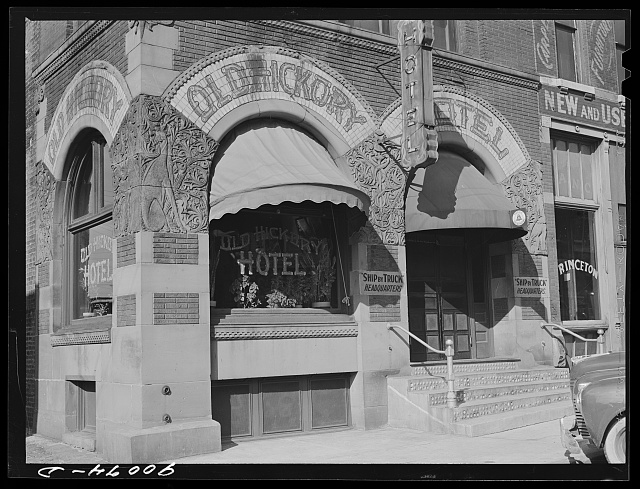
Stockmen’s and farmers’ and truckers’ hotel near Union Stockyards. South Omaha
They played hard
After a hard day’s work or big sell, men unwound bending an elbow at nearby gin joints. A few braced themselves before punching in each morning, like notable imbiber Claude Dunning, who is said to have drained a half-pint daily before the market even opened. “Some of the old guys would walk in the front of the building, make a left turn into the bar and get a drink of whiskey, then change clothes and off they’d go,” Stolinski says. “Most of the commission men had charge accounts in the bar. If you were a regular, they’d give you a second shot free.”
Fights inevitably broke out.
“They played hard,” Hatcher says, so much so the yard company cracked down. Still, there were ways, like riding in the caboose of a train shipping bulls to Chicago. Two men went along to see the bulls go watered and got tanked themselves on a case of beer. “We had fun,” Ryhisky says.
Other diversions ranged from regular craps and gin rummy games to sports betting. Once, the Stockyards took up a collection to bankroll local gin rummey king Art Jensen, a livestock trader, for a Las Vegas tournament. “They bought shares in him,” Jim Egan says. “He lost.” A good friend of Jensen’s was future Nevada gambling maven Jackie Gaughan, then a bookmaker, who allegedly used a livestock trading office as a bookie front. “You could get a lot of bets laid down there,” recounts Egan. Legend has it local stockmen sold cattle on a cash-only basis to one shady character back east who reputedly once brought a suitcase with $250,000. It’s said the fellow eventually ran afoul of the mob and was killed.
Francis “Doc” Stejskal, a former livestock commission salesman and later a packer-buyer, says people at the yards were not necessarily the raucous bunch many outsiders assumed. “I think a lot of folks thought it was rough and rowdy. That when business was over we all went down to some South Omaha cathouse. It wasn’t that way.”
Doris Wellman adds, “It was the wrong interpretation completely.” That’s not to say there weren’t establishments where women of ill repute rendered certain illicit services. “The dollies were in the Miller Hotel. The guys would take care of things there,” Harold Hunter says. “Big Irene” is said to have been a favorite among johns frequenting the whorehouses and clip joints comprising South O’s red light district.
Those who could not control their appetites were brought down. “Wine, whiskey and women ruined quite a few guys out here,” Ron Ryhisky contends. “I’d hate to have seen the casinos here back in the ’50s. We would have had a lot of broke men.” Adds Stolinski, “A lot of money was made and a lot of good men were lost to high living.”
But for most a big night on the town meant downing a few drinks and eating a hearty meal at Johnny’s Cafe, where stockmen had carte blanche. Many a farmer came to market with his family. While his stock was traded his family waited in the Exchange Building and later, fat check in hand, they went for a shopping spree. Philip’s Department Store was a favorite stop. In an industry that was a crossroads for people from nearly every strata of society – rural-urban, rich-poor – the Stockyards saw its share of memorable characters. Take Gilley Swanson, for instance. The stockmen say Swanson, a farmer, had such utter disregard for his own hygeine that he was infested with lice and slept in the yards’ hay manger. It got so bad, they say, that he was barred from the Exchange Building and people steered clear of his approach. Then there was Bernard Pauley, a mammoth shipper who overwhelmed his bib overalls and had a habit of stepping right from the feedyard into his latest Cadillac, soiling the interior. Forbidden from drinking at home by his wife, he went on benders in the big city, buying endless rounds for himself and his cronies.
Looks could be deceiving. A rancher might pass for a ripe vagrant after traveling by rail with his cattle, yet could pocket enough from one sale to pay cash for a new car and still have ample money left over. Eastern dudes passing through often didn’t know one end of a cow from the other, but knew balance sheets and some say the New York-based Kay Corp., which bought the ailing ards in 1973, simply wrote it off.
These are Stockyards people
Then, as now, money talked. For decades the Stockyards pumped the fuel powering Omaha’s economic engine. Sotuh Omaha owed its existence to the place. The Stockyards wielded power and commanded respect via the jobs it provided, the charitable works its 400 Club performed, the goodwill tours its members made and the boards its executives served on. This far-reaching impact is why stockmen feel such pride even today. “More than you’ll ever know,” says Ryhisky. As business there steadily declined the last 25 years the Stockyards saw its influence wane, operations shrink and grounds deteriorate. Now, with the City of Omaha practically running the Stockyards out of town and erasing any remnant of the past (although, as bound by law, the city is paying the relocation costs and commissioning a historic recordation of the site), it’s no wonder survivors feel forgotten and belittled.
Doris Wellman tells a story about Johnny’s Cafe founder Frank Kawa that sums up how stockmen were once regarded and would like to be remembered. “A group of us were having dinner at Johnny’s one evening years ago and the people nest to us thought we were a little too noisy, so they complained to Mr. Kawa. He told them. ‘If you don’t like it, get up and leave. These are Stockyards people. They built this place.'”
New Artist Residency Program at El Museo Latino supports the practice of local Latino artists
Omaha artist residencies for area visual artists are popping up with more frequency. That’s a welcome development in a city that for a long time pretty much only offered these opportunities to visiting artists, other than those grant funded residencies in schools and such, which left locals searching for residencies elsewhere. The Union for Contemporary Art and Carver Bank opened up the local artist residency scene here and now El Museo Latino has added to the mix. As any artist will tell you, it’s important to have local residency options because artists everywhere, including here, struggle finding access to studio space, equipment and venues to show their work. A residency typically addresses all those concerns, at least temporarily, by givng the artist a concentrated period of time to focus on their practice and to grow themselves personally and professionally. If nothing else, it exposes the artist and his/her work to new opportunities, communites and networks that might lead to commissions and patrons. The barriers to practice and exhibition artists face can be even greater for artists of color and that’s why the Union, Carver and Museo artist residency programs are potential game changers for participants. The Union program is undergoing some tweaking with the organization’s move to the Blue Lion this fall. The Carver is dormant as the Bemis tries figuring out its purpose. That makes Museo’s new program even more important. Two questions I’m sure many artists are asking are, Why aren’t more arts organizations stepping up to offer artist residencies and will the same old artists get the residency slots that are available? Another question which I know fr a fact has already been asked is whether the Museo residency will be opened to non-Latinos and to non-area residents in the future.
New Artist Residency Program at El Museo Latino supports the practice of local Latino artists
©by Leo Adam Biga
Originally appeared in El Perico (el-perico.com)
Artists are a diverse lot but a fundamental issue they all face at some point is finding space to practice their craft and showcase their work. The challenge can be greater for artists of color who may lack access to facilities and materials as well as to circles of influence. El Museo Latino is helping fill that gap with its new Artist Residency Program in support of area Latino artists.
The program builds on international residencies the museum’s hosted and it realizes a long-held dream of founder-executive director Magdalena Garcia to offer a residency for local artists.
Bart Vargas, Hugo Zamorano and Aaron Olivo, all of Omaha, comprise the first class. They will toil away at Museo in July and August during their two-month residencies. Garcia says each is at different stages in their careers and each works in different mediums. Supporting diverse artists where they are at and giving them a blank slate to create is the residency’s mission. So, too is exposing residents to seasoned art professionals with national and international resumes.
“We have a lot of talent and a lot of need in the local Latino artist community,” Garcia says. “It isn’t just about giving them the space, it’s about giving them the resources to develop their work. We want to provide them with a framework of opportunity and see where they can run with that.”

Bart Vargas
The most established of the three, Vargas, a University of Nebraska at Omaha art educator, says, “One of the things I hope this residency does is promote awareness of Latino artists in the Omaha community. We have a thriving art scene in the metro area, but I feel Latino artists, or for that matter artists of color, are quieter or not seen as much. I hope this residency brings more visibility.” He adds, “Space, materials and time to make art are all costs to the artist. Anytime an artist is given free space and financial support, it is a blessing.

Hugo Zamorano
Zamorano, a recent UNO graduate, says, “The experience will grow me in practice because I will have a space to work in outside of home. I will also be working alongside two great artists, which I think will be great for learning off each other and talking about art. I am currently working with Aaron (Olivo) on a mural at 25th and N in La Plaza De La Raza. I have never worked with Bart directly, so I am excited for that.”
Olivo says, “El Museo Latino has been a part of our neighborhood for a long time and I have always felt a connection as an artist and South Omaha native. I am by no means a studied artist. This is a first for me, so every aspect will help me grow. Just the environment alone will broaden my view as an artist as well as someone who works directly in the neighborhood.”
 A
A
Garcia has built in a mentoring component. Mexican artist, art educator and art administrator Humberto Chavez and president-founder of the National Museum of Mexican Art in Chicago, Carlos Tortolero, will share their expertise and experience about exhibiting and venues.
“Both guests will make studio visits with our resident artists and engage in discussions with them. Hopefully we can expand our network of working with other institutions as well as other artists,” Garcia says. “That’s a real plus with our residency. We’re not just giving you a place to work, time to work, and a stipend, but we’re trying to provide some other opportunities you wouldn’t necessarily be able to get otherwise.”
Garcia has a history of making Museo a conduit between local and visiting artists. Just last year she developed the exhibition Maiz with Museo de Filatelia de Oaxaca (MUFI), a postage stamp museum in Oaxaca, Mexico. Twelve local artists showed work alongside that of 10 Oaxaca artists. The theme of corn was chosen due to its importance to both Nebraska and Latin America. Prints of five postage stamps depicting different varieties of corn were selected from the MUFI collection and the artists created works inspired by the images. The exhibit ran five months here and traveled to MUFI last April, where it’s on view through September. Maiz is among many cross-cultural exchanges Garcia’s organized. Her opening doors for the international community of artists of Mexican descent earned her a lifetime achievement in the arts award from the Mexican government in 2015.
Her efforts include a long association with the well-connected Humberto Chavez, whose artistic relationships extend throughout Mexico. Those ties offer the possibility for Museo resident artists to get their work seen by wider audience. “That’s a huge window of opportunity for our artists,” Garcia says.,

Magdalena Garcia, ©photo by Bill Sitzmann
Other than showing up 15 hours a week, she says, “There are very few requirements with the residency. We’re giving them the freedom to create, to experiment and to explore as they see fit. We’re not demanding they have work ready to exhibit at the end. But we will accommodate their work when it’s ready.”
All three artists plan trying out new mediums or returning to mediums they used to practice in or to further projects already underway. Aaron Olivo echoes a shared sentiment by saying, “We are responsible for paving a path for artists here in South Omaha as well as the surrounding area” and for using the residency to its “full potential.”
Garcia expects the artists to be program ambassadors. It has already drawn interest from Latino and non-Latino artists around the nation, though for now it’s only for Latino artists living within a 70 mile radius of Omaha. She intends to expand the program to two or three rounds of residents in 2017. Applications for the next round open in January.
The residency is made possible in part by a $20,000 National Endowment for the Arts grant that marked the first time Museo applied for direct funding from the NEA.
“We were thrilled to receive that and hopefully people see it as a reflection of our growth and the continuation of what we started out to do 23 years ago,” Garcia says.
Visit http://www.elmuseolatino.org.
Marlin Briscoe – An Appreciation
Marlin Briscoe – An Appreciation
©by Leo Adam Biga
Some thoughts about Marlin Briscoe in the year that he is:
•being inducted in the College Football Hall of Fame
•having a life-size status of his likeness dedicated at UNO
•and seeing a feature film about himself going into production this fall

For years, Marlin Briscoe never quite got his due nationally or even locally. Sure, he got props for being a brilliant improviser at Omaha U. but that was small college ball far off most people’s radar. Even fewer folks saw him star before college for the Omaha South High Packers. Yes, he got mentioned as being the first black quarterback in the NFL, but it took two or three decades after he retired from the game for that distinction to sink in and to resonate with contemporary players, coaches, fans and journalists. It really wasn’t until his autobiography came out that the significance of that achievement was duly noted and appreciated. Helping make the case were then-current NFL black quarterbacks, led by Warren Moon, who credited Briscoe for making their opportunity possible by breaking that barrier and overturning race bias concerning the quarterback position. Of course, the sad irony of it all is that Briscoe only got his chance to make history as a last resort by the Denver Broncos, who succumbed to public pressure after their other quarterbacks failed miserably or got injured. And then even after Briscoe proved he could play the position better than anyone else on the squad, he was never given another chance to play QB with the Broncos or any other team. He was still the victim of old attitudes and perceptions, which have not entirely gone away by the way, that blacks don’t have the mental acuity to run a pro-style offensive system or that they are naturally scramblers and not pocket passers or that they are better with their feet and their athleticism than they are with their arms or their head. Briscoe heard it all, and in his case he also heard that he was too small.
After Briscoe swallowed the bitter pill that he would be denied a chance to play QB in The League after that one glorious go of it in 1968, he dedicated himself to learning an entirely new position – wide receiver – as his only way to stay in the NFL. In truth, he could have presumably made it as a defensive back and return specialist. In fact, he was primarily on the Broncos roster as a DB when he finally got the nod to start at QB after only seeing spot duty there. Briscoe threw himself into the transition to receiver with the Buffalo Bills and was good enough to become an All-Pro with them and a contributing wideout with the back to back Super Bowl winning Miami Dolphins. As unfair as it was, Briscoe didn’t make a big stink about what happened to him and his QB aspirations, He didn’t resist or refuse the transition to receiver. He worked at it and made it work for him and the teams he played on. The successful transition he made from signal caller to received is one of the most remarkable and overlooked feats in American sports history.
About a quarter century after Briscoe’s dreams of playing QB were dashed and he reinvented himself as a receiver, another great Omaha athlete, Eric Crouch, faced a similar crossroads. The Heisman Trophy winner was an option quarterback with great athleticism and not well suited to being a pro style pocket passer. He was drafted by the NFL’s St. Louis Rams as an athlete first, but ostensibly to play receiver, not quarterback. He insisted on getting a tryout at QB and failed. The Rams really wanted him to embrace being a receiver but his heart wasn’t in it and he loudly complained about not being given a shot at QB. He went from franchise to franchise and from league to league chasing a dream that was not only unrealistic but a bad fit that would not, could not, did not fit his skills set at that level of competition. Unlike Briscoe, who lost the opportunity to play QB because he was black, Crouch lost the opportunity because he wasn’t good enough. Briscoe handled the discrimination he faced with great integrity and maturity. Crouch responded to being told the truth with petulance and a sense of denial and entitlement. That contrast made a big impression on me. I don’t know if Crouch would have made a successful transition to receiver the way Brsicoe did, but he certainly had the skils to do it, as he showed at Nebraska. I always thought NU should have kept him at wingback and Bobby Newcombe at QB, but that’s for another post.
But the real point is that when the going got tough for Briscoe, he rose to the occasion. That strong character is what has allowed him to recover from a serious drug addiction and to live a sober, successful life these past two-plus decades. John Beasley is producing a feature film about Briscoe called “The Magician” and its story of personal fortitude will touch many lives.
Link to my profile of Marlin Briscoe at–
Link to my collection of stories on Omaha’s Black Sports Legends: Out to Win: The Roots of Greatness at–
OUT TO WIN – THE ROOTS OF GREATNESS: OMAHA’S BLACK SPORTS LEGENDS
Omaha South soccer poised for another state title run
The Omaha South High boys soccer program is a dynasty in the making. The only thing missing is a run of state championships. They have one, in 2013, and it came in record-setting, dominant fashion. There have been other state finals appearances, but so far that title three years ago is the only end of season, top dog bragging rights the Packers have been able to claim. Year in and year out for a decade now though the Packers are a threat to go all the way. This year is no different. This El Perico story I wrote appeared just as the 2016 state tourney got underway on Thursday, May 12. No. 3 ranked South expected to have it easy against wildcard North Platte but instead the Packers were extended to the limit before pulling out a 2-1 win. With the opening round win, South plays Saturday, May 14 against the state’s No. 1 ranked team, Omaha Westside, at Morrison Stadium on the Creighton University campus. It will be the teams’ first meeting this season. Should South win, the Packers will play for it all in the Tuesday, May 17 finals,, where they go up against their arch rival, Omaha Creighton Prep. But getting past Westside will pose a huge challenge. Then again, South seems to rise to the occasion more often than not.

Omaha South soccer poised for another state title run
©by Leo Adam Biga
Appearing in El Perico
The 18-2 No. 3-ranked Omaha South High boys soccer team is back in the state tournament a seventh straight time after winning the District A-3 championship at its own Collin Field on May 3.
South meets wildcard entry North Platte in the Class A quarterfinals on May 12. If the Packers win as expected they meet the winner of the Omaha Westside-Kearney match in Saturday’s semifinals. Westside is the top seed. The Packers and Warriors have not met this year. At state the only way South can face arch rival Omaha Creighton Prep, who beat the Packers in the regular season, is in the May 17 finals.
The state tournament is being played at Morrison Stadium on the Creighton University campus.
South topped Nebraska’s prep rankings the first half of the year and gained national bragging rights at the Smoky Mountain Cup in Gatlinburg, Tennessee. The team went unbeaten there to win its division. Back home a 3-2 loss to Millard South at the Metro Conference tournament, followed by a 1-0 setback to Prep, knocked South from the No. 1 perch. Inconsistent play nearly cost South more games.
“I feel when we got back from the mountains and the big emotional ride of that the kids’ legs were definitely tired and some of the kids were mentally tired, too,” Coach Joe Maass says. “We struggled a little bit.
We’d impose our will on a team and then kind of let up and let them come back. The Northwest game right before districts we were up 3-0 and they came back to make it 3-2. We won 4-2 but it wound up being a closer game than it should have been.”
In his team’s two losses and in several close calls Maass expressed frustration with South’s tendency to settle for long balls instead of playing to its midfield strength and controlling possession. South won its own Van Metre Invitational against a tough field but then scuffled in its last two regular season games before regaining form and swagger in district play. The Packers avenged their loss to Millard South by beating the Patriots 2-0 for the title.
“When we got to districts we were a little more focused, like we were in a must-win situation. Whenever our backs are against the wall is when our kids play the hardest and we’re the toughest.”
As has happened all season, South’s quality depth made the difference. Regular goalkeeper Luis Gama, a senior, missed districts due to injury but his backup, sophomore Adrian Felix, pitched two shutouts, including several outstanding saves against the Patriots. Midfielder Poe Reh had scored three goals all season before districts but netted four in back to back games.
Maass praised Felix for rising to the occasion, adding he always had confidence in him. He wasn’t surprised by what Reh did, either.
“Poh Reh was probably one of our better practice players during the season. In the games he would come close to making big plays but maybe didn’t have as much luck as some of the other players. But he’s been really a solid player throughout and then he just got hot that weekend with four goals in 24 hours.”
Through the 2016 campaign, even late in the season, Maass brought up several players from South’s dominant freshman, sophomore, JV teams. The late additions all made contributions. He says players are prepared to enter the bigger varsity stage by intense competition at practice. “In practice they’re competing on a level as if it’s a game.”
Individual and team expectations run high through the program.
“Our culture is based a lot on just belief that we can win every time. We are expecting to compete and win. It’s not good enough to just play on the team and walk around in your jersey in class. It’s about getting Ws.
You have to earn your spot and you have to maintain your spot.”
That winning mindset, he says, is “hard to beat.” “In Tennessee we were down two goals one game but we came right back and scored two and ended up winning. We just have the belief we can come back at all times. We beat Papio South in the 87th minute. We beat Omaha Central in the 99th minute in overtime.” He says it helps to have a senior-laden team. “They’ve played together for a long time.”
Then there’s South two sets of twins who demand excellence. “These four kids are very competitive, feisty and aggressive and they expect everybody else to play aggressive. Jimmi Becerril in particular. He’s the verbal guy that will get on people for not practicing as hard as they should. His brother Jordi is tough as nails but a little more soft spoken. But he pushes the pace as well. The other twins, Israel and Issac Cruz, are our defensive specialists and those guys have been really solid.”
Maass feels South’s poised for a good run at state. “We’re playing confident. We’re going to go just do our thing.” Adding to the confidence is that Morrison Stadium’s large field mirrors South’s home Collin Field.
“Our game is built around using the whole field and space to get around other teams’ size and athleticism. Once we get them out in space where they have to actually have skill on the ball, we have the advantage. A lot of teams just pack it in and hope to keep us out, playing for a shootout, because they know they’re not going to beat us if they play us straight up. It’s harder for teams to bunker in on a big field because there’s still space there.”
Having a team with a community behind it the way South does sure helps. “I know we’ll bring a lot of fans – we always do,” Maass says.
Keeper Luis Gama is expected back for state. His return could be key as Adrian Felix will miss the opener serving a one-game suspension for a red card violation in districts. No sweat for Maass. He feels secure in a third keeper he has ready, Fredy Nava. “He’s pretty good, too.”
At South, it’s always next man up.
South High soccer keeps pushing the envelope
When this story I wrote about the Omaha South High boys soccer team was originally published the second week of April in El Perico, the then-unbesten and top ranked Packers were freshly returned from winning their division at a national tourament in Tennessee. They were heading into the Metro Conference tourney with great confidence. But the Packers got upset there by Millard South and then dropped a second match to Omaha Creighton Prep a week and a half later. Having seemingly lost their momentum, they quickly regained it by winning their own Van Metre Invitational against a tough field and then dominating the A3 District playoffs, taking the title in a rematch with Millard South that the Packers won 3-0 to send the school to its seventh straight state tournament. I’m working on a new story about the team to preview its prospects for the tourney. Nothing’s ever a gimme in sports, but these Packers have overcome lots of injuries, including the loss of their goalkeeper late in the year, and then righted the ship after that mid-season swoon. Their depth and resiliency may be what leads them to the finals and a shot at the program’s second state championship. I would not bet against them.
As this story alludes to and as my profile on Coach Joe Maass from last year mentions more explicitly, South soccer has earned national attention in recent years as one of the country’s best high school squads. It’s also been singled out on the national stage for being part of a turnaround in South Omaha that is Hispanic-led. My new story and any subsequent stories I do on the program will continue this thread because it is at the heart of the bigger story that South soccer’s success represents. Somehow I missed until just now that the program got featured in Sports Illustrated in 2015. The feature is part of a larger series on the changing face of sports in America, as demographic shifts compel changes on and off the field at every level of sport. Titled “American Dreamers,” the article highlights the Packers’ journey from an after thought to a perennial power. It also looks at the ongoing transformation of South Omaha and South High and how this immigrant community takes great pride in their soccer team and the impact it’s had across the state. After South cemented its elite status by beating arch rival Omaha Creighton Prep for the 2013 championship players wrote to then-Nebraska Governor Dave Heineman asking him to work to help improve the lives of those in their community. The story also highlights “new life” at Omaha South, including an energized community and recent academic achievements.
South High soccer keeps pushing the envelope
©by Leo Adam Biga
Originally appeared in El Perico

Since capping a rebuilding effort with the Class A state title three years ago, the Omaha South boys soccer team now looks to new challenges.
South didn’t repeat after winning it all in 2013 but seeks getting back to the finals this year. A new goal became seeing how it stacks up versus top teams from the Southeast in the April 1-3 Smoky Mountain Cup in Gatlinburg, Tennessee. South, the No. 1 team in Nebraska and the No. 7 team in one national rankings, went 3-0 to win its eight-team bracket. The Packers played their best soccer to cement their own elite status.
“We went into uncharted territory to see how we measure up with other states,” Coach Joe Maass says. “We played against some of the best and did well and won, so maybe that shows Nebraska soccer is a little bit better than people would give it credit for on a national level. We didn’t just represent South, we represented the state of Nebraska. Our club teams go to national tournaments but we’d yet to see a hIgh school team do it. The fact we broke through is huge.”
Before the trip Maass expressed concern over how him team would fare with opening round foe Farragut (Tenn.) and its two Division I recruits and senior-laden roster. But South overcame a 2-0 deficit to force a shootout and won the kicks 5-3 to advance. In another comeback South beat McGill-Toolen (Alabama) 3-2 in the semifinals. In the finals South beat Station Camp, (Tenn.) 3-0 for the division title.
It was an impressive showing for a team Maass had openly questioned despite heading to the event unbeaten. He complained South was “winning” ugly and “not finishing” at the net though he did like its ball possession, defense and depth. Sweeping three unfamiliar opponents brought the team closer to the potential Maass sees for it.
“I think we came together, especially offensively.”
In what he called South’s “biggest team effort” to date, he felt his players finally began “to figure out their roles.”
Due to some key injuries South needed more players to step up besides leading goal scorer Alvaro Elizarraga and points leader Jimmi Becerril, and more players did.
“Juvenal Jacinto had a hairline fracture in his foot and was slowly trickling back in, but when we played McGill-Toolen he scored a really nice goal. He was really productive throughout the whole weekend. We brought up a JV player who had never even played in a game and he scored a goal against Farragut. He showed his ability to be productive up top as well.
“Our second or third leading scorer Ernesto Perez didn’t travel due to a hamstring, so it was really nice to see we have other options out there. I’m more confident in a few more players. Our depth showed. When somebody gets hurt, like Ernesto, it’s a huge loss but I think other teams would be hurting more.”
In addition to new contributors. Gatorade Player of the Year finalist Elizarraga scored three goals and steady hand Becerril had a big weekend scoring and assisting.
Maass says, “I think this year’s team is maturing. Our freshmen and sophomores are pressing for varsity time, so every day is a competition at practice. When we started the season I don’t think the younger kids believed they could actually get to the varsity level. Well, we’ve had some kids do that, so now they’re starting to believe. Every day in practice has been more of a battle than I can remember. I would say depth-wise we’re sitting pretty close to as good as we’ve been. That’s eventually going to get us closer to the state championship.”
He says besides the confidence boost that came with winning, the trip afforded “team-building” benefits.
“The overall experience of everybody going down and spending a few days together, riding around in a bus and sleeping in a cabin, it kind of covered everything you need to build a strong program behind the scenes,” he says. “It was almost like going on a retreat. It pulled us together like a family.”
“And the fact that we won reinforced everything. It might actually propel us into the end of the season.”
He adds that the chance “to experience life in a different area” was special. “None of our kids had been to the Smoky Mountains. It’s not like we’re a school with a bunch of rich kids that can just pile up and go somewhere. It was really a great opportunity for a school like ours.”
Maass felt better about his team coming out of the Smoky Cup and going into the Omaha Metro Tournament ahead of a key home contest with rival Creighton Prep on April 19. Then South hosts its four-team Van Metre tourney April 22-23 before closing the regular season on the road. Then its districts and a presumed date with state.
“Everybody assumes were No. 1. It makes the target always on us. When I started 17 years ago we were a bad team, so opportunities then were just to get our kids playing club. Now it’s progressed so far that we’ve won a state title and a national title. To me, winning the Smoky Cup was just another thing pushing the envelope.”
With South High boys basketball finally winning state, the school now has two championship-level teams that came from nothing. Only he and South hoops Coach Bruce Chubick know what it took to get there.
“Go back 10 years and you would see both programs were not built overnight,” Maass says. “Until you have done it, you really can’t understand the day-to-day challenges and stress. It takes a different type of personality to stay the course when things are going bad and there are setbacks. You do it because it’s about the kids being successful in life. In some cases, our programs create avenues-opportunities that can save the hardest of individuals.”
Yolanda Diaz success story with Little Miss Fashion nets her new recognition
One of Omaha’s most successful fashion designers, Yolanda Diaz, has earned many accolades for her Little Miss Fashion designs and for her entrepreneurial spirit. She was recently honored in Omaha and at the White House in Washington D.C. as Nebraska’s Small Business Person of the Year. Her story of perseverance and persistence is one we can all learn from. Her story also reminds me that the most commercially successful artists, in her case designer, are very entrepreneurial and must be in order to make a go of it. Through a lot of hard work she has mastered both the creative side of her work along with the business side. Most artists or creatives fail on the business side of things. She has been determined to not let that happen.
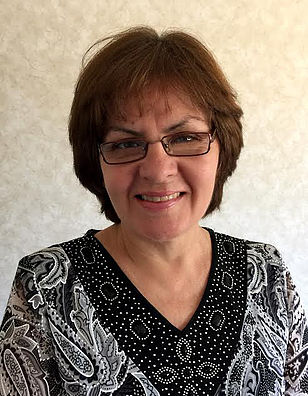
Yolanda Diaz
Yolanda Diaz success story with Little Miss Fashion nets her new recognition
©by Leo Adam Biga
Originally appeared in El Perico
Yolanda Diaz dreamed of being a fashion designer growing up in Monterey, Mexico. Living in poverty far from any fashion capitals, it seemed an unrealistic aspiration to some. Not to her. She actually realized her dream in Mexico and then did so all over again in America. Her clothing manufacturing company in South Omaha, Little Miss Fashion, has become such a success that she’s been named Nebraska Small Business Person of the Year.
The recognition comes from the U.S. Small Business Administration. Diaz will accept her award at May 1-2 ceremonies in Washington D.C., where she will be joined by other state winners. The 2016 National Small Business Person of the Year will be announced then.
She is also being honored May 3 at the Nebraska Small Business Person of the Year Award Luncheon and Entrepreneurial Workshops at the Salvation Army Kroc Center at 2825 Y Street. The 8:30 a.m to 12:30 p.m. event is free and open to the public. Registration is required. Call 402-221-7200 to register.
This is not the first time Diaz has been singled out for her entrepreneurial achievements. Her story has captured the imagination of business organizations and media outlets since 2011. Still, this newest recognition was not something she expected..
“Honestly, it surprised me,” she says. “However, I feel very happy. Even though my business has not grown as fast as I would like, it has grown in ways I didn’t expect. I have been working hard for years and I think the award is recognition not just for me but for all the people who work hard like I do in the community. There are a lot of people around me working hard and there are institutions and organizations helping me.
“It is an honor for me to have the opportunity to get this recognition.”
Aretha Boex, lead center director for the Nebraska Business Development Center, nominated Diaz for all that she’s done to find success. “She is hard working to the core. Her tenacity and her drive is very contagious. When you work with someone like her you buy into their passion and their idea,.” Boex says. Boex’s admiration grew when she discovered Diaz has mentored women at the Latina Resource Center and trained correctional facility inmates to sew. “She cares and she’s really out there to make a difference.”
Diaz’s children’s collections are sold online through Zulily and Etsy and in select boutiques. The business has seen ups and downs and she’s learned many hard lessons, but through business workshops and loans she’s grown her operation to where she now employs nine people. Her husband and son also assist.
She says news of the award is encouraging her local network of English-as-second-language entrepreneurs.
“They say, ‘Well, one day I will be in the same place as you,’ and I say, ‘You can do it, you will. If you work hard you will get the recognition one day.’”
Boex says there’s plenty in Diaz’s story to inspire others. “She’s a woman who built her business from the ground up. She moved here from Mexico to pursue the American Dream. There’s a lot to take away from her experience and how hard work really pays off. She had the resilience and the courage to build this from scratch. She’s a great success story. We love working with her.”
Diaz’s road to success began in Mexico, where she learned to stitch on an antique sewing machine.
“I really loved doing it, I fell in love with fashion because it gives me everything I want. ”


Marta Chavez (front) and Dolores Diarcos (back) working at Little Miss Fashion

Diaz holds her best-selling Little Miss Fashion design.

Diaz hopes to move Little Miss Fashion production into a location nine times larger in the near future.

(Diaz, owner of Little Miss Fashion LLC, Janell Anderson Ehrke, GROW Nebraska CEO, Laurie Magnus Warner, Central Plains Foundation Board Member)
From an early age she began making her own school apparel from old clothes and fabric scraps. Her ever-changing personal wardrobe drew much attention. Her dreams were encouraged when her talent was identified by a mentor who became her first client and referred other clients to her. Diaz even landed a contract to create school uniforms.
She steeped herself in her craft and built a successful business, learning from seamstresses and studying at design schools. Her business thrived but her then-husband didn’t support her pursuits. That proved frustrating to Diaz. who self-describes as “very independent.” After she and her family came to the States in 1996, her first marriage ended. She remarried and worked regular jobs searching for her niche here. She made pet tents before making children’s clothes. She started her company in 2003 under a different name, at first targeting the Latino market before expanding to the Anglo market. Along the way, she’s participated in the micro loan program Grameen America and taken classes at the Juan Diego Center, the Nebraska Business Development Center (NBDC) and Gallup University.
“She built her business while she had a night job, fulfilling all the orders herself, cutting and assembling by hand, which meant long hours, in addition to having a family. So she really believed in this,” says Boex.
A regular designer at Omaha Fashion Week, Diaz showed a collection that sparked interest from Zulily. The onset of online sales orders forced her to outsource production to Mexico, where family members pitched-in. Now everything’s done in-house in Omaha. An SBA microloan from the Omaha Small Business Network provided working capital to grow her business enough to meet large orders. Little Miss Fashion now averages $10,000 sales a month from online orders. Last May Diaz received a second SBA microloan through Nebraska Enterprise Fund. The loans allowed her to buy additional commercial sewing machines, purchase materials and hire more workers. She gets ongoing management consulting and export support from NBDC. Diaz recently sealed a deal to sale her clothing lines through the German e-commerce company Windelbar.de.
Every step of her journey, from improving her English to learning how to write a business plan to doing budgets to managing employees, has helped her succeed.
“I like challenges. I never say never,” she said. “A lot of work, but a lot of fun. I still learn something new every day.”
True to her entrepreneurial spirit, Diaz envisions growing into more markets, a larger production facility and her own retail shop. But for now, she’s content knowing she’s “doing what I’ve wanted to all my life – I’m following my passion.”
Follow Little Miss Fashion on Facebook or visit http://littlemissfashionusa.com/.
Talking it out: Inclusive Communities makes hard conversations the featured menu item at Omaha Table Talk
My, how Omaha loves to talk about race and then not. Everyone has an opinion on race and the myriad issues bound up in it. Most of us save our opinions on this topic for private, close company encounters with friends and family. Only few dare to expose their beliefs in public or among strangers. Inclusive Communities organizes a forum called Omaha Table Talk for discussiing race and other sensitive subjects in small group settings led by a facililator over a meal. It is a safe meeting ground where folks can say what’s on their mind and hear another point of view over the communal experience of breaking bread. I am not sure what all this talking accomplishes in the final analysis since the people predisposed to participate in such forums are generally of like minds in terms of supporting inclusivity and respecting diversity. But I suppose there’s always a chance of learning something new and receiving a if-you-could-walk-in-my-shoes lesson or two that might expand your thinking and perception. For the voiceless masses, however, I think race remains an individually lived experience that only really gets expressed in our heads and among our small inner circle. But I suspect not much then either, except when we see something that angers us as a racially motivated hate crime or a blatant case of racism and discrimination. Otherwise, most of us keep a lid on it, lest we blow up and say something we regret because it might be misunderstood and taken as an insult or offense. The dichotomy of these times is that we live in an Anything Goes era within a Politically Correct culture. Therefore, we are encouraged to say what is on our mind and not. And thus the silent majority plods, often gitting their teeth, while talking heads let out torrents of vitriol or rhetoric.

Talking it out: Inclusive Communities makes hard conversations the featured menu item at Omaha Table Talk
©by Leo Adam Biga
Originally appeared in the January-February 2016 issue of Omaha Magazine
When Catholic Charities of Omaha looked for somebody to take over its open race and identity forum, Omaha Table Talk, it found the right host in Inclusive Communities.
Formerly a chapter of the National Conference for Christians and Jews, the human relations organization started in 1938 to overcome racial and identity divisions. While the name it goes by today may be unfamiliar, the work Inclusive Communities does building bridges of understanding in order to surmount bigotry remains core to its mission. Many IC programs today are youth focused and happen in schools and residential camp settings. IC also takes programs into workplaces.
Table Talk became one of its community programs in 2012-2013. Where Table Talk used to convene people once a year around dinners in private homes to dialogue about black-white relations, under new leadership it’s evolved into a monthly event in public spaces tackling rotating topics. Participation is by registration only.
The November session dug into law enforcement and community. The annual interfaith dialogue happens Jan. 12. Reproductive rights and sex education is on tap March 22 and human trafficking is on the docket April 22,
The annual Main Event on February 9 is held at 20 metro area locations. As always, race and identity will be on the menu. Omaha North High Spanish teacher Alejandro García, a native of Spain, attended the October 13 Ethnic Potluck Table Talk and came away impressed with the exchanges that occurred.
“I had the opportunity to engage in very open conversations with people that shared amazing life stories,” he says. “I am drawn to things that relate to diversity, integration and tolerance. Even though I think I have a pretty open mind and I consider myself pretty tolerant I know this is an illusion. We all have big prejudices and fears of difference. So I think these opportunities allow us to get rid of preconceptions.”

New IC executive director Maggie Wood appreciates the platform Table Talk affords people to share their own stories and to learn other people’s stories.
“It’s exciting to be a part of a youth-driven organization that’s really looking to make a difference in the world. It’s about putting the mic in people’s hands and giving them the opportunity to voice what they feel is important.
“What I think Omaha Table Talk does is really give us the opportunity to have conversations we wouldn’t normally have in a structured way that helps us to think about other people’s ideas. Nobody else in town is doing this real conversation about tough topics.”
“These conversations do not happen in day-to-day life, at least not in my environment,” Garcia says. “I see people avoiding these topics. They find it uncomfortable and they are never in the mood to speak up for the things they might consider to be wrong and that need to be fixed. If you don’t talk about the problems in your community, you will never fix them.”
“The really beautiful thing about Omaha Table Talk,” Wood says, “is it really brings about hope for people who see how more alike we are than different.”

Maggie Wood
Operations director Krystal Boose says, “What makes Inclusive Communities special is we are very good at creating a safe space. It’s so interesting to see how quickly people open up about their identities. Part of it is the way we utilize our volunteers to help navigate and guide those conversations.”
Gabriela Martinez, who participated in IC youth programs, now helps coordinate Table Talk. She says no two conversations are alike. “They’re different at every site. You have a different group of people every single place with different facilitators. We have a set of guided questions but the conversation goes where people want to take it.”

Gabriela Martinez
Wood says the whole endeavor is quid pro quo.
“We need the participants as much as the participants need us. We need individuals to be there to help us drive the conversation in Omaha starting around the table. We’re now looking at how do we put the tools in participants’ hands to go out and advocate for the change they want to see.”
She says IC can connect people with organizations “doing work that’s important to them.”
IC staff feel Table Talk dialogues feed social capital.
“We’re planting seeds for future conversations” and “we’re giving a voice to a lot of people who think they don’t have one,” Martinez says.
“It’s not good enough to just empower them and give them voices and then release them into a world that’s not inclusive and shuts them back down,” Boose says. “It’s our responsibility to help create workplaces for them that value inclusivity and diversity.” Martinez, a recent Creighton University graduate, says milllennials like her “want and expect diversity and inclusion in workplaces – it’s not optional.”

Krsytal Boose
Boose says growing participation, including big turnouts for last summer’s North and South Omaha Table Talks and new community partners, “screams that Omaha is hungry for these conversations.”
Organizers say you don’t have to be a social justice warrior either to participate. Just come with an open mind.
Main Event registration closes January 15.
The IC Humanitarian Brunch is March 19 at Ramada Plaza Center. Keynote speaker is Omaha native and Bernie Sanders press secretary Symone Sanders. For details on these events and other programs, visit http://www.inclusive-communities.org/.
Bruce Chubick builds winner at South: State title adds capstone to strong foundation
There have been far longer droughts than the one the Omaha South High School boys basketball program had suffered since its last state title in 1990. But it would be fair to say its hoops fortunes dried up for the better part of a generation before Bruce Chubick arrived as head coach about a decade ago. He’s turned what became a perennial loser into a winner. Under him South did everything to reach the pinnacle of Nebraska prep basketball with the exception of a state title – until last weekend. In Lincoln the Packers entered as the No. i rated and seeded team and like two previous times under Chubick they made it to the finals. But where in the past they came up short and had to settle as runner up, this time they finished the job and were the last team standing and cutting down the nets after they beat Fremont 59-50 in the championship game. The story is very similar to what has happened with the South High boys soccer program under coach Joe Maass, except he took over a program that had never had any success and turned it into a juggernaut. His teams did everything but win a state title until they finally broke through in 2013. I have written about Maass and the rebuilding program he engineered that’s made South High soccer a feel good success story. This El Perico story is my first time writing about Chubick and the success story he’s led with South High hoops. It feels good, too.
Bruce Chubick builds winner at South
State title adds capstone to strong foundation
©by Leo Adam Biga
Originally appearied in El Perico (el-perico.com)
Entering the 2016 Nebraska boys state basketball tournament, Omaha South head coach Bruce Chubick occupied the same spot his soccer counterpart at South, Joe Maass, found himself in a few years ago.
Maass built the school’s once dreadful soccer program to elite status. But among the high national rankings, multiple district championships and finals appearances, the one thing missing was a state title. Similarly, Chubick’s engineered a dramatic turnaround with South hoops but for all the on-court feats – a handful of state tournament appearances and two runner-up finishes – there was no state title to show for it. Maass and his program finally got that elusive soccer prize in 2013.
Now Chubick has closed the deal after South’s 59-50 win over Fremont in the Class A finals in Lincoln on March 12. The Packers finished 28-1.
South entered as the tourney’s prohibitive favorite and No. 1 seed after a 25-1 regular season in which the team outscored foes 69 to 44 on average. The only loss came to a top Colorado club at a showcase event in Grand Island. In Lincoln, the Packers displayed the athleticism that separates them from their in-state competition. At least three Packers are Division I scholarship commits and D-I schools are looking at a fourth. No one will ever know if South would have reached this pinnacle with another coach, but the record shows the consistent winning ways began under Chubick, who deflects praise to his staff. Among his assistants is his son, Bruce Chubick Jr., who played for him at Atkinson West Holt before playing at Nebraska.
The fact is the senior Chubick, who at 65 is old enough to be his players’ grandfather, has flipped programs wherever he’s coached in his 42-year career. He led former patsy Atkinson West Holt to a Class C-1 title. At his last stop, Council Buffs Abraham Lincoln, he turned a perennial loser into a winner. Just as Maass took the South soccer job when nobody wanted it, Chubick committed to a dead end basketball program with a losing culture. It seemed a bleak challenge. Only Chubick didn’t see it that way.
“I mean, they had nowhere to go but up as far as I could see,” he told this reporter on the eve of the state tourney. “Everybody thought it was a hopeless situation. But I saw it as nothing to lose and everything to gain,” he told another reporter.
He knew he could win there but he didn’t expect to qualify for state six straight seasons and to play in three finals in that same span.
“I don’t know I would have believed that if you told me that nine years ago.”
But raising programs from the bottom up is what he does.
“I don’t know, maybe it’s just my personality,” he said. “I used to build houses, so I guess maybe I’m a builder and that’s kind of my M.O. I come in and I try to build programs. Before South, I’d get ’em built and then leave, but I’ve kind of stuck around on this one. I like South O, I always have. It’s working-class, blue-collar type people, and that’s me, so it’s a good fit.”
Besides, he’s found a great student-athlete base there that includes kids who need the strong, positive male role model he provides.
“You know, I’ve been in the Sand Hills of Neb. and the cornfields of Iowa teaching and coaching. I started in the inner city at Tech (Omaha Technical High School). And then I came back to the inner city for this job. This is the most rewarding job I’ve had. I’m not sure when I was in the suburbs or in the farming communities I was helping kids, but I’m pretty sure we’re helping kids here, and that feels pretty good.”
He’s rarely had this kind of talent to build around. Several players have gone on to play college ball and there’s more talent in the pipeline. This year’s squad started four seniors but it’s most impactful player, Nebraska basketball pledge Aguek Arop, is a junior wing. He led South in scoring and teamed with his older brother Makoor to key a high pressure defense and high efficiency offense. They’re among many South Sudan natives to emerge as difference makers in hoops just as Mexican-Central American natives key South’s soccer resurgence.
“I’ve had some really good teams over the years,” Chubick said, “and three years ago here was the most talented team I’ve ever coached. Just tremendously gifted. That was a special bunch. They’re all playing college ball somewhere. But the chemistry wasn’t good. They didn’t really mesh together and they didn’t really like each other.”

He ranks his 2015-2016 Packers as “not very far behind talent-wise” from that earlier team but far ahead in terms of cohesion. “Their chemistry is great and they’ve worked hard to get to where they’re at.”
Point guard Monte’ McGary, signed to play wide receiver at South Dakota State, said, “I think the biggest thing is we all get along as a team. Everybody likes each other, so it’s really fun. The majority of us played on the same team starting in sixth grade and then we all came here. Even if didn’t play together, we all knew each other.”
McGary said the team’s tight bond is reflected in its unselfish play.
“When we’re at our best we’re all playing defense and just having fun sharing the ball, not caring who scores. We’re just out there playing.”
That’s just what South did, too, down in Lincoln.
The Packers’s baseline to baseline game wore down the bodies and the will of opponents.
Aguek Arop said it was text book South style ball.
“We move the ball, we attack, we force turnovers, we get deflections, all that. With great defense we get easy buckets off transition.”
Aguek and McGary said they were “very hungry” to finally bring a title trophy back to South. McGary spoke of wanting “to put our names in the history books.”
With the title now in hand, McGary said, “We’re happy for the program and the school. It’s really special.”
“It’s been our goal the last three years to be the last one standing,” Chubick said. “We came close last year. I don’t think there was any denying these guys. I just think they were on a mission and they weren’t going to let anything to get in the way.”

Omaha South forward Caleal Walker (23) shoots against Papillion-La Vista during the fourth quarter of a Class A boys state tournament semifinal at Pinnacle Bank Arena, on Friday, March 11, 2016.

Before the tourney Chubick praised guard Caleal Walker as the team’s “unsung hero,” adding, “He leads by example. You want a complete player that gives a hundred percent – that’s Caleal Walker.”
In the title game Walker flashed big time moves and dunks in scoring a game-high 20 points. He scored 56 points in Lincoln and was named the all-tournament team’s honorary captain.
Chubick added, “Then you’ve got Monte’, who’s steady at point guard, and Karlon McSpadden at wing. Aguek is probably the most gifted of all of them. He’s really special.”
The coach didn’t mention South big man and Iowa football recruit Noah Fant, who was in his doghouse. But the 6-foot-5, 220-pounder gave South a solid interior presence and physicality.
Chubick said, “They’re all humble, really good kids, fun to coach, fun to be around. I can’t imagine not being around them. They’ve sacrificed and done everything we’ve asked them to do and driven us crazy along the way, but they’re kids, they’re supposed to do that.”
He thinks enough of his players that when he suffered a heart attack the day of a late February road game versus Lincoln Southeast he decided against checking himself into the ER until after coaching the contest. “I didn’t want to quit on the players,” he said. The next morning a physicias inserted two stents to unblock arteries. The youthful Chubick, who stays in great shape and had no prior heart problems, said he now has “more energy” than before. He earlier survived a cancer scare and he deals with rheumatoid arthritis.
Arop said Chubick’s toughness rubs off on them. “For him to be able to fight through his heart attack, I mean it’s just a good example for us fighting through like fatigue, adversity.”
Chubick admits to being old-school but adds, “I try to stay current school, too. You gotta do both. The kids don’t want to hear stories all the time about this team you had 30 or 40 years ago. They cant relate to that, so we don’t go there.”
McGary said there’s no generation gap with this coach, who’s known to get animated on the sidelines.
“He communicates and relates to us really well. From the stands he can look kind of crazy but he’s really cool with us, we never have any problems with him, nobody gives him trouble or anything like that.”
If not for some ill-timed injuries and suspensions, South may be in the midst of a dominant run like Omaha Central went on in the early 2000s with six titles in eight years. Only Chubick’s “cut loose” some of his best players for violating team rules and school policies. If they’d played, perhaps South would be celebrating a dynasty, too. “We’re an eyelash away from the same thing except we haven’t been very lucky,” he said. “Some of those disciplinary things we could have looked the other way and probably given ourselves a real good chance to win it, but I don’t want it that bad if you’re not going to do the right thing,”
With no major injury or disciplinary problems this season, he speculated South’s time had arrived, saying, “Maybe it’s all going to come together now.” Before the state tourney, he expressed confidence in his team’s ability to seize the moment.
“They’ve risen to the occasion every time except for one bad quarter. I’m not going to question whether they will or not this time. I’m pretty sure they’re gonna. The bigger the stage, the better they play. They love the attention. I hope this ends with a state championship, but if it shouldn’t work out that way I still think the world of these kids.”
Maneuvering his players like chess players in the South gym during a walk-through practice before heading to Lincoln, he told his team, “We’ll do what we do.” Code for: South’s up-tempo, full-court game will be too much for opponents.
Sure enough, South proved too much. After the nets were cut down, Chubick made it know he’ll be back at least one more year to make another run to Lincoln.
“I promised Aguek (Arop) when he came in I would stay until he graduated, so I want to keep my word, so I’m back next year anyway.”
Whenever he does leave, he’s secure that a foundation’s been built.
“It’s there. I think it’s kind of a turn-key thing for somebody down the road, but I’m going to keep her for awhile anyway – just as long as the health holds up.”


 Leo Adam Biga's My Inside Stories