

Nancy Oberst is one of those high energy, positive vibe individuals you can’t help but feel better for meeting or knowing, and that’s why it was a distinct pleasure working on two stories about her and her then work as principal at Liberty Elementary School in Omaha. This article for Medium Magazine appeared only months after the school was launched downtown in a former bus barn and still months away from moving into its then under construction dedicated school building down the street. The other piece about Nancy and Liberty appeared shortly after the new school building was complete and Nancy, her staff, and students finally took possession of a building they could call their own. The same enthusiasm and dedication I found the first time was evident when I caught up with her that second time. Nancy’s no longer at Liberty but the school she helped form and lead is still going strong. She and her husband Matt are living in the Washington D.C. area now, but their connection to this place remains strong, just as it does for their famous son, indie rock and Saddle Creek Records star Conor Oberst.
Nancy Oberst: Pied Piper of Liberty Elementary School
©by Leo Adam Biga
Originally published in Medium Magazine
Inner city public schools face a litany of challenges that cry out for dynamic, caring leaders willing to defy the low expectations set for their at-risk students. While Liberty Elementary School in downtown Omaha is better off than many of its counterparts, principal Nancy Oberst finds many issues to tackle there in her ebullient, high-energy, never-say-die style.
“Always looking for an angle” to give her fledgling, first-year school’s 400 largely disadvantaged students “a leg up,” she variously charms, prods, lobbies and cajoles “to level the playing field for our kids.”
“She is an advocate for her children like no one I’ve ever seen. I mean, if she wants something she thinks is best for the kids, she will get it. She is a woman of vision. She just really knows what she wants and she goes after it,” says Linda Daly, a Liberty reading-ESL specialist who followed Oberst from nearby Jackson Academy.
The 49-year-old Oberst is intent on making Liberty and the adjacent Drake Court, an historic apartment complex newly restored and occupied, the linchpin of an emerging 20th Street corridor some are dubbing Children’s Row. Liberty, the Omaha Children’s Museum, the YMCA and the Omaha Theater Company for Young People occupy a four-block strip from Leavenworth to Farnam. “We’re not only part of a new school,” Oberst says, “we’re part of a new community. That’s a big draw for us and a positive spin for the neighborhood. There’s a ripple effect going on with Liberty and Drake Court in terms of adding some stability to the area.”
For Oberst and staff, Liberty is not an assignment, but a mission. Temporarily housed in a renovated former bus barn while awaiting completion of a new three-story building down the street, Liberty serves a racially diverse, working-class student body drawn from downtown’s south side, an area once home to Italian immigrants and now a haven for Latino emigres.
An honor roll listing on a school bulletin board reveals Liberty’s ethnic flavor. Aside from Anglo names like Ruth, Sarah, Adam, Christa, Jenny and Tyler, most names, like Cesar, Wambli, Parisian, Andres, Misael, Juan, Indira, Jesus, Ebony, Shaquia, Dancingmoon, Hynalem and Hoa, reflect the large Latino presence and smaller black, Native American, African, Asian contingents. Oberst, the embodiment of Lady Liberty that stirs this melting pot, says, “There’s a beauty and a richness about a very urban group of kids.”
Alley-Poyner Architects-designed the open floor adaptation for the school’s warehouse setting, whose massive skylight and tall banks of windows bathe the place in golden light and whose cavernous spaces resonate with the sound of youthful voices. As many newly arrived students do not speak English, Liberty makes language arts and literacy its overriding emphasis, piloting the federally-funded Guided Reading program and employing ESL specialists in every classroom. Most staffers and paraprofessionals, like Legna Colon, are bilingual. Liberty also holds adult English classes. Children and families requiring extra support find in Oberst and Liberty a champion and resource center, respectively, attuned to their needs.

The old bus barn that served as Liberty’s first home
“Despite all the charges we have the one thing we are focusing on here is reading,” Oberst says, “because we believe reading is the key. If you can learn to read, math and science isn’t going to be that tough for you. We’re allowed to take the monies we get and buy supplemental books and resources that we feel as a school are going to make the difference with our kids, all the while knowing the goal is to catch up and be where everyone else is. I guess we feel a sense of urgency about what we’re doing. The needs are great.”
She knows the territory well from canvassing the neighborhood last summer, visiting many families’ homes, and from growing up in a working-class Omaha family herself. “We need to help children where the gap is wide and is getting wider. That’s why families come here (from Mexico, El Salvador) — to have a piece of the pie — and to invest in something for the future. That really is what America has been about. We want kids to feel their life is like everyone else’s and that there’s nothing that should get in the way. That’s really what public education promises.” Like the school’s namesake.
Getting past the barriers that cultural-language differences can pose is a matter of building trust. That’s why Oberst routinely has teams of educators make home visits and ensures that all school correspondence is printed in English and Spanish. She also sets a welcoming tone by insisting staff greet parents, holding informal coffees with moms and dads, inviting families to come to events at school — from community forums to special celebrations, like Cinco De Mayo — and encouraging staff to attend kids’ outside activities and even having kids over to their homes.
“It boils down to — How do you make people comfortable? Language is the key,” she says. “To engage people on their own terms and their own turf shows goodwill, respect and a real personalness. It heightens parents’ knowledge that we care and we want them to participate. We want parents to know they are valuable in this.”
Oberst, who takes predawn power walks to stay fit, is seemingly always on the move at Liberty. She hustles greeting the early-bird arrivals at first light and seeing-off the last stragglers at night. She’s outside, even in bad weather, supervising dismissal. She pops inside classrooms to casually survey things or to do formal observations. She’s a whirling-dervish presence at breakfast and lunchtime, seating kids, intervening in conflicts, confiscating contraband and picking up spills.
Displaying a warm paternal demeanor with kids, she makes a point of talking to them about their schoolwork and family. A daily ritual finds kids gathered around a mounted aerial photo of the Liberty hood, which Oberst turns into a lesson by having students identify their homes and area landmarks. Wherever she goes, whether eating with the kitchen staff or chatting-up teachers in the faculty lounge or sitting-in on meetings with the construction gang, she works her mojo as a cool schoolmarm for the new millennium who is down with today’s Generation Z hip-hopese. After all, one of her and husband Matt’s three sons is indie-rock musician Conor Oberst (known as Bright Eyes), who admires his mom’s compassion.
“She loves those kids so much. She wants to take care of them. She spent a good portion of her childhood not having very much, so she understands what it means to not have everything you need,” Conor explains. “Over the years there’s been kids she’s had special relationships with that she’s taken under her wing and had hang out with our family. She obviously has a great heart. She inspires me.”
Complicating the task of connecting with kids is the high mobility of families in the Liberty district — a mixed use ward of commercial-residential rental properties — that results in high student turnover. “Because we realize we’re not going to have them very long, we have to figure out ways to make kids feel welcome, comfortable and engaged,” she says. “We have to stay focused and be able, for however many days we have them, to make an impact.”
Oberst, who taught special ed before joining the administration ranks, makes clear just how much of a gap her students must overcome. “We don’t think many of our children have Internet access or even a computer or books in their home. For a lot of our kids we are their medical provider because families can’t afford a physician or lack health coverage. We’ve paid rent and utility bills and we’ve bought food for families in real desperate need.” Like at Jackson, Oberst has formed an emergency supplies cache to provide indigent families with everything from food and clothes to personal hygiene items. Liberty also acts as a referral center by directing families to social relief agencies.
Whatever obstacles kids face, Oberst refuses to lower student achievement goals because she feels that would send the wrong message.
“We can’t make excuses. We can’t say, Oh, this must be the reason why they can’t achieve. All that does is put people down and not encourage them to be what they can be. All of us have to believe in high expectations for kids” she says. “We need to always stay focused on what our real mission is and that is to make our kids competitive — to win as many awards as other kids. Recently, we took six children to the city-wide spelling bee and our children did very well. Two of them made it to the state competition. It’s all about where we think we can be. That we can have kids as competitive and that read as well as other kids. Our counselors tell them, ‘So what if English is not your first language? Don’t say you can’t, honey, look at what you can do — you’re speaking two languages. That’s even better…you’re even brighter.’”

The new Liberty
Attitude is everything with Oberst, who according to staffer Linda Daly infuses a “we-will-get-it-done” mantra at the school.
“She has such a positive outlook,” Daly says. “If you doubt you can do something she asks you to do, she’ll say, ‘Of course you can do that.’ Like anything else, there’s been growing pains, but Nancy will make it happen here, plain and simple.”
Oberst’s infectious enthusiasm, combined with her talent for networking, promoting and relationship-building, has brought in many benefactors, partners and extras for the school in terms of dollars, programs, in-kind services, supplies and opportunities. Her track record for eliciting support and for launching new schools in inner city environs, as she did at Jackson, is what led Omaha Public Schools Superintendent John Mackiel to tab her for Liberty.
“Her expertise in working with children and families of diverse backgrounds and educational needs, her experience in starting up new schools and her passion and love for creating school-community partnerships is what made her an excellent candidate,” Mackiel says. Then there is the long-stated desire of Oberst, who enjoys the process of “creating a school culture” from the ground up, “to be in an urban setting. That’s where I want to be. I’m a sort of in-the-trenches person.”
Typical of her pro activeness, she turned what could have been a negative at Liberty, namely the lack of a gym and stage, into a positive by forging ties with the YMCA and the Omaha Theater Company for Young People that allows students to access those facilities for recreation and drama.
With Liberty located amid a rough business district trafficked by street denizens and in what has become a major construction zone between the ongoing Drake Court renovation and work on the new school, safety issues have surfaced. She has largely quelled those concerns by working with the southeast Omaha police precinct and neighborhood associations to increase cop and adult safety patrols. As the new school begins taking shape, she intends on making the construction site an educational experience by leading groups of kids, in hard hats, to view the progress of Liberty’s future home.
Demographically-speaking, the future is now at Liberty, where diversity is not a buzz word but a simple reality. A tour is a multicultural immersion into an American microcosm — with brown, black, yellow and white faces commingling, colorful folk art hanging and Spanish and English phrases given life through singing, speaking and printing. Oberst embraces the heady brew of this ethnic stew. “I think it makes us all more worldly, more global, more able to really perceive the world as it is,” she says, “and to me that adds such richness and weaves such broader thought. We become bigger people. And I think that’s why diversity is a great experience for children to have. They learn to appreciate the differences in people.”
The next big thing for Liberty is the March 2004 opening of its new 600-plus student capacity building. In the neat symmetry of an old neighborhood reinventing itself, the warehouse Liberty occupies could see reuse as an arts-media center, the Drake Court may spur area renewal and the school should be an anchor of hope and a catalyst for change.
Oberst envisions attracting more students of middle-class parents, including those working downtown, thus bringing more economic diversity to the mix. “There’s a lot of excitement about the new building,” she says. “It will be more convenient than what we have here, but I think convenience is overrated, personally. It’s sort of fun to problem-solve.”
Always one to jones for challenges, she expects more as more students-in-need enroll. Despite “the great needs,” she says, “there’s also great joy” at Liberty. “Everyone just kind of gets pulled in.” Like the staffer who paid for a Statue of Liberty replica mounted on a pedestal outside the main offices. A fitting symbol for a school providing opportunity and for a headmistress embodying Lady Liberty herself.
The headline attached to this story is misleading, not because it’s untrue, but because it’s outdated. The headline reflected the facts when I wrote the story for The Reader (www.thereader.com) a few years ago, but since then Paul Bryant has left the Wesley House and the organization itself has disbanded. Indeed, there’s a story on this blog entitled “An Omaha Legacy Ends” and filed under the Paul Bryant and Wesley House categories that details the Wesley House’s closing after 139 years of service. Before that closure, Bryant led a revival of a once proud community center that had lost its way and its lustre. Bryant frequented the Wesley House as a youth, when it was a community force, but by the time he found success in the corporate world it had fallen on hard times. As this profile explains bryant left a corporate career to lead the nonprofit and to reinvent it as a youth academy of excellence. You will read about some of the great things he did there in a short time and about some of the dreams he had in store for down the line. In the end, the resources couldn’t match the vision. Paul is doing very much the same work he began at the Wesley House, only now through his own Leadership Institute for Urban Education. Paul is the author of the book, The Purpose Driven Leader.
NOTE: This blog also contains a story entitled “Artist Therman Statom Works with Children…” that profiles how the noted glass artist worked with youths from the Wesley House.

Paul Bryant
After steep decline, the Wesley House rises under Paul Bryant to become youth academy of excellence in the inner city
©by Leo Adam Biga
Originally published in The Reader (www.thereader.com)
Founded as the Omaha City Mission by the Christian Workers Association in 1872, the United Methodist Community Centers-Wesley House is the oldest social service agency in Nebraska. Traditionally focused on the underprivileged, the agency’s adapted over the years to target different groups, trends and needs among the poor. The Wesley House itself has seen hard times, but nothing like the financial quagmire that closed its doors the end of 2004 and start of 2005.
Since executive director Paul Bryant took over in May of 2005– leaving behind a career in banking — the agency’s gained a new lease on life as the Wesley House Leadership Academy of Academic and Artistic Excellence. While trying to get its house in order, it’s embarked on year two of a program to nurture high achievement among inner city children through tutoring, academic and life skills training and enrichment activities. Students are taught everything from small business and stock market concepts to good manners. Kids greet visitors with a firm handshake, direct eye contact and the words “Welcome to the Wesley House.”
The ACADEMIC Summer Academy targets boys ages 7 to 12. An after school program works with boys and girls, ages 7 to 12, over the school year.
In the spare conference room where he teaches a Business in the Boardroom class to 3rd and 4th graders, Bryant fits the exec profile with his crisp attire, tall frame and on-point demeanor. The fact he sounds like a banker, a brother and a preacher bodes well for building the broad-based support the organization needs.
In the Wesley House’s brick and glass building at 2001 North 35th Street the hope stirred by the new program is expressed in the eager faces, urgent voices and insistent raised hands of children vying for coveted blue blazers. Both a prize and a symbol, the jackets are reserved for students who demonstrate a grasp of business principles usually taught in high school or college.
Bryant puts the boys, many from single-parent homes, through their paces. Most are too small to rest their elbows on the table. “What’s the calculation for a balance sheet?” In unison, they answer, “Assets minus liabilities equals net worth.” “What about an income statement?” “Revenues minus expenses equals net income.” “When an asset loses value, what’s that called?” “Depreciation.” “What is it when it gains value?” “Appreciation.”
What may seem too dry or advanced is fun. “It’s structured, it’s cerebral, and they like it. They’re not bouncing off the walls,” he said. “This is a ‘Please’ and ‘Thank you,’ ‘Yes, Ma’am’ and ‘No, sir’ environment. There’s no sagging here. You’ve got to pull your pants up. There’s no cursing, no fighting. You can lose your privileges. That’s just the way it is, and we’re not apologetic about it.”
Holding kids to a higher plain is what it’s all about. Bryant feels so strongly about it that his son Paul (P.J.) attends the academy/after school.
“We’re changing lives,” he said. “I truly believe that. There’s a lot of programs that teach our kids how to score baskets and touchdowns and everything else, but we’re teaching them how to think and how to operate in the real world.”
A lifetime Omahan and a member of the storied Bryant-Fisher family that owns a long history of community service here, Bryant volunteered summers in an after school program operated by Wesley, located near where he grew up. He knew first-hand the positive activities offered there. When he heard about its problems, he felt “an obligation” to help rescue what’s been a community anchor.

“I said, ‘Not the Wesley House. Not another minority-managed organization going down the tubes on hard times. The Wesley House can’t go down’”
He applied for the job and soon left corporate America to head the troubled non-profit. “I was a leader looking for an organization and this is an organization that’s in dire need of some leadership,” he said. “My challenge is to bring this organization to its rightful place of prominence in this community.”
Eyebrows arched and tongues wagged when he left a Wells Fargo VP post to start from scratch with a tarnished agency whose vital signs read critical. He’s fine going from a sure thing to a long shot — and taking a pay cut — as long as kids succeed.
“My happiness really is not associated with money. Wealth isn’t the end all. It’s what you do. I’ve had dinner with President Clinton, I’ve had lunch with Colin Powell. I’ve had cocktails with Henry Kissinger. I’ve taken a seven-day cruise with Oprah Winfrey. I’ve been in Evander Holyfield’s house. My biggest client was Isaiah Thomas. I got no better feeling being in any of those circumstances than I do being with these kids here. When I see them get it. When I see them desire those blazers…I mean, they want ‘em. They want ‘em bad.”
Bryant, who holds master’s degrees in urban studies and urban education, is not an academic per se, but he professes to know what ails the community he calls home.
“I’m from this community. I’m a Bryant-Fisher. I don’t need to do scientific research to know what goes on. I see a culture floundering to find relevance in society post-Martin Luther King, Jr. How to fit into a society that really hasn’t found the value in who you are, and still be true to and proud of who you are.
“Somehow, we’ve got to a point in the inner city where black people think being smart is white behavior, and we’ve got to change that. This is a community that’s not identified by its talent. Ask anybody. Close your eyes and picture a junior high school African-American male. The mental picture you have isn’t going to be of a magna cum laude. But there is no correlation between intellect and income at birth. It’s a matter of what kids are exposed to. We’ve got to start identifying the success stories — the kids who like to read and write and learn science.”

He said the Gallup Organization surveyed the boys in last year’s academy and found some “have higher expectations than their parents. We want to raise standards, and we work with parents to do that.” He said post-testing revealed an increase in kids’ self-esteem. Anecdotally, the students seem to be doing better in school.
“What we want to do is expose inner city kids to cerebral activities and create an environment where it’s cool to be smart,” he said. “Our motto is, ‘Smart People Win.’ If you come here and pick up a book, nobody’s going to call you egghead and push you around and take your lunch money. If you want to write, we encourage you. We want the smart kids to know they’re not islands. We tell them, ‘If you stay in school and get good grades, you’re going to be at the top of your class and get a scholarship to college. And if you keep getting good grades, you’re going to get a good job. If you keep your nose to the grindstone, it’s really going to pay off.’”
Attitudes outside the inner city can get in the way, too, he said. “When I shared with a foundation president that I want these kids to aspire to Ivy-league schools, she told me, ‘Well, wouldn’t Metro (Metropolitan Community College) be more realistic?’” He knew he’d lost her, but he told her anyway that “kids at this age haven’t lost the game — they have the potential to succeed” anywhere.
His message has reached others. At a March 9 press conference he trotted out reps from many partnering organizations. Tutors from UNO, Creighton University, Metro and the Civil Air Patrol aid students with homework and “augment the educational process” with special training in math, reading, the arts, science, technology, etc. Kids display their handiwork in fairs and exhibits. They learn about different careers from professionals they meet on field trips or at Wesley. They track/trade stocks. Their summer garden project is also a small business venture.
A partnership with Mutual of Omaha has created the Technology Project, a pilot program to help bridge the digital divide. Mutual is to donate 60 computers annually to the Wesley House for use by kids in an on-site computer lab now under development and for ACADEMIC Summer Academy students to use at home.
If he can secure funding, Bryant envisions “keeping these kids together for 10 years. At that point, they’re going to be a group of smart young men that understand public and private sector finance and economics. They can truly help make north Omaha a vital part of the city’s growth and development, where we’re no longer the weakest link.” He has plans for early childhood and teen programs.
Opening an academy in an area associated with remedial and recreation programs is a bold move for an agency that appeared on its way out.
Before its recent change of course, Wesley House was providing services to youth in the state juvenile justice system. When juvenile justice staff expressed concerns over Wesley’s program outcomes and reporting methods, referrals made to the agency dropped. Soon, United Way raised its own questions about “the effectiveness” of Welsey programs and services. By 2003, all UW money was pulled. Wesley shifted to serving youth and families in the foster care system, but couldn’t bring in enough clients. With the loss of officials’ trust and of any steady revenue stream, Wesley exhausted $500,000 in reserves on operating expenses, saw its executive director resign and eventually let go all staff and shut down all programs.
Board chairman Dan Johnston confirmed closing the venerable institution was an option, but a decision was made “to give it one more good shot.”
By then, Wesley was decades removed from its days as a model community revitalization engine in the 1960s-early ‘70s War on Poverty. It was the agency’s shining hour. Money poured in and national recognition followed an array of initiatives to empower blacks. Then-executive director Rodney Wead led efforts that spawned a black owned radio station (KOWH), community bank (Community Bank of Nebraska), credit union (Franklin Federal Community Credit Union), minority scholarship program and an ethnic culture center. Later, north side redevelopment organizations led by Michael Maroney (New Community Development Corporation) and Alvin Goodwin (Omaha Economic Development Corporation) sprung up there.
Long before, the organization reached out to help youth, women and families living on the edge. One of 105 UMCC missions/institutions in the U.S., the agency began as a mission serving newly arrived immigrants then settling the Nebraska territory, one of many such shelters that grew out of the Progressive Area’s settlement house movement. Charged by a social reform agenda, these centers provided the types of programs and services then not being offered by government.
As the times dictated, the agency shifted its response. The early 20th century migration of rural families into the city, along with the growing Native American underclass and homeless population, became a prime focus. After years operating downtown, the local UMCC mission relocated to its present site in 1958, just a few blocks from Franklin Elementary School, and with the move made serving the area’s poor black residents a top priority. The neighborhood reflects north Omaha’s dual identity. While many low income families are stuck in a cycle of poverty and the area is run down by distressed houses and vacant lots, pockets of pricey new housing (Miami Heights) and resurgent business/service centers (the revitalized Lake Street corridor from 24th to 30th Streets) can be found.
Although Wesley receives some United Methodist church support, it’s long depended on most of its funding from the United Way and other public/private sources, leaving it vulnerable to the vicissitudes of donors.
Only 12 months into Bryant’s reign the center is still reeling from the aftermath of the United Way pull out. That severing meant the loss of not only hard-to-replace monies — some $300,000 worth annually — but the even more valuable endorsement that comes with UW support. Aware of how much stature Wesley lost in the eyes of the establishment, Bryant, a paradox of by-the-numbers-cruncher, deeply spiritual Christian and community-minded legacy-keeper, approaches his task to reinvent and redeem the agency as nothing less than a calling from above. To justify leaving behind a six-figure income with Wells Fargo (previous to that he was at Gallup and First National Bank), he’s put aside cold hard calculations and proceeded on faith.
“I am operating on faith every step of the way. My moves have not been thought out, studied and projected. When I accepted this job I didn’t have any staff. We had no revenues and a $40,000 debt I’d just found out about. I took a leap of faith. Quite frankly, I don’t have five-year projections. Right now, it’s a matter of survival for this organization. But, hey, I’m on a mission and I’m not too proud to beg,”
Bryant also felt it was time to give back. “I was at a point in my life when I was really looking for significance, and I felt this is what I’m supposed to do.” The agency’s bleak prospects gave him pause, but not enough to deter him. “I just felt pricked in my heart. Something’s got to be done, I thought.”
In short order, he introduced his new vision and set about restoring the agency’s good name. He promised to retire its $40,000 debt in a Biblically-inspired 40 days. He wiped out the deficit in 36 days. But getting there was never a sure thing.
“I can’t tell you how nervous I was. It wasn’t like I had some trump card up my sleeve. The fact is I didn’t have some big corporation in my hip pocket. I stepped out on faith and it happened. Just like this new direction we’re going. The largest contribution was $5,000. There was only one of those. There were several $1,000 donations. The rest was a whole lot of $500, $100, $25, $10 and $5 checks.”
The margin for error is still slim given the $20,000 in monthly operating expenses. “When I came, we had two weeks before our doors could be shut. Now, we’ve probably got a two-month cushion. We are not where we need to be but things are looking much better then they were this time last year,” he said. Another concern is the small number of children being served. Sixteen boys graduated last summer’s academy. Enrollment begins next week for this summer’s academy. A Summer Fun Club currently has 24 kids signed up. About 48 kids attended this past school year’s after school program. It’s not all about numbers, but as numbers go, monies flow. That’s why Bryant, who emphasizes recruitment is largely by word-of-mouth, hopes to see a spike in enrollees.
To bolster the financial footing, ensure continued operations and endow future growth, he hopes grant applications made to foundations and corporations pay off. Getting back in the UWs good graces is another goal. He’s also organized benefit events involving Omaha native and pro football Hall of Famer Gale Sayers and his wife Ardie, who are making Wesley House their official Omaha charitable cause. On April 28, a DVD big screen projection of the original 1971 made-for-television movie Brian’s Song was screened at Omaha Central High School’s auditorium. Bryant said the event raised about $2,000, enough for the agency to pay off a line of credit.

On June 19, the Gale Sayers Wesley House Classic is set for the Players Club at Deer Creek. Entries for the golf tournament sold out a month in advance. Among the celebrities expected to hit the links are National Baseball Hall of Famer Ferguson Jenkins, Heisman Trophy winner Johnny Rodgers, Cornhusker quarterback legend Jerry Tagge, the NFL’s first black quarterback in Marlin Briscoe, former NBA All-Star Bob Boozer and Creighton University head basketball coach Dana Altman. Tee-off is at 10 a.m.
Bryant knows public events like this can only do so much. Bottom line, he and the Wesley House must prove the agency is back to stay and demonstrate they’ve found a sustainable niche that others buy into. One indication he is there to say, is the new house he and wife Robin are building in the nearby Miami Heights development.
“It’s about longevity. There’s a lot of people who’ve heard about the bad recent history and they want to see if this is a flash in the pan. Will it still be here? Will I still be here? I can’t see going anywhere. I want to be part of the solution. I want to be a bridge-builder.” To bridge the achievement gap. The desired end result is summed up in the academy creed the kids recite from memory. It ends with, “Through self-discipline we will grow into adults of honor and integrity. Our legacy will be a source of pride to our families and communities.”
Ferial Pearson, the subject of this story for The Reader (www.thereader.com), is another individual I knew I had to write about as soon as I read about her work as a social justice-oriented high school English teacher, advocate, and adviser. Now she’s helping kids tell their stories in print. This winner of back to back national awards is up for another national honor. Here’s what she announced on Facebook about the latest recognition coming her way:
“I am the Nebraska Nominee and finalist for the NCTE/SLATE National Intellectual Freedom Award, sponsored by the Nebraska English Language Arts Council and National Council of Teachers of English. I will be honored at the Plum Creek Literacy Festival in Seward, Nebraska on September 24th during a luncheon with one of my heroes, Dr. Kylene Beers, and then in Chicago at the NCTE annual convention at the end of November, and finally at the Capitol in Lincoln on May 4th.”
Kudos to an educator making a real difference in the lives of students. There’s much more to her story, too, and I hope one day to tell more of her journey.
Ferial Pearson, award-winning educator dedicated to inclusion and social justice, helps students publish the stories of their lives
©by Leo Adam Biga
As published in The Reader (www.thereader.com)
Ferial (Mohamed) Pearson’s work with GLBT and other high-risk youths at South High Magnet School earned her the 2010 Gay, Lesbian and Straight Education Network‘s National Educator of the Year award and the 2011 National Education Association‘s Creative Leadership in Human Rights honor.
Pearson, now with the Avenue Scholars Foundation, continues her advocacy work among kids struggling with identity and self-esteem. As a persecuted Indian-Muslim minority in her native post-colonial Kenya and as an immigrant of color in America she knows first-hand the discrimination that comes with being The Other.

On Saturday, Pearson, 33, will reunite with former students at the Bookworm, 8702 Pacific Street, to sign copies of In My Shoes, a book the teens wrote about their real life challenges and secret hopes.
Published by WriteLife, LLC of Omaha, it features stories by 45 students from two English classes Pearson taught. This collaborative with Allison Rose Lopez and the Omaha Young Writers Project includes a foreword by Erin Gruwell of Freedom Writers fame. Omaha artist Watie White did the cover art. Lopez served as editor.
The students attended workshops led by Pearson and were assigned mentors from the community.
“The kids decided they wanted hope to be the theme,” says Pearson, a mother of two. “What gave them hope in their lives, what brought them to senior year when so many of them never thought they would make it. They also wanted to break stereotypes about kids in South Omaha and at South high. They knew they wanted to change people’s perceptions of who they were.”
Guided imagery sessions that asked kids to imagine their perfect day 10 years from now elicited strong emotions.
“It made the kids cry, and some of them refused to write anything down,” Pearson says. “They said they’re scared to hope for anything because it’s not going to come true.”
For a time, it didn’t appear there would be a book. “A lot of them wanted to give up half way,” she says. The kids stuck it out and their published stories pull no punches. “They have a lot of really hard things to share about what’s happened in their lives. Because of those hard things we didn’t put each student’s name with their story.”
The process proved an awakening for many. Some students have gone on to be published in local literary journals. She says Jesse Ortiz is an example. “When we started, he told me poetry is for girls, English is stupid, and I should just kick him out of class because he’s kicked out of every class, and he’s going to drop out anyway. Well, he’s been published several times now. He wrote the poem at the front of the book. He also wrote his own story.” Ortiz graduated and is considering college.
Pearson experienced an awakening of her own when she left Kenya for America to become the first in her family to attend college. At Gustavus Adolphus (Minn.) she met her husband, Dan Pearson, and was exposed for the first time to writers and educators of color like herself. “it kind of blew my mind. I realized when we don’t represent the lives of our students in the curriculum what we’re telling them very explicitly is that nothing you have gone through is valid and has anything of value.”

In My Shoes reflects her own intellectual emancipation and coming-of-age journey in claiming her own identity.
“That’s why I love the fact we wrote this book and why I’m teaching the Freedom Writers diary, because it explicitly tells kids, ‘you’re worthy.’ Otherwise, you’re devaluing an entire culture, race, religion, and what you’re telling students is that those people are not worth mentioning. It leads to ignorance and hate. So I think literature has a power.”
She says systematic, institutional, psychological, emotional, physical discrimination of gay, lesbian, bisexual, transgendered individuals “makes this the new civil rights movement and this needs as many people to fight for it as possible.” Her involvement extended to serving as faculty adviser for South’s Gay Straight Alliance Club and integrating GBLT literature in the classroom, which she now does at Ralston High and UNO, where she teaches an anti-bias human relations course.
She admires the courage kids display coming out and the compassion kids exhibit protecting peers from bullies. She’s crushed when harassed teens take their own lives. She says GSA is a haven for those with no where else to turn.
“When everyone around you tells you there’s something wrong with you, that you’re disgusting, that you’re going to hell, that everything you’re feeling is not normal…when you’re in danger of being kicked out of your house or your church or your circle of friends. and then you find out there’s this one room and this one group of people that will love you and accept you for whoever you are, no matter what, that’s hugely powerful.”
As an Avenue Scholars talent adviser she works to keep high-hope and high-risk teens in school and on track for college. Meanwhile, she’s organizing a second book, Breaking the Silence, written by GBLT youths across Nebraska.
The book can be purchased via writelife.com.
I wrote the following two pieces in memory of the late, much-beloved Omaha jazz artist Luigi Waites. I only met the man once and I only saw him perform a few times, but I knew a lot of people who knew him and his music well. I had always meant to do a full-blown profile of him but it just never worked out. These short recaps of his career will have to do. I wish now I had pressed forward in doing something with him. It’s a reminder that particularly with older subjects the time to interview them is now, because one never knows when they might be gone. And once gone, the wisdom of that elder goes with them.

©by Leo Adam Biga
Originally appeared in Encounter Magazine
The April 6, 2010 death of Omaha jazz percussionist, vibraphonist, band leader and music educator Luigi Waites brought an outpouring of tributes to this Classic Omaha Hep Cat.
Luigi, whose first name identified him for legions of fans, became an ambassador for jazz in his hometown of Omaha. Unlike the bombast of another local jazz icon, the late Preston Love Sr., Luigi was sedate. Contrasting personalities aside, these “brothers” came out of the same African-American social-cultural milieu to carve out careers.
The humble Luigi made friends wherever he laid down licks. It’s not surprising then his passing prompted memorials befitting a beloved hero. He touched innumerable lives with his timeless music and generous spirit.
Long ago divorced, the 82 year-old was survived by six children.
Wearing his signature floppy hat, Luigi exuded a Zen master’s inscrutable calm. His signature performance spot, Mr. Toad in the Old Market, lasted some 1,700 Sundays. Manager Rick Renn said what he’ll cherish most about Luigi is his “absolutely unique personality, adding: “He was just comfortable with everybody and he made everybody comfortable; he was one of these people who you met for the first time and you loved about a minute later; he was unusual, he was cryptic, he was always making you think.”
Whether playing a bar or festival, doing a school residency or giving private music lessons, Luigi was always teaching. Bandmates say he turned gigs into symposiums, encouraging an open exchange of ideas and approaches.
“You knew he was serious when you watched him play. You knew he was going, as the great ones do, into his element,. You’d sit and watch him on the vibes, the concentration on his face, but at the same time the fun he was having,” said Renn.
For years Luigi traveled the Midwest for the National School Tours program and Nebraska Arts Council. He provided music lessons, often for free, all over Omaha. His touring multicultural drum and drill corps, The Contemporaries, served at-risk kids. Professional side man and session player Arno Lucas credits his stint with the Contemporaries for saving him from the streets. He considered Luigi “a true mentor.”
For years, too, Luigi booked all the entertainment for the Summer Arts Festival downtown. He was also a clinician for Sonar, Trixon and Ludwig drums.
The lifetime learner never stopped being a student himself, whether teaching himself to play drums, later the vibes, or trying new things with his group, Luigi Inc.
He had some formal music training, courtesy a hitch in the U.S. Army and attending the Midwestern Conservatory of Music. Like many musicians of his era though he picked up his chops informally, traveling the country and Europe, but mostly in his hometown, where a vibrant live music scene back in the day saw him haunt the local night spots, sitting in on jam sessions galore and playing in various bands.
Luigi never lost his enthusiasm or curiosity. Late in life the amateur photography buff learned digital techniques from Omaha professional photographer Herb Thompson.
“He was always just very young at heart,” said Thompson, who mentored Luigi for a Nebraska Arts Council project that resulted in an exhibition.
Thompson said the only time he saw Luigi slow down was after the ailing musician underwent chemo treatments. The artist finally lost his battle with cancer, but till the end was making plans — for a new CD, for new photography projects.

A memorial service at Omaha North High School and the funeral at St. Cecilia Cathedral drew hundreds each.
“Neither of those was really a sad occasion, they were more a celebration,” said Thompson. “People just said how much they loved him, how much he meant to them. It was a cross-section of this city who celebrated the life of a man who had contributed so very much to his community. I don’t think there’s anyone in the black community of a certain age who hadn’t been touched by Luigi. Another thing that struck me is that it’s obvious he crossed racial barriers. It came out in almost all of the comments folks made at the tribute but also in the kind of racial mixture you had there.”
Playwright Monica Bauer can attest to Luigi gracefully defying social constraints. She was among many whites who took music lessons from him. In the 1960s he was teaching at Swoboda Music Center at 20th and Q. Few blacks worked in the heavily Czech area and despite some raised eyebrows from neighbors, owner Johnny Swoboda hired and kept Luigi, and the two became friends.
If anybody had objected to Luigi’s presence, Swoboda would have stood by his man. “We were buddies,” said Swoboda. “He made quite an impression on all kinds of people. It’s quite a legacy.” Swoboda’s children became the first white Contemporaries.
Bauer echoed the sentiments of many in describing Luigi as “a terrific music teacher” with a “kind and compassionate” manner. His students say he taught philosophical life lessons as much as music. She said she “learned how to be an artist” and a mensch from him. “Luigi always told me, ‘Be kind to everybody, and they will be kind to you.’ I took those words with me through two Ivy League degrees, three Master’s degrees, and a Ph.D.”
Her play My Occasion of Sin dramatizes Luigi’s social action of taking on white students in the racially tense ‘60s. He didn’t see it as making a statement. He was just being Luigi.

Luigi Gone But Not Forgotten
©by Leo Adam Biga
Originally appeared in The Reader (www.thereader.com)
As much as the music he made. the generous spirit of iconic Omaha drummer and vibraphonist Luigi Waites is likely be remembered even more. Waites died early Tuesday morning at Immanuel Hospital. He was 82.
His 70-year performing career encompassed much of the Omaha live music scene but extended well beyond his hometown borders. He’s perhaps best known for the more than 1,700 Sunday night shows he and his group, Luigi Inc., performed at Mr. Toad in the Old Market. Luigi was also a fixture at the Dundee Dell. As a Summer Arts Festival board member, he booked the event’s entertainment.
As early as age 12 he began playing drums and soon gigged at local nightclubs, where his mother served as his escort. He studied at the Midwestern Conservatory of Music in Chicago and worked as a clinician for drum manufacturers. He influenced many youths through the touring multicultural marching corps he formed in 1960, The Contemporaries. He applied R&B rhythms to the traditional military-style marching band aesthetic. Professional musicians Arno Lucas and Victor Lewis “graduated” from The Contemporaries.
In a 2007 interview Lucas spoke for many when he said “Luigi was the guy who made it possible for me to stay focused and to keep out of trouble.” Lucas recalled Waites as a “mentor, teacher, step-father.”
For decades Waites did artist-in-the-schools presentations.
His many honors included 1996 Nebraska Artist of the Year from the Nebraska Arts Council and 2009 Best Jazz Artist from the Omaha Entertainment and Arts Awards, which previously honored him with a lifetime achievement award. Waites was also inducted into the Omaha Black Music Hall of Fame.
The father of six leaves behind some recordings but mainly a legacy of teaching and sharing. He lives on in YouTube excerpts of his Mr. Toad shows.
Related articles

Mary Goodwin-Clinkscale
One of my favorite personalities from the last few years is Dr. Mary Goodwin-Clinkscale, who applies her passion for the Lord, for youth, and for the arts in a dynamic educational program she runs called the GBT Academy. She is its heart and soul, but she has a lot of help by a lot of people who believe in her and her mission, which is really a ministry. I spent some time with her and her staff and some of the young people they work with as the academy prepped for a fund raiser performance to help restore the auditorium that a vandal-set fire partially destroyed. I first became aware of the academy at a program that featured their recreation of a famous incident in late 1960s Omaha. The sheer energy and conviction the performers brought to the performance made me take notice. Then, a year or two later when I read in the paper about the fire and the academy’s intention to go on, I decided it was time I wrote about the program. I still hadn’t met Dr. Clinkscale or Dr. C as she’s called, but no sooner than I did then I realized she needed to be the focus of my story. Her commitment to the program is unwavering. I still want to tell an expanded story about her one day. But for now my piece below for The Reader (www.thereader.com) will have to do.
GBT Academy in Omaha undergoes revival in wake of fire
©by Leo Adam Biga
Originally published in The Reader (www.thereader.com)
Mary J. Goodwin-Clinkscale considers herself “a survivor.” That’s why when a June 29, 2008 arson fire destroyed the auditorium of the Greater Beth-El Temple, the black Apostolic church that sponsors her nonprofit GBT (Growing and Building Together) Academy of the Arts at 1502 No. 52nd St., she and fellow church officials resolved to rebuild. Proceeds from GBT’s July 2 7 p.m. Through the Fire program at the UNO Strauss Performing Arts Center will help refurbish the auditorium, now just a shell awaiting a new floor, ceiling and stage, plus seating.
The fire deferred the dream of turning the former Beth Israel Synagogue into the church’s new sanctuary and GBT’s new home. Services unfold at the church’s old 25th and Erskine site in the interim. Greater Beth-El purchased the abandoned 52nd St. property in 2004 in the largely white Country Club neighborhood. The church runs the academy along with after-school and day-care programs from the mid-town campus. The church’s extensive landscaping has transformed what was an eyesore into a showplace. Interior work to the pale brick building converted offices into classrooms and updated HVAC systems. Volunteers donate all the work.
Academy executive director Goodwin-Clinkscale — Dr. C — has built a dynamic, multi-media, Christian-based curriculum serving at-risk, school-age youths. Her staff conducts music, dance, drama, speech, creative writing, art classes. GBT members are known for their poise and enthusiasm. They really know how to project. Life skills are integrated into lessons. She coined the Academy’s mantra, “Through the performing stage to the stage of life,” and its mission “to equip youth with the character values of respect, discipline, teamwork, perseverance and leadership through diverse forms of artistic expression.” She said, “We’re trying to instill things that will take these children where they want to go.”
The neighborhood teens who set the fire aided the clean-up as part of their community service work. Dr. C said, “I really believe the kids are sorry for what they did.” GBT will dramatize the story of the fire and its consequences at UNO. “We’re trying to show that if there were more places like this, then youths would have a place to go after school,” she said. “Our plea is, Help us to help them. That’s what this is all about. We’re trying to offer a place of safety, of refuge.”
Assistant Ella “Pat” Tisdel said GBT provides avenues for kids to express themselves “in constructive rather than destructive ways. We’re seeing that if we can pull that creativity out of children it helps them to feel better about themselves and they actually do better in school.”
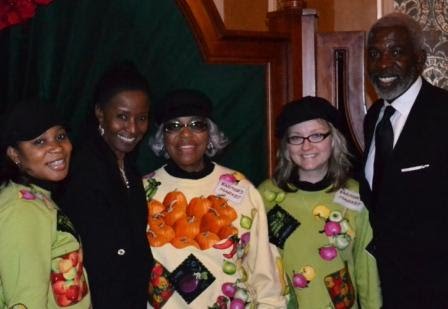
Mary Goodwin Clinkscale in the center
The Academy was incorporated in 2000 but Dr. C’s used the arts as empowering tools since ‘78. She produces/directs its energetic performances. Adults and kids collaborate on script, choreography, music, set design, costumes. African-American themed programs, some secular, others predominate. Performers as young as 6 share the stage with 20-somethings. Her five sons are GBT grads, including veteran television actor Randy Goodwin (Girlfriends). He’ll be back for the show along with special guest, stage/film/TV actor Obba Babatunde (Dreamgirls original cast).
Dr. C’s showcased GBT’s diverse talents at such high-profile gigs as the Holiday Lights Festival, Omaha Entertainment Awards and Omaha Black Music Hall of Fame. In 2006 her troupe performed a Tuskegee Airmen tribute in Milwaukee, Wis.
For this proud matriarch, the UNO show’s title refers not only to GBT rising-from-the-ashes and the arsonists finding redemption but to her own crucible. She was a high school drop-out and married teenage mother before turning her life around. A daughter of Arkansas sharecroppers, she worked the fields in the Jim Crow South, picking 300 pounds of cotton per day at age 10. “It takes a lot of cotton to weigh 300 pounds,” she said. She endured the back-breaking labor. Anything that doesn’t kill you makes you stronger, she believes.
She survived segregation and poverty. “I’ve always wanted more in life because we had nothing,” she said. She survived a fire to her family’s home. She was living with her grandmother then — her mother and uncles having gone to Omaha to work packinghouse jobs. After the fire Dr. C’s late mother brought her here, where she grew up in the Spencer Projects. She learned tough lessons from her Big Mama, a cook at the old Paxton Hotel downtown. “I got my work ethic from her.”
Dr. C earned her GED at Metropolitan Community College, where she won a scholarship for continuing education. “I went from there and started doing things.” Doctorates in theology and organizational administration from the International Apostolic University of Grace and Truth in Columbus, Ohio followed.
Her academic and youth ministry achievements only came after a born-again experience at Greater Beth-El in 1974. She was adrift then, without a church. “I just didn’t know what direction to go and the Lord led me to these people here,” she said. “I’d been looking for a church that offered something more than fashion or just a place to go hang out. I wanted truth.” She found it. “Before, my life didn’t have any meaning. There was no purpose until I came to the church. That’s when my life really began.” After being baptized she assumed lay leadership roles.
She was inspired “to implement” the teachings of her pastor in skits that engaged youth. “When I see a need, I go after it,” she said. Despite no formal arts background she said she felt prepared because “I’ve always been attracted to beauty. Raising my kids, decorating my home, making a garden, all that to me is an artistic expression. In everything you do there’s an art form to it. You just don’t throw things together. All my life I’ve been able to take a little something and make a lot out of it. I always strive for the best.” Two-hundred plus performances worth.
A perfectionist and task-master who describes herself as “hard but fair,” she views next week’s benefit as GBT’s coming-out party. “We started in January putting this together and we have worked our fingers to the bones on this production. It’s showcasing all the different facets of our talents. We want people to see there is something going on in this big historic building we can all be proud of.”
Her work with GBT has been recognized by the YWCA, UNO, Woodmen of the World, et cetera. GBT just received its first Nebraska Arts Council grant. She believes big things are ahead. She keeps meaning to step aside but, she said, “I never leave a job undone. I have to complete it.” As the soul song goes, “A Change is Gonna Come,” and she wants to be there to see her vision through the fire.
My blog features a number of stories that deal with good works by faith-based organizations, and this is another one. Northeast Omaha’s largely African-American community suffers disproportionately in terms of poverty, low educational achievement, underemployment and unemployment, health problems, crime, et cetera. These challenges and disparities by no means characterize the entire community there, but the distress affects many and is persistent across generations in many households. All manner of social services operate in that community trying to address the issues, and the subject of the following story, Hope Center for Kids, is among those. I filed the story for Metro Magazine (www.spiritofomaha.com) and I came away impressed that the people behind this effort are genuinely knowledgable about the needs there and are committed to doing what they can to reach out to youth in the neighborhoods surrounding the center.
Where Hope Lives, Hope Center for Kids in North Omaha
©by Leo Adam Biga
Originally published in Metro Magazine (www.spiritofomaha.com)
Northeast Omaha’s largely poor, African-American community is a mosaic where despair coexists with hope. A stretch of North 20th Street is an example. Rows of nice, newly built homes line both sides of the one-way road — from Binney to Grace Streets. Working class families with upwardly mobile aspirations live there.
Yet, vacant lots and homes in disrepair are within view. God-fearing working stiffs may live next door to gang bangers. To be sure, the good citizens far outnumber the thugs but a few bad apples can spoil things for the rest.
Endemic inner city problems of poverty, teen pregnancy, drug abuse, gun violence, unemployment, school dropouts and broken homes put a drag on the district. Church, school and social service institutions do what they can to stabilize an unstable area. Meanwhile, the booming downtown cityscape to the south offers a vista of larger, brighter possibilities.
One anchor addressing the needs is the faith-based nonprofit Hope Center for Kids. Housed in the former Gene Eppley Boys Club at 2209 Binney, the center just celebrated its 10th anniversary. An $800,000 renovation replaced the roof and filled in the pool to create more programming space. Four years ago the organization opened Hope Skate, an attached multi-use roller rink/gymnasium that gives a community short on recreational amenities a fun, safe haven.
In the last year Hope’s received grants from the Kellogg Foundation, the Millard Foundation and Mutual of Omaha to expand its life skills and educational support services. Additional staff and more structured programs have “taken us to a whole new level,” said founder/executive director Rev. Ty Schenzel.
Clearly, the 50,000 square foot, $1.2 million-budgeted center is there for the long haul. Hope serves 400 members, ages 7 to 19. Most come from single parent homes. Eight in 10 qualify for free or reduced price lunch at school. Hope collaborates with such community partners as nearby Conestoga Magnet Center and Jesuit Middle Schools, whose ranks include Hope members. University of Nebraska at Omaha students are engaged in a service learning project to build an employability curriculum. Creighton med students conduct health screenings. Volunteers tutor and mentor. Bible studies and worship services are available.
Some Hope members work paid part-time jobs at the center. Members who keep up their grades earn points they can spend at an on-site store.
Per its name, Hope tries raising expectations amid limited horizons. It all began a decade ago when two Omaha businessmen bought the abandoned boys club and handed it over to Schenzel, a white Fremont, Neb. native and suburbanite called to do urban ministry. He was then-youth pastor at Trinity Interdenominational Church., a major supporter of Hope.

He first came down to The Hood doing outreach for Trinity in the mid-’90s. He and volunteers held vacation bible studies and other activities for children at an infamous apartment complex, Strehlow, nicknamed New Jack City for all its crime. He met gang members. One by the street name of Rock asked what would happen to the kids once the do-gooders left. That convinced Pastor Ty, as Schenzel’s called, to have a permanent presence there. In a sea of hopelessness he and his workers try to stem the tide.
“What we believe is at the root of the shootings, the gang activity, the 15-year-old moms, the generation after generation economic and educational despair is hopelessness,” he said. “If you don’t think anything is going to change and you don’t care about the consequences then you lose all motivation. You have nothing to lose because you’ve lost everything.
“Our vision is we want to bring tangible hope with the belief that when the kids experience hope they’ll be motivated to make right choices. They’ll start to believe.”
Schenzel said what “differentiates Hope is that the at-risk kids that come to us probably wouldn’t fit in other programs. The faith component makes us different. The economic development-jobs creation aspect. The roller rink.”
He said former Hope member Jimmie Ventry is a measure of the challenge kids present. Older brother Robert Ventry went on a drug-filled rampage that ended in him being shot and killed. Jimmie, who’s been in and out of trouble with the law, had a run in with cops and ended up doing jail time. Schenzel said, “One day I asked Jimmie, ‘How do I reach you? What do I do to break through?’ And the spirit of what Jimmie said was, Don’t give up on me. Don’t stop trying.” Hope hasn’t.
Schenzel said results take time. “I tell people we’re running a marathon, not a sprint, which I think is what Jimmie was saying. We’re now in our 10th year and in many ways it feels like we’re still starting.” Hope Youth Development Director Pastor Edward King said kids can only be pointed in the right direction. Where they go is their own decision.
“It’s one thing when they come here and we’re throwing them the love and it’s another thing when they go back to their environment and the drug dealers are telling them not to go to work,” he said. “We’re here telling them: You do have options; you can make honest money without the guilt and having to look over your shoulder; you don’t have to go to prison, you can graduate from school — you can go to college.
“We provide hope but the battle is theirs really. When you don’t believe you can, when everything around you is hopelessness, it takes a strong person to want to make the right choices.”
Chris Morris was given up as a lost cause by the public schools system. Hope rallied behind him. It meant long hours of counseling, prodding, praying. The efforts paid off when he graduated high school.
“The Hope Center helped me in a positive way. Just having them around gave me hope,” said Morris.
King said several kids who’ve thought of dropping out or been tagged as failures have gone on to get their diploma with the help of Hope’s intervention.
“It took a lot of hard work for people to stay on them and to push them through,” said King. “We’re so proud of them.”
The kids that make it invariably invite Hope teachers and administrators to attend their graduation. That’s affirmation enough for King. “It’s the thing that keeps me coming back,” he said. “When I hear a guy talk about how coming here keeps him out of trouble or makes him feel safe or that he enjoys hanging out with my family at our house, that lets me know we’re doing the right thing.”
For many kids the first time they see a traditional nuclear family is at a Hope staffer’s home. It’s a revelation. Staff become like Big Brothers-Big Sisters or surrogate parents. They go out of their way to provide support.
“Our staff go to kids’ games, they connect with them on the weekend, they’re involved in the lives of the kids. Pastor King’s house should probably be reclassified a dormitory,” Schenzel said.
King comes from the very hard streets he ministers to now. Like many of these kids he grew up fatherless. He relates to the anger and chaos they feel.
“It breaks my heart to see the killings going on. I couldn’t sit back on the sidelines and not do anything. I feel like it’s my responsibility to be here. I know what it’s like to have resentment for not having a dad around. A lot of the young men don’t have a positive male role model at home to be there for them, to discipline them.”
Hope educators work a lot on discipline with kids. Positive behavior is emphasized –from accepting criticism to following instructions. Hope slogans are printed on banners and posters throughout the center.

There, kids can channel their energies in art, education, recreation activities that, at least temporarily, remove them from bad influences. A Kids Cafe serves hot meals. King supervises Hope’s sports programs. “If we can get them involved in our rec leagues, then it’s less time they can be doing the negative things,” he said. “There’s nothing like the discipline of sports to keep a guy in line. We get a chance to teach life skills to the guys. “
Ken and Rachelle Johnson coordinate Hope’s early ed programs. An expression of the couple’s commitment is the home they bought and live in across the street.
“For me personally it’s not a job, it’s a ministry it’s a lifestyle, it’s our life.” Rachelle said. “We love being around the kids in the neighborhood. The kids deal with a lot of abandonment-neglect issues. They all have their own story. We wanted to say, Here, we’re committed, we’re not going anywhere, because it takes a long time to build relationships.”
Relationship building is key for Hope. Staff work with families and schools to try and keep kids on track academically. Programs help kids identify their strengths and dreams. To encourage big dreams teens meeting certain goals go on college tours.
“Increasingly we want to create this culture of connecting our kids to higher education,” Schenzel said.
Optional worship services are offered but all members get exposed to faith lessons through interactions with staff, who model and communicate scripture.
“Here’s our mantra,” Schenzel said: “You can only educate and recreate so long but unless there’s a heart change through a relationship with the Lord it’s putting a Band Aid on wet skin.”
Hope strives to have about 100 kids in the building at any given time. “Much more than that feels a little bit like a daycare. We don’t want to be a daycare. We want to do some transformation,” he said.
Schenzel sees “little buds of tangible hope going on” in what he terms Omaha’s Ninth Ward. He and residents wonder why “there’s seemingly an unholy bubble over north Omaha” preventing it from “getting in on the growth” happening downtown and midtown.” Those frustrations don’t stop him from dreaming.
“We would love to do mini-Hope satellites in the community, maybe in collaboration with churches, as well as Hope Centers in other cities. We envision an internship program for college students who want something to give their hearts to. We could then exponentially impact more kids. We want to create cottage industries that generate jobs and revenue streams. Some day we want to do Hope High School.”
Keep hope alive, Pastor Ty, keep hope alive.
Dick Holland is the proverbial fat cat with a heart of gold. The avuncular Omaha philanthropist has been a major player on the local philanthropic scene for a few decades now. He was already a highly successful advertising executive when he heeded Warren Buffett’s advice and invested in Berkshire Hathaway. Holland and his late wife Mary became part of that circle of local investors who could trace their incredible wealth to that fateful decision to ride the Buffett-Berkshire snowball that made millionaires out of dozens of ordinary investors. Unlike some donors who prefer to remain silent, Holland is not shy about expressing his opinions about most anything. This classic liberal makes no bones about where he stands on social issues, and you have to give him credit – he really does put his money where his mouth is. The causes that he and Mary put their energies and dollars behind have helped shape the social, cultural, aesthetic landscape in Omaha.
Holland Performing Arts Center
Dick Holland responds to far-reaching needs in Omaha
©by Leo Adam Biga
Originally published in the New Horizons
When it comes to big time philanthropy in Omaha, a few individuals and organizations stand out. Richard Holland has become synonymous with king-sized generosity through the Holland Foundation he and his late wife Mary started.
If the 88 year-old retired advertising executive is not making some large financial gift he’s being feted for his achievements or contributions. In April he was honored in Washington, D.C. with the Horatio Alger Award “for his personal and professional success despite humble and challenging beginnings.” While his success is indisputable, how much adversity he faced is debatable. Closer to home Holland was presented the Grace Abbott Award by the Nebraska Children and Families Foundation “for his work in creating positive change for children through community.” No one questions his devotion to helping children and families, causes that legendary social worker Grace Abbott of Nebraska championed.
Several area buildings bear the Holland name in recognition of gifts the couple made, including the Holland Performing Arts Center in downtown Omaha and the Child Saving Institute in midtown. Mary was a CSI volunteer and benefactor. Her passion for its mission of improving the lives of at-risk children was shared by Dick once he saw for himself the pains that staff and volunteers go to in “restoring” broken children.
The couple made sharing their wealth, specifically giving back to their hometown, a major priority through the establishment of their foundation in 1997. Since Mary’s death in 2006 Dick, as he goes by, has continued using the foundation’s sizable assets, $60 million today and expected to be much more when he’s gone, to support a wide range of educational, art, health, human service and community projects.
True to his social justice leanings, Holland is a mover and shaker in Building Bright Futures. The birth-through-college education initiative provides an infrastructure of tutoring, mentoring, career advice and scholarship support for disadvantaged youth.
Like many mega donors he prefers deflecting publicity from himself to the organizations he supports. He makes some notable exceptions to that rule, however. For one thing, he vociferously advocates people of means like himself give for the greater good. For another, he believes in speaking his mind about issues he cares about and isn’t afraid to ruffle feathers along the way, even if those feathers belong to a political kingpin.
Just last March Holland took the occasion of accepting the NEBRASKAlander Award from Gov. Dave Heineman to criticize a stance by the conservative Republican leader. Heineman publicly opposes renewal of government-funded prenatal services for low income immigrant women in America illegally. Holland, who supports the care, used the evening’s platform to editorialize.
“No one should be denied prenatal care in Nebraska,” he bluntly told the black tie audience and the governor. His comments were viewed as ungracious or inappropriate by some and as a strategic use of the bully pulpit by others.
Consistent with his Depression-era roots, Holland is not rigidly bound by the constraints of political correctness and so he doesn’t mince words or tip-toe around controversy when he talks. Neither does he hide his political allegiance.
“I’m a liberal Democrat and I underline that,” said Holland, a Unitarian who also prides himself on his free-thinking ethos.

Dick Holland
He recently sat down for an interview at his home, where he readily shared his frank, colorful, unparsed, unapologetic impressions on the state of America in this prolonged recession. Critics may say someone as rich as Holland can afford to be opinionated because he’s already made his fortune and therefore nothing short of a mismanaged investment portfolio can hurt his standing. Besides, dozens of organizations and institutions rely on his goodwill and they’re not about to object to his pronouncements.
Those who know him understand that Holland’s just being himself when he says it like it is, or at least the way he sees it. Most would concede he’s earned the right to say his piece because unlike some fat cats, he worked for a living. His proverbial ship came in only after he’d launched a highly successful business. It was after that he followed his gut and his head and became an early Berkshire Hathaway investor. The millions he accrued made him a Player, but he first made a name for himself as a partner in one of Omaha’s premier advertising agencies, Holland, Dreves and Reilly, which later merged with a Lincoln agency to become Swanson, Rollheiser, Holland, Inc.
All along the way, from young-man-in-a-hurry to middle-aged entrepreneur to mature tycoon, he’s been speaking his mind, only when you carry the clout and bankroll he does, and make the kind of donations he makes, people are more apt to listen.
The Omaha Central High graduate came from an enterprising family. His father Lewis Holland emigrated to the States from London, by way of Canada, where a summer working the wheat fields convinced him his hands were better suited for illustration than harvesting. Lewis settled in Omaha and rose to advertising director for Orchard and Wilhelm Furniture. He later opened his own ad agency, where Dick eventually joined him and succeeded him.
Before Dick became a bona fide Mad Man in the ad game, he began studies at Omaha University. Then the Second World War intervened and after seeing service in the chemical corps he returned home to finish school, with no plans other than to make it in business and study art. Indeed, he was all set to go to New York when he met Mary. Their courtship kept him here, where he found the ad world fed his creative, intellectual, entrepreneurial instincts. He built Holland, Dreves, Reilly into the second biggest agency in the state, behind only Bozell and Jacobs.
He was certainly a well-connected, self-made man, but by no means rich. That is until he started investing with fellow Central High grad Warren Buffett, who is 10 years his junior. Much like Buffett, he’s careful about where he invests and donates his money. When Holland sees a problem or a need he can help with, he does his homework before committing any funds.
“I’m not throwing money at it,” he said, adding that the best thing about giving is getting “results.” He said, “It’s always great to have ideas but somehow or other somebody has to pay, and pay big, in order to get something done.”
The socially-conscious Holland is keenly aware that in these financially unstable times the gap between the haves and have-nots has only widened, something he finds unforgivable in what is held out to be a land of plenty for all
“What has happened in the United States over the past 40 years has been to make a helluva lot of people poor and less wealthy and to make a few people much richer, and we’ve done that by taxation, by trade policies, by not controlling health insurance costs,” he said. “We increased poverty during this period by at least 35 or 40 percent, but the worst thing that’s happened is the middle class itself, which was coming along after World War II very well, suddenly starting making no gain, particularly when inflation’s taken into account.”
He said the great promise of the middle class, that repository of the American Dream, has actually lost ground. The prospects of poor folks attaining middle class status and the-home-with-a-white-picket-fence dream that goes along with it seems unreachable for many given the gulf between minimum wage earnings and home mortgage rates
“It’s almost ridiculous,” he said. “We might as well say we’ve screwed ’em. I mean, it’s a really sad thing because this country is supposed to be a liberal democracy. The general idea is to provide an equal opportunity and life for almost everyone you possibly can. It sure as hell isn’t having huge groups of impoverished people going to prison and posing all kinds of social problems. All these things should be brought under control by education. It is not supposed to be a South American republic with wealth at the top and a whole vast lower class at the bottom, and we’re headed in that direction unless we make some serious changes in the way we approach this subject.”
When Holland considers the deregulated environment that led to unchecked corporate greed, the Wall Street bust, the home mortgage collapse and the shrinking safety net for the disadvantaged, he sees a recipe for disaster.
“We began to deregulate everything, thinking that regulations made things worse and deregulation would make everything better, and the truth is there are a lot of things that need to be regulated, including human behavior in the marketplace,” he said. “We just ignored that. In fact, it’s almost like saying our social system is every man for himself, and that’s crazy. It’s not every man for himself, we’re interdependent on one another on everything we do. This whole thing is wrong. We’re beginning to see we have to make some changes, but the changes I’ve seen so far are not nearly as drastic as I think they should be.
“I guess I sound like a doomsday guy, but I really believe unless we correct some of these things the United States risks its future.”
The health care reform debate brought into stark relief for Holland how far apart Americans are on basic remedies to cure social ills.
“Why can’t we get together more on this?” he asked rhetorically. “I have a hunch that part of it is misunderstanding, a growing ignorance among a large body of the populace, not recognizing just exactly what has happened. Talking about health care reform, poor people or middle class people objecting to it don’t seem to understand all the benefits they’re going to gain from it, they’re worried their health care won’t be as good as it was when it’ll be just as good,”
He said health care reform will help the self-employed and small business employees get the coverage they need but couldn’t afford before and will allow persons with preexisting conditions to qualify without being denied. Someone who will benefit from reform is right under his own roof.
“I have a helper who looks after the house. She has a preexisting condition. I pay her insurance, and it’s just over $1,300 a month,” an amount the woman couldn’t possibly afford on her own. “It’s absolutely wrong,” he said.He said the ever rising cost of health care under a present system of excess and waste drains the nation of vital resources that could be applied elsewhere.
“There’s no question in my mind that a nation as wealthy as the United States having to pay 17 percent of its gross national product for health care versus every other advanced country in the world sticking around 10 or 11 is just leaving several hundred billion dollars on the table that should be available for education, which at the primary level is in terrible shape.”Education has become the main focus of Holland’s philanthropy. Years ago he began seeing the adverse effects of inadequate education. He and Mary became involved in two local programs, Winners Circle and All Our Kids, that assist underachieving schools and students in at-risk neighborhoods. The couple saw the difference that extra resources make in getting kids to do better academically.

Dick and Mary Holland portrait by Debra Joy Groesser
He views education as the key to addressing many of the endemic problems impacting America’s inner cities, including Omaha’s. He wasn’t surprised by what a 2007 Omaha World-Herald series revealed in terms of African-American disparity. Blacks here experience some of the worst poverty in the nation and lag far behind the majority population in employment and education. He said he and other local philanthropists, such as Susan Buffett, were already looking into the issue and formulating Building Bright Futures as a means to close ever widening achievement gaps.
“I think one of the things we don’t really understand really well about cause is the effect of abject poverty,” said Holland. “Most people who have a decent life don’t understand that having no money, no transportation, not having an adequate diet or health care or stimulating opportunities for children in a very poor family is a straight line to prison and social problems. Those children, more than half of them, enter kindergarten not ready at all, with limited vocabularies of 400 words when they should have 1,200 to 1,500, and you can just go from there and it just all goes down hill.”
He said those critical of the job teachers do miss the point that too many kids enter school not ready to learn.
“That’s not because a bunch of teachers are dumb, that’s because there’s a bunch of kids that have not been looked after properly from the beginning. You can blame teachers until the cows come home, but I just say to you, How is a teacher going to teach a child who is that far behind? It’s almost impossible, and that’s the first great neglect. If we had been doing that differently, we would avoid an awful lot of this. In fact, we’d avoid most of it.”
When students enter school unprepared to learn, he said, there’s little that can be done.
“After they get into the grades, there again, there’s no family, no money, no reading, no looking after, no stimulation, no going places, and the net result is the child goes from 1st through 4th grade not catching up and instead starting to diminish. By the 7th and 8th grades they find out they can’t hack it and they get awfully damn tired of being regarded as dumb, and the net effect of that is dropping out.
“It’s as plain as the nose on your face this is what goes on and this is what we don’t do anything about. It’s a tragedy and one of the great national disasters.”
Things get more complicated for children who enter the foster care or juvenile justice systems. Teen pregnancy and truancy add more challenges. The entrenched gang activity and gun violence in Omaha, he said, has at its source poverty, broken homes, school drop outs, lack of job skills and few sustainable employment options.
He said the fact the majority of Omaha Public Schools students come from households whose income is so low they qualify for the free/reduced lunch program indicates how widespread the problem is. “When a child has to have a free lunch all you can say is something is terribly wrong,” he said.
To those who would indict an entire school district he points out OPS students attending schools in middle and upper middle class neighborhoods do as well or better than students in the Westside and Millard districts. He said the real disparity exists between students from affluent environments and those from impoverished environments.
“The way I sometimes put it to people is, ‘The kids make the school.’ It’s a funny thing how we don’t understand this. It’s very obvious to me,” he said, that on average children from “reasonable affluence” do better than children from poverty. He said Winners Circle and All Our Kids, two programs under the Building Bright Futures umbrella, are full of success stories, as is another effort he and Bright Futures endorses, Educare. Through these and other programs Bright Futures is very intentional in putting in place the support students need from early childhood on.
“We’re going to have a thousand kids this year in early childhood programs. We have organizations that are working in something like 12 or 14 schools. We’ve got five hundred volunteers of all kinds. And we actually have cases. From the very beginning it’s been shown that if we get a hold of a child, even after this bad beginning, and mentor him properly we can get him higher up in the education scale. In All Our Kids we have 40 kids in college, 50 that have graduated, several with master’s degrees, and every one of those kids was a kid at risk. So we know what to do if we work hard enough on it. What we have to overcome is the kid who doesn’t think he’s so hot. At home an impoverished child often gets put down, diminishing his ego. We have to overcome that, and that’s one of the things we really try to do.”
Mary Holland recognized there must be a continuum of support in place all through a student’s development. Dick said that’s why she encouraged the merger between Winners Circle, whose focus is on elementary school students, and All Our Kids, whose focus is on junior high and high school students.
“We’re trying to take those kids all the way through the 11th grade, taking them every where and teaching them what college requires, what businesses are like, exposing them to the world,” he said. “Bright Futures is not a five or six year program, it’s a 15-year program. It’s gotta be done like that.”
The idea is to get kids on the right track and keep them there. Getting kids to believe in themselves is a big part of it. “If you don’t have a lot of self-confidence you don’t try things, and we try to overcome that. With some kids it works. Some find out, I’m better than I thought, I can do that.”
The goal is qualifying students for college and their attaining a higher education degree. Towards that end, Bright Futures works with students from 12th grade through college.
“We follow you there,” said Holland. “We’ve set up things in universities to help people. We’re still trying to bring it all together. It’s an effort to refresh, restore, make them understand what they have to achieve in order to do anything in life.”
Enough funding is in place that cost is not an issue for Bright Futures students.
“We have adequate scholarship money for thousands, we don’t even have to worry about that, and yet we don’t have enough people to take them that qualify. Just because you graduate from high school doesn’t mean you’re ready for college. Sometimes I think they (schools) get ‘em out of high school just to get ‘em out of high school.”
Holland has a better appreciation than most for the barriers that make all this difficult in practice. He and Mary mentored some young people through All Our Kids and they experienced first-hand how things that most of us take for granted can be stumbling blocks for others. He recounted the time he and Mary mentored a young single mother. Things started out promisingly enough but then a familiar pattern set in that unraveled the whole scenario. He said the young woman got a job, her employer liked her and her performance, but she stopped coming to work and she got fired. The same thing happened at another job. And then another. Each time, he said, the challenge of affording child care, getting health problems addressed and finding reliable transportation sabotaged both the young mother’s and the Hollands’ best efforts.
“She couldn’t hold a job, and we gave up,” he said. It’s not something he’s proud of, but he’s honest about the frustration these situations can produce. Other mentoring experiences ended more positively but still highlighted the challenges people face.
“You find out an awful lot about how tough this is because they don’t have the same kind of get up and go confidence like my daughters, who think that nothing is beyond them. You try to instill that, and when you see a little bit of it happening it’s worth the price of admission.”
He acknowledges that despite government cutbacks there’s still plenty of public aid to help catch people who fall through the cracks. But he feels strongly that a different emphasis is required — one that helps people become self-sufficient contributors.
“We have all kinds of government programs designed to grab these people as they fall off the cliff. The failure is to raise them so they can climb cliffs. There’s no question in my mind sooner or later it’s going to be a major government project. It has to be.”
Policies also need to change in terms of guaranteeing people a living wage, he said.
“Let me give you an idea of how we look at things,” said Holland. “We had a $2 (hourly) minimum wage in 1975 and that was adequate to get people out of poverty, it really was. But since the ‘80s the minimum wage has not kept pace with the cost of living and inflation. It’s kept people in poverty. The Congress of the United States, Republicans and Democrats alike, failed to really go after that. They failed to understand it.”
He said despite the minimum wage having increased to $7.25 in Nebraska and higher in other states, “it ought to be $10 or $11” to give families a chance of not just getting by but getting ahead. “We’re not looking at this problem the right way, we’re just creating it. There’s a dismissal of the problem by people that don’t have it.”
Similarly, he said early childhood programs must be learning centers not babysitting or recreational centers, that address the entire needs of children.
“We have a fractional help system. Somebody helps them after school, somebody sets up a club, somebody sets up something else over here. Some of those after school things make you feel better, they’re fun to go to, they’ve got cookies, but that doesn’t focus on their actual intellectual needs. There’s a lot of that that goes on.”
Holland calls for systemic change that comprehensively affects lives.
“I’m more and more positive it’s going to take a revolution. We’re going to have to stop what we’re doing and start doing something along the lines I’ve talked about. At various times there’s been various suggestions about poverty, but one thing that will help alleviate poverty a helluva lot is money, there’s no getting around it. If it takes 5 or 10 percent of the gross national product it will be a benefit over time because once you have a little money you begin to be able to do a few things, and then you begin to learn a few things, and your children do the same.”
A model approach in his eyes is Educare’s holistic early childhood education. “We’re (surrogate) parents there, that’s what we are,” he said, “and the people that bring their children there know what’s happening, they know that suddenly the whole world is opening for that child. When those kids enter kindergarten they’re ready, they’ve got these big vocabularies. We know it can be done, but we also know the price.”
To those who might balk at the $12,000-$13,000 annual cost of caring for a child in a state-of-the-art center, he said it’s but a fraction of what it costs to incarcerate someone or to navigate someone through the justice system or the foster care system.
Agree or disagree with him, you can be sure Dick Holland will continue putting his money where his mouth is and where his heart is.
Omaha is known as an unusually philanthropic community and the following story for Metro Magazine (www.spiritofomaha.com) charts how a venerable childcare institution found support for a badly needed new building from a circle of dedicated divers and why these well-heeled individuals contributed to the project. The result is that the drab, old and cramped institutional-looking structure was remade into a gleaming, new and expansive showcase. What a difference a few million dollars can make.

The new, redesigned Child Saving Institute
The Joy of Giving Sets Omaha‘s Child Saving Institute on Solid Ground for the Future
©by Leo Adam Biga
Originally published in Metro Magazine (www.spiritofomaha.com)
The Child Saving Institute has a brand spanking new home for its mission of “responding to the cry of a child.” CSI dedicated the new digs at 4545 Dodge St. in March, turning the next chapter in the organization’s 106-year history. The social service agency addresses the needs of at-risk children, youth and families.
The project was made possible by donors who saw the need for a larger, more dynamic, more kidscentric space that better reflected the organization’s expanded services and more comfortably accommodated staff and clients. A $10.7 million campaign secured funds for a complete makeover of the old building, which was stripped to its steel beams, redesigned and enlarged. An endowment was created.
The goal was soon surpassed and by the time the three-year campaign concluded, $12.2 million was raised.
Upon inheriting the former Safeway offices site in 1982 CSI officials knew it was a poor fit for the child care, emergency shelter and adoption programs then constituting the nonprofit’s services. The mostly windowless building was a drab, dreary bunker, its utilitarian interiors devoid of color, light, whimsy, fun.
The two-story structure was sound but lacked such basic amenities as an elevator. The day care and early childhood education classrooms lacked their own restrooms. Limited space forced staff to share offices. Inadequate conference rooms made it difficult for the board of directors and the guild to meet.

The drab, old Child Saving Institute
There were not enough dedicated facilities for counseling/therapeutic sessions. As CSI’s services have broadened to address youth, parenting and family issues, with an emphasis on preventive and early interventive help, more clients come through the doors.
Additionally, the organization’s outdoor playground was cramped and outmoded. Limited parking inconvenienced staff and clients alike.
“We were dissatisfied with the building,” CEO Judy Kay said. “It had at least been 10 years prior even to the decision to build that we knew we needed a different space.” She said CSI once explored new building options but “gave up, because, honestly, we all became so frustrated and we didn’t have the funds to do it.”
Enter philanthropists Dick and Mary Holland. The late Mary Holland was a CSI board member with a passion for the agency and its mission. At his wife’s urging Dick Holland toured the place Mary spoke so glowingly about. Two things happened. His big heart ached when he saw the children craving affection and his bad knees screamed from all the stairs he had to climb.
Holland pestered CSI to install an elevator. One day he and Mary summoned then-CEO Donna Tubach Davis and development director Wanda Gottschalk to a special meeting. “And at that meeting he said, ‘Ladies, it’s time to have an elevator. We’re going to get started on this project,’ and he handed us a very large check. It was for just under $3 million,” Gottschalk recalled.
He wasn’t done giving. After Mary passed CSI remembered her at a board luncheon. Upon accepting a plaque in her memory daughter Amy surprised CSI with a million dollar check from her father.
“I don’t think anybody in the city could hear anything more meaningful to them then to have Dick Holland say I will help you,” said Gottschalk.
Mary and Dick Holland, ©By Debra Joy Groesser
The CSI campus is named after Mary Holland. Dick didn’t want his name anywhere but conceded to the elevator being dubbed, “Dick’s Lift.” RDG Schutte Wilscam Birge’s redesign more than doubled the square footage, opened up the interior to create bright, spacious work areas, added multiple meeting rooms and provided vibrant colors and active play centers. The large lobby is awash in art and light.
CSI can now serve twice the number of children in its day care.
The Hollands’ generous donations launched the building-endowment campaign. A committee of past board presidents set about raising the remaining funds.
“We were very blessed with their help.” Gottschalk said. “These past board presidents obviously also had invested a lot in CSI and cared very deeply about it.”
She said donors become “total advocates” and ambassadors for CSI. As a result, she said, “we were able to raise the $12.2 million with about 30 people.” None of it may have happened, she said, had Holland not taken the trouble to see for himself why his wife was so moved.
“Mary had become an important participant and she got me interested in it,” he said. “Together we began to do whatever we could for the Child Saving Institute. It just became one of the loves of our life. It was a pleasure to work with them and we got all kinds of things done. We saw opportunities to do more things, bigger things, and in a decent environment.”
“He was truly then invested in child saving and what we do here,” Gottschalk said. “The passion that he has for kids just keeps coming through.”
The Hollands’ enthusiasm won over others.
“We got some of our friends interested in it,” he said.
Such links can pay big dividends.
“I think it’s always about the relationships,” Gottschalk said. “It’s a one-on-one relationship. It can be with any one of us on staff. A lot of times those relationships are through board members.”
CSI was delighted when Holland offered to loosen some well-heeled friends’ purse strings. Gottschalk accompanied him. “He’s very powerful. It’s very hard to say no to Dick,” she said. Sometimes the Hollands worked on their own.
“One of the donors asked to meet with just Dick and Mary,” she said. “They walked out of this gentleman’s house with a million dollar check.”
One friend the Hollands turned onto CSI was the late Tom Keogh. The retired architect volunteered there nurturing babies.
“He rocked, he cuddled, he wiped noses. He’d eat with the kids. He was phenomenal,” said CSI Developmental Child Care Director Kathleen Feller.
“It made Tom’s retirement very meaningful,” his wife Rae said.
When a weak immune system dictated Tom avoid the child care area he helped in other ways — filing, stuffing envelopes and serving on the board of directors.
“He also brought with him his architect’s mind,” said Kay, noting that Keogh shared with staff a book he read that urged connecting children to the outdoors. His enthusiasm set in motion a nature playground.
“Tom was very instrumental in helping develop that,” Kay said. “He worked with a young man he had mentored who helped design it.”
The playground became his sweet challenge.
“He solicited in-kind donations from nurseries, irrigation companies sod companies, stone companies,” Rae said.

Nature Explore Classroom at CSI
He didn’t stop there. “Tom went out and raised a lot of money and contributed himself,” Gottschalk said.
Rae said her husband rarely approached others to support his causes but in the case of CSI he did. “It had to be something that he was truly interested in before he would ask anybody else to contribute,” she said.
That same passion got Rae involved, too. Since Tom’s death she’s continued the family’s support.
She said before donating to an organization it’s vital “you get to know what their beliefs are and how they handle things. There’s no replacement for that personal contact.” CSI won the Keoghs over. “We got to know the staff and the operation,” she said. “We were very impressed by how they treated the children. They’re very careful with the care they give. It’s a very warm environment.”
For her, as it was for Tom, giving’s return on investment is priceless: “It’s very simple,” she said, “I think you gain more than you give. The personal joy I receive in giving is important to me.”
Former CSI board member Charles Heider, who contributed to the building-endowment, was long ago sold on the agency. “I saw the mission and how they were carrying out their good work,” he said. “I was impressed by their good management. It’s a very good organization.” When the building campaign got underway he didn’t hesitate.
“I was quick to respond when they asked if I wanted to be involved financially.”
It’s gratifying for him to see CSI realize its building and endowment goals.
“The satisfaction is that they are obviously moving forward. If they weren’t they wouldn’t have the new building,” he said. “The enthusiasm they have with this new facility is very evident. They built a very attractive building.”
Heider said behind the gleaming facade is a track record of substance and service.
“Buildings by themselves don’t satisfy the mission,” he said. “CSI has a marvelous record of assisting young people. My wife and I have enjoyed giving to it.”
The Paul and Oscar Giger Foundation that Janet Acker and her two siblings administer has long supported CSI.
“We’re just a little foundation,” Acker said. “We can’t support everything. We have to pick and choose and do little projects. We fund a lot of programs that affect kids and music. We’ve given pianos away all over Omaha.”
For CSI’s nature playground the foundation donated an outdoor xylophone in memory of Acker’s late aunt, Ruth Musil Giger. The instrument belonged to Giger, who was a piano/organ instructor. “This was a real match with Aunt Ruth’s interests in music,” Acker said.
Previously the foundation supported CSI’s emergency respite center and adoption program. While the foundation’s support can’t compare to the mega gifts of others, Acker said, “You need a lot of little donors to pull off a big project.”
Gottschalk said CSI depends on contributions from “our bread and butter donors” to help fund daily operations. Donors who give a few hundred dollars or even at the $25 or $10 levels are vital, she said, as major funds are often restricted for certain uses. If CSI’s to remain sustainable, she said, a safety net must secure donations of all sizes, from diverse funding streams, year-round.
Everyone has their own reason for giving. What’s the joy of giving for Dick Holland? “Results,” he said. In CSI he sees an organization helping undo the damage some children suffer and an agency needing a new space to further its mission. “We were in a position to put up enough funds to make some of the ideas a reality,” he said. “It’s always great to have ideas but somehow or other somebody has to pay, and pay big, in order to get something done.”
He said he makes his donations public because “I’ve learned I actually influence a few people. I’m sure if somebody hears I’m into a thing big they say, ‘Well, he’s not just playing around.’ I hope it’s true.”
Omaha Legacy Ends, Wesley House Community Center shutters after 139 years – New use for site unknown
©by Leo Adam Biga
As seen in The Reader (www.thereader.com)
Omaha’s oldest social service agency closed earlier this year with a whimper, not a bang. The Wesley House Community Center, a United Methodist Church mission since 1872, has ended 139 years of service, confirmed Rev. Stephanie Ahlschwede, interim executive director and head of United Methodist Ministries in Omaha.
The agency’s two-acre, twin-building campus at 2001 North 35th St. will be sold, she says. And it’s unclear who will purchase it.
Wesley served the African-American community for the last half century. At its peak, it offered youth and adult programs and spun off a black-run radio station, a community bank, a credit union and a pair of economic development organizations.
But Wesley lost traction in the 1990s. Later, when management came under fire, primary funding support was pulled. By the early 2000s, Wesley barely hung on as a youth center. In 2005, Paul Bryant came on as executive director to shore up the nonprofit’s reputation and finances. He largely succeeded through the youth leadership academy he launched.
In October, Bryant tendered his resignation with the understanding Wesley would continue.
“Last year was our absolute best year at the Wesley House. Things were hitting on all cylinders,” he says, adding that the agency’s annual fundraising dinner and golf tournament were successful.
Paul Bryant
However, financial pressures remained. He says the academy struggled competing with larger, better-funded programs with more facilities. It scrambled just to meet operating costs. Besides, he says, “it was time to go, my work there was done. I felt a calling to take this work and expand it outside the walls of Wesley House into the schools.” He’s doing that under his Purpose Leading brand.
Bryant says he offered to remain through 2010 to assist the transition once a new executive director was hired. On Nov. 12, Ahlschwede was appointed. Bryant says he was then asked to clear out and disband the academy by Nov. 19.
Ahlschwede says she and the board intended to keep the center open, but closer examination revealed it wasn’t financially sustainable.
“The type of program Paul envisioned was much more difficult to fund than we realized,” she says. “You’ve got program costs to have things be adequately staffed and nurtured and tended, but you also have overhead, and the property itself comes with a significant amount of overhead because they’re big, old buildings.”
She says the board considered converting the site into an urban farm and food-justice campus, “until we realized the significance of the financial shortfall.”

Rev. Stephanie Ahlschwede
With Bryant — the center’s chief programmer and fundraiser — leaving to form his own nonprofit, the board soon decided to close the agency.
“They probably got a first-hand look at what it took to keep that thing afloat — I raised close to $2.5 million in the time I was there,” Bryant says.
Ahlschwede says she and the board concluded it was time to break the decades-old cycle of underfunding and revolving programs.
“We’ve been on a roller coaster here and at some point you can’t ignore it anymore,” she says.
She’s aware a legacy’s come to an end.
“It’s hard to end things and to say no to things,” she says. “When you talk to United Methodists who’ve been around about Wesley House, everyone sighs and is really sad because there’s been all these dreams and a long, rich history with many visionary and charismatic leaders, including Paul.
“It was very difficult. the board really struggled, because the dream and the reality weren’t matching up, and that is heartbreaking.”
Bryant learned of Wesley’s demise from The Reader.
“This is quite shocking to me it’s closed and it’s going to be sold,” he says. “It was so much more than a gym and swim program. In Omaha, at one time, it was the point agency for change.”
While the center received donations from Methodist congregations, even in outstate Nebraska, he says, “It really didn’t feel like we had the whole weight and support of the United Methodist Church behind it.”
Omaha Economic Development Corporation president Michael Maroney shares a heavy heart over the news of Wesley’s closing.
“It had meant so much over the years, particularly in the ’60s and ’70s, when it actually was doing unprecedented things,” says Maroney, who worked there on three occasions.
In a twist of fate, OEDC, which began at Wesley, is weighing a purchase agreement for the site. If OEDC decides to buy, Maroney says, “we would do the best we could to ensure it continues to add value to the community going forward, and no one knows exactly what that means. But we didn’t want to see an abandoned property or an inappropriate use. We wanted to make sure that whatever goes in there is hopefully embraced and supported by the community.”
Bryant and Ahlschwede express confidence in Maroney’s stewardship should OEDC proceed. The OEDC board is expected to decide before June.
Two graduating seniors fired by dreams and memories, also saddened by closing of school, St. Peter Claver Cristo Rey High
©by Leo Adam Biga
As published in The Reader (www.thereader.com)Four years ago Daniel Mayorga-Alvarez and Treasure Anderson took the challenge of enrolling in a brand new high school with strict disciplinary codes, high academic standards and the requirement of working a paid internship.
The teens signed on to the inaugural, all-freshman class at St. Peter Claver Cristo Rey High School. The Cristo Rey Network affords youths from low income families a quality Catholic education and professional work experience.
The Class of 2011 filled this start-up’s blank slate with memories and traditions,. embodying the school nickname, Trailblazers.
The gregarious Daniel and shy Treasure thrived in the rigorous work-study environment even as classmates transferred or were expelled.
Entering this year, the pair were among about 50 seniors set to graduate May 26. Then came the February 11 Archdiocese of Omaha announcement the school would close in June due to its $7 million debt. The Cristo Rey model calls for employer partners to subsidize student tuition with paid internships. SPC’s struggle to find enough Hire4ED partners gravely impacted revenues.
School and archdiocese officials say the recession exacerbated the shortfall. With no endowment as a cushion, the hole was deemed too deep from which to recover.
Thus, the senior class, now 45, will go down as not just the first but the only in Claver’s abbreviated history. Since the shocking news, delivered at a school assembly that turned emotional, a countdown’s ensued to the end of this once promising experiment.
Former school president, now chaplain, Rev. Jim Keiter, admires what Daniel, Treasure and Co. did.
“The entire class will forever be etched in my mind,” he says. “They were pioneers. It took guts to come to a new school that never existed and that sent you to work one day a week. It took guts to be the only class, with no upper class to look up to. It took guts to come to a school without all the electives at most any other school. These were courageous kids. They still are. What I’ll remember most is their courage, their trust, their perseverance, their diligence.”

He says Daniel and Treasure exemplify what Claver accomplished.
“They learned incredible things about the importance of work, education, setting goals, being honest, seeking to be a good Christian, a good human being, a good citizen. They’ve demonstrated tremendous growth — spiritually, emotionally, mentally, academically. These are two kids that have done well. They’ve persevered and have overcome challenges.”
The Reader first profiled Daniel and Treasure in May 2008, near the end of that flush-with-excitement opening year. Today, these poster students describe mixed emotions as the reality sets in they won’t have a school to come back to anymore.
Much has happened in three years. Most dramatically, Treasure is now a mother and her chronically ill father, Christopher Anderson, received the kidney transplant he’d been waiting on. Meanwhile, Daniel’s been balancing school with working 30 hours a week to help support his Mexican immigrant family.
Each is bound for college on a scholarship.
Student transition director Joe Ogba says they “know how to deal with adversity and they know how to be leaders, because they had to be leaders from day one.”
Despite the school’s impending demise, Daniel and Treasure harbor no regrets for taking a leap of faith.
School administrators and staff stung by the collapse remain convinced of Cristo Rey’s work-study approach and see success ahead for Claver students.
Daniel, who will attend the University of Nebraska at Omaha in the fall, says, “If I had gone to a public school I don’t think I would be where I’m at, and I wouldn’t have learned lessons I learned here. The teachers are so supportive. I’ve made good friends. As for my education, it didn’t slack in challenging you.”
His mother, Maria Mayorga Alvarez, says she appreciates how her youngest of three boys “has become more independent” and assertive.
For the second consecutive year Daniel’s internship has been at Woodmen of the World Life Insurance Company, where he’s found a niche.
“The internships have really kind of opened my eyes to just what I have a passion for,” he says. “When I hit Woodmen I really liked it. I liked the whole corporate setting, everything I do over there. I fell in love with business these past few years.”
He credits Claver with expanding his horizons.
“It’s shown me the sky’s the limit. You can really go anywhere you want to just as long as you try and put in the effort,” says Daniel, whose parents work blue collar jobs. “It definitely boosted my confidence and made me more determined. It gives me more inspiration for the future. I’m eager to go ahead to put myself out there and see what I can accomplish.”
Ogba recalls the irrepressible Daniel making an immediate impression when as a 14-year-old he volunteered to address a thank you luncheon for employers providing internships.
“We kind of put him on the spot…but he went up there and did it, and he did a phenomenal job,” says Ogba. “That there let me know this kid is destined for success. He’s not scared of anything, he’s definitely a go-getter.
“That’s what it’s all about — giving kids an opportunity and watching them make the most of it.”
Ogba says Daniel also benefits from a “strong, loving family” that supports his educational aspirations.
Treasure’s father is glad she went to a school that demanded so much.
“It’s a blessing for her to go to that school. I believe it helped her tremendously — the structure of the school, the academics. Numerous colleges wanted her. I’m happy to see she’s grown up the way she has,” says Christopher Anderson. “She’s very independent thinking. She’s not a follower, thats for sure. The maturity, it’s always been there, but she’s voicing it more.
“She has a lot of determination. Her potential is unlimited.”
Treasure says she feels like an old soul, particularly after giving birth to her daughter Kera in October. She and the infant’s father, Derrick Jackson, whom she met at Claver, are preparing to live on their own. He works two jobs. She describes him as” my best friend,” adding, “he’s really involved” in caring for Kera.
“We’re teenagers, we’re in love, we have a child, we’re happy,” she says.
The goal-oriented young woman credits much of her resiliency to her father and how he’s handled his health crises, including a serious setback last year.
“It was really hard — that really tested him, but he got through it,” she says. “It’s the struggles that get us through life. That’s how we build ourselves. They make us who we are. He has made me who I am today and I am thankful for him in every way possible. He’s a strong man, he’s been through a lot. I love him to death for it, I do.”
Getting pregnant her junior year, then getting sick enough to be hospitalized, then giving birth resulted in her missing much school. She fell behind but she got back on track.
“The struggles, the obstacles, being thrown a curve ball every now and then have impacted on my life, they have made me who I am,” she says. “I’m stronger. I’m not afraid to say, ‘This is hard’ or ‘I need help,’ because there’s always another day, there’s always another chance to get back up and keep going.”
Ogba’s struck by how she’s weathered it all. For example, he says, “she never brought it to school with her when her dad was sick,” adding, “She held it together real well.” He’s seen the same grit in her since she became a mother. He says her “strong, caring family” at home and second family at school pulled her through.
“Teachers made sure she was able to get work made up, they kept encouraging her not to give up, it’s not the end of the world. That persistence from the home and the school sides,” Ogba says, “is the reason why she kept on pace to graduate, kept applying to colleges, and will be starting at Bellevue University in the fall.”
She attributes her endurance to “being an Anderson.” The prospect of her not finishing school, Christopher Anderson says, “never was a concern to me — I knew she had the support. School was her first and main and only (priority). My mom watched Kera and now Derrick’s mom watches her. She had every option available to her. She had a sister that offered to adopt if she couldn’t handle the baby.”
The baby never became an excuse for sloughing off or feeling sorry for herself.
“She was never ever shamed about being pregnant,” Anderson says.
Says Treasure, “There was no doubt in my mind I would complete high school because I knew I had the capability to.” Likewise, she never considered giving up her baby or her dreams, saying, “I do have strong expectations of myself.” She feels ready for raising a child as a young single mom and new college student.
“I have no doubt it will be hard. That struggle doesn’t scare me. I think it will work out.”
She plans getting a full-time summer job, confident her impressive work history, which includes stints at Immanuel Hospital, Creighton University, the Open Door Mission and the Henry Doorly Zoo, will get her hired.
“With my resume I feel I do deserve a good job and I will excel.”
Daniel says his internships helped him land his call center job at Oriental Trading.
Treasure says she gained valuable office and people skills at her internships, although some positions were eliminated when the economy tanked. The same thing happened to dozens of Claver students. “A lot of us were let go,” she says. She and classmates ended up working at the school with little to do, in effect biding time in study hall.
Daniel was among the lucky few with internships not impacted by the downturn. His supervisor at Woodmen, advertising manager Tonya Kalb, says she feels fortunate to have had Daniel work there two years.
“He’s been an asset to the team,” Kalb says. “He’s so open to ideas and learning things. He catches on so quickly. I’ve been able to teach him more and more about the company and advertising as time goes on, and everybody enjoys working with him. He’s just so approachable and so energized. He’s kind of a breath of fresh air.”
She sees a bright future ahead for him.
“With his personality I can see him getting into sales, he’s just so good with people.
He’s really easy to talk to and he’s so positive.”
Ogba sees Treasure’s nurturing personality meshing well with her interest in human services work.
Just as Treasure’s academics suffered during her pregnancy, Daniel lost focus working long hours outside school before, Ogba says, “he toed the line and got back on track, which shows his maturity and his ability to see the big picture.”
Kalb hired Daniel last summer. She’s already lined him up for this summer and hopes to employ him again when he starts college . She says Woodmen was a major employer of Claver student interns and looked forward to hiring more.
“We’ve been involved from the beginning,” she says. “It’s too bad about the closing because we see nothing but positive outcomes from the whole model.”
In the end, there weren’t enough employers who embraced the program like Woodmen. Deacon Tim McNeil, chancellor of the Omaha archdiocese, says, “The job program was the weak link at the school.” Fr. Keiter says fundraising lagged as well. The failure of Claver and the struggles of other start-up Cristo Rey schools explain why the network now requires new schools have $2 million secured before opening, says McNeil.
While Daniel and Treasure get to finish what they started at Claver, the school’s underclassmen must find new schools.
“That’s probably the saddest part,” says Daniel. “I really do feel for them.”
Treasure says she regrets her younger siblings “won’t be able to come here and have the opportunities I had.” She says it will be weird not having a school to visit.
“I can’t bring my daughter here down the road and introduce her to teachers and tell her, ‘These are the hallways I walked,’ because it won’t be here. The building itself might be, but the love in it, the passion, the people will be gone, and it’s really kind of sad.”
With the seniors’ last day the 20th, there’s no time for tears. Plenty were shed when the school’s closure broke. Everyone expects the graduation at the Kroc Center on the 26th to be a big cry-fest. Claver staffer Joe Ogba says, “I’m bringing my own box of tissues.”
Even without an alumni office, Daniel and Treasure anticipate their class will stay connected through social media because of how tight their small numbers grew over four years. Annual retreats helped build bonds.
For now though Treasure says she’s focused on “my family, my friends, my career, my love, my passion, my desire.” She intends studying behavioral sciences toward a hoped-for career in social work. Daniel just wants to be successful for his family.
Christopher Anderson’s gotten to know the Class of 2011 at open houses and other events and he says “they are just as mature and goal oriented and futuristic and determined” as his daughter. “I believe they’re going to succeed.” He says the school’s closing is just one more thing that’s made them stronger.
Fr. Keiter agrees, saying, “They’re going to do very well. They’ll have their ups and downs, but I think they have the skills and the gifts and the talents to be resilient.”
Related articles


 Leo Adam Biga's My Inside Stories