Archive
Ron Hull’s magical mystery journey through life, history and public television
For years I only knew Ron Hull through the prism of television. He was an affable, erudite executive and sometime host on the PBS affiliate in my state, Nebraska Educational Television. I knew that he was a friend of Dick Cavett‘s and over the years I prevailed upon Hull more than once for his help in contacting Cavett for various projects I was working on. But it wasn’t until a couple years ago I finally met Hull, who proved as amiable and generous in person as he was by phone. I long wanted to profile him but had never quite gotten around to it. Then a couple things happened: In the course of interviewing Cavett, the former talk-show host mentioned some things about his longtime friend Hull that peaked my interest even more; and then I read a local newspaper story about Hull that hinted at some colorful origins I wanted to flesh out in more detail. That’s exactly what I do in the following profile, which originally appeared in the New Horizons. By the way, this blog site also contains some of the articles I’ve written about Cavett and at least one of those pieces references Hull.
Ron Hull’s magical mystery journey through life, history and public television
©by Leo Adam Biga
Originally published in the New Horizons
Only recently has Nebraska Educational Television pioneer Ron Hull, 77, come to appreciate the remarkable arc of his life, one that’s literally gone from bastard child of a bordello to chairing the board room.
“I went from that situation to this situation. It’s incredible when you think about it,” Hull said from his NET office in Lincoln.
His journey’s taken him around the world, introduced him to legends, given him access to inner circles of power and allowed him to indulge his love for the arts, the humanities and history. Perhaps none of it would have happened if not for the kindly madam, Dora DuFran, whose house of ill repute he began life in.
He’s come a long way from that dubious start in a Rapid City, S.D. den of inequity. He never knew his real parents. His adoptive parents, who got him as an infant, gave him a good home in town. His father was a mechanic and his mother, a former country school teacher, a realtor. His dad opened his own garage and used car lot. His folks made extra money buying old properties and renovating them for resell.
“There was never any doubt about how much they thought about me. I couldn’t have had better parents,” Hull said. “Coming out of the Depression my parents had nothing except each other and lots of integrity. But they really worked hard. They were very industrious people and they gave me every opportunity. I’m very lucky.”
From such modest roots, he’s forged a substantial public television career here and in the nation’s capitol. The Nebraska Broadcasters Association Hall of Fame inductee helped build the statewide NET network, considered one of the best in the PBS chain, and once wielded major influence in Washington, D.C.
In the course of his work he’s developed friendships with notables from the worlds of stage, screen, literature, media and politics. Talk show host Dick Cavett is a pal.
His much-traveled life has taken him from the Black Hills to Hollywood to New York City and back to the Midwest. Except when he worked back east as an executive with the Corporation for Public Broadcasting and with the Public Broadcasting System, Nebraska is where he’s made his home since 1955. There have also been extended stays as a guest lecturer in international broadcasting in Taiwan and as a television advisor to the government of South Vietnam during the Vietnam War.
The Lincoln, Neb. resident is still very much a citizen of the world. He’s as likely to be visiting favorite haunts in Manhattan or Los Angeles or off on some adventure in Asia, Europe or Africa as he is to be at home. He has friends all over the world.
After 52 years in public TV he’s still in the game. He serves as a special advisor at NET, where keeps a hand in programming, archiving, fundraising and just about anything he cares to involve himself in. He also teaches international broadcasting at the University of Nebraska-Lincoln, where he’s a professor emeritus.
History, though, remains a top priority for the man who helped initiate The American Experience, the acclaimed documentary series that remains a PBS staple. He pushed for the series while director of the CPB Program Fund, a $42 million annual kitty he controlled and doled out to producers from 1982 to 1988.
His D.C. stint taught him the vagaries of power and politics. Producers seeking funding for their projects schmoozed him. He had to separate what was real from what wasn’t. “Every morning I’d get out of bed the first thing I’d say to myself was, ‘It’s the money they like.’ That really kept me on a pretty even keel.” The CPB board he reported to was comprised of Presidential appointees who displayed their partisan colors. As conservative Republicans exerted more influence, he left.
Back home he’s nurtured NET’s film production unit, whose Oregon Trail, Willa Cather, Standing Bear and Monkey Trial documentaries have aired nationally. He’s the founder and director of the Nebraska Video Heritage Library, an archive of thousands of programs that touch on life in the state over the past half-century. Among these gems are interviews with Nebraska writers John G. Neihardt, Mari Sandoz and Wright Morris, actress Sandy Dennis and entertainer Dick Cavett as well as coverage of legislative sessions, political campaign debates, et cetera. Hull’s enlisted Cavett’s interviewing-vocal talents for many NET and UNL projects.

The history bug first bit when Hull produced the NET series, Your Nebraska History, which led to an association with Sandoz, whom he convinced to do several shows. He’s headed the Sandoz Society. He’s served on the board of the Willa Cather Pioneer Memorial in Red Cloud. Then there’s his decades-long work with the Neihardt Center in Bancroft. He emcees the annual Neihardt Days. Neihardt was another key figure in the early life of NET, he said, as the poet’s appearances lent credence to public TV as a prime cultural source. Hull also led the Lewis & Clark Bicentennial Commemoration committee for seven years.
Hull’s made it his mission as a broadcaster to satisfy what he says is a basic human desire for people “to know who they are” and “where they come from.” He often refers to something Cather noted. “She said, ‘The history of every country begins in the heart of a man or a woman.’” These questions and concepts have taken on personal import for Hull ever since learning at age 15 that he’s adopted.
“I discovered it by accident…I found a birth announcement in my grandmother’s house. Of course she disavowed that. I’m sure she was so embarrassed. I have to hand it to all the relatives. Nobody ever talked. Nobody ever told me. Not my grandparents. Not my aunt who lived nearby. Nobody. They had to of known.”
He didn’t broach the subject with his folks right away.
“I didn’t have the nerve to ask my parents,” he said. “It was about a year later I went down to the courthouse to check the birth records because I knew I was born in Pennington County. I took my best friend. We said were on a school assignment and had to see our birth records.
“They looked up my friend’s. ‘Yep, here you are,’ the clerk said. Then my turn came. ‘You’re not here.’ I said, ‘Well, I have to be. I know I was born in this county. If I was born in this county and I’m not listed here, why not?’ The clerk said, ‘Well, I’m sure this isn’t your case, but illegitimate children aren’t listed in the county of their birth, those records are at the state capitol in Pierre.’”
The disclosure, Hall said, was “a big clue.” As those records were under seal, his search was stymied for a long time. Unable to keep silent anymore, he confronted his mother. She admitted the truth. “She told me as much as she could. She didn’t know much,” he said. “She had a friend, Mrs. Benjamin, who ran the social agency and she told her they’d like to adopt. She liked my mother” and an arrangement was reached to contact the Halls should a child come available.
From the time of these revelations Hull’s life’s been all about seeking answers. His search intensified over time. In 2002 he obtained a court order to unseal his birth records. The discovery of his true identity and the unusual circumstances that led to his adoption made his journey from townie to sophisticate all the more unlikely.
The brothel he entered the world in was owned and operated by one of the American West’s best-known madams, Dora DuFran. “She’s a colorful character. I’ve done a lot of research into her,” he said. DuFran got her start in the sex trade in Deadwood, S.D., that infamous frontier outpost of wild and woolly goings on.
A late 19th century immigrant from England, DuFran settled in Nebraska before making her way north to Deadwood, a gold rush town she cleaned up in. She expanded to run stables of sporting girls at brothels in Sturgis, Rapid City and Belle Fourche. Like many a successful madam she cultivated strong allies in the form of her gambling magnate husband, Joseph DuFran, and local authorities, whose ranks no doubt included regular customers.

It was in Deadwood DuFran befriended Calamity Jane, a former scout under William F. Cody, aka Buffalo Bill, whose Wild West Show she performed in. Renowned for her horsemanship, shooting and rowdy ways, Calamity knew iconic gunman-turned-lawman Wild Bill Hickok. A young Calamity once worked for DuFran and when down- and-out near the end of her life DuFran took her in. Hull’s link to the notorious DuFran and her historical cohorts is more than passing. Among other things she was a midwife and, yes, it turns out she delivered Hull. On his birth certificate the word physician is crossed out. Written over it is “midwife” and “Dora DuFran.”
“And I only know this because my mother told me,” Hull said, “but Dora DuFran carried me herself down to the Alex Johnson Hotel where the social office was and gave me to Mrs. Benjamin. Mrs. Benjamin called my mother up and said, ‘Come and get him,’ and that was me. So, anyway, I owe Dora DuFran a lot.”
As a teen Hull worked as a bell hop summers at the Alex Johnson. He didn’t know then his connection to it. “I always wondered what brought me to apply there, but I never figured it out,” he said.
DuFran’s Rapid City house also served as a popular speakeasy during Prohibition. Upon her death in 1934 the Black Hills Pioneer referred to her as “a noted social worker.” Her grave in Mount Moriah Cemetery in Deadwood, which Hull’s visited, is near Calamity’s and Wild Bill’s plots. DuFran’s grave features four urns, each adorned with grinning imps in recognition of her four houses of pleasure. She authored a 1932 book entitled Low Down on Calamity Jane that contained her recollections of “the untamed woman of the wild, wild west.”
What Hull’s learned about DuFran, he likes.
“She was that proverbial madam,” he said, referring to her reputed heart of gold. “The sheriff, the police — everybody loved her. She’d be down at the railroad station on Thanksgiving bringing hoboes and bums back to her place to feed them Thanksgiving dinner. She was a midwife, she was a lot of things. And I was born in Dora DuFran’s house of prostitution in Rapid City. She had nine girls working for her at one time. It was a thriving business.”
This “back story” of unwanted pregnancy, abandonment and adoption has given Hull an inkling as to why he’s felt compelled to continually prove himself and why he’s rushed off to faraway places in search of some larger meaning.
“I can tell you one thing, I’m very sympathetic to anybody that’s adopted because if they’re like me you eternally wonder why somebody didn’t want you,” he said. “You could couch it another way. You can intellectualize it. She couldn’t take care of you, she couldn’t afford you, look how lucky you are…You can do all that, but the bottom line is — why didn’t they want me? And it hurts.
“It’s just something every adopted kid has to deal with…On the positive side, it’s a very powerful motivation to measure up. Am I going to be good enough? You always feel like you have to prove yourself. I decided I’d show ‘em.”
He feels strongly enough about giving lost children a home that he and his wife Naomi adopted their first child, Kevin. The couple added three children “the hard way.” Their son Brandon and his wife Linda continued the family tradition of adopting by flying off to China to bring home a baby girl, Eliza.
Hull continues trying to piece together his own pedigree. He knows the name of his birth mother, Jeanne May Ramsey, but doesn’t know if she worked as a prostitute at DuFran’s house or if she went there for help as “a girl in trouble.” He’s learned the name of his biological father, Paul Vaughn. Again, he’s unsure if he was a john or boyfriend or one night stand. He’s found his given name at birth was Theodore Vaughn Ramsey. Once adopted, his parents named him Kenneth, which he was called for a year or so, before they changed his name to Ronald.
However, he’s been unable to track down any more about his birth parents. “I have had no luck finding either parent,” he said. “I’ve really searched.” He just knows they weren’t married, which explains why his birth certificate has a box checked ‘No’ under the heading ‘Legitimate.’ He said the law changed at some point to remove “the stigma” of illegitimacy on birth records.
The intrigue of his own roots reminds Hull of life’s rich tapestry and how his work as a producer, director and programmer has tried to capture that richness.
He’s found a niche for himself in television, where he’s nurtured a lifelong love for the humanities, yet he fell into the field by happenstance. Still everything he did as a young man prepared him for his career.
Growing up in Rapid City his passion for the arts made him an odd duck. “I had certain proclivities for music,” he said. “I took piano. I loved theater.” He loved to read. His parents, meanwhile, “were not cultured people. They loved to dance, they loved to play cards. They had a lot of friends. They were very social. But I had the tickets to the concert series, to the Broadway theater league, they didn’t. All those things, from the time I was in the 7th grade, they saw to it I had them. You just have to say I was cut out of a different piece of cloth, and they knew that.”
He was delighted to move with his parents to North Hollywood, Calif. for his junior year of high school. “They always saw that as the end of the rainbow,” he said. “While I was perfectly happy out there my parents weren’t. It was just too hard for them to sever all the friendships, ties and everything. They realized they’d made a mistake.” He moved back with his folks for his senior year in Rapid City. It wasn’t long before he returned to Calif. — this time to study theater at the then-College of the Pacific. He gained valuable experience on stage in high school and college.
Hull once again went home, this time to please his strong Methodist parents by completing his theater studies at Dakota Wesleyan, a church-affiliated school in Mitchell, S.D. He and Naomi met there. Upon graduating Hull heeded the call many young people feel — to make it in the Big Apple. The military draft was hanging over his head and he, Naomi and friends opted to try their luck in New York.
“I just knew we had to get Manhattan under our belt. I knew an educated person had to have an appreciation for New York City — that’s the Acropolis of our culture. We all got jobs. Our intent was to see every play on Broadway and if we really saved our money — the Starlight Roof at the Waldorf Astoria.”
He also hoped to break into the New York theater world. “Yeah, that was always in the back of my head,” he said. Then, just as he feared, he got drafted. He wound up at Fort Sill, Okla., assigned to Special Services. He worked as a recreation equipment clerk — “…the most boring job in the world,” he recalled.
One day a sergeant came by and changed his life forever. A check of Hull’s file showed his theater background, which was enough for the young private to be offered a new job producing a TV show on Fort Sill for the post’s commander. Sensing a golden opportunity, Hull fibbed when he told the sergeant he knew something about TV when, in fact, “I didn’t know anything.”
Given only days to prepare a script, he went right to the base library to learn the basics. He spoke to a director at a local station to learn what cameras do. Before he knew it he was lining up members of the 89th Army Band to play music and signing up the wife of a major to sing in the studio. That just left interviews with soldiers coming back from or going off to Korea.
Producing-directing-writing-emceeing all came naturally to the then-22 year-old, which he chalks up to the fact that “I had a lot of experience in plays by then in summer theater.” He did 95 weekly TV shows before his hitch was over, enough experience to convince him he wanted a career in television.
“I thought, This is pretty good for me because, you know, television combines any aspect of life you want. I mean, there’s music, drama, culture, news, public affairs, documentary. It’s the whole thing.”
He used the GI Bill to study television at what’s now known as Syracuse University’s Newhouse School of Public Communications, where he earned a master’s degree. He’s since been invited back to speak as one of its distinguished alums. Naomi was with him at SU, working in the speech department. “That was a wonderful time in Syracuse. We loved it,” he said.
Hull assumed he would go into commercial broadcasting but while at SU he heard about this newfangled educational television “where you might do something, like Pollyanna, to improve people’s lives, and that really attracted me. Everybody said, ‘Well, you don’t want to go into that because you don’t make any money.’ They were certainly right about that,” he said, smiling.
He hit the road in search of a job, traversing the Midwest and South on a Greyhound Bus. “California was my goal — that golden green place out there,” he said. Except he didn’t go there. Instead, he stopped in Denver, Amarillo, Oklahoma City, Memphis, Atlanta and Chicago, leaving his resume everywhere he went, getting interviews here and there. Mostly he applied at commercial stations. Then he heard about an opening at the fledgling educational station in Lincoln, Neb.
“By this time I’d been on the road for about two weeks,” he said. “I was exhausted from the bus, from everything.”
He interviewed with Jack McBride, the father of NET and the man Hull considers his best friend. The final interview was with the university’s crusty old PR man, George Round. Hull, who had other offers, was noncommittal. Finally, Hull said, an impatient Round bluntly asked, Listen, do you want the job or not? Well, yeah, OK, Hull replied. “And I took the job,” he said. “I didn’t plan to stay here.” But Hull fell in love with Nebraska and its people. He’s remained loyal to his adopted state. He’s always returned to live here, even after extended stays abroad and back East.
“I don’t know if this place has claimed me but I certainly have claimed this place. It’s just who I am, you know. It’s where I established my family. It’s the values of the Midwest I revere. I think the people out here know how to work really hard and are basically honest. You can trust them.”
Among the first people he and Naomi met here were the parents of Dick Cavett. The Hulls, Cavetts and some other couples formed a social-cultural club called the CAs or Critics Anonymous, whose motto was, We criticize everything. A young Dick joined in on some of the activities. Hull and Cavett became close.
Upon accepting the state’s 2000 Sower Award for Humanities, Hull articulated the symbiosis he feels with Nebraskans. “We’re talking about relationships when we talk about the humanities,” he said “To me, relationships are the essence of our lives, the relationships that we have with each other…how fortunate I am, how thankful I am to have the privilege of being a part of you…in this state.”
In a real sense Hull feels he’s a steward for the state’s culture and history, not surprising when you realize he was there nearly from the start of what became NET. He arrived in October 1955. KUON had gone on the air only the previous November — the ninth public TV station to transmit. It was a humble launch.
“There’s nothing like starting at the beginning,” he said. “There were four of us. I was a producer-director, I wrote the continuity…You did everything. We were completely live. We had to be because we had no videotape, we had no network. We shared a studio with KOLN Channel 10. Our signal’s radius was maybe 35 miles.”
Live TV offered a visceral, ephemeral, enervating experience unlike any other.
“I really miss the live shows,” he said. “It makes such a demand on the people in front of the camera and behind the camera that you get a level of energy going all around. Every nerve ending is alive. It’s electrical. You can sense it, you can feel it. We used to say, ‘Poof in the night.’ You can’t replicate those experiences.”
On the down side, he said, “we made some terrible gaffes. You’ve got to be grateful there’s nobody to play those back.” A memorable one he recalled came when, “while introducing a travel film ‘live,’ our host, smiling into the camera, said, ‘Today we visit Hawaii — those lovely islands of beautiful beaches and flat sandy women.’”
Hull said video-digital technology not only eliminates the possibility of most mistakes, it “serves the viewer in the long run” by affording repeats. But he said live TV “was a little more honest” than today’s canned version.
He recalled an example of spontaneity that could never happen now.
“I was directing an interview with (Neb. Gov.) Frank Morrison, a big, lanky wonderful man. I’m sitting at the counsel (control booth) and the phone rang. ‘Hello.’ The voice at the other end said, ‘Ron, this is Maxine.’ ‘Oh, yes, Mrs. Morrison.’ ‘Tell Frank to sit up!’ ‘Yes, Ma’am.’ So I told the floor manager, ‘Make a big sign saying, Frank, sit up! — Maxine. I can still him going, Ohhhh…rolling his eyes and sitting up. Well, that’s live, interactive. It’s a different level of communication.”
“To me, one of the important things about public broadcasting is never to lose that local connection with local Nebraska people,” Hull said. “They own the station. So you’ve got to be in communication with them at every level you can be by listening to what they say and providing the things you think are useful to them and their lives. And we’ve always run this place based upon that.”
Legislative support for NET “has been wonderful,” he said. “They’ve provided us state-of-the-art equipment — millions of dollars worth. They believe in it.” Despite budget-staff cuts, NET boasts fine facilities, adequate resources and top talent.
Even as the Internet threatens TV’s hold on mass communication, the medium still reaches huge audiences and affords the possibility of informed public commerce.
“We’re trying and I think we’re getting closer and closer to make public broadcasting the central meeting place, the town hall where the issues are debated, where people have a say. I don’t detract from what commercial television does but we are the last vestige of local programming and documentaries.”
Where commercial TV once considered news-public affairs a higher calling, distinct from entertainment, he said it’s now part of the profit line along with situation comedies and reality shows. Networks and local stations don’t produce documentaries the way “they used to,” he said. “Those are expensive and nobody spends that money anymore. But you look at our schedule and we spend 600,000 bucks on Willa Cather: The Road is All documentary. That takes two years to produce but what you get is something that is worth people’s time to watch.”
Hull’s belief in the public service potential of TV remains undiminished.
“Television affects how people think. It goes right into their heads,” he said. “It is a terribly, terribly powerful instrument of persuasion that has the potential to be used for the good of the common man. I always identified with that from the beginning. The measure’s always been — Is this going to enhance somebody’s life?”
That doesn’t mean skirting hard realities or controversial subjects, he said, “because you have to show the other side of things and people have to be able to make up their own mind about things. But basically I have believed from the beginning we have an opportunity to make people’s lives better, to give people a perspective on the world and their place in it they can’t get any other way.”
He points to NOVA, Frontline, The News Hours, American Experience, American Masters and Great Performances as TV at its best. “To me, those series are the most thought-provoking, serious programs available to the American public.” Hull is proud, too, of public TV’s noyed work in children’s programming, led by Sesame Street, and how PBS has carried fare its commercial counterparts do not, such as American Playhouse, Meeting of the Minds, Steambath and Anyone for Tennyson?
New York producer Bill Perry had pitched his concept for Tennyson — mini-dramas bringing to life history’s great poets and their poems — to no avail until he approached Hull. “I liked the idea,” Hull said and the two put the series together at NET, enlisting such “brilliant actors” as Henry Fonda, Jack Lemmon, Claire Bloom, Irene Worth, Ruby Dee and Vincent Price. Hull became close friends with the show’s “first-class director,” the late Marshall Jamison. Hull, who calls the show “my favorite,” said it may have had a small audience but it made a big impact.
“I’ve never ever believed in measuring our success by the number of people who watch,” he said. “Rather you measure your success by what effect you had on people. It’s really hard to measure, but I prefer to believe there are people out there who learned from these programs.”
Similarly, he believes the programming he did in Vietnam made a difference. His experience trying “to win the hearts and minds” of its people gave him a new outlook on public service. Desiring an overseas adventure he parlayed state department contacts to get assigned a foreign service post as a TV advisor to South Vietnam. He was there in ‘66-67 and periodically the next few years to oversee construction and operation of stations in Saigon and outlying cities. Programming centered on public health and education — from potable water to immunizations.
The war raged around Saigon and casualties did not exclude those in the TV ranks.
“During the (1968) Tet Offensive all of our American engineers working at the Hue station were marched off and shot. I wasn’t in-country at the time,” he said.
He arrived in Vietnam a supporter of U.S. policy there but left convinced America “had made one of the major blunders in our country’s history.” He found distasteful the role that he and other Westerners played as outsiders looking in.
At the fancy Caravel Hotel in Saigon he and other noncombatants from the Free World bent their elbows at the rooftop Romeo and Juliet Bar. A frequent drinking companion was correspondent Peter Arnett. “We would look down at those streets to the Saigon River, the area beyond all controlled by the VC (Viet Cong). We would watch planes fly in and see the tracers any night of the week. The flares lit up the countryside. And we’re sitting there — who the hell are we? — drinking our little wine…I’m not proud of that,” he said. “But that’s the position we were in.
“Everybody who was there has to deal with the fact they were part of that war — I don’t care who you were or what your job was.”
Hull returned to Vietnam in 1999, in part to see the fruits of his labors there. Before going he was advised by foreign service veterans not to expect too much in the way of visible, tangible progress from the project he’d led.
He went to the very station in Saigon, now Ho Chi Minh City, he’d officed in decades earlier. He met with the station manager, a reserved man in a military uniform. The man answered Hull’s questions without any elaboration. Anxious to know more, Hull confided, “I was here teaching your people how to run this station in 1971-72. Where were you?” Hull said the manager “looked at me and said, ‘I was in Tay Ninh Province in the People’s Revolutionary Army. Mr. Hull, you and I were not on the same side.’ And then I knew where he was coming from. I said, ‘I knew what your people wanted. They wanted one Vietnam, one country. I am really happy you have your country.’ With that, his defenses went down. He showed me everything.”
What Hull saw impressed him. “My gosh, they had the news in French, Vietmanese, English. There was a ballet going on in one studio and the news being set up in another studio. The place was vibrant, alive and kicking, fabulous. I walked out of there with a happy heart. They’ve taken what we did and they’ve thrived.”
Asia is one of his favorite regions of the world. He occasionally visits China, where he stays with friends. On his last trip there he traveled via the Trans-Mongolian Railway from China to Russia, where he continued his trek on the Trans-Siberian Railway into Moscow. “It’s a fabulous trip. The cultures are fascinating,” he said. He continued on to Copenhagen to visit more friends. “I love travel,” he said.
An annual international broadcasting convention he attends takes him to exotic places. The next is set for Johannesburg, South Africa. He’s anxious to go — ever curious, ever eager to seek out new experiences.
“One of the secrets to having a good career is having a good time,” he said. “I always tell my kids, ‘If you’re not having a good time, you’re doing something wrong.’ It’s how I’ve lived. That’s the only way you stay healthy…”
Still, never far from his thoughts are nagging questions that may never find answers.
“I did find my niche in life, although I am forever this insecure, why-did-they-throw-me-away person who is still searching for Shangrila.”
Related Articles
- PBS chooses Bellingham to show sustainable economy (seattletimes.nwsource.com)
- PBS Ombudsman Criticizes Shultz Series (mediadecoder.blogs.nytimes.com)
- PBS fund searching for Explorer-friendly pitches – RealScreen (countercultureprodco.com)
The Myers Legacy of Caring and Community

Image by New York Public Library via Flickr
Myers Funeral Home is an institution in northeast Omaha‘s African-American community, and like with any long-standing family business there is a story behind the facade, in this case a legacy of caring and community. My article originally appeared in the New Horizons.
The Myers Legacy of Caring and Community
©by Leo Adam Biga
Originally published in the New Horizons
Strictly speaking, a funeral home is in the business of death. But in the larger scheme of things, a mortuary is where people gather to celebrate life. It’s where tributes are paid, memories are recalled, mourning is done. It’s a place for taking stock. One where offering condolences shares equal billing with commemorating high times. In a combination of sacred and secular under one roof, everything from prayers are said to stories told to secrets shared. It encapsulates the end of some things and the continuation of others. It’s where we face both our own mortality and the imperative that life goes on. Perhaps more than anywhere outside a place of worship, the mortuary engages our deepest sense of family and community.
Besides organizing the myriad of details that services encompass, funeral directors act as surrogate family members for grieving loved ones, providing advice on legal, financial and assundry other matters. It means being a good neighbor and citizen. It’s all part of being a trusted and committed member of the community.
“It’s more than just being a funeral director. It’s like I used to tell people, ‘Look, you called me to perform a service, and I’m here to do it. Think of me really as a part of the family. We’re all working together because we have a job to do. My role is to see it goes the way it’s supposed to go,” said Robert L. Myers, former owner and retired director of Myers Funeral Home in Omaha. The dapper 86-year-old with the Cab Calloway looks and savoir-faire ways lives with his wife of 54 years, Bertha, a retired music educator, guidance counselor, choir director and concert pianist, at Immanuel Village in northwest Omaha. After the death of his first wife, with whom he had two daughters, he married Bertha, who raised the girls as her own. They became educators like her.
For Myers, community service extended to social causes. Much of his volunteering focused on improving the plight of he and his fellow African-Americans at a time when de facto segregation treated them as second-class citizens.
He learned the importance of civic-minded conviction from his father, W.L. Myers, the revered founder of Myers Funeral Home — 2416 North 22nd Street — Nebraska’s oldest continuously run African-American owned and operated business. Since the funeral parlor’s 1921 Omaha opening, three generations of Myers have overseen it. W.L. ran things from 1921 until 1947, when his eldest son, Robert, went into partnership with him. Then, in 1950, W.L. retired and Robert took over. He was soon joined by his brother, Kenneth, with whom he formed a partnership before they incorporated. In the early ‘70s, Kenneth handed over the enterprise to his son and Robert’s nephew, Larry Myers, Jr, who still owns and operates it today.
The Myers name has been a fixture on the northeast Omaha landscape for 84 years. From its start until now, it’s presided over everyone from the who’s-who of the local African-American scene to the working class to the indigent.
W.L. saw to it no one was turned away for lack of funds. He assisted people in their time of need with more than a well-turned out funeral, too.
“Families come in helpless. They’ve had a death. It’s a traumatic event. They don’t know what to do. They’re upset. They need some guidance. Dad was more interested in counseling and guiding people than he was in the financial part of it,” Myers said. “He’d tell them which way to go. What extra step they should take. How to handle their business affairs. How to dispose of their property. They’d plead, ‘What am I going to do, Mr. Myers?’ He’d say, ‘Don’t worry about it. You just ask me anything you want.’ I’d say the same thing. That’s where I learned a lot from him. Be fair and be truthful. He was that, so people would call him because they knew he would lead them in the right way. Money was secondary.”
Myers said his father’s goodwill helped build a reputation for fairness that served him and the funeral home well.
“A lot of times, people couldn’t pay him, especially back in the Depression days. He did a lot of charity service. He would talk to Mom about it. ‘They don’t have any money,’ he’d say. ‘Well, go ahead and give ‘em a service,’ she’d tell him. He’d try and reassure her with, ‘It’ll come back some way or another down the line.’ And as a result, he got a lot of repeat business. The next time those people came back, why they were able to pay him. They’d say, ‘I remember you helped me out. I’ll never forget that and I want to employ you again, and this time I’ll take care of it myself.’ Word of mouth about his generosity built his business.”
The Golden Rule became the family credo. “Compassion. That’s what we learned from Dad. He wouldn’t let anybody take advantage of our people. He looked out for our people and saw that they were treated fairly,” he said.
“Back in those days, a lot of our people couldn’t read and write and were afraid of dealing with white collar types, who were usually Caucasian and liked to assert their authority over minorities. Dad used to take folks to the insurance office or the social security office or the pension office, so he could talk eyeball to eyeball with these bureaucrats. That way, our people wouldn’t be intimidated. If the suits got confrontational, he would take over and intercede. He’d say, ‘Wait a minute. Back off.’ He’d speak for the people. ‘Now then, she has what coming to her?’ He’d do the paperwork for them. We’d carry people through the process.”
Myers said his father rarely if ever made a promise he couldn’t keep.
“The word is the bond. That was my dad,” Myers said. “And that’s what I developed, too, in dealing with people. If I say something, you can go to the bank with it.” That reputation for integrity carries a solemn responsibility. “People reveal confidences to you that you would not divulge for love of money. Everything is confidential. You appreciate that type of trust.”
His father no sooner got the funeral home rolling than the Great Depression hit. W.L. plowed profits right back into his business, including relocating to its present site and making expansions. He never skimped on services to clients.
In an era before specialization, Myers said, a funeral director was a jack-of-all-trades. “We did everything from car mechanics to medicine to law to vocal singing to counseling to barber-beautician work to yard work.” Keeping a fleet of cars running meant doing repairs themselves. W.L. graced services with his fine singing voice, an inherited talent Robert shared with mourners. Robert’s mother, Essie, played organ. His wife, Bertha did, too. Describing his father as “a self-made and self-educated man,” Myers said W.L. enjoyed the challenge of doing for himself, no matter how far afield the endeavor was from his formal mortuary training.
“He was very hungry for knowledge. He read incessantly. Anything pertaining to this line of work, to business, to the law…He sent off for correspondence courses. He just wanted to know as much as he could about everything. He knew a lot more than some of these so-called educated people. He could stand toe-to-toe and converse. Doctors and lawyers respected his intellect.”
The patriarch’s “classic American success story” began in New London, Mo., a rural enclave near Hannibal. He sprang from white, black and Native American ancestry. His folks were poor, hard-working, God-fearing farmers. His mother also ran a cafe catering to farmers. Born in 1883, W.L. enjoyed the country life immortalized by Mark Twain. Myers said his father felt compelled from an early age to intern the remains of wildlife he came upon during his Huck Finn-like youth. “He just felt every living thing should have a decent burial. That was his compassion. He just loved to funeralize — to speak words and what-not in a service. I think he had the calling before he realized what he was doing. That just led him into the real thing.”
But W.L.’s journey to full-fledged mortician took many hard turns before coming to fruition. As a young man he found part-time work burying Indians for the State of Oklahoma. Later, he worked in a coal mine in Buxton, Iowa, a largely-black company town that died when the coal ran out. He eventually scraped together enough money to enter the Worsham School of Embalming in St. Louis. When his money was exhausted, he took a garment factory job in Minneapolis, where he was gainfully employed the next eight years. He made foreman. In 1908 he married Essie, mother of Robert, Kenneth and their now deceased older sisters, Florence and Hazel.
The good times ended when W.L.’s black heritage was discovered and he was summarily fired — accused of “passing.” With a family to support, he next made the brave move of picking up and moving to Chicago. There, he worked odd jobs while studying at Barnes School of Anatomy in pursuit of his mortuary dream.
Upon graduating from Barnes in 1910 he was hired as an embalmer at a Muskogee, Ok. funeral home. After a long tenure there he was again betrayed when the owner, whom he taught the embalming art, fired him, saying he no longer needed his services. It was a slap in the face to a loyal employee.
Tired of the abuse, W.L. opened the original Myers Funeral Home in 1918 in Hannibal, where Robert was born. When slow to recover from a bout of typhoid fever he’d contracted down south, doctors ordered W.L. to more northern climes. So, in 1921 he packed his family in a touring car en route to Minneapolis when a fateful stopover in Omaha to visit friends changed the course of their lives.
It just so happened a former Omaha funeral home at 2518 Lake Street was up for grabs in an estate sale. W.L. liked the set-up and the fact Omaha was a thriving town. North 24th Street teemed with commerce then. The packing houses and railroads employed many blacks. Despite little cash, he rashly proposed putting down what little scratch he had between his own meager finances and what friends contributed and to pay the balance out of the proceeds of his planned business. The deal was struck and that’s how W.L. and Myers Funeral Home came to be Omaha institutions. As his son Robert said, “He wasn’t heading here. He was stopped here.” Character and compassion did the rest.
Myers admires his parents’ fortitude. “Dad was a school-of-hard-knocks guy. He was determined to do what he wanted and to make it on his own, and he succeeded in spite of many obstacles. I always appreciated how our mother and father sacrificed to give us advantages they did not have. They put all four of us through college.”
Old W.L.’s instincts about relocating here proved right. Under his aegis, Myers Funeral Home soon established itself as the premiere black mortuary in Omaha.
“He had a little competition when he came in, but it all faded away,” Myers said. “Some of the black funeral homes were fronts for whites. They didn’t have the training, the skills, the know-how, nor the techniques Dad developed over the years. Plus, he was very personable. People took to him. The clientele came to him, and he ran with it.”
“Everybody was pretty much in the same boat. But we had community. We had fellowship. We had a bond through the church and what-not. So, everybody kind of looked out for everybody else,” Myers said.
As youths, Robert and Kenneth had little to do with the family business, but since the Myers lived above the mortuary, they were surrounded by its activities and the stream of people who filed through to select caskets, seek counsel, view departed. Their mother answered the phone and ushered in visitors. The boys were curious what went on in the embalming room but were forbidden inside. They knew their father expected them to follow him in the field.
“It was kind of understood. When I was in school, I looked into other areas like pharmacy and law and this, that and the other thing, but it didn’t go anywhere,” Myers said. “I guess Dad’s blood got into me because there was really nothing else I wanted to do. Besides, I liked what he was doing and the way he was doing it. I always felt the same way he did with people.”
A Lake Elementary School and Technical High School grad, Myers earned his bachelor’s degree from prestigious, historically black Howard University in Washington, D.C., where Kenneth followed him. After graduating from San Francisco College of Mortuary Science, he worked in an Oakland funeral home three years. He intended staying on the west coast, but events soon changed his mind. Frustrated by an employer who resisted the modern methods Robert tried introducing, he then got word that W.L. had lost his chief assistant and could use a hand back home. The clincher was America’s entrance in World War II. Robert got a deferment from the military in light of the essential services he performed.
From 1943 until the mid-’60s, Myers had a ringside seat for some fat times in Omaha’s black community. Those and earlier halcyon days are long gone. Recalling all that the area once was and is no more is depressing.
“It is because I can think back to the Dreamland Ballroom and all the big bands that used to come there when we were kids. We used to stand outside on summer nights. They’d have a big crowd out there. The windows would be open and we could hear all this good music and, ohhhh, we’d just sit back and enjoy every minute of it. Yeah, I think back on all those things. How at night we used to stroll up and down 24th Street. Everybody knew everybody pretty much. We’d stand, greet and talk. You didn’t have to worry about anything. Yeah, I miss all that part.”
The northside featured any good or service one might seek. Social clubs abounded.
“We had a lot of black professional people there — doctors, lawyers, dentists, pharmacists. They intermingled with the white merchants, too,” he said. Then it all changed. “Between the riots’ destruction and the North Freeway’s division of a once unified community, it started going down hill. And, in later years, after the civil rights movement brought in open housing laws and our people had a chance to better themselves, many began moving out of the area’s substandard housing.”

He said northeast Omaha might have staved-off wide-spread decline had blacks been able to get home loans from banks to upgrade existing properties, but restrictive red lining practices prevented that. Through it all — the riots, white flight, the black brain drain, gang violence — Myers
Funeral Home remained.
“No, we never considered moving away from there. Even though North 24th Street was pretty well shot, the churches were still central to the life of the community. People still came back into the area to attend church,” he said.
Emboldened by the civil rights movement, Robert and Bertha put themselves and their careers on the line to improve conditions. As a lifetime member of the NAACP and Urban League, he supported equal rights efforts. As a founder of the 4CL (Citizens Coordinating Committee for Civil Liberties) he organized and joined picket lines in the struggle to overturn racial discrimination. As a member of Mayor A.V. Sorensen’s Biracial Commitee and Human Relations Board and a director of the National Association of Christians and Jews, he promoted racial harmony. As the first black on the Omaha Board of Education (1964-1969), he fought behind the scenes to create greater opportunities for black educators.
With blacks still denied jobs by some employers, refused access to select public places and prevented from living in certain areas, Myers was among a group of black businessmen and ministers to form the 4CL and wage protest actions. The short-lived group initiated dialogues and broke down barriers, including integrating the Peony Park swimming pool. In his 4CL role, he went on the record exposing Omaha’s shameful legacy of restrictive housing covenants.
In a 1963 Omaha Star article, Myers is quoted as saying, “The wall of housing segregation” here is “just as formidable as the Berlin Wall in Germany or the Iron Curtain in Russia.” Labeling Omaha as the “Mississippi of the North,” he said the attitudes of realtors is “one of down right ghetto planning.” He and Bertha raised the issues of unfair housing practices in a personal way when they went public with their ‘60s ordeal searching for a ranch-style home in all-white districts. Realtors steered them away, some discreetly, others bluntly. The Myers finally resorted to using a front — a sympathetic white couple — for building a new residence in the Cottonwood Heights subdivision. When the Myers were revealed as the actual owners, a fight ensued. Subjected to threats and insults, they endured it all and stayed.
“That’s what my dad gave me an education for — to not accept these things. To see it for what it’s worth and to do something about it,” said Myers, who replied to a developer’s offer to move elsewhere with — “You don’t assign us a place to live.”
In a letter to the developer, Myers wrote, “Let me remind you that this is America in 1965 and…you must accept the fact there are some things money, threats or circumstances cannot change. We knew we could expect some trouble, we just figured it was part of the price we have to pay for living in a new area.”
Myers also worked for change from the inside as a member of the Omaha school board. The board had a lamentable policy that largely limited the hiring of black teachers to substitute status or, if hired full-time, placed them only in all-black schools and blocked promotion to administrative ranks. Even black educators with advanced degrees were routinely shut out.
“That was my wife’s situation. After she finished Northwestern University School of Music she couldn’t get a job here. She had to go to Detroit,” he said. Bit by bit, he got OPS to relax its policies. “The majority of school board members were in the frame of mind that they saw the unfairness of it. I was the catalyst, so to speak. All my work was done in the background in what’s called the smoke-filled back room.”
Advocating for change in a period of raging discontent brought Myers unwanted attention. He got “flak” from blacks and whites — including some who thought he was pushing too hard-too fast and others who alleged he was moving too soft-too slow. “I became something of a hot potato,” he said. “I thought I was independent and could do what I wanted because I didn’t have to rely on whites for business, but I found out people in my own community could get to me.”
The experience led Robert to retreat from public life. At least he had the satisfaction of knowing he’d carried on where his father left off. An anecdote Myers shared reveals how much his father’s approval meant to him.
“I handled a service one time when Dad was out sick. This was before my brother had joined us, so everything fell on me. I was scared,” he said. “There’s a lot to deal with. The mourners. The minister. The choir. The pallbearers. The employees. And you’re in charge of the whole thing. The whole operation has got to jell with just the right timing — from when to cue the mourners to exit to what speed the cars are to be driven. It’s all done silently — with expressions and gestures.
“Well, we went through the whole service OK. Later, a friend of the family told me. ‘Your old man told me to keep an eye on you and to watch everything you do and report back to him.’ He said he told my dad “everything was perfect — that I handled things just the way he would have’ and that my dad said, ‘That’s all I wanted to know.’ So, in that respect, Dad was still watching over me. It made me feel good to know I’d pleased him.”
Related Articles
- Woman Claims ‘Death at a Funeral’ Ripped Off Her Real-Life Funeral Nonsense (cinematical.com)
- A Dying Industry to Die For (fool.com)
- Home funerals making a comeback (nj.com)
I’ll Be Seeing You, An Alzheimer’s Story
Alzheimer’s scares me. I suspect it does many people. I cannot hardly think of anything more devastating or tragic than having your mind slip away or watching helplessly as a loved one’s mind fades into confusion, and ultimately oblivion. All of which is to say I was a bit queasy when I got the assignment to profile a woman with Alzheimer’s, or more accurately to profile a family and their odyssey with the afflicted loved one in their care. But I was struck by the love this family has for each other and for their beloved Lorraine, who was variously a wife, mother, grandmother to them. The way they rallied behind her is a testament to the family. Of course, not all families are as close or loving, and not all Alzheimer’s victims are fortunate to have such attentive support. If you’re in the mood for a sentimental story that is based in fact, than this might be your cup of tea. The piece originally appeared in the New Horizons.

I’ll Be Seeing You, An Alzheimer’s Story
©by Leo Adam Biga
Originally published in the New Horizons
I’ll be seeing you in all the old familiar places, and in all the old familar faces…
Blessed with the voice of an angel, the former Lorraine Clines of Omaha enchanted 1930s-1940s audiences with her lilting renditions of romantic ballads as the pert, pretty front singer for local bands. Billed as Laurie Clines, she was also featured on WOW radio’s “Supreme Serenade,” whose host, Lyle DeMoss, made her one of his “discoveries.”
From an early age, she used her fine singing voice to help her poor Irish Catholic family get by during the Great Depression — winning cash prizes in talent contests as a child and, after turning professional in her teens, earning steady paychecks singing with, among others, the Bobby Vann and Chuck Hall orchestras at area clubs and ballrooms. After the war, she gave up her performing career to marry Joe Miklas, an Army veteran, semi-pro baseball player and Falstaff Brewery laborer. The couple raised seven children and boast 17 grandchildren.
The memories and meanings bound up in such a rich past took on added poignancy at a recent Miklas family gathering during which Lorraine, a victim of Alzheimer’s Disease since 1990, sang, in a frail but charming voice, some standards she helped popularize in the big band era. Her family used the occasion to preserve her voice on tape, thus ensuring they will have a record of her singing in her senior years to complement the sound of her voice on platters she cut years before. While even advanced Alzheimer’s patients retain the ability to hum or sing, Lorraine has clung to music with an unusual ardor that reflects her deep feeling for it and the significant role this joyous activity has played in her and her family’s life.
“There was always music in the house — singing, records, dancing,” daughter Kathy Miklas said. “When we were little we each learned two songs Mom recorded, “Playmate” and “Little Sir Echo,” and we all learned how to dance to “Ball and the Jack.” At their mother’s insistence, the Miklas kids took piano lessons and at their father’s urging, they played ball. “We really were lucky Dad loved sports and Mom loved music. It was a great combination. They made sure we did both. It was a nice foundation to have,” daughter Theresa Ryan said, adding the family participated in neighborhood talent shows and competed in softball leagues as the Miklas team.

Even though she went from headliner to homemaker, Lorraine never stopped making music. She harmonized doing chores at home. She sang lullabies to her kids. She broke into tunes on holidays and birthdays. Away from home, she taught music at St. Adalberts Elementary School, vocalized in the church choir, led singalongs on family road trips and performed for her children’s weddings. Ryan said she and her siblings knew that whenever Mama made music, she was in a merry mood.
“You would get a yes if you asked her a favor while she was singing. You knew that was a good time.” Even now, despite the ravages of Alzheimer’s, music continues to hold a special place in Lorraine’s mind and heart. In a reflective moment one September Sunday afternoon Lorraine commented, ‘We gotta get all the music we can.” And then, as if remembering how music enriched life for her and her family despite scant material comforts, she said, “We haven’t had a lot of other things, but we sure have had a lot of music.” Accompanied on piano by Carolyn Wright, Lorraine found most of the words, with some prodding from husband Joe, to ballads like “I’ll Walk Alone” and “Girl of My Dreams.” When she got around to singing the bittersweet “I’ll Be Seeing You,” which is about being true to an absent loved one, Joe broke down in tears — the lyrics hitting too close to home.
“Not having her around” is the worst agony for Joe, who loses a little more of his wife each year. “It’s hard to live alone,” said Joe, breaking down with emotion. As he has seen Lorraine slip further and further away into the fog that is Alzheimer’s, he has had to content himself with memories of “the good old days.” He said, simply, “We had some good times.” A son, Joe Miklas, Jr., said the cruel reality of the degenerative disease is that it feels like losing a loved one, only the afflicted is not dead but stranded in a dementia that makes them increasingly unreachable. unknowable, unrecognizable. They are present, yet removed, their essence obscured in a vague shadowland of the mind. “Physically, she’s there, but she’s not Mom anymore. We’ve lost our mother and yet she’s still here.” Kathy Miklas describes the experience as akin to “a slow grieving process.”
Bill Miklas, the youngest among his siblings, is convinced his mother is, on some level, aware of the prison her impaired brain has confined her to, although she is unable to articulate her predicament. Evidence of that came only last year when, Kathy Miklas said, her mother confided to her, “‘I think something’s wrong with me, but I don’t know what it is. It makes me feel bad that people are having to do things for me that I used to have to do for them.’”
The sad thing, Bill said, is “this disease has forced her to be isolated, not only from those around her, but from herself. She has to live within her world. She has to travel this journey, for however long, by herself. It must be very frustrating to her to realize when she talks she’s not making sense. She can see the reactions on our faces, but her pride won’t allow her to show she’s debilitated. It’s hard for her to look me in the face and say, ‘I don’t remember your name.’ Yet even as debilitating as this disease can be…she still likes to sit and talk, and she’s still a happy person.”
As Alzheimer’s evolves, its victim presents changing deficiencies, behaviors and needs. Mirroring the patient’s own journey are the changing emotions and demands felt by family members. Just as no two sufferers are alike, the experience for each family is individual. Every step of the way, the Miklas clan has made Lorraine’s plight a family affair. “Everybody just kind of took their part in it and did what had to be done,” said Ryan. “I don’t know what I would have done without them,” Joe said of his family’s pitching-in. Not everyone always sees eye-to-eye on how to handle things, but the Miklas’s remain united in their commitment to do right by Mom. And, no matter what, they’ve stuck together, through thick and thin, in illness and in health. “We’ve kind of become our own support group,” Joe, Jr. said. “We don’t always agree, but we always communicate, which is the key.”
Married 54 years, Joe and Lorraine hail from a generation for whom the vow “for better and for worse” has real import. That’s why when she was stricken with Alzheimer’s he put his life on hold to become her primary care giver at the couple’s home, where she continued living up until about a year ago. Lorraine’s first symptoms were shrugged off as routine forgetfulness, but as her memory deficits and confused states grew more frequent and pronounced, her family could no longer ignore what was going on. It all began with Lorraine making repeat phone calls to family members without knowing who she was dialing and not remembering she made the exact same call just minutes before.
Ryan said, “At first, we laughed it off among ourselves. It was like, ‘Oh, did Mom call again to ask who’s making the turkey for Thanksgiving? I told her 10 times.’ And then, we got a little upset with her. We’d say, ‘Mom, would you pay attention. You’re just not listening.’ There were other signs. Normally a precise, productive person who kept on top of her large family’s many goings-on, she could no longer keep track of things. She let the house and herself go. She grew disorganized. And she seemed to just shut down. “I think one of the things we first started noticing is that she just wasn’t doing as many things as she was doing before,” Kathy said. “One of the striking differences was she’d always been very organized and efficient” but not anymore.
Concerned, Kathy convinced her mother to be evaluated by the University of Nebraska Medical Center geriatric team. “When the doctors said she didn’t have any physical reason for this — that it’s probably Alzheimer’s — I was totally shocked,” she said. The entire family was. Lorraine went on living at home with Joe. “I think our family…was in denial,” Bill said. “We didn’t want to mention Alzheimer’s in front of Mom. I think a lot of us thought there was a mixed diagnosis. That, you know, it’s not really Alzheimer’s — Mom just forgets things. It’s not that big a deal.” From denial, the family gradually accepted Lorraine’s fate, the diminished capacity that accompanies it and the demands her care requires.
To get to that point, however, the Miklas children first had to come to terms with how their mother’s condition was affecting their father. “We were all kind of going on with our lives,” Ryan said, “but I don’t think we were focused too much on the disease because Dad was there to do the day to day caring.” As the disease progressed and Lorraine grew more unmanageable, the job of caring for her 24/7 consumed Joe’s life. He halted his active recreational life to attend to her needs. “Dad started to give up a lot of the things he likes to do,” Ryan said. It got so that it was dangerous leaving her alone, even for brief periods, and no longer possible for anyone untrained like Joe, now 79, to always be on call. Overwhelmed by it all, he could no longer hack it alone, and that’s when the family began the long, winding odyssey to find the right care giving situation.

Kathy, a private practice speech-language pathologist, steeped herself in Alzheimer’s — from possible causes to drug therapies to support services to care providers. “I felt like I could deal with it better if I understood it. So, I started talking to the Alzheimer’s Association and reading lots of stuff. As a family, we shared information about what Alzheimer’s is and what goes on with it. I didn’t want to miss an opportunity to do something or to have something because we didn’t know about it.”
Family members also attended conferences to glean more understanding — from health professionals and family care givers alike — about what to expect from Alzheimer’s and what adjustments the family could make to ease things for themselves and for Lorraine. For further insight about her condition and how to manage it, they consulted one of the world’s preeminent Alzheimer’s experts, Dr. Patricio Reyes, director of the Center for Aging, Alzheimer’s Disease and Neurodegenerative Disorders at Creighton University Medical Center. “We just lived and made adaptations and accommodations as needed,” Kathy said. “We knew not to ask Mom to do certain things because she wouldn’t remember them and we reminded her to do things she maybe still remembered how to do.”
The family explored several care giving options: first, enrolling her in a respite day care program; next, arranging for a home health nurse to come each morning to assist with her personal needs; and, then, when respite/home care was no longer sufficient to accommodate her unfolding illness, they sought more intensive aid.
“In November, we decided it was not a good idea for Dad to have to constantly be on duty all the time,” Kathy said. “We could see his health deteriorating from the stress…so we started looking at nursing homes.” Lorraine was placed in one, but the family found its medically-based approach and strictly-regulated environment stifling for their mobile, verbal, social mother, who felt uneasy in such a restrictive setting.
According to Kathy, the site “just wasn’t set-up to handle somebody like Mom. They had everybody get up at seven, eat breakfast at eight and go to bed by seven-thirty. Well, having been a singer — Mom never gets up at seven and she’s used to going to bed at about one o’clock in the morning. Plus, they had her heavily medicated. One night, they called and said, ‘Your mom is having a behavior episode we can’t manage.’ Well, I got there and she was having ice cream with a nurse. She was fine. Mom was very frustrated because in her mind this was her house and at night she got terrified. She would ask, ‘Why are all these people in my house?’ After a month of that place, we decided it wasn’t working out.”
Searching for the best care facility for a love one means weighing many complex issues and making many difficult decisions, not the least of which are financial. Although the nursing home was unsatisfactory, it did have the advantage of being Medicaid certified. As the Miklas’s looked around for an alternative, they discovered most quality care centers do not accept Medicaid patients, are cost prohibitive on a private pay basis and, even if the family could afford to pay privately, they would face a two or three-year waiting list.
“We were struggling with what we were going to do,” Kathy said. That’s when they found new hope and the right fit in Betty’s House, a residential assisted care facility, where Lorraine resides today. Where, at the large, institutional nursing home, Lorraine was anxious and irritable, the family has seen “a dramatic difference” in her mood at Betty’s House, Kathy said, adding: “It’s been a godsend. It’s small and home-like, not like a nursing home. The lady who runs it, Mary Jo Wilson, cared for her own Alzheimer’s-sticken mother for 10 years. She knows how to do Alzheimer’s. She knows what you say, when you argue, when you don’t argue, what’s important, what’s not important and she teaches her staff…that you give residents praise and tell them how happy you are they’re there, and I really think that positive feedback is part of the reason Mom’s been so calm and so happy the past few months. She’s doing well.”
And, relieved from the pressure of daily care giving, Joe Miklas began doing better, too. “Now, he can relax,” Kathy said.
Joe is just relieved Lorraine is situated where she seems at peace. “She’s safe. She seems to be happy,” he said. “They’re very good out there. The owner does a hands-on job. She’s always around, supervising things. She’s got some good help. It makes a lot of difference. I try to make it out there every other day if I can. Lorraine talks about coming home, and I’m not sure whether she has this (he gestured to mean their home) in mind or what. I thought she considered that (Betty’s House) her home. It’s hard to know.”
He does know she’s content whenever she breaks into song, as she did upon overhearing a conversation he had with another visitor to Betty’s House. “We got to talking about music when Lorraine suddenly sang ‘When Irish Eyes Are Smiling’ and she just took it up right from there.” Anything Irish elicits a response from her, said Kathy. “She’s always been passionate about her heritage. St. Patrick’s Day was a big day at our house. She’d sing Irish songs. Even now, when you mention something about being Irish, she’ll go into her version of an Irish brogue” and maybe start up a song.
Music remains a vital conduit to the past. “Still, in spite of all the things she can’t do, if you put a microphone in front of her, she turns into Laurie Clines, the singer,” Kathy said. “Her body moves as a singer. Her voice changes and her intonation, her breath and her rhythm become that of the singer again.” This transformation was evident the night son Tim Miklas appeared with his band, the Pharomoans, at Harvey’s Casino. “I went down into the crowd where Mom was and we sang “When Irish Eyes Are Smiling” together. That was pretty special,” Tim said.
Family and faith have defined Lorraine’s and Joe’s lives. Growing up within blocks of each other in south Omaha, each lost their father at a young age and each began working early on to support their family during tough times. They attended the same school and church, St. Adalberts, but didn’t start dating until after the war.
“I thought she was the prettiest girl in school,” Joe said, “but I didn’t think I had a chance to get a date with her, so I just kind of put it out of my mind.” After marrying and starting their own family, the pair made sure all their kids attended parochial school, scraping together the tuition from his modest Falstaff salary, and even saved enough for family vacations. “Family was very big to her and she passed that on,” Theresa Ryan said. “I think they both wanted that family environment and worked very hard to achieve it.” Bill Miklas added, “One of their man ambitions was to raise a great family, and I think they did a wonderful job.”
Through the process of Lorraine’s sickness, the Miklas’s, always close to begin with, have drawn ever closer. If there’s anything they’ve learned about dealing with a loved who has Alzheimer’s it is, Tim Miklas said, “to try to maintain the courage to go on and make sure that person is still a member of your family. Maintain your relationship with that person as much as possible. At some level, some of the things get through to them.” Whatever the family occasion, Joe knows his wife still “wants to be part of it, that’s for sure.”
Kathy Miklas advises others to “really value the time and the experiences you have with your loved one because you don’t know what it’s going to be like three months or six months from now. Like many people with Alzheimer’s, physically Mom’s going to last a lot longer than she is mentally.” Another piece of advice she has is: “Give people choices. Give people dignity and the ability to have some control over their lives. For example, giving my mother the choice of when gets dressed eliminated a lot of arguments.”
In the end, this Alzheimer’s story is about the enduring love of a man and a woman and of a resilient family. “Theirs was a very subtle love,” Bill Miklas said of his parents. “It was something you always felt. The same with the faith they lived. It was a constant. There was never a question — never a doubt. It was a very stable reality. I think Mom taught us a lot about faith and about commitment — to ourselves and to our family. She taught us not to focus on what you don’t have but to enjoy what you do have and to find the value in that. Somehow, if I can take that to my family than that will be Mom’s greatest legacy.”
I’ll see you in the morning sun and when the sky is grey. I’ll be looking at the moon, but I’ll be seeing you…
Related Articles
- ‘Memory Show’ a sweet, painful portrait of Alzheimer’s toll (boston.com)
- Caring for a Loved One With Alzheimer’s: New Insight on Memory Care (health.usnews.com)
- Test may catch Alzheimer’s in earliest stage (abclocal.go.com)
- Maria Shriver Raises Awareness of Alzheimer’s Disease (psychologytoday.com)
- Progress made on blood test screening for Alzheimer’s (ctv.ca)
- Half of All Alzheimer Cases Might Be Preventable (newser.com)
Contemplative Compassion
Sometimes a writer can shed light on a little understood facet of society or humanity, and through the prism of a story perhaps bring some new clarity and insight to the subject. That’s the task I set for myself with this story about a community of contemplative nuns who after a very long presence in my hometown of Omaha left for another city. Few people had even heard of much less knew anything about the Contemplative Sisters of the Good Shepherd. Their neighbors could only imagine what went on behind their semi-cloistered compound. In truth, the sisters for some time now have led rather community-oriented if not public lives thanks to relaxed restrictions. When I heard they were leaving the campus they occupied not far from where I lived and once attended church and school, I decided to explore for myself who these women were, how they lived, and what they did. In doing the piece I met an extraordinary woman, Sister Cecelia Porter, whose formidable spirit and gentle soul impressed me, and if I did my job right will impress you, too. The story originally appeared in the New Horizons and I am glad to share its bittersweet tale here.

Mary Euphrasia Pelletier
Contemplative Compassion
©by Leo Adam Biga
Originally published in the New Horizons
With the departure of the Contemplative Sisters of the Good Shepherd in November, Omaha lost an exceptional group of older women dedicated to a regimen of prayerful meditation, hard labor and good will. Due to advanced age, ill health and depleted ranks, this once large Catholic community of nuns has moved to the Good Shepherd provincial colony in St. Paul, Minn. While the sisters are gone, the legacy of their amazing grace endures.
The Contemplative Sisters of the Good Shepherd (CGS) is an international congregation founded in 19th century France by St. Mary Euphrasia Pelletier. The contemplatives, a branch of the Good Shepherd order serving marginalized women and children, maintained a presence in Omaha much of the past century. Originally called Sister Magdalens and, later, Sisters of the Cross, their first home here was on South 40th Street. They moved in 1969 to the former Poor Clare Sisters convent at 29th and Hamilton. When the huge old building became untenable a new convent was erected at 3321 Fontenelle Blvd.. Occupied in 1989, the new site was home to the contemplatives until last November. It is now for sale.
Consistent with the good shepherd mission, the sisters pray for the poor, the sick, the dispossessed or anyone else needing spiritual intercession. They accept prayer requests by phone and mail. All who call on them find refuge in their gentle house of hearts. From the quiet of their tree-shaded Omaha sanctuary, complete with chapel and dining hall, the sisters provided solace and support to countless petitioners. It is a mission they continue today from their bucolic St. Paul retreat.
Despite being an enclosed community, the sisters lead lives fully engaged with, not removed from, the world. Indeed, since Vatican II eased restrictions on religious orders in the 1960s, the sisters have enjoyed greater freedom. No longer a classically cloistered community bound by strict monastic codes of silence and isolation, the sisters have used the more relaxed rules to extend their grace to ever more souls. That has meant getting involved in the lives of persons pleading for help, including “adopting” families in distress and distributing food to the hungry.
Sister Barbara Beasley, RGS, an apostolic Good Shepherd leader in St. Paul, said, “If the contemplatives are really doing their job, which is all about spirituality, then they are connected with everything that’s going on. And that’s exactly the truth about these women. The proof of their contemplative life is that they are not turned inwards on themselves. They are the least turned-in people you can imagine. Their interests are outward. Before news of a crisis hits the paper they already know it because somebody has called up asking them to pray about it. They’re truly centered people. They know what they’re about. They know their calling is to pray for ministries, to pray for needs, to pray for everything. They are alert and responsive to what’s happening.” She said while there is no plan to do so, a small group of contemplatives could one day again be assigned here.

The oldest and longest professed member of the former Omaha community, 89-year-old Sister Cecelia Porter, CGS, finds people from all walks of life confiding in them. “They tell us many things. They talk on the phone for hours, especially people living alone. You’d be surprised who it is too. You can be rich and still be lonely. Sometimes it’s hard to listen. We have one sister, Edith (Hesser), who listens and listens and listens to every kind of problem under the sun and everyone just loves her for that,” she said. “One talent God has given me is to pray with others, and to pray with them in a way that they feel they are included in the making of the prayer. If I know your problems I can pray for you so deeply. I can pray almost out of your own hope. People tell me they feel encouraged and helped by that.”
A measure of the impact the sisters made here was the stream of friends and patrons stopping by the convent to say farewell and thanks in the days prior to the move. Denise Maryanski of Papillion spoke for many in describing the sisters’ amazing grace. “Nothing I do in my life, even raising four children, would be as hard as the work they’ve done and the dedication they’ve shown in their life,” she said. “These women are totally pure in spirit. It is perfection. They are as close to being saints on earth as anyone we have met. They just don’t seem to have ugly days. They deal with whatever they’re handed and they deal with it with this joyful spirit and heart. When you’re with them, you just smile. You can’t help it. Even in their darkest hours, dealing with life-threatening illnesses, the joy is still there. They accept the challenges God gives them. You never hear them say, ‘Why me?’ When life looks really ugly to me I think, ‘What would Sister Clare (Filipowicz) do? What would Sister Edith do?’ They’ve enriched our life and been an inspiration.”
As divorced Catholics-turned-Episcopalians, Denise Maryanski and her husband Tony cherish the unconditional love extended them and trace the success of their home construction business to the prayers granted them. “You don’t have to show your Catholic badge at the door. They’re not at all judgmental,” she said. “We know they’ve taken care of us too. Stressful things have happened in our family and in our business over the last two years and all we had to do was pick up the phone and say we were having some issue in our lives and they were right there praying for us. We attribute all our blessings to them.”
There is no limit to what the sisters pray for. “We consider ourselves responsible for the entire world, prayerwise, and we are very thoughtful to that,” Sister Porter said. “That’s one thing about contemplation — it widens the mind so much. We make our prayer fruitful by having an intention, a motive and a thought in mind. It can be a disaster, a tragedy or an accident or it can be people looking for better jobs or better marriages or better health. All of it is a matter for prayer. Whether we know the people or not, we put some spiritual power in their lives that wouldn’t otherwise be there. You never know for sure what your prayer does, but people do call and say, ‘Thanks, it happened.’”
Even with the world as their focus, there are special prayer causes. For example, Sister Porter prays for governmental leaders. And, as a group, they pray for their fellow religious. Sister Eileen Schiltz, RGS, an Omaha counselor who often attended Sunday mass with the contemplatives, said, “At mass they always remember all of our Good Shepherd sisters and ministers all over the world.”
For years, Rev. Lee Lubbers, SJ, of Creighton University, took turns with other Jesuits saying mass at the convent and has relied on the sisters’ mediation for various Jesuit-related endeavors. “It was important for me to count on their prayers for the non-profit educational satellite network (SCOLA) I started in 1981. I kind of count them as the founders of that whole operation, which has become a big network worldwide. I keep them praying for every development. I count on their support constantly,” he said. Typical of the sisters’ caring, he added, was their desire to visit SCOLA and minister to its staff, which they did every year. For him and others the sisters represented a comforting presence where “the important things in the universe were in touch at least, someplace, all the time.”

Rev. Lee Lubbers
In her work counseling abused women and children, Sister Schiltz often calls and asks the contemplatives to pray for her clients and senses a genuine interest in their plight. “I have never been let down. They always ask how the woman or child they’re praying for is doing.” She said the sisters have even taken under their wing children whose parents are imprisoned or deceased — sharing mass and meals with them. She said the sisters have not only provided a prayer-line, but a lifeline to those in need. “I wish I could find a donor for an 800 number so people could call them up in St. Paul and still have their prayers answered in Omaha.”
In a culture like ours, where tangible results are held sacred, something as ephemeral as prayer may seem like wishful fancy to a cynic. For Sister Porter, it is an article of faith. “You can’t see it. You can’t prove anything. The only thing you can live by is faith. But the things we can’t see are so real. Look at your radio or TV. Their reception is based on signals and waves. You can’t see those things, but do you doubt they exist? Or oxygen. You can’t see it, but by golly if you didn’t have it you sure would miss it. Just like those things, you’ve got to have faith your prayers will be heard. I believe with all my heart it can and does happen.”
In a loud, hectic world muddled with distractions, finding the time and space for quiet reflection can be a challenge. It is all a matter of intent and focus. Likewise, being contemplative is more than taking a vow or mouthing words. It means embodying one’s faith and spirit through expressions, thoughts and deeds. “Your entire life has to have a contemplative stance in order to produce any real contemplative fruit, because your mind does not snap like that from one thing to another, usually,” Sister Porter explained, snapping her fingers for emphasis. “You can wear the habit and say all kinds of prayers and do all this stuff and not change your character one bit. To me, it’s more of a thing of opinions and dispositions and actions and priorities. You have to have the depth to know you don’t live here just to wear a habit. It’s how deep you think. How deep you live.”
Sister Schiltz feels these women remind us what our spiritual life can be. “I think they’re a symbol. We need those symbols of contemplative life more than ever now because we’re so rushed and hurried. A lot of people long for that because the world is so chaotic. The contemplatives show it can be done. But it’s hard to live. It’s a gift that God calls you to. Some choose to answer it and some don’t. Maybe we can’t do it ourselves, but it’s something we can strive for in our own way.”
Ultimately, a contemplative life is a calling. Sister Porter heeded the call as a young woman. “I didn’t resist it. I was looking forward to more of the deep mystery of spiritual life.” But the story of how she came to follow her calling, like the stories of her fellow nuns, is probably not what you would expect. Born Thelma Porter in 1910 Portland, she grew up in Seattle. Her family, she said, practiced no particular faith and were in fact hostile to Catholicism. Her mother died when she was young and her stern father raised her and her two brothers alone. Despite her father’s opposition, she had Catholic schoolgirl friends and came under the influence of local Good Shepherd nuns, whose flowing white habits made them appear “angels.”
At 16, she left home to fend for herself. She only completed a couple years of high school before going to work. By 19, she decided to become a Catholic. Even though she admits she had a rather naive idea of the commitment she was making, she decided to not only take up the forbidden faith but become a nun as well. When she told her father, he disowned her. In her youthful arrogance, she defiantly turned away from him too. They never saw each other again. She also became alienated from her brothers and extended family. The separation hurt.
“As years went by I knew I hadn’t done the right thing. I could have handled it differently. It caused me much suffering and much bitterness. I felt it was my own fault. I was pretty unhappy about that part of my life.”
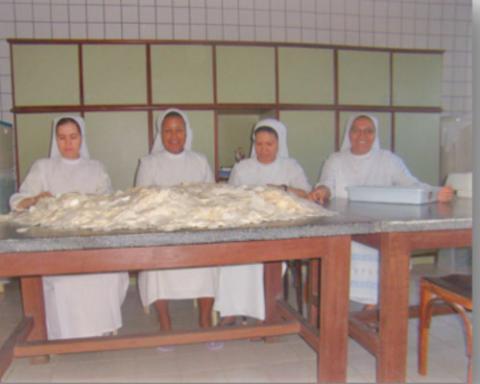  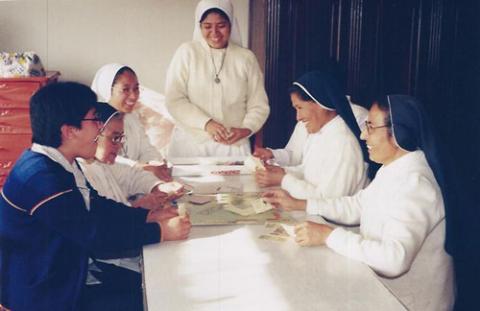  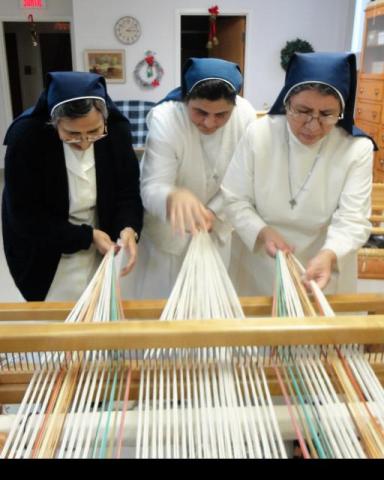 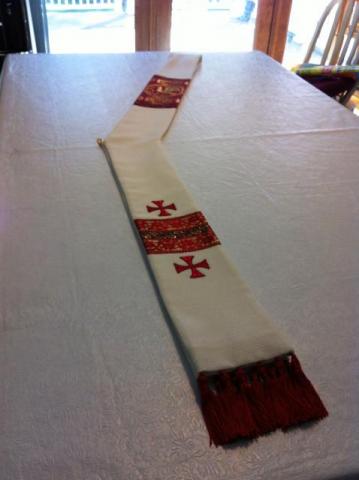  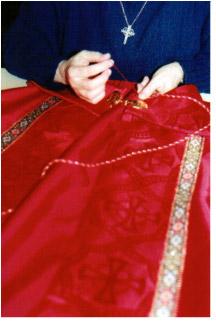 |
It was only as she matured she came to terms with what happened. By then, however, her father was dead, the bad feelings between them left unresolved. Amidst the sweeping changes of Vatican II, when many religious reexamined their vows and dropped out, Sister Porter too had an awakening that helped her overcome the doubt and acrimony and rededicate herself to her vocation.
“At that time I rethought my whole life and I came to the conclusion this life has got to be a better one if I live it right because I feel drawn to it. It must be what I’m meant to do.I dropped all the bitterness I had about my family. I realized you can’t undo what you’ve done when you’re young, no matter how much you regret it. The Lord sent me so much satisfaction with my life as soon as I let that go.”
She flourished amid the new freedom Vatican II and modern feminism ushered in. “I just really sort of blossomed in so many ways. I made a lot of new friends. I began to paint. I began to do things and go places. I got elected to the order’s leadership council and went to Europe. I met Good Shepherd sisters aiding women all over the world. It gave me an experience of belonging to the entire world. It also made me realize so many women are not treated equally and are just used in so many ways.”
She believes the ensuing large exodus from religious life was not all bad, but instead a necessary, if painful, purge. “The truth is it needed to be done. There were lots of people in religion because mama wanted a priest and papa wanted a nun. If you kept the routine, that’s all that was required, really. It wasn’t a deep spiritual thing like it should have been.” She speaks from personal experience, having come to religious life with starry-eyed ideals that were soon dispelled. “I didn’t know how to be a Catholic much less how to be a nun. The reason I became a nun was because I thought, erroneously, living a contemplative life would be a religious equivalent to a studious life. That I would write and read and meditate and be untouchable by other things. It was a rather romantic, mystical notion. I never realized we had to work, we had to eat, we had to pay bills. I was the bookkeeper the last 30 years, so I’m very conscious there’s more to life than prayer.”
Besides her faith, music has been her refuge. A trained pianist and organist, she accompanied the sisters’ singing of the psalms since entering the order in 1936. She spent the first 30-some years of religious life in Denver and after the convent there closed in 1969 she moved to Omaha, where she remained active right up until the community’s departure. Her vocation has been both rewarding and trying. As she can attest, a contemplative cannot be an idler. It is a life of rigorous devotion and discipline. Little time is wasted. Scant thought given to personal needs. Orders must be obeyed. Sacrifices made. Slackers need not apply. An unbending routine of required daily prayers and assigned chores fill the hours. The routine used to be even tougher. Rising well before dawn, sisters followed a taxing prayer and work schedule. Until just a few weeks before their move, the Omaha sisters supported themselves working as seamstresses for clothing and fabric manufacturers and making altar breads for churches.
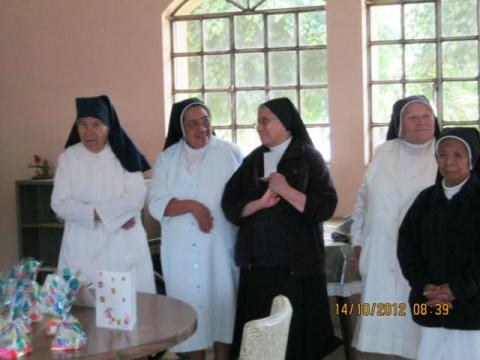  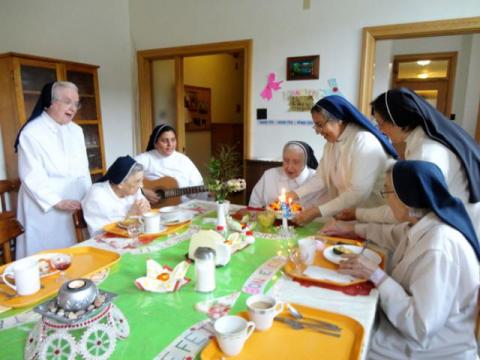 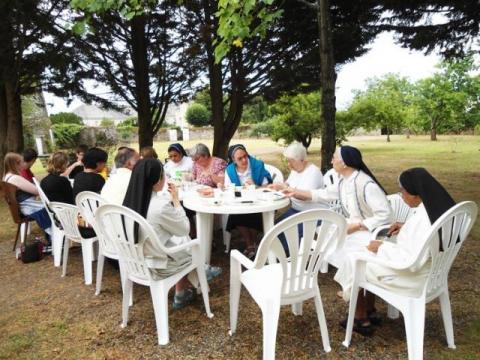 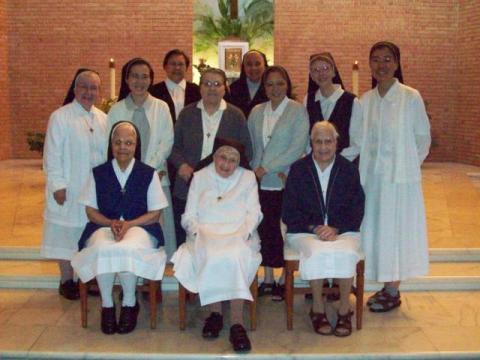  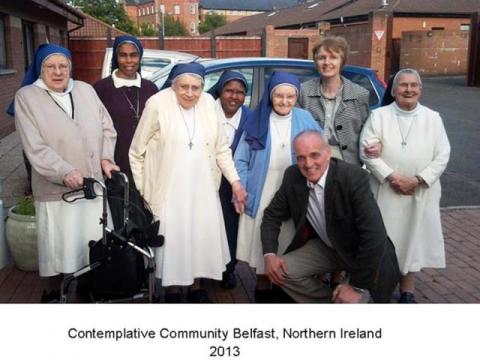  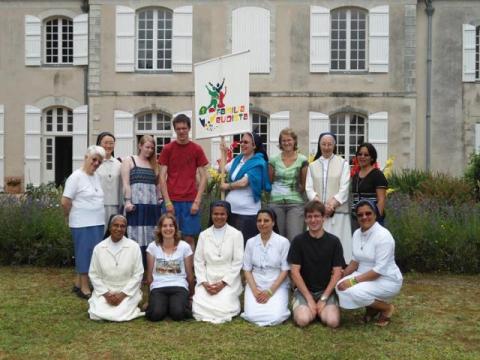 |
“Because we’re considered a relaxed community now, our day starts at 6 a.m. But when we were younger we got up at 4:30. In the old days the thinking went if you had any spare time you were not doing something worthwhile. You were supposed to be doing some kind of labor at all times. You were expected to just keep going, even if you were sick, until you couldn’t go another step. The harder you were on yourself, the better. That was the way religious life was. And, boy, it was hard,” Sister Porter said. “But after Vatican II we began to live more like the world lives. We didn’t have to work quite so hard. Our life was divided between work and prayer and leisure, but leisure was the thing that always suffered. Personally, as far this new thinking is concerned, I’m right with it. Why treat your body like that? And the fact I’m here at my age, and in good health, tells me it works.”
She feels past hardships likely contributed to the health crisis that beset several members of her community last fall. With the weakest unable to work (some were transferred months earlier to the St. Paul infirmary), the aging nuns, their ranks already depleted by illness or death, lacked the necessary vigor and numbers to maintain the Omaha facility. It was the final straw that broke the convent’s back.
“Four of them could hardly walk they were so old and tired. They were to the end of their strength. They simply couldn’t go on anymore. It’s just my opinion, but their life was probably too hard when they were younger. We were going to hang on here another two years, but things fell apart so fast we had to act.”
Leaving Omaha has been a strain on the sisters, all of whom are in their 70s and 80s and own deep-rooted ties to the area. Of their relocation, Sister Porter said, “You have no idea of the trauma it really was. I’m only now beginning to be quite accepting of what’s happened. I just need to forget it. I think I will. I always know I’ll have a lot of friends there who love me.” And there is the camaraderie among her sisters of the cloth. “The loyalty among us is something you can’t believe.”
The people they served so faithfully through the years remain close to their hearts. She said she and her fellow sisters appreciate the outpouring of support Omahans showed through donations of time, talent and treasure, whether landscaping the convent’s grounds or supplying the religious enclave with food or helping maintain financial records. More often than not, she said, these Good Samaritans became dear friends. She firmly believes such relationships marked the Holy Spirit in action.
“God has blessed us in so many ways with so many friends. Everything we ever needed seemed to show up before too long. Food and books and just about everything you can think of. In that way we got to know so many people. All of those people came to us by God sending them,” she said. “Somehow, our friendships with others seem to be founded more on deeper things in life. It often begins with us praying for them, and somehow the bonds just develop into something very personal.”
John Hoich was introduced to the sisters 11 years when, as owner of his own landscape and lawn sprinkler business, he gave them a bid on a sprinkler system. Hoich, a single lapsed Catholic at the time, soon found his life transformed.
“When the sisters got done with me I told them I’d knock the sprinkler system down to cost if they prayed for me. I installed the system at cost and, boy, did they ever keep their end of the bargain. They pretty much adopted me at that point and I just fell in love with them. I started bringing trees out and planting them. I donated money. Every time I’d come they’d sit me down and feed me. They constantly ministered to me too. They prayed for me. They prayed I’d get married to a Catholic woman and have a family, and three years ago I married Denise and two years ago we had healthy twin boys. I really believe Denise came into my life and my business grew due because of them. They’re powerful, powerful ladies.”
The sisters got to know Hoich’s wife and boys and even attended a pig roast he held on an acreage he owns. Along the way, Hoich, orphaned at a young age and raised in foster homes, gained a renewed appreciation for his faith and for the goodness of others. “They reminded me to keep my priorities straight. To keep God first, family second and business third,” he said, “They taught me the spirit of giving and caring. They walk and talk their belief, yet they’re down to earth.”
Friends like Hoich say the sisters may be gone but will not be forgotten. Letters and phone calls have already been exchanged. Visits have been made or are being planned. “We’ll keep in touch. This chain will not be broken. It is that much an integral part of our lives. They are our extended family,” Denise Maryanski said.
As for Sister Porter, she’ll be turning 90 soon but far prefers embracing the here and now to wallowing in the past. “Time doesn’t hang heavy on my hands and I don’t look back. I’ve had so much in front of me all my life I’ve never had a minute when I didn’t have something to do and there’s still a lot of things I want to do.” In February she goes to Atlanta for meetings of her order. In July she’s taking a month’s sabbatical in her birthplace of Portland. She is content with where her chosen path has taken her. “I made sacrifices for this life. I could have had a better education. I could have married and had a family. But I think I’ve done something extra special. My life has been worth something.”
 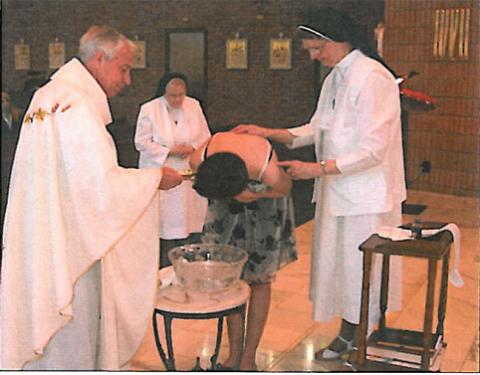 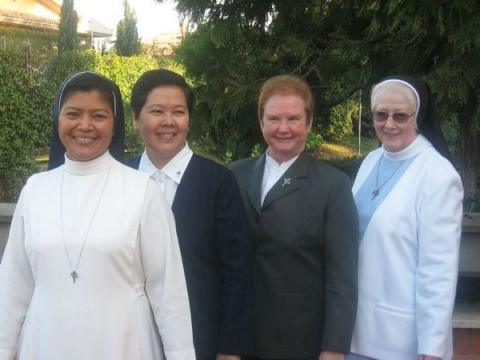   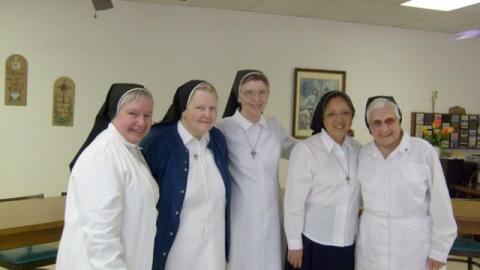  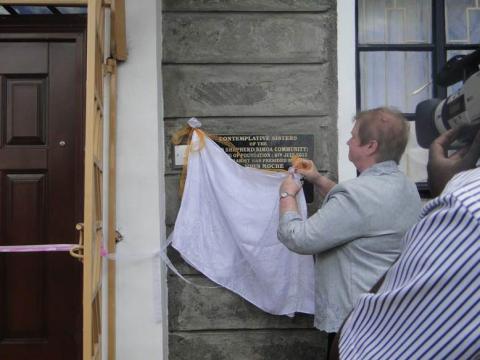 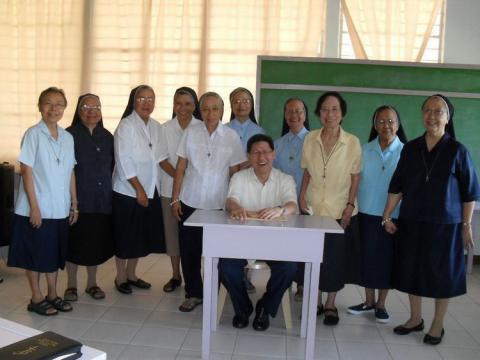  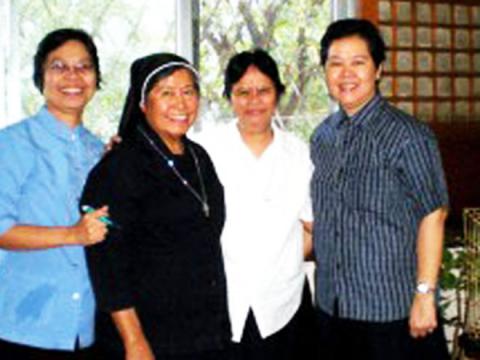  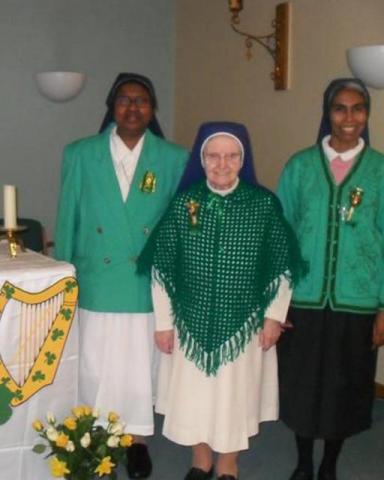 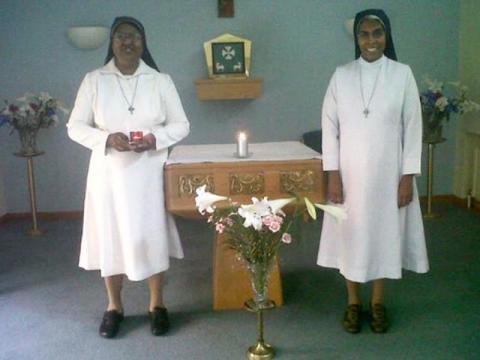 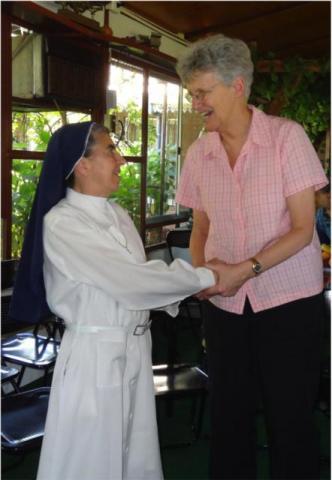 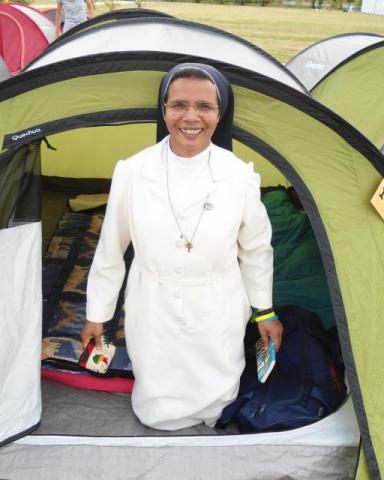  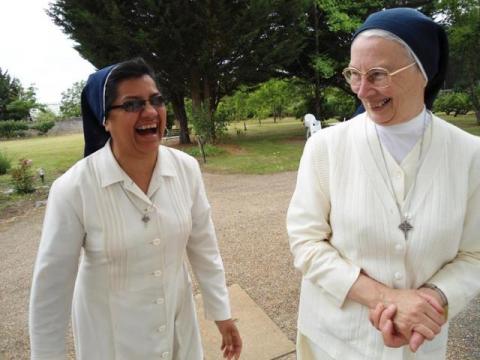 |
Related Articles
- Lord, hear our prayer: Benedictine sisters cope with tragedy (beliefnet.com)
- Nuns embrace technology to help the needy (telegraph.co.uk)
- Janet Haag: What Is Prayer? A Conversation with Sister Joan Chittister (huffingtonpost.com)
- Omaha Address by Cuban Archbishop Jaime Ortega Sounds Hopeful Message that Repression in Cuba is Lifting (leoadambiga.wordpress.com)
- Where Hope Lives, Hope Center for Kids in North Omaha (leoadambiga.wordpress.com)
- Two Year Anniversary of ContemplativeChristians.com (contemplativechristians.com)

The Saturday Night Bingo Brigade
I grew up a member of Holy Name Catholic Church in Omaha. It’s the church my parents belonged to. The church my two brothers and I were baptized in, said our first communion in, and were confirmed in. It’s where my oldest brother Greg was married. Greg, my other brother Dan, and I attended the church’s K-12 school. We lived just four blocks from the church and school. For years our later mother worked in the cafeteria kitchen on bingo nights. Ah, bingo. The game was king at Holy Name, where hordes of players turned out and enough money was raked in to help keep the church and school afloat. I never saw more than the periphery of the bingo scene. Finally, a few years ago I decided to write about it. The crowd and the take were significantly reduced from bingo’s heyday, before the casinos across the river, the video slot machines everywhere, and online betting cut into the action, but what was the same was the passion and magnificent obsession of the die-hard players. That’s what I tried conveying in this story, which originally appeared in the New Horizons. It’s one of those slice-of-life stories I like doing from time to time. I hope you like it as much as I do.

The Saturday Night Bingo Brigade
©by Leo Adam Biga
Originally appeared in the New Horizons
Along about 6:30 on a Saturday night in the basement cafeteria of Holy Name Catholic Church, 2909 Fontenelle Blvd., regular troops in the local bingo brigade settle in their favorite seats in anticipation of the first game. Of the 200 or so faithful players gathered this evening, probably a little more than half are senior citizens.
For many in the crowd, bingo is a way of life that finds these dedicated souls playing this familiar game of chance as much as seven, eight or nine times a week. Beyond the cash prizes tendered, the game is a casual, pleasant pastime for widows and widowers alike who feel there are few other recreational options for older adults like them. It is also a relatively cheap night out for senior singles and couples who simply thrive on the gambling action and the laid back socializing that permeate this smoke-filled scene. Tanked-up on coffee and nicotine, the bingo brigade plays on.
Many in the Golden bingo set have been at it for decades. They make the rounds at the various bingo halls, sitting in the same spots and following the same routines night after night. Rituals are a big part of bingo and whether it’s a cherished charm or a favorite spot to sit in or a habitual pregame activity, everyone has their own way of courting Lady Luck.
Over in a recessed alcove is 82-year-old Ada McGargill, taking turns dragging on a cigarette and sipping coffee from a thermos mug. She arrives early to claim her spot and wiles away the time with her nose in a romance novel or playing solitaire. Across from her is retired railroad chef Frank O’Neal, a soft-spoken man of 87 with a display of talismans arranged before him, including a turkey wishbone that he hopes to “bring me some luck.”. A few tables back is retired geriatric nurse Virginia Wilson, a dynamic 80-year-old with a flair for clothes and jewelry and a penchant for laying out a menagerie of elephant amulets she hopes bring her good fortune.

Clear on the other side of the room are sisters Clara Langenbach and Betty Berg, who make a habit of attending mass at Holy Name Church before the Saturday bingo session starts downstairs. Whether they say a prayer to hit bingo or not, nobody knows, but that doesn’t stop friend and fellow player Marie Berg to ask for their indulgences. “If they do, it hasn’t helped me any, I’ll tell you that — because I don’t win very often,” said Berg. Then there is Betty “Bingo” Mittermeier, age 77, who has become a kind of bingo folk hero among her fellow players for her consistent winning ways, which she attributes not so much to luck as to good old fashioned pluck.
These are just a few of the bingo maniacs who frequent the various church and social halls that form a kind of loose bingo circuit in town. The people come from all walks of life and each individual has a story to tell about and apart from bingo. Some come for companionship. Some for love of the game. Some for the slim chance of repeating an earlier success.
Bingo first got in the blood of Ada McGargill as soon as she began going some four decades ago. Her husband was confined to a wheelchair after suffering a stroke and Ada, who cared for him at home, needed an outlet. When her husband died in 1972, she made bingo her great escape from grief and loneliness.
“There isn’t much a widow woman can do,” she said. “I had no desire to date or hang out in a beer joint or anything like that. Bingo is someplace to go. It’s getting away and getting out around people. You make a lot of friends. It’s just a good enjoyable night out for me. It’s something to do, and I guess I like to gamble a little bit.” There is also a certain comfort in coming to the same place and seeing the same faces all the time, said McGargill, who’s been coming to play at Holy Name since the church started bingo in the 1960s. “I see people here that I’ve seen since I started, which is 35 years ago. When I started, priests called the bingo games. You don’t see priests do that anymore.”
Winning a few bucks is another lure. But while McGargill said she has won the $1,000 jackpot six times, she emphasizes that is “not too many times considering I’ve played for almost 40 years.” Her luck has been especially sour of late. “I’ve been in a slump. I haven’t won for a long time. It’s like that. Sometimes you win every time you go, and then you don’t win for a long time.” Unlike many veteran bingo players who abandoned the game for the glitzy appeal of the casinos, McGargill has remained loyal. “I don’t go to the casinos very often. I don’t have that much money. I can sit here all night and play for $15-20, but at the casinos that’s nothing. That’d be gone in 15 minutes.” Her bingo schedule is so regular (“I go just about every night.”), she said, that “if one of my kids needs to reach me, they know to try the bingo halls. They know that’s where I am.”
Barb and Bob Smejkal and Tess Perry have been coming to Holy Name bingo for as long as the game has been played there. They remain faithful players out of a desire “to support the church,” Barb said, and because the cost to play is a lot more “reasonable” than casino gambling. Besides, she said, it offers a night out with “the gang.” For retired Omaha fire captain Pete Peterson, 70, and wife Nancy bingo is extra income — “We’ve been on a pretty good winning streak” — and a way “to just kind of relax and get your head off the rest of the world,” he said.
For Frank O’Neal, a night of bingo relieves the tedium of staying home and watching the boob tube. “TV gets boring. Bingo’s a way of getting out and meeting people. The older you get the more you coop yourself up and the only way for older people to get out of the house is through some recreation like this,” he said. “It’s an enjoyment for an older person.”
Besides, O’Neal has never been one to plant himself in front of the set like some couch potato. He has always had an itch to get up and go places. During a 40-year career as a chef/cook for the Burlington Railroad, the dining car was his privileged perch for seeing America.
“I enjoyed my work and I got to see a lot of the country, too. I started out in Lincoln, Neb. and then I got transferred to Chicago and then from Chicago I ran all over. During the war, I was running everywhere because the dining car went wherever the troops were. I was moving,” he said.
His favorite run, he added, took him from Chicago to California. He feels people of a certain age who only know passenger rail service via Amtrack missed out on a special chapter in American travel. “In the heyday, train travel was special. The food was special. No, it’s not special anymore. When I was riding the railroad we made everything fresh. They don’t do that now. The meals are already prepared and they put ‘em in the microwave. The way we did it, well, that’s something of the past,” said O’Neal, an Omaha native who with his wife raised a family during the Great Depression, when bingo first emerged as a popular game in America.
There’s something about the poised, confident way Virginia Wilson carries herself, even when merely setting up her array of daubing markers and good luck charms, that tells you she is her own woman. Growing up with a passel of siblings in the only black family in Beatrice, Neb., she learned early on about asserting herself.
During World War II she followed her seven brothers in the service by joining the WACs or the Women’s Army Corps. She actually began her tour of duty in its precursor organization — the Women’s Auxiliary Army Corps (WAAC). The pride she feels all these years later about her wartime service is evident in a photo she carries with her. The picture — of herself in her crisp GI-issued uniform — was taken while she was stationed in Paris. In addition to France, she served in England, Germany, Switzerland and Belgium. The experience changed her. Just imagine, she said, the impact that seeing the world had on “a little town country girl,” adding, “When I came out of the service, Beatrice was too small for me.” Her expanded dreams found her studying pre-law at the University of Nebraska-Lincoln before embarking on a career in nursing. She lived and worked in Denver and then moved to Omaha, where she raised three children as a single working mom.

By her own reckoning, Wilson has been a steady bingo player for some 55 years. She feels getting out to play the game beats sitting at home. “I get claustrophobia if I stay home. The walls close in on me,” she said. “Plus, I love to play.” Just how often does she play? “I play bingo every night, thank you.” She prefers the simple, direct charm of bingo to the casinos. “I don’t like to have the slot machines gulp my quarters. I don’t get any enjoyment out of it at all. Bingo’s more fun.”
Winning has become such a habit with Betty Mittermeier that she has not — not even once — dipped into her late husband’s Union Pacific pension checks. Indeed, bingo is such a steady source of income for her, she said, that she thinks of her playing nights as “my part-time job.” Recently widowed, Betty and her husband of 59 years raised five children. She used to take her youngest son with her to bingo, where she would play while he built model airplanes. Children are no longer allowed on the premises. Her magic at bingo has been there from the very start. She still wins money virtually every night and her success is so well known that she answers to “Betty Bingo” and finds players coming up to her and rubbing her for good luck, something she is not fond of, by the way. Mittermeier, who plays a large number of cards, doesn’t believe her success is due so much to luck as to persistence and to her increasing the odds in her favor by playing dozens of cards.
It is not uncommon for players like Betty to play up to 100 cards at once between the paper and the electronic bingo games offered. But the more cards one plays, the more money it costs and some folks, like Ada McGargill, cry foul. “Some people are playing 96 cards, and I can’t afford to do that. Most of us can’t afford to do that. So, they spoil it for everybody else, because they win all the time.”
Whether one wins or not, it is the mere possibility of hitting bingo that hooks people and keeps them coming back for more. “It’s the anticipation of how you’re going to do,” said Barbara Finkle, 68, a longtime player around town. “That’s what it is. Everything leading up to it is the exciting part of it. A couple of times I’ve won a $1,000 jackpot, but that’s not very often, let me tell you. But I keep coming back. I’m a sucker.” Or, as a regular at the Holy Name bingo game, John Speese, put it, “One night I did get the jackpot, and that’s what I keep coming back for.”
Yelling out “Bingo,” is nice, as is the cold hard cash a winning hand provides, but the real appeal for players like Marie Beran, 86, is the personal interaction the game affords. A widow whose children and grandchildren live outside the state, Beran would be alone without her bingo family. “I’m all by myself. All I have left is my bingo friends,” she said. “That’s my life — my bingo. If it wasn’t for that, I don’t know what I’d do.”
An every night player, she eats all her meals at bingo. She has been playing for more than half a century, making it a daily and sometimes twice a day affair since her husband died on their 52nd wedding anniversary in 1991. He had battled bone cancer for years. Marie had stayed home to care for him. After losing him and without any other family nearby, her life began to revolve around the game. She is independent enough to still live in her own home and to drive. “If it gets to the point I can’t drive anymore,” she said, “why then I’ll do something else. I just take it day by day.” She believes even more than the camaraderie she finds at bingo, she benefits from the activity it provides. “If you keep active, I think you keep going. Otherwise, I think you sit in a rocking chair and get old.”
Aside from the stimulus that a little gambling action affords, there is the concentrated focus bingo demands, which is not unlike completing a crossword puzzle. Aging experts agree such mental activity is healthy for older people. The focus required increases when playing paper bingo, where row upon row of numbers must be examined and matching numbers marked or daubed. “It takes concentration, especially when you’re playing a lot of cards,” Barbara Finkle said. “I play the paper because I like to be busy daubing. There’s definitely an art to it.”

(Photo by Bill Kelly, NET News)
Indeed, once a game begins and the first number called out, paper players are studies in concentration. An observer on the scene notices several things. First, the pregame drone of gabbing and chitter-chatter falls to a whisper, like in a church, which is ironic since Holy Name Church is directly above the bingo hall. Finkle said there is an unwritten rule to maintain silence when playing, something newcomers unknowingly violate through idle conversation.
“When you get some people in that haven’t played very much, they don’t realize that you should really be quiet and not talk during the game because people are trying to concentrate,” Finkle noted. Hushing such noisemakers is not uncommon. After all, as fellow player Clara Langenbach put it, “It’s serious business.” Then, once the game proceeds, it as if everyone has begun praying. There is a mass of furrowed brows and bobbing heads as each player first tilts their head upward to intently, silently, almost reverently scan the closed circuit TV or tote board for the current number in play and then bows their head back down to examine the sheets spread out before them in search of the corresponding number.
Next, you observe how the dauber is grasped in the hand and positioned above the paper like a fine brush held by an artist over a canvas. With each matching number, the inking begins in what can only be called brush strokes, and soon the sheets resemble the cross-hatched blotchings of a modern art painting. During the game, floorwalkers sell special games and pickle cards. Some in the crowd leave their seats to grab a snack, use the restroom or catch some fresh air. Most winners react in a fairly subdued manner, which is natural considering most payouts range from $20 to $100, but the $300 and up winners do occasionally hoot, holler, hug their neighbors or dance a jig in celebration.
Bingo attendance is not what it used to be. Many players left bingo behind once Council Bluffs opened its casinos. Still, enough loyal players remain to make the game a viable attraction for folks who don’t care for the casinos or can’t afford them. Like many parishes over the years, perpetually cash-starved Holy Name has sponsored bingo for decades as a prime source of income to help subsidize its church-school operations.
In addition to the games held in the cafeteria on Wednesday and Saturday nights, Holy Name also conducts bingo in a social hall at 60th and Hartman on Thursday and Sunday nights. Bingo once ruled at Holy Name. Game nights attracted near-capacity crowds on a regular basis. But then the state legislature imposed new restrictions on bingo (limiting the number of sessions any one sponsor can hold) and new competition arrived in the form of the lottery and the casinos. The parish’s annual bingo proceeds have fallen from nearly a quarter of a million dollars to about a fifth of that amount since casino gambling opened across the river, according to Holy Name Pastor, Rev. Richard Quinn. He said some parishioners advocate abandoning bingo altogether while others continue to embrace what has become a tradition and a steady, if diminished, revenue stream.
While it is true the casinos have taken away many veteran bingo players, Betty Mittermeier said, so has natural attrition — as more old-time players than she can count have passed away over the years with few new players replacing them. It has gotten to the point, she said, that she and her old time bingo buddies joke with each other that “whoever goes first should save a table for us up there.” While there may or not be bingo in heaven, chances are that as long as bingo maniacs like Betty are still around, the game will continue attracting crowds wherever it is played. Long live bingo!
Related Articles
- Bingo trouble in the cards (dispatch.com)
- Who knew bingo was so funny? (interbent.com)
- Bingo! Not for Seniors Only (nytimes.com)
- Bingo popularity growing uptown (nydailynews.com)
- Underground Rebel Bingo: Balls at the Blockley (independentphilly.com)
Power Players, Ben Gray and Other Omaha African-American Leaders Try Improvement Through Self-Empowered Networking
| The following story on the African-American Empowerment Network in Omaha appears here just as it does in print and online in The Reader (www.thereader.com),. It is part one of a two-part cover series on the grassroots community initiative focused on making positive change to address longstanding disparities in key quality of life areas. I will post part two here after it’s published next week. I worked on and off over a period of two years assembling the data, mostly based on interviews, for these stories. As sometimes happens in my line of work, the story I submitted has been severely cut, primarily for space, and as its author I would argue it has lost something in translation — depth, texture, nuance, and perhaps. continuity, although I would be purely guessing at this point, because you see I don’t read my published work anymore, this story included. That is, I stopped reading my freshly published years ago. It just got to be too upsetting to find articles winnowed down by hundreds, even thousands of words in some cases. Too often something went wrong in the process. This is not an overly sensitive writer condemning the very useful and necessary practice of editing. Earlier today I edited, on an editor’s orders, a 3,400 word story down to 1,600 words, and all that tightening didn’t kill the story so much as focus it. Ah, but you see, I did the edit myself. The following story was truncated without my input. Now, it might be perfectly fine in its shortened form. Or it might not. Eventually, I’ll let you the reader decide. In a couple weeks I will post the version I submitted and run it on the same page with this version. You be the judge. For now though, read about an interesting effort to revitalize Omaha’s African-American communityfrom the ground up.
Power Players, Ben Gray and Other Omaha African-American Leaders Try Improvement Through Self-Empowered Networking ©by Leo Adam Biga As seen in the The Reader (www.thereader.com)
It may have been 2007 when northeast Omaha’s depressed African-American community reached its limit. A demographic bound by race, history, circumstance and geography seemingly exhaled a collective sigh of exasperation to exclaim, “Enough already!” Longstanding discontent over inequities in income, housing, education, economic development and opportunity solidified into resolve by a people to take action. Nearly four years ago, a coalition of local blacks decided to rebuild the community from within. They formed the nonprofit African-American Empowerment Network. The effort was inspired by author and television/radio talk show host Tavis Smiley in his best selling 2006 book, The Covenant with Black America. Omaha’s Empowerment Network targeted 13 areas for improvement. Efforts by the Network and partners are the latest attempted remedies. In the 1940s and ’50s the De Porres Club pressed for civil rights. In the ’60s the Citizens Coordinating Committee for Civil Liberties or 4CL, took up the banner. Well into the ’70s federally funded programs and agencies spurred by the Great Society and its War on Poverty operated here. At various times the Urban League of Nebraska and the Omaha Chapter of the NAACP have led on social justice and community betterment issues. When the last in a series of major civil disturbances in the late 60s badly damaged the old North 24th St. business-entertainment hub, many businesses left. Few new businesses have opened. Northeast Omaha’s chronic gun violence contributed to the perception of an unsafe environment. It is regarded as a mission district dependent on government assistance, social services and philanthropy. President and consultant at Innovations By Design, LLC, Tawanna Black, also vice-chair of the board for the Network, and co-chair for the race relations covenant, summed it up. “In the absence of African-Americans in powerful political or economic positions to drive this, small changes have occurred but nothing major. The Network really flips that theory on its head and says,”Why are we waiting for the power to be given? Let’s own the power that’s within.’ It’s an empowerment thing. It means more than just a name on a piece of paper. It’s really what it’s all about empowering people to take control of themselves. A process committed to that is completely new in this community.” “There’s been a lot of psychological damage done to us as a people. Historically we just allow things to happen to us and what we have to do is starting taking control of our own destiny and that means also having skin in the game,” said Omaha City Councilman and Network violence intervention-prevention chair Ben Gray. Empower Omaha drafted a rising-tide-lifts-all-ships community covenant. Through monthly community meetings, periodic summits and prayer walks, neighborhood cleanups, block parties and surveys, the Network interfaces with residents through a North Omaha Neighborhood Alliance. “We keep the community engaged, we listen to the community, we write down what they say. I think that’s how we get the buy-in from the community,” said director of operations Vicki Quaites-Ferris. “Most things implemented actually come as a result of listening to the community.” Highlander Neighborhood Association president Kristina Carter said the Network’s an integral part of neighborhood cleanups. Network strategies encompass neighborhoods, housing, employment, education, family, faith, crime, etc. The strategies come from community leaders, residents and best practices in other cities. Not a direct service provider, the Network partners with others to support or facilitate programs. The Network was in place before a 2007 Omaha World-Herald series revealed black Omaha poverty rates as among the nation’s worst. What was already known is that many youths underachieve in school — only half graduate. There is an epidemic of sexually transmitted diseases, a preponderance of single-parent homes and little economic development or opportunity. Newly detailed were high jobless rates and low household income levels. Freeway construction disrupted, some say severed, a tight community. As restrictive housing practices waned, upwardly mobile blacks moved west. Others left the state. Many feel the city needs to make an “It stops here” pledge. Rev. Jeremiah McGhee doubts the larger community yet appreciates a revitalized north Omaha is good for all of Omaha. The city has managed a united front against gun violence. The Network has endorsements from Mayor Jim Suttle, Omaha Police Chief Alex Hayes and some 100 public-private partners for the Omaha 360 anti-violence coalition. Connecting the dots, it became clear that despair is rooted in certain realities: entrenched gang and drug culture; fractured families; a lack of positive role models; barriers to educational, job, home ownership and business opportunities; a sense that no one cares. Douglas County Treasurer and Network chair John Ewing knows it from his former career as an Omaha cop and Empowerment prayer walks and community meetings. He said residents complain of violence, lack of economic opportunities, that they feel abandoned, neglected, overlooked, forgotten. It leads to a sense of hopelessness. And northeast Omaha’s lost some 11,000 households over time. A diminished tax, voter, consumer base diluted the minimal clout it had to hold public and private sectors accountable the economic and social ills. “There’s been a lot of benign neglect that’s gone on in north Omaha by the majority community and I don’t hesitate in saying that because it’s a fact,” said Gray.”But what we’ve got to do now is rather than point fingers and place blame put together the necessary mechanism to fix it. We’ve got so much work to do and we’ve got so many areas that we’re operating in.” Davis Companies CEO Dick Davis spearheads a formed Economic Strategy Taskforce whose goals address economic viability. Those include preparing every African-American for a sustainable living-wage job; moving persons from unemployment or underemployment to full employment and from jobs to careers; encouraging entrepreneurship by increasing access to credit and capital. The Network endorses a from-birth-to-career strategy. Davis has long been active, starting black businesses and providing college scholarships to black students. Entities like the African-American Academic Achievement Council, 100 Black Men, 100 Black Women, the Omaha Economic Development Corporation, the Urban League of Nebraska, along with black churches, have done their part. Pockets of progress have appeared in some new home construction, a few business parks, a refurbished section of North 24th St. and new quarters for anchors Salem Baptist Church, the Urban League and Charles Drew Health Center. Nothing large-scale has been attempted. A recent Pew Partnership for Civic Change report found that of 33,000 metro businesses, only 200 are black-owned – most are single owner-operator endeavors. Family Housing Advisory Services director Teresa Hunter, co-chair of the Network’s housing development covenant, said “We work within the framework of what’s already going on, trying to make it cooperative … Why are people still falling through the cracks – what else do we need to do?” Where most Network players are native Omahans like Hunter, the driving force is a transplant, Willie Barney, who until recently was a strategic consultant. The Iowa native worked in media marketing for Lee Enterprises and moved here for an Omaha World-Herald post. He worked on Salem Baptist Church’s administrative team when he galvanized efforts to create the Network. He served as the Network’s unpaid president and facilitator, then as a consultant, and is now its second paid staff member. “In evolving over time we’ve stayed true to our mission,”said Barney. “We said we want to be positive and pro-active and to build partnerships … with the entire city. It has to be bottom-up and top-down for it to be anywhere close to being successful — individuals, families, leaders at all levels working together collaboratively.”
The effort started focusing on seven core areas: jobs, business-economic development, education-youth development, voting, violence prevention, housing-neighborhoods-transportation and engagement. Evidence of the Network’s wide reach was seen during its annual Harmony Week (May 21-29), when dozens of organizations and thousands of people across the Metro participated in expressions of unity and community engagement. In 2009 the organization opened an office in the historic Jewell Building in the heart of North O, across from the Omaha Star. The Network boosted its presence via an expanded website, Facebook page and Revive! Omaha Magazine, which Barney’s SMB Enterprises LLC publishes. A TV spot features Network leaders reciting, like a creed, the Empowerment credo: “We can change Omaha. It’s time to rebuild the village. Family by family, block by block, school by school, church by church, business by business. Each person doing their part. Working together, let’s transform Omaha. Do your part. Live the covenant.” The Network’s first full-time staffer was Quaites-Ferris, a former deputy assistant to former Mayor Mike Fahey said. Three-and-a-half years in, the Network has a track record. Barney said whatever course the Network adopts, it relies on others to carry it out. “At the end of the day it’s ENCAP, the Urban League, Omaha Economic Development Corporation that are doing the work. But I think because we’re here we’ve helped facilitate potentially more partnerships than would have happened before.” Malcolm X Memorial Foundation president Sharif Liwaru said he feels the Network’s facilitator rather than direct service provider role “is still hard for people to grasp.”Barney concurred. While Liwaru and community activist Leo Louis feel the Network effectively engages established organizations and leaders, they advocate more outreach be done to new, more loosely organized groups as well as to youths. “We’re doing more to really make sure it is an inclusive process,” said Barney.”If they don’t come, we’ll go to them, and we’re not perfect, we make mistakes, but we keep pushing forward.” In mid-2008 the Network noted workforce development gaps for at-risk youth and launched a life skills and jobs program. No one wanted a summer like 2007, when there were 31 reported shootings in 31 days during one stretch. Program participants included kids failing in school and drop-outs , ex and active gang members. Barney and Gray contacted employers to secure 150 paid internships. The program was repeated last summer, with enrollees split between returning and new participants. Barney said many “transitioned back into school, some went on to get GEDs and others got offers for fulltime work.” 2009 saw hundreds more jobs created by federal stimulus funds and private donors. The Urban League facilitated. Minus any federal funds in 2010, the number of summer jobs provided at-risk youth this year will be closer to 500, rather than last year’s 800. “In a lot of instances we basically have to start from scratch — we have to teach people how to fill out an application, how to successfully interview, how to do some things we take for granted,” said Gray. “This is a big job because you’ve got to change attitudes as well as change behavior. Neither is easy, but you’ve got to get it done because the only other choice is to build more jails and at the end of the day that’s costing us three to four times as much money as to provide jobs and job training and proper schooling.”  Ben Gray Barney said the group launched a multifaceted violence prevention collaboration. “It’s not just telling folks, ‘Don’t do this,’ now we’re providing options.” Impact One Community Connection, formerly New World Youth Development, was formed to do gang intervention-prevention. The Network also collaborates with ENCAP, the Eastern Nebraska Community Action Partnership (formerly GOACA). Teresa Hunter said she, Barney and others were impressed “a group of youths wanted to continue meeting and talking about the issues and the remedies. They wanted to keep coming back and to make a change.” In turn, said Barney, participants “were amazed somebody cared enough to spend all that time one-on-one with them and to help them get a job. They will flat out tell you no one has ever given them these opportunities before. Even some of the kids on the street that everybody totally discounts and that people said there’s no way you’re going to reach, well, we reached them.” Recruiting them, he said, was largely the work of the late Roy Davenport and of Gray. Both brought longtime gang intervention experience. The Network’s aligned itself with the Omaha Police Department, particularly the Northeast Precinct, and North Omaha Weed & Seed to do Safe Night Outs and other efforts for improving police-community relations. Gray, who leads an emergency response team, said street work is where it’s at in reaching past or present gangbangers. “You got to meet them where they are. If you are not willing to get out in those blocks, in those neighborhoods, in those houses where they live, you are not going to reach those young people. You gotta be at the hospitals, you gotta be at the funerals, you gotta be constantly talking about not retaliating … about going in a different direction. That’s very time consuming, painstaking, difficult work and there are no set hours. We have ex-gang members employed through Impact One. They monitor the streets on a regular basis.” Gray lauds the Network for “putting its neck on the line” to even do this outreach, saying it’s a microcosm for how a wounded community can heal. “We have people that have been disappointed so much they’re not willing to necessarily buy-in until they have seen some stability in you going down the road getting a few things accomplished, and then you’ll hopefully get that groundswell of people that will come on board with you.” Barney said the Network “has the opportunity to really make a tremendous difference. Some of it will be over time, some of it will be dramatic,” such as the 36 percent reduction in gun violence in July-August 2008. Barney said he’s sure some people feel the Network effort is not open enough, or that they don’t have a voice. He wants them to contact him. “We’ll sit down and we’ll meet and we’ll listen and try the best we can to make adjustments.” “We are building a long-term foundation. We’re getting more and more people engaged, more people are stepping forward. That doesn’t mean the violence is going to stop today or next week. I keep saying to folks, ‘It did not happen overnight and it will not be solved overnight. ‘We’ve seen some things slowly move in the right direction.” Geraldine Wesley with Long School Neighborhood Association embraces the Network “getting people’s hopes up to empower” North O, adding, “If they carry out all the things they intend to do, it would be good.” “Well, right now its just ideas, there’s nothing concrete as far as I know,” she said. I am waiting for the results. It’s going to be a long process, I know that. I hope I’ll live to see it.” |

Related Articles
- Black church: Place of empowerment (cnn.com)
- Empowerment via the new media (thehill.com)
- Urban League at 100: Pledging to put black America back to work (thegrio.com)
- BLACK ENTERPRISE Announces Plans for 40th Anniversary Celebration (prnewswire.com)
- Omaha Native Steve Marantz Looks Back at the City’s ’68 Racial Divide Through the Prism of Hoops in His New Book, ‘The Rhythm Boys of Omaha Central’ (leoadambiga.wordpress.com)
- A Rich Music History Long Untold is Revealed and Celebrated at the Omaha Black Music Hall of Fame (leoadambiga.wordpress.com)
- Walking Behind to Freedom, A Musical Theater Examination of Race (leoadambiga.wordpress.com)
African-American Empowerment Network Sets Course for Change
Check out my new cover story in The Reader about Omaha’s African American Empowerment Network. It’s the first installment in a two-part cover series on this nonprofit, grassroots, community initiative to raise the educational, economic, quality of life prospects for a segment of the population that, on average, lags behind the majority population and other ethnic minority groups.
I will soon be adding the story to this blog site, but for now you can find it at The Reader-
Also, I will be using the two-parter as a case study for how I go about doing what I do. That look inside my process will be featured on my Notes from a Working Journalist
Squidoo lens page. Look for an announcement here about it. If you haven’t visited that site yet, you can access it at-
Notes from a Working Journalist
Another facet of my online presence is the new Squidoo lens page I have formed. I call it:
Notes from a Working Journalist.
It is meant to be a kind of diary or journal of my writing life by sharing insights into the process behind creating the projects that pay my bills and feed my soul. Every now and then I will use the page to talk about what’s happening with various projects I am engaged in, providing notes into their genesis, their development, their research, their writing-editing phase, and, finally, their publication. I hope these insights prove an interesting glimpse at what goes into my process as a working journalist.
You can access my Squidoo lens page at:
A Man of His Words, Nebraska State Poet William Kloefkorn
UPDATE: It is with some sadness I report that the subject of this story, the poet William Kloefkorn, has died. He was a real master of his craft. I only met him the one time, when I interviewed him at his home for the profile that follows, but in the space of that two hours or three hours, buoyed by having read one of his autobiographical works of prose, Out of Attica, it was apparent enough that I was in the presence of a formidable yet gentle sage. He will be sorely missed, but his writing lives on.
New Horizons editor Jeff Reinhardt suggested I profile Nebraska State Poet William Kloefkorn and I’m glad I did. I knew the name but not his work and it was a pleasure steeping myself a bit in his writing in preparation for interviewing him. Whenever I read a master wordsmith like Kloefkorn I am humbled by their considerable talent and my own modest gift by comparison. His work exemplifies the spare, delicately modulated style I admire in many writers. He warmly welcomed Jeff and I to his home, where we spent a pleasurable couple hours in his company. As one who writes feature profiles, kt is my job, of course, to try and capture the essence of my subject in 500 or 1,000 or 1,500, or 2,000 words or more. This story is 4,000-some words, a length that few print or online publications allow journalists to write at these days. But Jeff, my editor on this project and on more than a hundred other stories the past 12-15 years, generously allows me to write at length. I try not to abuse that privilege, rather use it to tell richly textured stories.
 JACOB HANNAH / Lincoln Journal Star
I always try to be true to the voice of my subject, but in this case I made a concerted and hopefully subtle effort to minic, as a kind of homage, Kloefkorn’s distinctive writing voice in my own writing. I never heard anything from him after the story appeared in the Horizons, and so I don’t know if he approved or not, or whether he even recognized what I did in terms of style. In case you see this Mr. Kloefkorn, let me know.
If you enjoy reading my Kloefkorn piece, then check out some of my other stories about Nebraska writers, including profiles of: poet Ted Kooser, folklorist Roger Welsch, and novelists Ron Hansen, Richard Dooling, Timothy Schaffert, and Kurt Andersen. Look for posts in the near future on James Reed, Sean Doolittle, Carleen Brice, Robert Jensen, Scott Muskin, and Rachel Shukert.
A Man of His Words, Nebraska State Poet William Kloefkorn
©by Leo Adam Biga
Originally published in the New Horizons
The rhythms of the small south central Kansas town writer William Kloefkorn grew up in are deeply imbued in him, right down to the marrow.
Nothing much ever happened there, or so it seemed. But with the passage of years and the angle of vision that distance brings, more than enough went on to burnish the memories of Nebraska’s State Poet. The smallest details provide rich fodder for Kloefkorn poems and stories as well as memoirs that take the measure of that place and its people.
He left decades ago, yet that past is fresh in his mind: the farm pond he fished in; the tree house he built; the kitchen fire he started — proof that he’s never really abandoned those roots and that one can go back, at least on the page.
Attica, Kansas was a conservative, barely hanging-on rural hamlet whose closed strictures you either made your lot with or whose dust you shook off your pants on the way out of town. He dedicated an entire book of poems to it, Out of Attica.
“I loved my little hometown, but I also despised it,” Kloefkorn said with the luxury of perspective and the duty of reflection, his deep amber voice belying his short-lived gig as a radio announcer. The retired University of Nebraska Wesleyan professor spoke from the parlor of the classic ranch house he and his wife Eloise share in Lincoln. Large picture windows look out on a well-tended backyard.

At the time this sensualist and contrarian felt his small town diminished him, but it did in fact yield much, including his wife, who was his sweetheart. Then there’s the lifetime of material it gave him.
Still, there’s little doubt that hometown’s small horizons would have stifled this free-thinking, high-spirited man. Besides, the struggles of his family’s subsistence life deflated him. He wanted no part of that hard scrabble existence or the harsh judgment imposed by gossip or scripture.
“There were about six or seven churches there for 700 people, a pool hall, no drinking, legally, no dancing. My parents were very poor, we moved around a lot, always trying to move up a little, but it went like this,” he said, pantomiming the zig-zags of an up-and-down graph. “I think we moved eight times inside the city limits. They were very hard working people. My dad worked for the county doing WPA projects. Kind of a handyman really. They tried all kinds of little businesses — a cafe, a filling station, a grocery store.”
Without knowing it, Kloefkorn trained as a writer by closely observing his boyhood haunts — the barbershop, the pool hall, the movie theater, the farms, the grain bins, the open fields, the school, the churches — and their inhabitants. Characters, all.
“I got to know that town inside out, upside down, I got to know every square inch. I could still do the newspaper route today and name the people pretty much.”
His parents, whose divorce after he left home shocked him despite their frequent disagreements, were long-suffering souls. His tight-lipped father said little besides the curse words he expertly strung together in a kind of profane poetry. When the son tried imitating him he got his mouth washed out with soap for the trouble. As family lore has it, Will’s mother gave birth to him after milking a cow. Only after completing her chore did she give in to labor’s call. That’s the kind of hardy, stubborn, we-shall-endure stock he comes from.
Kloefkorn didn’t want to end up like his embittered, pent-up father or his German immigrant grandfather, whom he admired and despaired for at the same time.
“My granddad was one of my heroes, I worshiped that guy. He had all kinds of ability, all kinds of talent. His wife was a former school teacher, a very sharp woman. She gave up her teaching when she married him to become the farmer’s wife. They just eked out an existence on their little farm. He was so happy he escaped his family, his father was abusive. He counted himself lucky to have gotten away from it.”
Similarly, Will’s father counted himself lucky to have escaped the family farm and Will deemed himself fortunate to have avoided a dreary hand-to-mouth life.
He said his grandfather “resorted to the last bastion of hope, which is called religion, and religion of the most sordid type– right-wing fundamentalism. It did suppress all vestiges of imagination and creativity. As a young man my grandfather had been a member of what he called illiterarie. They had read and memorized a lot of stuff. Anything fun became a sin in this Old Testament, fire-and-brimstone, Pentecostal church. I detest that church with a passion.”
An unrepentant agnostic, Kloefkorn takes delight, as his grandpa did, in tweaking the nose of authority and decorum. He makes no bones about his quarrel with God. He has no truck with organized religion, no use for puffery or counterfeit dandies.
“My grandfather, much to the chagrin of my grandmother, would recite stories he’d memorized (and perform songs on his accordion). I was fascinated by his language, not only with the stories but the way he delivered them. It was delightful and at the same time it was pathetic.”
The poet has oft-written about Grandpa Charles.
The first inkling of a writing life came in high school, with the arrival of a comely young female English teacher who recognized in Will a bright, curious mind that needed to be challenged. He didn’t read much of anything outside what was assigned, which was little to start with, but he did like what he read. Similarly, he just wrote what was assigned.
“She noticed I wasn’t doing very much. I said, ‘Well, to be honest with you, I’m taking this because I’ve taken it before and I didn’t have to work very hard.’ She was very gracious about it. She totally unnerved me by saying, ‘Look, if you’re not too
interested in what’s going on in class why don’t you do me a favor,’ and I thought she’d say drop the class, but she said, ‘and instead of attending class go to study hall and write something for me. By the end of two weeks bring it to me and we’ll look it over.’ I couldn’t believe it.”
Kloefkorn said he dawdled the first week away not doing “hardly anything except pester a couple of gals. I had no idea what to have for her. Well, I finally began to write a story and the more I worked on it, the more I got into it and by the deadline I had it done, and that amazed me. It was a 20-page story. I took it to her and we spent an hour talking about it. She not only read it but she offered some suggestions. She said, ‘You know, you could make this a longer story or you could write another story.'” He opted to rejoin her class, but the experience had invigorated him. “I discovered I liked to write — I didn’t know that before.”
At Emporia State University he found the pathway for reaching his potential.
“That college experience for me, it was such a departure from how I’d been taught, it was such an opening up, it was incredible. That was really a big stage.”
Everything was new and different.
“The first time I was ever on a college campus was the day I matriculated,” he said.
“I took a freshman English class and I had of all things a male teacher, and I promise you I didn’t know there was such a thing. Here was a young man standing nicely dressed in front of class, sharp as a tack. On the first or second day he wrote us a poem, and I was stunned. He read it without apology, talked about it clearly, asked us about it, and I’ve never forgotten that experience.
“It was beginning to occur to me that language is so interesting and it kind of snowballed from there. I really did enjoy writing. As an undergraduate I had another professor I enjoyed writing papers for. I was writing to impress the profs, that was half of it. I wanted to do well so I worked hard.”
The English major set his sights on a teaching career. He and Eloise married between his junior and senior years in college. “It was just a good time,” he said.

He played football for a time but after quitting the team he satisfied himself as sports editor of the school paper, which he ended up managing.
“I thought maybe I wanted to be a journalist.”
He also dallied in radio for a back water station, his sonorous voice made for the air. Then his sensibilities as a writer got rocked. His younger brother John and a mutual friend showed up one day excitedly saying they’d just finished a novel that he simply had to read. They promised it would upset everything in his well-ordered world. The novel was J.D. Salinger’s The Catcher in the Rye and true enough once Kloefkorn read it, in a single sitting. he was never the same.
“I was caught up in the voice of Holden Caulfield. I don’t think it was only the voice though, he was reflecting a lot of attitudes I had. The phonies were coming in the (g.d.) windows and I felt the same way. I think a lot of readers did.”
So much was he taken with it, he soon started his own coming-of-age, anti-establishment novel. Typical of most first novels, it was a fairly autobiographical tale of a young man off at college. He composed it on an old Royal typewriter and when done sent it to Macmillan Press. “I’d never sent anything anywhere — and I felt, Well, hell, it’ll be published in a couple months.” He didn’t know the extreme unlikelihood his manuscript would be accepted, much less responded to.
“Well I did get a reply, very soon actually, a one-page, single-spaced typed letter. At the time I didn’t realize that’s a pretty good rejection. I felt it would be an acceptance and anything less an abject failure. Anyway, they liked it but they said ‘there’s one major flaw that has to be corrected. You need to rewrite the book in third person so it doesn’t sound as much as it does now like the voice of Holden Caulfield.'”
He had no idea until then how he’d “borrowed too heavily from Salinger,” imitation being the highest form of praise. “You talk about being influenced without knowing it,” he said. “They were so right. I picked up some of Salinger’s phraseology I needn’t had because I had my own pool hall lingo that would have done nicely.”
Long story short, that first novel, The Voice of the Turtle, remained tucked away except for a few half-hearted attempts to revisit it. “I was scared to,” he said, “Then on an impulse one day I burned it and two other novels I’d written — one for my master’s thesis and another one.” All unpublished. It was his ritual purging of that period in his writing life. He sort of regrets doing it.
“I wish I hadn’t done it in a way. You know, you’re kind of haunted by that stuff. I mean, I’d kind of like to go back to that first novel.” He said “it might be worse then I thought.” But then again it might be better than he imagined. He said that wishful thinking is “Twains’ definition of faith — ‘faith is believing what you know ain’t so.'”
He said those formative projects helped him realize “I really do enjoy language and enjoy using it to tell stories, and in the process perhaps reflect some attitudes and perceptions.”
It was the early 1950s. The Cold War and Korean War were on. Sensing he was about to be drafted into the Army he joined the Marine Corps. He became a 1st lieutenant in charge of a platoon of flame throwers, rocket launchers and demolitions. More life experience to tap for his work.
After his military hitch was up he taught school, one year of high school in Kansas and after getting his master’s at Emporia and doing some additional study at the University of Nebraska-Lincoln, he taught four years at Wichita State University.
It was during this time his writing vision was broadened again. He was introduced to The Beats and other contemporary poets whose free verse he found appealing and liberating.
“I’d never read any poetry like that. I guess a lot of us hadn’t. What it did was open up the possibility of subjects. The Beats were just fearless in that, and in just using any form. This suggested you can write about anything. What I think I learned from them is it’s not the subject you write about, it’s how you write about the subject. I’ve learned that since in other ways.”
The more poetry he immersed himself in the more revelatory it was. Reading Edgar Lee Master’s Spoon River Anthology, he said, was like reading about “the people in my town.” The same with reading Edward Arlington Robinson and other poets, including Ted Kooser, whose work reverberates around the seemingly mundane.
All of a sudden the small town background Kloefkorn hadn’t thought properly belonged to poetry became a bottomless well or mine to draw on. It feeds him still.
“It just keeps opening up, the landscape, then it gets all interwoven with the people, so it’s hard to tell where the landscape ends and the people begin, and vice versa,” he said. “And it’s not only the place and the people but what’s going on politically and otherwise, and so it’s the place and the time and the people that make up what you might think of as a landscape. You’re mining it.”
Much of his childhood coincided with World War II, and he’s written his share of remembrances describing what it was like to be a boy amid the nationalistic fervor and drama of that era. Since moving to Nebraska a good share of Kloefkorn’s work has dealt with his adopted home state, including his beloved Loup River jaunts.
The move that brought him here to stay came in 1962. when a friend recommended he apply for an open faculty post at Nebraska Wesleyan. Kloefkorn had reservations about fitting in at a straight-laced Methodist school. But his friend and fellow reprobate insisted the liberal arts college would leave him to his own devices, academically, philosophically and otherwise. Kloefkorn came and interviewed and was hired the same day and he said with the exception of a minor fracas “I taught there 40 years and said whatever I (g.d.) pleased in the classroom and never had an ounce, not an ounce, of problems.”
His transformation from novelist to poet took time but once he got the hang of it he knew he was where he was supposed to have been all along.
“It took me a long time to turn the fiction spigot off and turn the poetry on,” he said.
Someone asked him recently what is poetry and he answered, “It’s an attitude looking for something solid to sit on”. He has been described as a lyric poet. “Frequently the poem does what I want the poem to do by leaving things out, so it’s more distilled and relies more heavily usually upon figurative language, especially on metaphor. I don’t want the poem to be obscure.” he said. “I would like my own prose to be rhythmic and I would like my poetry to be somewhat prosy.”
He certainly looks the part of poet today. This old lion of Nebraska scribes has a mane of white hair and a prominent forehead that suggests wizened reflection.
Poems come when they come. He said he has sat down intending to write one only to have it morph into a short story, and vice versa
One of the many appeals of poetry, he said, is that “there are so many types and different ways of approaching subjects.”
He said poet Gary Gildner helped him see the difference between the literal and the nonliteral. That lesson helped Kloefkorn write about his high school basketball team, whose coach kept telling the players, Kloefkorn among them, “One of these days you’re going to gel.” That was the mantra through 17 consecutive losses. It never happened. In the resulting poem, “Waiting to Gel,” Kloefkorn suggests that gelling need not occur in the space of a season or a lifetime. The expectation lives on in spite of time or even death.
Because poetry is, as he puts it, “a slow moving commodity,” getting any poem published is a coup. Kloefkorn’s early work drew the attention of master Nebraska poet,Ted Kooser. “He had looked at some of my poems,” said Kloefkorn. “He had a series of poetry postcards, and he put one of mine on a postcard. I was very proud of that.” The poem, entitled “After Ten Winters,” goes:
“I stand alone at the footmof my grandfather’s grave trembling to tell the door to the granary is open, sir, and someone lost the bucket to the well”
Kooser and Kloefkorn collaborated on the book of poems Cottonwood County.
Kloefkorn got things published in minor periodicals but his breakthrough came with The Prairie Schooner. He’d received several rejections, but always encouragement to submit more. The noted literary journal finally published his “Funeral for an Old Man.” The Old Man of the title was his grandpa.
“It was really thrilling. Getting your first poem accepted by a major publication is a big boost and it helps to get other confirmations. I don’t know you ever get enough to make you completely comfortable. In fact, I may be more confident than I am comfortable. I’m confident in what I’m doing, but sometimes I’m a little nervous.”
More poems were published in more periodicals. He’s had several books of poetry published and his work has appeared in numerous anthologies. He was named Nebraska State Poet in 1982. He’s since received numerous awards and honors for individual works and for his body of work. His “bad lungs” be damned, he’s still at it, too. As a concession to his health he’s cut back on his public readings.
Another thing he’s curtailed is his work in public schools. After being named State Poet he initiated the poets-in-the-schools program in Lincoln, which eventually brought him to virtually every school in town. He worked with students of all ages but he was surprised how much he liked working with grade schoolers.
“I discovered it really was a challenge and a lot of fun working with elementary school students,” he said. “We would compose a poem on the board and have great fun choosing over a word. We would just kick around the possibilities. Man, that was fun.” Fourth graders proved his favorite, he said, because of their bright imagination, fair vocabulary and decent focus. He fondly recalled an exercise that had a class collaborate to compose a poem. On their first pass they came up with, After dinner, Jim decides to nap. Dissatisfied, the kids substituted die for nap, and then concocted a back story to explain why, After dinner, Jim dies. An incredulous Kloefkorn said, “So in this 4th grade class we’re talking about nap, then suicide, then murder, all just by changing that one little word.”
Teaching was much more than the means that allowed him to write. It was a vocation every bit as much as writing. “They fed into each other,” he said. He put it down this way in words, “Not many things, if any, are more important or more fulfilling than are classrooms filled with eager, vibrant students.” He said, “By far the interaction with the students was the best part of it. I do miss that.” Not so much the politics and bureaucracy of academia. “I was not a good administrator.”
He found himself leaving committee meetings without the foggiest notion of the dry procedurals discussed, but he did find them fruitful for an unlikely reason. “There’s almost always a poem in a committee meeting, so I’d be there listening for that. Even with all the horseshit that goes on somebody would say something, a phrase or a word, that clicked and reminded me of something.” Thus, the notes he scribbled during meetings were not minutes but ideas for poems.
Like most parents of his generation, his folks demonstrated little outward affection or praise. He’s sure they were proud of his teaching and professor’s credentials. As for his writing, they had no real frame of reference to discuss his work.
“I would send my dad every book I wrote, and inscribe it to him. When he was killed by a drunk driver John and I went in and took care of his belongings, which were few and far between. I opened a drawer and found everything I’d sent him, rubber-banded, every one of them in absolute mint condition, which suggested to me my dad saw my books as something to preserve, something to care for.”
Nonconformist or not, Kloefkorn said he thrived at Wesleyan thanks to tolerant colleagues and administrators who admired his independence. As for his cursing, he did not censor himself. He unleashed a blue streak every time a piece of chalk broke in his hand. He was always apologetic in case he’d offended someone. For fun once, he installed a student as a surrogate curser. It happened to be the daughter of two ministers. One day her mother visited class. On cue, he broke the chalk and the girl let loose a torrent that pleased both mother and teacher.
He said the question of obscenity or profanity is one of “appropriateness.” “In writing class we get that out of the way really early,” he said. “Language is language.” If not used in the right context, it falls flat or veers off into vulgarity or bad taste. “I also think it’s the spirit of the thing, too We’re talking about language. Once we know that, once we get that out of the way, it’s a dead taboo.”
If nothing else, Kloefkorn believes in being himself. “If you’re not, they spot you right away,” he said. You won’t catch him acting the phony. Not alive at least.
Yes, he’s retired and not as vigorous as he once was, but he’s still prolific. He has no fewer than four new works forthcoming: New & Selected (poems) from the University of Nebraska Press; In a House Made of Time from Logan House Press; and This Place, These People and The Zoo Fantasy, a children’s book, both from Nebraska Life.
It’s never been all about work for Kloefkorn. He is, among other things, a sports fan, a lover of wood, a whittler (he has an impressive collection of pocket knives in his office). Cranes and walking sticks he’s carved from driftwood found along the Loup adorn his home. He’s also the father of four adult children, a grandfather of 11 and a great-grandfather of two. He is, of course, a storyteller wherever he finds himself and whomever he finds himself with.

Given his druthers though, he’d most likely be somewhere amid nature. The Sand Hills maybe. The Loup River definitely. For years he and Nebraska folklorist and friend Roger Welsch led what they dubbed The Loup River Expeditionary Force, a fancy title for a tribe of men who went on annual trips along the river, boating, fishing, camping, cooking, shooting the bull. This pilgrimage was their deliverance, offering its share of the sublime, the absurd and the harrowing.
“The Loup is a beautiful river,” he said, “but the river’s not necessarily tame. It has its moments.”
A near drowning was enough for one member to quit.
Kloefkorn knows its currents and channels, its sandbars and beaches, as intimately as any river rat. His ode to the river is his book of poems, Loup River Psalter. His excursions ended in 2003. He’s looking forward to a Loup reunion this summer.
Just as he and his brother John found that time could stand still on the river, a well-rendered poem can erase all temporal boundaries to transport the reader where the words and their meanings and the images they conjure take you. Reading Kloefkorn, you are enveloped in the earth-worn truth of a man who has, paraphrasing the poet, breathed in the fullness of life and time, and found it good.
Related Articles
- Poetry Pairing | July 8, 2010 (learning.blogs.nytimes.com)
- A Poet For The Mosque (bigthink.com)
- Lincoln author on local radio (nebraskapress.typepad.com)
- Remembering Bill Kloefkorn (nebraskapress.typepad.com)
- The Tipping Point for Equality in Nebraska (pinkbananaworld.com)
The Pawnshop Beat

Image via Wikipedia
The first and last time I walked into a pawnshop was when I did this story. On second thought, I may have been in a pawnshop or two when I was a kid, accompanying my dad on trips to find some bargain items, maybe a guitar for my older brother Greg or something like that. But otherwise my only take on pawnshops is derived from the movies and from books and articles. My research for this story didn’t necessarily overturn any assumptions I had about these places, other than the fact that they can be extremely large and profitable operations with vast warehouses full of merchandise that rival that of discount department stores. This story for the Omaha Weekly may not dispel any of your ideas about pawnshops either, but after doing the piece I did have a better appreciation for why they are so ubiquitous — simply put, they fill a need or demand that all the banks and loan offices cannot. I try in the piece to present the good, the bad, and the gray about these marketplace and moneychanging emporiums, where commerce of all kinds is transacted.
The Pawnshop Beat
©by Leo Adam Biga
Originally appeared in the Omaha Weekly
In what is a combination bazaar, everything-under-one-roof discount store and cash-on-the-barrelhead lending operation, the neighborhood pawnshop offers something for everyone. This marketplace for buying, trading and borrowing is a center of commerce where the down-and-out rub shoulders with the upwardly mobile in a common search for a good deal. From cars and boats to lawn mowers and weed whackers to guns and games to stereos and VCRs to rings and necklaces, pawnshops, which have been called the world’s greatest garage sale, deal in it all.
Because they are also historically dumping grounds for stolen goods, every single transaction is reviewed by law enforcement authorities, who, based on hunches and crime reports, look for red flags in the merchandise moved there and in the profiles of customers doing business there.
You generally don’t seek a loan at a pawnshop unless some life event — usually a bad one — has brought you to one. Maybe you’re out of work or in between pay checks. Maybe your credit cards and checking accounts are tapped out. Maybe your car’s on the blink. Maybe medical bills are due. Perhaps you’ve lost more than you can afford at Harvey’s.
Whatever your story, and there’s a million of them, you find yourself strapped for cash and unwilling or unable to borrow from family, friends, traditional lending institutions and more non-traditional sources like loan sharks. So, you grab whatever possessions you can lay your hands on and hock them for some greenbacks to help you get out of a bind. Often described as the bank of last resort, pawnshops are, for some, a stop-gap money source for when true crises arise and for others simply a way of life whose no-questions-asked ready-cash supply helps folks get by when other avenues are closed.
Jack Belmont, who’s been in the trade since growing up in the Great Depression, explained the basic appeal for people of doing business at a pawnshop as opposed, for example, to a bank. “It’s a quick deal,” he said from behind the main counter at Mid-City Jewelry & Loan, where he is a partner with owner Don Hoberman. “You walk in when you feel you’ve got something to pawn and you make the loan. You can be in and out of here inside of five minutes. You can come back anytime you want. Nobody knows your business. You don’t have to fill out a balance sheet or anything else like that. It’s very convenient, very quick.”
For those engaged in that left-handed form of human endeavor known as crime, pawnshops are convenient places to unload hot property and turn a fast buck, although the chances of avoiding detection are slim. Indeed, if it wasn’t for pawnshops, police officials say, many stolen goods would not be recovered. When stolen property in a pawnshop is detected and its rightful owner contacted to identify and retrieve it, the owner is invariably upset to find out he or she must pay to get the stuff back. This redemption charge, which is usually a fraction of the item’s cost, may seem somewhat heartless but is completely legal.
Clerking at a pawnshop is a little like being a bartender or a barber. Just about everyone who sidles up to the counter has a hard luck story to tell. Saul Kaiman, the introspective bearded owner of Sol’s Jewelry & Loan, which has four locations in the Omaha metro area, said, “When I first started working in pawnshops in the ‘50s I heard so many tales of people needing $50 to get to a funeral that I didn’t think there was anybody left alive in the United States. I was naive. I believed everything they said at first. After awhile, you know some of them are just stories and you just try to keep a straight face,” he said.

Christy, a pretty clerk in Sol’s downtown store at 514 N. 16th Street, said she has heard it all. “We get a lot of people who need help with their bills or need to get their car fixed or need to get their house repaired. Once in a while we get pawners who’ve never pawned before. They have some family emergency and they actually cry they’re so desperate.”
For a gun lover, getting a loan on a prized weapon can be as torturous as giving up a first-born son. At least that’s how painful it appeared for a man wearing a jacket and hat emblazoned with NRA slogans who came to Sol’s to pawn his Mossbach 810 rifle: “My car broke down and I needed to get it working again and this is all I had to get me what I need to get by,” he said, referring to the gun. “It’s a very fine gun. I just want to get it back.” He said it’s the first time he’s had to give up his gun. As with any pawn transaction in Nebraska, he has four months to redeem his weapon, with interest accruing from the date of the loan.
According to Tedi, a pert and petite clerk at Sol’s downtown store, “There’s a lot of people that come in here that feel bad about the circumstances they’re in. I tell them that it’s happened to everybody. That bad stuff happens and we all need money to get out of jams, and that’s what we’re here for. I try not to make them feel embarrassed about. I try to make them feel like it’s OK.”
Don Hoberman, the sardonic owner of Mid-City Jewelry and Loan at 515 So. 15th Street, explained there is an implied Don’t Ask-Don’t Tell pact in place at pawnshops to protect people’s privacy. “You don’t ask them why” they need the cash, he said. “It’s immaterial anyway. It’s their money. They don’t have to tell me why. Some people just walk in, borrow money and walk out. But some people feel they have to, so you listen,” he said.
A pretty but sad-eyed wife and mother of two recently entered Sol’s looking distraught as she used one hand to push an electric snowblower ahead of her and the other hand to cart a camera case. “I missed a payday at work and I needed a little help to pay some bills today. That way I won’t get behind and I know I still have time to come back down and get my stuff out. I’ve been dealing with Sol’s for 10 years and they don’t ask any questions — they just help if they can.” With her $275 loan in hand, she left with a smile.
Customers don’t always leave happy, however. In assessing the fair market value of a pawned item, for example, there is bound to be some difference of opinion. Christy at Sol’s said, “We get quite a few irate customers. They get mad because we don’t give them what they want or they think we’re gypping them. We’re not. We’re being fair with the game. When they sign the contract they know what they’re signing.” Tedi at Sol’s added, “No matter how hard we try to explain the loan process, you get some people that…don’t seem to understand that the item they pawned a year ago and never paid on is no longer here, because if you don’t come back for it or pay on it after four months we can sell it. A lot of times it was a sentimental thing, and they’re angry about it. Like it’s all our fault.”
Then there are the regulars. Take Judy Johnson, for example. She often pawns jewelry at Mid-City to help tide her over when things are tight. “Right now I’m painting my house, and I need extra money” for supplies, she said one morning at the shop. She still has several jewelry pieces in hock.
“I miss them a lot,” she said. She is one of several loyal customers to follow Belmont to Mid-City from the shop he and his late brother ran, and that their late father started, Crosstown Loan, which was located on N. 24th Street until it burned down in the 1969 riot, and which later moved to 16th Street. At Sol’s, the regulars include a mother-daughter combo who say they’re such frequent customers that “they should put a revolving door in for us.” Kaiman said many elderly customers, including a man who pawned his Colt. 38 revolver over and over again, make a habit of pawning as much for the social interaction as for the money.
Hoberman and partner Jack Belmont own a combined 90-plus years in the business. For them, the pawnshop is a kind of social laboratory and money changer in one where the disparate mix of human kind meet to haggle and strike a deal.

So, what’s the oddest thing someone has tried pawning? Hoberman recalled the man who came in once and asked, ‘Do you take anything?’ I said, ‘Yeah.’ He goes, ‘How about an eyeball?’ I said, ‘C’mon quit kidding.’ So, he popped it out and put in on the counter. And I said, ‘Make it wink.’ He couldn’t do it, so I had him put it back.” Then there was the World War II veteran who made a habit of pawning his prosthetic leg, which he never picked up — Veterans Administration Hospital workers did. Hoberman draws the line at living creatures. “We always figure if you gotta feed it or clean it, you don’t want it, so we don’t take it.”
You never know who will show up at a pawnshop, either. Back in the early 1980s then-Governor Bob Kerrey, who became a good friend of the store’s through his predecessor, former governor and senator Jim Exon, whom Hoberman knew from Exon’s days in the furniture business, stopped by to ask, “What do you give somebody who’s a movie star?” Kerrey was referring to his then girl-friend, screen actress Debra Winger. “I told him one of the fashionable things was pearls, and so we acquired 30-inch strand of pearls and he gave them to her for a present. Two day afterwards her picture was taken at some event and she had them on. He sent me the picture. He doesn’t have the girl anymore, but she still has the pearls.”
If all his years in the trade have taught him anything, Hoberman said, it is that people “from all walks of life” — from high rollers to penniless tramps — frequent pawnshops and the thing is you can’t always tell who’s who.
“You can’t qualify who comes through the front door and decide what they’re going to pawn or what they might be able to buy. It’s a lesson I learned a long time ago. I once had somebody pawn a $5 watch and then he wanted to look at a $1,000 ring. And I thought, Well, why should I show him this ring when he’s having trouble getting $5 together?
“But I soon learned you don’t look at it that way. The guy came back and he said, ‘Thank you for loaning me on the watch,” and he walked over to the jewelry case and plunked down cash to buy the ring. You see, you just don’t decide what they can and can’t do by what they look like.” In other words, assuming someone is broke just because he or she needs fast cash is a no-no. “It isn’t always because you’re broke,” Hoberman said, “it’s because you’re short.”
Or, as a distinguished looking black man said one morning at Sol’s, where he was redeeming a bracelet he originally bought there, “I get paid every two weeks and with utilities the way they are and everything in general going up, I get little shortfalls between paychecks, and so pawning’s a matter of just being able to make it and keep everything current with bills, groceries, bus fare and things like that.” He added, “You know, sometimes you don’t want to do it, but it just comes in handy as a safety net. It’s just another tool in helping you make it through.”
Besides, the kind of fast turnover loans made by pawnshops just aren’t available elsewhere. “Say you have a ring you bought at a retail store for $1,000, and now you need $200 for something. You can’t take it (the ring) to the bank because they don’t loan on products like that,” Hoberman said. “Even if the ring was worth $40,000, the bank still won’t loan on it. I have people come in with $10,000 in their pocket. They need another $4,000 to buy something and they’ve got to do it NOW. They come with something we can loan them $4,000 on and they’re out the door and they’re back.”

Hoberman believes most people find themselves financially short due to their own actions or decisions. He points to the casinos across the river as a major reason why some people end up on the margins or fringes. He said where items were once being redeemed at a nearly 80 percent rate, they are now redeemed at only 62 percent.
“The redemption percentage has dropped because I think people never recover from their gambling losses,” he said. “I have one gentleman who pawns his car here. He stops in on his way to the casino. We loan him money on the car, then we drive him over and drop him off at the boat, and we put his car into storage. On occasion…he hits and he’s back to get his car the same day.” Other times, the car sits in storage for days or weeks before he can afford to retrieve it.
Kaiman, of Sol’s, agrees that gambling addiction, along with drugs, accounts for the lower redemption rates being seen in pawnshops.
“My personal opinion is that a lot of people get financially hurt over at the casinos. You know they pawn their diamond ring or something with hopes of winning over there. They don’t win and they don’t have enough to get it back. The casinos have probably changed the way we operate more than anything than I can remember. It used to be a cyclical thing. From October to February more people were buying things and picking up things, and the rest of the months were more input — with people bringing things in more than picking up. But because the casinos are 12-months a year, 24-hours a day, that’s changed a lot. We get less pickups and just more coming in.”
It’s meant an ever expanding inventory at Sol’s, which must increasingly try to resell unredeemed items, often at close to cost just to reduce backlogs.
Detective Mike Salzbrenner of the Omaha Police Department’s Burglary/Pawn Unit works the local pawnshop beat. He, and his colleagues, follow a daily routine that finds them making the rounds at the local shops, where they scour through identification cards completed on every transaction. Each pawn card includes the customer’s name, address, telephone number, height weight and fingerprint as well as a summary of the transaction and a description of the items dealt. Rifling through the cards, the well-tanned and blue-suited Salzbrenner looks for anything that appears fishy.
“See, this one bothers me,” he tells a visitor one morning at Sol’s. “Here’s a young lady who just turned 18, which is the legal minimum age to pawn, and she brought in a $250-$300 tennis bracelet. Because of her age, that makes me think the bracelet’s her mother’s or somebody’s. That’s one I’ll call and speak with the mother about. I swear, half the time the mother will come back and say, ‘It’s not in my jewelry box.’ And I’ll tell her, ‘I’m sorry ma’am, but she just pawned it and you better find out why.” Often, Salzbrenner said, it’s to support a drug habit or to cover debts.

Although he has no hard evidence to prove it, Salzbrenner is sure that pawning — of stolen goods or not — has increased since the arrival of the casinos. Gambling debts, he said, force otherwise law-abiding citizens to take desperate measures. “A typical case I’m working on is somebody with a gambling problem. They get addicted to gambling and, of course, they run out of money. They turn around and start stealing from their employer. Well, a lot of these people are not common thieves. They wouldn’t know a fence out on the street. But they do know pawnshops, where they go and claim items as their own and get $20 for a watch or whatever. They go across the river, lose their money and they want to gamble again.” So, they steal again. And the cycle goes on.
The job, Salzbrenner acknowledges, calls for much interpretation. “We’re the judgment call beat. We’re looking for anything suspicious. Suspicious to us,” he said, includes youths bringing in merchandise not appropriate to their age or anyone selling things, especially new items, for a fraction of their value or customers not knowing much about the goods they represent as their own.
He said in following up on questionable deals, citizens often grow defensive about what they consider a hassle and an intrusion into their private lives. “We get a lot of accusations thrown at us. A lot of times they say, ‘If there’s no victim, then why are you bothering me?’ Well, I tell them, we’re trying to find out if there is one.”
When his nose tells him something stinks, he said, he’ll track the customer’s pawn and criminal records on the police computer, he’ll place phone calls and he’ll make other inquiries until he’s exhausted all lines of investigation. “Somebody’s going to have to satisfy me someplace,” he said. Until he has an answer, he can put a hold on any item, and it cannot be touched again until he releases it.
Salzbrenner’s superior, Sgt. Mary Bruner, said smart thieves either avoid pawnshops altogether — preferring to exchange their ill-gotten goods on the street — or else enlist accomplices, including residents of shelters, to pawn the booty, which makes suspect identification and apprehension more difficult. While only a fraction of all stolen goods is ever recovered, Bruner said the OPD’s Burglary/Pawn Unit cleared a record $752,000 in recovered stolen property last year. Contributing to that total, she said, was the unit cracking a couple large jewelry theft rings.
According to Hoberman, the way business is conducted at pawnshops these days — with paperwork filled out in triplicate and unredeemed items stockpiled in warehouses brimming with goods from floor to ceiling — some of the joy has gone out of the work. He said there isn’t quite the trust and conviviality there once was.
“People have changed. It used to be word was bond. Way back, a guy would come in with a two-cent lead pencil and you’d loan him $10 on it. Now, that may sound strange, but his word was bond. That’s all he had was his word. He would come back and get that lead pencil. Now, he knew he could go out and buy another pencil for two cents. He didn’t have to come back and pay that $10, but he would. It used to be a little more casual and a lot more fun. It’s still fun, but it’s more business. Back in the old days you could kind of fly by the seat of your pants. I used to keep a whistle under the counter and when it would get really crazy in here, I’d blow the whistle and say, ‘Wait a minute, let’s start this whole day over.’”
Related Articles
- Pawnshops finding unlikely customers (seattletimes.nwsource.com)
- Pawnshop oddities reflect Gulf struggles (cnn.com)
- Before the Wall Street Crisis, There Was “Poverty, Inc.” (politics.usnews.com)
- Pawning the family heirlooms (money.cnn.com)
- Pawnshops Becoming More Respectable (volokh.com)
- Groupon Founders Reinvent The Pawnshop (fastcompany.com)
- Pawnshops Flourish in Hard Times, Drawing Scrutiny (time.com)


 Leo Adam Biga's My Inside Stories