Archive
Bob Boozer, Basketball Immortal (from my Omaha Black Sports Legends series, Out to Win: The Roots of Greatness)
Bob Boozer
2012 UPDATE:
It is with a heavy heart I report that the hoops legend subject of this story, Bob Boozer, passed away May 19. As fate had it, I had a recent encounter with Boozer that ended up informing a story I was working on about comedian Bill Cosby. Photographer Marlon Wright and I were in Cosby’s dressing room May 6 when Boozer appeared with a pie in hand for the comedian. As my story explains, the two went way back, as did the tradition of Boozer bringing his friend the pie. You can find that story on this blog and get a glimpse through it of the warm regard the two men had for each other. For younger readers who may not know the Boozer name, he was one of the best college players ever and a very good pro. He had the distinction of playing in the NCAA Tournament, being a gold medal Olympian, and winning an NBA title.
Unless you’re a real student of basketball history, chances are the name Bob Boozer doesn’t exactly resonate for you. But it should. The Omaha native is arguably the best basketball player to ever come out of Nebraska and when he decided to spurn the University of Nebraska for Kansas State, it was most definitely the Huskers’ loss and the Wildcats’ gain. At KSU Boozer became an All-American big man who put up the kind of sick numbers that should make him a household name today. But he starred in college more than 50 years ago, and while KSU was a national power neither the team nor Boozer ever captured the imagination of the country the way, say, Cincinnati and Oscar Robertson did in the same era. But hoop experts knew Boozer was a rare talent, and he proved it by making the U.S. Olympic team, the orignal Dream Team, that he helped capture gold in Rome. And in a solid, if not spectacular NBA career he made All-Pro and capped his time in the league as the 6th man for the Milwaukee Buck’s only title.
Boozer retired relatively young and unlike many athletes he prepared for life after sports by working off-seasons in the corporate world, where he landed back in his hometown after leaving the game. If you look at the body of his work in college, he should be a sure fire college basketball hall of fame inductee, but somehow he’s been kept out of that much deserved and long overdue honor. The fact that he helped the U.S. win Olympic gold and also earned an NBA title ring puts him in rare company and makes a pretty strong case for NBA Hall of Fame consideration. Some measure of validation happened this week when the 1960 Olympic team was enshrined in the Naismith Memorial Basketball Hall of Fame.
2016 UPDATE:
Bob Boozer, Basketball Immortal, to be posthumously inducted into the National Collegiate Basketball Hall of Fame
I posted this four years ago about Bob Boozer, the best basketball player to ever come out of the state of Nebraska, on the occasion of his death at age 75. Because his playing career happened when college and pro hoops did not have anything like the media presence it has today and because he was overshadowed by some of his contemporaries, he never really got the full credit he deserved. After a stellar career at Omaha Tech High, he was a brilliant three year starter at powerhouse Kansas State, where he was a two-time consensus first-team All-American and still considered one of the four or five best players to ever hit the court for the Wildcats. He averaged a double-double in his 77-game career with 21.9 points and 10.7 rebounds. He played on the first Dream Team, the 1960 U.S. Olympic team that won gold in Rome. He enjoyed a solid NBA journeyman career that twice saw him average a double-double in scoring and rebounding for a season. In two other seasons he averaged more than 20 points a game. In his final season he was the 6th man for the Milwaukee Bucks only NBA title team. He received lots of recognition for his feats during his life and he was a member of multiple halls of fame but the most glaring omisson was his inexplicable exclusion from the National Collegiate Basketball Hall of Fame. Well, that neglect is finally being remedied this year when he will be posthumously inducted in November. It is hard to believe that someone who put up the numbers he did on very good KSU teams that won 62 games over three seasons and ended one of those regular seasons ranked No. 1, could have gone this long without inclusion in that hall. But Boozer somehow got lost in the shuffle even though he was clearly one of the greatest collegiate players of all time. Players joining him in this induction class are Mark Aguirre of DePaul, Doug Collins of Illinois State, Lionel Simmons of La Salle, Jamaal Wilkes of UCLA and Dominique Wilkins of Georgia. Good company. For him and them. Too bad Bob didn’t live to see this. If things had worked out they way they should have, he would been inducted years ago and gotten to partake in the ceremony.
|
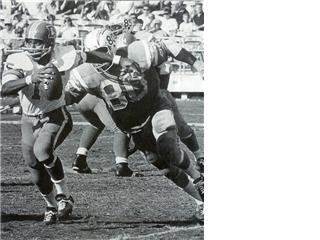
Boozer with the Los Angeles Lakers
Bob Boozer, Basketball Immortal (from my Omaha Black Sports Legends series, Out to Win: The Roots of Greatness)
©by Leo Adam Biga
Originally published in the New Horizons and later reprinted in The Reader (www.thereader.com) as part of my Omaha Black Sports Legends series, Out to Win: The Roots of Greatness
Omahan Bob Boozer chartered a bus to Manhattan for a February 5 engagement with immortality. By the way, that’s Manhattan, Kansas, where 50 of his closest friends and family members joined him to see his jersey retired at half-time of the Kansas State men’s basketball game.
In case you didn’t know, Boozer is a Wildcat hoops legend. In the late-1950s, he was a dominant big man there. In each of his three years, he was first team all-conference. He was twice a concensus first-team All-American. And that doesn’t even speak to his elite-level AAU play, his winning an Olympic gold medal on the original “Dream Team” and his solid NBA career capped by a championship.
Unless you’re a serious student of the game or of a certain age, the name Bob Boozer may only be familiar as one adorning a road in his hometown. But, in his time, he was the real deal. He had some serious game. He overwhelmed opponents as an all-everything pivot man at Omaha Technical High from 1952-55, earned national accolades as a high-scoring, fierce-rebounding forward at K-State from 1955-59, led an AAU squad to a title, played on the legendary 1960 U.S. Olympic basketball squad and was a member of the 1971 NBA champion Milwaukee Bucks. It’s a resume few can rival.
“There’s very few guys that really had it all every step of the way, like I did. All City. All State. All Conference. All-American. Olympic gold medal. NBA world championship. Those are levels everybody would like to aspire to but very few have the opportunity,” he said.
He is, arguably, the best player not in the college hoops hall of fame. He is, by the way, in the Olympic Hall of Fame. His collegiate credentials are unquestionable. Take this career line with the Wildcats: 22 points and 10 rebounds a game. And this came versus top-flight competition, including a giant named Wilt at arch-rival Kansas, when K-State contended for the national title every year. If anything, the Feb. 5 tribute is long overdue.
Of his alma mater feting him, he said, “It’s quite an honor to have your jersey retired. That means in the history of that school you have reached the pinnacle.”
The pinnacle is where Boozer dreamed of being. His Olympic experience fulfilled a dream from his days at the old North YMCA, mere blocks from his childhood home at 25th and Erskine. Then, he reached the pinnacle of his sport in the NBA. A starter most of his pro career, he was a productive journeyman who could be counted on for double figures in points and rebounds most nights. His career NBA averages are 14.8 points and 8.1 rebounds a game. The 6’8 Boozer played in the ‘68 NBA All-Star game, an honor he just missed other years. He led the Chicago Bulls in scoring over a three-year period. He was the Bucks’ valuable 6th man in their title run.
Still, he was more a role player than a leading man. His game, like his demeanor, was steady, not sensational. He was, in his own words, “a blue-collar worker.” He could shoot like few other men his size, utilizing deadly jumpers and hook shots.
“I was a good player. I would make you pay if you made a mistake. I could move out for the jump shot and the hook shot or make a quick move for a layup,” he said.
While he admires the athleticism of today’s players, he doesn’t think much of their basic skills.
“We could flat-out outshoot these kids today. We worked awfully hard at being able to shoot the jump shot. I used to always say that a 15- to 18-foot jump shot is just like a layup. That was my mind set — that if I got it clear, it was going down.”
He perfected his shot to such a degree that in practice he could find his favorite spots on the court and nail the ball through the hoop with his eyes closed.
“It’s just something that with thousands and thousands of repetitions gets to be automatic. And when I shot I always used to try to finger the ball for the seams and to swish it because if the ball left my hand with a backward rotation and went through the net, it would hit the floor and come right back to you. That way, when you’re shooting by yourself, you don’t have to run after the ball very much,” he said, chortling with his booming bass voice.
Unlike many players who hang around past their peak, once Boozer captured that coveted and elusive ring, he left the game.
“I had made up my mind that once I walked, I walked, and would never look back. Besides, your body tells you when it’s getting near the end. I started hating the training camps a little more. The last few years I knew it was coming to an end,” he said. “The championship season with the Bucks was the culmination of my career. It was great.”
Indeed, he left without seeking a coaching or front office position. The championship was made sweeter as he shared it with an old pal, Oscar Robertson. As players, they were rivals, teammates and friends. Both were college All-Americans for national championship contending teams. As a junior, Boozer and his KSU Wildcats eliminated “The Big O” and his Cincinnati Bearcats from the 1957-58 NCAA quarterfinals. The next year Robertson turned the tables on Boozer by knocking the No. 1-ranked ‘Cats out of the regionals.
The two were teammates on the 1960 US Olympic basketball team, considered by many the best amateur basketball talent ever assembled. Besides Boozer and Robertson, the team featured future NBA stars Jerry West, Jerry Lucas and Walt Bellamy. It destroyed all comers at the Rome games, winning by an average margin of 34-plus. Then Boozer and Robertson were reunited with the Cincinnati Royals. Cincy was the site of some fat times for Boozer, who was popular and productive there. It’s also where he met his wife, Ella. The couple has one grown child and one grandchild.
After a trade to the New York Knicks that he protested, Boozer bounced around the league. He played a few years with the expansion Chicago Bulls, where he enjoyed his biggest scoring seasons — averaging about 20 points a game. He led the Bulls to the playoffs in their inaugural season — the first and last time a first-year expansion team did that.

A card from his time with the Cincinnati Royals
He had one happy season with the Los Angeles Lakers, spelling the great Elgin Baylor, before he joined Robertson in Milwaukee. With the incomparable Kareem Abdul-Jabbar at center, smooth Bob Dandridge at forward, playmaker Robertson at guard and the steady Boozer coming off the bench (he averaged 9 points and 5 boards), the Bucks, in only their second year, blew away opponents en route to a 66-16 regular season mark. They captured the franchise’s first and only championship by sweeping the Baltimore Bullets in four games.
By then, Boozer was 34 and a veteran of 11 NBA seasons with five different teams. He left the league and his then-lofty $100,000 salary to build a successful career off the court with the former Northwestern Bell-US West, now called Qwest.
Now retired from the communications giant, the 67-year-old Boozer enjoys a comfortable life with Ella in their spacious, richly adorned Pacific Heights home in Omaha, a showplace he refers to as “the fruits of my labor.” He moves stiffly from the wear and tear his body endured on the hardcourt those many years. His inflamed knee joints ache. But he recently found some relief after getting a painful hip replaced.
With his sports legacy secured and his private life well-ordered, his life appears to have been one cozy ride. Viewed more closely, his journey included some trying times, not least of which was to be denied the chance to buy a home in some of Omaha’s posher neighborhoods during the late 1960s. The racism he encountered made him angry for a long time, but in the end he made peace with his hometown.
Boozer grew up poor in north Omaha, the only son of transplanted Southerners. His father worked the production line and cleanup crew at Armour’s Packinghouse. His mother toiled as a maid at the old Hill Hotel downtown. Neither got past the 9th grade and these “God-fearing, very strict” folks made sure Bob and his older sister understood school was a priority.
“They knew racial prejudice and they said education was the way out. Their philosophy was, you kids will never have to work as hard as we did if you go get your education. We had to get good grades,” Boozer said. “My junior year in high school my mother and dad set my sister and I down and said, ‘We‚ve got enough money to send your sister to Omaha U. (UNO). You’re on your own, Bob.’ Well, it just so happened I started growing and I started hitting the basket and I figured I was probably going to get a basketball scholarship, and that came to fruition.”
No prodigy, Boozer made himself into a player. That meant long hours at the YMCA, on playgrounds and in school gyms. His development was aided by the stiff competition he found and the fine coaching he received. He came along at a time when north Omaha was a hotbed of physical talent, iron will and burning desire.
“That was a breeding ground,” he said. “All the inner city athletes were always playing ball. All day long. All night long. If you were anything in athletics, you played for the Y Travelers, a basketball team, or the Y Monarchs, a baseball team, under Josh Gibson (Hall of Fame pitcher Bob Gibson’s older brother), who was a fine coach.”

Boozer said he spent so much time at the Y that its executive director, John Butler, “used to let me have the keys to the place. Butler provided the arena where I could work out and become an accomplished player and Josh Gibson provided the opportunity to play with older players.”
He said his dedication was such that while his buddies were out dating, “I was shooting hoops. It was a deep desire to excel. I always wanted to be a basketball player and I always wanted to be one of the best. I realized too at an early age athletics could provide me with an education.”
Athletics then, like now, were not merely a contest but a means of self-expression and self-advancement. Boozer was part of an elite lineage of black athletes who came out of north Omaha to make their mark. Growing up amid this athletic renaissance, he emulated the older athletes he saw in action, eventually placing himself under the tutelage of athletes like Bob Gibson — or “Gibby” as Boozer calls his lifelong friend, who is a year his senior. They were teammates one year each with the Y Travelers and at Tech.
“Some of the older athletes worked with me and showed me different techniques. In the inner city we basically marveled at each other’s abilities. There were a lot of great ballplayers. We rooted for each other. We encouraged each other. We were there for each other. It was like an inner city fraternity,” Boozer said. “I used to sit in the stands at Burdette Field and watch ‘Gibby’ pitch. As good a baseball player as he was, he was a finer basketball player. He could play. He could get up and hang.”
By the time Boozer played for Tech coach Neal Mosser, he was a 6’2” forward with plenty of promise but not yet an impact player. No one could foresee what happened next.
“Between my sophomore and junior years I grew six inches. With that extra six inches I couldn’t walk, chew gum and cross the street at the same time without tripping,” Boozer said. “That’s when I enlisted my friends, Lonnie McIntosh and John Nared, to help me. Lonnie, a teammate of mine at Tech, was a physical fitness buff, and John, who later played at Central, was probably one of the finest athletes to ever come out of Omaha.
“We’d go down to the Y every week. Lonnie would put me through agility drills on some days and then John and I would go one-on-one other days. John was only 6’3” but strong as a bull. I couldn’t take him in the post. I had to do everything from a guard-forward position. And, man, we used to have some battles.”
By his junior season Boozer was an imposing force — a big man with little-man skills. He could not only post-up down low to score, rebound and block shots, he could also shoot from outside, drive the lane and run the floor. With Boozer in the middle and a talented supporting cast around him, Tech was a powerhouse comprised mainly of black starters when that was rare. Then came the state tournament in Lincoln, and the bitterness of racism was brought home to Boozer and his mates.
“We had the state championship taken away from us in 1955. We played Scottsbluff. We figured we were the better team. I was playing center and I literally had guys hanging on me. The referees wouldn’t call a foul. I’d say, ‘Ref, why don‚t you call a foul?‚ and all I heard was, ‘Shut up and play ball,’ he said. “On one play, Lonnie McIntosh stole the ball and was dribbling down the sideline when one of their guys stuck his foot out and tripped him. There was Lonnie sprawled out on the floor and the referee called traveling and gave the ball to Scottsbluff. I will never forget that.
“We were outraged, but what could we do? If we had really got on the refs we’d have got a technical foul. So we had to suck it up and just play the best we could and hope we could beat ‘em by knocking in the most shots.”
Tech lost the game on the scoreboard but Boozer said players from that Scottsbluff team have since come up to him and admitted the injustice done that day. “It’s a little late,” he tells them. According to Boozer, Tech bore the brunt of discrimination in what should have been color-blind competition.
“Tech High always used to get the shaft, particularly in the state tournament.” He said Mosser, whom he regards as one of Nebraska’s finest coaches, helped him deal with “the sting of racism” by instilling a certain steeliness.
“Neal was a real disciplinarian. And he used to always tell us that life was not going to be easy. That you‚ve got to forge ahead.”
That credo was tested when Boozer became a hot recruit his senior year but was rejected by his top choice, the University of Iowa.
“Neal showed me a letter that Iowa coach Bucky O’Connor wrote telling him he had his quota of black players. “Neal said, ‘Bob, these are things you’re going to have to face and you’ve just got to persevere in spite of it.’ It hardens you. It makes you tougher.’”
Kansas was in the running until Wilt Chamberlain signed to play there. Boozer settled on Kansas State, where he made a name for himself and the Wildcats. Under coach Tex Winter, Boozer was the go-to-guy in the triangle post, an offense made famous years later by Michael Jordan and the Chicago Bulls.
“A lot of plays flashed across the middle. We had a double screen where I’d start underneath and come back. The off forward and guard would come down and pinch and I’d brush my guy off into them and pop out for my jump shot.”
During his three-year varsity career, the Cats went 62-15 and won two Big Eight titles. Boozer was unstoppable. His 25.6 scoring average as a senior remains a single-season record. He ranks among KSU’s all-time leaders in points and boards.
In a famous 1958 duel for league, intrastate and national bragging rights, he led a 75-73 double overtime win over Wilt Chamberlain and KU in Manhattan. He outscored Wilt 32 to 25.
“Nobody could go one-on-one with Wilt. He was just too powerful. From his waist up he was almost like a weight lifter. You always had to be aware of where he was because he’d knock the ball in the 13th row. I had one move where I’d face him and fake him and he’d take a step back and I would do a crossover hook shot. He’d be up there with it and always miss it by about like that,” Boozer said, holding his index finger and thumb an inch apart. “I’d say, ‘In your face, big fella.’ And he’d say, ‘I’ll get you next time.’ Wilt and I always enjoyed each other.”
After his banner senior year the NBA came calling, with the Cincinnati Royals making Boozer the No. 1 overall draft pick, but Boozer had other ideas.
“I delayed going pro one year to keep my amateur standing and get a shot at the Olympic Trials.”
To stay sharp he played a year with the Peoria Cats of the now-defunct National Industrial Basketball League, an AAU-sanctioned developmental league not unlike today’s CBA or NBDL. Boozer worked at the Caterpillar Tractor Co. by day and played ball at night. He led his team to the NIBL title, which qualified the team and its players to showcase their talents at the Olympic Trials in Denver. Boozer and a teammate made the grade. The Rome Olympics are still among his personal highlights.
“I was a history buff and just the idea of being on the Appian Way, where the Caesars trod, and all the beauty of Rome — it was magnificent. And winning the gold medal for my country was very, very meaningful.”
Even after entering the NBA, Boozer honed his game in the off-season back home with John Nared in one-on-one duels at the Y. “If he could guard me, as small and quick as I was, he could guard anybody in the NBA,” Nared said.
“We used to go out and get dinner, go back to our rooms, light up some cigars, pop open some beers and talk basketball until the wee hours of the morning.”
Boozer prepared for post-hoops life years before he retired by participating in a summer management training program with the phone company. By the time he quit playing ball, he had a job and career waiting.
“You see, I never forgot how my mom and dad stressed getting an education and looking after your family.”
In 1997, he retired after 27 years as a community affairs executive and federal lobbyist with the communications company. Restless in retirement, he accepted an appointment that year from then-Gov. Ben Nelson to the Nebraska Parole Board. Gov. Mike Johanns reappointed him to a new six-year term running through 2006. Boozer enjoys his work.
“It’s almost like being a counselor. I’ll pull an offender aside, especially a young male from the inner city, and have a common sense conversation with him, and most times he’ll listen. I think my athletic name helps me because most young males identify with an athlete.”
Boozer’s not just any ex-athlete. He’s an immortal.
Related Articles
- Collegians Were the Olympic Basketball Show in 1960 (nytimes.com)
- The Dream Team Enters The Basketball Hall Of Fame: Can The Lakers, Bulls, And Celtics Come Too? (sbnation.com)
- Basketball Hall Of Fame Speech: The 1960 U.S. Olympic Team (sbnation.com)
- Making the Case for a Nebraska Black Sports Hall of Fame (leoadambiga.wordpress.com)
- From My Series Out to Win: The Roots of Greatness, An Exploration of Omaha’s Black Sports Legends (leoadambiga.wordpress.com)
- Closing Installment from My Series Out to Win: The Roots of Greatness, An Exploration of Omaha’s Black Sports Legends (leoadambiga.wordpress.com)
- Omaha Hoops Legend John C. Johnson: Fierce Determination Tested by Repeated Run-Ins with the Law (leoadambiga.wordpress.com)
Prodigal Son: Marlin Briscoe takes long road home (from my Omaha Black Sports Legends series, Out to Win: The Roots of Greatness)
I never saw Marlin Briscoe play college football, but as I came of age people who had see The Magician perform regaled me with stories of his improvisational playmaking skills on the gridiron, and so whenever I heard or read the name, I tried imagining what his elusive, dramatic, highlight reel runs or passes looked like. Mention Briscoe’s name to knowledgable sports fans and they immediately think of a couple things: that he was the first black starting quarterback in the National Football League; and that he won two Super Bowl rings as a wide receiver with the Miami Dolphins. But as obvious as it seems, I believe that both during his career and after most folks don’t appreciate (1) how historic the first accomplishment was and (2) don’t recognize how amazing it was for him to go from being a very good quarterback in the league, in the one year he was allowed to play the position, to being an All-Pro wideout for Buffalo. Miami thought enough of him to trade for him and thereby provide a complement to and take some heat off of legend Paul Warfield.
The following story I did on Briscoe appeared not long after his autobiography came out. I made arrangements to inteview him in our shared hometown of Omaha, and he was every bit as honest in person as he was in the pages of his book, which chronicles his rise to stardom, the terrible fall he took, and coming back from oblivion to redeem himself. The story appeared in a series I did on Omaha’s Black Sports Legends, Out to Win: The Roots of Greatness, for The Reader (www.thereader.com) in 2004-2005. Since then, there’s been a campaign to have the NFL’s veterans committee vote Briscoe into the Hall of Fame and there are plans for a feature film telling his life story.

Prodigal Son:
Marlin Briscoe takes long road home (from my Omaha Black Sports Legends series, Out to Win: The Roots of Greatness)
©by Leo Adam Biga
Originally published in The Reader (www.thereader.com) as part of my Omaha Black Sports Legends series, Out to Win: The Roots of Greatness
Imagine this is your life: Your name is Marlin Briscoe. A stellar football-basketball player at Omaha South High School in the early 1960s, you are snubbed by the University of Nebraska but prove the Huskers wrong when you become a sensation as quarterback for then Omaha University, where from 1963 to 1967, you set more than 20 school records for single game, season and career offensive production.
Because you are black the NFL does not deem you capable of playing quarterback and, instead, you’re a late round draft choice, of the old AFL, at defensive back. Injured to start your 1968 rookie season, the offense sputters until, out of desperation, the coach gives you a chance at quarterback. After sparking the offense as a reserve, you hold down the game’s glamour job the rest of the season, thus making history as the league’s first black starting quarterback. When racism prevents you from getting another shot as a signal caller, you’re traded and excel at wide receiver. After another trade, you reach the height of success as a member of a two-time Super Bowl-winning team. You earn the respect of teammates as a selfless clutch performer, players’ rights advocate and solid citizen.
Then, after retiring from the game, you drift into a fast life fueled by drugs. In 12 years of oblivion you lose everything, even your Super Bowl rings. Just as all seems lost, you climb out of the abyss and resurrect your old self. As part of your recovery you write a brutally honest book about a life of achievement nearly undone by the addiction you finally beat.
You are Marlin Oliver Briscoe, hometown Omaha hero, prodigal son and the man now widely recognized as the trailblazer who laid the path for the eventual black quarterback stampede in the NFL. Now, 14 years removed from hitting rock bottom, you return home to bask in the glow of family and friends who knew you as a fleet athlete on the south side and, later, as “Marlin the Magician” at UNO, where some of the records you set still stand.
Now residing in the Belmont Heights section of Long Beach, Calif. with your partner, Karen, and working as an executive with the Roy W. Roberts Watts/Willowbrook Boys and Girls Club in Los Angeles, your Omaha visits these days for UNO alumni functions, state athletic events and book signings contrast sharply with the times you turned-up here a strung-out junkie. Today, you are once again the strong, smart, proud warrior of your youth.
Looking back on what he calls his “lost years,” Briscoe, age 59, can hardly believe “the severe downward spiral” his life took. “Anybody that knows me, especially myself, would never think I would succumb to drug addiction,” he said during one of his swings through town. “
All my life I had been making adjustments and overcoming obstacles and drugs took away all my strength and resolve. When I think about it and all the time I lost with my family and friends, it’s a nightmare. I wake up in a cold sweat sometimes thinking about those dark years…not only what I put myself through but a lot of people who loved me. It’s horrifying.
“Now that my life is full of joy and happiness, it just seems like an aberration. Like it never happened. And it could never ever happen again. I mean, somebody would have to kill me to get me to do drugs. I’m a dead man walking anyway if I ever did. But it’s not even a consideration. And that’s why it makes me so furious with myself to think why I did it in the first place. Why couldn’t I have been like I am now?”
Or, like he was back in the day, when this straight arrow learned bedrock values from his single mother, Geneva Moore, a packing house laborer, and from his older cousin Bob Rose, a youth coach who schooled him and other future greats in the parks and playing fields of schools and recreation centers in north and south Omaha.
For Briscoe, the pain of those years when, as he says, “I lost myself,” is magnified by how he feels he let down the rich, proud athletic legacy he is part of in Omaha. It is a special brotherhood. One in which he and his fellow members share not only the same hometown, but a common cultural heritage in their African–American roots, a comparable experience in facing racial inequality and a similar track record of achieving enduring athletic greatness.

Marlin Briscoe, a South High alum, is honored with a street named in his honor on Oct. 22, 2014.
Briscoe came up at a time when the local black community produced, in a golden 25-year period from roughly 1950 to 1975, an amazing gallery of athletes that distinguished themselves in a variety of sports. He idolized the legends that came before him like Bob Boozer, a rare member of both Olympic Gold Medal (at the 1960 Rome Games) and NBA championship (with the 1971 Milwaukee Bucks) teams, and MLB Hall of Famer and Cy Young Award winner Bob Gibson. He honed his skills alongside greats Roger Sayers, one of the world’s fastest humans in the early 1960s, NFL Hall of Famer Gale Sayers and pro basketball “Iron Man” Ron Boone. He inspired legends that came after him like Heisman Trophy winner Johnny Rodgers.
Each legend’s individual story is compelling. There are the taciturn heroics and outspoken diatribes of Gibson. There are the knee injuries that denied Gale Sayers his full potential by cutting short his brilliant playing career and the movies that dramatically portrayed his bond with doomed roommate Brian Piccolo. There are the ups and downs of Rodgers’ checkered life and career. But Briscoe’s own personal odyssey may be the most dramatic of all.
Born in Oakland, Calif. in 1945, Briscoe and his sister Beverly were raised by their mother after their parents split up. When he was 3, his mother moved the family to Omaha, where relatives worked in the packing houses that soon employed her as well. After a year living on the north side, the family moved to the south Omaha projects. Between Kountze Park in North O and the Woodson Center in South O, Briscoe came of age as a young man and athlete. In an era when options for blacks were few, young men like Briscoe knew that athletic prowess was both a proving ground and a way out of the ghetto, all the motivation he needed to work hard.
“Back in the ‘50s and early ‘60s we had nothing else to really look forward to except to excel as black athletes,” Briscoe said. “Sports was a rite-of-passage to respect and manhood and, hopefully, a way to bypass the packing houses and better ourselves and go to college. When Boozer (Bob) went to Kansas State and Gibson (Bob) went to Creighton, that next generation — my generation — started thinking, If I can get good enough in sports, I can get a scholarship to college so I can take care of my mom. That’s how all of us thought.”
Like many of his friends, Briscoe grew up without a father, which combined with his mother working full-time meant ample opportunity to find mischief. Except that in an era when a community really did raise a child, Briscoe fell under the stern but caring guidance of the men and women, including Alice Wilson and Bob Rose, that ran the rec centers and school programs catering to largely poor kids. By the time Briscoe entered South High, he was a promising football-basketball player.
On the gridiron, he’d established himself as a quarterback in youth leagues, but once at South shared time at QB his first couple years and was switched to halfback as a senior, making all-city. More than just a jock, Briscoe was elected student council president.
Scholarship offers were few in coming for the relatively small — 5’10, 170-pound — Briscoe upon graduating in 1962. The reality is that in the early ‘60s major colleges still used quotas in recruiting black student-athletes and Briscoe upset the balance when he had the temerity to want to play quarterback, a position that up until the 1980s was widely considered too advanced for blacks.

But UNO Head Football Coach Al Caniglia, one of the winningest coaches in school history, had no reservations taking him as a QB. Seeing limited duty as a freshman backup to incumbent Carl Meyers, Briscoe improved his numbers each year as a starter. After a feeling-out process as a sophomore, when he went 73 of 143 for 939 yards in the air and rushed for another 370 yards on the ground, his junior year he completed 116 of 206 passes for 1,668 yards and ran 120 times for 513 yards to set a school total offense record of 2,181 yards in leading UNO to a 6-5 mark.
What was to originally have been his senior year, 1966, got waylaid, as did nearly his entire future athletic career, when in an indoor summer pickup hoops game he got undercut and took a hard, headfirst spill to the floor. Numb for a few minutes, he regained feeling and was checked out at a local hospital, which gave him a clean bill of health.
Even with a lingering stiff neck, he started the ‘66 season where he left off, posting a huge game in the opener, before feeling a pop in his throbbing neck that sent him “wobbling” to the sidelines. A post-game x-ray revealed a fractured vertebra, perhaps the result of his preseason injury, meaning he’d risked permanent paralysis with every hit he absorbed. Given no hope of playing again, he sat out the rest of the year and threw himself into academics and school politics. After receiving his military draft notice, he anxiously awaited word of a medical deferment, which he got. Without him at the helm, UNO crashed to a 1-9 mark.
Then, a curious thing happened. On a follow-up medical visit, he was told his broken vertebra was recalcifying enough to allow him to play again. He resumed practicing in the spring of ‘67 and by that fall was playing without any ill effects. Indeed, he went on to have a spectacular final season, attracting national attention with his dominating play in a 7-3 campaign, compiling season marks with his 25 TD throws and 2,639 yards of total offense, including a dazzling 401-yard performance versus tough North Dakota State at Rosenblatt Stadium.
Projected by pro scouts at cornerback, a position he played sparingly in college, Briscoe still wanted a go at QB, so, on the advice of Al Caniglia he negotiated with the Denver Broncos, who selected him in the 14th round, to give him a look there, knowing the club held a three-day trial open to the public and media.
“I had a lot of confidence in my ability,” Briscoe said, “and I felt given that three-days at least I would have a showcase to show what I could do. I wanted that forum. When I got it, that set the tone for history to be made.”
At the trial Briscoe turned heads with the strength and accuracy of his throws but once fall camp began found himself banished to the defensive backfield, his QB dreams seemingly dashed. He earned a starting cornerback spot but injured a hamstring before the ‘68 season opener.
After an 0-2 start in which the Denver offense struggled mightily out of the gate, as one QB after another either got hurt or fell flat on his face, Head Coach Lou Saban finally called on Briscoe in the wake of fans and reporters lobbying for the summer trial standout to get a chance. Briscoe ran with the chance, too, despite the fact Saban, whose later actions confirmed he didn’t trust a black QB, only gave him a limited playbook to run. In 11 games, the last 7 as starter, Briscoe completed 93 of 224 passes for 1,589 yards with 14 TDs and 13 INTs and he ran 41 times for 308 yards and 3 TDs in helping Denver to a 5-6 record in his 11 appearances, 5-2 as a starter.
Briscoe proved an effective improviser, using his athleticism to avoid the rush, buy time and either find the open receiver or move the chains via scrambling. “Sure, my percentage was low, because initially they didn’t give me many plays, and so I was out there played street ball…like I was down at Kountze Park again…until I learned the cerebral part of the game and then I was able to improve my so-called efficiency,” is how Briscoe describes his progression as an NFL signal caller.
By being branded “a running” — read: undisciplined — quarterback in an era of strictly drop back pocket passers, with the exception of Fran Tarkenton, who was white, Briscoe said blacks aspiring to play the position faced “a stigma” it took decades to overcome.
Ironically, he said, “I never, ever considered myself a black quarterback. I was just a quarterback. It’s like I never thought about size either. When I went out there on the football field, hey, I was a player.”
All these years later, he still bristles at the once widely-held notions blacks didn’t possess the mechanics to throw at the pro level or the smarts to grasp the subtleties of the game or the leadership skills to command whites. “How do you run in 14 touchdown passes? I could run, sure. I could buy more time, yeah. But if you look at most of my touchdown passes, they were drop back passes. I led the team to five wins in seven starts. We played an exciting brand of football. Attendance boomed. If I left any legacy, it’s that I proved the naysayers wrong about a black man manning that position…even if I never played (QB) again.”

Despite his solid performance — he finished second in Rookie of the Year voting — he was not invited to QB meetings Saban held in Denver the next summer and was traded only weeks before the ‘69 regular season to the Buffalo Bills, who wanted him as a wide receiver.
His reaction to having the quarterback door slammed in his face? “I realized that’s the way it was. It was reality. So, it wasn’t surprising. Disappointing? Yes. All I wanted and deserved was to compete for the job. Was I bitter? No. If I was bitter I would have quit and that would have been the end of it. As a matter of fact, it spurred me to prove them wrong. I knew I belonged in the NFL. I just had to make the adjustment, just like I’ve been doing all my life.”
The adversity Briscoe has faced in and out of football is something he uses as life lessons with the at-risk youth he counsels in his Boys and Girls Club role. “I try to tell them that sometimes life’s not fair and you have to deal with it. That if you carry a bitter pill it’s going to work against you. That you just have to roll up your sleeves and figure out a way to get it done.”
While Briscoe never lined up behind center again, soon after he left Denver other black QBs followed — Joe Gilliam, Vince Evans, Doug Williams and, as a teammate in Buffalo, James Harris, whom he tutored. All the new faces confronted the same pressures and frustrations Briscoe did earlier. It wasn’t until the late 1980s, when Williams won a Super Bowl with the Redskins and Warren Moon put up prolific numbers with the Houston Oilers, that the black QB stigma died.
Briscoe was not entirely aware of the deep imprint he made until attending a 2001 ceremony in Nashville remembering the late Gilliam. “All the black quarterbacks, both past and present, were there,” said Briscoe, naming everyone from Aaron Brooks (New Orleans Saints) to Dante Culpepper (Minnesota Vikings) to Michael Vick (Atlanta Falcons).
“The young kids came up to me and embraced me and told me, ‘Thank you for setting the tone.’ Now, there’s like 20 black quarterbacks on NFL rosters, and for them to give me kudos for paving the way and going through what I went through hit me. That was probably the first time I realized it was a history-making event. The young kids today know about the problems we faced and absorbed in order for them to get a fair shot and be in the position they are.”
Making the Buffalo roster at a spot he’d never played before proved one of Briscoe’s greatest athletic challenges and accomplishments. He not only became a starter but soon mastered the new position, earning 1970 All-Pro honors in only his second year, catching 57 passes for 1,036 yards and 8 TDs. Then, in an example of bittersweet irony, Saban was named head coach of the moribund Bills in 1972 and promptly traded Briscoe to the powerful Miami Dolphins. The move, unpopular with Bills’ fans, once again allowed Briscoe to intersect with history as he became an integral member of the Dolphins’ perfect 17-0 1972 Super Bowl championship team and the 1973 team that repeated as champs.
Following an injury-plagued ‘74 season, Briscoe became a vagabond — traded four times in the space of one year — something he attributes to his involvement in the 1971 lawsuit he and five other players filed against then-NFL commissioner Pete Rozelle, an autocrat protecting owners’ interests, in seeking the kind of free agency and fair market value that defines the game today. Briscoe and his co-complainants won the suit against the so-called Rozelle Rule but within a few years they were all out of the game, labeled troublemakers and malcontents.
His post-football life began promisingly enough. A single broker, he lived the L.A. high life. Slipping into a kind of malaise, he hung with “an unsavory crowd” — partying and doing drugs. His gradual descent into addiction made him a transient, frequenting crack houses in L.A.’s notorious Ho-Stroll district and holding down jobs only long enough to feed his habit. The once strapping man withered away to 135 pounds. His first marriage ended, leaving him estranged from his kids. Ex-teammates like James Harris and Paul Warfield, tried helping, but he was unreachable.
“I strayed away from the person I was and the people that were truly my friends. When I came back here I was trying to run away from my problems,” he said, referring to the mid-’80s, when he lived in Omaha, “and it got worse…and in front of my friends and family. At least back in L.A. I could hide. I saw the pity they had in their eyes but I had no pride left.”
Perhaps his lowest point came when a local bank foreclosed on his Super Bowl rings after he defaulted on a loan, leading the bank to sell them over e-bay. He’s been unable to recover them.
He feels his supreme confidence bordering on arrogance contributed to his addiction. “I never thought drugs could get me,” he said. “I didn’t realize how diabolical and treacherous drug use is. In the end, I overcame it just like I overcame everything else. It took 12 years…but there’s some people that never do.” In the end, he said, he licked drugs after serving a jail term for illegal drug possession and drawing on that iron will of his to overcome and to start anew. He’s made amends with his ex-wife and with his now adult children.
Clean and sober since 1991, Briscoe now shares his odyssey with others as both a cautionary and inspirational tale. Chronicling his story in his book, The First Black Quarterback, was “therapeutic.” An ESPN documentary retraced the dead end streets his addict’s existence led him to, ending with a blow-up of his fingers, bare any rings. Briscoe, who dislikes his life being characterized by an addiction he’s long put behind him, has, after years of trying, gotten clearance from the Dolphins to get duplicate Super Bowl rings made to replace the ones he squandered.
For him, the greatest satisfaction in reclaiming his life comes from seeing how glad friends and family are that the old Marlin is back. “Now, they don’t even have to ask me, ‘Are you OK?’ They know that part of my life is history. They trust me again. That’s the best word I can use to define where I am with my life now. Trust. People trust me and I trust myself.”
Related Articles
- Black like me (cbc.ca)
- Black like me: CFL QB legacy (cbc.ca)
- UNO Wrestling Dynasty Built on a Tide of Social Change (leoadambiga.wordpress.com)
- Today’s Exploration: Omaha’s History of Racial Tension (theprideofnebraska.blogspot.com)
- Omaha Native Steve Marantz Looks Back at the City’s ’68 Racial Divide Through the Prism of Hoops in His New Book, ‘The Rhythm Boys of Omaha Central’ (leoadambiga.wordpress.com)
- Back in the Day, Native Omaha Days is Reunion, Homecoming, Heritage Celebration and Party All in One (leoadambiga.wordpress.com)
- Eric Crouch To Play For UFL’s Omaha Nighthawks, Fulfill Destiny (sbnation.com)
Golf shots: Patrick Drickey lives dream photographing the world’s great golf courses
This successful art and commercial photographer has in recent years found his niche making panoramic images of the world’s great golf courses. The creative artist’s early work goes back to the founding, fledgling years of Omaha’s Old Market. He never really left the Market in his heart and when he could he bought property. He’s developed cool living-work-community spaces out of old buildings tastefully renovated to retain their charming urban historical character. Subsequent to this profile being published he’s opened a popular art gallery and event space, the 1516 Gallery, in one of his buildings. Those who know of Drickey or who know only one aspect of his life and work will likely be surprised by the breadth and depth of his experience and of his output. With any profile subject it’s best to get to know their passion because once you know that then you get to know the man or woman you’re writing or reading about. If nothing else, I hope this adequately expresses the extent of Drickey’s passion.

Golf shots: Patrick Drickey lives dream photographing the world’s great golf courses
©by Leo Adam Biga
As published in the current edition (August 2010) of the New Horizons
The same wanderlust that sent Patrick Drickey off to see the world at 17 in the U.S. Navy Reserve carries him today on photographic shoots around America and overseas.
After working as an art, architectural, food and agricultural photographer, Drickey hit upon an idea for photographing the world’s great golf courses. He saw a market for indelibly commemorating the signature golf holes that make these green meccas and Elysian Fields iconic symbols for everyone from professionals to weekend duffers.
He appreciates the irony of being one of the world’s most in-demand golf photographers yet not having grown up playing the game. Though he plays now, he’s hardly accomplished as a 25-handicapper. But this “history buff” is well-versed in the game’s heritage. He knows its hallowed grounds, having trod many of those very links himself. He is schooled in its legends, many of whom he’s met and photographed, including Jack Nicklaus and Arnold Palmer.
He also enjoys reviving his own family’s golf legacy. His late maternal grandmother Helen Burmester was a local amateur champion in the 1930s. His mother didn’t play the game, therefore he didn’t. The images he makes today would have surely pleased grandma. He displays her antique clubs at Stonehouse.
His is the ultimate niche business specializing in panoramic images of picturesque places like Pebble Beach and St. Andrews. Drickey and his staff employ a rigorous production process to create archival quality prints imbued with painterly attributes. Customers collect framed Stonehouse prints the way some folks collect fine art works.
None of that was on his mind 44 years ago. In 1966 he was a bored Omaha Burke High School junior, just marking time before going off on some undefined adventure. He got what he wanted when he joined the Navy — both to see the world and escape the military draft for the escalating Vietnam War.
He counted on being assigned a cushy, scenic port of call out of harm’s way. He got his wish in Guam. Then in January ’68 he was sent to a naval supply facility in Saigon, where as “a storekeeper” he was in charge of procuring most everything for delta patrol boat crews and construction battalions.
“It was like being given the keys to the kingdom as an enlisted man,” he said. The job gave him latitude as the point person who could lay his hands on whatever people wanted. “Pretty much anytime anything needed to be greased, they’d come to me.”
He would apply that keep-everybody-happy skill set to his professional photography career, where pitching and pleasing clients is paramount.
He knew Saigon was far from the front line action and so he had little cause for worry.
“I had no idea what to expect, except Saigon was considered a safe zone, so I wasn’t that concerned about anything. We were at a place called the Annapolis, like a temporary Navy billet right outside Tan Son Nhut Air Base (the near Saigon base accommodated military personnel from each branch). From there guys would get assignments and be sent everywhere in the country. Because we were on temporary assignment they had us staying there. We would drive to the main warehouse compound early in the morning.”
On his third morning there he and fellow supply personnel left for the drive into Saigon, unaware the area they left behind would come under attack by Viet Cong forces in the Tet Offensive, which took its name from the traditional Vietnamese holiday it coincided with.
The VC flooded into the south by the tens of thousands. Fire fights and full scale battles erupted over a wide battlefront. Except Drickey and his mates didn’t know it was happening until almost too late.
“The morning Tet started we all piled on a two-and-a-half ton flatbed stake truck. The streets were dead quiet and we didn’t really think anything of it. There was no machine gun fire going off or anything like that. The three days prior the streets were filled and fire works were going off in celebration of Tet. That’s a big event for those people. Kind of like the Fourth of July in America.”
He and his mates figured the quiet was the post-holiday lull, but they were then jolted into reality.
“We went past the U.S. embassy and we noticed damage to the facade, like big mortar or artillery rounds hit it. We got down to the compound and the gates were closed, which was unusual. Then guards popped up from over the top, outfitted in flak jackets, brandishing M-16s. They asked, ‘What are you guys doing — haven’t you heard?’ We hadn’t heard anything.”
Strategic parts of Saigon were, Drickey said, “under siege,” a situation in which “anything could happen.” He recalled,,” We got in the compound and spent the next seven days isolated there. We did come under sniper fire. We had guard duty on all the perimeters. No (regular) food, we had to break out sea rations.”
Though the offensive was repelled, it put everyone on edge.
“You didn’t go anyplace after that without firearms,” he said. “I had my own vehicle, and they issued anybody who was driving a truck a sawed-off shotgun because the blast pattern was so big that all you had to do was point and shoot and it would take out anything.”

Drickey was stationed in Saigon during the Tet Offensive
Even his “sweet sawed-off” was no gauranteed protection against tactics targeting U.S. military. In those tropical climes he said it was standard practice to drive with vehicle windows rolled down, making drivers and passengers susceptible to a grenade or other explosive being thrown inside or someone taking pot shots at them. Drickey luckily escaped injury.
Indeed, he settled into a familiar, comfortable routine. Along the way, he was exposed to an intrepid band of men who inspired a new vision for what he might do with his life. The backdrop for this revelation were great big R & R bashes the local commander of Naval supply operations threw.
“The old man was interested in camaraderie among the troops,” Drickey explained. “There were seven warehouses in Saigon and once a month you’d get together at one of them for an afternoon of barbecue, volleyball, poker, and shoot-the-shit. It was also a time to get grievances ironed out. The food during those events was always top rate, and that was attractive to the AP (Associated Press) and UPI (United Press International) photographers, who would spend time in our compound.”
These photojournalists covering the war were a breed apart. Their independence and their enthusiasm for their work made a distinct impression on Drickey.
“I was just a kid and they were the first people I met who never complained about their jobs. They couldn’t wait to get their next assignment, wherever it was going take them around the world, and that intrigued me,” he said. “It was their attitude. I said, Wow, that’s the kind of adventure I want my life to be.”
Before encountering the lensmen, he’d never considered photography a career choice. He’d only fiddled with a Brownie back home. Until ‘Nam, no photographer served as a model he might follow.
“My only experience with a photographer was posing for one at a wedding or for high school portraits. I had absolutely no interest in that. But the adventure of photojournalism hooked me.”
Back home in the States in ’69, he pursued his new found aspiration. He used the GI Bill of Rights to enroll at the University of Nebraska at Omaha but between meager funds and a requirement he take writing-reporting classes, he dropped out. At the time, he said there was no focused photojournalism program or track at any area school, and so he pieced together his own by taking a course here and a course there.
“I wound up auditing courses for photography at Bellevue College and Creighton University. I took a course over at Iowa State specializing in architectural photography. My dad was a carpenter and contractor, so for me getting involved with buildings seemed like a natural choice.”
Drickey never became a news hound like those romantic figures who sparked his imagination. But he learned the craft bit by bit, carving out a place for himself that, while hardly heroic, made him a nice living and ultimately provided the freedom to find his passion and travel the world.
Early on, he identified himself as an art photographer.
“I was doing black and white still-lifes then. I had a show with Judith Welk (Omaha acrylic and oil painter) called “Fresh Produce,” all based on still llfes and a visit to Seattle. I was somewhat successful with that but I soon realized it wasn’t a career move for me unless I decided to get a degree and become a teacher.”
In the early ’70s Drickey immersed himself in the emerging Old Market counterculture scene. “I was always drawn to it. Everybody down there was very independent thinking. I was one of the founding members of the Artists Cooperative Gallery, when it was above M’s Pub. It was a true coop . You were required to work one period a month, typically a Friday night opening. It taught me the discipline of pulling together a show and what that takes.”
Other pioneering Old Market artists whose paths he crossed then included the late Lee Lubbers, installation artist Catherine Ferguson and the former Ree Schonlau, now Ree Kaneko. Ree’s husband is celebrated ceramic artist Jun Kaneko. Ree founded the Bemis Center for Contemporary Arts, whose artist-in-residency program has brought hundreds of artists from around the world to live, work, and exhibit in Omaha.
“Ree’s my all time hero in the city. Her vision for what could be, can be, is still amazing to me. She is just one-of-a-kind and an absolute Omaha treasure. She was one of four women who had an operation called the Craftsmen’s Guild. Ree was the potter. I was a young photographer looking for space and they had an upper floor open I considered doing a studio in. For whatever reason the deal fell apart but I maintained a relationship with Ree. She always had me photograph the artists’ work for the invitations.”
That led to contacts with other local artists. He’s collected their work ever since. His artist friends include Larry Sasso and the Kanekos. He was close to the late Kent Bellows, whose hyper realistic drawings are the basis for a fall Joslyn Art Museum retrospective Drickey’s helped organize.
The Old Market remains his artistic home. He’s maintained property in the historic district for years, always making his studio and office there, though never residing there.
“I started in a basement at 12th and Harney. Back then I paid $175 a month rent. It was affordable, it was doable, I don’t know that anybody can do that (starting out) today. I bought my first building at 14th and Howard.”
The two-story red brick building his Stonehouse Publishing occupies at 1508 Leavenworth was originally St. Philomena school. As he tells the story, a fire led to the third floor being removed. At some point, he said, a tractor supply company bought the entire block and combined that building with two adjacent ones. A porch addition was made to the original structure.

In the ‘70s Omaha businessman and politico Leo Kraft bought the complex, converting it into a home and studio (his wife Frances Kraft was an artist) . Drickey and his wife Karen, a Bryan High School art teacher, led efforts to preserve Tomlinson Woods as a public arboretum and they found an ally in Kraft, the then-Omaha City Council president.
“We came there for a brunch one Sunday with kind of an eclectic mix of people and I never forgot the space. That was the first time I’d witnessed anything like this,” Drickey said, referring to the urban loft space with exposed original brick and wood work.
Drickey’s appreciation for well designed historic buildings was instilled in him by his father and honed by the photography he did for HDR and for Leo A. Daly. His work for Daly sent him all over the country, photographing their projects.
When the Krafts passed away Drickey approached their son Marc about the property but, he recalled, “it was so close to the family’s hearts I couldn’t ever see a chance when they’d part with it.” In 2000 he saw a for sale sign out front. He acted quickly to purchase the site. He’s put much sweat equity into renovating the studio-office space. He and his three brothers learned the construction trades from their father.
“Construction is in our blood,” he said. “We all know how to do stuff. I know how to dig a footing and put up a building. There’s nothing I can’t do.”
His blue collar sensibility is why his closest relationships in golf are with the course superintendents.
“Let’s just say in the world of golf I probably get along better with the golf course superintendents than anyone else,” he said. “I’m more drawn to those guys. They’re the unsung heroes to me because they are the ones out there providing what it takes to make that course a beautiful challenge. I’ve made so many friends on the superintendents side.”
When he finishes a golf project he generally gives a limited edition print to the course super as a thank you for the courtesy and access they provide on a shoot.
Drickey’s pathway to golf photography came via ag photography. His apprenticeship included a five-year stint with Walter and Nancy Griffith and their Photographers Associated. He said it was under Walter Griffith’s tutelage “where I learned how to be a studio photographer. He had an extraordinary studio.”
One of Griffith’s big accounts was Omaha Steaks, and Drickey went on to build his own food clientele, including Godfather’s Pizza.
Griffith also introduced Drickey to the panoramic format for shooting outdoor landscapes by way of a panoramic camera he built himself for the ag business. When Fuji came out with a panoramic camera Drickey was one of the first in this area to get one.
“Whenever you looked at those panoramic images on the light table and studied them with a loop it was like you were standing in the field,” said Drickey. “I knew the power of that image. That had great impact on me.”
Subsequently, Drickey said, “I chased the ag business.” He felt at ease with the farmers and ranchers he met on projects, saying, “They just have a different quality about them.” He came to appreciate the unexpected similarities of how light and shadow fall on the contours of a food and ag landscape.
“It’s funny because I aways heard that shooting food is like shooting landscapes, just on a different scale, and it’s true. A successful food shoot is a landscape, in how it’s lit, all of the elements are there.”
Reinventing himself as a golf photographer came about in a mother-of-invention way. A client, Cushman, a leading manufacturer of golf carts and lawn maintenance equipment, put out an annual calendar using “the tool girl” concept of a Playboy centerfold posing with products. “It worked for years,” he said. When a new, female marketing director asked him to take the calendar in a whole new direction, he hit upon the idea of picturing Cushman products against the backdrop of the world’s best golf courses.
The marketer loved the idea but then Cushman was sold and the new owners ditched the campaign. Fortunately for Drickey his idea was shared with Cushman’s advertising agency. They liked it so much they pitched the idea to another client, Rainbird Irrigation, which serviced many top courses, and they bought it.
“The next thing I knew I was on a worldwide, whirlwind tour of all the world’s best courses, starting with Pebble Beach,” Drickey said.
That very first assignment at Pebble Beach in 1995 proved pivotal. He was there to get a shot of its famed No. 7 hole, only the weather didn’t cooperate.
“I waited there in the rain for six days for it to stop raining, and on the seventh day the sun shone and I got a beautiful panoramic shot.”
The shot remains the best-selling print in the Stonehouse archive. When 600 prints of that image sold at the 1996 AT & T Pebble Beach National Pro-Am, he said, “that’s when I knew this could be a business. it’s been a fun ride, a bit of a roller coaster, but a fun ride ever since.” He sold his ag-food photography business to form Stonehouse, whose name comes from the field stone lake house he kept in Iowa.
The USGA (United States Golf Association) saw the image, and, he said, “they embraced it and put in their catalogue and it was like the top selling item for six consecutive issues.” That exposure, he said, “got the attention of some folks at The Open (the British Open), and I wound up doing all of the British open rotation courses, including some of the historic ones, like Royal Port Rush in Northern Ireland.”

This year Stonehouse was selected as one of the official images by St. Andrews Links, which runs the course on which the 2010 Open at St. Andrews was played. Contestants autographed the picture for permanent display in the St. Andrews clubhouse, a rare honor accorded a Yank photographer.
“It validates my career in the manner Kent Bellows was validated when the New York Metropolitan Museum acquired his work for their permanent collection,” said Drickey.
He’s also been privileged to do special projects for living legends Jack Nicklaus and Arnold Palmer. The Nicklaus project involved Drickey documenting Jack’s last round as a player at St. Andrews.
“That turned out to be great, but totally unnerving for me because it’s not something I specialize in. I was like, OK, what are you going to do to capture this icon within an icon in a panoramic format? You preview these things in your head, what you expect, where you’re going to be, where he’s going to be, and it’s not a matter of, Hey Jack, look over here. You don’t get that opportunity.
“I took my son on that and that was a great experience for him.”
It turned out one of Nicklaus’s sons caddied for Jack that day.
Drickey failed to get a hoped-for element in the shot but made up for it by nailing another: “Jack was playing with Tom Watson and Luke Donald. I wanted the leader standard in the shot to show where the players stood in the tournament, but when Jack lined up for his putt on No. 1, I was limited to where I could be, and I couldn’t control where those guys were.”
Thus, the leader standard ended up out of frame. But Drickey did get Jack in the sweater he wore when he won his last British Open. Picturing the golf god in it took on added importance when Jack then removed it, giving Drickey one of the only shots of the Golden Bear in that sentimental garb on the Old Course.
“It’s the shot I’m the most proud of,” said Drickey. “We did a big print of it and sent it down to Jack, and his people called me and said that Jack added the prints to his personal collection.”
At the storied Latrobe Country Club in Latrobe, Penn. the course that Palmer’s father designed and where Arnie learned to play, Drickey got to contribute to the Palmer lore by shooting an assignment there. He said the only instruction given by club officials was “to pay special attention to the back nine, where the covered bridges are — those are real special to Mr. Palmer.”
“I knew it was significant to the Palmers. I walked out on this course…I had misty early morning light. Then I got to No. 11, and the sun came out in such a way that it kind of highlighted the bridge, with the mist rolling back. That’s how Pennsylvania people see their countryside all the time in their mind’s eye. and I got the shot. I said, I don’t need to do anything else on this course, this is it.”

The framed print was sent to Palmer, who invited Drickey to a licensee event at Latrobe. It was there Drickey learned his print made quite an impact.
“I ate dinner with his brother Jerry, and I had brought these mini-prints I give out as examples of who we are, and he said, ‘Oh you’re this guy, I gotta tell you this story: When you sent that framed print Arnie’s assistant put it on an easel for him to see it and all of us were standing around just to see his reaction. Arnie looked at it, he had a tear in his eye, and he said, Boy did you ever think this place could look this good?'”
Drickey said he was told Palmer got so “emotional” that he purportedly declared, “When I’m dead and in a coffin one of those prints is going to be buried with me.” The photographer also learned some of his images hang in Palmer’s office. Having Palmer as a fan, he said, has “opened some doors for us like you can’t believe.” For example, the Golf Channel did a piece on Drickey and now carry Stonehouse prints online.
In addition to being endorsed by some of golf’s top names, Stonehouse is licensed by major courses, by the USGA and by the PGA, giving him access to virtually any fairway and green. From Pinehurst to Medinah to many other championship courses with rich histories, Stonehouse and Drickey are recognized names with carte blanche access.
“Which is a significant deal,” he said, ”because we are becoming that embedded in the lore of golf.”
Additionally, he said more than 600,000 Stonehouse prints are now in circulation.”We’ve branded the panoramic format for golf,” he said “That belongs to Stonehouse. One of the things I like about what I’ve been able to do is carve out a niche that goes beyond the confines of Omaha.”
Employing all-digital equipment in the field and in the studio, Drickey applies exacting standards to his imagemaking not possible with film. Digital enhancements bring clarity from shadows and achieve truer, more balanced colors, he said. Even a sand trap can be digitally raked.
“It’s just incredible what you can do — the control you have,” he said.
The refinements or touch-ups accomplished in the post-production process are why he calls what he does “more photo illustration than straight photography.”
He said Stonehouse has adopted the fine art Giclee process to its own printmaking methods, which entails using expensive pigmented archival inks on acid free watercolor paper to ensure prints of lustrous, enduring quality.
“I want to produce a product that’s going to be around for a long time. The color hits that paper and stays with it — it will not fade,” he said.
He feels another reason for Stonehouse’s success is its images portray the timeless characteristics that distinguish a scenic hole or course. He strives to fix each scene into a frieze that expresses the design, the physical beauty, the tradition. His eye for detail helps him bring out “the architecture” of it all.
The clubhouse is often featured in shots because club members expect to see it.
Getting the composition just how he wants it means “waiting for the right light,” he said, adding, “Even a tree shadow coming across the green will change the dynamics of that composition.” Waiting for magic time can mean hours or days.
Much care and research go into finding the one idyllic, golden-hued shot that will speak to avid golfers. That’s who Stonehouse prints are marketed to. He said a typical customer wants a print of the famous hole or course they challenged, much like a hunter wants the head of the game he bagged.
Building-updating Stonehouse’s image collection keeps Drickey on the road several days a month. He’s half-way to his goal of photographing the world’s top 100 courses. One he’s still waiting to shoot is Augusta, home to the Masters.
“That’s one of America’s crown jewels. We are present at the other majors and we’d like to have a presence there. It’s just a matter of time. Those introductions have been made,” he said.
![]()
Glimpses at the 1516 Gallery he’s opened and directs
Stonehouse prints grace books-periodicals-calendars and other publications. Some of its images are included in the coffee table book, Planet Golf.
Not all his assignments are outside Nebraska. He often shoots in-state courses, at least one of which — the Sand Hills Golf Club near Mullen — is regarded as world-class. Its managing partner, Dick Youngscap, said Drickey “does all of our work. He’s a premier photographer. He’s the best I’ve been around. Pat seems to have an empathy for not only the golf course but the physical environment — the scale and the scope of it. He’s just special, both as a human being and as a talented artist.”
Whether trudging across the Sand Hills or the Scottish Moors, Drickey always brings his clubs along in case the mood strikes to shoot a round or two. He said club officials “always offer” an invitation to play. “They assume I’m a golfer first and a photographer second, and that’s not true. I am a photographer first. I love the game, not that I have what I would call a game. I just like being out there. I don’t keep score. I stopped a long time ago. It makes it a much more enjoyable game. What’s the point? I guess to see if you’ve improved, but I know when I’ve hit a good shot, and that’s all I care about.”
Just like he knows when he’s composed a winning photograph.
He realizes how lucky he is to visit such oases for his job. “They’re beautiful places, absolutely stunning,” he said. It’s his dream job come true.
“I’m doing exactly what I want to do.”
Visit the Stonehouse website at http://www.stonehousegolf.com or call 1-800-949-7274.
Related Articles
- How to Photograph a Golf Course (brighthub.com)
- Masters 2011: Woods, Mickelson and McIlroy Remind Us of the Human Side of Golf (bleacherreport.com)
- Fairways Where Golf Becomes the City Game (travel.nytimes.com)
Harley Cooper, The Best Boxer You’ve Never Heard Of
Even if you consider yourself a real student of boxing and its history in America, chances are the name Harley Cooper isn’t familiar to you. Yet, pound-for-pound, he was as tough as they come in the ring and he just may have been the best boxer you’ve never heard of. The highlight of his amateur career — he never went pro — was winning two National Golden Gloves light heavyweight titles. He was in middle of a long U.S. Air Force Career at the time. My New Horizons story about Cooper sort of makes the case for him as this unsung warrior whose achievements have been largely forgotten today, but who came oh-so-close to joining the sport’s ranks of immortals before a bad break prevented him from fighting on the world stage in the Olympic Games. Then, when he opted not to turn pro, but rather continue his military career, his amateur feats soon faded into obscurity. No one can ever take those Golden Gloves titles away from him though. Cooper didn’t fight anymore but he remained in boxing as a coach and amateur boxing organizer, and continues to be active in the sport today. He’s also a devoted family man with 13 grown children and many grandchildren.

Harley Cooper, The Best Boxer You’ve Never Heard Of
©by Leo Adam Biga
Originally published in the New Horizons
Then Air Force tech sergeant Harley Cooper never saw the punch Joe Frazier knocked him down with during a Washington, D.C. sparring session in preparation for the 1964 Olympic Games in Tokyo. A tough Savannah, Georgia native, Cooper grew up fighting in The Hood, but got schooled in the Sweet Science in the military. Upon winning the second of two national Golden Gloves titles while boxing out of Offutt Air Force Base, he then won the right to be the U.S. Olympic light heavyweight entry by capturing the Olympic Trials. In peak fighting trim and riding an unbeaten streak, he was primed to bust some heads in Tokyo.
For his Olympic training, Cooper often worked out with team heavyweights Frazier and alternate Buster Mathis, the actual Trials champ who lost his Tokyo shot after suffering a broken hand. Fate then took a sad turn in Cooper’s own bid for Olympic glory when, on the eve of leaving for Japan, he was medically disqualified. During an earlier assignment in Germany, Cooper, born with a deformed kidney, developed problems with his other kidney after drinking water from a mountain stream, causing doctors to remove the damaged organ. Left with a single kidney, he boxed with no ill effects right up until officials nixed his Olympic trip. “They had an Air Force officer there who told me I could go, but I couldn’t fight. They felt it was a danger to me, even though I’d been fighting for about three-four years with one kidney. I told them if they wouldn’t let me fight to let me go home. Now, I wish I would have went,” says Cooper, his soft eyes filled with regret even now at the thought of missing all the Olympic pomp and pageantry.
This seemingly arbitrary decision denying him a chance for Olympic gold, especially when so close to pursuing it, hurt him to his core.
“That was really, really tough,” says the soft-spoken Cooper, an inscrutable man with the pensive demeanor of a scholar. “Honestly, I believe if I would have gone, I would have won. Well, I gotta believe this, because in boxing, if you don’t think you can win, you’re lost.”
Only a couple years before, he’d transfered to Omaha. His new training ground became Hawk’s Gym, where his sparring partners included pro heavyweight Lou Bailey. He shot up the amateur ranks by sweeping thw Golden Gloves. It was his first Gloves action, but he was no rookie, having already compiled hundreds of hours in the ring and dozens of bouts in the military, winning service titles wherever duty called, including Japan and Europe. Once here, he out-classed the field. “In all honesty, I had the advantage because of my experience,” he says. “I had the strength. I had the discipline. I had the knowledge. I had the ability.”
He’d dabbled in the sport earlier, when he trained for one bout and lost, but only got serious following a scene straight out of the movies. He was based in Japan when, one night, he and a buddy went to a service boxing exhibition. There was a call, just like in carnivals of old, for a volunteer to have a go at one of the fighters. He took the bait. “Being young and dumb,” he says,. “I put my hand up and I went in, and me and this guy started boxing. At this time, I didn’t know how to box, but I could fight, OK? I knocked this guy down and the coach came and asked me to join the team. I joined…and that’s how I got into boxing.”
Boxing gave him something other sports he tried, didn’t. “I was always involved in some kind of sport, but once I started boxing than I stopped doing all the rest. For some reason, it just fit me. In boxing, you’re the only one…you either rise to the occasion, alone, or you don’t. With my background, it was more the challenge…of the give-and-take. And when you survive and win…there’s no other feeling like it.”
The youngest of eight children in a poor, working class family, he quickly learned how to use his fists. “As the baby of the family, I know I got tough from the older kids picking on me. When you’re the small one, you get all the lashings. And I was born and raised in a family where you didn’t back down, especially if you got in a fight,” he says. “If I got beat up and I went home crying, than my brothers would smack me a couple times and take me back. You dried your tears before you got home. So, I was pretty tough. But I wasn’t a bully.”
Playing the usual team sports as a youth, he says “I could hold my own” but was no superstar. He left home at 17 to join the Army and after a year’s hitch he signed up with the Air Force, where he found a home.
By the time he got to Omaha, Cooper was a mature 27-year-old veteran of both the ring and the military and the father of eight. The arrival of such a man and fighter on the local pugilistic scene soon turned heads and started tongues wagging.
“Everybody wanted him to fight for them,” says Omaha boxing historian Tom Lovgren, a former prize fight matchmaker and a longtime observer of the local fight scene. “The first time anybody saw him in the gym they knew this guy was going to be a national champion. He could punch. He could box. He could do it all. He was the most complete fighter I ever saw from around here. I never saw Harley Cooper lose a round in amateur fights in Omaha. He was that dominant.”
Boxing is replete with back room dealings and personal jealousies. So, once local coaches got a gander at Cooper, they vied like mad to get him to train with them and fight for their teams. That’s when, Lovgren says, the late Omaha World-Herald sports columnist, Wally Provost, stepped in and told Cooper, “You’re fighting for me,” to squelch any in-fighting and bad feelings. A few local figures worked with Cooper during his amateur career here, including the late Jack Fickler, but Cooper says, “I was seasoned enough that I trained myself. I knew what I had to do.”
He was able to do this, he says, thanks to his strict military training, which complemented boxing. “It’s not only the mental toughness I learned, but the confidence and the discipline. I would get up around 6 to go run. I’d run until I was exhausted. Then I’d come home and shower and go to work by 8. I’d get off work around 4:30 or 5, and by 6:30 I’d be in the gym, working out for a couple hours. I had a large family, so to supplement my income I refereed sports on weekends, but I still worked out every day. That’s commitment, man.” In the ring, this single-minded dedication paid off, too. “In boxing, you have to be very, very disciplined. You go into the fight with a plan, but once it’s on, things change and, so, you have to adapt to it, and if you don’t have the discipline to control what you’re doing, well, you’re not going to survive. I guarantee you, what separates the guys who are successful from the other guys is focus. I was so focused I didn’t feel the pain of the punches that hit me. Not until the next day.”
A hard-hitting, smooth-moving boxing machine, Cooper twice won the Golden Gloves Trinity by taking the Omaha, Midwest and National tournaments in both ‘63 and ‘64. His first title run came, unexpectedly, at heavyweight, culminating in the ‘64 finals in Chicago. Cooper was a natural light heavyweight but after an overseas transfer to Nebraska he didn’t have time to cut weight in advance of the local Gloves. Over the light-heavy limit, his handlers convinced him, against his better judgment, to compete in the heavyweight division, where he felt woefully undersized at 183 pounds. Even after winning the local-regional heavyweight titles, he still campaigned to go back to light-heavy, where he was more comfortable, but “they wouldn’t let me move down,” he says, referring to his trainers. “They kept saying, ‘Well, let’s see how far you can go.’” He went all the way.
The underdog used his superior quickness to offset his opponents’ greater size and power in winning only the second national gloves title by a Nebraska boxer since the 1930s. For Cooper, boxing is all about being smart enough to discern a winning strategy, often on the fly, and then having the requisite skill and heart to carry out the plan. Brains over brawn. “It’s like, when I fought at heavyweight. I didn’t win because I was the strongest guy and the biggest guy,” he says. “I knew if we got to pushing arms on arms, man, I wouldn’t stand a chance. It was the traps I set for those guys, and I took advantage of them.” Ah, traps — among the key tenets of Cooper’s cerebral boxing philosophy.
“See, I don’t see boxing as two guys swinging at each other,” he says. “I see boxing as people setting traps for other people, OK? Like, I would come out and do some things and, honest to goodness, I could predict what that person was going to do by his reaction to what I did. Like, I could make a guy jab at me by feinting at him, and he would expose himself and then the next time I could slip under his jab and get into him. You don’t think about it. That’s just something you see, and it goes somewhere back in your head, and the next time you do it, you know it’s going to be there. You’ve already set the trap, and then you take advantage of it.”
Traps are a two-way street, however. “Now, remember, the other guy is setting traps for you also,” he says. “So, you have to maintain, like a poker face, that coolness and not get excited, and just continue what you’re doing. It’s knowing traps are being set for you and out-thinking the other guy.”
In ‘64, Cooper fought at his accustomed light-heavy spot, plowing through to the nationals in Nashville, where he won. In the proceeding 40 years, only one other Nebraska fighter has won a national Gloves title. That same weekend in Nashville, then-Cassius Clay met Sonny Liston for the heavyweight title. Cooper and his fellow Gloves boxers were guests at the fight. While the introspective Cooper would never use the braggadocio style of the man later known as Muhammad Ali, he says he did learn from him that “you have to think you are good, before you are good.”
Cooper’s win in Nashville put him in line for the Olympic Trials box-off in New York, which he won. Whatever bitterness he felt over his Olympic bid later being snatched away has long faded into the realm of rich anecdotes. And he has plenty of stories from his two-months long Olympic training experience that put him in the same ring with some then and future legends whose respect he earned.
Like the time he sparred then-light heavyweight champ Bob Foster, a fellow Air Force vet. The way Cooper tells it, after sparring a couple rounds, Foster said, “Man, where’ve you been? I’m sure glad we never fought,” which he took to mean he would have given Foster fits. “This guy’s a big-time pro and world’s champion and he’s saying it would have been a helluva fight. That made me feel good.”
Or the times he and Smokin’ Joe Frazier traded leather, Frazier boring in, looking to corner Cooper on the ropes or sucker him into slugging it out, and the dancing, probing Cooper staying clear of trouble, looking for openings to counterpunch. Cooper says he held his own, except for that one time he got caught by an uppercut that dropped him, although he’s quick to point out, “I got right back up.” Today, he can talk about getting tagged by Olympic and world heavyweight champ Joe Frazier like the badge of honor it is. Years later, during an Omaha appearance with Ron Stander, Frazier told then-Husker linebacker Ira Cooper, one of Harley’s 13 children by two marriages, that his old man “was the best amateur fighter I ever saw who never turned professional.” High praise, indeed.
Why Cooper never turned pro despite attractive offers, including an overture from boxing legend Henry Armstrong, reveals much about the man. “Well, you gotta remember, I had a big investment in the service at that point,” he says, adding that with a large family to support he chose the sure thing rather than chancing it. “I’m satisfied with my life. If I had to do it over again, I don’t know I would change anything. One part of my life I would not change is having kids.”
After his first marriage ended in divorce, Cooper retired from the Air Force in ‘73 and came back to Omaha, where he raised a new family with his present wife, Edie. Their kids are grown now and he’s a grandpa many times over. He post-military work life has centered, not surprisingly, around kids — at the North Omaha Boys Club, Glenwood State School and the Cornhusker Striders track program.
But the pull of boxing never left and, so, for 30 years he’s volunteered with the Great Plains Amateur Boxing Association, the organizing-sanctioning body for local-regional boxing cards such as the Golden Gloves. He’s even helped train some kids.
“I love boxing. I’m lucky I have a wife that understands it’s such a big part of me.”
Occasional what-might-have-beens creep in. “There’s still some times when I kind of wish I had of…” Turned pro, he means. “I was better than I realized I was at the time. I see these guys now and they just don’t look that good to me, man.” Lace ‘em up, Harley‘s in the House of Pain and he’s lookin’ to whup somebody.
Related Articles
- Golden Gloves…& golden heart (nydailynews.com)
- Gildardo Garcia finds redemption in ring and in life (denverpost.com)
Isabella Threlkeld’s lifetime pursuit of art and Ideas yields an uncommon life
UPDATE: As some of you who have recently come to this post know already the subject of this profile, Isabella Threlkeld, passed away March 4, 2012. I met her just a few years before. By the time I met her she was quite on in years and living in a retirement community, but her passion and curiosity for life were undiminished. She will always be one of the more unforgettable characters of my journalistic career. Rest in peace, dear Isabella.
Someone, I don’t remember who now, told me about Isabella Threlkeld, suggesting she’d make an interesting profile subject. To say the least, she did. My New Horizons piece about Isabella follows, and I believe it’s a case in point of how people all around us have fascinating stories if we only take the time and show the interest to search out and learn their tales. As a journalist, I am in a privileged position to seek out people’s stories and to share them with others. For every great story I come upon and end up writing, I can only imagine there are dozens, hundreds, thousands, that I miss or will never have the time to get to. I am only one writer, one storyteller, after all. I am glad I found Isabella and her story. As you’ll read, she is my prototypical profile subject in that she has a great passion and magnificent obsession that permeates every fiber of her being. During the course of several conversations I had with her before the interview and then during the interview and in subsequent conversations, she described an unlikely association with Albert Einstein that I wanted to believe but that I couldn’t find any confirmation of. I still want to believe it happened the way she tells it, but even if it didn’t it’s just another manifestation of her passion and magnificent obsession, which are qualities I find irresistible.
Isabella Threlkeld’s lifetime pursuit of art and ideas yields an uncommon life
©by Leo Adam Biga
Originally published in the New Horizons
Isabella Threlkeld could feel sorry for herself. She chooses not to. She’s too busy enjoying life. The Omaha artist, art enthusiast, collector, instructor and art therapist is still very much engaged in her passion and work at 86. Still a vivacious force of nature whose brassy personality is the life of any gathering.
Opinionated, curious, quick-to-laugh, Isabella loves the stimulation of a good conversation, book or artwork.
Despite compromises to her age she still paints/draws every day, her precious sketchpad never far from her lithe hands. She even has a new exhibition opening Dec. 5 at the Hot Shops Art Center in NoDo.
The show’s Futurism theme perfectly expresses this dynamo’s focus on energy and states of being. Always reading, always exploring, she’s more attuned to the here-and-now and things-to-come than the past. Not that she doesn’t think about her much-traveled, event-filled past. She does. She has a keen appreciation for history and what it teaches. She savors her visits to Mexico, England, Italy, France, Germany, Spain, Greece, Egypt, Morocco, Norway, Denmark, Sweden, all locales she studied in, all cultures she immersed herself in.
She also dips into the past to inform her work, like a commissioned mural of Albert Einstein and comets she completed for her show. Einstein’s work inspired the international Futurism movement, which incorporates science in art. She’s been an adherent since the 1960s. When her thoughts turn to Futurism, she considers big bang theories, black holes, space-time continuums and parallel universes the way the rest of us do sports or politics. She reads Scientific American cover to cover.
|
Isabella Threlkeld
Her Einstein piece is more than an idle fan’s rendering of an icon. It displays the deep stirrings of a woman who claims to have spent time with the famed theoretical physicist. As she tells it, she was barely more than a girl when she found herself taking notes for not only Einstein, whose theory of relativity changed the world, but other leading physicists, including Robert Oppenheimer and Enrico Fermi. Scientists were embroiled in discussions over peaceful atomic energy use. She said these meetings took place at the Institute for Advanced Study in Princeton, N.J. in the mid-1940s.
The story of how Isabella, a Wellesley art student from Omaha, may have come to be associated with the fathers of atomic energy, must wait. First, there’s more to know about her uncoventional life, one in which Einstein and Co. are but a few of the famous people with whom she’s crossed paths.
Spend any time at all with Izzie and you soon realize she’s far more than the sum of her considerable parts. It all combines to make her one of those “most unforgettable characters” the Reader’s Digest features. Eclectic to the core.
Not that her life’s been a bed of roses. Despair and regret have touched her. She lost the love of her life, husband Harry Threlkeld, decades ago. She’s never remarried. Childless, she has no son or daughter or grandkids to visit her at Mable Rose Estates, the Bellevue assisted living facility she resides in. She’s outlived most of her oldest friends. About a year ago Isabella was forced to move from the house she made her home and the base for her Threlkeld Art Studios. It’s a sore subject.
She misses her independence as well as the invigorating salon scene she presided over at her home/studio, where art was always being made, discussed, appraised, appreciated. A Mable Rose office doubles as a studio. Isabella and other residents set up easels to make art. But it’s not the same as having her own space.
She misses, too, being surrounded by young people. Her old place was often filled with her students. Some even stayed with her. Her proteges became her children.
Don’t feel sorry for Isabella though. She’s still a surrogate mother to people who studied under her, like Mary Harrington, and still a friend to old cronies, like Jack Latenser. Young and old alike, they make the pilgrimmage to Bellevue to bask in her infectious enthusiasm. All who come under her influence receive the gift of her sharp wit, throaty laughter, aesthetic musings and philosophical beliefs.
“I have known Isabella since the mid-1980s when I began taking classes at Threlkeld Art Studios while in high school,” said Harrington. “Since the day I met her, she has been a driving force in my life similar to Rosalind Russell’s famous Auntie Mame character. ‘Isabellaism’ pops into my life to this day. She continues to challenge me to do more, travel, read, think more deeply and incorporate art into my life. My life would not be remotely the same without her.”
Auntie Mame’s credo — “life’s-a-banquet,” so catch all you can “before the parade passes by” — perfectly expresses Isabella’s credo: Flaunt it, baby, flaunt it.
Ask Isabella to describe herself and she arches her eyebrows and voice to say, “Who is she? Uh, she’s a funny little white-haired lady that’s overweight and loves life.” Oh, c’mon, Iz, you can do better than that. OK, try this on for size: “She’s a little old lady who’s still trying to be an artist,” she said of herself. If there’s anything art’s taught her, it’s to never give up.
“You know what it gives you? An appreciation of the need for failure, because you fail and you try again.” she said, “and each time you have to try again. Without failure, we wouldn’t get up and do it again.”
Spirit. She overbrims with it. So much activity, so many interests. Such a rich life.
“Well, I’ve just lived a lot, you know,” she said by way of explanation.
Perhaps the best way to understand the Isabella experience is to look at what’s gone into shaping her. Born into a prominent Omaha family, the Byrnes, she was the oldest of three children of her insurance executive father and homemaker mother. She grew up in Dundee, where neighbors included Omaha’s elite. Life in their well-appointed home was the kind of never-ending banquet Mame sings about.
“My dad and mother were always very active in the community. My dad was always bringing somebody for dinner.”
Some dinner guests were living legends. Polar explorer Richard Byrd. Aviatrix Amelia Earhart. Others were simply neighbors who became icons, including a young Henry Fonda. Dodie Brando, the mother of future superstar Marlon Brando, was a frequent guest. Marlon’s mom was an Omaha Community Playhouse fixture and like many society families the Byrnes were supporters, too. “Every time there was a new Community Playhouse director he came to dinner,” Isabella recalled. “They all came for dinner. Did Dad remember to tell mother? Uh, sometimes.”
She said, “A cousin once commented, “Your father thinks he’s the chamber of commerce, and mother said, ‘You’re right.”
As the big sister it was Isabella’s thankless task to keep her young siblings in check while exciting personalities discussed their record-setting adventures. “It was hard to hold down my little brother. He would get bored at Admiral Byrd and throw a butter pad. How do you keep a 5-year-old quiet when Amelia Earhart is trying to speak? I was the oldest and I had to control these monsters.”
She admits she wasn’t old enough herself to appreciate the distinguished company her folks kept. “No, I didn’t get it.”
Weekends found the family at their Idelwild farm near Nickerson, Neb., right on the Elkhorn River .“The best part of all,” she said, “it had horses, milk cows, pigs, turkeys, guinea hens. Oh, yes, we looked forward to it. Every weekend we got to go and gather the eggs. It was a lot better than going to Dundee School.”
The farm’s still there. She visited recently and rued the disintegrating shoreline. “It just breaks your heart to see the erosion that’s went on,” she said.
Education then wasn’t a priority but she did discover her calling for art under Dundee teacher Dorothy Gray Bowers.
“I didn’t really excell until I got to Brownell Hall (Talbot), where I think I realized I was really serious about art and would major in it when I got to college. Everybody said, ‘Oh, no, you can’t do that.’ The practical one in the family was Dad. He said, ‘You’re never going to make a living. How are you going to eat? How are you going to live?’ Mother said, ‘Oh, let her go with it.’ Then I got a scholarship to Wellesley out of it, so it was well worth it.”
Wellesley. Right across the Charles River from Harvard and MIT. “Pretty good location wouldn’t you say?” commented Isabella. Attending there was “a big tradition” with women in the family. Her mother was class of 1911. A legacy school.
A rude awakening made Iz want to leave as soon as she got there.
“It was rough, I’ll tell you, very rough because I wasn’t prepared. Let’s face it, I was still with the pigs at Idelwild farm. My first letter home in 1940 said, ‘I cannot stay here. Everywhere I go there are big signs that say, ‘No Irish need apply.’ My dad was Scotch-Irish. I had never seen discrimination before. So I wasn’t going to stay in school. My parents got so upset they called me and said, ‘Don’t come home, you’re going to stay there and change the system.’”
She stuck it out but not before things got tougher.
“My sophomore year my grades went down and I was called in by the chair of the art department. She said, ‘I’m taking away your scholarship.” I told her, ‘You can’t do that — I’m the oldest of the family. This is the Depression.’ No luck. I went to the dean — a very straightlaced New England lady, who said, ‘I’m so sorry, there’s nothing we can do for you.’ And I lost my scholarship.
“‘Well, I can’t go home,’ I said. The dean said, ‘We’ll get you a job.’ I got two jobs. Best thing I ever did.”
In true Yankee fashion Isabella worked at a campus soda shop and in the school’s Italian library, where she “got to handle original Italian manuscripts. So then I decided to minor in Italian. I learned more on those jobs than I did in the classroom. I loved those jobs. I had a lot of fun.”
Half-way through Wellesley America entered the war. Her life would change in unimaginable ways. Everything accelerated and concentrated. She furthered her studies at the Cape Anne School of Art in Rockport, Mass. “A wonderful experience. It was all studio,” she said, versus the art history diet pushed on her at Wellesley. “Every morning we painted in the studio and every afternoon we painted outdoors, on the ‘rocks.’ And I got to meet some fantastic artists there. A lot of these were New Yorkers vacationing in Rockport. They’d come up and make comments on your work. I turned around once and said, ‘Aren’t you Joan Miro?’” Yes, I am, came the reply by the Spanish surrealist painter/sculptor.
Around the same time Isabella also studied at the Boston Museum of Fine Arts, where, she said, “I learned the most.”
She graduated Wellesley in ‘44. She took her first paying jobs in art at summer camps in Hackensack, Minn. and on Orcas Island in the Pacific Northwest.
“My parents were impressed. ‘Well, she’s proving that art will pay,’ Dad said.”
She said her association with Einstein began around war’s end when her uncle, Walter Wohlenberg, dean of the Yale University School of Engineering, called to ask if she had Friday afternoons free. She did. At his request, she said, she agreed to take notes and make sketches for meetings in Princeton, N.J.
The arrangements made, Uncle Walter picked her up in his car the next Friday and drove them to Princeton. As the pair walked across campus, she said, “along came little old Albert (Einstein).” She recognized him instantly from newsreels and press photos. “He embraced my uncle, which shows you some intimacy, and spoke to him in German, and I was totally left out. And we walked along to the little white cottage where he lived with his sister.”
Meeting Einstein, she said, came as a complete surprise. She knew little about him except he was a preeminent scientist from Germany. “That was about it,” she said. She later gathered from her uncle the two were colleagues on an atomic energy committee Einstein led at the Institute for Advanced Study. It was this committee, she said, for whom she began taking notes-making sketches that very afternoon.
“He (Einstein) went into the little cottage and sat there with a few others and I took notes. It was that simple,” said Isabella.
Einstein, a one-time avowed pacifist, begged President Franklin Delano Roosevelt not to militarize atom splitting research. After the war he led groups of like-minded scientists. Isabella said the exploratory committee she sat in on met “to discuss the problem of atomic energy for peaceful purposes.” The participants varied, she said, but at one time or another included Oppenheimer, Fermi, Niels Bohr, Leo Szilard and other luminaries. Einstein and Wohlenberg were fixtures.
Marcia Tucker, librarian for the Historical Studies-Social Science Library at the Institute for Advanced Study, has been unable to confirm Isabella’s experience. Neither has Barbara Wolff with the Albert Einstein Archives at Hebrew University of Jersusalem. Is it possible the committee was a precursor to the Emergency Committee for Atomic Scientists Einstein headed after the war? Nobody knows. “I hope that this mystery may be solved,” said Tucker, whose search continues.
For a time, Isabella said, committee meetings were unsupervised. No security clearances or secrecy oaths. “We were a bunch of academics. We were all civilians.” Still, precautions were taken. “We never got to keep the notes. They were always collected at the end of a session. They confiscated everything,” she said, including sketches she made of the participants. Then it got more restrictive.
“Things changed,” she said, once Gen. Leslie Groves, head of the secret Manhattan Project already under way, began sitting in on the proceedings. “It was so hush-hush then. Gen. Groves sat right here (indicating next to her). Very military. How much he knew about atomic physics, I don’t know. He scared the hell out of me.”
Einstein biographies have established the eccentric genius as a womanizer. So, did he ever come on to Isabella? “No, no, no, no, he was preoccupied in outer space,” she said. “You won’t get any tittilation there.”
She does offer a few Einstein anecdotes that reveal aspects of his peculiar self.
“This man had a wonderful sense of humor — like Warren Buffett (a lifelong friend of hers). He (Einstein) had a chain hanging down in this little cottage’s living room, and he would say good evening to my uncle in German and good evening to me in English, and he’d pull this chain and a step-ladder would come down. He’d go up and pull it up after him. She ascribed the behavior to his focus “on outer space, on planetary changes, on other universes than the one you and I live in.”
One of her cosmic art pieces
![]()
She said the thought of defying Gen, Groves was enough to muzzle her. “He kept my mouth shut for how many years? Oh, I was scared to death. I didn’t want Gen. Groves back here or his ghost,” she said, laughing. She said she’s still nervous about it all. “You wanna’ go to Guantanamo Bay with me?” she joked.
So why’s she talking now? “The information has just been released. It’s been sitting there all along,” she said, adding that someone from a national archives, she’s unsure who or which one, called in August to say her materials are now declassified. The New Horizons was unable to determine what archives may have them. Is it a case of Isabella, who keeps a biography of Einstein near her, wishing herself with people in places? Or might there be a perfectly good explanation for it all? Either way, it’s a good story.
Top secret described some of Harry’s work in the Judge Advocate General’s Corps. After retiring as a Navy commander he practiced international law.
As the war wound down Isabella joined the American Red Cross. “I wanted to serve and I found a way to serve,” she said. “They kept sending me back to school for art therapy,” a then-new discipline. Her duty saw her assigned to military bases in Virginia. At one of these she met Harry, then a lieutenant. They married in ‘46. Her final RC stint was at Walter Reed General Hospital in D.C. — in the psych section. She worked with male and female patients suffering from both physical and psychological war wounds. She trained for it at American University.
She embraced the work. “Art therapy really works,” she said. “It’s a great field.” She found the work so gratifying she’s “done it off and on ever since. We have three hospitals in this area that work with art therapy.” Overall, she noted, the discipline’s “still not accepted” here as in some other cities. “The healthcare institutions that don’t use it are ones whose people have never been exposed much to art. There’s the problem. So they just can’t see that art therapy would be of any benefit.” She said she’s some trained area art therapists.
She left Walter Reed after butting heads with officials she felt ignored concerns WAC/WAVE patients received inadequate treatment. She was “a wreck”. Her own therapy came working as a stewardess aboard a Great Lakes cruise ship.
Soon after a three-month honeymoon in Mexico, Harry left to serve on Gen. Douglas MacArthur’s staff for the International Military Tribunal for the Far East, which convened war crimes trials in Tokyo from 1946 through 1948.
The newlywed pined to go but Harry had her rejoin her family. “I never made it to the Orient. He did come back twice (over three years) and each time he was sick.”
Upon his return the couple moved to Seattle, Wash. Isbella worked at the Seattle Art Museum. Back in Omaha in 1950, she began her Joslyn Art Museum career as education director, instructor and extension services director. In her outreach role she was an art appreciation ambassador. It suited her outgoing personality.

After leaving the Joslyn in the early ‘60s she filled a series of art teaching posts at Duschene College, the College of St. Mary and Bellevue University. By the late ‘60s-early ’70s the counterculture movement was in bloom and Isabella was caught up in it. She encouraged students in helping make the Old Market a happening scene.
“College kids built that thing,” she said, referring to the transition from wholesale produce to arts center. “I sent all my students there. I drove them down there after school. Oh, I was really impressed with what kids could do. They learned to mix cement, lay bricks, to use the tools I was hoping they’d use. Lee Leubers (the late artist and art teacher) was a driving force and leader. He was the key to getting them down there and going to work. They worked like mad.
“I really got to love those kids. I did not love them when teaching art history and they were marching (protesting) outside the window.”
It was in those halcyon times she met Ree Kaneko (then Schonleau), who went on to found the Bemis Center for Contemporary Art and to marry noted artist Jun Kaneko. Isabella and Ree once had an exhibition together.
During this time Isabella wrote an Omaha World-Herald art column. Then, as now, she made and exhibited her own art, filtering life experiences through her work. Inspiration came from the many travels she and Harry made outside the country. They preferred seeing the sights on their own and doing as the natives do.
“We were never on a tour,” she said. “We were alone. If you’re that outnumbered, baby, you have to go with the flow. I didn’t need a tour. I had read all the stuff before I went. While he was busy doing his legal stuff as an international lawyer, I had time to draw and paint.” Or visit museums-galleries. Meet the people. Her fluent Italian and servicable French went a long way. Harry knew five languages.
On a ‘58 European excursion she studied at the Louvre in Paris. The couple met Pablo Picasso. “We were watching him make a disturbance at an outdoor cafe.,” she recalled. “I wanted to go over and say hello but my husband couldn’t stand it and said. ‘We are leaving.’ So we left, and on the way out he (Picasso) came to us and said hello.” In Avignon, France in the early ‘70s she saw the last exhibition Picasso had before his death.
Once, Isabella nearly got her hubby arrested over art. After visiting a Cairo gallery she said she discovered Harry had removed a necklace from a sarcophagus on display. What he thought a lark — “I think he was showing off, ou know, look what I can do — offended her orthodox art sensibilities. So she snitched.
“Oh, yes, I turned him in in Egypt,” she said. “The average wife would not have, I realize that, but I’d been trained at the Boston Museum of Fine Arts. You never touched anything in the Boston Musuem of Fine Arts, let alone take something…”
Harry was detained by a gallery guard. “This could have been really bad,” she said. “Oh, it was so awful. I was so scared. I thought I’d lost my only husband.” All turned out well in the end, as Harry used his gift for gab and, she suspects, a cash bribe, to talk his way out of the jam and keep the artifact. Said Isabella, “They didn’t turn him in. I would have lost him. He would never have gotten out of an Egyptian jail. He came back speaking Aarabic and drinking tea. But he never let me forget it. Oh, he was so angry at me. Whenever he’d get upset with me he’d say, ‘I’ll take you back to Egypt and turn you in.’” She still has the necklace.
By ‘68 she was engrossed in Futurism, That whole year in Europe she researched in Italy, where the movement began. “We lived on the Mediterranean outside of Rome,” she said. “Oh, was it beautiful.” She studied at modern art museums and the University of Rome. Her work fed the master’s degree in art she earned at the University of Nebraska at Omaha in ‘71. Her thesis subject? Futurism, of course.
Reflecting the turbulent times in her work, she created an anti-war piece called “Vietnam Fortune Cookie.” In the wake of Watergate, she made a large painting symbolizing “the disillusion of the United States into pure energy. Wait till you see this painting,” she said. It’s in her new show.
When Harry died in ‘73 Isabella reinvented herself again. She and a friend, photographer Mae Louise “Hinky” Hamilton, bought a house together at 324 So. 68th St. that became their creative base. “I went in business for myself,” is how Isabella puts it. “I couldn’t have done it without Hinky Hamilton’s help. She put in $25,000, I put in $25,000. I helped her in photography, she helped me in art.”
Threlkeld Art Industries employed artists to create commissioned murals, many for area schools. That business became Threlkeld Art Studios, which found Isabella giving private art lessons to youths and adults and providing professional appraisals. She’d often lead students on field trips to local-regional museums: the Joslyn, Lincoln’s Sheldon Memorial Art Gallery, the Des Moines Art Center, the Nelson Atkins in Kansas City, the Walker Art Center in Minneapolis and the Denver Art Museum. Several students, such as Paul Otero and Stephen Roberts, have enjoyed successful careers as artists. Already established artists sought refuge at her salon.
Over the years she hosted UNO graduate exchange students from Japan, China and Nepal. Interacting with young folks from around the globe invigorated her. “The one from Nepal changed my life. I mean, she really changed my life,” she said. “Her name was Amoura Lohani She was from Katmandu.” The political major introduced isabella to Hindu traditions. Isabella, who took in Lipani’s family, always thought her Asian guests were compensation for her never visiting the Orient.

She stopped hosting international students awhile ago but she was still doing everything else out of her home up until January, when relatives prevailed on her to give up the large studio/residence. That’s when she moved into Mable Rose Estates. “It was not my idea,” she said. How much does she miss her own place? “A lot,” she said, her voice breaking. “A lot.” She appreciates all that staff do to make her feel at home. “They spoil me. They invent things to make me happy. Well, they’ve never seen anybody like me. You can believe that can’t you?”
An October estate sale liquidated a lifetime’s worth of fine artworks, books, furniture, decorative objects. Many of her prized possessions went to Collectors Choice. Sad to see it all go. As usual, she learned something in the process.
“Because of that estate sale I sold thousands of dollars worth of art to men, to corporations, to businesses, not to little old ladies with pretty little houses. The point I’m making is I’d never been in a gallery where I sold art. It taught me about the buyer and where the money is. I had so much to learn and boy did I learn a lot about money. Men control the money.
“We had 400 people at this the first day, 500 the second day, 400 the third day. Can you imagine the amount of art?”
The sold art included works in various mediums by local artists she’s championed.
Just because she’s moved doesn’t mean she’s retired. She continues doing appraisals right out of Mable Rose Estates. She jumps on the Internet to research items. Some real treasures have surfaced. “It’s wonderful the things they bring to me,” she said. “A lot of times they (clients) don’t know what they have.”
Making art remains her main escape. Her show has her all “revved up,” she said. “I want people to see this show on Futurism. It’s big. I don’t mean just in area. It’s big. You’re going to see outer space, the energies of outer space. E-equals-mc-squared. Super novas. Other universes. You’re going to see the future in my work.”
Forever an artist and searcher. “My life has been a mess of dirty smocks,” she said.
Related Articles
- 19 reviews of Albert Einstein (rateitall.com)
- Blog – Using Einstein’s Relativity to Speed up Supercomputer Simulations 10,000% (technologyreview.com)
- Inpsired by Einstein: Monday Morning Mantra and The Continuum Conundrum (chicagonow.com)
Theater-Fashion Maven Elaine Jabenis

©Photo by Bill Sitzmann
Cities the size of Omaha or smaller have their local theater legends. Omaha claims many, including at least two figures, in Henry Fonda and Dorothy McGuire, who became legends on a much larger stage. One of the local legends who stayed local but whose talent might have played well beyond these confines had she sought to try is the subject of this New Horizons story. As I was growing up, Elaine Jabenis epitomized glamour by the way she carried herself in theater, in fashion, in television, and at community events. She was a queen and a diva without the baggage. She seemed apart from yet wholly approachable. When I finally met her seven years ago I found she is still that charming mix of Grande Dame and down-to-earth hometown girl. She’s still full of vitality and curiosity. I must admit that I’ve never seen her perform in the theater, the domain where she perhaps made her biggest impact. But I saw enough of her on television to appreciate her expressive talents. And even interviewing her at her home I was captured by her magnetic charm. She gives off a positive energy that you can’t help but be energized by yourself.
As if I needed proof, not long after my story appeared Elaine appeared with Michal Simpson in the SNAP! Productions staging of Richard Alfieri’s Six Dance Lessons in Six Weeks, earning as usual rave reviews. She’s gone on to win a series of lifetime achievement awards. Look for a new story about Elaine and her unaging passion in a coming post.
Theater-Fashion Maven Elaine Jabenis
©by Leo Adam Biga
Originally published in the New Horizons

Elaine Jabenis
When considering her charmed life, Elaine Jabenis, that pert, pretty, petite bundle of energy Omahans have come to know as a well-versed radio-television personality, veteran stage actress, longtime fashion maven, seasoned author and perennial woman of style, has to admit it reads like “a storybook.”
Take the time she was waiting out a rain storm in the Times Building as a young newlywed in 1944 New York, where her husband Mace, a Kansas City native, was stationed as a flight crew member aboard Army Air Transport Command missions over the Atlantic, when she decided, on a whim, to put in an application at that bastion of American newspapering — the New York Times.
Mind you, she’d never worked on anything but the Omaha Central High School Register staff and had only taken a few courses at Northwestern University’s prestigious Medill School of Journalism before her money ran out. But, showing the penchant for imagination that would define her life, she bent the truth a little, well, a lot, by inventing from whole cloth a high-gloss work background, including a fictitious World-Herald reporting stint. What gave her the chutzpah to pull such a cheeky stunt?
“I was really doing it as a kind of lark,” she said. “I exaggerated, never in the world expecting to get a job. I was just playing this silly little game. This was the sense of drama in me” coming out, a vivacious Jabenis said in an interview from the home she shares with hubby Mace in Omaha’s exclusive Loveland neighborhood. The rich, tasteful decor of the home, featuring art objects from the couple’s wide travels to China and elsewhere, is a reflection of Jabenis, whose well-coiffured hair, stylish ensembles and trim figure, still make her every inch the fashionable lady.
After all, there wasn’t a chance in hell she’d get on at the venerable Times, right? Wrong. In a case of being at the right place at the right time, she was on her way out the building when a certain Mr. Tootle flagged her down and, much to her disbelief, offered her, on the spot, a temporary job filling-in for a secretary taken ill that day. She accepted and in typical Jabenis fashion she displayed such poise, industry and charm that at the end of her term she was kept on as an assistant in the high-octane city room. Thus, what began as a lark turned into a three-year whirlwind that provided invaluable experience and exposed her to the high-end creative world she would make her life’s work. “That application was probably the best piece of fiction I ever wrote,” is how she sums up the episode today.
Despite the frivolous attitude she adopted when applying at the Times and the fortuitous manner in which she got hired there, she really did have a hankering to write. Growing up one of three children of Sol and Ida Lagman, Russian immigrant grocers whose Laggie’s Market was a north Omaha fixture, she said, “I always had a pencil and pad under my pillow and I was always writing poems and stories.” At Central, she was encouraged to pursue writing by journalism department head Anne L. Savidge, who persuaded her to continue her studies at Northwestern.
At the Times Jabenis was first assigned to the Town Hall page and later as an aid to several experienced journalists under whose doting tutelage she learned a thing or two about writing, working under deadlines and trusting her muse. As a young reporter-in-training, she did a little of everything, from fielding phone calls to fixing copy, and sometimes accompanied beat writers on assignment, once to the first meeting of the United Nations security council.
One of her mentors was education editor Benjamin Fine, who advised Jabenis on her ambition to be a serious writer with this admonition: ‘Go home and write a million words and then tell me you’re a writer. The only way to be a writer is to write all the time.’” And, like a good pupil, she took his sage advice years later when, writing “every single day,” she authored a suspense novel, The Burning of Georgia, set amidst the fashion world, an arena she knows well from her years as fashion guru for J.L. Brandeis & Sons Department Stores. In the early 1970s she penned the first of her two long-in-print fashion merchandising college texts published by John Wiley & Sons. She’s also written the book for two musical plays. Her Generation to Generation, with music and songs by composer and producer Karen Sokolof Javitch, is “a celebration of life” about a dying Jewish woman passing on her legacy to the grandchild she won’t live to see. Generation won the best new script award from the Theater Arts Guild.
Two other Times staffers she worked for, drama critic Brooks Atkinson and film reviewer Bosley Crowther, were living legends whose printed words carried much weight, but none more so than those of Atkinson whom Jabenis describes as “the most feared theater critic of all time. I mean, if Brooks Atkinson put his thumb down on a show, it could close tomorrow. He didn’t pull any punches.”
Looking back on her Times experience, she said, “It was a wonderful training ground. I gained so much while I was there. I was like a sponge just soaking up all that knowledge.” Her association with Atkinson afforded privileged access, via her Times press pass, to stars, including rubbing shoulders with Rex Harrison at the swank Stork Club, and taking in scores of Broadway opening nights for such classics as Oklahoma and Moon for the Misbegotten. Her total Broadway immersion prompted her own passion for theater, until she knew her place was not in the audience anymore but on stage. “I began to think — I don’t want to be down here, I want to be up there. I just began to love it. It was always there, that desire to act or to perform. If that basic temperament is there, it only needs cultivation to bloom.”
With a hoped-for life in theater or journalism before her, Jabenis was in an envious position, but reality has a way of tempering dreams. It was, after all, wartime and she had more pressing concerns than what professional path she should take. She explains, “My husband was crossing the Atlantic on ATC missions and my mind was more on, Is he coming home safely this trip? than on what I would do” for a career.
A life in the theater did indeed come to fruition for Jabenis, only in her hometown of Omaha, where she and Mace moved a year after the war ended, not in New York, where she longed to study at the famed Actors Studio but never found the time and where she ached to trod the boards but never took the plunge. As she would soon discover, her destiny as an actress lay on the Omaha Community Playhouse stage, not on Broadway. But before launching her six-decade run of success with the Playhouse, which in July honored her with its Dick Boyd Award for lifetime achievement, she had an unexpected brush with Hollywood.
About the same time her thespian ambitions flowered in New York, she said, she was offered a screen test by a major Hollywood studio, she thinks Paramount, a heady thing to have happen to “a country girl” with stars in her eyes and greasepaint in her veins. Flattered and flummoxed by the offer, Jabenis sought the counsel of one of her Times mentors, Crowther, whose resulting bromide may have dramatically changed her life. “
He said, ‘Elaine, don’t do it.’ And I said, ‘Why, because you don’t think I have the talent or the warmth or something?’ He said, ‘No, you probably have both, but you don’t have a killer instinct and without a killer instinct they’ll destroy you. You don’t want to be a part of that world and those ruthless people.’” A deflated Jabenis heeded the warning, even though “it was very hard to hear,” at the time, she said. “He just decided I was a nice Midwestern girl” unsuited to the cruel vagaries of Hollywood or New York. “Later, I was so grateful because after I got back here (Omaha) I had the best of both worlds. Not only could I have theater as an avocation, I had New York through my fashion career and I was able to raise my children and have a decent life.”
In Omaha Jabenis wasted little time embarking on her entertainment career. “Almost immediately I got a job as a continuity writer at WOW Radio,” then aligned with WOW-TV. “I wrote commercials and copy for on-the-air people,” she said. Then, one day an unlikely chain of events propelled her into the performing spotlight.
As Jabenis recalls, “Shaver’s Food Mart wanted a commercial tailor-made for them” and she obliged with one, which the general manager had her put on tape. “I went in the announcer’s booth of a little studio and recorded it and they took it over for Mr. Shaver to hear and he liked the concept really well and bought the package.” Then, the story goes, when Shaver was told, “We’ll get you an announcer” to cut the spot, he balked, saying, “No, I want the voice I heard on that tape.” When pointed out to him the voice belonged to a writer, he persisted, “I don’t care, I like what she said and the way she said it.” Acceding to “the customer is always right” credo, WOW put Jabenis on the air and, she said, “before I knew it I had a show of my own” — Saturday’s Scrapbook — and a star was born.
Saturday’s Scrapbook, which Jabenis co-hosted with Ray Olson, was what she calls “a forerunner of the talk show.” She added, “We talked back and forth. We had music and special topics. We did it quite loosely, but I think that’s what made it work.”
The program was recognized by Billboard Magazine as one of the best of its kind. Soon, she joined the television side of WOW, serving as spokes-model for commercials on evening newscasts, as featured guest on local morning programs and as host of prime time special event broadcasts, such as the Ak-Sar-Ben ball. It was all live, too. “There was no such thing as teleprompters or idiot boards. You just got up there and talked. It was very stimulating,” she said of those halcyon days. “Back then, television was just coming in and none of us knew what we were doing. We just did it. It was, Let’s try this, let’s try that.”
Among the talents at WOW she worked with was a young fire brand named Johnny Carson. At the time he was hosting his Squirrel Cage TV show and one day she came on to read some prepared copy when Carson, already known for his free-spirited, anything-goes ad-libbing, forced her to improvise as she joined him on set.
“I came in scripted and he knew I was going to want to look at those notes and he just tore up the script and cleared off the desk, sending stuff flying across the studio, and he said, ‘OK, Lainie, what did you want to tell me?’ That taught me.” From then on, she said, she knew to be ready to just wing it. Lainie is what Carson always called her and the nickname, which no one else but her mother used, endeared him to her. “It was such fun. He was always doing silly things. We always had a good time together. We were good friends. I like him a lot.”
The rapport they enjoyed is evident in a 1966 interview he gave her during one of his rare Nebraska visits. On the tape, the two engage in the easy, intimate banter and horse play of old chums, as she playfully slaps him and they embrace like schoolkids. “It’s so funny to be in this position of interviewing you,” she tells him.
She and Carson stayed in touch over the years. Once, returning from the West Coast after having given himself a year to make it out there, he tried coaxing Jabenis to join him in L.A., where he predicted great things for her. But she declined. By then, she and Mace had started a family and well, just like the Hollywood opportunity before, who’s to say whether she really would have succeeded or not and whether it was right for her or not? “I wasn’t that adventurous to pack up and move my family and risk everything on that chance.” Mace was in business then with his brother Eli as owners of Travelware Luggage.
In her career Jabenis has had the privilege of working with major talents. There was Carson, who forever put his stamp on the late-night talk format as host of The Tonight Show, and, more recently, there was John Beasley, a top character actor in movies (The Apostle) and television (Everwood). “Absolutely. I have found that when you’re around very talented people it just brings your level up,” she said. “I know when I played opposite an actor of the caliber of John Beasley in Driving Miss Daisy at the Playhouse it was a thrill because John is such a perfectionist and a professional. He really brought me to places where I never knew I could go.”

Jabenis got so busy working as a freelance commercial talent with Bozell and Jacobs and its stable of clients that some nights found her hurrying from station to station to pitch products on the evening newscasts.
“I would be booked into a commercial at Channel 3 for Peter Pan Bread, which I’d have to commit to memory and do live, and then I’d get in the car with the script for another spot beside me and as I drove up to WOW I’d be reviewing the lines I had to do for MUD and its new gas ranges. And then I’d go over to host a late-night movie show on Channel 7 and do the live cut-ins.” The excitement was intoxicating. “You just had to really move. But, boy, that really taught you to think fast on your feet. I loved the action. I loved the electricity of all those personalities and how ideas bounced off of each other. You began to pick up the pace of that kind of life. It was really wonderful.”
While her TV career flourished, she pursued a parallel career in drama.
“There was that pull to go into the theater,” she said.
So strong was the pull that in 1952, six weeks after giving birth to her second child, she played the ingenue in Father of the Bride at the Playhouse, then at 39th and Davenport. Years of award-winning lead and character roles followed, the most recent a 2001 supporting turn in My Fair Lady. Like a true calling found, the theater became her second home. “Yeah, I really loved it. I could just hardly wait to get into the next play, but it was very hard at first because I was raising our two children. I kept watching to see what was coming up next that had a good part for me.” Her passion extended to all aspects of theater. “There were times I worked backstage…props, costumes…I would do just about anything because I wanted to be in the environment of the thing I loved.” She could only pull it all off, she said, with “the support of Mace.”

Whether as a radio-TV personality or theater actor, Jabenis proved a natural. Without any formal training, she simply took to it.
“I had an aptitude for it, I guess,” is how she explains it. “Nobody had to tell me. I just think it’s something you do and you know. I think it’s in here,” she said, patting her heart. Natural or not, Jabenis still battled stage fright. “I was terrified every time I went on camera, but the minute the light went on I was fine. That’s the same way it was with the theater. I’d stand back in the wings and feel like I was going to have a heart attack before the curtain went up, but once on the stage I forgot about Elaine and became whatever I had to become.”
Her absorption in her craft is complete. Take her approach to acting.
“What I think is important is to have a moment of truth with the audience…to give an honest interpretation of the author’s words. It’s exciting when it happens. It really is,” she said. Now, forget the glamour of the theater and consider the grind of working a full-time job, as she did 23 years at Brandeis, then coming home to shower and catch a bite to eat before spending hours in rehearsal or performance. “Once I got involved with the Playhouse it was totally consuming,” she said. “You have to be up every night.” Her devotion is such that one night during the run of Wingless Victory the trouper went on despite a high fever. “I was just going on sheer guts,” she recalls. “I just had to do it.” After her final exit she was delirious in the wings. “I didn’t know where I was. I was really sick. I was in bed the next two days.”
Broadcasting and acting success led Jabenis into another creative field — fashion. It happened this way. Having covered the Ak-Sar-Ben ball, Jabenis “got very well acquainted with the buyers and presidents of the stores furnishing gowns for the event. Brandeis invited me to be a guest commentator for fashion shows and this and that. Then, one day I got a call from Dick Einstein of Brandeis asking if I’d like to make it a permanent arrangement.”
As Brandeis fashion coordinator and, later, fashion merchandising director, she canvassed the designer market by reading the industry trades and by frequently visiting New York, Los Angeles and Europe to catch the biggest shows and identify the hottest trends. She met the top name designers — from de la Renta to Cardin — and worked with celebrities — from Irene Dunn to Vanna White. She recommended entire lines and styles of clothing for the store to purchase and pitched those fashions via all size and manner of shows.
“I was probably the first one to introduce theatrical pieces into fashion shows here when I started adding singers and dancers and that kind of thing,” she said, adding that she drew on her theatrical acumen in staging events. After Brandeis was sold she formed her own fashion production company and dished-out fashion advice as a TV and print commentator. Her biggest fashion forum has become the Woman of the Year Gala she created as a benefit for the Arthritis Foundation. As she said, “All stops are pulled,” for the extravaganzas. “That’s right up my alley.”
Reticent about revealing her age for professional reasons, it’s safe to say Jabenis is years removed from traditional retirement age, but she does not concede anything to mere numbers. “I haven’t retired from anything, honey,” she told a visitor to her home. “I don’t believe in that. I’m not going to let chronological years interrupt what I want to do.” What she wants to do is continue traveling, writing and acting. She’s already planning her next novel and she’s awaiting the next prime part to come her way.
“I’ve always felt there’s some kind of little angel sitting on my shoulder guiding me and taking care of me. I feel like I’ve led a charmed life.”
Related Articles
- Elaine Stritch and Other Matrons of ‘Night Music’ (nytimes.com)
- Theater Talkback: The Replacements’ Greatest Hits (artsbeat.blogs.nytimes.com)
- Omaha Arts-Culture Scene All Grown Up and Looking Fabulous (leoadambiga.wordpress.com)
- Canceled FX Boxing Show, ‘Lights Out,’ May Still Springboard Omahan Holt McCallany’s Career (leoadambiga.wordpress.com)
- Omaha Fashion Show: VIP Spring Runway Show (thebrunetteone.com)
- Quiana Smith’s Dream Time (leoadambiga.wordpress.com)
- Great Plains Theatre Conference Ushers in New Era of Omaha Theater (leoadambiga.wordpress.com)
- Kevyn Morrow’s Homecoming (leoadambiga.wordpress.com)
- Walking Behind to Freedom, A Musical Theater Examination of Race (leoadambiga.wordpress.com)
- A Q & A with Edward Albee: His Thoughts on the Great Plains Theatre Conference, Jo Ann McDowell, Omaha and Preparing a New Generation of Playwrights (leoadambiga.wordpress.com)
- Playwright/Director Glyn O’Malley, Measuring the Heartbeat of the American Theater (leoadambiga.wordpress.com)
Jim Suttle Feels the Heat as Omaha’s Mayor
UPDATE: Omaha Mayor Jim Suttle incurred the wrath of some fat cats and some average Joe the Plumbers and became subject to a recall election this winter. Voters opposed to the recall and in support of Suttle remaining in office defeated the pro-recall ranks in a tight Jan. 25 election. The situation even caught the attention of the New York Times, whose Jan. 26 article makes note of how Omaha and greater Nebraska seem to take the recall route with unusual frequency. My take is that Suttle’s rigid engineering demeanor was the wrong note at the wrong time for some in the community who saw him as an interloper on the scene. He walked into a slate of problems that would have alienated almost any leader, but he didn’t do himself any favors with his autocratic style and superior attitude. Like most of us, he is his own worst enemy. But he’s survived to at least complete this term, and now that the economic forecast is looking a bit better for the city and the nation he’s out of the hot water, at least until the next crisis hits.

Omaha Mayor Jim Suttle was feeling the heat in office when I wrote this story for the New Horizons about nine months ago. But the temperature has only gotten hotter since, as the City’s economic morass has proven even deeper than once thought, and the mayor’s ideas for digging out of the hole have elicited the ire of more and more residents. It may be that the recession that’s forcing difficult decisions at every level of government is a problem too big for any one elected official to effectively address, and that whomever is in office would be compelled to take stands and to propose fixes that displease a whole lot of people.
NOTE: As of September 2010 the anti-Suttle sentiment ratcheted up to the point that a formal recall petition drive was instituted, requiring organizers collect a substantial number of signatures by a certain deadline. If the required signatures are gathered within the designated time frame then a recall election would be held. Omaha went through this before when rancor directed at then mayor Mike Boyle led to a recall campaign, and in that case the sitting mayor was unseated by a vote of the citizenry. The action didn’t necessarily lead to better city government or leadership in the mayor’s office, but it did shake things up.
Jim Suttle Feels the Heat as Omaha’s Mayor
©by Leo Adam Biga
Originally published in the New Horizons
Jim Suttle served as an Omaha City Councilman during a mostly robust economic period for the city. Then last spring he went and got himself elected mayor in the midst of a recession, promptly inheriting the worst financial crisis in recent city history. Priority one his first six months in office has been getting a grip on a budget that’s been running in the red and finding ways to trim spending and increase revenues to avoid a projected deficit next year.
Dealing with the city’s precarious financial straits has been a trial-by-fire baptism for Suttle, who’s weathered much criticism over his cost-cutting and revenue- generating plans. The 66-year-old retired corporate suit and City Hall veteran knows that flak comes with the territory, especially when city programs, services, jobs, wages and benefits are on the line.
Before becoming a household name the Baltimore native and West Virginia University grad enjoyed a decades-long career with international architecture-engineering firm HDR of Omaha. As mayor, he’s been vilified in the media, but he’s been nothing if not consistent and resilient. He’s called it like he’s seen it. He’s gone on record saying he’s not only ready for the challenges of this crucial position in this uncertain time, but relishes the responsibility for pulling the city out of its quagmire and, what’s more, that he’s uniquely qualified to do so.

He proudly points to a long private sector career and to service as Omaha Public Works Director as experiences that steeled him for the tough issues he faces in the hot seat he now occupies. As a civil engineer he headed up the controversial urban renewal North Freeway project that displaced residents and ruptured a community. As public works director under Mike Boyle in the ‘80s he felt the wrath of taxpayers over street repair, snow removal, garbage pickup, et cetera.
“I certainly knew all about the tenseness of the job and the pressures because I worked very closely with Mike Boyle when he was mayor, and so I was in this office a lot and I saw what he was going through and that was all in my mind as I prepared for this,” he said.
Even in the best of times a sitting mayor feels the heat that comes with the position, but the temperature rises when people’s pocketbooks and bank accounts are hurting, their jobs hang in the balance and the basic city services their tax dollars support are reduced. In grappling with severe budget issues Suttle’s been forced to make some Solomon-like choices.
He’s not helped by a dull, clipped delivery that falls flat in this sound bite era. He can come off as cold and imperious in print or on TV. On the other hand, the calm and certainty he radiates may be just what the city needs in a leader at this unstable juncture. Spend any time with his honor and it’s hard not to note his sure, decisive air. Where some see arrogance, he exudes confidence.
“I am confident,” he said. “I know I can do this job. I’m just prepared for meeting these challenges. I’ve been through this, I was through this as public works director, I was through this in my time at HDR when we would have something chaotic happen with a project or something catastrophic happened with the company, and I would just plow right into it. I’m not afraid of problems. I’ve dealt with catastrophic problems all throughout my career, and you can’t run from them, you have to turn and face them and step into them, and that’s what I do.”
Fairly or unfairly, he’s come under extreme fire from the moment he entered office. Even before then, really. In a headline-grabbing episode a week before he was sworn-in reports emerged that one-time key Suttle adviser Matthew Stamp, who was slated to be co-chief of staff, had been the subject of a police investigation some years ago regarding allegations he’d had sex with a minor. No charges were brought against Stamp. Suttle at first seemed to dismiss concerns about Stamp as rumblings from the rumor mill and implying he didn’t believe in background checks. He seemed to be sticking by his man.
Then, in the wake of public outcry, Suttle did an abrupt about-face and rescinded Stamp’s appointment and cut all ties to Clear Communication Partners, the political consultant firm of Stamp and Gary Di Silvestro, another key former aide. But Suttle did not reveal what he knew about Stamp prior to the story blowing up. Some chided his decision-making process and penchant for staying on-message platitudes to the exclusion of answering legitimate questions.
Months after the imbroglio Suttle acknowledged that ending associations with such close aides “was really difficult. We were family. They were involved in my campaigns and in my personal world for five years.” He said the news caught him “blind sided,” adding, “I learned something for the first time in my life when my wife called and read me this horrible article. I was in West Virginia visiting my mother. That was not fun. I was a deer in headlights, but I came out of that, I saw what I needed to do, I called some 20 people and 27 hours later I made my mind up to sever relationships. I just made my decision and I did not look back.”
As he’s settled into the job he seems less reactive and more open to seeing other points of view, although he makes no bones about standing firm on his beliefs.
“I like to make decisions and then run with that decision, but if I find the decision has got flaws or there’s something better I will change my mind, and I’m not embarrassed about that. I’m not driven by the ego, I’m driven by doing what’s right
for this city and not what’s right for Jim Suttle, and if that leaves me in the wake of the tide, then so be it. The people put me in this position, I represent the people, I don’t represent any other special interest groups whatsoever.”
He won’t temper his assertive manner to avoid critics.
“No, because to do that you’re starting to go in the direction that you see too many politicians go,” he said, “and that is they start paying attention to polls. They start making decisions around the polls or they start making decisions around what’s on the editorial page or letters to the editor or talk radio. No, that’s wrong and that’s going to get you in deep trouble when it’s all said and done because the problems will still be there and there’ll be messier. You get to the problems and get to them now and don’t let them get worse.”

He won’t be thrown by negative comments directed his way.
“I would say you’ll find me take five percent of it personally, whereas my wife takes 95 percent of it personally. I’m conditioned to just go ahead and let the flack come forward and deflect it to the side and then get on with the mission. This is the whole thing I was faced with in the campaign and in these early months in office.
“I could see there was a particular course that needed to be followed and I was going to stay on that course, and those who didn’t want me in this office or those who disagreed and were trying to get me off mission, off course, they never succeeded. I stayed the course, and I think quite frankly that’s a reflection of my leadership — that I can let the flak and the noise and everything else go around and stay on course toward the better good in front of it.”
He can come across as stubborn, cantankerous and aloof when pressed. At other times he can be easy, warm and engaging, which is how this reporter found him on a recent visit to his office in the City County Building.
Some might view becoming mayor just as the recession hit as rotten luck. Not Suttle. This self-described “optimist” and “glass-is-always-half-full” fellow sees it as an opportunity for making a difference in his adopted hometown. Public office is the fulfillment of a long-harbored dream and long-practiced philosophy of service. Being in this lightning rod post is exactly where he wants to be, good times or bad. It’s why he left corporate America six years ago to run for City Council.
He credits an HDR mentor, Bob Rohling, with instilling in him a greater-good orientation. “He said to me, ‘You can’t just take, take, take from your community without give, give, giving back.’ I’ve never forgotten those words,” said Suttle.
“I think we need to start though with a foundation. I am following a dream and I’ve had this dream for 40 years, and so as I was approaching my 60th birthday I said to myself, You have a choice here. So I went into see Dick Bell, the chairman of HDR, and started talking to him and he said, ‘Jim, I know this is your dream, let’s make it happen.’ I talked to my wife that night and she said, ‘Let’s make it happen.’ And then I went to talk to my financial adviser, who I thought would tell me to pound salt and he said, ‘Now you can afford to do it,’ and so we put it together.
“So I had the basics of what you really need to run for public office — you gotta have that fire in the belly, you really do, and I was committed to taking my dream and moving on my dream. And I had the support of my employer, I had the support of my family and I had the financial capabilities to do it. I didn’t have to be dependent on anything else or anybody else except me.”
While he seemingly came out of nowhere to defeat incumbent Marc Kraft for the District 1 City Council seat in 2005, Suttle was no newcomer. There was his public works tenure. His Council win came in his only bid for public office up to then, but he’s been active in local and state politics since HDR brought him to Omaha in 1971. He and wife Deb raised their two daughters here. A trained nurse, she’s also been active in politics — appointed by then-Gov. Ben Nelson to a Nebraska Legislature seat she later won election to. She’s also a busy community volunteer.
The couple had moved around the country for his work but once they came to Omaha they stayed put. Before long the political animal in Suttle found him raising money for candidates, stumping for them, advising them.
His involvement in politics goes back even farther, to college in the mid-’60s, when he served on the WVU student legislature, and to HDR posts in New Mexico, Missouri and Massachusetts. His student government experience got him hooked. As he worked in politics he recognized his analytical mind, managerial skills, leadership qualities and collaborate bent made him suited for the field.
“I found I liked it. I found my engineering mind let me figure out how to get good problem definition, which is necessary in anything you do, so that’s what I’m good at and I’d been doing it all my life in my professional world but also doing it while dabbling in politics as well. Good problem definition lets you begin to assemble the people and the alternatives to solving, and then you can solve — one, two, three. That’s my success as an engineer, that’s my success as a politician.”
At HDR Suttle embedded himself in the political arena of the communities he served, laying the groundwork for the company doing business in new markets. He beat the bushes, he pressed the flesh, he did dog-and-ponies, he cultivated relationships — the very things a lobbyist or politician does in building a base.
“I was part of the growth engine that took the company from seven offices to 150 offices, that took the company from 350 people to 8,000, and I found as I went to the different marketplaces I needed to know who the local officials were, be it at the state, county or city level, so they knew who HDR was,” he said. “And out of that we really began to follow the decision makers. So when it came time for us to seek professional work or offer professional services we were in the right places at the right time dealing with the decision makers. It helped us to maximize our time, get focused and make sure we were paying attention to local customs, local cultures, whatever it might be that was going to let HDR be hired.
“An example of that was going to Boston with nothing and winning back-to-back contracts on the Central Artery. That was a design all around the community in what I was seeing and learning, and that headline in the Boston Globe when we won that second contract says it all, because it told me I succeeded with my plan: ‘Local firm wins Central Artery contract.’ Notice it said ‘local firm,’ and we really weren’t, but we were because we designed it that way and in the eyes of the community and of decision makers and of the Boston Globe we were local. We became local as we continued to grow that office from zero to 75-100 people.”
Outside local Democratic political circles and corporate back rooms, however, Suttle remained relatively unknown to the general public until his City Council stint. Even after four years on the Council his low-key style made made him a dark horse candidate against mayoral challenger Hal Daub, a Republican stalwart and former Omaha Mayor and U.S. Congressman from Nebraska. Suttle’s blunt but bland persona and short elected history undoubtedly worked to his advantage though in facing off with the sharp-tongued Daub, who carried the baggage of a long, productive but contentious-filled public service career.
Though he seemed a decided underdog at the outset, Suttle appeared supremely confident in his chances from the get-go. He’s well aware he didn’t inspire excitement in many quarters, but he never let detractors spin him from his prize. In his bulldog manner, he kept grinding away, focused on that big bone, never doubting he’d get it. He drew extra motivation from being underestimated.
“I think it goes to the fact that a lot of people didn’t want me in this job, a lot of people didn’t think I would even win. I did, I knew I was going to win. From the moment I made the decision to run in August (2008) I knew I was going to win. And I’m not saying that from an ego standpoint, I’m saying it from something that the people didn’t study about me, the media and the Chamber and other places — I am a part of the marketing success of HDR, which was always looking for a new mousetrap. Every two years we reinvented our marketing thrust, and so I built on all that because I knew how to put the winning plan in place, and I did.
“What has been the challenge here is how do I get the acceptability of the business community and the Republicans that didn’t vote for me in the west and any of the other naysayers. I have to earn that, I know I have to earn it. I don’t lose sleep about it. I know it’s on my shoulders to earn their trust, not on their shoulders to just automatically give it to me.”
Soon after taking the oath of office June 8 as Omaha’s 50th mayor, Suttle put in perspective just how dire the budgetary crunch is when he spoke about the need for taking drastic measures “to prevent the city from falling off a cliff,” perhaps even into bankruptcy. This was unchartered territory for a city that had drawn the admiration of analysts and observers for its stable, diversified, economy, Triple A bond rating, low unemployment and high quality of life. It was only when Suttle delineated a laundry list of cuts that the crisis made page one news.
“I’ve been feeling all along and saying all along that the public was in denial that there was a problem. Closing the swimming pools one week early, closing libraries on weekends, shutting down helicopters for a month, all got us out of denial and the public began to see there is a real problem.”
After the campaign but before taking office, the fiscal crisis was only partly known. Still, he spoke about the need for belt tightening. Once the full extent of the dilemma was apparent, he no sooner took office than he described the hard choices that lay ahead and laid out in no uncertain terms what was at stake.
He confronted the problem head-on, a trait he learned long ago and still lives by.
“Well, my whole persona, my whole methodology for being an engineer, for being a manager, for being a business person is molded by the people who influenced me in my career,” he said. “So let’s just take Chuck Durham (an HDR founder) — he had a philosophy that if you see something that needs to be done, don’t ask permission, get it done. I never forgot that and that’s always been in my style. And this got me into some conflicts when I was on the City Council, with some Council members who maybe saw me getting in the way of things in their district, or in the way of their issues, but that’s the way I was trained.
“I ran for mayor because I did sense we had some horrific problems and we were doing too much waltzing around those problems, and as an engineer and as a trained problem solver that was the frustration. I saw when I was on the City Council that I was one of seven in trying to get things done, but as mayor I was going to be one of one. I felt the times were calling me to be the leader of this city because of my engineering and my business background.”
Suttle sensed the time was right to take the leap.
“I would say I got indications. See, I’m a visionary, I’m a guy who’s got a nose for what’s over the crest in the road. I don’t have any magic crystal ball, I just have a feel. About two years before the election I could sense there was going to be a whole different scenario and so I kept my eyes and ears glued to what I thought was going to happen and then just waited for it to happen.
“Now I was preparing in the meantime, I was continuing to get myself mentally ready because I had to have it down here,” he said, tapping his belly. “I basically put the final decisions together in August right after Mike Fahey made the announcement he would not run (for reelection). That’s when I moved into a hundred percent go, 24-hours-a-day mode.”
Fahey, enjoyed an eight-year reign as mayor that during more prosperous times saw the city grow its tax base via annexation and its debt via the Qwest Center. When revenues declined, cutbacks to city services began. By the time Suttle defeated Daub in the nonpartisan general election, it was clear city revenues were on a continuing downward spiral while expenditures were going ever up.
A looming budget shortfall required some hard decisions from the new mayor.
No one knew the depth of the economic woes until after the election. Suttle said his and Fahey’s jaws dropped upon discovering the city’s sales tax stream took a major hit. The sales tax collapse, combined with rising costs and pension payouts, resulted in a $9.5 million hole for 2009 and an even larger projected deficit in 2010. By charter, the mayor was mandated to submit a balanced budget by late July.
None of the options for addressing the problems have proved pleasant or popular. All involve some level of loss or sacrifice. Suttle and his team went about devising a plan. In the lead up to the final plan, Suttle drew the ire of many when he broached cutting more city services, raising property taxes, imposing an entertainment tax, laying off city employees and enacting wage-hiring freezes.
“I could not get any sense of consensus from the Chamber, from the Council, from the public or anywhere,” he said.
At roundtable budget forums he got an earful from taxpayers. When he announced specific cuts, debate began anew. With “the clock ticking,” he said, “we rolled it out. Right or wrong, we had a balanced 2010 budget document. When it was all said and done we had to do some massaging but at least I had something out there I could stand on and felt confident about and it forced the Council, the Chamber and the public to come up with other ideas they could put it into the game.”
As things played out, the Mayor won some points and compromised on others.
“There were really some decisions I did not like to make but some good came out of that,” he said. He admitted to “a couple” sleepless nights in the deliberations.
The city also faces major financial obligations outside its general fund budget: $325 million owed on the Qwest Center; a $500 million shortfall in the police-fire pension fund; and the $1.7 billion federally-mandated sewer improvement project. He wants more fiscal accountability in how the city budgets and conducts business.
Among those advising Suttle are some young staffers not long out of college. Asked if he’s concerned about their inexperience, he said, “no, because City Hall is steeped in the status quo, City Hall needs change, it needs constructive change, so I want to bring in fresh faces and fresh ideas and fresh people in a businesslike process. You’ll see me do that in just about everything I do.”
He said his “keen eye” helps him identify top talent. “I have hired roughly a thousand people in my career, and I’ve failed a few times, I’ve hired some real dogs, but I would say 98 percent of the folks I’ve hired I’ve made good choices. I’m trained to read people, I’m trained to read situations, I’m trained to read the tea leaves and so I will only employ the best.”
One of his older hires, City Planning Director Rick Cunningham, was a protege of Suttle’s at HDR. Suttle’s still looking to fill a few positions. “I’m ready to move on and get a personnel director hired from business that can do the changes in the system here that are progressive, the same with the parks director, and I do want to fill the deputy chief of staff position.”
He termed “bothersome” the tendency by some to compare every move he makes, including personnel and salary decisions, to what Fahey did.
“Making those comparisons is useless and worthless,” he said.
Aside from budget fixes, Suttle wants to create jobs, attract new business, upgrade the city’s infrastructure and spur more development. As for what kind of job he’s doing, he’ll let the only critics who matter decide.
“I’m the actor on the stage. It’s the audience that’s going to take me and it’s the audience that’s going to judge whether or not I do a good performance.”
Related Articles
- Hilton Omaha to Undergo $35 Million Expansion (eon.businesswire.com)
- Clean Energy Leaders Discuss Innovation at First Regional Summit as Offshoot of White House Conference (kauffman.org)
- States Combat Health Costs, Workforce And Safety Issues (medicalnewstoday.com)
- You: Recall Campaigns Become a Growing Hazard for Mayors (nytimes.com)
- Recall drives popular tactics for irate voters (sfgate.com)
- Omaha mayor narrowly survives recall effort (reuters.com)
One Day at a Time, A Recovering Alcoholic’s Story
I met the subject of this New Horizons story, John H., while on assignment for another story. His intelligence and honesty struck me and when he revealed some hard things about his life I knew I wanted to write his story. This is the result. This account of his struggle with alcoholism is written mostly in John’s own words. After all, he’s lived it, and because he came out the other side to become a treatment specialist at a detox unit, he can speak with the authority of someone who’s been there, done that. I lost track of John after the story appeared. I don’t even know if he’s still around. I really like him though. Maybe I’ll make a call and see if he’s still in town. I have no doubt that if he’s still living, he’s still helping others out of the dark and into the light., because that very service is part of his own recovery process.
One Day at a Time, A Recovering Alcoholic‘s Story
©by Leo Adam Biga
Originally published in the New Horizons
“I always knew I was going to die drunk. Now I know I will die a drunk, but hopefully a sober one. And there’s a difference.”
The bittersweet words belong to John H., an Omaha resident and recovering alcoholic who works as a treatment specialist in the detox unit at the Omaha Campus for Hope, a Catholic Charities counseling and shelter site formerly known as St. Gabriel’s. It is precisely where John finally got dried out some 11 years ago after decades of abusing alcohol and other drugs. If nothing else, his journey from client to staff member there proves addicts can make a fresh start if they really want to.
Born into a family of heavy drinkers in Chicago, John tried quitting booze several times but could never stay on the wagon more than a few months. His drinking wrecked four marriages, strained relations with his children, cost him several jobs and sent him on an odyssey around the country as he fruitlessly searched to escape his worst enemy — himself and his addiction. He suffered frequent blackouts, developed cirrhosis of the liver and squandered opportunities in a constant quest for getting his next buzz or fix. In the end, it took a savage assault that nearly left him dead before he realized a higher power was looking after him and he finally accepted the fact his life was too valuable to waste away in a permanent vodka-induced stupor.
Omaha Campus for Hope
Today, John shares a modest home in north Omaha with his youngest child, Shawn. The house, whose exterior is ablaze in color from all the flowers John has planted, is mere blocks from both his job and from the scene of his catharsis. A witty and intelligent man with an Irishman’s gift for turning phrases, John works one-on-one with active drunks and drug addicts in trying to help them kick the habit. In detox he sees desperate people contending with the agony of withdrawal.
“Getting clean hurts,” he said. “It’s easier to stay clean than it is to get clean.” It is not a pretty sight between the night sweats and the hallucinations, but it is exactly what John himself went through himself and that experience allows him to empathize with clients and, hopefully, use his own story as a model of sobriety. “I love it,” he said of his job. “Where I work we try to share our experience, strength and hope. That’s all we can do. I think sometimes it helps if clients know you’ve been there yourself. I let them know I have.”
As he sees it, the job boils down to providing unconditional support to those with no where else to turn. “We can’t fix anybody,” he said. “What we try to do is help them fix themselves by talking straight to them. No alcoholic-addict gets clean and sober until they hit bottom and the only place they can go then is up. What we try to do is raise their bottom so they don’t have to go so far down. We never see our successes. They go out and lead normal lives and we never see them again. We see the failures. We don’t really consider them failures as individuals, but they’re people who just haven’t got it right yet and keep coming back.”
He said the last thing users need is reprimanding because that only exacerbates the depression and self-loathing that accompany drug abuse. “Alcoholics-addicts have no self-esteem and no self-worth. I think they know what they’re doing isn’t right, but telling them that won’t do any good. They’re already down and all you’re doing then is deflating their own low opinion of themselves. Besides, they have a disease. It’s not a matter of choice after awhile.”
With the perspective of time, John has come to understand how and why drinking overwhelmed his life. The roots of his problem extend to early childhood, when he and his siblings were weaned on alcohol as a rite of passage.
“Both of my folks were alcoholics, as were my grandfolks and aunts and uncles. From a very early age there was always drinking around me. Being the oldest of four kids, I saw how my folks would pour some Rock and Rye in a glass and stick their finger in it and rub my sisters’ and brother’s gums. So, I suppose, that’s when I started drinking too. My folks were also the type of people who gave us a small glass of wine or a weak high ball with dinner when we were children. The assumption was, ‘Well, they’re going to drink when they get on the outside, so they may as well learn how to do it at home.’ The whole family drank. It was just the status quo. There were lots of arguments because of the booze. It got very, very ugly at times.”
Drinking shadowed every family activity, even the clan’s shared passion for the Chicago Cubs. One of his clearest schoolboy memories is coming home after class and finding his mother well on the way to tying one on while rooting for the Cubs. “We lived in a 3rd floor apartment within walking distance of Wrigley Field and in the summer I can remember coming home from school and entering the apartment, which had no air conditioning, and there would be my mother in her bra and half-slip with a quart of beer in a Pilsner glass in one hand and an iron in the other while watching the Cub game on television.”
Wrigley Field and surrounding neighborhood
His own serious drinking habit developed in his teens. “In retrospect, I know now that I was more than likely an alcoholic in high school,” he said. As a young man, he somewhat successfully masked his drinking but in reality he was what he calls “a functional alcoholic.” He adds, “I could still maintain some decorum of sensibility and reasonableness. Then, by the end of the disease, I would just fall off the edge of the world when I drank.” Bothered by the turmoil in his family, he often stayed away from home. He left home for good at 17 when he and his girlfriend eloped the night of their high school graduation. The young couple lived in Texas and a number of other places before the marriage collapsed. He worked his “way back up north” and it was in Kansas City that he met wife No. 2. She was an Omaha native and her desire to return to her roots first led John here.
In his mid 20s John and his second wife suffered the loss of a young child to cancer, an event that may have triggered more intense drinking in the grieving father, who acknowledges he was bitter and inconsolable over his son’s death.
With no real skills to speak of, other than a gift for gab and an intimate knowledge of liquor, he gravitated to the one line of work he seemed eminently qualified for — bartender. He was a natural, plus the job gave him access to all the booze he could guzzle on the sly, only he didn’t always get away with it. “I was a good bartender at first until, toward the end, when I became my own best customer. Then it was not so good. It got me fired a couple of times,” he said.
Between bartending gigs he put his people skills to work selling women’s shoes and hawking greeting cards as a traveling salesman. For several years he hit the road selling door to door, relocating several times along the way. including to Atlanta and Nashville. When regular jobs like these petered out, he always went back to tending bar. All this moving around, he said, was his desperate bid to find “the geographical cure for alcoholism,” which, of course, doesn’t exist. By the time he moved back to Omaha in the 1970s, John had been through three broken marriages and several careers. He was back to tending bar again and his drinking was worse than ever. He was descending into a kind of oblivion whose end result was inevitably going to be imprisonment or death.
“Alcoholism is a progressive disease. It keeps getting worse. By the time I finally got help there was no high, there was no enjoyment, there was no pleasure in drinking. I drank so I didn’t get sick. It was pure maintenance drinking.”

His first couple attempts at getting help did not take. “I was in two treatment programs. First, I went to Immanuel Hospital as an out-patient and after a few weeks, I said, ‘I’m wasting your time and my money because by coming in only a couple times a week I keep going right back to the same environment doing the same things.’ Later, I went to Immanuel as an in-patient and I stayed there a month. I stayed clean and sober for, oh, maybe three months and then I went back and stayed out for maybe eight years.” Why didn’t these tries at sobriety work? “I wasn’t ready,” he said. “It wasn’t anybody’s fault. It was on me. Alcoholism is a disease where you’re not going to get clean and sober until you’re ready to get clean and sober. It just depends on you. It’s strictly up to you.”
For a long time, he convinced himself he could control his drinking by moderating it. He knows now he was fooling himself. “I will never control it. Even now, going on 11 years of sobriety, I don’t control it. Abstinence is the only thing that will work for me. So, as long as I don’t take the first one (drink), I don’t have to worry about the last one.”
The leap from dependency to sobriety is a great one because it involves changing an entire mind-set. As John explains, an addict is obsessed with the acquisition and consumption of his/her drug of choice. “Your life revolves around the alcohol or drugs. You wake up in the morning planning on using. I would wake up at a quarter to six. By the time I got up, got dressed and walked to the liquor store on 30th and Laurel, it was 6 o’clock. I would get a half-pint of vodka. That was my breakfast. I would drink it on the way home, come into the house, smoke two cigarettes and start getting the kids up for school. Then I would go back and get a larger bottle and get serious about it.”
As the disease evolves John said an alcoholic alienates and isolates himself more and more from the mainstream of life until he or she is totally, utterly alone. “You start out drinking socially but you eventually hit a point where it’s just you and the bottle. You weed out people one at a time because you don’t even want your fellow drinkers to know how much you’re drinking. I had a drinking buddy for, oh, like 19 years. He had an old, battered pickup truck and we would drive to a park and sit there and drink. He and I would take turns trying to get sober. He did get sober a year before I did and that was the longest year I ever spent in my life because now it was just me and the bottle.”
Just as in the classic 1941 drama about alcoholism, The Lost Weekend, John said the shame of addiction led him to try and conceal his drinking from disapproving spouses and the disorientation of drunkenness put him on constant edge.
“You think you’re hiding it, but you’re not hiding anything. Everybody knows you have a problem except you.” In his case, he usually confined his drinking to public settings, although he sometimes snuck a bottle home. “I would very seldom bring a bottle in the house. I would just go up to the store and get some and drink it on the way back. I could kill a pint of straight booze in a few blocks. When I finished it I’d just throw it in the alley. Once in a while I would bring a pint home and hide it somewhere. I would go to bed, wake up an hour later and take a couple nips, then go back to bed and wake up another hour later to take a couple more. Well, you do this three or four times and you get paranoid, and you move it. Now, the next time you get up you can’t find it. You don’t know whether you can’t remember where you put it or whether your wife found it and threw it away. And you sure enough can’t ask her, ‘Did you find the bottle I hid in here last night?’”
By 1990 John was a wreck. He was separated from his fourth wife and raising their two oldest children alone. He functioned, but moved through life like a ghost. Life was a blur. Everything was muted and dulled in a kind of permanent haze or fog. He was about to get a rude awakening.
On a September night he walked from his house to fetch — what else? — a half-pint of vodka on his way to a meeting at the Viking Ship community center in nearby Miller Park.
“I was cutting through the park and I saw three guys sitting on the side of a hill and one of them stood up as I approached and asked me if I had a cigarette. I reached down to grab one and as I looked up I got hit in the face and that’s the last thing I remember for a month,” he said.

Immanuel Medical Center
The beating he absorbed at the hands of the strangers, who were never apprehended, left him with five fractured ribs, a jaw busted in three places, broken bones above and below his left eye (whose sight is permanently damaged), a broken nose and countless cuts and abrasions. Amazingly, he managed walking home, where his kids answered the door to find a grotesque figure sagging on the porch. They did not even recognize their own father for all the blood, bruising and swelling. He was rushed to St. Joseph Hospital, where he drifted in and out of consciousness and needed weeks for his concussion and other injuries to heal.
What happened to John that night had nothing at all to do with his alcoholism, yet he attributes the event and others following it with finally getting him to make the pledge to stop drinking stick.
“I have very mixed emotions about it,” he said of the beating. “It was a negative event but it had a positive result.”
Before he could make the commitment to stop drinking, he still had one last bender to go on.
“My jaw was wired shut and when I got it unwired I went out and got drunk that night, and I drank for a couple months. My last drunk was like a two-week drunk and it was a real bad one. Eight consecutive days are a total black out. Then, I finally got sick enough that I quit. In the meantime, my wife filed papers with the Douglas County Attorney that I was a danger to myself and others, and I more than likely was. Sheriff’s deputies came to my house and hauled me off in handcuffs to the psyche unit at Immanuel Hospital (Medical Center).

After his release from Immanuel John checked himself into then St. Gabriel’s detox unit. Before entering detox, however, he had a whole weekend on his hands at home, which posed yet another test to his resolve. “I had free reign to do what I wanted and yet I found myself not even wanting to drink. Even in my fuddled-up condition I thought, ‘There’s hope now.’ That was the start of it.”
Upon completing treatment at St. Gabe’s, he joined Alcoholics Anonymous, whose program he continues in today and that he intends participating in the remainder of his life. These days John is a content man who finds love and support among both his AA family and his own family. His son Shawn is living with him and sharing in his new life. He said, “Shawn got a lot of the benefits of my being sober. I’ve taken him places and done things with him that I never did with the older kids, who were out of the house by time I got sober. There was some resentment by my older kids, but we’ve been able to talk about it and work our way through it.” John’s dream is to one day retire to Mesa, AZ, where his beloved Cubs have spring training. Until then, he remains ever vigilant.
“Recovery is a continuing process. The first time I think I’m recovered, I’m drunk. I was an alcoholic yesterday. I’m one today. I’ll be one tomorrow. They’ll always make the stuff. They’ll always sell it. I’ll always be addicted to it. That doesn’t mean I have to give into it, though,” he said.
He realizes that without the support of his AA sponsor and circle of friends, he would be lost again. His philosophy about sobriety reflects the AA creed.
“It starts with attitude. And for the first time in my life I am comfortable in a sober world. I am not comfortable with my sobriety in that I take it for granted. I do what I have to do to maintain it.”
That means attending daily AA meetings. For John and others like him, sobriety is a one day at a time thing,
“All it is a daily reprieve,” he said.
Related Articles
- AA marks 75 years of helping alcoholics ‘rise from the depths of hell’ (seattletimes.nwsource.com)
- Getting Sober: Hope In the Rooms and Online (beliefnet.com)
- Alcoholism: The Basics (addictionts.com)
- A Dry Drunk is a just as mean as a wet one (spreadinformation.wordpress.com)
- Alcoholism and alcohol abuse (addictiontreatmentnow.wordpress.com)
- Is addiction a brain disorder? (theage.com.au)

Lela Knox Shanks: Woman of conscience, advocate for change, civil rights and social justice champion
UPDATE: As the world turns these days I know when the subject of one of my stories on this blog is in the news by the corresponding uptick in views. When I noted dozens of viewers landing on my profile about Lela Knox Shanks I hoped for the best but suspected the worst, and sadly as some of you reading this right now already know she has passed away after a long illness. She is a woman worth remembering and if you haven’t read the story below yet I trust you’ll take the time to. If you don’t know nothing about her, then by all means familiarize yourself with some of her work and experiences in the civil rights and social justice struggle. If you knew her or her story, you still might find oout something new about her you didn’t know before. In either case, you’ll be honoring her memory by reading about her good works. Rest in peace, Lela.
New Horizons editor Jeff Reinhardt told me about the subject of this profile, Lela Knox Shanks, and I’m glad he did. I’d never heard of her, but she’s someone who deserves to be more widely known because she’s spent the better part of her 80-plus years doing the right thing in the struggle for freedom, justice, and equal rights. Jeff and I drove to meet with her at her home in Lincoln, Neb., and we were both captivated by her unwavering commitment to equality. She’s taken many brave stances in her life and she’s paid some dear prices, but she’s never backed down, never given up. She’s a model and an inspiration for us all. I think you’ll find as memorable and impressive as Jeff and I did.

JILL PEITZMEIER / Lincoln Journal Star
Lela Shanks, pictured in her home in 2008. (LJS file)
Lela Knox Shanks: Woman of conscience, advocate for change, civil rights and social justice champion
©by Leo Adam Biga
Originally published in the New Horizons
Activist, humanitarian, scholar, speaker, feminist and author Lela Knox Shanks could be excused for getting weary after a lifetime of agitating for equal rights. As an 81-year-old African American who came of age in the Jim Crow South and fought many civil rights battles in the Midwest, she’s stood up against injustice. She’s picketed, protested, demonstrated. She’s written countless letters to elected officials.
Driving up to the cozy home in Lincoln, Neb. she’s resided in 43 years, expressions of her activism are visible in sloganed signs on her porch: “War is not the answer,” “Every human being is born legal,” “The State should be about life, not death.” She’s butted heads with the-powers-that-be. She’s advocated for the oppressed. At various times her activities have made her the object of harassment and surveillance. She’s been arrested but never convicted for her civil disobedience.
Her partner in life and in social justice causes was her husband of 50 years, the late Hughes Hannibal Shanks, who developed Alzheimer’s Disease in the mid-1980s.
A fellow product of the South, he fought his own battles on the job and in the community. Together, the couple proved an immovable force, never backing down from a perceived wrong, always striving to do the right thing. They saw much social progress flower in America, including gains by minorities in education, employment, housing. Their children, now grown with families of their own, are all professionals. The prospects for their grandchildren, bright, too.
AD marked the progressive loss of her best friend. She was Hughes’s primary caregiver when little information about the illness or how to care for loved ones afflicted with it existed. She did what she always does when confronted with an obstacle, she educated herself and threw herself into finding solutions.
Hughes had been the family radical. He presided over lively discussions at the dinner table. Everyone was expected to join in. He and Lela were kindred spirits with their keen social consciousness. As dementia stole more and more of him, she said, “the thing I missed most about my husband was that I didn’t have anybody that I could share that kind of intimacy of conversation with.”
Her odyssey caring for him was a profound experience. It led her to write a book, Your Name is Hughes Hannibal Shanks: A Caregiver’s Guide to Alzheimer’s, that received praise upon its initial 1996 publication and 1999 reprint. It was a fitting project for a woman who earned a college journalism degree and worked for the famous black newspaper, The Chicago Defender, but who abandoned a dreamed-of career as a writer in deference to Hughes’s wish she not work but raise the kids.
Reception to the book was so strong she became a much-in-demand public speaker, thus ushering in a new phase in her life as a lecturer and independent scholar. For years she’s shared her insights on caregiving with audiences around the country. She’s also given many talks about women’s empowerment, once serving on a United Nations panel addressing the subject.
She’s made many African American history presentations, too. Just as she became an expert on caregiving for AD by reading everything she could find on it, she researched black history so she could share this rich heritage with others.
“When I became a speaker on African American history for the Nebraska Humanities Council,” she said, “I made a comprehensive study of it.”
That’s the way Lela does things. No half measures. It’s all or nothing with her.
Her interest in history was stoked by the legacy of her great-grandmother, Hannah Mason McCrutcheon, who was born a slave. Lela knew her well and said this matriarch’s proudest moment was having seen Abraham Lincoln speak. This is why Lela’s so passionate to have history disseminated.
“I went to segregated schools (in Oklahoma) and in my school I took Negro history,” Lela said. “So I grew up learning it. Plus, I heard famous African Americans speak at my high school. Mary McLeod Bethune for one.”
Slavery was a taboo topic, however, in her family. Whenever Lela tried bringing it up with her elders, she said, “It was always, ‘Baby, we don’t talk about that.’ It was too awful.” It’s a painful enough history that generations later some descendants of slaves would rather not be reminded of it. “I have relatives today that don’t want me to ever say anything about that. I guess its’ so degrading.”
Linked as she is to that past Lela testified before the Nebraska Judiciary Committee last April in support of a resolution (LR284) that the state apologize for slavery.
“Words cannot really express the emotion I feel, living long enough to testify at such an historic hearing,” she told members. “An acknowledgement by this official body of the historical facts of injustices perpetrated on African Americans due to race, dating back to the Nebraska Territory, clears the air and provides an atmosphere in which honest racial healing and reconciliation can finally begin to take place in Nebraska.
“Passage of this official document can hopefully provide school administrators and teachers with the courage and the information and the permission to teach, finally, an inclusive American history not yet included in American history textbooks, thus preparing all Nebraska children with a better understanding of themselves and their prejudices…and to live in the larger, multicultural world…”
After Hughes died in 1998 there was a hole in her that could not be filled. No one could have blamed her if she’d retreated from her public life. But she’s gone right on fighting the good fight. That’s because adversity is her old friend. “We were born into it,” is how she puts it. Life in the South was a constant reminder to blacks of their second-class citizen status. “It was something I was constantly plagued by growing up,” she added. “One of the hardest things for me to accept was why I have to be treated this way. Why can’t I do something about this?” The experience toughened her for the hard times.
“My husband and I didn’t set out to be activists. We really just wanted to have whatever a so-called normal life was and raise our family, go to church and do the things that were acceptable, support the government where we could.”

Lela Knox Shanks has enjoyed pressing flowers almost all her life. Her husband made the frames and she said she gave at least 500 as gifts.
Racism made that difficult. Said Lela, “From time to time as African Americans you get so tired of it all. You would like for it to just go away. You’d kind of like to not have to think about it. But we could not ignore it, there was just no way.”
She and Hughes, a World War II vet 10 years her elder, met at Lincoln University outside St. Louis. She graduated with a journalism degree and he with a law degree. He worked for the Social Security Administration. They started their family in segregated St. Louis. When denied the opportunity to apply for jobs he was qualified for he moved the family to Denver, Colo. in the early-’50s.
“Denver was like heaven,” she said, “because we could go to the swimming pools, we could go to the museums, we could go to restaurants. It was wonderful.”
But when the couple’s oldest child, Nena, was denied equal access to the education they wanted for her, Lela drew the line.
“I went to the Urban League, the NAACP, all the civil rights organizations, to see if there was anything they could do about the problem,” she said. “There wasn’t any help coming from anybody, and I just threw myself across the bed and cried, and then it just came to me — You’re the one who’s going to have to do something.”
Questioning authority is something Lela inherited from her Okie upbringing.
“I’m not sure my parents would have even known civil rights, it was just that my mother was given intuitively the ability to speak up for herself. She was not afraid to be her own advocate, and I always say I learned that at my mothers breast because I never had that problem. It’s a great feeling to feel like you always have the inner strength to speak for yourself. It was just given to me — that’s the only way I can explain it.”
Growing up under such “a powerful person” as her mother, who “defied whatever” was in her way, Lela knew she, too, could stand up for her rights.
This same sense of independence is something Lela and Hughes instilled in their own children. As a token of their admiration and appreciation for that lesson they presented her with a card that simply reads, “Question Everything.” It’s displayed on the mantel above her fireplace, next to some of her many awards.
“That’s what my children gave me because that’s what we had taught them — question us, because if you don’t question us and state yourself and stand up for yourself as a human being with us, you won’t stand up to other authority figures. And that’s what you have to do in life — you’ve got to be your own advocate. You can’t depend on somebody else being there for you.”
When the time came for Lela and Hughes to stand together, they never wavered.
“We were different in many ways but we were essentially the same when it came to what was important to us. When we were courting we talked about what was important to us in life. We wanted to help our people but what, of course, I came to realize was that I was helping myself.”
Faced with an unfeeling educational system and Hughes once running into a glass ceiling at work, the family left Denver for Kansas City, Kan. at the height of the civil rights movement. There, they butted heads with the public school board. She said boards then used such tactics as gerrymandered school boundaries, selective pupil transfers and feeder schools “to keep the schools separate and unequal.”
Upset by this bias the couple joined others in lodging complaints and finally withdrew their children from school to enroll them in a “protest school” they opened at home. Others joined the protest by removing their kids from the public schools and having them attend what students lovingly called Shanks University.
Ten children in all attended Shanks U that 1962-63 school year. Lela was their primary educator. The ruling class though took a dim view of this renegade school operating in defiance of the established order.
“We were going against the power structure so they weren’t about to certify us and that’s why we were arrested for truancy,” Lela said. “We didn’t trust any of the attorneys there and so we went to Topeka to retain Elijah Scott, the attorney who filed the original brief for the Brown vs. Board of Education case.”
The arraignment proved traumatic. Lela remembers: “Our attorney went to post the bond and while he was gone a couple deputies came over. One pulled on me from one side and the other pulled on me from another side, with my husband and children standing there. My husband knew not to move, not to say a word. The children though were yelling and screaming, ‘Mama, Mama,’ and hanging onto my legs, because it was obvious they were trying to take me away. That was the most terrifying thing about that experience.”
Scott returned just in time, her bond posted, and she was released. Lela and her family left the courthouse breathing a sigh of relief.
In retrospect Lela said, “I can’t even begin to imagine what would have happened to me if I had actually been jailed, because African Americans were telling us it was stupid what we were doing — that we were going to get killed. A lot of the parents wouldn’t let their children play with our children. They were afraid because they just knew whatever we were doing we weren’t going to win and something terrible was probably going to happen to us. In those days African Americans could be killed and nobody gave a second thought to it.”
Lela ran afoul of authorities again when she and others were arrested for picketing outside a federal building. By this time she was active in CORE or Congress for Racial Equality. She was ordered to appear before a federal grand jury. Hughes couldn’t be with her — he was in the nation’s capitol for Martin Luther King Jr.’s historic march and speech on the mall.
She stood up to that inquisition with uncommon grace and eloquence.
“The first question a juror asked me was, ‘What were you doing picketing the federal building?, and I said, ‘I was doing what my husband is doing right now, and that’s marching for my freedom.’”
Lela was acquitted but intrusions into her and her family’s private life continued.
She said their home phone was tapped and that on one occasion three FBI agents showed up unannounced when she was home alone with her youngest child, Eric, demanding she answer questions, “trying I’m sure to intimidate us.”
“They (the FBI) went on my husband’s job and they went on the jobs of several other people who had been picketing,” she said. “We received some death threats, just like all the rest of the people who spoke out.”
Despite the risks, the Shankses stood firm. “We would not have done what we did if we had let fear take us over,” Lela said.
Meanwhile, an integrated lay Catholic social action committee took up the fight to get black children an equal education. Lela welcomed the support.
“We decided it would not be wise to put our children back in public school. We were really afraid of reprisals. We had already had an incident with our oldest child,” she said. “The black teachers were afraid for their jobs. They knew that in integration the black teachers lost out initially. They were the first to be let go. A lot of these principals and teachers we’d gone to college with. They were my sorority sisters, his fraternity brothers. And those people didn’t want to have anything to do with us. We were pariahs, we were troublemakers.”
As Lela can attest, being an activist can be lonely.
“It was always a struggle. I’m a human being and I wanted a fine house and a fine this and a fine that, like anybody would want, but I just found I had to forego that to do what I knew deep within was the right thing to do. We had both agreed that trying to do away with segregation was more important than making money.”
After much wrangling the social action committee arranged for the Shankses and other parents to enroll their children in a Kansas City parochial school.
Hughes was transferred to Lincoln in 1965. The family found a home in an all-white district. He and Lela knew little about Nebraska besides it being the birthplace of Malcolm X and the home to a militant young barber, Ernie Chambers, “who dared to speak the truth to power.” Forty-three years later she praised the outgoing state senator at a dedication naming the capitol’s judiciary review room in his honor.
Before Hughes moved his family up north he went on ahead alone, unsure what reception awaited a black man in the Woods Park neighborhood. As a precaution, Lela said, he slept on a board in their home’s bathtub. When a week passed without incident, he had Lela and the kids join him. One neighbor, who later became a close friend, asked Lela if they wouldn’t feel more comfortable in the Malone area, a black section. Another neighbor circulated a petition “to get us out,” said Lela. Nothing happened. The family wasn’t going anywhere anyway.
Lincoln became home. The kids went to public schools — often the only blacks in their classes. Hughes still brooked no inequity at work. Once the nest was empty he finally relented and let Lela work — as a field supervisor for CETA with the Nebraska Department of Labor. She’s immersed herself in Nebraskans for Peace.
The journey that is her life is “an evolutionary process” to “break through the boundaries of tribes, ethnic groups, religions, nationalities” that, she said, separate us. Her search is to “find that common thread…that lives in all of us and links us one to the other.” She said this “unseen force pushes the human race forward to do new things, such as discover cures, invent the computer and to elect a Barack Obama. The change we need is already here. We just have to catch up with it.”
Like most folks Lela’s age the idea of a black president seemed remote and yet Obama’s attained the highest office. Did she think she’d see it happen in her lifetime? “No, I did not, but without a doubt I knew it was possible,” she said.
“Hughes would have celebrated Obama’s election. We would have hugged each other and cried together.” The way she sees it, Obama seized a moment in time when America was ready for historic change.
“Obama is a man for his time,” she said, “and this is his time right now. I think the time is more important than the person. I don’t think you can stop a thing when its time has come. You just can’t stop it. And he’s the man at this particular time.”
No matter what happens during his administration, she said, things will never be the same because his presidency has broken barriers once thought unbreakable.
“Even if he’s the worst president…it still will have changed this world, not just this country,” she said. “It’s inevitable that there will be psychological effects on peoples around the world, and that’s just for starters.”
The fact the White House is occupied by a strong black family presents an image that not all the marches during the entire civil rights movement could project. Obama’s victory is a culmination of what that movement and a lot of other efforts to combat discrimination and racism fought so hard to bring about.
Lela recalls how not so very long ago even the suggestion that blacks be portrayed in the popular media like anyone else amused or appalled producers, whose views, she said, reflected the demeaning way blacks were held.
“I remember when I would hear advertisers on television laughing when asked, ‘Why don’t you use African Americans in commercials?,’ and, ‘Why don’t African Americans ever kiss on television?’ These were big Madison Avenue advertisers and they thought it was funny to even ask the question,” said Lela. “Their reply was, ‘White people wouldn’t be interested in seeing African Americans kiss or caress. They don’t want to look at them on TV.’”
The Cosby Show disproved that notion. That was a situation comedy though. Oprah’s immense popularity has given lie to that thinking as well. But she’s a talk show host. The Obama presidency is on a whole different scale.
“Every day now there’s going to be a black face on TV for the world to see.” Lela said. “I mean, they’ll see his two little children and his wife, and him with his family, and see these people acting like what they are — human beings. That’s part of that psychological effect that it will have.”
Looking at things from a broad perspective, Lela believes the Obamas will do much to supplant the dehumanizing stereotypes that for so long have been used to denigrate African Americans. The First Family’s example won’t eradicate racism, she knows, but it will expose the fallacies of long ingrained beliefs that blacks are somehow inferior or different.
“The people who say that are people who have not yet discovered their common humanity,” she said. “That’s ignorance, sheer ignorance. That’s the way I would describe it, because when you discover that common humanity then you know at least intellectually that you have to accept everybody as they are. It’s the same with any of the differences (between people). When you get right down to it we’re all just people. All wanting the same thing pretty much, and all doing the same things pretty much every day. Why can’t we get this through our head?
“That doesn’t mean I’m going to agree with everything you say. I certainly don’t agree with some of the things Obama says. But you see when you discover that common humanity and you know that that DNA is virtually the same in all of us, you don’t think like that anymore.”

If nothing else, she hopes the Obama factor opens the door to multiculturalism.
“You know the great tragedy of the bigotry that we have so made a tradition in this country is that it denies us the enriching life we could have if we opened ourselves up to three fourths of the rest of the world’s population, because three fourths of the world’s population are people of color.”
Her extensive travels to speak across Nebraska convince her the state is a microcosm for a parochial outlook on the world.
“Nebraskans have not permitted themselves to really learn enough about the rest of the world,” she said, “and I think many Nebraskans still envision that the world is just like Nebraska — mostly all white.”
Along with a broader world view, she’s hopeful “a more inclusive history” — one that includes the whole of the African American experience — will be adopted and taught in schools, where there’s a paucity of materials from a black perspective. “You can graduate from college with a Ph.D. having never read a book written by an African American,” she said. It’s something dear enough to her she’s gone out of her way to promote it at teachers conferences.
“I made up a bibliography of books for children about black Americans in l986 to give to teachers. I took about 25 books with me to show to them. These were primarily children’s books about every aspect of African American history, culture and life. Some of the schools where I spoke in during the ‘80’s and ‘90’s either had no books or very few about African Americans, so for awhile I bought books and donated at least one to their school libraries in honor of Hughes.
“When I talk on African American history I say, ‘The important thing for you to know about the slaves first of all is that they laid the foundation for this country to be the number one economic power in the world through those 200 years of free labor.’ Nobody ever talks about that. Let’s talk about what African Americans were doing besides being slaves — they were inventors, they were artists, they were explorers, they were in every discipline of American life. There were always some free blacks, even in the midst of the darned slavery.”
At times she’s rankled by mainstream America boxing black history into one month, February. She said, “We ought to be talking about African American history in every month of the school year.”
In an even larger sense, she feels Obama’s presidency represents a return to the common origin of our species. “There’s always deeper meaning of things than just the obvious and I think symbolically he represents taking America and the world back to where we began. History’s been rewritten so much that people forget this is where it all started — in Africa — and symbolically he represents the possibilities of the uniting.”
One thing Lela won’t do is give Obama a free pass just because he’s black. “I know that being African American is just one part of who I am and so my judgments don’t go through that prism before they go through just common humanity.” She realizes Obama must tread carefully. “I understand what he’s going through. I know that as an African American he’s going to bend over backwards trying to make sure he doesn’t come across as a militant or these things that don’t put you in good standing with the public in general.”
Similarly, she doesn’t view Obama as some kind of savior figure. “I don’t feel that way about people. You have to be your own savior. And I’m not inferring I don’t believe in a higher power.” She does, explaining, while “I am not a member of an organized group, my faith is my anchor, my life. That is where I draw my strength from. My faith is what I hang on to. That is what keeps me going. Outer labels have different meanings for different people, so I avoid them. Ultimately, I believe it is our energy that tells people who we are.”
To Lela’s way of thinking, we’re each responsible for making our own path. “I think everybody can be a leader and certainly should be their own leader,” she said.
She’ll judge what kind of president Obama is on his own merits and it’s much too early yet to form an opinion. Lela will closely eye his decisions.
“Now whether he will be this person of peace, that’s to be seen, we don’t know that. Only time will tell,” she said. “He’s already calling for more troops in Afghanistan. He believes in the death penalty. Rev. (Jeremiah) Wright said he would be watching Obama just like he would anybody’s administration, and that’s exactly what I will be doing. And when I think he’s wrong…well, I already wrote him two or three letters during the campaign about things where I thought he was wrong. I have a file. One thing I may write him a letter about is — if Rev. Rick Warren is acceptable why is not Rev. Wright? That is something I would really like to ask him.”
If Lela’s learned anything it’s that the change we seek is within us. “With what I did in the civil rights movement, really the most important thing was that I changed myself. You’ve got to free itself. I learned I can’t free other people, but I can share my experience if people ask for it and maybe something will have some meaning for them. But ultimately something has to be triggered on the inside for each of us.”
In her book she writes about “finding the strength to face each new obstacle and a solution for each new problem. Difficulties can be transcended. There is always a new way. The choice is ours.” Through her trials Lela has learned the art of surrender. That’s why as trying as Hughes’s condition was, she said, “I knew it was a gift, I knew it had happened for a purpose, never dreaming that I would go all over the country speaking to people that they have a choice in life. That they don’t have to be a victim. That’s really what I try to do.”
For all her contentment, would Lela still be willing to go to jail for her convictions? “If my medical needs could be met, yes,” she said. If she could relive her life, would she be an activist again knowing the sacrifices it exacts? “Yes, I would, because it gives purpose, meaning and value to my life.”
Lela says one’s words or actions tell only so much. “The doing is the being. I think it’s what we transfer to each other in an unseen way that tells about you.” In that case then Lela Shanks Knox is a warm light in the cold darkness.
Related Articles
- In the Spirit of Juneteenth, Sixties Activist Timothy Fitzgerald Commemorates the Pillars of the Civil Rights Movement (prweb.com)
- Clarence Lusane: Racism, Shirley Sherrod and the Obama White House (huffingtonpost.com)
- NAACP takes on Tea Party’s ‘racist element’ (thegrio.com)
- Letting go of the past lifts a weight from caregivers (mayoclinic.com)
Show goes on at Omaha Community Playhouse, where Henry Fonda and Dorothy McGuire got their start
I wrote this New Horizons story during the 75th anniversary season of the Omaha Community Playhouse, a not so ordinary community theater where stage and film legends Henry Fonda and Dorothy McGuire both got their start in acting. The Playhouse is a genuine institution in my hometown. It’s rich history is interesting enough, but the theater’s success over all these years is the passion of the people who make its productions possible. That love of theater is the same today as it was decades ago, only the names and faces, casts and crews, most all volunteers, have changed. After a rocky couple years, the Playhouse has regained its bearings and the tradition, just like the old theater credo about the show going on, continues.
Show goes an at Omaha Community Playhouse, where Henry Fonda and Dorothy McGuire got their start
©by Leo Adam Biga
Originally published in the New Horizons
For 75 years now, just about anyone with a bit of ham in them has been afforded the chance to trod the boards or rig the lights or erect the sets at the largest community theater in America — the Omaha Community Playhouse. Because it is first and foremost a volunteer theater, where no professionals need apply, countless people, from all walks of life, have left their 9-to-5 jobs behind at the door for its magical world of greasepaint. For a chance to go on with the show. And for the chance to launch a Broadway or Hollywood career, as some Playhouse alums have done, most notably Nebraska natives Henry Fonda and Dorothy McGuire.
On April 7, another opening night found an electric current running through the crowd, cast and crew for The Last Night of Ballyhoo, a bittersweet comedy. No matter what the show, it never gets old, this thrilling adventure in live performance. There is a palpable excitement among the playmakers, whose craft brings a make-believe world to life, and among audience members, who willingly surrender to the spell the players cast. Then there’s the unpredictability of live theater, where anything is liable to occur. Only the night before, a mechanical wagon smashed into wooden flats that did not fly out in time and, amid the sound of splintering wood, everything came to a screeching halt.
“No matter how many plays you’ve done, it’s absolutely a live experience and anything can happen. You never get too smug because you’re always perfectly capable of having your pants pulled down around your ankles. It’s truly putting yourself out on a limb,” Playhouse Artistic Director Carl Beck said. “And being a community theater we have varying degrees of experience. It runs the gamut from veteran actors and actresses to some doing their very first show.”
Adding to the charm is the fact just plain folks — friends, neighbors, relatives, co-workers — are the ones putting on the show as performers or technicians.
With the main stage auditorium still empty that April night, the crew trussed-up the Ballyhoo set while lead actor Jeffrey Taxman paced-off nervous energy with his character’s (Uncle Adolph) ever-present stogie in his mouth. Backstage, director Judy Hart encouraged her players to “break a leg.” The show, opening in mere minutes, was out of her hands by then. According to Beck, at that late stage the director, any director, is “the most useless person in the world. There’s absolutely nothing you can do by the time opening night rolls around, except stay out of the way and keep your fingers crossed.”
In a dressing room, four female cast members animatedly chattered while applying makeup, adjusting wigs and squeezing into costumes. A stagehand knocked at the door to ask, “Hey, how’s it going?” and the actresses replied, “Just fine, honey,” mimicking the southern Belles they portray. Even as an overhead voice announced, “Ten minutes to the top of Act One,” the girls of Ballyhoo continued nonchalantly getting ready for the curtain rising on this opening night, only their steady jabbering betraying their butterflies.
Out in the lobby, arriving theatergoers buzzed with anticipation. Among them was Omahan Lisa Jensen and her family. For Jensen, the appeal of live theater is “the excitement of seeing real people up there portraying a show, a story, a song. You get a different interaction than you feel watching a movie or a TV program. You’re clapping for people who are up there performing for you, and that’s exciting. And I think you get a little different excitement on opening night you don’t get as the play progresses. The actors are more breathless, the jitters more pronounced.”
As the near-capacity crowd filed in the auditorium and settled in their seats, the sound of eager voices rippled throughout. A darkened set, meant to represent a richly-appointed Southern parlor, only hinted at what lay ahead. Then, as the lights dimmed, a hush fell over the theater and the stage was illuminated by the glare of spots and warmed by the spark of actors breathing dramatic life into a space that only moments before was cold, static, dead. For the the next two-and-half hours 400 people suspended their sense of disbelief at the unfolding story before their eyes. As in all good theater, a visceral exchange occurred between stage and spectator, until only the play became the thing. Until the lines between fantasy and reality blurred. Another show begun. Another journey into imagination joined.
Whimsy alone is not enough to make a theater succeed. It also takes guts, vision, labor, love and money. With that kind of dogged spirit behind it, the Playhouse has enjoyed 75 uninterrupted performance seasons — weathering wars, a depression, a tornado and changing times along the way. This spirit of “the show must go on” has been translated into unparalleled support for the theater, which boasts a season membership base of 9,800, a volunteer corps of 2,000 to 4,000 and a large, plush physical plant including two theaters, many rehearsal halls and bustling costume and scenic shops (The theater is unique among community theaters in building its own own costumes and sets rather than renting them.).
What accounts for the community’s deep embrace of the theater? Longtime volunteer Florence Young, who appeared in the very first play there in 1925, said, “There’s a feeling that it is OUR theater, and that makes it seem very close to us and very special to us. That we’re really a part of it. We love it.” She said community support for it mirrors the support Omahans show the Henry Doorly Zoo and the College World Series. “We really get behind things in Omaha. We don’t do things half-way. People really pitch-in, and that’s been the story of the Playhouse…of so many people contributing to it. One person’s enthusiasm for it draws another person to it, and they become enthused too. It’s an inspiration.”
Perhaps Henry Fonda summed it up best when he said once, “The Omaha Community Playhouse isn’t a mere building. It’s the spirit that has been put into the Playhouse by thousands of volunteers over the past many years.”
And true to its grassroots community origins, the theater’s artistic staff work hand-in-hand with amateur casts and crews to achieve productions of professional caliber. “Prior to most people’s first visit to the Playhouse they have certain expectations of what a community theater will be — a group of amateurs getting together to do a show of not so high caliber quality — but after they see the work of the Playhouse their perceptions of community theater are generally completely altered. It is the mission of the Playhouse to bring the quality of performances and production values to their highest possible end,” Beck said. Over the years its work has shined outside Omaha as select casts have participated in regional, national and international (Bulgaria and the former Soviet Union) theater festivals and through annual touring shows of its A Christmas Carol production.
The Playhouse presents 10 to 12 diverse productions each season. There is no sure formula for finding the right mix of plays that will please young, old, conservative and adventurous theatergoers alike. Said Beck, “There are people who have been members of the Playhouse for 20 and 30 and 40 years. These same people will support you but will also let you know very quickly when artistically you’re falling short. You see it directly in box office and membership sales. As a staff we try to live up to the heritage and continuity of the Playhouse by finding a balance of plays that challenge both the audience and the performer and that live up to the mission of a community theater, which is a varied and diverse season.”
The Playhouse also has an educational component via theater arts classes and workshops for all ages. It also offers an accredited apprenticeship program in technical theater. As part of an educational outreach effort to make theater available to everyone in the state the Playhouse formed a professional touring wing, the Nebraska Theater Caravan, in 1976. Since then the Caravan has taken to the road each year performing plays in smaller communities across Nebraska, Iowa and the greater Midwest. The Caravan annually mounts three productions of A Christmas Carol for audiences coast to coast. The Caravan, which recruits performers and technicians at regional auditions, has become an internal talent pool for the Playhouse. Beck, a Caravan veteran himself, said, “We have at least a dozen persons on staff who began as Caravan personnel. Together, we bring a professional strength and continuity to this community theater that is exciting.”
From the first opening night in 1925, when The Enchanted Cottage premiered, to this 75th anniversary season’s finale production of My Fair Lady, closing June 18, thousands of volunteers have supported the theater through long rehearsal hours, generous contribution dollars and annual season memberships. The story of the Playhouse is the story of the arts in Omaha. Of visionary figures (including early Playhouse stalwart Dorothy Brando, the mother of Marlon) pursuing a dream. Of a community pitching-in to realize that dream. Of supporters not letting hurdles stand in the way of grand designs. With The Roaring Twenties in full swing, the idea of creating a playhouse in Omaha was a natural. The city was fast transitioning from a frontier outpost into an urban center where all the amenities of modern life could be enjoyed. Movie and vaudeville theaters flourished. Why not a playhouse then? A group of civic and arts-minded citizens took up the challenge. By the fall of 1924 a board of directors was elected and by the following spring the Playhouse, aided by proceeds from fundraising events, was incorporated — with $10 shares issued to hundreds of stockholders. Now, it only needed a performing space.
A temporary home was found in the Cooper Dance Studio at 40th and Farnam. It was there The Enchanted Cottage, with Dorothy Brando and Jayne Fonda (a sister of Henry’s) in the cast, was performed. Within months a shy, gangly young man named Henry Fonda made his stage debut there, and, well, the rest is history. The Cooper remained the Playhouse’s home for two and a half seasons but when it was unceremoniously converted into a chicken restaurant in 1928, the theater finished its third season at the Benson High School Auditorium. In need of new quarters, the board set their sights on five nearby lots purchased a few years earlier from Sarah Joslyn, the widow of printing-publishing magnate George Joslyn. The story goes the lots, on the corner of 40th and Davenport, served as pasture land for Dame Joslyn’s cow. The fertile ground proved a rich spot for the new Playhouse, erected in only 28 days, to grow. The theater, variously described as “an old barn” and “an ungainly thing,” was meant to be a temporary facility but instead saw service for 31 years. Casts and crews made do with the structure’s shortcomings, including backstage space so cramped actors exiting stage left had to dash outside, exposed to the elements, to enter stage right.

A defining moment for the theater came in May of 1975, when a killer tornado ripped the roof off the building, blew -out the windows and doors and scattered costumes and props to the winds. A Rebuild the Playhouse campaign fund drive promptly began and by that fall the structure was repaired and a lavish 50th anniversary production, The Golden Follies, dazzled audiences. According to Charles Jones, the disaster made the community realize how much they valued the Playhouse and how fragile its continued existence was without their support, and people’s quick and generous response to its plight was the springboard for a new era of dramatic growth — in terms of memberships, contributions and additions.
Major renovations and expansions in the mid-1980s saw the refurbishing of the plush lobby, the addition of a second, more intimate, performing space (the Howard Drew Theater) and the creation of a newer and bigger scene shop. Later improvements have included a state of the art computerized lighting console. But now, some 15 years later, the Playhouse has once again outgrown its digs and is pursuing a new, grander vision: namely, to become a regional theater on par with the fabled Guthrie.
To bring that ambitious vision to life the theater is embarking on an $11 million dollar fund drive to support a new renovation project and to supplement its endowment. To stage today’s large-scale musicals, plans call for enlarging the main stage proscenium to allow for soaring two-story sets. To update the physical plant, old heating and cooling systems are to be replaced. To house the growing staff, who share quarters now, more office space is on the drawing board. To meet the growing demand for acting, dancing, singing classes, additional classrooms are in the works.
Big dreams indeed. Then again, the world of theater is all about making dreams come true. Will the Playhouse meet these lofty goals? Only time will tell, but if longtime supporter Dee Owen’s recent donation of the former Chermot Ballroom building (to provide more storage space for the theater’s $3 million worth of costumes) to the Playhouse is any indication, than Omahans will once again heed the call.
Just ask season subscribers Steve and Cindy Hutchinson of Omaha. According to Cindy, she and her husband value the Playhouse for the “consistent high quality of its marvelous productions” and “the continuity” it offers from year to year. Steve said they feel they have “an investment” in the Playhouse: “Because it’s a community playhouse the community stars in it. It’s a real expression of how much people here appreciate the arts.” Season subscriber Lisa Jensen of Omaha added, “It’s a little piece of Omaha culture at its best, and something we should all take advantage of.”
Bravo, Omaha. Now, let’s go on with the show.
Related Articles
- La Jolla Playhouse Wins Big with Memphis at the Tony Awards; Opens 2010 Season (prweb.com)
- Why the show must go on — and off — for local theater groups (commercialappeal.com)
- Pasadena Playhouse Emerges From Bankruptcy (artsbeat.blogs.nytimes.com)
- Kevyn Morrow’s Homecoming (leoadambiga.wordpress.com)
- Camille Metoyer Moten, A Singer for All Seasons (leoadambiga.wordpress.com)
- Great Plains Theatre Conference Ushers in New Era of Omaha Theater (leoadambiga.wordpress.com)