
This article was printed in the December 2018/January 2019 edition of B2B. To receive the magazine, click here to subscribe.

https://leoadambiga.com/2018/10/16/nonprofits-lever…hem-to-the-polls/
https://leoadambiga.com/2018/07/10/greg-fripps-whis…ghlander-village
https://leoadambiga.com/2019/01/27/hope-hero-vanessa-ward
https://leoadambiga.com/2018/04/30/north-omaha-rupt…f-playfest-drama/
Hope Hero: Vanessa Ward
©by Leo Adam Biga
Appearing in the February 2019 New Horizons (hitting mailboxes and newsstands starting Jan. 31)
They call her the Hope Hero.
Vanessa Loftin Ward, 65, is a positive, energetic spirit by nature. Anyone who’s ever heard her speak – whether stumping for the Nebraska Democratic Party’s gubernatorial nomination in 2018 or leading prayer chains for peace – can attest to her dynamic presence.
“I’ve always been an encouraged heart,” she said. “My grandmother worked for rich white people and she taught me to hold your head up and to be proud.”
The historical example of abolitionist-activist Harriet Tubman leading escaped slaves to freedom via the underground railroad made a big impression on Ward.
“I could clearly see the power that Harriet demonstrated by one person caring enough to do something over and over and over again.”
But in the late 1980s Ward despaired at the sorry quandary she and her late husband Keith Ward found themselves in. Like their fellow working-class neighbors, the couple struggled getting by. Their poor but once peaceful northeast Omaha neighborhood had become plagued by unsavory, illegal, dangerous activities that sprung up there like weeds. A few drug dealers, gang members, pimps and prostitutes took hold and stubbornly, brazenly held on.
Bereft of trust, respect and consideration, neighbors became strangers to each other.
A pall fell over the neighborhood. Its upstanding citizens were afraid of being victims in what became known as Death Valley for all the violent fatalities there. Calling the police was discouraged. People didn’t seem to care anymore. They let their properties go and litter fill the street. The sense of safety and community Vanessa and Keith grew up with only a few blocks away was broken. It became a rough place to raise their four children but limited means left them with few options. Besides, they lived in their own home and the couple were not about to be run out by some thugs. So they stayed.
“When my neighborhood was so disconnected because nobody knew each other, that bothered me,” Ward said.
“Living in an impoverished area where nobody really connected or cared because it’s The Hood, the slum, the ghetto – that bothered me. Then the fact my children had to play in the backyard. There was no break for them. Why couldn’t they play in the front? But we were worried about a drive-by. That’s the way we survived – by hiding. I just couldn’t take it.”
The last straw came after a young man got shot and killed right across the street from where the gang members hung out. He died in front of the Wards’ home.
“Nobody did anything. Nobody called the law. Because if you called you were a snitch. You didn’t do anything but survive. It was always eating at me because I had a free childhood without all this mess.”
Somebody do something
Rather than hide and remain silent anymore, Vanessa, an ordained minister who pastored Afresh Anointing Church, proceeded to step out on faith to lift up her neighbors and confront the troublemakers.
The healing ministry she did right there on her own block eventually restored a sense of community and hope among residents. It all began with Ward picking up trash and greeting her neighbors. Then, drawing on an event her mother organized back in the day, she planned the first of what became an annual block party there. She reached out to gang members to get their assurance there would be no trouble. The party went on without incident and proved a rallying point for the neighborhood, drawing hundreds for fellowship and fun. Over time, the area underwent a profound change. Gardens were planted and homes renovated. She led outdoor church services. The bad element moved out and criminal behaviors ceased. Death Valley became Hope Valley.
The block party celebrated 20 years in 2017. It grew so big that last year it moved off the block to nearby Fontenelle Park, where some 1,500 people gathered.
The transformation that occurred in the neighborhood has earned Ward much recognition. It became the inspiration for her book, Somebody Do Something. None of it would have happened though, she insists, if she hadn’t changed her own heart first.
“I hated the gang members, I hated my neighborhood, I hated my quality of life. If I had stepped out out of hate I would never have endured. It took love, forgiveness, empathy to be able to step out and make significant change. To go over to the gang members and ask that there not to be any trouble during this event took love –and they knew it.
“You can’t accomplish anything without truth,” she said. “Truth builds trust, and you’re nowhere without it.”
Placing fault or pointing fingers wasn’t the answer. “You can’t choose sides,” she said. “You have to find a better way.” It wasn’t about expecting someone else to come to the rescue either. “No one can come into your community and produce effective change. You have to accomplish that from within.”

Be the change
Empowering others to be change agents became her life’s work.
“I feel like in every negative situation, be it relational, community, citywide, worldwide, people need to understand they have the potential of making a difference beyond the bolt. I think you need people to inspire you to step out or step up in whatever your situation is to make positive change.
“Now your situation may not be as dire as mine with a young man dying right in front of your home and you’re already totally dissatisfied with the condition of your condition. It may not have to be that much to push you, but it does require asking what can I do. It may be as small as greeting, smiling, waving, engaging. Always more is required. But if you’re keeping your head down, not making eye contact, avoiding your neighbor – that’s how this negative element around us grows.”
Just don’t be looking for scapegoats.
“Everybody wants to blame the government. The government can’t see what’s going on on your block or in your family. That’s not the government’s responsibility. You can’t be blaming other people.
“For me the block party was basically an example of what YOU can do where you are.”
Ever since then her mission’s been to raise up others by encouraging them to be the change they want.
“What I’m doing is giving wisdom keys to people to inspire them to keep hope alive.”
She feels elders like herself have much to offer. She likes repeating what her fellow residents at Salem Village have to say about being seniors: “Retired but not expired.”
She feels she and other seniors can show the way for how things are done.
“Without direction, people go astray. If somebody’s not there like grandpa and grandma and we don’t keep the direction and say, this is the way you do it, we go astray. We need to pull on that wisdom because we need direction. This young generation is screaming for it. It’s a silent scream of ‘somebody tell me what to do, how to do it – encourage me to do it.'”
A once cohesive community torn asunder
This woman that stepped boldly forth to reclaim her community went through her own transformation only a few years before. Without this “conversion,” she said, she wouldn’t have been able to take the actions she did. To understand that transition one has to return to her childhood and young adulthood and the doldrums she found herself in at age 38 before being born again.
One constant in her life is community. She’s always been about community.
“I love community. Community for me was the Near Northside.”
She grew up at 25th and Evans when segregation was still the de facto force of law.
“This was North Omaha in the late ’50s, early ’60s when the civil rights movement was at its peak. We were living in the cluster of moving no farther south than Cuming Street, no farther north than Ames Avenue, no farther east than 16th Street and no farther west than 30th Street. No matter what your educational status was, your profession, your financial stability – as long as you looked like me, that’s where you lived.”
Segregation had its benefits, including a tight-knit, self-sustaining black community.
“My fondest memories came from community,” Ward said. “We looked out for each other. It was like there was no divisiveness, no competition. There was Miss (Bertha) Calloway right next door. Johnny Rodgers right up the street. Officer Mahoney down the alley. Brenda Council and Thomas Warren and all the rest of them around the corner – Luigi Waites, Camille Steed.
A cohesive village raised her and her peers.
“My community had guidelines. You didn’t ever talk back to your elders. That was a no-no. You had to be in the house-yard by the time the street lights came on. Men in my community took an active role model presence. Mr. Winburn would take all the neighborhood youth on ‘The Hay Ride’ – a ride in the back of his truck to Hummel Park or out in the country – just to get us out of The Hood. Mr. Waites led the Contemporary Drill Team.
“If any adult had to scold you, then by the time mom and dad got word you were sure to get a ‘whupping’ back home. My community understood living and working together. We watched out for one another. Everyone knew one another. Most adults were homeowners.”
Her family was active at Hope Lutheran Church. She and her siblings attended its Christian school. Two-parent households were the norm, not the exception. Ward grew up in one until age 10, when her folks divorced. She adored her father, who operated the first black barber shop in South Omaha.
“My fondest memories were with my biological father.”
Her mother was an entrepreneur, too, making and selling home-made candied apples and popcorn balls from the family’s home. Ward recalls she and her siblings going to a North Omaha orchard with their mother to pick apples.
Suddenly living in a broken home “was hard on me.” she said, Her mother remarried but things just weren’t the same with the stepfather and that second marriage didn’t last anyway.
Ward went through a period of rebellion in her late teens before checking herself and finding a positive outlet in cheerleading at Omaha Technical High School. When her mother and stepfather moved to New York state, she went there her senior year to complete school and to see the Big Apple, but she found it too big, fast and unfriendly and gladly returned to her hometown.
When desegregation came, the sense of community and stability she knew eroded. Where before, professionals and laborers were all mixed together, blacks began dispersing by income or class. Busing to integrated schools found black students sometimes separated from friends.
“When we started dispersing, you definitely could not live in neighborhoods you couldn’t afford. That became a big divider. You started to lose that sense of oneness. When you’re separated you’re no longer quite sure what someone else’s plight is or where they’re struggle comes in. You don’t know. That’s what happens when we start getting more divided.”
Further disrupting things and causing insecurity were the loss of good paying packinghouse and railroad jobs that many blacks worked. Many natives left to pursue better opportunities elsewhere.
The riots of the late 1960s destroyed several businesses in the North 24th Street hub. The mostly white owners chose not to rebuild. Owners of unaffected businesses chose to close shop in that tense time. Many vacant lots and abandoned storefronts remained empty for decades. Some still remain so
“Twenty-fourth Street was burning right outside my neighborhood,” Ward recalled. “There was burning and pillaging of stores of friends you met in the community. Everything was being destroyed. My whole life was up in flames during that time.”
Construction of the North Freeway forced many residents to move and imposed a barrier that severed neighbors and neighborhoods from each other.
The community that was once so “alive and vibrant” became a shell of its former self.
“It was rough,” Ward said. “But I think if we didn’t have each other, it could have been a whole bunch worse. I really believe that.”

Through thick and thin
As if the deteriorating community were not challenge enough, her husband Keith was diagnosed with Type I Diabetes and eventually lost his legs. This jack of all trades who drove a bus and was employed as a custodian, groundskeeper and security guard, could no longer work and the family lost their home.
An angel came to their rescue.
“A landlord who had a vacant home let us come stay there free for six months because he admired what I was doing in the neighborhood. Then we were able to get into another home. We never had to leave the neighborhood. You can’t do the block work if you’re not on the block. You have to actually live there.”
For two years the couple did live off-site for his health. Even though she went back on weekends to pray for the neighborhood, it wasn’t the same. She found that without her nurturing, things had become stagnant. When she told Keith she was dissatisfied being apart from her roots, they moved back.
“My husband was my number one supporter.”
Even when he disagreed with how she went about things and feared for her safety, Keith had her back. And even with their world coming down around them, she persevered. They were strong for each other that way.
She told a biographer, “I had to keep my work going – it was too important. I had to keep Keith going. He was literally dying in my arms and he was afraid for my life. Can you imagine – he was worried about me?”
These high school sweethearts married three times.
“The first time we got married in front of the justice of the peace. The second time we had an official church wedding where all our children were in it. That was awesome. And then the third time we got married in the community garden so that the neighbors and everybody could come share.”
His remains are buried in the Hope Garden.
The soulmates made a life for themselves and their family. Things were tough but good. But it never set right with her that as blacks they often had to settle for things.
“I was never satisfied living where we had to live because this was all we could afford. It took you back to slavery where you have the house slaves and the field slaves. Light skin, dark skin. Silky hair, wooly hair. All of that division.”

Crucible
Just when things got really tough, she underwent a crisis of faith that spurred a catharsis that changed her life’s course.
“We were going through the roughest part of our marriage. I wasn’t even sure I wanted to continue it. I felt like a zombie. I was dead inside. I was going through the motions taking care of my husband and children. I didn’t even know you could get that removed and still function. Keith knew there was a problem. He said, ‘I want you to go take care of my mother.’ She was dying of cervical cancer. I said, ‘Okay. sweetheart.;”
Ward didn’t know it then, but this caregiving experience with her mother-in-law, whom she called Mom, would prove more impactful for her than the patient.
“Mom would sing songs like ‘Amazing Grace.’ She had Christian TV on and she was always talking the Lord. It started doing something inside of me. I could feel my spirit trying to come awake. I revisited that place of love I knew as a child.”
The spirit moved in her and took her to another place.
“One day I broke down crying at the dining room table talking to my mother-in-law about her son like a dog. She got out of her seat, put her hands on my shoulders and she began to pray in a tongue. All of a sudden I had an out-of-body experience. I traveled back, and I knew it was the Lord with me, to the second grade on my knees praying in chapel that I would never have premarital sex. Why was it so important to have made that promise at age seven? When I saw myself it resonated in me and I heard the Lord say clearly, ‘I forgave you, how come you haven’t forgiven yourself?’
“Suddenly I was back at that dining room table. I thought, Was it that easy – am I really mad at me? What’s wrong? I looked into my mother-in-law’s eyes and she said, ‘Baby, you’ve got to forgive yourself.'”
Right there Ward declared, “I need to know this Jesus.” She began studying the Bible under Mom’s tutelage. The New Testament’s theology of love, compassion and peace set the framework for a reborn life that saw her become Apostle Vanessa Ward.
“My conversion activated what was already in me, but it also caused me to have the courage and the love to take the steps. I tell people be prepared to examine your motives in whatever you step out to do. You don’t want to find out if it gets difficult along the journey that you didn’t have enough steam because you’re out here for your own reasons.
“You have to be out here for a greater reason than yourself in order to make significant change.”
She undertook a personal housecleaning.
“Once i was able to look at myself I decided the premise has to be love. God is love. Anything I’m doing I’m moving in love. If I’m standing against injustice or saying there’s a better way, it’s all based in that. As I project out, that’s the voice you’ll always here, even in correcting. I’ll correct you, too, in love.”
Carrying her message across the state
To thine own self be true, she preaches.
“Until you as an individual find your identity, your purpose, your destiny, you’re just aimless. I don’t care what color you are, where you live, how much money you have, you’re just aimless. Your identity is not how much money you have or don’t have.”
That lesson got reinforced during her campaign for governor.
“When I first started my campaign the frustrating part was people telling me I had no business running because I didn’t have the money. My response was, ‘How can you tell me that when I’ve never had the money?’ When do you ever aspire for your dreams or set course for your goals based on having money?Where I come from not having the money is merely a hurdle or an obstacle you have to clear in order to finish the race. So that should never be a geiger counter as to where you’re at. I’m called to discourage that.”
Ward’s commitment to serving others is clearly engrained. Most of that work’s done without any renumeration, though it has brought her notoriety.
She received the key to the City of Omaha from Mayor Jean Stothert and the “Gold Volunteer Of The Year” award from President Barack Obama. A four-block stretch of North 38th Street now bears her name.
So by the time she announced her surprise candidacy for governor, she was already a public figure in some quarters. But few gave this black woman without an established base a chance in such a red-white state.
She had in fact been approached by party operatives to put her name in the ring.
“I had been doing a lot of soul-searching prior to the delegation approaching me and asking me to run. I felt called to share my life experiences as well as the wisdom I’ve gained over the years. It was just about stepping out – and that’s the same thing I’ve represented all my life. Step out and do something you believe. No matter how hard the obstacles may seem, just go ahead and do what you know to do.
“I’d like to encourage more people to do that right where they are.”
It’s a message she shares with audiences large and small and with cadets in her Hope Hero Academy. The Academy promotes “identity, destiny and victory” in its youth cadets. “Our young people need that.” she said.
She will share that message again during the Hope Hero Conference on March 23 at Tri Community Church at 6001 Fontenelle Boulevard. She will deliver the keynote address and other presenters will lead breakout sessions. The free, family-friendly event is from 8:30 a.m. to 4 p.m. and includes breakfast and lunch.
“I’m getting heroes together that will inspire our community to make positive change where they are. The focus is building up future leaders,” she said. “A hero is just an ordinary person that overcomes outstanding obstacles.”
The charismatic Ward can get a crowd fired up. “I’ve always had a knack for speaking,” she said. “That’s a gift.”
Whenever Ward has an audience, whether it’s one person or a crowd, she aims to teach.
Her daughter Va’Chona Graves benefits from many lessons.
“I’ve learned that one person can make a difference,” said Graves. “If you are that difference, if you are that change, it can spread. It really starts with one person and she’s living proof of that. I’ve seen that change and I really want to apply that more in my life.”
Va’Chona credits her mother for making her a better mother to her sons. More than anything, this proud daughter wants people to know her mother is genuine.
“I get to see her behind closed doors and I can honestly say she is really real about what she does. It’s not a show, it’s not just for the pulpit or the camera. She lives it on and off the screen. She’s a real living, walking testimony.”
But politics operates by its own rules and Ward found that the team organized around her had little faith in her ability to raise money, much less win votes. Some of the very people charged with trying to get her elected, sabotaged or abandoned her when the going got tough. A campaign manager quit when she questioned how certain things were being done without her consent.
“I said, what did you plan for me? Did you think I was going to be a puppet? Why would you approach me to run for the most important position in the state if you didn’t think I would need to know?”
Another campaign manager publicly dismissed her viability as a candidate. She felt betrayed.
“If you don’t support me, then do it silently or get out of the way. Even if you don’t think I have a chance, don’t publicly say it. If we’re going down, we’re not going to hang each other on the way down. By the end, the only person left on my team was Va’Shona. We had no money and we still pulled in close to 30,000 (25,692)votes.”
The impressive second place showing in last May’s primary to the well-monied campaign of Nebraska legislator Bob Krist, who received 50,000-plus votes, was not expected by anyone inside or outside the state Democratic Party.
Her simple message seemed to resonate with folks.
“We need to have integrity, come together, stand united and be willing to listen. That commonality I really believe is what brought my votes in,” she said. “The rural areas were the strongest.”
She got a warm welcome everywhere she stopped on her caravan.
“On the governor trail I went from here all the way to Scottsbluff. I took my kids and the grand-babies with me. I was not just tying to get votes, I was trying to create memories, so I took the whole family by van. People were excited to see I brought my family. What I learned along the journey is how hungry people are that don’t look like me for relationship. We were received with love all across Nebraska.”
If there was an over-riding takeaway from the trip, she said, “I saw how important it is that you speak the truth.”
She chalks up the campaign as a positive experience.
“No regrets at all. I feel it was both rewarding and refreshing for myself and for Nebraska.”
|
|
|
(left to right) Pastor Vanessa Ward; Mayor Stothert, and Mr. Stothert |
All we need is love and with a little hope we’ll get by
The attempt only confirmed her belief that the way past the animosity permeating the nation is by meeting people where they’re at without judgment.
“I believe the way we get there is to be intentional about becoming safe. When people feel safe they can be themselves regardless of their differences. When people feel safe, they talk, and when we start communicating then we start building relationships – without the masks and the personas.
“We have to create that place to feel safe. It’s all an approach to being an approach – and we’ve got to make some approaches or I think we’re going to self-consume. Without hope, there’s chaos, and with chaos then there’s doom.”
If people from different backgrounds are to be in communion with one another, she said, it must be modeled.
“If you do not teach or train people how to stay engaged, they won’t, they’ll disconnect really quick.”
Meanwhile, she’s expecting to be fully healed from a broken leg she suffered last fall by the time the next block party rolls around for its traditional second Saturday in August (the 10th) slot. Like last year, this year’s event will be held at Fontenelle Park from 10 a.m. to 5 p.m. in and around the pavilion.
“in another four months it should be like the broken leg never happened and by the block party I should be skipping.”
Whatever she does, you can bet she’ll be moving forward in hope and love.
“Let’s keep hope alive.”
Follow Vanessa Ward on Facebook and YouTube.
Read more of Leo Adam Biga’s work at leoadambiga.com.
Omaha’s Amber Ruffin has so much to say and so much going on that I couldn’t fit it all into one story. That’s why in addition to the recent Omaha Star cover story I did on her, I wrote a Reader feature on this writer-actress best known for “Late Night With Seth Meyers.” While she came to national attention with her work on that show, she’s no overnight sensation. She put many years into an improvisational comedy career before network TV gave her a mass media platform for her talents. Her performing start goes clear back to Omaha Benson High School and local theaters.
But first, here are some thoughts about Amber and her being part of a long legacy of African-Americans with Nebraska ties making their marks in the entertainment industry.
Putting it on the Line
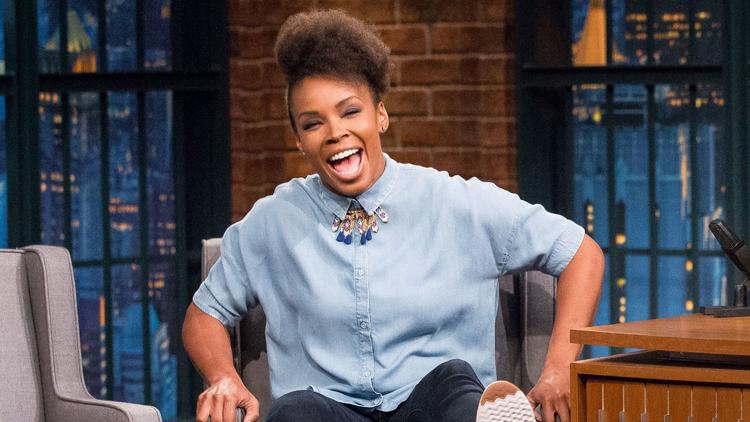
Omaha’s Amber Ruffin making a name for herself in late-night TV
©by Leo Adam Biga
Appearing in the December 2018 issue of The Reader (www.thereader.com)
Since joining NBC’s “Late Night with Seth Meyers” in 2014 as a writer-performer, Omaha native Amber Ruffin has made a name for herself. The gig made her the first black female writer in U.S. late-night network television.
Her strong Afro-centric takes on social issues are part of a disarming package. She can be sweet, silly, manic comedian or edgy commentator and provocateur.
In the recurring “Late Night” segments “Amber Says What” and “Amber’s One-Minute of Fury,” she skewers newsmakers and outs injustice. Her subversive bits play like funny truth sessions by a righteous sister reporting from the trenches of Being Black in America.
“That’s my goal,” Ruffin said. “You’ll never be wrong when you say police should stop murdering children in the street. That (racism) being a lot of my subject matter just gives me tremendous confidence because it’s never been more right and it’s never been more important.”
This fresh TV face and voice is steeped in a long, deep improv background that started here and took her to comedy capitals. Last month she came home to display her authentic, unvarnished self during an Inclusive Communities event at Slowdown. The audience got a taste of her formidable improv skills.
Replicating improv on TV is elusive.
“Oh, how I wish the feeling of improv translated to television. A lot of people have tried to get that feeling in a show, but it’s pretty difficult.”
Playing off a live audience is crucial.
“You’re constantly adjusting your tone, cadence because you have instant feedback and that allows you to give the best performance.”
Working in a corporate culture is still an adjustment.
“It is crazy for comedy to exist in an office. I’d never seen it before I was a part of it. I still find it shocking that it works.”
She’s learned to work within network TV boundaries.
“You can’t be crazy politically incorrect. When you’re on stage doing improv it only exists in that moment, so you can say whatever comes to mind, but on this show whatever you say exists forever. So you have to get it right so that 20 years from now when someone plays it you’ll still stand by it.”
Going out on a limb is a Ruffin trait.
“We are a little adventurous,” Ruffin said of her family. “My mom graduated high school at 16. Every summer she went to New York to find out what the world was about. My oldest sister lived in Panama. Another sister lived in Namibia. It’s just in our bones to see what’s out there.”
Her retired military parents are from the South. They met at Offutt Air Force Base. They later ran their own daycare business. Amber’s the youngest of their five children. Her sisters are also published writers.
Growing up, Ruffin used humor as escape.
“Humor WAS my way to survive. When kids make fun of you, it’s nice to give them something else to laugh at.”
That experience still informs her.
“My day-to-day humor stems from a need to make everyone feel welcome and comfortable and happy, which stems from getting made fun of so badly. It’s assumed people use comedy to put up walls, but I think in many cases the opposite is true. I can say exactly how I feel no matter how uncomfortable it makes you – if there’s a joke attached.”
Musically and dramatically inclined (she plays piano and sings), she developed an early passion for theater.
“I just love musicals.”
The movie The Wiz made a big impression for more than the music.
“It was rare to see a show with an all-black cast that has nothing to do with being black,” she said. “Often times, black people have to talk about their experience being black to be valued. But these people didn’t. It was just a story of joy. The movie, the live musical, every performance of it leaves so much room for you to express yourself. It reminds us the world wants us at our weirdest. When you pretend to fit in, you fade away.”
She contributed to the book of a new stage version of The Wiz that premiered in June at The Muny amphitheater in St. Louis. She hopes a national tour comes here on what could be a Broadway-bound path.
“What distinguishes our version is its timelessness. I wanted it to never have to be rewritten again.”
The stage bug bit while playing Princess Winnifred in an Omaha Benson High production of Once Upon a Mattress. The Benson grad honed her craft via Stages of Omaha at the Millennium Theatre. She did improv at the Shelterbelt and Blue Barn.
Encouraged to try it in Chi-Town, she caught on with Boom Chicago – working with Jordan Peele, Matt Jones and Jessica Lowe – and then Second City. In between, she did a stint with Boom’s company in Amsterdam, the Netherlands.
Within days of an unsuccessful “SNL” audition, she got hired by “SNL” and Boom alum Seth Meyers.
“I think it’s been a natural progression because I have always been writing my own black point of view. I haven’t found it (TV) to be too crazy because at Boom Chicago we would do short form, where the audience suggests the set-up and then you have to deliver punch lines. You have three or four seconds to come up with something. But on “Late Night” I have all day to come up with a punch line. It’s much more relaxed.”
She usually has a week to hone her “Late Night” routines.
“You write it up and you rewrite it a bunch and you show it to the audience and you get one last rewrite and then it has to go in the show.”
She believes she provides a good change-up.
“Because Seth is so grounded in his comedy there is room for an insane person like me.”
She doesn’t make a big deal about having been the first black female writer in the late-night lane.
“I am not sure if any of that matters. What matters is knowing that we exist and being able to see us. What matters is that everyone knows there’s room for them – because there is.”
She says she was long ready for the opportunity. “I could have done this job years ago, for sure.” But happening when it did kept her real. “Now that I’m in this environment, I’m still me. If I had got this job years ago, I would have bent to what the culture was, and it’s my not having done that has made my career what it is.”
Her go-to topic, racism. is informed by her travels.
“The racism in Omaha is different than anywhere else. We don’t have a huge history of lynchings, scary slavery and Confederate monuments, and so we feel we are above racism, which is what puts us so far beneath it. No one’s really angry because you’re a black woman. People don’t think of you as much as a threat. They just think you are kind of gross.
“Omaha’s pretty bad. It’s way less in Chicago. In Amsterdam, way less, but still there – just a different kind. In L.A., there’s less palpable racism. It’s all institutionalized instead of in your face. In New York, people say something the tiniest bit racist and everyone knows it and sees it. It has gone from me being gross to racism itself being the gross thing, which is a relief.
“Now racism is fixed and over, so we win. Just kidding.”
Coming of age here, she craved diversity.
“I remember being in Omaha and just wanting there to be more me and to have a place where you felt like you could belong, and there wasn’t. I still don’t have a lot of me. I just see how critically important it is, especially for young kids.”
Her diversity advocacy made her an apt choice as special guest for the Inclusive Communities FriendsGiving fundraiser.
Meanwhile, she has an NBC development deal for a show, “Village Gazette,” on which she has co-writing and executive producer credits. It’s set in fictional Benson, Nebraska. The name is inspired by her real-life alma mater, Benson High, and the neighborhood that school is in.
She’s also writing feature film scripts. And she can be seen on Comedy Central’s “The Detroiters” and “Drunk History.”
“I shouldn’t be doing this many things, but I figure you only have so much time. I want to give it a shot.”
Follow Amber on Facebook and Twitter.
Read more of Leo Adam Biga’s work at leoadambiga.com.
Cathy Hughes has forged media empire by disrupting the status quo
photo by Bill Sitzmann
story by Leo Adam Biga and Daisy Hutzell-Rodman
Originally published in B2B Omaha Magazine (omahamagazine.com/articles/cathy–hughes)
Disruptors don’t ask permission. They refuse accepting no for an answer. Neither do they cow to tradition for tradition’s sake, nor let barriers deny realizing their goal.
Make no mistake, Omaha native media mogul Cathy Hughes built the first leg of her Urban One empire by being a disruptor. Doing it in the nation’s capital gave her a national platform. After running radio station WHUR at Howard University, where her innovative programming made waves, she made her move in ownership at WOL, which became the flagship for her Radio One broadcast network.
She developed a reputation as a sharp entrepreneur and tough negotiator. Her intuitive grasp of what the public wanted and her ability to provide it as both a programmer and an on-air host built a brand and a following. In 1999 she became the first African-American woman to chair a publicly traded company. This media magnate added a television network to her holdings when her son Alfred Liggins III launched TV One. Though Alfred now runs things on a day by day basis for a diverse portfolio of companies, including online and gaming divisions, she’s still very much involved and remains Urban One’s public face.
Hughes recently added movie producer to her credits. She is second only to Oprah when it comes to individual black women wealth. None of it would have been possible, she says, without what she learned in her hometown of Omaha, where Alfred also grew up.
Mentors included civil rights champion priest John Markoe, Omaha Star publisher Mildred Brown and advocate journalist Charles B. Washington. Her activist parents resisted racial inequality as members of the social action group the De Porres Club, Her mother Helen Jones Woods was a professional musician turned licensed practical nurse and social worker. Her father William Woods was an accountant. Her maternal grandfather, Lawrence C. Jones, was founder of Piney Woods Country Life School in Mississippi.
“My mother, father and grandfather were very committed to trying to improve the plight of our people, and I inherited that,” says Hughes.
Another influence informing her own independent spirit was a group of prominent African-Americans who bought local radio station KOWH.
“Their example inspired me to become a broadcast owner of what ultimately became the largest black media company in the world.”
Her sense of self-determination and aspiration as a single mother in North Omaha, where she worked at both the Star and KOWH and participated in demonstrations, carried her far.
Instead of making her single mother status a negative or barrier, she embraced it and used it as motivation to achieve. Her son was there for her entire struggle and ascent. She sometimes brought him to classes and to work.
National journalist Tony Brown was so impressed upon meeting the vivacious Hughes when he appeared in Omaha that he invited her to be a lecturer at Howard despite the fact she was not a college graduate herself.
“He saw that I was so hungry for the opportunity and that this was a passion for me.”
Brown was one of a string of illustrious mentors who saw her potential. Others included Susan Thompson Buffett, Washington Post publisher Katharine Graham and Johnson Publishing founded John H. Johnson.
Hughes parlayed the Howard opportunity to become D.C.’s first female general manager of a radio station when asked to take the reins at WHUR in 1973. She grew ad revenues and helped WHUR go national after creating the urban format “Quiet Storm,” which hundreds of stations across the country adopted.
Realizing she still had a lot to learn, Hughes studied psychographic programming at Harvard and took a programming seminar at the University of Chicago.
In 1980, she and then-husband Dewey Hughes purchased struggling WOL. She reversed the station’s fortunes by transforming it from R&B to a 24-hour-a-day news-talk format she dubbed “Information is Power.” She hosted an on-air morning show for 11 years, thus becoming the voice and face of black urban radio.
Hughes took cues from her Omaha mentors in remaining connected to her community while finding commercial success.
Years before in Omaha, she said Mildred Brown and Charles Washington “understood that information is power.” She learned from them and the folks who ran KOWH that black media isn’t just about a business, it’s about a community service.” That realization has informed everything she’s done with Urban One.
“Our commitment to our community is what has built brand loyalty. Investors and bankers respect that. They’re interested in numbers and they understand the numbers will be there because the community responds positively to that loyalty.”
Building a radio network was her vision and ambition.
“I always wanted more than one station,” she says.
She sees opportunity where others don’t.
“We have been turnaround experts. That’s what our whole corporate strategy has been. We take under-performing stations and turn them around. Under-performing stations have practically called our name. That’s how we’ve approached broadcasting.
“We built Radio One with numerous formats, including some mainstream white formats.”
Hughes put together most of the funds for her initial purchase of WOL.
“I had $100,000 of my own personal money. That’s why when Dewey and I split there wasn’t a big hassle because it was his opportunity and my money.
“I raised an additional $100,000 from 10 investors – each putting in $10,000 a piece, and then I borrowed the rest. I needed a million dollars from a senior lender. I was turned down by 32 different banks. The 33rd presentation was to a Puerto Rican woman banker – and she said yes. She was the one that made the difference. I put together another $600,000 from black venture capitalists.”
Part of persevering and being resilient meant having to prove to skeptics that she could go it alone.
“The most perilous time in the history of my company was when I decided to divorce my husband. He was not making a contribution to the business. He was a drain. But that’s not how it was seen by my advertisers, by my lenders, by my creditors, by my listeners. They saw it from the perspective that I wouldn’t be able to survive with Dewey no longer in the picture.”
Survive and thrive she did by leaning into the example set by Omaha Star publisher Mildred Brown, whose “dogged determination” she admired.
“When somebody told Mildred no, she saw it as an opportunity to change their mind, she never saw it as a rejection. She didn’t take no seriously. No to her meant Oh, they must not have enough information to come to the right conclusion.”
Like that earlier media matriarch, the charismatic Hughes brings “activism with marketing and salesmanship” to her personal art of persuasion.
Early in her Radio One ownership, when loans were hard to come by, she openly expressed doubts. She credits a male investor-advisor with getting her to speak into action her successful acquisition of capital, stations, listeners and advertisers.
“He told me to change my terminology, which changed my thinking, because I was the first person to hear it.
And guess what, one day it was no longer a lie, it became my truth.”
Even after her multi-billion dollar company went public, the ever-driven Hughes was anything but complacent.
“I don’t see it as success yet, I still see it as a work in progress.”
Being a woman in a male-centric industry hasn’t fazed her, she said, because “I never put woman first. I am black first and a woman second. Plus, I had my eyes on a prize. I didn’t see it as proving something to the old boys network. I was not intimidated by the fact I was the only female. I really thought because I was the first woman general manager there would be a whole proliferation of black women owning and managing radio stations. But women have made more progress in sports than they have in media.”
Her business rise took some aback as it didn’t follow expectations. For instance, when she found herself a single mother again after putting together the WOL deal, she and her son Alfred slept at the station until things improved. A black single mom with a penchant for telling it like it is disrupted the prototypical corporate culture.
“It’s not a role white women have enjoyed for too long and so it’s definitely still brand new for African-American women, especially for someone outspoken like me.”
Along the way, she says, she’s had to educate some folks that it was she who actually built Radio One and made it a success, not her ex-husband or her business partner son. Perhaps a sign of progress is that she now gets credit for forming TV One and taking the parent company public when it was her son Alfred’s doing.
She’s grateful that her son, a Wharton School of Business graduate, came to not only embrace her media vision and passion but to expand it to across platforms.
Things came full circle for the pair last May when Hughes was honored in Omaha for her achievements and Liggins joined others in singing her praises.
“I could always recognize and appreciate her drive, tenacity and lessons,” he says. “First and foremost, I respect her as a human being and as my mother. In terms of our business partnership, we don’t let any of the mother-son-family potential squabbles disintegrate that partnership. I guess we’ve always been a team since the day I was born.”
Hughes now has a boulevard named after her in North Omaha and she is a Face on the Barroom Floor at the Omaha Press Club.
“It doesn’t get any better than that,” she says.
Visit https://urban1.com.
Read more of Leo Adam Biga’s work at leoadambiga.com.
This article was printed in the December 2018/January 2019 edition of B2B. To receive the magazine, click here to subscribe.
Add Amber Ruffin to the roster of folks with Omaha roots to find success beyond here in stage-screen-media. The writer-performer got her start in theater and improvisation in her native Omaha. After years honing her craft with major improv troupes around he U.S. and abroad, she broke onto the national scene by joining the writing staff and cast of “Late Night with Seth Meyers” in 2014. She also has a presence on Comedy Central. She’s working on developing her own TV show and she recently co-wrote a new stage adaptation of “The Wiz.”
For the second year in a row Ruffin has come home to headline the Inclusive Communities FriendsGiving event (this year’s iteration is today from Noon to 2 p.m. at Slowdown).
There’s little doubt we will be hearing and seeing a lot more from this smart, engaging writer-performer who often skewers wrongdoers and haters with her subversive, silly, serious takes. Her humor, especially when it deals with race and other social justice issues, resonates strongly because it’s grounded in reality and truth, I wouldn’t be surprised if she proves herself a fine dramatic actress as well.
She’s part of an impressive contingent of black creatives from here to make their mark variously in music, theater, film, television, literature and media.
These talents include:
Noble and George Johnson
Lloyd Hunter
Preston Love Sr.
Wynonie Harris
Anna Mae Winburn
Mildred Brown
Helen Jones Woods
Ruth Norman
Buddy Miles
Arno Lucas
Calvin Keys
Victor Lewis
Cathy Hughes
Carol Rogers
Nole Jeanpierre
Lois “Lady Mac” McMorris
John Beasley
Monty Ross
Kevyn Morrow
Randy Goodwin
Camille Steed
Sandra Organ
Alfred Liggins Jr.
Jade Jenise Dixon
Gabrielle Union
Yolonda Ross
Q Smith
Carleen Brice
Kim Louise
Victoria Benning
Omowale Akintunde
Michael Beasley
Lafayette Reed Jr.
Tim Christian
Beaufield Berry
Symone Sanders
Chanelle Elaine
Funny, yet serious, to the core:
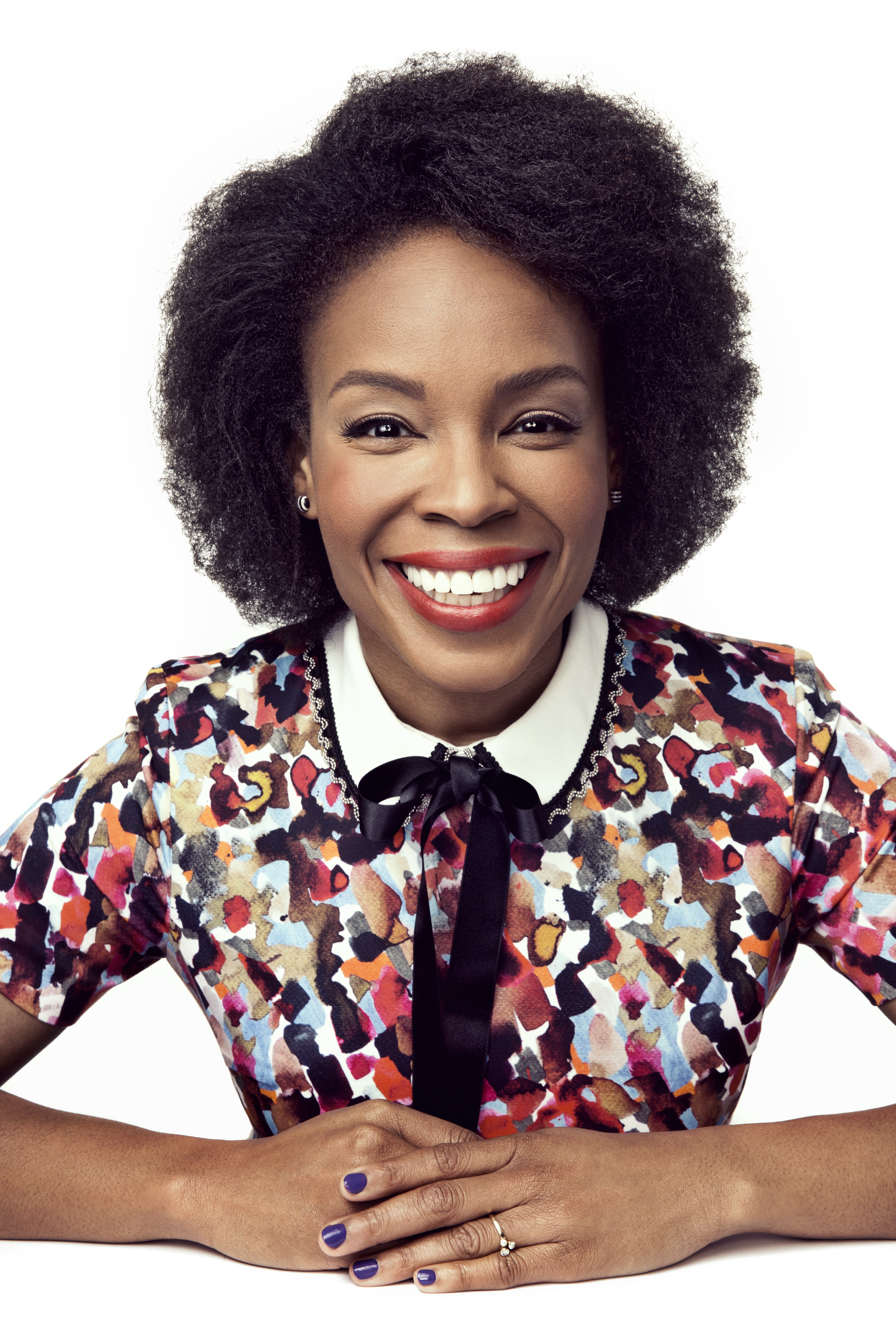
The Amber Ruffin story
©by Leo Adam Biga
Originally appeared in the Nov. 16, 2018 issue of The Omaha Star (https://theomahastar.com)
NBC’s “Late Night with Seth Meyers” gives more than lip service to diversity thanks to Omaha native Amber Ruffin, a writer-performer on the New York-based show.
She’s a singular presence for her strong Afro-centric takes on social issues. She became the first black female writer in U.S. late night network television when she joined the staff in 2014. It marked her national debut. But she’s no newcomer. She comes from a deep improv background that started here and took her to comedy capitals.
In the recurring “Late Night” segments “Amber Says What” and “Amber’s One-Minute of Fury” she calls out newsmakers for everything from their stupid attire to their ugly rhetoric to their heinous acts. Her subversive bits play like funny truth sessions by a righteous sister reporting from the trenches of Being Black in America.
“That’s my goal,” Ruffin said. “You’ll never be wrong when you say police should stop murdering children in the street. That (hate) being a lot of my subject matter just gives me tremendous confidence because it’s never been more right and it’s never been more important.”
The writer-actress headlines the Sunday, November 25 Inclusive Communities (IC) FriendsGiving at Slowdown.
Her high-energy performances sometimes find her flitting across stage as cameras try tracking her. While she can be serious when making a point, her default personality is sweet, silly, manic. She was voted Class Clown at Omaha Benson High School,
It seems this dynamo hasn’t fallen far from the tree.
“You think I’m a happy person, whoo-whee, my parents are really happy,” said Amber, whose mother was voted Class Clown at her high school in Savannah, Georgia.
As a kid, Amber used humor to deflect the hurtful things classmates said about her then-homely looks. Nobody thinks the vivacious Ruffin is homely anymore.
“Humor WAS my way to survive. When kids make fun of you, it’s nice to give them something else to laugh at.”
That experience still informs her.
“My day to day humor stems from a need to make everyone feel welcome and comfortable and happy, which stems from getting made fun of so badly. It’s assumed people use comedy to put up walls, but I think in many cases the opposite is true. I can say exactly how I feel no matter how uncomfortable it makes you – if there’s a joke attached.”
Her folks, Theresa and James Ruffin, are both from the South, They met at Offutt Air Fore Base while serving in the military. They later ran their own business, T and J Daycare Centers. Amber’s the youngest of their five children. She’ll be with family over the holiday when she comes home for the IC event. It’s her second year in a row doing it.
IC Executive Director Maggie Wood said Ruffin’s humor is appreciated by the organization.
“We know how heavy this work can be and the levity of laughter makes us a little more resilient to confront prejudice, bigotry and discrimination.”
Instead of a stand-up set or a speech, Ruffin will engage in conversation with the IC team on stage in response to some loosely scripted questions.
“Our donors, volunteers and supporters all know we need to face this work head on. That’s exactly what Amber does in her commentary. We’re so excited to have her back,” Wood said.
Growing up, Ruffin acutely felt Omaha’s lack of diversity.
“I remember just wanting there to be more me, and there wasn’t. I still don’t have a lot of me. I’ve seen how important it is to have a place where you feel like you can belong and I’m also quite jealous of it because I’ve never had just a place like that where you can be as you as you want to be.”
Theresa Ruffin said dealing with Omaha’s lack of diversity “was challenging to say the least.” When she worked at Peter Kiewit Corp. for a year, she said, “I was the only black person in the building.”
Though Amber didn’t have any immediate show business role models, she gravitated to performing. She played piano at Omaha Trinity Hope Foursquare Church. She also developed an early love of theater.
“I just love musicals,” she said.
She got the bug playing Princess Winnifred in a Benson High production of Once Upon a Mattress.
“I just spent so much time watching theater and doing a lot of theater that everything I love is theater-based.”
Going out on a limb is a Ruffin trait.
“We are a little adventurous,” Amber said. “My mom graduated high school at 16. Every summer she went to New York to find out what the world was about. My oldest sister lived in Panama. Another sister lived in Namibia. It’s just in our bones to see what’s out there.”
Her sisters are also published writers.
The movie The Wiz made a big impression on Amber.
“Many people believe The Wiz has the best music of any musical. I am one of those people. It was also rare to see a show with an all black cast that has nothing to be with being black. Often times, black people have to talk about their experience with being black to be valued. But these people didn’t. It was just a story of joy.”
She’s contributed to the book of a new stage version of The Wiz that premiered in June at the 11,000-seat Muny amphitheater in St. Louis.
“I rewrote the words with the original writer (William F. Brown) who is 91 in April. I have written a few musicals and my love of The Wiz is no secret. We’re going to take it on tour and see how close to Broadway we can get.
“One of the things that stands out to me about our version is that it is timeless. The original Wiz is very much of that era, like many rewrites since. I wanted our Wiz to never have to be rewritten again. It could be from this year, or 20 years ago or 20 years from now.”
Writing musicals has become a new niche.
“I just always assumed because it’s the funnest thing to write, everybody was writing musicals. But it turns out not a lot of people are. So, yeah, I’ll do it.”
Performing in a musical may be another matter.
“I can sing just fine, but I don’t know that I’d ever be in a musical, unless I wrote one for myself.”
She honed her craft via Stages of Omaha at the Millennium Theatre. She did improv at the Shelterbelt and Blue Barn.
“We had the best time. It’s how I learned that I love improv. To be a good improviser, you just have to trust whoever you’re improvising with. If you treat them like a genius, you’ll both end up looking good.”
Encouraged to try it in Chi-Town, she caught on with Boom Chicago – where she worked with Jordan Peele, Matt Jones and Jessica Lowe – and then Second City. In between, she did a stint with Boom’s company in Amsterdam, The Netherlands.
“Boom Chicago was terrifying and it was bad for awhile and there was nothing I could do. I just had to keep trying to survive. I didn’t have a college degree. I didn’t have a lot of money. So there were times when I wanted to go home so bad, But I just had to stay. Thank God I did because it turned out great.”
Her parents encouraged her through the tough times.
“Because they think I’m great because they’re my parents, they were like, ‘You’re excellent and soon everyone will be able to see that.’ That was very sweet of them.”
Ironically, she met her Dutch husband, Jan, in America. The couple struggled in L.A. for a period. She feels it only made them stronger.
“I did a lot of my own projects. I wrote musicals, made a bunch of funny videos and really did what I wanted to do. Financially, I struggled, but I also had a great time.”
An unsuccessful “SNL” audition was soon followed by “SNL” and Boom alum Seth Meyers hiring her.
“Those two things happened within days of each other,” Theresa Ruffin recalled. “Amber was very down about ‘SNL’ and over the moon when Seth called.”
Going from improv to “Late Night” has been seamless for Amber. “I think it’s been a natural progression because I have always been writing my own black point of view. “I vastly prefer a live audience to just being in front of a camera alone. Improvisers make a thousand corrections a minute every performance until they figure out what the audience likes. You can do that with scripted material, too.”
Being the designated comic who outs racism, narcissism and mendacity, she said, is “this odd space to exist in.”
“I kind of feel like if I don’t say it people might feel desperate and insane. I have to be like, Okay, the president said that, and that’s cuckoo, and you do not have to accept it It sounds silly but it feels so good to have an adult say you’re a human being and you shouldn’t be treated like this. Until you hear it from someone you do not know and have never met,
it doesn’t carry the same weight.”
Theresa Ruffin loves that her daughter echoes what many black Americans feel. “She says most of the things we are already thinking.”
Every time Amber outs someone’s misbehavior, her mother said it’s cause to shout, “THAT’S OUR GIRL.”
As brutally honest as Amber is on “Late Night,” she must deal with network censors, which is why she feels she was “rowdier and took more chances” doing improv.
On her way up, she met one of her biggest influences, Whoopi Goldberg. “She’s great,” Ruffin said.
Amber’s close friend since childhood, Kristina Haecke of Omaha, said watching her bestie’s breakthrough has been “awesome and great but mostly it has been completely expected..” Haecke insists fame hasn’t changed Ruffin, calling her “very down to earth” and “almost too calm about it.”
Grounded, too. “Her on-screen is her off-screen, just with a platform,” said Haecke.
Fame hasn’t changed Ruffin’s lifestyle. Yet. “Maybe someone recognizes me on the street once a week. No one cares. So when someone says, ‘Hey, Amber.’ I still think it’s pretty neat.”
Her celebrity may grow should a new TV show she’s trying to get off the ground escapes the development hell that befell her previous attempts as a producer.
“I’m not sure if I’m allowed to say it, but I’m going to because I don’t know what the rules are. I have a show called ‘Village Gazette,’ which is the third show I’ve sold to NBC. The premise of it is I am the editor of a small town newspaper in Benson, Nebraska. The owner’s nephew is a big shot reporter fallen from grace after making up a story that people find out is false. He gets fired and this is the only job he can get and he doesn’t want to be in this small town. But then he realizes we’re not so bad.”
Her “boatload of other projects” includes movie scripts she’s’ writing. She also pulls duty on Comedy Central’s “The Detroiters” and “Drunk History.”
By now, she’s mostly over having cracked the glass ceiling in late night, though she feels she did strike a blow for inclusion.
“What matters is knowing that we exist and being able to see us. What matters is that everyone knows there’s room for them – because there is.”
Follow Amber on Facebook and Twitter.
Tickets to FriendsGiving with Amber Ruffin are $25 and include one drink and heavy hors d’oeuvres..The event is from Noon to 2 p.m.
Visit http://www.inclusive-communities.org for more details and to purchase tickets.
Read more of Leo Adam Biga’s work at leoadambiga.com.
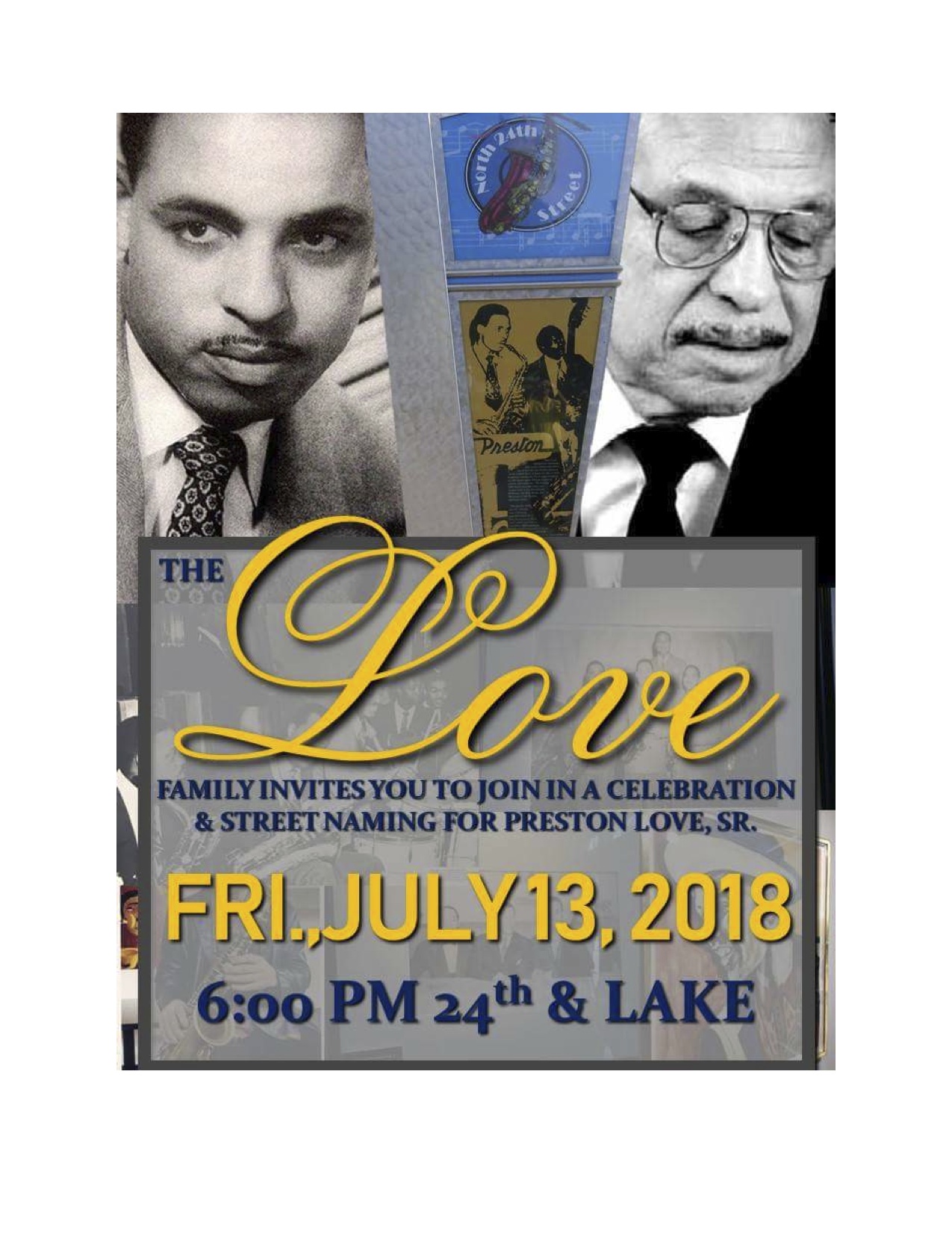
Omaha’s Love Family hosts celebration and street naming for Preston Love Sr.
Friday, July 13
6 p.m.
24th and Lake
Preston Love Sr. Street
Speakers to include John Beasley and Curly Martin sharing stories about the late jazz musician, composer, arranger, band leader, educator, commentator and author. Preston Love Sr. was a charter member of the Omaha Black Music Hall of Fame, the namesake of Loves Jazz & Arts Center and the author of the critically acclaimed memoir “A Thousand Honey Creeks Later.”
Musical tribute concert immediately following at Loves Jazz & Arts Center by some of Omaha’s finest artists. Featuring songs performed and loved by Preston Love.
$7 donation
ON A PERSONAL NOTE:
When I began writing about North Omaha’s African-American community 20 years ago or so, Preston Love Sr. was one of the first persons I reached out to. He became a source for the and the subject of many of those early stories. He was a wise and loquacious sage with a real sense of history about his music, his people and his community.
The first article I got published in a national magazine was about Preston.
A good share of my work about him appeared around the time of the release of his long-in-the-making and highly regarded memoir, “A Thousand Honey Creeks Later.”
Upon his death, I was asked to write an in memoriam piece for The Reader.
A few years ago, I wrote a new piece compiled from my many stories about him, and read it at Loves Jazz before a packed house.
I have also written some about his son Preston Love Jr. and his daughters Portia Love and Laura Love.
Whether you knew the man and his legacy or not, here is a list of articles I featured him in that hopefully provide a fair representation of the man and the artist:
https://leoadambiga.com/2016/05/05/preston-love-a-t…late-hepcat-king/
https://leoadambiga.com/2010/06/03/preston-love-192…ed-at-everything
https://leoadambiga.com/2010/06/03/omaha-blues-and-…end-preston-love
https://leoadambiga.com/2010/06/03/preston-love-his…l-not-be-stilled
https://leoadambiga.com/2010/06/03/mr-saturday-night
There are several more stories in which I quoted him about everything from Native Omaha Days to soul food or referenced him in relationship to North Omaha’s live music scene and the area’s attempted revitalization.
Cathy Hughes proves you can come home again
©by Leo Adam Biga
Appearing in the July 2018 issue of New Horizons
Nebraskans take pride in high achieving native sons and daughters, Some doers don’t live to see their accomplishments burnished in halls of history or celebrated by admirers. This past spring, however, Cathy Hughes, 71, personally accepted recognition in the place where her twin passions for communication and activism began, North Omaha.
The mogul’s media holdings include the Radio One and TV One networks.
During a May 16-19 homecoming filled with warm appreciation and sweet nostalgia, Urban One chair Hughes reunited with life-shaping persons and haunts. An entourage of friends and family accompanied Hughes, who lives in the Washington D.C. area where her billion dollar business empire’s based. Her son and business partner Alfred Liggins Jr., who was born in Omaha, basked in the heartfelt welcome.
Being back always stirs deep feelings.
“Every time I come I feel renewed,” Hughes said. “I feel the love, the kindred spirit I shared with classmates, friends, neighbors. I always leave feeling recharged.”
With part of Paxton Boulevard renamed after her, a day in her honor officially proclaimed in her hometown and the Omaha Press Club making her a Face on the Barroom Floor, this visit was extra special.
“It was so emotionally charged for me. It’s like hometown approval.”
During the street dedication ceremony at Fontenelle Park, surrounded by a who’s-who of North O, Hughes said, “I cannot put into words how important this is to me. This is the memory I will take to my grave. This is the day that will stand out. When you come home to your own and they say to you job well done, there’s nothing better than that.”

Photo Courtesy of Cathy Hughes

Cathy Hughes’ mother, Helen Jones Woods with the International Sweethearts of Rhythm, circa 1940
Welcoming home an icon
Good-natured ribbing flowed at the park and at the Press Club, where she was roasted.
The irony of the Press Club honor is that when Hughes was young blacks were unwelcome there except as waiters, bartenders and kitchen help. The idea of a street honoring a person of color then was unthinkable.
“This community has progressed,” Hughes told an overflow Empowerment Network audience at the downtown Hilton. “An empowerment conference with this many people never could have taken place in my childhood in Omaha. This is impressive.”
Empowerment Network founder-president Willie Barney introduced her by saying, “She is a pioneer. She is one of the best entrepreneurs in the world. She is a legend.”
Nebraska Heisman Trophy-winner Johnny Rodgers helped organize the weekend tribute for the legend.
“I think Cathy Hughes is the baddest girl on the planet,” Rodgers said. “She’s historical coming from Omaha all the way up to be this giant radio and TV mega producer and second richest black lady in the country. It’s just fantastic she’s a product of this black community. I want to make sure all the kids in our community realize they can be what Cathy’s done. Anything’s possible.
“I want hers to be a household name.”
Some felt the hometown honors long overdue. Everyone agreed they were well-deserved.
A promising start
People who grew up with her weren’t surprised when she left Omaha in 1972 as a single mother and realized her childhood dream of finding success in radio.
She had it all growing up – sharp intellect, good looks, gift for gab, disarming charm, burning ambition and aspirational parents. Her precocious ways made her popular and attracted suitors.
“She’s very personable,” lifelong friend Theresa Glass said. “She’s been a gifted communicator all the time. My grandmother Ora Glass was her godmother and she always believed Cathy was destined for great things.”
Radio veteran Edward L. “Buddy” King said, “She had this thing about her. Everybody projected she would be doing something real good. She knew how to carry herself. Cathy’s a beautiful woman. She’s smart, too.”
Glass recalled, “Cathy was always an excellent student. She’s always used her intellect in various pursuits. She was always out in the working world. Cathy used all the education and skills she learned and then she built on those things. So when she went to D.C, she was prepared to work hard and to do something out of the ordinary for women and for African Americans to do.”

Members of the De Porres Club in 1948
Cathy’s parents were pioneers themselves.
Her mother Helen Jones Woods, 94, played trombone in the all-girl, mixed-race swing band the International Sweethearts of Rhythm. Helen’s adoptive father, Laurence C. Jones. founded the Piney Woods Country Life School in Mississippi, which Helen attended. Cathy and her family lived in Jim Crow Mississippi for two years. She’s a major supporter of the school today.
Cathy’s late father, William A. Woods, was the first black accounting graduate at Creighton University. He and Cathy’s mother were active in the Omaha civil rights group the De Porres Club, whose staunchest supporter was Omaha Star publisher Mildred Brown.
“Very young, I marched,” recalled Cathy Hughes, who’s the oldest of four siblings. “I was maybe 6-years old when we picketed the street car (company) trying to get black drivers. I remember vividly being slapped on the back of my head by my mother to ‘hold the sign up straight.’ I remember demonstrating but most importantly I heard truth being spoken.”
“Cathy’s parents were community-oriented people,” King said. “They cared about their community. They were well-to-do in their circles. Cathy grew up in that but she never lost her street savvy.”
While attending private schools (she integrated Duschene Academy), she said, “The nuns would send notes home to my mother saying I had delusions of grandeur, I talked all the time, and I was very opinionated. I bragged I would be the first black woman to have a nationally syndicated program.
“I was good and grown before I found out that had already been accomplished.”
Her penchant for speaking her mind stood her apart.
“When I was growing up black folks didn’t verbalize their feelings and particularly children didn’t.”
Mildred Brown gave her father an office at the Star. Cathy did his books and sold classified ads for the paper. Her father also waited tables at the Omaha Club and on the Union Pacific passenger rail service between Omaha and Idaho. She sometimes rode the train with her father on those Omaha to Pocatello runs.
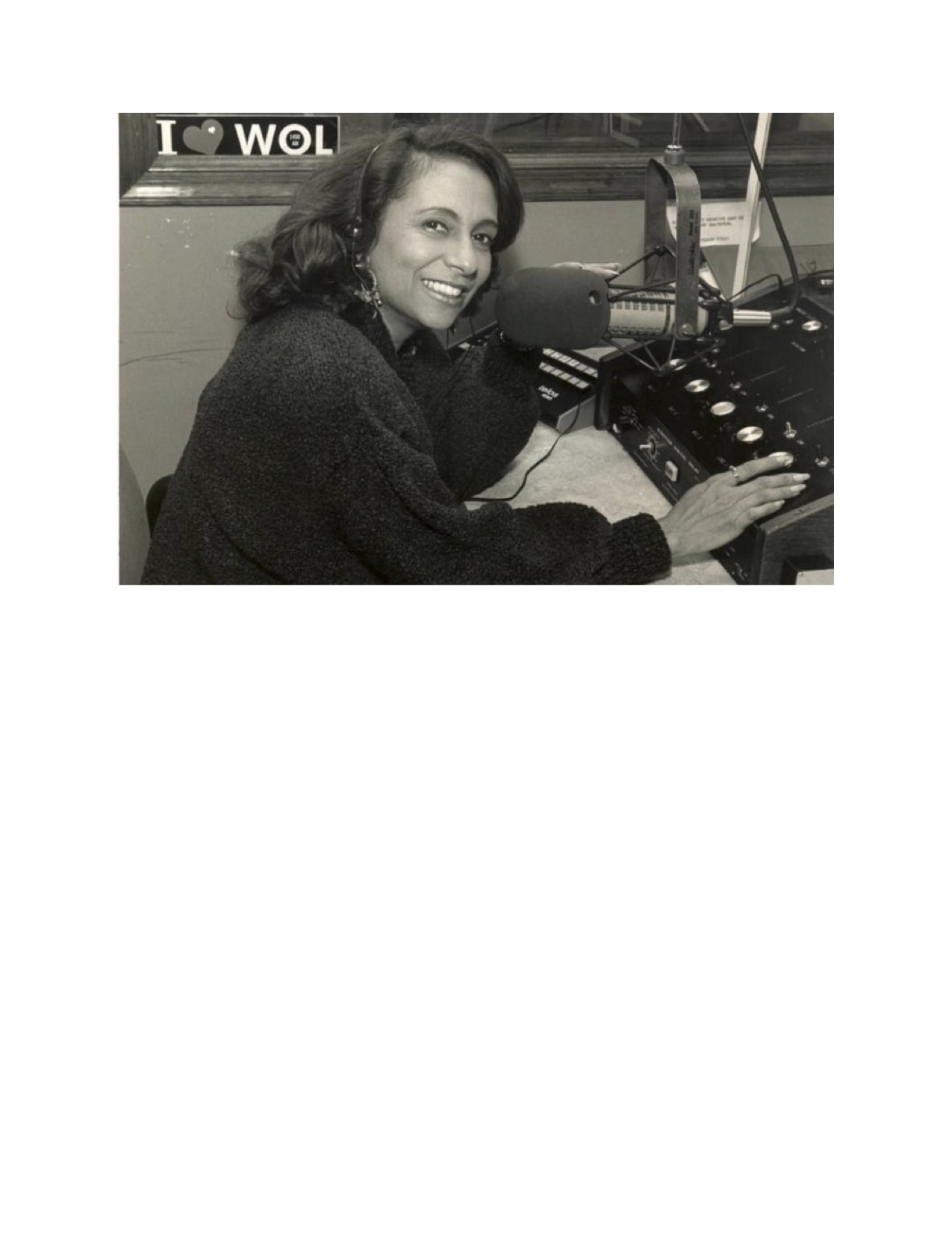 Taken under wing
She found mentors in black media professionals Brown and Star reporter-columnist, Charlie Washington. The community-based advocacy practiced by the paper and by radio station KOWH, where she later worked, became her trademark.
“We had a militancy existing in Omaha and when you’re a child growing up in that you just assume you’re supposed to try to make life better for your people because that’s what was engrained in us. We didn’t have to wait to February for black history. We were told of great black accomplishments on a regular basis at church, in school, in social gatherings. Black folks in Omaha have a nationalist pride.
“I was imbued with community service and activism. I don’t know any different. My mother on Sunday would go to the orphanage and bring back children home for dinner. We were living in the Logan Fontenelle projects and one chicken was already serving six and she would bring two or three other kids and so that meant we got a piece of a wing because Daddy always got the breast.”
During her May visit she recalled the tight-knit “village” of North Omaha where “everybody knew everybody.”
In the spirit of “always doing something to improve your community and family,” she participated in NAACP Youth Council demonstrations to integrate the Peony Park swimming pool.
“Because we were disciplined and strategic, there was a calm and deliberate delivery of demands on our part. I don’t know if it was youth naivete or pure unadulterated optimism, but we didn’t think we would fail.”
Peony Park gave into the pressure.
Opposing injustice, she said, “instilled in me a certain level of fearlessness, purpose and accomplishment I carried with me for the rest of my life.”
“It taught me the lesson that there’s power in unity.”
Her passion once nearly sparked an international incident on a University of Nebraska at Omaha Black Studies tour to Africa.
“The first day we arrived in Addis Ababa, Eithiopia, the students at Haile Selassie University #1 were staging demonstrations that ultimately led to the dethroning of emperor Haile Selassie. Well, we almost got put out of the country because when I heard there was a demonstration I left the hotel and ran over to join the picket line with the Eithiopian students. My traveling companions were like, ‘No, you cant do that in a foreign country, they’re going to deport us.’ Hey, I never saw a demonstration I didn’t feel like i should be a part of.”

Charlie Washington
The influence of her mentors went wherever she went.
“Mildred Brown unapologetically published Charlie Washington’s rants, exposes, accusations, evidence. She didn’t censor or edit him. If Charlie felt the mayor wasn’t doing a good job, that’s what you read in the Omaha Star. It took the mute button off of the voice of the black community. It promoted progress. It also provided information and jobs. It’s always been a vehicle for advocacy, inspiration and motivation.
“That probably was the greatest lesson I could have witnessed because one of the reasons some folks don’t speak out in the African-American community is they’re afraid of being financially penalized or losing their job, so they just remain silent. Mildred and Charlie did not remain silent and she was still financially successful.”
Both figures became extended family to her.
“Charlie Washington became like my godfather. He was the rabble rouser of my youth. He had the power of the pen. Charlie and the Omaha Star actually showed me the true power of the communications industry. I saw with Charlie you can tell the truth about the needs and the desires of your community without being penalized” even though he wrote “probably some of the most militant articles in the United States.”
“That’s the environment I grew up in. So the combination of Charlie always writing the truth and Mildred being able to keep a newspaper in Omaha solvent were both sides of my personality – the commitment side and the entrepreneurial side.”
Today, Hughes inspires young black communicators with her own journey of perseverance and imagination in pushing past barriers and redefining expectations.
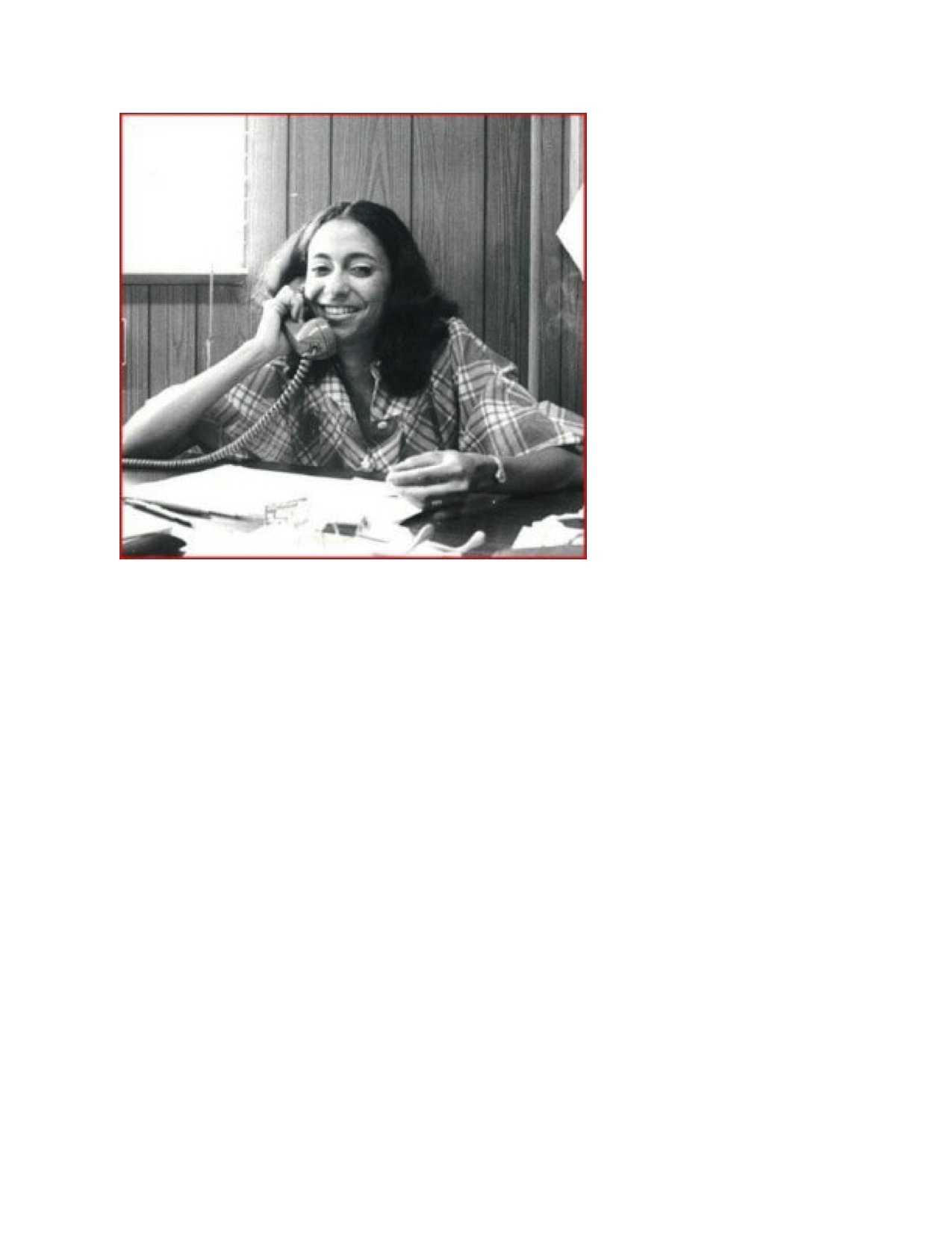
No turning back
As an aspiring media professional. Hughes most admired Mildred Brown’s “dogged determination.”
“When somebody told Mildred no, they weren’t going to take an ad, she saw it as an opportunity to change their mind, she never saw it as a rejection. She didn’t take no seriously. No to her meant. Oh, they must not have enough information to come to the right conclusion because no is not the right conclusion.
“Nothing stopped Mildred.”
Nothing stopped Hughes either.
“When I was 17 I became a parent. I realized I was on the brink of becoming a black statistic. My son Alfred was the motivation for me to think past myself. It was the defining moment in my life direction because for the first time I had a priority I could not fail. I was like, We’ll be okay, I’m not going to disappoint you, don’t worry about it. It was Alfred who actually kept me going.”
Her first ever radio job was at Omaha’s then black format station, KOWH.
“KOWH fed into my fasciation with having a voice. I think it is truly a blessing to have your voice amplified. I wasn’t even thinking about being an entrepreneur then. I was thinking about being able to express. I wasn’t at an age yet where had come into who I was destined to be.”
She left for D.C. to lecture at Howard University at the invite of noted broadcaster Tony Brown, whom she met in Omaha. It’s then-fledgling commercial radio station, WHUR, made her the city’s first woman general manager.
Leaving home took guts. Staying in D.C. with no family or friends, sleeping on the floor of the radio station and resisting her mother’s long-distance pleas to come back or get a secure government job, showed her resolve.
“Omaha provided me a safe haven. Once in D.C., I had to rely on and call forth everything I had learned in Omaha just to survive and move forward. If I had not left, I probably would not have become a successful entrepreneur because I had a certain comfort level in Omaha. I was the apple of several individuals’ eyes. They saw potential in me, but I think their love and support would not have pushed me forward the way I had to push myself once I moved into a foreign land.”
She feels Nebraska’s extreme weather toughened her.
“It builds a certain strength in you that you may or may not find in other cities.”
If sweltering heat, high winds and subzero cold couldn’t deter her, neither could man-man challenges.
“You learn that determination that you can’t let anything turn you around. When I went to D.C. and realized there weren’t people of color doing what I wanted to do, I just kept my eye on the prize. I refused to let anyone turn me around. When you learn to persevere in all types of elements, then business is really a lot easier for you.”

Mildred Brown
Brown was her example of activist entrepreneur.
“The Star was to Omaha what Jet and Ebony were to the black community nationwide. It’s why I have this media conglomerate. When you’re 10 years old and you’re looking up to this bigger-than-life woman, she was a media mogul in my mind. She had a good looking man and wardrobe and all the trappings.”
Just as Hughes would later help causes in D.C., Brown, she said, “was kind of a one-woman social agency before social agencies became in vogue.”
“She helped a lot of people. My father graduated from college and didn’t have a place to open an office and she opened her lobby for him. He was just one of many. Charlie Washington had a very troubled background and yet because of her he rose to being respected as one of the great journalists of his time in Omaha. Dignitaries would come and sit on Charlie’s stoop and talk to him about what was going on. He was considered iconic because of Mildred Brown.
“She put students through school and raised hell to keep them there. When my mother was short my Duschene tuition, Mildred told them, ‘You’re going to get your money, but don’t be threatening to put her out.’ She literally walked the walk as well as talked the talk. She didn’t tell folks what they needed to do, she helped them do it. She continued to inspire and advise and mold me.”
Full circle
Howard’s School of Communications is named after Hughes, who never graduated college. Decades after first lecturing there, she’s a lecturer there again today.
“They say I am their most successful graduate who never matriculated. I wasn’t prepared to be the first woman general manager of a radio station in the nation’s capital. That’s why Howard sent me to Harvard to take a six-week course in broadcast management and to the University of Chicago to learn psychographic programming. I went to various seminars and training sessions. Howard literally groomed me. They were proud of the fact I was the first woman in the position they had placed me in “
Hughes readily admits she hasn’t done it by herself.
“I have been blessed by the individuals placed in my life. They sharpened me, prepared me, educated me, schooled me, nurtured me, mentored me. I have been blessed so many times to be in the right place at the right time and with the right people.”
She grew ad revenues and listeners at WHUR. A program she created, “The Quiet Storm,” popularized the urban format nationally. With ex-husband Dewey Hughes she worked wonders at WOL in D.C. After their split, she built Radio One.
Upon arriving in D.C., Hughes found an unlikely ally in Washington Post publisher Katharine Graham. She met Graham through Susan Thompson Buffett, the wife of investor Warren Bufffett, and part owner of the paper.
“Susie was staying at the Grahams’ house. At that time Susie was a singer with professional entertainment aspirations and I was her manager. Katharine Graham took an interest in me and because she had this interest in me other people, including the folks at Howard University, embraced me.”
Networking
Hughes parlayed connections to advance herself.
“Part of my innate abilities since childhood has been to recognize an opportunity and take full advantage of it.”
Her first allegiance was to listeners though. Thus, she lambasted Graham’s Post for unfair portrayals of blacks, even encouraging listeners to burn copies of the paper.
Hughes has succeeded in a male-dominated industry.
“I never thought about being a woman in a male field. First of all. I was black. I’ve never put woman first. I was black first and a woman second. I had a goal I wanted to achieve, an objective that had to be accomplished. I didn’t see it as proving something to the old boys network. I was not intimidated by being the only female.
“I was naive. I really thought there would be a whole proliferation of black women owning and managing radio stations. Women have made more progress in professional basketball – they own and coach teams – than they have in the broadcasting industry.”
Men have played a vital role in her business success.
The two black partners in Syndicated Communications, Herbert Wilkins and Terry Jones, loaned her her first million dollars to build Radio One. Wilkins has passed but Jones and his wife Marcella remain close friends.
When things were tough early on, it was Jones who instructed a downcast Hughes to change her mindset.
“He said to me when people ask you how are you doing they can’t be hearing you complaining or saying I don’t know. You’ve got to say it was a great day because the first person that hears the lie is you. Tell yourself your business is doing good. Tell yourself you’re going to make it. Everyone’s going to start agreeing with you. He told me to change my terminology, which changed my thinking, and guess what, one day it was no longer a lie, it became my truth,” she shared in Omaha.
Friends and family true
Theresa Glass said success has not changed Hughes, who looks keeping it real.
“She’s the kind of friend who’s always your friend and we always can start off where we last left off. I never have to do a whole bunch of catch up with her. We immediately go into friend mode and are able to talk to one another. A lot of times you’ve been away from somebody for a long time or your lives have really shifted and they’re not even close to being the same, and you feel awkward, and that’s not happened for us.”
Hughes acknowledges her success is not hers alone. “I didn’t do it on my own. Right time, right place, right people.” She leans on staff she calls “family.” She believes in the power of prayer she practices daily. She credits her son’s immeasurable contributions.
“Radio One was me. TV One was totally Alfred. He decided he wanted his own path. Our expansion, our going public, all of that, was in fact Alfred. He does the heavy lifting and I get to take all the bows.”
Not every mother-son could make it work.
“Alfred and I had to go to counseling, alright, because one of us was going to die during those early years. It was not happy times – and it was basically my refusal (to relinquish control),” she said at the Hilton.
Alfred Liggins acknowledges their business partnership ultimately worked.
“It was my mother’s willingness to want to see me succeed as a human being and as a business person and unselfish ability to share her journey with me. When it came time to let me fly the plane, she was more than willing to do that.”
He recognizes how special her story is.
“I could always recognize and appreciate her drive, tenacity and lessons. We didn’t let any of the mother-son-family potential squabbles disintegrate that partnership, so I guess we’ve always been a team since the day I was born.”
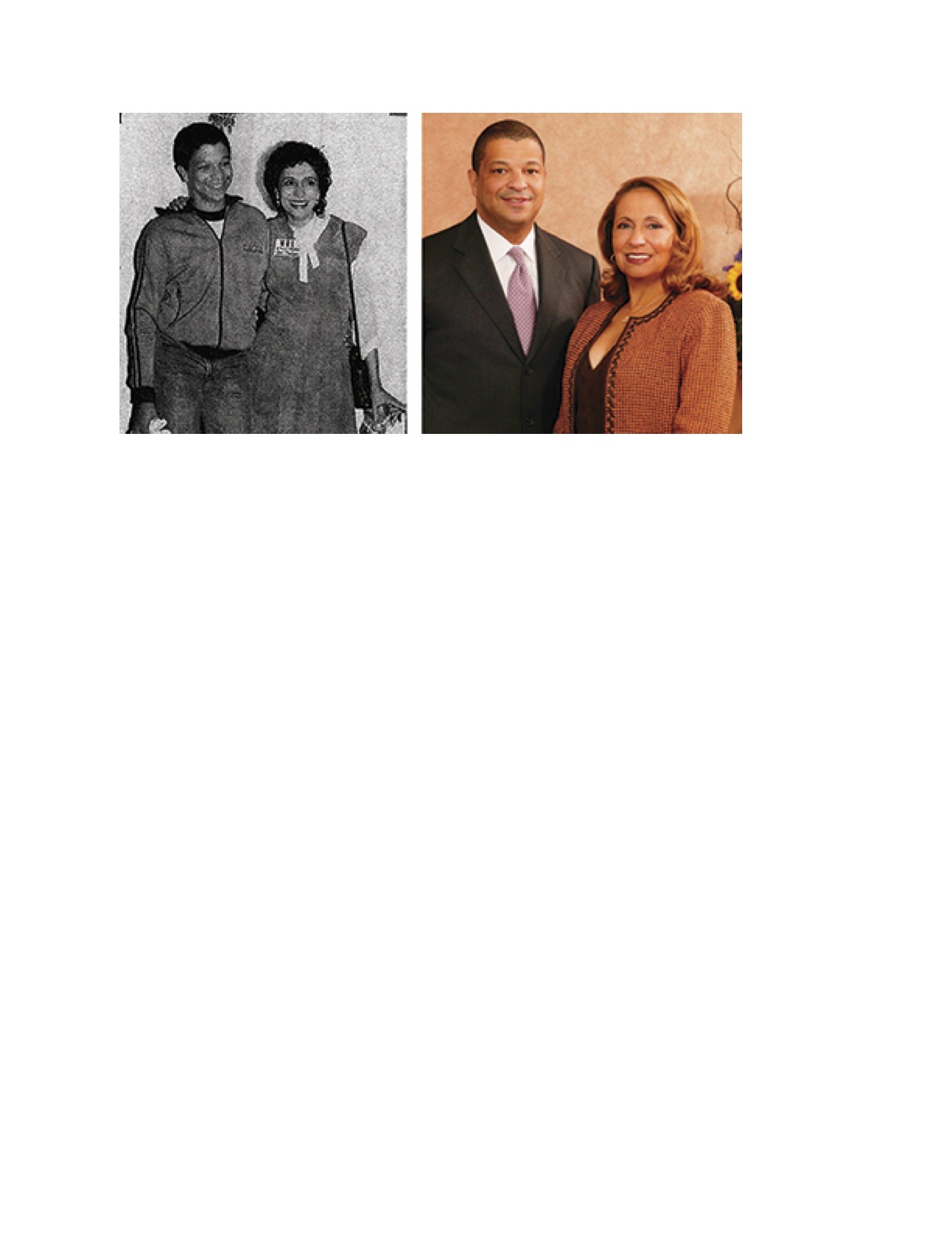
Challenges and opportunities
“Buddy” King. who’s had his own success in satellite radio, is happy to share a KOWH tie with Hughes.
“I’ve always admired Cathy. We KOWH alums are all proud of her success because her success shines light on what we did in Omaha.”
King further admires Radio One continuing to thrive in an increasingly unstable broadcast environment.
“iHeart media and Cumulus, two of the largest broadcast owners in the country, are both in bankruptcy, but Cathy is still chugging along. Her son has done an excellent job since making it a publicly-traded company. As the stock market fluctuates, they’ve able to survive.”
Diversification into online services and, more recently, the gaming industry, has kept Urban One fluid.
The changing landscape extends to Me Too movement solidarity around survivors of sexual harassment in the entertainment field.
“Was I subjected to it? Yes, absolutely,” Hughes said, “and I’m so glad women are stepping forward. Now we have a voice. The reality is we need more than a voice, we need to have action. Just talking about it doesn’t change it. I mean, how long have black folks talked about disparity and a whole host of things.
“It’s great that women are speaking out but we have to put pressure on individuals and on systems. Wherever we can find an opening. we must apply pressure to change it. Let’s start with education.”
She despairs over what she perceives as the dismantling of public education and how it may further erode stagnant income of blacks and the lack of inherited wealth among black families. She shared how “disturbed” she was by how Omaha’s North 24th Street has declined from the Street of Dreams she once knew.

Mrs. Marcella Jones, Alfred Liggins, III and his mother Cathy Hughes
Black media
Voices like hers can often only be found in black media.
“Black radio is still the voice of the community. Next to the black church, black-owned media is the most important institution in our community,” she said.
She embraces technology opening avenues and fostering change, but not at the expense of truth.
“I pray that truth prevails in all of these advancements we’re making. I see a world of opportunity opening, particularly for young people. I’m so impressed with this young generation behind the millennials. These kids are awesome because they’re not interested in just celebrity status. They’re interested in real change and I think the technology will be a definite part of that and I think with it comes a different level of responsibility for media than we’ve had in the past.
“Information is power. Mildred Brown understood that and it wasn’t just about a business for her – it was about a community service.”
Hughes credits an unlikely source with unifying African-Americans today.
“President Trump has single-handedly reignited activism, particularly in the black community. That did not occur in the Clinton administration, nor the Obama administration. But Trump has got people riled up, which is good. He has made people so mad that people are willing to do things, voice their opinion, and that’s why black radio is so important. You are able to say and hear things that you couldn’t get anywhere else.”
The Omaha Star is in its eighth decade. Hughes maintains its survival is “absolutely critical – because again it’s the voice of the people,” adding, “It’s our story from our perspective.” She still reads every issue. “It’s how I know what’s going on. The first thing I do is read Ernie Chambers’ editorial comments.”
Hughes is adamant blacks must retain control over their own message.
“You cannot ever depend on a culture that enslaved you to accurately portray you. That just cannot happen. I think too often African Americans have looked to mainstream media to tell our story. Well, all stories go through a filter process based on the news deliverer’s experience and perception and so often our representation has not been accurate.
“The reality is we have to be responsible for the dissemination of our own information because that’s the only time we can be reasonably assured it’s going to be from the right perspective, that it’s going to be from the right experience, and for the right reasons.”
Yet, she feels blacks do not support black media or other black business segments as much as they should.
A challenge she addressed in Omaha is black media not getting full value from advertisers.
“My son and I are not going for that. We want full value for our black audience and we insist on that with advertisers. I learned that from Mildred Brown. She did not allow y’alll to be discounted because it was a black weekly newspaper. She wanted the black readership of the Omaha Star to have the same value as a white readership to the Omaha World-Herald.
“I learned at the Omaha Star you don’t take a discount for being black.”
Still learning
Six decades into her media career and Hughes said, “I’m still learning. I’m not totally prepared for some of the responsibilities and charges I’m being blessed with now. Like I’m just learning how to produce a movie (her debut project, Media, premiered on TV One in 2017). I want to learn how to direct a movie. I want to learn how to do a series. Thank God we went into cable, which has given me an opportunity to learn the visual side.”
She’s searching for a new project to produce or direct.
“I’m reading everything I can get my hands on. I am just so thankful to the individuals in my life who have loved and nurtured me that I keep acquiring new skill sets at this age. I’m still growing and learning. which is kind of my hobby.”
Hughes is often approached about a documentary or book on her life. If there’s to be a book, she said, “I don’t want someone else interpreting who I am. I don’t want someone else telling my story from their perspective. I want to tell my own story.”
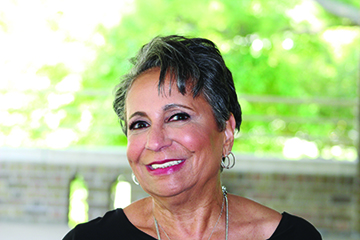
Lasting impact and legacy
Her staff is digitally archiving her career. There’s a lot to capture, including her Omaha story.
“I thank Omaha. Nothing’s better than making your mark in your hometown.”
Getting all those accolades back here is not her style.
“In Omaha, we just don’t get carried away with a whole bunch of fanfare and hero-worshiping. Again, it’s how I grew up. That’s our way of life in Omaha and I thank God for that because it’s made a big difference. It’s a whole different mentality and way of life quite frankly.”
Omaha’s impact on her is incalculable.
“It touched me probably a lot more deeply and seriously than I realized for many decades. When you’re trying to build your business you don’t have a lot of time to reflect on how did I get here and the people who influenced me. I went through a couple decades working on my career and my personal and professional growth and development before I realized the impact the Omaha Star had had on me and what a positive influence Omaha has been on me.”
“Buddy” King said he always knew if from afar.
“Even when she was a young single parent, Cathy was a fighter. It all to me comes back to her Omaha roots.”
Though Alfred Liggins and his mom have been back several times, with this 2018 visit, he said, “you feel like you finally made it and made good and you’re making you’re community proud.”
“It’s about meaning and legacy. That’s why this is hugely different. It really is the culmination of a journey I’ve shared with my mother trying to elevate ourselves and in the process elevating the community from which we came. I’m proud to have been part of what my mother embarked on and I feel like I am being recognized alongside her.
“And it is a deserving honor for her. She’s got guts, grit and she still has a ton of energy. She always gives me lots of praise and lots of love – until I do something she doesn’t like. But it has kept me on the up-and-up and to have my nose to the grindstone.”
At the close of her Empowerment Network talk, Hughes articulated why coming back to acclaim meant so much.
“I think Omaha teaches you to best your best and practices tough love. If you have the nerve to leave here and go someplace else, you better hope you do good because if you come home, you don’t want to hear (about returning a failure). But it’s really love telling you, You should have done better, you should have been more persistent.
“That whole village concept sometimes is not comfortable but it’s so productive because it pushes you to best your best. It teaches you that when you come home one day … they may hang a sign and name a boulevard in your honor.”
As she told a reporter earlier, “My picture’s on the floor of the Press Club, okay It don’t get no better than that.”
Visit https://urban1.com.
Read more of Leo Adam Biga’s work at leoadambiga.com.
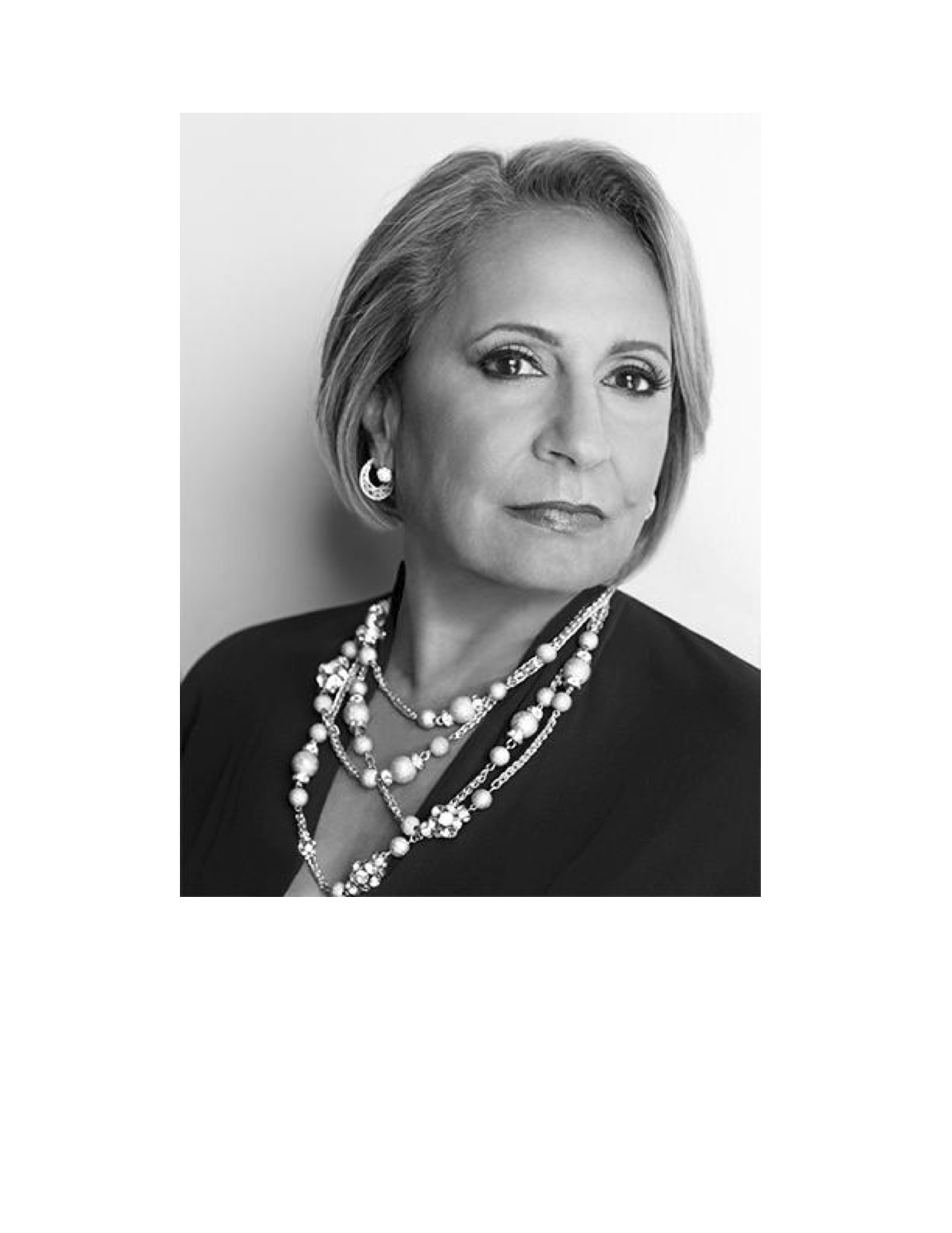
Coming home is sweet for media giant Cathy Hughes
©by Leo Adam Biga
Originally published in the June 2018 issue of The Reader (www.thereader.com)
Sweet nostalgia flowed when Omaha native media titan Cathy Hughes got feted in her hometown May 17-19. It marked the first time many Nebraskans heard of Hughes, even though this head of national networks cites her Midwest upbringing for the resilience behind her barrier-breaking entrepreneurial success.
After the hoopla around her coming back, she owns the state’s undivided attention.
The Omaha African-American community that produced Hughes has long followed her achievements. Her multimedia Urban One Inc., whose brands include Radio One and TV One, are black-centric platforms. Despite a media footprint rivaling Oprah and a personal net worth of half a billion dollars, her black market niche didn’t register with the general public. Until last month. Heisman Trophy-winner Johnny Rodgers marshaled coverage for street renaming, Empowerment Network and Omaha Press Club recognitions.
Surrounded by friends, family and local black leaders, Hughes, the 71-year-old Urban One chair, and her son and business partner, CEO Alfred Liggins Jr., 53, basked in the glow of defining legacies. Liggins said admiringly of her: “She’s got guts, grit and she still has a ton of energy. She’s well-deserving of these honors.”
She recently produced her first movie, Media, for TV One.
Rodgers is among history-makers whose paths she’s intersected. She appreciates him making her mogul ascent more widely known so as to inspire others.
“Johnny told me, ‘I’m doing this for the black kids that need to know you exist – that you grew up in the projects in Omaha (to become the first black woman chair of a publicly traded company).’ Johnny added, ‘I’m also doing it for the white folks who don’t realize that in a whole different arena and way you’re our Warren Buffett.’ That kind of caused me to choke up.”
She came up in Logan-Fontenelle public housing when northeast Omaha truly was “a village.” Her accountant father and International Sweethearts of Rhythm musician mother were civil rights warriors (the De Porres Club). The former Cathy Woods attended Catholic schools. She demonstrated for equal rights. The bright Central High student was “the apple of many influential eyes.” When she became a teen single mom, she didn’t let that status or reality define her, but drive her.
Neither did she keep her radio fame ambitions to herself.
“Ever since I’ve been born, I’ve been running my mouth. I remember once almost getting suspended because I challenged a nun. She said, ‘You have a big mouth,’ and I said, ‘One day I’m going to make a lot of money off of my big mouth.’ I knew as a child I was a communicator. As I grew in my knowledge and awareness of my African history and legacy, I realized I was from the giro tradition of maintaining folklore and history in story form. I just innately had that ability.”
In 1972 she left for Washington D.C. to lecture at Howard University at the invite of noted broadcaster Tony Brown, whom she met in Omaha. It’s then-fledgling commercial radio station, WHUR, made her the city’s first woman general manager. She grew ad revenues and listeners. A program she created, “Quiet Storm,” popularized the urban format nationally. With ex-husband Dewey Hughes she worked wonders at WOL in D.C. After their split, she built Radio One.
“Omaha provided a safe haven, but once in Washington D.C. I had to rely on and call forth everything I had learned in Omaha in order just to survive and move forward. Folks in D.C. were like, ‘Oh yeah, another small town hick girl come to town to try to make a way for herself.’ It was an entirely different environment.”
Remarkable connections opened doors.
“I was prepared to recognize an opportunity and take full advantage of it. Howard University (whose School of Communication is named after her) literally groomed me. They were proud of the fact I was the first woman in the position they placed me in and they kept going with me because Katharine Graham (the late Washington Post publisher) was enthusiastic about me.”
She met Graham through the late Susan Thompson Buffett, the first wife of billionaire investor and then-major Post shareholder Warren Buffett.
“Susie was staying at her house. At that time Susie was a singer with professional entertainment aspirations and I was her manager.”
Hughes already knew Buffett from their shared social activism in Omaha.
“Katharine Graham took an interest in me. Because of her interest in me other people, including the folks at Howard University, embraced me. They saw potential in me. They paid for me to get training at Harvard University and the University of Chicago.”
The late publishing magnate John H. Johnson (Ebony, Jet magazines) became a friend, mentor and adviser.
She first got schooled in community-based black media by Omaha Star publisher Mildred Brown and columnist Charlie Washington. Her keen social consciousness got sharpened by Ernie Chambers, Rodney Wead and Al Goodwin. Thus, her guiding credo: “I’m unapologetically in the black people business.”
“In Omaha, we had black pride and black love and a militancy that was very unique. When you’re a child growing up in that you just assume you’re supposed to try to make life better for your people. That’s what was engrained in us. We didn’t have to wait to February for black history. We were told of great black accomplishments at church, in school, in social gatherings. I thank Omaha for instilling that in me.
“The combination of Charlie (Washington) always writing the truth and Mildred (Brown) keeping a newspaper solvent were both sides of my personality – the commitment side and the entrepreneurial side. Charlie taught me how to be proud of my blackness and Mildred taught me how not to compromise my blackness.”
Working at KOWH. the metro’s first black radio station, affirmed for her blacks could realize their media dreams.
Fulfilling her dreams necessitated leaving home.
“If I had not left Omaha I probably would not have become a successful entrepreneur because I had a certain comfort level here.”
Her career’s based on the proposition black media is the unfiltered voice of a people.
“It is impossible for a culture that enslaved you to accurately portray you. Our people are still under oppression and denied opportunities. We don’t need anybody to give us anything, just get the hell out of our way. All we want is self-determination.”
She advocates black consumers collectively focus their purchasing power in support of black businesses, thus creating greater opportunities for economic growth and job creation within black communities.
Her visit home sparked bittersweet nostalgia.
“Driving down North 24th Street was so disturbing to me,” she said of sparse business activity along this former Street of Dreams now undergoing revival efforts.
Fittingly for someone whose amplified voice reaches millions, the North Omaha Legends Award she received celebrates her work “”to empower individuals and communities through the power of information.”
She thanked those “who removed obstacles out of my path so I could be who God destined me to be” and “Omaha’s tough love” for pushing her to excel.
“I haven’t done it on my own. Right time, right place, right people. Sometimes prepared, sometimes not. But the combination of it propelled me forward.”
She rejects the idea her recognition here was overdue.
“Everything in its proper time. I don’t think I’ve been overlooked or anything. Nothing’s better than your hometown saying job well done.”
Meanwhile, when she gets asked, “Are there black people in Omaha?” she’ll continue bragging on its notable black sons and daughters:
Bob Gibson
Malcolm X
Buddy Miles
Marlin Briscoe
John Beasley
Gabrielle Union
Monty Ross
Yolonda Ross
Kevyn Morrow
Q. Smith
“I want to help put Omaha in the right light. I am unapologetically Omaha until the day I die.”
Visit https://urban1.com.
Read more of Leo Adam Biga’s work at https://leoadambiga.com.
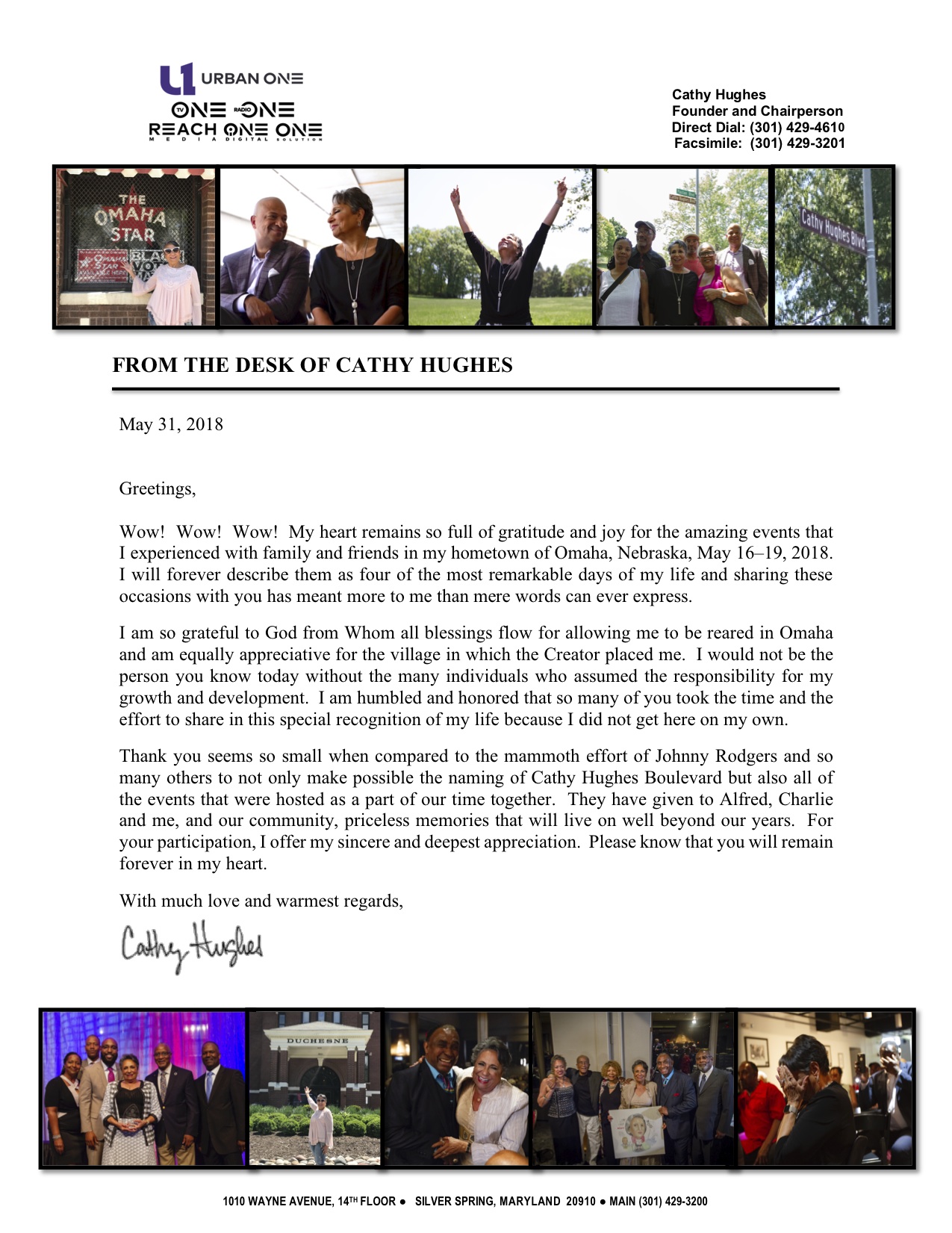
The Reader asked some African-American native Omaha media professionals what they find inspiring about Cathy Hughes:
ANGEL MARTIN
Freelance journalist
“Just to see where she started from in her career with a small studio in D.C. to large media owner. She was determined to never give up no matter what challenges she had to face. Very inspiring for a freelance journalist and radio host-producer at Mind and Soul/Malcolm X Radio like me. She also comes from very humble beginnings right in the Omaha metro. A very positive example of what can happen when you keep your eyes on the prize, so to speak.
“With her being a double minority -– this is a great example of how one should not only play with the ‘good ol’ boys’ but rather change the rules and win. When you think of radio and media ownership, Oprah’s name comes to mind and when you do your research you’ll soon realize Ms. Hughes is right up there, in fact she’s the number two based on her net worth.”
_ _ _
MONIQUE FARMER
Omaha Public Schools communications director
“Her accomplishments are truly inspirational, particularly for African-American women in the fields of journalism, communication, entertainment and entrepreneurship. She’s been breaking glass ceilings for decades and she continues to prove that some barriers are merely mental. She’s also proven that hard work, drive, discipline and possessing the boldness necessary to reach for one’s goals can account for so much. She makes us native Omahans all proud to be from the city we call home.”
_ _ _
WILLIAM KING
Founder, 1690-AM The One and 95.7-FM The Boss
“It’s inspiring because I’m currently walking in her footsteps with the creation of radio stations. I’m following every lesson from the matriarch of radio and TV.
“She’s an example that greatness come from the North Omaha community. It gives one the belief that if she can do it so can I. It’s motivation that drives you to succeed.
I recently talked to her and our conversation focused on both of us telling our stories on how we struggled and sacrificed to build our radio stations.”
_ _ _
MICHELLE TROXCLAIR
Mind and Soul radio host
“A black woman having achieved the success she has is an inspiration and motivator to all black women. Her accomplishments have transcended the barriers of race and gender. She has laid an important path.”
_ _ _
CARINA GLOVER
Founder, Ace Empire Media
“Cathy Hughes has raised the bar in the media industry and is inspirational as a black woman, professional,and business woman. As a young woman from Omaha on the path to building my own empire in media and tech, Cathy Hughes is a major inspiration. On a national scale, there’s a false perception that the roots of successful media companies generate from the west and wast coasts. Cathy demonstrates the barriers that can broken and how there’s no limit to success, despite where you began your journey.”
_ _ _
CHANELLE ELAINE
New York-based film producer (First Match)
“What i find inspiring is Ms. Hughes’ willingness to take chances, to go against expectations and push forward by her own definition of what a young African-American woman can do. She refuses to be put in a box by gender, color or origin, giving us all equity in the landscape of opportunity.”
Omaha Press Club to salute media mogul Cathy Hughes
©by Leo Adam Biga
Nebraskans are about to get an education about one of their own they should know more about and embrace as one of the state’s greatest ever exports but very few outside of Omaha’s African-American community do. This exemplary product is Omaha native Cathy Hughes, founder and owner of two major media networks, Radio One and TV One, that she grew into African-American market empires. Hers is an entrepreneurial success story unlike few others and one that transcends color and gender. Think Oprah Winfrey but only more niche and you have an idea of just how big a deal she is and just what a footprint she has in a segment of the national media marketplace. Her personal net worth is estimated at half a billion dollars. Get the picture? She’s about to come on your radar in a big way, perhaps for the first time, because of a series of events feting and featuring her in her hometown the week of May 14-20.
If you’re wondering why you’ve never heard of her before or why there haven’t been things named after her before, it may say something about how this predominantly white state has not exactly gone out of its way to recognize her or any other woman of color. As a whole, Omaha’s been guilty of the same, The festivities being planned around her are largely the effort of the African-American community here, though a broad spectrum of city officials and movers and shakers will be present for the street renaming ceremony and the Omaha Press Club Face on the Barroom Floor roast in her honor (see about the Press Club event by clicking below). Her omission, until now, as a generally known and acknowledged Nebraska Great is all the more vexing because she got her media start in Omaha, counted as her mentor Omaha Star publisher Mildred Brown and has retained very close ties to the city and the black community. She has also been very generous with her time with this reporter and others from here and with other members of the community here. I will be doing a whole new round of writing about Cathy and her business and life journey in the coming months.
Oh, by the way, her mother Helen Jones Woods is a great story in herself as a member of the famed International Sweethearts of Rhythm during the big band swing era.
For those of you playing catch-up when it comes to Cathy Hughes, here are links to some stories I have done about her or that have extensively quoted her:
https://leoadambiga.com/2010/04/29/radio-one-queen-…-keeping-it-real
https://leoadambiga.com/2013/04/11/the-omaha-star-c…ack-woman-legacy
https://leoadambiga.com/2017/08/11/native-omaha-day…ng-like-no-other
https://leoadambiga.com/2015/12/04/news-of-omaha-st…ic-papers-future/
https://leoadambiga.com/2011/07/04/native-omahans-t…n-their-hometown
Here’s a link to my story about Cathy’s mother, Helen Jones Woods, and the International Sweethearts of Rhythm:
Now Wasn’t That a Time? Helen Jones Woods and the International Sweethearts of Rhythm
|
||||
Cancellations require a 48-hour notice.
Free parking for OPC members in the Central City Garage from 5 p.m. to 2 a.m.;
North Omaha rupture at center of PlayFest drama
©by Leo Adam Biga
Appearing in the May 2018 issue of The Reader (www.thereader.com)
In her original one-act More Than Neighbors, playwright Denise Chapman examines a four-decades old rupture to Omaha’s African-American community still felt today.
North Freeway construction gouged Omaha’s Near North Side in the 1970s-1980s. Residents got displaced,homes and businesses razed, tight-knit neighborhoods separated. The concrete swath further depopulated and drained the life of a district already reeling from riots and the loss of meatpacking-railroading jobs. The disruptive freeway has remained both a tangible and figurative barrier to community continuity ever since.
Chapman’s socially-tinged piece about the changed nature of community makes its world premiere Thursday, May 31 at 7:30 p.m. as part of the Great Plains Theatre Conference’s PlayFest.
The site of the performance, The Venue at The Highlander, 2112 North 30th Street, carries symbolic weight. The organization behind the purpose-built Highlander Village is 75 North. The nonprofit is named for U.S. Highway 75, whose North Freeway portion severed the area. The nonprofit’s mixed-use development overlooks it and is meant to restore the sense of community lost when the freeway went in.
The North Freeway and other Urban Renewal projects forced upon American inner cities only further isolated already marginalized communities.
“Historically, in city after city, you see the trend of civil unrest, red lining, white flight, ghettoizing of areas and freeway projects cutting right through the heart of these communities,” Chapman said.
Such transportation projects, she said, rammed through “disenfranchised neighborhoods lacking the political power and dollars” to halt or reroute roads in the face of federal-state power land grabs that effectively said, “We’re just going to move you out of the way.”
By designating the target areas “blighted” and promoting public good and economic development, eminent domain was used to clear the way.
“You had to get out,” said Chapman, adding, “I talked to some people who weren’t given adequate time to pack all their belongings. They had to leave behind a lot of things.” In at least one case, she was told an excavation crew ripped out an interior staircase of a home still occupied to force removal-compliance.
With each succeeding hit taken by North O, things were never the same again
“There was a shift of how we understand community as each of those things happened,” she said. “With the North Freeway, there was a physical separation. What happens when someone literally tears down your house and puts a freeway in the middle of a neighborhood and people who once had a physical connection no longer do? What does that do to the definition of community? It feels like it tears it apart.
“That’s really what the play explores.”

Dramatizing this where it all went down only adds to the intense feelings around it.
“As I learned about what 75 North was doing at the Highlander it just made perfect sense to do the play there. To share a story in a place working to revitalize and redefine community is really special. It’s the only way this work really works.”
Neighbors features an Omaha cast of veterans and newcomers directed by Chicagoan Carla Stillwell.
The African-American diaspora drama resonates with Lorraine Hansberry’s A Raisin in the Sun and August Wilson’s Jitney with its themes of family and community assailed by outside forces but resiliently holding on.
Three generations of family are at the heart of Chapman’s play, whose characters’ experiences are informed by stories she heard from individuals personally impacted by the freeway’s violent imposition.
Faithful Miss Essie keeps family and community together with love and food. Her bitter middle-class daughter Thelma, who left The Hood, now opposes her own daughter Alexandra, who’s eager to assert her blackness, moving there. David, raised by Essie as “claimed family,” and his buddy Teddy are conflicted about toiling on the freeway. David’s aspirational wife, Mae, is expecting.
Through it all – love, loss, hope, opportunity, despair, dislocation and reunion – family and home endure.
“I think it really goes back to black people in America coming out of slavery, which should have destroyed them, but it didn’t,” Chapman said. “Through our taking care of each other and understanding of community and coming together we continue to survive. We just keep on living. There are ups and downs in our community but at the end of the day we keep redefining communityhopefully in positive ways.”
“What makes Denise’s story so warm and beautiful is that it does end with hope,” director Carla Stillwell said.
Past and present commingle in the nonlinear narrative.
“One of the brilliant things about her piece is that memory works in the play in the way it works in life by triggering emotions. To get the audience to experience those feelings with the characters is my goal.”
Feelings run deep at PlayFest’s Neighborhood Tapestries series, which alternates productions about North and South Omaha.
“The response from the audience is unlike any response you see at just kind of a standard theater production,” GPTC producing artistic director Kevin Lawler said, “because people are seeing their lives or their community’s lives up on stage. It’s very powerful and I don’t expect anything different this time.”
Neighbors is Chapman’s latest North O work after 2016’s Northside Carnation about the late community matriarch, Omaha Star publisher Mildred Brown. That earlier play is set in the hours before the 1969 riot that undid North 24th Street. Just as Northside found a home close to Brown and her community at the Elk’s Lodge, Neighbors unfolds where bittersweet events are still fresh in people’s minds.
“The placement of the performance at the Highlander becomes so important,” said Chapman, “because it helps to strengthen that message that we as a community are more and greater than the sum of the travesties and the tragedies.
“Within the middle of all the chaos there are still flowers growing and a whole new community blossoming right there on 30th street in a place that used to not be a great place – partly because they put a freeway in the middle of it.”
Chapman sees clear resonance between what the characters in her play do and what 75 North is doing “to develop the concept of community holistically.”
“It’s housing, food, education and work opportunities and community spaces for people to come together block by block. It’s really exciting to be a part of that.”
ChapMan is sure that Neighbors will evoke memories the same way Northside did.
“For some folks it was like coming home and sharing their stories.”
Additional PlayFest shows feature a full-stage production of previous GPTC Playlab favorite In the City in the City in the City by guest playwright Matthew Capodicasa and a “homage collage” to the work of this year’s honored playwright, Sarah Ruhl, a MacArthur Fellowship recipient. Two of Ruhl’s plays have been finalists for the Pulitzer Prize.
Capodicasa uses a couple’s visit to the mythical city-state of Mastavia as the prism for exploring what we take from a place.
“It’s about how when you’re traveling, you inevitably experience the place through the lens of the people you’re with and how that place is actually this other version of itself – one altered by your presence or curated for your tourist experience,” he said.
In the City gets its world premiere at the Blue Barn Theatre on Tuesday, May 29 at 7:30 p.m. Producing artistic director Susan Clement-Toberer said the piece is “a perfect engine” for the theater’s season-long theme of “connect” because of its own exploration of human connections.” She also appreciates theopen-ended nature of the script. “It’s evocative and compelling without being overly prescriptive. The play can be done in as many ways as there are cities and we are thrilled to bring it to life for the first time.”
You Want to Love Strangers: An Evening in Letters, Lullabies, Essays and Clear Soup celebrates what its director Amy Lane calls Ruhl’s “poetic, magical, lush” playwriting. “Her plays are often like stepping into a fairytale where the unexpected can and does happen. Her work is filled with theatre magic, a childlike sense of wonder, playfulness, mystery. We’ve put together a short collage that includes monologues, scenes and songs from some of her best known works.”
The Ruhl tribute will be staged at the 40th Street Theatre on Friday, June 1 at 7:30 p.m.
All PlayFest performances are free. For details and other festival info, visit http://www.gptcplays.com.


 Leo Adam Biga's My Inside Stories