

This article was printed in the December 2018/January 2019 edition of B2B. To receive the magazine, click here to subscribe.

Omaha native Phil Kenny a player among Broadway co-producers and investors
©by Leo Adam Biga
Appearing in the June 2019 edition of The Reader (www.thereader.com)
Phil Kenny resembles the starstruck dentist with songwriting ambitions in the stage classic The Bells are Ringing. Growing up in Omaha, Kenny played the lead in a high school production of Oklahoma! and appeared in a Ralston Community Theater production of Fiddler on the Roof. Listening to the Les Miserables cast album became a ritual. He wrote plays through college with the ambition of penning a Broadway musical, The technology law attorney still pursues that dream today.
He and collaborator Reston Williams, formerly of The Blue Man group, hope one day to get their own four-years-in-the-making musical on its legs in New York.
Far from a frustrated wannabe, Kenny’s made himself a theater insider co-producing major musicals through his 42nd Club investors group. As unlikely as it sounds, this married, devout Mormon father of seven living in Utah has co-produced some of Broadway’s most successful musicals the past few years, including Anastasia and Sunset Boulevard.
In 2018 he even copped a Tony Award for Best Revival of a Musical with Once on This Island. On a side note, one of its stars, Merle Dandridge, shares a hometown connection: Both she and Kenny are Papillion LaVista High School graduates, though not classmates.
Odds are Kenny will take home another statuette at the June 7 Tonys since three of the five Best Musical nominees are 42nd Club co-produced shows: Hadestown, Tootsie and Beetlejuice. Kenny and Co. also co-produced King Kong – nominated for three Tonys and receiving a special Tony for puppetry.
Phil Kenny and wife Clare
Meanwhile, the 42nd Club co-production Be More Chill enjoyed breakout off-Broadway success that’s transitioned into a Broadway run still going strong. The show led all nominees for the 2019 Broadway.com Audience Choice Awards nominations.
For Kenny, crashing the Broadway world as a producer never occurred to him as a thing until two people suggested he try it.
“A number of friends and I have been able to participate in Broadway musicals by investing in and co-producing, which we didn’t even know was an available option,” Kenny said.
The investing opportunity was first broached by Greg Franklin, a veteran investor and co-producer. Then again by Jay Kuo, himself an attorney who ended up co-writing the Broadway musical Allegiance.
“I told them both no initially,” Kenny said. “They didn’t pressure me at all. But after I called Greg (Franklin) to grab lunch and get answers to my questions, I decided to get into it. I found out Broadway investing is less like throwing money away and a donation, and more like a high risk investment where there actually is the potential to make money – and possibly a lot of money if you pick the right shows. That excited and interested me because I feel like I have my finger on the pulse of what people like in a Broadway show.
“My first investment was a play called Living on Love starring opera star Renee Fleming. It ended up closing early and didn’t return any of our investment. We didn’t have nearly the same type of access to the best shows then as we do now. We were just excited lead producers were talking to us.”
Then Kenny got more connected.
“When you invest in a Broadway show you frequently get opening night tickets and after-show party passes,” he said. “Those parties are filled with other people who invest $25,000 or more in shows. I made it my business to meet everybody I could.”
With Greg Franklin, he said, “I came up with the idea that if we all grouped together we could then co-produce a musical rather than just be an investor. By co-producing we get a bigger say and might be invited as the table when lead producers are talking about various marketing initiatives or having creative discussions.”
This let’s-put-on-a-show economic model has paid off well enough that the club’s grown to 100 members.
“Most of our investors tend to be outside of New York. The interesting thing about we do is that we have the opportunity to invest in the very best and highest level of commercial theater – shows like Waitress, Matilda and An American in Paris – where the buy-in to invest in big Hollywood projects is cost prohibitive.
“Our members are all accredited investors who’ve invested in Broadway shows in the past. We are very selective about the shows we invest in.”
Scripts are read. Staged readings and workshops viewed. At a minimum, Kenny said, there must be “a great story and memorable music.” “And this isn’t a hard and fast rule,” he added, “but I do like to have some sort of commercial hook in the plot or title.”
Once On This Island
He often bets on proven track records, such as an adaptation of a popular movie or a project featuring music that already has a built-in following.
His metrics also include analyzing the slated budget and calculating how many seats must be filled weekly to turn a profit. He prefers shows play in smaller houses of about 1,000 seats where demand exceeds supply, thereby creating extra urgency and buzz.
“Because we’re now at the co-producer level,” he said, “a lot of opportunities now come to us rather than us having to seek them out. Hadestown is one one them, Tootsie is another. A co-producer credit means the lead producer shares producing billing with you if you help with a variety of things, chief among them fundraising by bringing in an investment amount of a certain level – perhaps a half-million or a million dollars.”
Among the perks that go with getting your name above the title is being eligible to win a Tony Award
“Our first nomination was when we co-produced a new musical called The Visit by (John) Kander and (Fred)Ebb – the same composers of Chicago and Cabaret – with a book by Terrence McNally. Our second nominated show was Waitress – a huge commercial success. It’s been the most profitable investment we’ve been a part of. That show was nominated in the same year as Hamilton, so we knew we had zero chance of winning.”
Then came Once on This Island’s upset win. The odds-on favorite was My Fair Lady, which swept all the pre-Tony awards shows.
“Our winning was really a surprise to a lot of people, including us producing partners. I was in the back of the house pacing back and forth with my wife when they read Once on This Island as the winner. That single moment was probably the most exciting of my life – and vie had some pretty exciting moments.I looked at my wife and took her by the hand and we ran down the aisle with our other partners and we got to be up on stage for something we have such great passion for.
“It was just a thrill beyond explanation.”
Another perk: “Each of us was able to bring home our own Tony statuette.”
Kenny’s already joined a select list of Tony winners from Nebraska in Henry Fonda, Sandy Dennis, Swoosie Kurtz and John Lloyd Young. A second win would put Kenny and Kurtz in select company as multiple winners.
Kenny shares the ride with wife Claire.
“We’re both huge musical theater fans,” he said. “Our whole family’s really into it.”
The couple met when he saw her in the chorus of a Utah community theater production of, you guessed it, a musical, and he complimented her backstage. Two weeks later he got her pone number and asked her out. Ten months later, they were married.
Even though Kenny’s met stars like Matthew Broderick and Lin-Manuel Miranda, he said, “A lot of the people I look up to in the Broadway world are people most folks haven’t heard of. They’re lead producers like Hunter Arnold and Tom Kirdahy, They’re bringing incredible art to the stage and taking huge risks. To me, they’re just as much heroes as the people dedicating their lives to the performance aspect of it.”
Kenny concedes he’s “not the normal, every day co-producer” but added, “I’ve found the Broadway community very accepting of me and my faith and our big family.”
He said he doesn’t currently aspire to be a lead producer. “Part of the reason I don’t have that on my bucket list is the fact that I live in Utah. It would be really difficult to launch a whole production from beginning to end not living in New York.”
Among the shows 42nd Club is backing next season is Jagged Little Pill. The musical opens on Broadway in December. It features music from Alanis Morissette’s best-selling album of the same name.
To date, only one show he’s co-produced has made it to Omaha on tour – Waitress – but Anastasia arrives in June 2020.
Visit 42nd.club.
Read more of Leo Adam Biga’s work at leoadambiga.com.
The greening of the OPPD board bodes for a more clean energy focused utility
©by Leo Adam Biga
Appearing in the April 2019 edition of The Reader (www.thereader.com)
Polls show most Americans are now sold on climate change as real and requiring action. Thus, green’s no longer the new red bait.
Consistent with the public’s reset on greater environmental stewardship, the Omaha Public Power District’s board of directors has a new green majority after this last election cycle. Newly elected directors Eric Williams, Janece Mollhoff and Amanda Bogner have joined holdovers Rick Yoder and Craig Moody as ardent clean energy advocates. It’s not as if this potential voting bloc is so far apart from the other three directors, led by chair Anne McGuire. Indeed, there’s consensus to continue OPPD’s already impressive gains on the renewables front. Differences come down on how far, how fast the utility goes from here.
Regardless of where OPPD lands in its push toward renewables, it’s clear this billion dollar company reflects its customers micro energy concerns. Now that environmental engagement is cool, more folks are doing their part to reduce emissions by driving electric cars. More homes and businesses are going solar or using programmable timers to conserve usage,
Green-minded measures like these are one answer. But until entire communities and industries switch from fossil fuels reliance to clean energy sources pollutants and waste will leak out. The big frontier for sweeping impact is as close as the local electric utility. OPPD serves hundreds of thousands of customers in 13 counties with an energy profile mix that, while on an ever more renewable trajectory, is still largely dependent on coal-fired generating plants that release carbon.
“Utilities are clearly at the forefront of figuring out how we can have a reliable and affordable electricity energy system while mitigating and adapting to climate change,” Craig Moody said. “It’s difficult but probably the most important work I will do in my lifetime.”
OPPD’s made clean energy a top priority through strategic directives set by its publicly elected board.
Moody, managing principal at sustainability consulting firm Verdis Group, feels he represents a broad cross-section of ratepayers in Subdistrict 5..
“Nobody wants pollution. But people also want a measured, deliberate, socially just transition to clean energy,” he said. “The reality in this state is that our economy is driven by agriculture, which can only happen with fertile soil, clean water and clean air.”
He sees rural constituents perhaps even more climate change-attuned than their urban counterparts.
“They get it. They see the risks. I mean, look at the flooding. It’s here now.”
Anne McGuire, representing Subdivision 2, has served on the board since 1996 and she said the utility’s made renewables a focus for 20 years. OPPD set its first hard renewable energy goal in 2010.
“Our goal was 10 percent renewable by 2020,” she said. “Everybody thought that was crazy. But we surpassed that last year at about 33 percent. At the end of 2019 we’re going to be about 40 percent renewable energy. It’s gotten less expensive to put up wind towers. They’re more efficient now, so it became far more viable and cost effective. We’ve always said we will adopt at the pace we can afford.”
“It’s gone much faster than most anyone really anticipated,” Moody said.
With carbon emission controls, LED street lights and a new community solar program,” Moody said, “we’re ahead of many other utilities when it comes to the pace at which we’ve continued to adopt renewables.” “I’m proud of how quickly it’s happened. Part of what we are trying to figure out as a utility is what’s next.”
McGuire and Janece Mollhoff, who both have nursing backgrounds, echo health concerns over pollutants. Health and safety concerns extend to decommissioning the Fort Calhoun Station nuclear plant and the frequent flood threat posed to the Nebraska City Station.
McGuire feels the new board members will help move OPPD forward.
“They’re very engaged, very educated, very socially public-minded, and they know a lot about climate change,” she said. “So this will help us even more in bringing on more sustainable things.”
Moody sees things the board as a whole must address.
“Most electric utilities are seeing pretty flat if not declining growth as measured by demand from customers’ need for kilowatt hours. Ours is growing primarily due to data center activity in Papillion. So how we manage and meet that new demand while continuing to reduce carbon emissions is one of our bigger challenges in the coming years.”
He senses “alignment” by the board on the longterm vision for renewables. “The nuances are about pace and what that transition looks like from where we are today to what that vision is. We need to ensure a good amount of study and analysis goes into making decisions about how we will achieve that vision.”
Even seemingly small items like emissions measures – carbon intensity versus carbon ratio – are up for debate.
Agreeing on the particulars must happen within the board’s mandate of keeping energy affordable and reliable while maintaining environmental sensitivity. Easier said than done in a field dependent on both old and still developing new technologies and wide fluctuations in energy demands on the grid.
“It is a really difficult balancing act,” Moody said. “We often describe it as pulling levers. By focusing more on one issue, it’s going to create pressure on maintaining other aspects.”
Said McGuire, “You have to balance the scales. This is where we work on reaching compromises. It’s recognizing the fact you have to look at the entire company when you make changes.”
Balancing scales means tempering expectations.
Mollhoff (Subdivision 7) wants OPPD “to move away as quickly as possible from fossil fuels” but concedes that goal is subject to “fiscal responsibilities and making sure we’re not jeopardizing rates and our bottom-line.” She said the board must deliberately review and revise the 15 strategic directives previous boards put into place. “It’s too important we maintain stability to turn those all upside down and make it hard for staff and management to comply.”
Moody agrees, saying. “With an industry like this you don’t want to constantly be sending management new directions and be zig-zagging all over the place. That’s unhealthy, inefficient and not productive.”
Eric Williams (Subdivision 6), a natural resource planner at the Papio-Missouri River Natural Resources District, also believes due diligence serves the utility well.
“It’s not as if there could be an agenda item next month to vote on one hundred percent renewable energy. That is not how a utility operates, nor should it. There are a number of different times when different pieces will be up for public discussion. Those 15 strategic directives work together. All are very critical to the discussion about what is the total percentage of energy generated from renewable sources and how we’re going to continue increasing that.”
Williams views the board’s job as “working to understand this really complicated and complex set of parameters that guide how the utility operates, ways where we can make improvement and strategies we can use to work toward more clean energy. There’s a balancing between the different directives. For example, you could immediately jump to 100 percent clean energy, but that might be in conflict with cost effectiveness goals we currently have based on the price of technology available today.”
‘It’s easy to say we want to have a hundred percent clean energy and there are utilities – Mid-American and Xcel – who have said that. But if you ask them specifically how they’re going to get there I don’t think they have specific answers yet because transitioning to a hundred percent clean energy economy is a very long process. A lot of the technology we will need has not yet been developed.”
Amanda Bogner (Subdivision 1), an engineer by trade, knows this territory well.
“I would like to see OPPD’s renewable capacity increase to meet 100 percent of electric demand with renewables. This will become feasible as utility-scale energy storage becomes economically viable,” said Bogner, whose business Energy Studio makes buildings more energy efficient.
Bogner is concerned that two bills introduced in the Nebraska Legislature, LB 155 and LB 700, “will undermine our state’s potential to generate wind energy.” “Wind energy is a huge economic opportunity for our state. We need legislative action to encourage more wind energy development, not create roadblocks.”
While “wind and solar technologies are available in abundance in Nebraska,” Williams said, “they are intermittent, which is used as a criticism often of clean energy.” Williams regards such criticism as “a short-sighted view of how utilities function in general,” adding, “A utility is made of a number of generation assets all operating at different times, with different capacities, from different original energy sources and providing different benefits to the grid.”
Whatever the issue, the directives drive the change.
“In my view the most important job of our board is to get those strategic directives right,” Moody said. “Everything else the organization does flows into those strategic directives. Management is without question getting good guidance from those directives and often refers back to them as they think about what they’re doing.”
Anne McGuire describes the directives as “a living, breathing document we’ll alway revisit.” Added McGuire, “It’s important to have that broad policy because things are always changing. There’s going to be new technologies. These broad policies allow us as a company to be flexible when dealing with change.”
OPPD has an innovation team tasked with future solutions. Whether present or future-directed, Williams said “the board is responsible for understanding all of the different values of the district to provide affordable and reliable and environmentally sensitive energy and to make decisions guiding the district towards getting to those outcomes over time.” That means “understanding the technologies available.”
Williams said those technologies include clean energy generation at the utility-scale. It also mean distributed energy production, such as solar or wind, vent-metered at a house or business with excess sent back to the grid. There’s also energy storage with batteries, demand management programs and smart business maps.
“All of those work together to get a picture of the total generation and demand at the utility,” he said. “I am particularly interested in seeing us move toward more clean energy and more efficiency and becoming a part of and a leader in the new energy economy. But we do need to keep in mind we have come a long way and there are things that take awhile to transition.”
As more clean energy comes online, there’s bound to be displacement.
“We need to make sure as we transition we’re creating growth in other parts of the economy that fill the gap for skills and jobs lost in that transition,” said Janece Mollhoff. “I think it’s an important part of our work.”
Subdivision 4 director Rick Yoder a Nebraska Business Development Center consultant, champions Nebraska taking more advantage of the new energy economy.
“This is a wonderful opportunity to distribute the benefits of business to landowners around rural areas of Nebraska,” Yoder said. “I represent seven of the 13 counties OPPD has from Sarpy County all the way to the Kansas line. There are plenty of acres there. We are losing out in terms of job growth, business impact by not being more aggressive in pursuing the clean energy economy. The opportunity is there to invest in energy efficiency, housing and the construction jobs that would make that happen.”
Eric Williams advocates a big picture view as well.
“I think the board is generally in agreement that we should continue to develop clean resources in our state that have benefit to the locations where they’re constructed as well as the ratepayers in the utility.”
Mollhoff regards wind farms good investments, whether OPPD builds them or enters purchase power agreements with third parties, as long as it’s “wind sited in places that meet demand without having to invest too much more in infrastructure, transmission and distribution lines.” For example, she said, “bringing wind energy here from the Sandhills doesn’t make sense.”
The volatile nature of agriculture and climate, Yoder said, makes the case for urgency.
“We’ve seen prices go up and down and major floods. There’s land that does not always offer a strong income for the landowners. This is a great opportunity to diversify and to make our system more reliable and more resilient than it already is. OPPD and other utilities along the Missouri River should by now recognize the risk associated with recurring flood waters. A central hub and spoke system is not as resilient, reliable or risk-less as distributed energy generation.”
How OPPD’s adapting to the new energy economy depends on what lens you look through.
“If you use a Nebraska-only lens,” Yoder said, “I think OPPD is on the leading edge. It’s exciting the energy sector is transforming with the greatest wealth creation opportunity in my lifetime. The new technologies will enable us to extract resources rich to Nebraska that don’t run out – wind and solar. They have to be managed appropriately and we still have some technical issues we have to watch out for.
“But OPPD has certainly installed a ton of wind or partnered with companies installing wind here, I don’t just mean power purchase agreements with companies that install wind towers. There’s also the new Sarpy County resident (Facebook) building wind to offset the coal it purchases from OPPD. So wind expansion is happening because of OPPD above and beyond everybody else in the state, and that’s a good thing.
“OPPD is slower on solar, but I think now that it’s got its toe in the water it’s going to see the advantages there.”
Williams describes the community solar program coming online in April as “an opportunity for people to participate in local community clean energy even if they can’t install it directly on their home.”
Compared to nearby states and the country. Yoder believes Nebraska is “lagging” in new tech adoption.
“I think we’re losing economically because of it. Some people don’t use that as a measure. They use environmental measures. In either case, there’s a real urgency to make some change.”
Yoder calls for reducing “the amount of bureaucracy it takes to install solar for households and small businesses.” “The cost of when someone puts in solar is argued unfairly as a disadvantage to other users in the system. We’re working on what is the right rate for that user to pay to stay connected to the grid.”
Whatever the technology, Williams said, “we need to make sure we’re looking long-term while providing stability and certainty in the short-term.” He cautioned, “You want to be careful about saying something about a long-term vision without having fully understood the steps necessary to get there.”
Mollhoff describes a push-pull at work. “Management’s being pushed by entities like Facebook that want renewables,” she said, “and it’s important to recognize that management will respond to external forces probably as much as they’ll respond to the board. I want to make sure that whatever we do as a board we don’t tip that balance and put us on a path that isn’t sustainable or reliable. W
“e’re not trying to micromanage and yet we want them to move in a certain direction. It’s really the most we can do. We set rates and these strategic directives, but we don’t run the organization. We have to let management and staff do their jobs in a way that meets those strategic directives.”
So how well poised is OPPD to make bigger strides in clean energy?
“That’s where we have the greatest need for discussion between board and management,” Yoder said. “They’re much closer to the actual changes and smarter about the time and resources needed to make the change than the board.”
Yoder said unless or until the board sets more specific clean energy directives, “we don’t have those policies pushing management right now.” He added, “That’s really where the board has an opportunity to more deeply engage and I think we all recognize that’s what we need to do. The change we’re talking about is seen as disruptive, but I think there is an organizational culture change happening.”
Underpinning any change, Yoder said, “we have to have the right data to make decisions.” He feels comprehensive data “hasn’t always been” available. “So we’re asking for larger time spans for the reporting and better measures of what’s being reported. That will allow us to make better policy decisions.”
Another area he’d like OPPD to explore is “shaping the load by working with customers to reduce when they choose to use electricity, so that demand that requires generation is spread out more evenly.” Doing that, he said, will take “a more modernized distribution system, which will require an investment.”
“The real tension for the board and management is where does the money come from, how do we do this, what is the return on investment if we choose to encourage more people to manage their load. Not everybody’s going to want to do that, so how do we find technologies that put in a default option for users.”
A more pro-active approach would be a start.
“As a utility we have not demonstrated an interest in helping people save their energy costs,” Yoder said. “The Austin, Texas electric utility raised its rate but worked with ratepayers to reduce the amount of energy they use, so monthly bills ended up the same. We could do that here if we chose to compete on efficiency rather than on price. When you compete on efficiency you compete on technologies, know-how, building practices. You’re no longer just a utility – you partner with the sectors of the economy for community betterment.”
Then there are meeting restrictions imposed by state Sunshine laws and differing agendas..
“We work the best we can through the meetings we set up,” Yoder said. “It is a struggle. But there’s a good amount of collegiality. I think we all have the same vision of where we’re going. The struggle we have is some of us are more focused on the outcome and others on the process to get there. Some understand it takes several steps to get to where we want to go and others, like myself, want to see it happen now.
“It’s a tough tension.”
Moody cites the fluidity of new tech and impinging climate change as making everything move faster. “The utility industry historically has been pretty slow to change,” he said, “because it takes a lot of time, study, energy, resources, money to put in new transmission- distribution, to build new generating plants. That meant it went very slow. It’s not slow any longer.”
Something McGuire doesn’t want lost in all this is the “valued” work done by OPPD employees who operate the coal fired units that still energize the district. “They’re the ones that really keep the lights on 24/7 and we have to respect them and their important role in this,” she said “If we didn’t have that we wouldn’t have the reliable resilient energy we have right now.”
As the utility prepares for a greener future, McGuire said, “There’s discussion and compromise, but in the end we’re all after the same goal, and we all respect each other. This is not Congress.”
Moving forward, Moody said, “it will be a collaborative effort by those some describe as the green majority and the other members of the board and management.”
Read more of Leo Adam Biga’s work at leoadambiga.com.
Outperforming and Including Others
Makayla McMorris
Story by Leo Adam Biga
Photography by Bill Sitzmann
Originally published in the March-April 2019 edition of B2B Omaha Magazine (https://omahamagazine.com/articles/outperforming-and-including-others/)
Marketing whiz Makayla McMorris became executive director of the University of Nebraska-Omaha’s Office of University Communications in December 2018.
The Omaha native hopes to elevate her hometown community, leading by example as an African-American female in UNO’s executive ranks. “Being in this position is a huge hope for the community,” McMorris says. “It’s difficult in Omaha. A lot of people from the community leave for better opportunities. ”
She and her husband, Charles Drew Health Center CEO Kenny McMorris, have spurned offers to relocate.
“We both are very committed to the success of Omaha,” she says. “We see where change is starting to happen. Networking and understanding how things work here has allowed us to stay in Omaha and thrive.”
The Nebraska Wesleyan graduate’s local professional life began as a Hearst Television Broadcast Sales Academy Fellow, where she found herself to be the only African-American in local media marketing. She often exceeded sales goals, surpassing her new business goal alone by 30 percent in 2007.
The position at Hearst empowered her to be an entrepreneur. That two-year experience helped her relate to clients when she joined Cox Media in March 2009.
“I could talk to business customers about things other consultants couldn’t—about how to write a business plan, supervise construction of a physical space, hire and train employees, make payroll,” she says. “I had a connection with, and understanding of, small- to medium-sized businesses and what the value of a dollar means to them. It put me so far ahead of other consultants.”
Over the next few years, she climbed steadily in her career, and in 2013, exceeded her first quarter goals by 12 percent for new business, and by 139 percent for digital. But it took time to for McMorris to overcome stereotypes.
“When I would go into a business for the first time I could see they didn’t expect a black person,” McMorris says. “They were like, ‘who is she to tell me how to run my business?’ I felt like I was always under the microscope. I had to perform at a higher level. I had to break down barriers to get them to understand I’m of value to their company.”
She out-performed revenue targets by devising integrated media campaigns across broadcast, publishing, and digital platforms. Word of her achievements led KETV to recruit her back into the Hearst fold. As the KETV senior marketing executive, she led multi-million dollar integrated sales campaigns that grew station revenue by millions.
She’s also grown her circle of influence, serving on the Omaha Women’s Fund and Metro Community College Foundation boards, doing professional meet-ups, and encouraging peers.
“You just really have to be connected,” McMorris says. “This position at UNO came to me because of those things. People I had worked with who I stayed in connection with vouched for me in this role. It’s a testament to that networking.”
That’s one reason she brings a democratic, inclusive leadership style to “the UNO family.”
“I lead a team of 21. I want to be someone they actually feel connected to,” McMorris says. “I like to sit back and listen. But when I do have something to say, it’s effective. I want it to be relatable. People don’t respond well to jargon…I prefer one-on-one, intimate conversations.”
McMorris believes UNO is “a premier institution for higher learning, not only on a local level, but on a national level.”
And with her track record for marketing, she will certainly help elevate the school into an even more premier institution.
Visit unomaha.edu/university-communications for more information.
This article was printed in the April/May 2019 edition of B2B. To receive the magazine, click here to subscribe.

The Reader newspaper is celebrating 25 years with a special anniversary March 2019 issue. This is one of two articles I have in that milestone edition. In commemorating the paper’s quarter century serving the community, we’re noting some behind the scenes figures and events that helped get the paper this far. This piece profiles legacy Omaha investor John Webster, whose capital allowed publisher John Heaston to reacquire the paper and whose money and advice helped Heaston stabilize the operation through the economic downturn and the changing landscape for print media. Another Omaha investor who stepped up at the same time as Webster to aid The Reader was John Blazek, a social entrepreneur I profile in the second article. It takes a lot of talents and resources to put out a paper and it’s good to recognize some of the untold stories and unsung heroes who have a hand in making it reality. I didn’t know of Webster until I got the assignment to interview him. His role was eye-opening to me and I personally appreciate the way he assisted Heaston and bailed out the paper because I have been a Reader contributing writer for 23 of its 25 years. The bulk of my wide-ranging work as a journalist has been with the publication, where I have had something like a thousand or so pieces appear in its pages, including hundreds of cover stories. It’s been an eventful marriage filled with highs, lows, opportunities, adventures and all the usual stuff that attends a relationship that long-standing. I am glad to have some presence in this landmark edition and I look forward to being part of The Reader reaching new milestones over time.
A Man for All Reasons
Legacy Omaha Investor John Webster Was a Go-To Guy for The Reader
by Leo Adam Biga
Originally appeared in The Reader (www.thereaer.com)
Being from a legacy family carries expectations. Retired broadcaster John Webster, 70, grew up knowing he was part of a historical line. Even though making his own mark as a Webster was expected, it wasn’t a given.
“I’m a fifth generation in Omaha on my dad’s side and sixth generation on my mother’s, so we’ve been around for a while. I come from a great family. It’s one thing to come out of a good family, but if you don’t have the desire to do something with yourself, it’s just not going to happen,” said Webster, whose family was successful in investments and transportation.
Blessed with creative and enterprising genes, he made his biggest imprint as owner of Omaha radio station KEFM. He was also a director of Ash Grove Cement Company, a cement and cement kiln dust provider to the construction industry. Additionally, he’s served on numerous community boards and committees.
“I was heavily involved in the masonic organizations in Omaha. I got to meet people from all walks of life. That was a big part of how I formed myself.”
When Reader publisher John Heaston needed capital to buy back the paper and stabilize it in this disruptive media space, Webster became an investor. He kept a low profile doing it, which is the Webster way.
“My grandfather and father were big influences on me. As a family we’ve always been pretty private and quiet as to what we do with investments or philanthropy. I’ve followed suit.”
Webster attended Shattuck, a private boarding school in Faribault, Minnesota, when it was a military academy. He earned a business administration degree from Menlo College in Menlo Park, California. His interest in the radio business was stoked visiting a West Coast station.
“I became fascinated with the broadcast side of things. I thought it was terribly creative.”
Back in Omaha, the licenses of radio stations KEFM and KOIL were suspended after owner Don Burden ran afoul of the FCC in 1976.
“When the properties came up I thought this would be a thing I would enjoy doing for a living and I might be pretty good at,” Webster said. “My father and I and Joe Baker formed a small company to go after the licenses.
We thought nobody would want to file against us but
11 other groups did. We went through a seven-year comparative hearing process I wouldn’t wish on anybody. We thought we could serve the community as well as anyone else given our strong Omaha history.
“After seven years the FCC finally decided the same thing. We went on the air officially in 1983. We started from scratch and we built it. Joe Baker left and my father and I continued on and I basically ran the thing.”
He said a lesson he learned is that “you can’t be a broadcaster and be thin-skinned.”
After a nearly two-decade run as a local independent, Webster saw the competitive landscape change when the FCC opened ownership to unlimited stations and markets.
“I could see the writing on the wall that I wasn’t going to be able to compete with somebody that had many more stations and resources. I called a friend of mine who was a license station broker and said, ‘It’s time for me to get out.’ And I got out at the right time.”
Webster made a cool $10 million selling his profitable stations to Clear Channel.
“I think if I had waited six months it would have been a totally different game.”
He added, “If the FCC hadn’t changed things, I’d probably still be in broadcasting.”
He misses it, especially the people.
“When it’s all gone, there’s a vacuum.”
Other business opportunities have popped up, he said,
“but broadcasting was my bread and butter,” adding, “Being in the business and being able to grow the business through creativity and drive meant a lot to me.”
He served as president of the Nebraska Broadcasters Association and was instrumental in creating its charitable foundation. In 2001, he was inducted into the association’s Hall of Fame.
Besides owning his own specialty advertising company, his only other media foray was The Reader.
“I met John Heaston and I liked him, and I liked what he was doing. John Blazek and I got involved as investors.
It was interesting.”
Webster appreciates the publisher’s entrepreneurial zeal. “I think a lot of John Heaston. He’s creative. He has worthwhile ideas. He pursues stories that maybe mainstream publishers wouldn’t lay a hand on. I think there’s something to be said for an alternative newspaper. It adds a different viewpoint.
“The Reader may not be the biggest operation, but I think it serves a very vital part in providing information to the Omaha community.”
Webster and Blazek’s infusion of cash helped The Reader through some tough times.
“It hasn’t been an easy road. It’s been a real struggle. It’s a real compliment to John Heaston that he stuck with it.”
Webster’s been there himself.
“When you own your own business the buck always stops at your desk,” he said. “You can’t blame it on anybody else.”
Satisfaction, he said, comes in direct proportion “to the degree that you can work things out and solve problems and continue to grow.”
Webster, who’s married with three adult children (a fourth died in 2015), keeps a wintertime residence in South Carolina, but Omaha remains home.
“I’ve always loved Omaha. I don’t think I could ever really cut my ties with the city or Nebraska.”
Read more of Leo Adam Biga’s work at leoadambiga.com.
The Reader newspaper is celebrating 25 years with a special anniversary March 2019 issue. This is one of two articles I have in that milestone edition. In commemorating the paper’s quarter century serving the community, we’re noting some behind the scenes figures and events that helped get the paper this far. This piece profiles social entrepreneur John Blazek, an Omaha investor whose capital allowed publisher John Heaston to reacquire the paper and whose money and advice helped Heaston stabilize the operation through the economic downturn and the changing landscape for print media. Another Omaha investor who stepped up at the same time as Blazek to aid The Reader was John Webster, a former broadcast radio owner I profile in the second article. It takes a lot of talents and resources to put out a paper and it’s good to recognize some of the untold stories and unsung heroes who have a hand in making it reality. I didn’t know of Blazek until I got the assignment to interview him. His role was eye-opening to me and I personally appreciate the way he assisted Heaston and bailed out the paper because I have been a Reader contributing writer for 23 of its 25 years. The bulk of my wide-ranging work as a journalist has been with the publication, where I have had something like a thousand or so pieces appear in its pages, including hundreds of cover stories. It’s been an eventful marriage filled with highs, lows, opportunities, adventures and all the usual stuff that attends a relationship that long-standing. I am glad to have some presence in this landmark edition and I look forward to being part of The Reader reaching new milestones over time.
More Bang for His Buck
Social Entrepreneur John Blazek Helped Reset The Reader’s Course
©by Leo Adam Biga
Originally appeared in The Reader (www.thereader.com)
Omaha investor John Blazek likes getting “a two-fer” when putting his money to work.
“I always figured why do something for just one reason when you can do things for more than one reason. It’s what I really enjoy. That’s why I’ve done everything I have in my career,” he said.
“I’m a really big believer that to whom much is given, much is required. You’ve got an obligation to try to help the other guy. That’s what makes life enriching.”
As a social entrepreneur, he’s started, acquired and sold businesses with this two-for-one goal in play. At some critical junctures in its history, even The Reader benefited from his strategy, as Blazek infused capital that allowed the paper to remain a viable alternative voice while netting him a return on investment.
“I like to leverage the things I do so it’s not just about me but also provides service to others.”
The Creighton University graduate is Entrepreneur in Residence at his alma mater, where he teaches entrepreneurship and real estate.
His multi-faceted career has encompassed being a pharmacist, executive, educator, real estate developer, philanthropist and mayoral cabinet member.
He served patients as a Kohll’s and Clarkson Hospital pharmacist. He created jobs as a home (Total HomeCare) and workplace healthcare provider (Wellcom). His Old Market and downtown real estate projects have reactivated old buildings, He, Mark Keffeler and Mike Moylan redeveloped the historic Paxton Hotel. Blazek’s an investor in The Jewell jazz club in Moylan’s Capitol District and a partner in the Prairie Hills residential-commercial real estate development.
Reared in a midtown Omaha working-class family, he learned early about leveraging resources. His World War II veteran father was a Union Pacific machinist. His homemaker mother worked part time as a Walgreens cashier. His immigrant grandparents laid a foundation anchored in high aspirations and strong values.
“I think every generation wants the next generation to better themselves,” he said, “but maintain the same values. I think lots of times as people better themselves, they lose some of those core values, which are what got them there.
“Probably the biggest thing I took from my growing upwas a really good work ethic. There’s plenty of people way smarter than me, but I will outwork anyone.”
This practicing Catholic’s faith is central to his life.
“I served as board president of Skutt Catholic High School and Catholic Charities. My wife and I sent our three daughters to Catholic grade schools, high schools and colleges.”
Blazek champions Omaha and its many opportunities.
“It’s all here. You’ve just got to roll up your sleeves and go after it.”
In the late 1990s, then-Omaha Mayor Hal Daub appointed Blazek to the city planning board. Later, as director of economic development, Blazek led the city’s charge to demolish the old Asarco lead refinery plant, whose decades of contamination resulted in East Omaha being declared a Superfund site. A public bond issue paved the way for construction of the convention center-arena and the creation of the Metropolitan Entertainment & Convention Authority (MECA), which he served on the first board of directors.
“That was a great experience,” Blazek said. “The convention center-arena has been a game-changer for the city in the entertainment and development it’s generated.”
An encounter with Reader publisher John Heaston, who was investigating the Asarco site, forged a bond.
“I thought he did a good job and was a fair journalist,” Blazek said of Heaston. “I gained a lot of respect for him and I enjoyed our relationship.”
By the early 2000s, Heaston, who had been bought out, was looking to buy The Reader back from then-owner Alan Baer. Heaston approached Blazek and another local investor, John Webster, to assist him.
“We put up the capital in order for John to do that,” Blazek said.
The investors also helped Heaston acquire El Perico newspaper.
In The Reader, Blazek saw an opportunity to make a profit and stabilize a struggling media entity.
“I thought the survival of the paper was important to the community. Certain things would not be covered if not for The Reader. It often brings up a social-justice voice that I think is healthy. If it were gone, I do think there would be a void.”
His estimation of Heaston has only grown.
“We all know the pressures on print media but John’s a survivor. He works his tail off. He’s a trencher who hung in there through the tough times. He added a digital imprint. He downsized the paper to a monthly. He changed as the times changed. Yet he’s kept the same journalistic principles in place.”
Blazek’s ownership interest was “more from a board-seat standpoint” offering “business advice and mentorship.” Despite the paper not always reflecting his views, he kept involved.
“John and I certainly didn’t agree on everything. I disagreed with a lot of the positions the paper took. But I never interfered with any editorial content.”
All along, the idea was to let Heaston eventually have the paper again all to himself.
“We negotiated an exit strategy where John acquired our interests back. We sold it back to him on an installment basis. John’s done a great job and we wanted to see him continue to do that. It’s kept the paper going and allowed him to stay on as publisher.”
The paper fully became Heaston’s again in 2017.
“I think John had a good year last year,” Blazek said, “so mission accomplished as far as I’m concerned.”
As for Blazek, he intends to finish a self-help book he’s writing and to pursue a doctorate in education.
“I’m open to other ventures as long as they support my direction of moving from ambition to meaning.”
Read more of Leo Adam Biga’s work at leoadambiga.com.
The man behind the Steamroller machine
©by Leo Adam Biga
Appearing in the December 2018 issue of New Horizons
Music is a birthright for Grammy Award-winning American Gramophone and Mannheim Steamroller founder Chip Davis.
The Omaha transplant has built an international following with his music, which has earned some half a billion dollars in retail sales over four decades. Millions more have come from performing multimedia concert dates across the U.S. and the world.
An acknowledged entrepreneurial and branding whiz, he’s leveraged his music’s appeal to partner with Walt Disney Company, NBC, Universal Studios, NASA and the National Parks System.
In terms of fame and riches, only one other Nebraska musician can rival Davis – singer-composer Paul Williams, a Grammy and Oscar-winner. But where Williams is a solo act, Davis fronts a multi-dimensional machine under the Mannheim Steamroller name.
Davis maintains a large production-recording-distribution complex in North Omaha. It covers five acres and four buildings, three of which are interconnected. He sponsors two national touring bands performing Steamroller’s popular Christmas catalogue. The tours nearly rival the Nebraska Theatre Caravan’s tours of A Christmas Carol.
Due to a bum arm from neck surgery, Davis no longer tours, though he still makes surprise appearances. His touring musicians travel via luxury buses, but the grueling every night schedule is too strenuous for him.
His private Hawker 900 XP jet gets him wherever he needs to go quickly and in comfort. He keeps a vacation home in Florida.
In December he’ll fly to Orlando to conduct a 60-piece orchestra at Universal Studios playing the music from The Grinch Who Stole Christmas. The concerts are held in an outdoor bandshell he calls “absolutely beautiful.”
He creates and oversees a branded line of non-music products, including food items that range from a spay-on meat baste to a cinnamon hot chocolate mix.

Breaking the mold
This third-generation musician from small town Ohio is credited with helping give birth to the New Age genre for his signature fusion of classical and rock. Before that though he was hard on the path of becoming a symphony orchestra player. But then a funny thing happened on the way to his dream. He went from the world of Bach, Beethoven and Mozart to the great American Songbook to a rock opera to advertising jingles to winning country music writer of the year to hitting upon his synthesized Steamroller sound of baroque meets easy listening.
It wasn’t the first time someone in his musical family made a detour. His parents made their own break from classical to commercial. His father Louis played saxophone in the Glenn Miller touring band. His mother Betty played trombone in the NBC Symphony and in Phil Spitalny’s All Girl Orchestra.
His family’s connections to American popular music run deep. His country doctor grandfather loved the (John Philip) Sousa marches and the lead trombonist in the Sousa band taught Chip’s mother in high school.
His folks. plus an aunt and uncle, studied at the University of Michigan’s prestigious music school. His father taught music, led choirs and built instruments. His mother also taught music. Davis intended following suit as a teacher and classical performer.
Influences
Reflecting on how much of his own musical predisposition is inherited and how much is a result of environment and exposure, he said, “I think there’s probably a combination of both. I grew up around it. Third generation both sides of my family. Music was flowing in my veins from the time I was born. In fact, my mother said when I was 6-months old I could hum the melody to ‘Silent Night,’ which is pretty crazy at that age. So I must be just full of music.”
The precocious only child started on piano at 4 with his grandmother as his first teacher. He conducted in front of the family console radio. At 6 he composed a four-part chorale ode to his pet dog, Stormy, who died.
“It broke my heart.”
In addition to being immersed in music and feeling compelled to create it, he said, “I had some of the best teachers you could ever have.” His accomplished father taught music theory-music history and was Chip’s main teacher through high school.
“I had all of that and then I went to the University of Michigan’s famous music school.”
For his primary instrument, Davis chose bassoon though he’s best known as a percussionist. It may surprise some this instrumental icon was a singer through his early 20s.
“I sang in a boys choir when I was about 10-years old in Oregon after our family moved there.”
He was invited to sing with the Vienna Boys Choir.
The family moved back to Ohio, where Davis was in his dad’s high school choir.
At Michigan Davis sang in the glee club and played drums in the marching band. He joined select students performing with the Toledo Symphony Orchestra.
His classical tradition focus was so intense he missed the en vogue music of the 1960s.
“I wasn’t sensitive to it at all. I mean, I certainly knew who Diana Ross and the Supremes were because they were right over in Detroit. I had roommates not in music that would go to concerts at the Fisher Theatre in Detroit. But it kind of slipped by me. I was so classically oriented that I didn’t really notice what was going on.”
While his friends listened to the latest hits from Motown and British Invasion rock bands, he stuck to classical.
“I listened to WJR Detroit – a big 100,000 watt AM station – primarily because Karl Haas (later an NPR fixture) had a classical music program on every day and I would listen to that. I actually learned quite a lot from his explanations of different things, of composers and pieces and the way they’re constructed.”
Music kept him so preoccupied he was oblivious to the Vietnam War and civil rights protests on the Michigan campus, which was a hotbed of student activism.
“I didn’t even notice that.”
He did not participate in the counter-culture revolution at Michigan, but the school gave him the foundation for his professional music career.
“I still have a close connection with them,” he said. “When I was first there as a student the university opened a new music building. Now they’ve added a new wing and I’m fortunate enough to have my name on the Chip Davis Technology Studio. It’s full of computers and things we use for composing today.”
He donated about a million dollars to create the tech suite, which serves as a project workshop, research laboratory and multimedia gallery for courses in Sound Recording and Production, Interactive Media Design, Immersive Media and Performance Systems.
Davis finds it ironic that Michigan became a legacy school – “a lot of family ended up there” – when his family’s from Ohio, not Michigan.
Little did he know a youthful fascination with electronics would be revisited when his music career took off.
“I had this ridiculous notion in high school I was going to go into electrical engineering – until I found how much math it took. Then I was like, Well, I’m pretty good at music, I guess maybe I’ll do that. I built electrical things, including an oscilloscope, from a Heath kit. For a senior science project I used it to analyze music notes. For example, flute is almost all sign waves.”
He could never have imagined how electronics would intersect with his music years later.
“Right, exactly,” he said in his state-of-the-art recording studio where everything’s digitally programmed.
The room’s on its third control board, though it too has grown nearly obsolete in the new digital age, he said.
“We don’t even use it anymore. Everything’s done on Pro Tools” (an Avid Technology digital audio workstation for Microsoft Windows and macOS). Everything’s in the computer as far as controlling levels and all that.”
Exploration
Ever the searcher, Davis loves the freedom technology affords to explore.
“Something astounding you can do today you couldn’t just a few years ago is sample different instruments. I have a new album coming out called ‘Exotic Spaces.’ I wrote pieces about exotic spaces like the Taj Mahal. I had access through Pro Tools to all these Indian instruments. I wrote with those instruments and I did it in the style of Indian music but with my Mannheim spin.
“I wrote another piece about Egyptian pyramids and I found Egyptian instruments, including one called the nay, which is a flute that almost sounds like a bagpipe.”
Perhaps his “farthest out” experiments have involved capturing natural sounds.
“I’m a scuba diver. I’m way into that,” he said. “I have Navy grade hydrophones because I’m interested in capturing sound under the surface of the ocean. On one dive we recorded a whale singing. On this new album ‘Exotic Spaces’ I use the whale song as the basis for a song I wrote the accompaniment around.
“I almost always write in the key of C because you don’t have sharps and flats and all that unless you want to add them. It’s an easy key signature to maneuver around in. Well, that darn whale was singing in the key of C. I had no idea beforehand. but when I put down the whale song track in the mix I discovered it was singing in the same key I write in.”
His Ambience series records terrestrial sounds.
“I’ve got microphones out in the woods back on my farm. They’re 200 feet apart in a square and record the sounds of nature out there. The sound engineers here come out and run the gear for me.
“I wanted to go further. I used to go to Canyon Ranch (Arizona) quite frequently as a chill-out place. Once, my crew and I home-based there and went out and recorded desert sounds, which are entirely different from Great Plains sounds. Then we went to the west coast and got the sounds of waves.”
On a Northern Minnesota excursion to record loons he and his crew arrived at Black Duck Lake. Listening devices were strategically placed before inclement weather set in. The team holed up in a cabin listening to what the remote devices picked up.
“Out of the blue, we heard a loon. I said, ‘Hey, hit the record button quick.’ We were getting this great loon sound. Then all of a sudden the door to the cabin opens and my son comes in, saying, ‘Did you get that?’ I said, ‘Yeah.’ He said, ‘That’s a loon whistle i got down at the Sinclair station.'”
Integrating music wit nature adds an ethereal depth of atmosphere and background listeners find soothing.
“I write the music over it. I write the music around the sounds. The sounds take precedence. The amount of music content is maybe only a third out of an hour. It’s not music heavy, it’s nature heavy. We’re hardwired to recognize those sounds.”
The Ambience series is available in four-channel DVDs. Davis sends film crews to capture images of nature that are then married with the nature sounds and music.
“People can play the DVDs in their home theater systems. Within three minutes, you are there. You close your eyes and you’re in the desert, you’re at the ocean. It seems to be real good chill out kind of stuff.”
He’s since applied this nature-music sonic approach to health and healing. His Ambience Medical company creates calming psychoacoustic tracks for use in medical settings. His Ambient Therapy combines specially-recorded sounds of nature with distinctive music content via a patented Ambient Therapy System.
The system is used in post-op treatment rooms at the Mayo Clinic, for example.
He also has a series on seasons.
Nature
This work combining nature with music has intersected with his abiding passion for wildlife conservation. His interest in the natural world, he said, goes back to his childhood, when he “played all the time in the woods.”
His “Yellowstone: The Music of Nature” project raised over $3 million for conservation efforts between the concert tour and album.
“I did ‘True Wilderness’ for Glacier National Park. The head ranger at the time was from my dad’s high school choir. She had grown up in my hometown. One of those quirky things. I did ‘Saving the Wildlife’ in conjunction with Lee Simmons as a fundraiser for the Omaha Henry Doorly Zoo’s Species Survival program.”
He recently gave $350,000 to fund an Eagle Mew for the Raptor Woodland Refuge at Fontenelle Forest.
At his 150-acre farm nestled in Ponca Hills north of Omaha, Davis keeps horses and wolves. A buddy built his rustic-chic 10,000 square foot Swiss Chalet-style home there.
From classical to country
The expansive breadth of his musical life may not have blossomed had he not diverged from the classical path. Soon after graduating college he got an opportunity that changed the course of his life and career when he signed to sing with the famed Norman Luboff Choir.
“I met Norman when he came to do a workshop in Toledo. He took new singers on every year. I asked if I could audition and at his invitation I went to his New York apartment to audition. He hired me on the spot.”
Singing tenor with Luboff freed Davis to be more diverse in his own music appreciation and experimentation
“Absolutely. It was the way Norman was. He wrote original compositions but he was a fabulous arranger.
He had songs of the West and songs of the South, and we did those different songs on tour. So I became very familiar with a lot of different styles that my classical upbringing kept a clamp on. It really opened a floodgate of, Hey, let’s try this.”
Thus, when Davis came to Omaha for an early ’70s workshop, he was ripe for branching off in new directions. While here he met the late noted choral conductor Mel Olson (Master Singers), who informed him Talk of the Town Dinner Theatre needed a music director for a regional production of Hair.
Davis had never seen the musical but was just curious enough about the opportunity to apply. He got the gig.
“They needed somebody to rewrite the arrangements from the Broadway size down to where it could be played by a handful of players. I wasn’t familiar with any of that type of music and I had to learn it and then figure out how to rearrange it. So I did.”
The show proved a smash.
“We did six shows a week. It was supposed to run six weeks and it ran 26.”
Singer-actress Karla DeVito was in that production and Davis became good friends with her. She later performed with national rock acts, on Broadway and in feature films. She’s married to actor Robby Benson.
Omaha began as a waystop for Davis but he found his creative home and career-making work here.
“It completely opened me up. During that time I met the guys at Sound Recorders. They asked me to write jingles for their ad agency clients, On my off days (he was teaching) I started writing jingles. I found out I could make a really good living doing that.”
He became music director at Sound Recorders, where he met Bozell & Jacobs creative director Bill Fries.
“Bill and I started on the C.W. McCall path and that just took precedence over everything.”

Some Steamroller fans are too young to remember, but Davis first made the big-time writing music to a series of Old Home Bread commercials penned by Fries. The folksy campaign was built around a fictional trucker named C.W. McCall, the Old Home Filler-Up an’ Keep-on-a-Truckin’ Café and a waitress named Mavis.
“Bill was writing these sagas of C.W. McCall and he was trying to find voice talent to do it the way he heard it in his head and the guys at the studio said, you sound great doing it, just do it yourself. I got involved writing the arrangements and songs .
“The C.W. McCall thing picked up and really took off.
People knew the commercials.”
The spots not only boosted the regional food company’s sales but caught the attention of media, advertising and music executives, especially when the campaign won the ad world’s highest honor – the Clio.
“Then we started writing a lot of original material,” said Davis. “I think we wrote 90 songs altogether.”
Realizing they were onto something big, Davis, Fries and Sound Recorders owner Don Sears formed American Gramophone to capitalize on these country and western musical tales, which they packaged and released as albums and singles.
“When we made the first 45 (record) we got it into all the jukeboxes. We had an ad campaign with a budget of $50. We turned it all into quarters. Everybody at the studio would grab a pocketful of quarters and go punch up the tune on jukeboxes at bars around town so that people could hear it and know that it existed.
“Later, we hired an independent promoter to go out and plug radio. In a very short period of time we sold 350,000 units.”
A subsequent single, “Wolf Creek Pass.'” was a crossover hit – even making Casey Kasem’s nationally syndicated “American Top 40” countdown show..
The second McCall album, “Black Bear Road,” contained a song called “Convoy” with an elaborate CB (Citizens Band) radio narrative. To everyone’s surprise, the single went viral.
“On the album we had ‘Convoy’ buried in the middle, as the seventh cut, because we thought it was too crazy. The DJs found it on their own. The DJs made that work. We didn’t push it at all.”
The success of “Convoy” led to commercial endorsement deals for CB radios, even lawnmowers.
Nashville came calling.
It even led to a 1978 major motion picture, Convoy, that took the song as its title. The legendary but troubled Sam Peckinpah directed the movie for EMI Films. It starred A-listers Kris Kristofferson, Ali McGraw, Burt Young and Ernest Borgnine.
The film shot in New Mexico. At that point in his life Peckinpah was an alcoholic and drug addict. He was nearly fired from the chaotic production and when he submitted a nearly four-hour long cut, the studio did ax him and editor Garth Craven. A new editor, Graeme Clifford, recut the film and drastically shortened it. Davis was then approached to score the film that his song inspired. The studio asked Davis to record a sample track before committing to him.
“They wanted me to record it in L.A. and I said, ‘No, I want to record it in Omaha.’ They were like, ‘All right, go try it.’ I recorded two or three cuts and synched it to film. We knew how to do all that stuff down at Sound Recorders. I took the sample out to L.A. and played it for the suits and they said, ‘You’ve got the job.’ I asked, ‘When do you need it?’ ‘Three weeks.'”
Doing a complete film score in that short of a window pushed Davis to the limit but he loved the challenge.
“It was frame-to-frame scoring. I had to synchronize all the music to the cuts.”
The movie did good box-office, due no doubt in part to its subject coinciding with the CB craze.
Finding his niche with Mannheim Steamroller
Davis was tempted to try his luck as a freelance film scorer in L.A. but thought better of it.
“It’s right when Mannheim Steamroller was about to start. I thought if I go out to L.A. I’m going to be up against these hot composers like James Horner and John Williams and I just decided that seems pretty competitive and out of my control. But I have a lot more control with my own record label and music back in Omaha, where I have a shot of maybe making something out of this.”
The money Davis made off McCall funded his 18th century classical rock endeavor. As Davis readied his first Steamroller album, ‘Fresh Aire I,’ he had no idea how it would be received by the masses.
The first inkling he was onto something came from music producer Jimmy Bowen and TV music composer Mike Post, whose engineer John Boyd went to work for Davis.
“I played a couple tracks off of ‘Fresh Aire I’ and they said, ‘That’s what you should be doing. This McCall thing is great, you’ll make a bunch of money on it, your ship’s coming in, but this unique blend of classical and rock is worth exploring.'”
The first market inroad came when Sound Recorders owner Don Sears “got placement for the first ‘Fresh Aire’ album in hi-fi stores,” said Davis. “Then we started going to the Consumer Electronics Show, renting a booth and passing out these albums as demo material.”
Davis and Fries found a formula in McCall that worked in the country category, “but this was a completely different animal,” since no one had ever heard anything quite like ‘Fresh Aire’ before.
“I wanted to call it eclectic because it’s eclectic music. The retailers all thought I said electric,” Davis recalled.
Even Davis wasn’t sure what he had.
“I was so classical that when writing the first ‘Fresh Aire’ album I thought I was writing rock ‘n’ roll. I had no idea it was still sounding like classical music to a lot of people. I didn’t realize what I was doing and that this hybrid mix was coming out as a combination. Just because I put bass and drums with it didn’t make it rock. I kind of forgot I still had harpsichord and string orchestras in it.”
Do it yourself
Being an independent music creator and record producer may have been his greatest stroke of genius.
“The really fortunate thing for me is that the RCAs and industry guys I pitched it too did not take it. If they had taken it and if it didn’t work right away, I would have been dead in the water and never would have recovered. By distributing it ourselves, showing up with a trunk-full of records at Homer’s and other places around town, we got a good jumpstart right here in Omaha. That taught me how to go on with it.”
Besides, “he said, “I had more passion for it I’m sure than they did in New York or Los Angeles because it was my creation. And I had more control.”
He suddenly found himself both a musician and a businessman.
“The music part, I certainly was prepared for, but I had no business training at all. I was really flying seat of the pants trying to figure out how to run a company and how to promote and how to advertise and sell and do distribution and all that.”
What explains the appeal of his music and it selling something like 50 million units to date?
“Honestly, I don’t know,” he said. “It’s different and it has a sound of its own.”
Mannheim Steamroller merchandising not only includes food lines but casual clothing, holiday books and personal comfort items like lotions and candles. Davis calls it “connect-the-dots marketing.”
For him, it’s all part of the same creative urge.
“it comes from the same place the music comes from. It’s just another way to do what I do and create. I mean, I love all of it. I wouldn’t trade it for anything.”
His family enjoyed the ride as Steamroller gained momentum and found unexpected mega success.
“When I first started touring with my own band my parents went went me. My dad was part of the crew as the piano tuner. Mom went along, too. They went all over the place with us. They were really proud.”
When Davis needed a harpsichord with a distinct sound, his father built him one.
Fringe benefits
Travels for his music have brought him to Great Britain to record with the London Symphony Orchestra, St. Petersburg, Russia to score the Goodwill Games, the Czech Republic to record with the Czech Philharmonic Orchestra and the namesake of his group’s name, Mannheim, as part of a nine-city tour in Germany.
“I’ve been all over the place/”
He’s recorded with notable guest artists such as popular pop singer Johnny Mathis and he produced an album with the late superstar John Denver. Denver went morel mushroom hunting on Davis’ farm.
Davis’ wide-ranging interests have given him access to NASA space subtle launches. He provided the technology to make hyper-accurate film-sound recordings of Discovery and Atlantis launches. He’s met several astronauts, including Buzz Aldrin.
Mannheim Steamroller has performed at the Lighting of the National Christmas Tree ceremony during the Clinton, George W. Bush and Trump administrations.
“I’m around a lot of cool people and get to see a lot of cool things.”
His celebrity isn’t something he dwells on.
“You don’t think about fame when you are concentrating on composing and producing music and building your own record label-company and planning for the future.”
Davis is grateful his music resonates with so many.
“I couldn’t do this without my fans obviously.”
He’s also wise enough to know he’s often been in the right place at the right time.
“I feel very fortunate I’ve had the retail breaks I’ve had. People gave me a shot with my 1984 Christmas album (the first of many Xmas recordings). With their help, we got it out there. I’m really fortunate to have run across these people and to be given those opportunities.”

Ties that bind
There there’s the artists he’s gathered around him for studio sessions and concerts. He credits concertmaster and violinist Arnie Roth with landing stellar classical musicians.
“We’re talking real big-deal players from the Chicago Symphony Orchestra I could never have gotten to myself. French Horn superstar Dale Clevenger played all my sessions. We had just monster players in the studio. I couldn’t have done it without Arnie.
“And my musicians are just intensely loyal.”
For the Steamroller tours, contract musicians are hired at each stop to join the touring players to create a great big sound machine on stage.
The first violin player Davis hired to play, Steve Shipps, is associate dean at UM’s School of Music and he sits in as lead violinist whenever Steamroller plays in that area.
“It’s like a gigantic family of musicians stationed in different places,” Davis said.
Some of Omaha’s best known musicians have collaborated with Steamroller: Jackson and Almeda Berkey, Joey Gulizia, Ron Cooley, Becky Kia, Chuck Penington.
The music connections are everywhere.
Omaha native Jonathan Swoboda plays keyboards in the Universal Studios orchestra Davis conducts. Swoboda’s father was the attorney who trademarked American Gramophone for Davis.
Davis has had the same business partner and the same agent for decades. He became-remains friends with the head buyer who got his work in Target.
“These relationships have lasted,” he said.
A gift shared
Most of all Davis is grateful for the gift of music and the ability to share it. He feels obligated to.
“This music comes into me from somewhere. I don’t know where. I feel like it comes from above or from God or the ultimate creator. I feel its pouring into me and it just kind of leaks out.
“Sometimes it comes to me in my sleep.”
He may awaken in the middle of the night with an idea and stay up all night to write it. He keeps a voice recorder handy to whistle or hum notes that appear.
The framework for his music is always classically based.
“There are very distinct forms like a Rondo form, a Saraband form. I follow those forms but I plug my own notes into them. It’s a super structure.”
Making a difference with his music is icing on the cake.
“Doing things for people like the Ambience project makes me feel I’m repurposing different things I have been given a shot at doing. To not take advantage of it would be a sin.”
He’s made sizable donations of CDs to U.S. troops, military hospitals, the VFW and military support groups.
For the Strategic Air Command & Aerospace Museum’s 20th anniversary gala on October 19 he conducted Mannheim Steamroller in concert and led the audience in singing the national anthem.
He’s far more comfortable in the studio than on the stage, where there are no do-overs.
“You’re only as good as your last performance. You can make mistakes out there in front of a bunch of people.”
The gregarious Davis is surprisingly shy.
“The thing that bothers me the most is talking to the audience.”
Doing press is another thing he’d rather not do, though he does a lot of it. He’s employed a high-priced interview coach to help him hone his message.
The family musical line hasn’t stopped with Davis. He said his two daughters are “really good singers.” He wrote an album for his youngest, Elyse. She’s yet to commit to music as a career. “I wish she’d pursue music,” he said. “Maybe she will later. It has to be on her own terms.”
Davis himself is still exploring new ground.
He and Mark Valenti co-wrote a boxed-set audio book, The Wolf and the Warlander, inspired by the friendship between a horse and a wolf who’ve grown up together on Chip’s farm.
The two men wrote the book in the Tiki-style hut Davis keeps in Florida.
“When we got done with the last chapter it was sad – we were having such a good time creating,” Davis said.
He could live and work anywhere but Omaha continues being his permanent home. Why leave where it all happened for him?
“The hand of God put me down here in this town and said, ‘You will create,” he said, laughing. Seriously, he added, “I wouldn’t want to be in any other place. There’s a lot of freedom here. A lot of memories.”
Chip Davis and Mannheim Steamroller will perform Christmas concerts at the Orpheum Theater on December 22 and 23.
Visit http://www.mannheimsteamroller.com.
Read more of Leo Adam Biga’s work at leoadambiga.com.
Cathy Hughes has forged media empire by disrupting the status quo
photo by Bill Sitzmann
story by Leo Adam Biga and Daisy Hutzell-Rodman
Originally published in B2B Omaha Magazine (omahamagazine.com/articles/cathy–hughes)
Disruptors don’t ask permission. They refuse accepting no for an answer. Neither do they cow to tradition for tradition’s sake, nor let barriers deny realizing their goal.
Make no mistake, Omaha native media mogul Cathy Hughes built the first leg of her Urban One empire by being a disruptor. Doing it in the nation’s capital gave her a national platform. After running radio station WHUR at Howard University, where her innovative programming made waves, she made her move in ownership at WOL, which became the flagship for her Radio One broadcast network.
She developed a reputation as a sharp entrepreneur and tough negotiator. Her intuitive grasp of what the public wanted and her ability to provide it as both a programmer and an on-air host built a brand and a following. In 1999 she became the first African-American woman to chair a publicly traded company. This media magnate added a television network to her holdings when her son Alfred Liggins III launched TV One. Though Alfred now runs things on a day by day basis for a diverse portfolio of companies, including online and gaming divisions, she’s still very much involved and remains Urban One’s public face.
Hughes recently added movie producer to her credits. She is second only to Oprah when it comes to individual black women wealth. None of it would have been possible, she says, without what she learned in her hometown of Omaha, where Alfred also grew up.
Mentors included civil rights champion priest John Markoe, Omaha Star publisher Mildred Brown and advocate journalist Charles B. Washington. Her activist parents resisted racial inequality as members of the social action group the De Porres Club, Her mother Helen Jones Woods was a professional musician turned licensed practical nurse and social worker. Her father William Woods was an accountant. Her maternal grandfather, Lawrence C. Jones, was founder of Piney Woods Country Life School in Mississippi.
“My mother, father and grandfather were very committed to trying to improve the plight of our people, and I inherited that,” says Hughes.
Another influence informing her own independent spirit was a group of prominent African-Americans who bought local radio station KOWH.
“Their example inspired me to become a broadcast owner of what ultimately became the largest black media company in the world.”
Her sense of self-determination and aspiration as a single mother in North Omaha, where she worked at both the Star and KOWH and participated in demonstrations, carried her far.
Instead of making her single mother status a negative or barrier, she embraced it and used it as motivation to achieve. Her son was there for her entire struggle and ascent. She sometimes brought him to classes and to work.
National journalist Tony Brown was so impressed upon meeting the vivacious Hughes when he appeared in Omaha that he invited her to be a lecturer at Howard despite the fact she was not a college graduate herself.
“He saw that I was so hungry for the opportunity and that this was a passion for me.”
Brown was one of a string of illustrious mentors who saw her potential. Others included Susan Thompson Buffett, Washington Post publisher Katharine Graham and Johnson Publishing founded John H. Johnson.
Hughes parlayed the Howard opportunity to become D.C.’s first female general manager of a radio station when asked to take the reins at WHUR in 1973. She grew ad revenues and helped WHUR go national after creating the urban format “Quiet Storm,” which hundreds of stations across the country adopted.
Realizing she still had a lot to learn, Hughes studied psychographic programming at Harvard and took a programming seminar at the University of Chicago.
In 1980, she and then-husband Dewey Hughes purchased struggling WOL. She reversed the station’s fortunes by transforming it from R&B to a 24-hour-a-day news-talk format she dubbed “Information is Power.” She hosted an on-air morning show for 11 years, thus becoming the voice and face of black urban radio.
Hughes took cues from her Omaha mentors in remaining connected to her community while finding commercial success.
Years before in Omaha, she said Mildred Brown and Charles Washington “understood that information is power.” She learned from them and the folks who ran KOWH that black media isn’t just about a business, it’s about a community service.” That realization has informed everything she’s done with Urban One.
“Our commitment to our community is what has built brand loyalty. Investors and bankers respect that. They’re interested in numbers and they understand the numbers will be there because the community responds positively to that loyalty.”
Building a radio network was her vision and ambition.
“I always wanted more than one station,” she says.
She sees opportunity where others don’t.
“We have been turnaround experts. That’s what our whole corporate strategy has been. We take under-performing stations and turn them around. Under-performing stations have practically called our name. That’s how we’ve approached broadcasting.
“We built Radio One with numerous formats, including some mainstream white formats.”
Hughes put together most of the funds for her initial purchase of WOL.
“I had $100,000 of my own personal money. That’s why when Dewey and I split there wasn’t a big hassle because it was his opportunity and my money.
“I raised an additional $100,000 from 10 investors – each putting in $10,000 a piece, and then I borrowed the rest. I needed a million dollars from a senior lender. I was turned down by 32 different banks. The 33rd presentation was to a Puerto Rican woman banker – and she said yes. She was the one that made the difference. I put together another $600,000 from black venture capitalists.”
Part of persevering and being resilient meant having to prove to skeptics that she could go it alone.
“The most perilous time in the history of my company was when I decided to divorce my husband. He was not making a contribution to the business. He was a drain. But that’s not how it was seen by my advertisers, by my lenders, by my creditors, by my listeners. They saw it from the perspective that I wouldn’t be able to survive with Dewey no longer in the picture.”
Survive and thrive she did by leaning into the example set by Omaha Star publisher Mildred Brown, whose “dogged determination” she admired.
“When somebody told Mildred no, she saw it as an opportunity to change their mind, she never saw it as a rejection. She didn’t take no seriously. No to her meant Oh, they must not have enough information to come to the right conclusion.”
Like that earlier media matriarch, the charismatic Hughes brings “activism with marketing and salesmanship” to her personal art of persuasion.
Early in her Radio One ownership, when loans were hard to come by, she openly expressed doubts. She credits a male investor-advisor with getting her to speak into action her successful acquisition of capital, stations, listeners and advertisers.
“He told me to change my terminology, which changed my thinking, because I was the first person to hear it.
And guess what, one day it was no longer a lie, it became my truth.”
Even after her multi-billion dollar company went public, the ever-driven Hughes was anything but complacent.
“I don’t see it as success yet, I still see it as a work in progress.”
Being a woman in a male-centric industry hasn’t fazed her, she said, because “I never put woman first. I am black first and a woman second. Plus, I had my eyes on a prize. I didn’t see it as proving something to the old boys network. I was not intimidated by the fact I was the only female. I really thought because I was the first woman general manager there would be a whole proliferation of black women owning and managing radio stations. But women have made more progress in sports than they have in media.”
Her business rise took some aback as it didn’t follow expectations. For instance, when she found herself a single mother again after putting together the WOL deal, she and her son Alfred slept at the station until things improved. A black single mom with a penchant for telling it like it is disrupted the prototypical corporate culture.
“It’s not a role white women have enjoyed for too long and so it’s definitely still brand new for African-American women, especially for someone outspoken like me.”
Along the way, she says, she’s had to educate some folks that it was she who actually built Radio One and made it a success, not her ex-husband or her business partner son. Perhaps a sign of progress is that she now gets credit for forming TV One and taking the parent company public when it was her son Alfred’s doing.
She’s grateful that her son, a Wharton School of Business graduate, came to not only embrace her media vision and passion but to expand it to across platforms.
Things came full circle for the pair last May when Hughes was honored in Omaha for her achievements and Liggins joined others in singing her praises.
“I could always recognize and appreciate her drive, tenacity and lessons,” he says. “First and foremost, I respect her as a human being and as my mother. In terms of our business partnership, we don’t let any of the mother-son-family potential squabbles disintegrate that partnership. I guess we’ve always been a team since the day I was born.”
Hughes now has a boulevard named after her in North Omaha and she is a Face on the Barroom Floor at the Omaha Press Club.
“It doesn’t get any better than that,” she says.
Visit https://urban1.com.
Read more of Leo Adam Biga’s work at leoadambiga.com.
This article was printed in the December 2018/January 2019 edition of B2B. To receive the magazine, click here to subscribe.
Cathy Hughes proves you can come home again
©by Leo Adam Biga
Appearing in the July 2018 issue of New Horizons
Nebraskans take pride in high achieving native sons and daughters, Some doers don’t live to see their accomplishments burnished in halls of history or celebrated by admirers. This past spring, however, Cathy Hughes, 71, personally accepted recognition in the place where her twin passions for communication and activism began, North Omaha.
The mogul’s media holdings include the Radio One and TV One networks.
During a May 16-19 homecoming filled with warm appreciation and sweet nostalgia, Urban One chair Hughes reunited with life-shaping persons and haunts. An entourage of friends and family accompanied Hughes, who lives in the Washington D.C. area where her billion dollar business empire’s based. Her son and business partner Alfred Liggins Jr., who was born in Omaha, basked in the heartfelt welcome.
Being back always stirs deep feelings.
“Every time I come I feel renewed,” Hughes said. “I feel the love, the kindred spirit I shared with classmates, friends, neighbors. I always leave feeling recharged.”
With part of Paxton Boulevard renamed after her, a day in her honor officially proclaimed in her hometown and the Omaha Press Club making her a Face on the Barroom Floor, this visit was extra special.
“It was so emotionally charged for me. It’s like hometown approval.”
During the street dedication ceremony at Fontenelle Park, surrounded by a who’s-who of North O, Hughes said, “I cannot put into words how important this is to me. This is the memory I will take to my grave. This is the day that will stand out. When you come home to your own and they say to you job well done, there’s nothing better than that.”

Photo Courtesy of Cathy Hughes

Cathy Hughes’ mother, Helen Jones Woods with the International Sweethearts of Rhythm, circa 1940
Welcoming home an icon
Good-natured ribbing flowed at the park and at the Press Club, where she was roasted.
The irony of the Press Club honor is that when Hughes was young blacks were unwelcome there except as waiters, bartenders and kitchen help. The idea of a street honoring a person of color then was unthinkable.
“This community has progressed,” Hughes told an overflow Empowerment Network audience at the downtown Hilton. “An empowerment conference with this many people never could have taken place in my childhood in Omaha. This is impressive.”
Empowerment Network founder-president Willie Barney introduced her by saying, “She is a pioneer. She is one of the best entrepreneurs in the world. She is a legend.”
Nebraska Heisman Trophy-winner Johnny Rodgers helped organize the weekend tribute for the legend.
“I think Cathy Hughes is the baddest girl on the planet,” Rodgers said. “She’s historical coming from Omaha all the way up to be this giant radio and TV mega producer and second richest black lady in the country. It’s just fantastic she’s a product of this black community. I want to make sure all the kids in our community realize they can be what Cathy’s done. Anything’s possible.
“I want hers to be a household name.”
Some felt the hometown honors long overdue. Everyone agreed they were well-deserved.
A promising start
People who grew up with her weren’t surprised when she left Omaha in 1972 as a single mother and realized her childhood dream of finding success in radio.
She had it all growing up – sharp intellect, good looks, gift for gab, disarming charm, burning ambition and aspirational parents. Her precocious ways made her popular and attracted suitors.
“She’s very personable,” lifelong friend Theresa Glass said. “She’s been a gifted communicator all the time. My grandmother Ora Glass was her godmother and she always believed Cathy was destined for great things.”
Radio veteran Edward L. “Buddy” King said, “She had this thing about her. Everybody projected she would be doing something real good. She knew how to carry herself. Cathy’s a beautiful woman. She’s smart, too.”
Glass recalled, “Cathy was always an excellent student. She’s always used her intellect in various pursuits. She was always out in the working world. Cathy used all the education and skills she learned and then she built on those things. So when she went to D.C, she was prepared to work hard and to do something out of the ordinary for women and for African Americans to do.”

Members of the De Porres Club in 1948
Cathy’s parents were pioneers themselves.
Her mother Helen Jones Woods, 94, played trombone in the all-girl, mixed-race swing band the International Sweethearts of Rhythm. Helen’s adoptive father, Laurence C. Jones. founded the Piney Woods Country Life School in Mississippi, which Helen attended. Cathy and her family lived in Jim Crow Mississippi for two years. She’s a major supporter of the school today.
Cathy’s late father, William A. Woods, was the first black accounting graduate at Creighton University. He and Cathy’s mother were active in the Omaha civil rights group the De Porres Club, whose staunchest supporter was Omaha Star publisher Mildred Brown.
“Very young, I marched,” recalled Cathy Hughes, who’s the oldest of four siblings. “I was maybe 6-years old when we picketed the street car (company) trying to get black drivers. I remember vividly being slapped on the back of my head by my mother to ‘hold the sign up straight.’ I remember demonstrating but most importantly I heard truth being spoken.”
“Cathy’s parents were community-oriented people,” King said. “They cared about their community. They were well-to-do in their circles. Cathy grew up in that but she never lost her street savvy.”
While attending private schools (she integrated Duschene Academy), she said, “The nuns would send notes home to my mother saying I had delusions of grandeur, I talked all the time, and I was very opinionated. I bragged I would be the first black woman to have a nationally syndicated program.
“I was good and grown before I found out that had already been accomplished.”
Her penchant for speaking her mind stood her apart.
“When I was growing up black folks didn’t verbalize their feelings and particularly children didn’t.”
Mildred Brown gave her father an office at the Star. Cathy did his books and sold classified ads for the paper. Her father also waited tables at the Omaha Club and on the Union Pacific passenger rail service between Omaha and Idaho. She sometimes rode the train with her father on those Omaha to Pocatello runs.
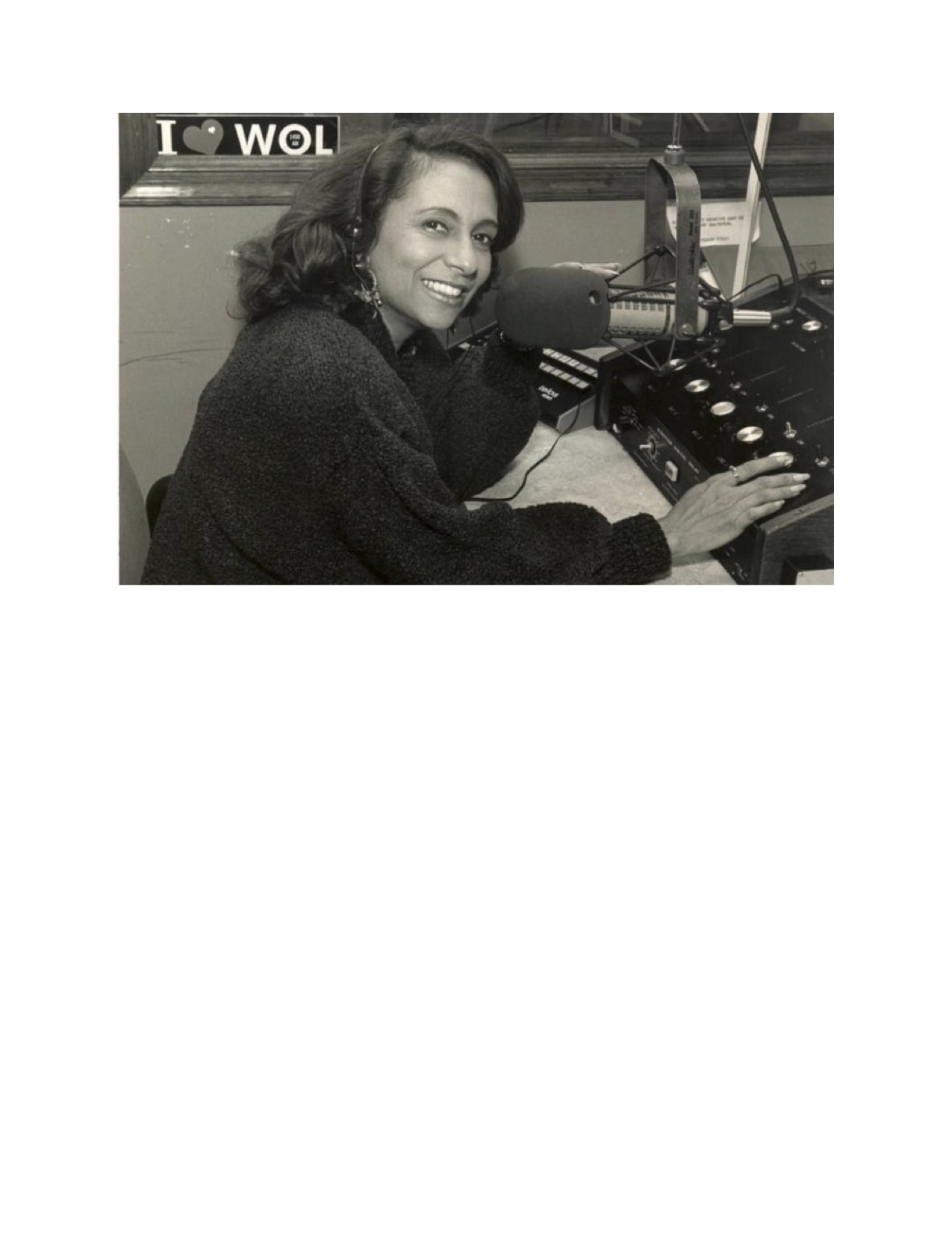 Taken under wing
She found mentors in black media professionals Brown and Star reporter-columnist, Charlie Washington. The community-based advocacy practiced by the paper and by radio station KOWH, where she later worked, became her trademark.
“We had a militancy existing in Omaha and when you’re a child growing up in that you just assume you’re supposed to try to make life better for your people because that’s what was engrained in us. We didn’t have to wait to February for black history. We were told of great black accomplishments on a regular basis at church, in school, in social gatherings. Black folks in Omaha have a nationalist pride.
“I was imbued with community service and activism. I don’t know any different. My mother on Sunday would go to the orphanage and bring back children home for dinner. We were living in the Logan Fontenelle projects and one chicken was already serving six and she would bring two or three other kids and so that meant we got a piece of a wing because Daddy always got the breast.”
During her May visit she recalled the tight-knit “village” of North Omaha where “everybody knew everybody.”
In the spirit of “always doing something to improve your community and family,” she participated in NAACP Youth Council demonstrations to integrate the Peony Park swimming pool.
“Because we were disciplined and strategic, there was a calm and deliberate delivery of demands on our part. I don’t know if it was youth naivete or pure unadulterated optimism, but we didn’t think we would fail.”
Peony Park gave into the pressure.
Opposing injustice, she said, “instilled in me a certain level of fearlessness, purpose and accomplishment I carried with me for the rest of my life.”
“It taught me the lesson that there’s power in unity.”
Her passion once nearly sparked an international incident on a University of Nebraska at Omaha Black Studies tour to Africa.
“The first day we arrived in Addis Ababa, Eithiopia, the students at Haile Selassie University #1 were staging demonstrations that ultimately led to the dethroning of emperor Haile Selassie. Well, we almost got put out of the country because when I heard there was a demonstration I left the hotel and ran over to join the picket line with the Eithiopian students. My traveling companions were like, ‘No, you cant do that in a foreign country, they’re going to deport us.’ Hey, I never saw a demonstration I didn’t feel like i should be a part of.”

Charlie Washington
The influence of her mentors went wherever she went.
“Mildred Brown unapologetically published Charlie Washington’s rants, exposes, accusations, evidence. She didn’t censor or edit him. If Charlie felt the mayor wasn’t doing a good job, that’s what you read in the Omaha Star. It took the mute button off of the voice of the black community. It promoted progress. It also provided information and jobs. It’s always been a vehicle for advocacy, inspiration and motivation.
“That probably was the greatest lesson I could have witnessed because one of the reasons some folks don’t speak out in the African-American community is they’re afraid of being financially penalized or losing their job, so they just remain silent. Mildred and Charlie did not remain silent and she was still financially successful.”
Both figures became extended family to her.
“Charlie Washington became like my godfather. He was the rabble rouser of my youth. He had the power of the pen. Charlie and the Omaha Star actually showed me the true power of the communications industry. I saw with Charlie you can tell the truth about the needs and the desires of your community without being penalized” even though he wrote “probably some of the most militant articles in the United States.”
“That’s the environment I grew up in. So the combination of Charlie always writing the truth and Mildred being able to keep a newspaper in Omaha solvent were both sides of my personality – the commitment side and the entrepreneurial side.”
Today, Hughes inspires young black communicators with her own journey of perseverance and imagination in pushing past barriers and redefining expectations.
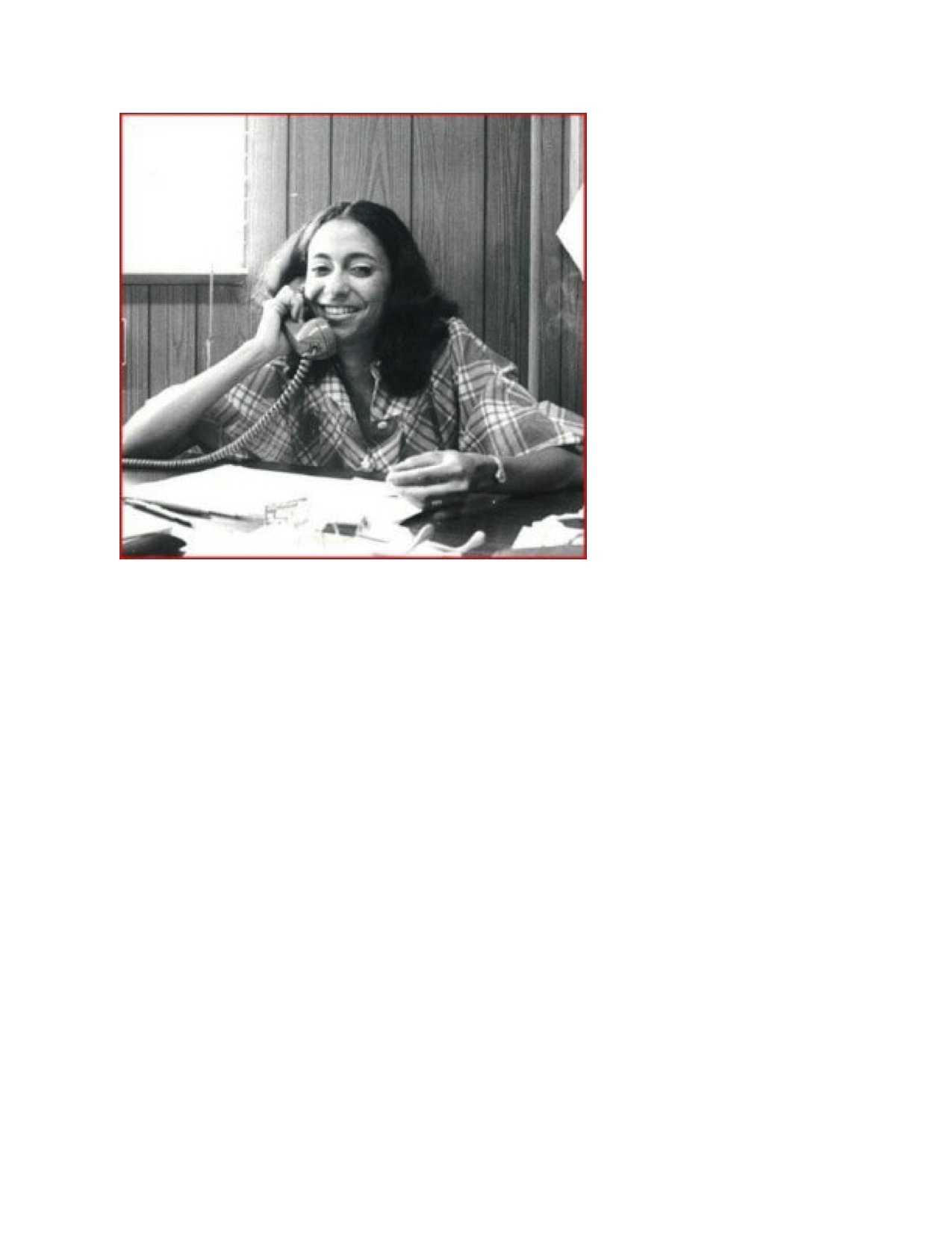
No turning back
As an aspiring media professional. Hughes most admired Mildred Brown’s “dogged determination.”
“When somebody told Mildred no, they weren’t going to take an ad, she saw it as an opportunity to change their mind, she never saw it as a rejection. She didn’t take no seriously. No to her meant. Oh, they must not have enough information to come to the right conclusion because no is not the right conclusion.
“Nothing stopped Mildred.”
Nothing stopped Hughes either.
“When I was 17 I became a parent. I realized I was on the brink of becoming a black statistic. My son Alfred was the motivation for me to think past myself. It was the defining moment in my life direction because for the first time I had a priority I could not fail. I was like, We’ll be okay, I’m not going to disappoint you, don’t worry about it. It was Alfred who actually kept me going.”
Her first ever radio job was at Omaha’s then black format station, KOWH.
“KOWH fed into my fasciation with having a voice. I think it is truly a blessing to have your voice amplified. I wasn’t even thinking about being an entrepreneur then. I was thinking about being able to express. I wasn’t at an age yet where had come into who I was destined to be.”
She left for D.C. to lecture at Howard University at the invite of noted broadcaster Tony Brown, whom she met in Omaha. It’s then-fledgling commercial radio station, WHUR, made her the city’s first woman general manager.
Leaving home took guts. Staying in D.C. with no family or friends, sleeping on the floor of the radio station and resisting her mother’s long-distance pleas to come back or get a secure government job, showed her resolve.
“Omaha provided me a safe haven. Once in D.C., I had to rely on and call forth everything I had learned in Omaha just to survive and move forward. If I had not left, I probably would not have become a successful entrepreneur because I had a certain comfort level in Omaha. I was the apple of several individuals’ eyes. They saw potential in me, but I think their love and support would not have pushed me forward the way I had to push myself once I moved into a foreign land.”
She feels Nebraska’s extreme weather toughened her.
“It builds a certain strength in you that you may or may not find in other cities.”
If sweltering heat, high winds and subzero cold couldn’t deter her, neither could man-man challenges.
“You learn that determination that you can’t let anything turn you around. When I went to D.C. and realized there weren’t people of color doing what I wanted to do, I just kept my eye on the prize. I refused to let anyone turn me around. When you learn to persevere in all types of elements, then business is really a lot easier for you.”

Mildred Brown
Brown was her example of activist entrepreneur.
“The Star was to Omaha what Jet and Ebony were to the black community nationwide. It’s why I have this media conglomerate. When you’re 10 years old and you’re looking up to this bigger-than-life woman, she was a media mogul in my mind. She had a good looking man and wardrobe and all the trappings.”
Just as Hughes would later help causes in D.C., Brown, she said, “was kind of a one-woman social agency before social agencies became in vogue.”
“She helped a lot of people. My father graduated from college and didn’t have a place to open an office and she opened her lobby for him. He was just one of many. Charlie Washington had a very troubled background and yet because of her he rose to being respected as one of the great journalists of his time in Omaha. Dignitaries would come and sit on Charlie’s stoop and talk to him about what was going on. He was considered iconic because of Mildred Brown.
“She put students through school and raised hell to keep them there. When my mother was short my Duschene tuition, Mildred told them, ‘You’re going to get your money, but don’t be threatening to put her out.’ She literally walked the walk as well as talked the talk. She didn’t tell folks what they needed to do, she helped them do it. She continued to inspire and advise and mold me.”
Full circle
Howard’s School of Communications is named after Hughes, who never graduated college. Decades after first lecturing there, she’s a lecturer there again today.
“They say I am their most successful graduate who never matriculated. I wasn’t prepared to be the first woman general manager of a radio station in the nation’s capital. That’s why Howard sent me to Harvard to take a six-week course in broadcast management and to the University of Chicago to learn psychographic programming. I went to various seminars and training sessions. Howard literally groomed me. They were proud of the fact I was the first woman in the position they had placed me in “
Hughes readily admits she hasn’t done it by herself.
“I have been blessed by the individuals placed in my life. They sharpened me, prepared me, educated me, schooled me, nurtured me, mentored me. I have been blessed so many times to be in the right place at the right time and with the right people.”
She grew ad revenues and listeners at WHUR. A program she created, “The Quiet Storm,” popularized the urban format nationally. With ex-husband Dewey Hughes she worked wonders at WOL in D.C. After their split, she built Radio One.
Upon arriving in D.C., Hughes found an unlikely ally in Washington Post publisher Katharine Graham. She met Graham through Susan Thompson Buffett, the wife of investor Warren Bufffett, and part owner of the paper.
“Susie was staying at the Grahams’ house. At that time Susie was a singer with professional entertainment aspirations and I was her manager. Katharine Graham took an interest in me and because she had this interest in me other people, including the folks at Howard University, embraced me.”
Networking
Hughes parlayed connections to advance herself.
“Part of my innate abilities since childhood has been to recognize an opportunity and take full advantage of it.”
Her first allegiance was to listeners though. Thus, she lambasted Graham’s Post for unfair portrayals of blacks, even encouraging listeners to burn copies of the paper.
Hughes has succeeded in a male-dominated industry.
“I never thought about being a woman in a male field. First of all. I was black. I’ve never put woman first. I was black first and a woman second. I had a goal I wanted to achieve, an objective that had to be accomplished. I didn’t see it as proving something to the old boys network. I was not intimidated by being the only female.
“I was naive. I really thought there would be a whole proliferation of black women owning and managing radio stations. Women have made more progress in professional basketball – they own and coach teams – than they have in the broadcasting industry.”
Men have played a vital role in her business success.
The two black partners in Syndicated Communications, Herbert Wilkins and Terry Jones, loaned her her first million dollars to build Radio One. Wilkins has passed but Jones and his wife Marcella remain close friends.
When things were tough early on, it was Jones who instructed a downcast Hughes to change her mindset.
“He said to me when people ask you how are you doing they can’t be hearing you complaining or saying I don’t know. You’ve got to say it was a great day because the first person that hears the lie is you. Tell yourself your business is doing good. Tell yourself you’re going to make it. Everyone’s going to start agreeing with you. He told me to change my terminology, which changed my thinking, and guess what, one day it was no longer a lie, it became my truth,” she shared in Omaha.
Friends and family true
Theresa Glass said success has not changed Hughes, who looks keeping it real.
“She’s the kind of friend who’s always your friend and we always can start off where we last left off. I never have to do a whole bunch of catch up with her. We immediately go into friend mode and are able to talk to one another. A lot of times you’ve been away from somebody for a long time or your lives have really shifted and they’re not even close to being the same, and you feel awkward, and that’s not happened for us.”
Hughes acknowledges her success is not hers alone. “I didn’t do it on my own. Right time, right place, right people.” She leans on staff she calls “family.” She believes in the power of prayer she practices daily. She credits her son’s immeasurable contributions.
“Radio One was me. TV One was totally Alfred. He decided he wanted his own path. Our expansion, our going public, all of that, was in fact Alfred. He does the heavy lifting and I get to take all the bows.”
Not every mother-son could make it work.
“Alfred and I had to go to counseling, alright, because one of us was going to die during those early years. It was not happy times – and it was basically my refusal (to relinquish control),” she said at the Hilton.
Alfred Liggins acknowledges their business partnership ultimately worked.
“It was my mother’s willingness to want to see me succeed as a human being and as a business person and unselfish ability to share her journey with me. When it came time to let me fly the plane, she was more than willing to do that.”
He recognizes how special her story is.
“I could always recognize and appreciate her drive, tenacity and lessons. We didn’t let any of the mother-son-family potential squabbles disintegrate that partnership, so I guess we’ve always been a team since the day I was born.”
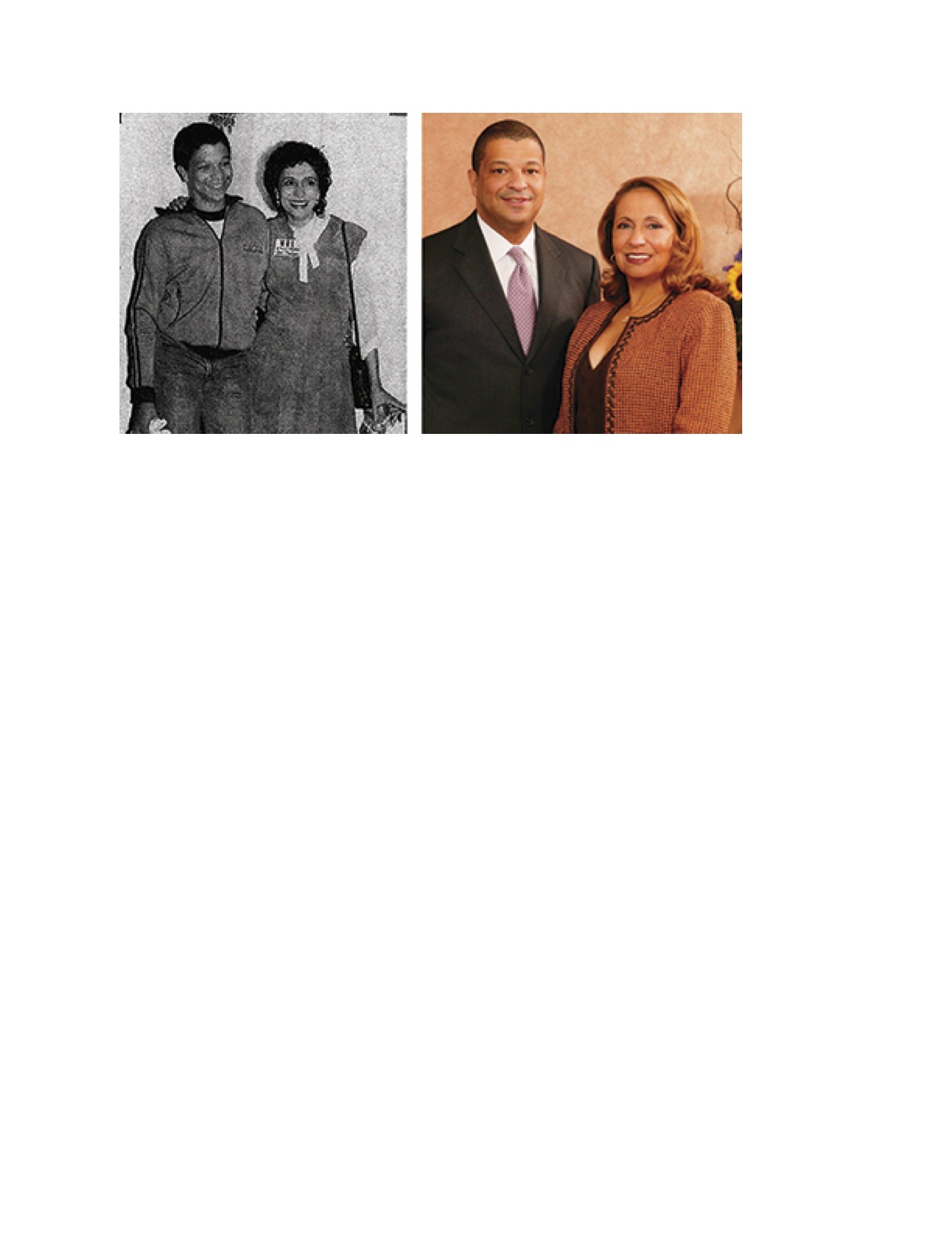
Challenges and opportunities
“Buddy” King. who’s had his own success in satellite radio, is happy to share a KOWH tie with Hughes.
“I’ve always admired Cathy. We KOWH alums are all proud of her success because her success shines light on what we did in Omaha.”
King further admires Radio One continuing to thrive in an increasingly unstable broadcast environment.
“iHeart media and Cumulus, two of the largest broadcast owners in the country, are both in bankruptcy, but Cathy is still chugging along. Her son has done an excellent job since making it a publicly-traded company. As the stock market fluctuates, they’ve able to survive.”
Diversification into online services and, more recently, the gaming industry, has kept Urban One fluid.
The changing landscape extends to Me Too movement solidarity around survivors of sexual harassment in the entertainment field.
“Was I subjected to it? Yes, absolutely,” Hughes said, “and I’m so glad women are stepping forward. Now we have a voice. The reality is we need more than a voice, we need to have action. Just talking about it doesn’t change it. I mean, how long have black folks talked about disparity and a whole host of things.
“It’s great that women are speaking out but we have to put pressure on individuals and on systems. Wherever we can find an opening. we must apply pressure to change it. Let’s start with education.”
She despairs over what she perceives as the dismantling of public education and how it may further erode stagnant income of blacks and the lack of inherited wealth among black families. She shared how “disturbed” she was by how Omaha’s North 24th Street has declined from the Street of Dreams she once knew.

Mrs. Marcella Jones, Alfred Liggins, III and his mother Cathy Hughes
Black media
Voices like hers can often only be found in black media.
“Black radio is still the voice of the community. Next to the black church, black-owned media is the most important institution in our community,” she said.
She embraces technology opening avenues and fostering change, but not at the expense of truth.
“I pray that truth prevails in all of these advancements we’re making. I see a world of opportunity opening, particularly for young people. I’m so impressed with this young generation behind the millennials. These kids are awesome because they’re not interested in just celebrity status. They’re interested in real change and I think the technology will be a definite part of that and I think with it comes a different level of responsibility for media than we’ve had in the past.
“Information is power. Mildred Brown understood that and it wasn’t just about a business for her – it was about a community service.”
Hughes credits an unlikely source with unifying African-Americans today.
“President Trump has single-handedly reignited activism, particularly in the black community. That did not occur in the Clinton administration, nor the Obama administration. But Trump has got people riled up, which is good. He has made people so mad that people are willing to do things, voice their opinion, and that’s why black radio is so important. You are able to say and hear things that you couldn’t get anywhere else.”
The Omaha Star is in its eighth decade. Hughes maintains its survival is “absolutely critical – because again it’s the voice of the people,” adding, “It’s our story from our perspective.” She still reads every issue. “It’s how I know what’s going on. The first thing I do is read Ernie Chambers’ editorial comments.”
Hughes is adamant blacks must retain control over their own message.
“You cannot ever depend on a culture that enslaved you to accurately portray you. That just cannot happen. I think too often African Americans have looked to mainstream media to tell our story. Well, all stories go through a filter process based on the news deliverer’s experience and perception and so often our representation has not been accurate.
“The reality is we have to be responsible for the dissemination of our own information because that’s the only time we can be reasonably assured it’s going to be from the right perspective, that it’s going to be from the right experience, and for the right reasons.”
Yet, she feels blacks do not support black media or other black business segments as much as they should.
A challenge she addressed in Omaha is black media not getting full value from advertisers.
“My son and I are not going for that. We want full value for our black audience and we insist on that with advertisers. I learned that from Mildred Brown. She did not allow y’alll to be discounted because it was a black weekly newspaper. She wanted the black readership of the Omaha Star to have the same value as a white readership to the Omaha World-Herald.
“I learned at the Omaha Star you don’t take a discount for being black.”
Still learning
Six decades into her media career and Hughes said, “I’m still learning. I’m not totally prepared for some of the responsibilities and charges I’m being blessed with now. Like I’m just learning how to produce a movie (her debut project, Media, premiered on TV One in 2017). I want to learn how to direct a movie. I want to learn how to do a series. Thank God we went into cable, which has given me an opportunity to learn the visual side.”
She’s searching for a new project to produce or direct.
“I’m reading everything I can get my hands on. I am just so thankful to the individuals in my life who have loved and nurtured me that I keep acquiring new skill sets at this age. I’m still growing and learning. which is kind of my hobby.”
Hughes is often approached about a documentary or book on her life. If there’s to be a book, she said, “I don’t want someone else interpreting who I am. I don’t want someone else telling my story from their perspective. I want to tell my own story.”
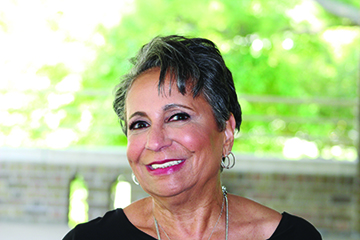
Lasting impact and legacy
Her staff is digitally archiving her career. There’s a lot to capture, including her Omaha story.
“I thank Omaha. Nothing’s better than making your mark in your hometown.”
Getting all those accolades back here is not her style.
“In Omaha, we just don’t get carried away with a whole bunch of fanfare and hero-worshiping. Again, it’s how I grew up. That’s our way of life in Omaha and I thank God for that because it’s made a big difference. It’s a whole different mentality and way of life quite frankly.”
Omaha’s impact on her is incalculable.
“It touched me probably a lot more deeply and seriously than I realized for many decades. When you’re trying to build your business you don’t have a lot of time to reflect on how did I get here and the people who influenced me. I went through a couple decades working on my career and my personal and professional growth and development before I realized the impact the Omaha Star had had on me and what a positive influence Omaha has been on me.”
“Buddy” King said he always knew if from afar.
“Even when she was a young single parent, Cathy was a fighter. It all to me comes back to her Omaha roots.”
Though Alfred Liggins and his mom have been back several times, with this 2018 visit, he said, “you feel like you finally made it and made good and you’re making you’re community proud.”
“It’s about meaning and legacy. That’s why this is hugely different. It really is the culmination of a journey I’ve shared with my mother trying to elevate ourselves and in the process elevating the community from which we came. I’m proud to have been part of what my mother embarked on and I feel like I am being recognized alongside her.
“And it is a deserving honor for her. She’s got guts, grit and she still has a ton of energy. She always gives me lots of praise and lots of love – until I do something she doesn’t like. But it has kept me on the up-and-up and to have my nose to the grindstone.”
At the close of her Empowerment Network talk, Hughes articulated why coming back to acclaim meant so much.
“I think Omaha teaches you to best your best and practices tough love. If you have the nerve to leave here and go someplace else, you better hope you do good because if you come home, you don’t want to hear (about returning a failure). But it’s really love telling you, You should have done better, you should have been more persistent.
“That whole village concept sometimes is not comfortable but it’s so productive because it pushes you to best your best. It teaches you that when you come home one day … they may hang a sign and name a boulevard in your honor.”
As she told a reporter earlier, “My picture’s on the floor of the Press Club, okay It don’t get no better than that.”
Visit https://urban1.com.
Read more of Leo Adam Biga’s work at leoadambiga.com.




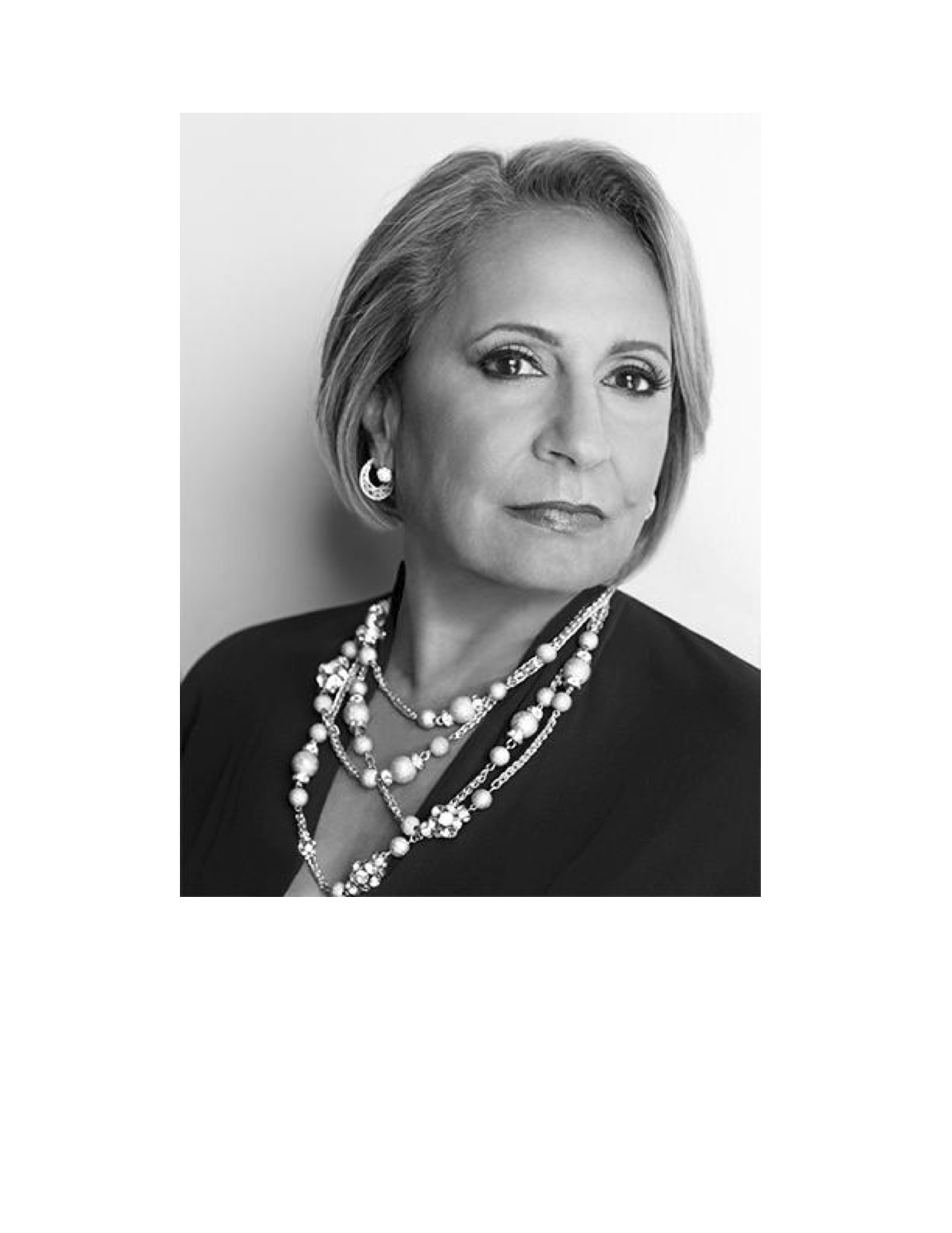
Coming home is sweet for media giant Cathy Hughes
©by Leo Adam Biga
Originally published in the June 2018 issue of The Reader (www.thereader.com)
Sweet nostalgia flowed when Omaha native media titan Cathy Hughes got feted in her hometown May 17-19. It marked the first time many Nebraskans heard of Hughes, even though this head of national networks cites her Midwest upbringing for the resilience behind her barrier-breaking entrepreneurial success.
After the hoopla around her coming back, she owns the state’s undivided attention.
The Omaha African-American community that produced Hughes has long followed her achievements. Her multimedia Urban One Inc., whose brands include Radio One and TV One, are black-centric platforms. Despite a media footprint rivaling Oprah and a personal net worth of half a billion dollars, her black market niche didn’t register with the general public. Until last month. Heisman Trophy-winner Johnny Rodgers marshaled coverage for street renaming, Empowerment Network and Omaha Press Club recognitions.
Surrounded by friends, family and local black leaders, Hughes, the 71-year-old Urban One chair, and her son and business partner, CEO Alfred Liggins Jr., 53, basked in the glow of defining legacies. Liggins said admiringly of her: “She’s got guts, grit and she still has a ton of energy. She’s well-deserving of these honors.”
She recently produced her first movie, Media, for TV One.
Rodgers is among history-makers whose paths she’s intersected. She appreciates him making her mogul ascent more widely known so as to inspire others.
“Johnny told me, ‘I’m doing this for the black kids that need to know you exist – that you grew up in the projects in Omaha (to become the first black woman chair of a publicly traded company).’ Johnny added, ‘I’m also doing it for the white folks who don’t realize that in a whole different arena and way you’re our Warren Buffett.’ That kind of caused me to choke up.”
She came up in Logan-Fontenelle public housing when northeast Omaha truly was “a village.” Her accountant father and International Sweethearts of Rhythm musician mother were civil rights warriors (the De Porres Club). The former Cathy Woods attended Catholic schools. She demonstrated for equal rights. The bright Central High student was “the apple of many influential eyes.” When she became a teen single mom, she didn’t let that status or reality define her, but drive her.
Neither did she keep her radio fame ambitions to herself.
“Ever since I’ve been born, I’ve been running my mouth. I remember once almost getting suspended because I challenged a nun. She said, ‘You have a big mouth,’ and I said, ‘One day I’m going to make a lot of money off of my big mouth.’ I knew as a child I was a communicator. As I grew in my knowledge and awareness of my African history and legacy, I realized I was from the giro tradition of maintaining folklore and history in story form. I just innately had that ability.”
In 1972 she left for Washington D.C. to lecture at Howard University at the invite of noted broadcaster Tony Brown, whom she met in Omaha. It’s then-fledgling commercial radio station, WHUR, made her the city’s first woman general manager. She grew ad revenues and listeners. A program she created, “Quiet Storm,” popularized the urban format nationally. With ex-husband Dewey Hughes she worked wonders at WOL in D.C. After their split, she built Radio One.
“Omaha provided a safe haven, but once in Washington D.C. I had to rely on and call forth everything I had learned in Omaha in order just to survive and move forward. Folks in D.C. were like, ‘Oh yeah, another small town hick girl come to town to try to make a way for herself.’ It was an entirely different environment.”
Remarkable connections opened doors.
“I was prepared to recognize an opportunity and take full advantage of it. Howard University (whose School of Communication is named after her) literally groomed me. They were proud of the fact I was the first woman in the position they placed me in and they kept going with me because Katharine Graham (the late Washington Post publisher) was enthusiastic about me.”
She met Graham through the late Susan Thompson Buffett, the first wife of billionaire investor and then-major Post shareholder Warren Buffett.
“Susie was staying at her house. At that time Susie was a singer with professional entertainment aspirations and I was her manager.”
Hughes already knew Buffett from their shared social activism in Omaha.
“Katharine Graham took an interest in me. Because of her interest in me other people, including the folks at Howard University, embraced me. They saw potential in me. They paid for me to get training at Harvard University and the University of Chicago.”
The late publishing magnate John H. Johnson (Ebony, Jet magazines) became a friend, mentor and adviser.
She first got schooled in community-based black media by Omaha Star publisher Mildred Brown and columnist Charlie Washington. Her keen social consciousness got sharpened by Ernie Chambers, Rodney Wead and Al Goodwin. Thus, her guiding credo: “I’m unapologetically in the black people business.”
“In Omaha, we had black pride and black love and a militancy that was very unique. When you’re a child growing up in that you just assume you’re supposed to try to make life better for your people. That’s what was engrained in us. We didn’t have to wait to February for black history. We were told of great black accomplishments at church, in school, in social gatherings. I thank Omaha for instilling that in me.
“The combination of Charlie (Washington) always writing the truth and Mildred (Brown) keeping a newspaper solvent were both sides of my personality – the commitment side and the entrepreneurial side. Charlie taught me how to be proud of my blackness and Mildred taught me how not to compromise my blackness.”
Working at KOWH. the metro’s first black radio station, affirmed for her blacks could realize their media dreams.
Fulfilling her dreams necessitated leaving home.
“If I had not left Omaha I probably would not have become a successful entrepreneur because I had a certain comfort level here.”
Her career’s based on the proposition black media is the unfiltered voice of a people.
“It is impossible for a culture that enslaved you to accurately portray you. Our people are still under oppression and denied opportunities. We don’t need anybody to give us anything, just get the hell out of our way. All we want is self-determination.”
She advocates black consumers collectively focus their purchasing power in support of black businesses, thus creating greater opportunities for economic growth and job creation within black communities.
Her visit home sparked bittersweet nostalgia.
“Driving down North 24th Street was so disturbing to me,” she said of sparse business activity along this former Street of Dreams now undergoing revival efforts.
Fittingly for someone whose amplified voice reaches millions, the North Omaha Legends Award she received celebrates her work “”to empower individuals and communities through the power of information.”
She thanked those “who removed obstacles out of my path so I could be who God destined me to be” and “Omaha’s tough love” for pushing her to excel.
“I haven’t done it on my own. Right time, right place, right people. Sometimes prepared, sometimes not. But the combination of it propelled me forward.”
She rejects the idea her recognition here was overdue.
“Everything in its proper time. I don’t think I’ve been overlooked or anything. Nothing’s better than your hometown saying job well done.”
Meanwhile, when she gets asked, “Are there black people in Omaha?” she’ll continue bragging on its notable black sons and daughters:
Bob Gibson
Malcolm X
Buddy Miles
Marlin Briscoe
John Beasley
Gabrielle Union
Monty Ross
Yolonda Ross
Kevyn Morrow
Q. Smith
“I want to help put Omaha in the right light. I am unapologetically Omaha until the day I die.”
Visit https://urban1.com.
Read more of Leo Adam Biga’s work at https://leoadambiga.com.
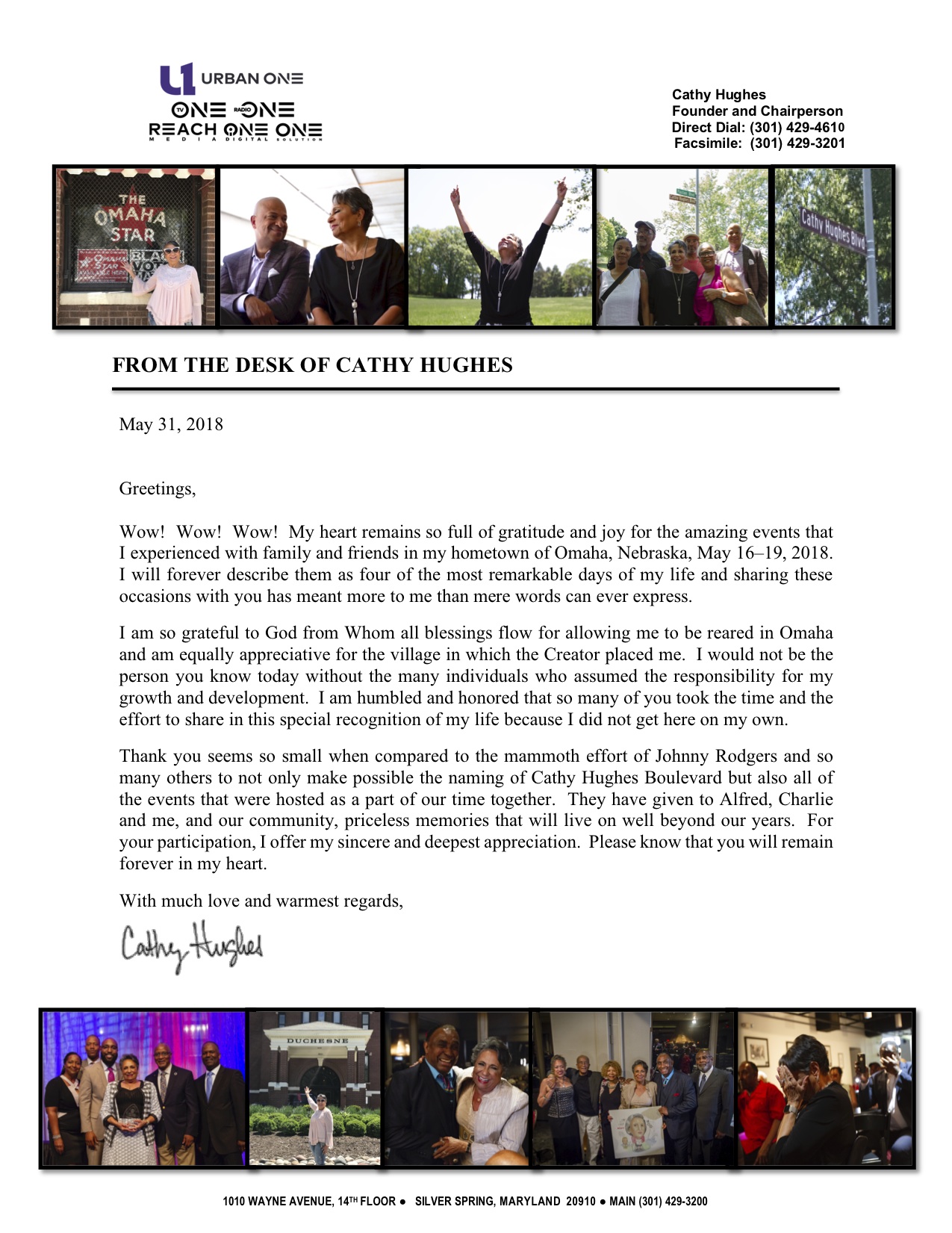
The Reader asked some African-American native Omaha media professionals what they find inspiring about Cathy Hughes:
ANGEL MARTIN
Freelance journalist
“Just to see where she started from in her career with a small studio in D.C. to large media owner. She was determined to never give up no matter what challenges she had to face. Very inspiring for a freelance journalist and radio host-producer at Mind and Soul/Malcolm X Radio like me. She also comes from very humble beginnings right in the Omaha metro. A very positive example of what can happen when you keep your eyes on the prize, so to speak.
“With her being a double minority -– this is a great example of how one should not only play with the ‘good ol’ boys’ but rather change the rules and win. When you think of radio and media ownership, Oprah’s name comes to mind and when you do your research you’ll soon realize Ms. Hughes is right up there, in fact she’s the number two based on her net worth.”
_ _ _
MONIQUE FARMER
Omaha Public Schools communications director
“Her accomplishments are truly inspirational, particularly for African-American women in the fields of journalism, communication, entertainment and entrepreneurship. She’s been breaking glass ceilings for decades and she continues to prove that some barriers are merely mental. She’s also proven that hard work, drive, discipline and possessing the boldness necessary to reach for one’s goals can account for so much. She makes us native Omahans all proud to be from the city we call home.”
_ _ _
WILLIAM KING
Founder, 1690-AM The One and 95.7-FM The Boss
“It’s inspiring because I’m currently walking in her footsteps with the creation of radio stations. I’m following every lesson from the matriarch of radio and TV.
“She’s an example that greatness come from the North Omaha community. It gives one the belief that if she can do it so can I. It’s motivation that drives you to succeed.
I recently talked to her and our conversation focused on both of us telling our stories on how we struggled and sacrificed to build our radio stations.”
_ _ _
MICHELLE TROXCLAIR
Mind and Soul radio host
“A black woman having achieved the success she has is an inspiration and motivator to all black women. Her accomplishments have transcended the barriers of race and gender. She has laid an important path.”
_ _ _
CARINA GLOVER
Founder, Ace Empire Media
“Cathy Hughes has raised the bar in the media industry and is inspirational as a black woman, professional,and business woman. As a young woman from Omaha on the path to building my own empire in media and tech, Cathy Hughes is a major inspiration. On a national scale, there’s a false perception that the roots of successful media companies generate from the west and wast coasts. Cathy demonstrates the barriers that can broken and how there’s no limit to success, despite where you began your journey.”
_ _ _
CHANELLE ELAINE
New York-based film producer (First Match)
“What i find inspiring is Ms. Hughes’ willingness to take chances, to go against expectations and push forward by her own definition of what a young African-American woman can do. She refuses to be put in a box by gender, color or origin, giving us all equity in the landscape of opportunity.”


 Leo Adam Biga's My Inside Stories