
Archive
Archive for the ‘Creighton University’ Category
Ex-reporter Eileen Wirth pens book on Nebraska women in journalism and their leap from society page to front page
March 22, 2013
6 comments
Women journalists cover anything and everything today. They work in all facets of media. But there was a time, and not so long ago at that, when they were restricted to a narrow range of reporting topics and jobs. There were always exceptions to that rule. Here and there, pioneering women journalists defied conventions and overturned stereotypes to file assignments and fill roles traditionally prescribed for men only. A new book by Eileen Wirth profiles some of the revolutionary figures among Nebraska women journalists over the last century. Wirth is a pioneer or revolutionary herself. She became one of the first modern women in city news at the Omaha World-Herald in the late 1960s-early 1970s, then she broke the gender barrier in the public relations at Union Paciific, before becoming the first female chair of the Journalism Department at Creighton University, where she oversees what’s now called the Department of Journalism, Media and Computing. Her book, From Society Page to Front Page, is published by the University of Nebraska Press. It’s officially out in May. My story about Wirth and the female journalists she writes about whose lives and careers advanced the cause of women both inside and outside the media field will appear in the April 2013 New Horizons. This blog contains several stories by me about journalists in print, radio, and television.

Eileen Wirth
Ex-reporter Eileen Wirth pens book on Nebraska women in journalism and their leap from society page to front page
©by Leo Adam Biga
Originally appeared in the New Horizons
Eileen Wirth doesn’t seem to fit the part of a revolutionary but that’s exactly what she’s been during her three careers. Wherever she’s worked, whether as a reporter or public relations practitioner or academic, she’s broken gender barriers.
As the women’s liberation movement played out from the 1960s through the 1980s she fought the good fight for equal rights, only not in the street or in the courtroom but by challenging male chauvinism, sexism and discrimination in newsrooms, offices and boardrooms. Her feminist predecessors fought similar battles as suffragists from the late 19th century through the immediate post-World War II era.
She says the struggles women endured to open new opportunities in the workplace is a story she feels deeply about, especially the stories of women in her own profession of journalism.
In the course of researching her new book, From Society Page to Front Page, Nebraska Women in Journalism, Wirth developed a deep appreciation for and kinship with maverick women who preceded her in the field she loves. She documents dozens of women of high achievement, many of whom she never previously knew about, and the obstacles they faced to work as publishers, editors, reporters. PR professionals and media moguls.
Some ran small weeklies, some made their names as columnists with local newspapers, others as reporters with national wire services and major metropolitan dailies. One woman covered the White House. Three women covered the Starkweather murder spree in great detail. Beverly Deepe became the longest serving American correspondent of the Vietnam War.
Mildred Brown became one of America’s only black newspaper publishers. Cathy Hughes is still running a media empire. Other women are still doing their thing as well.
“In writing the stories of these women it became a journey of self discovery,” says Wirth. “I identified so strongly with these women and with their struggles and their achievements. Both of my sisters had national level careers and I’ve always been in Omaha, but I realized we need to redefine what we mean by female achievement. We have too often downplayed the local, the personal, the balancing act of career and family. I don’t think our society values that enough. One of the things I hope this book does is really give recognition to women who juggled both.”

She also hopes the book gets some deserving women elected to the Nebraka Journalism Hall of Fame, where there are cases of men inducted there whose wives are not, even though the wives were co-editors and publishers and full partners of small weeklies.
Wirth says doing the book proved both an awakening and an education for her.
“What was amazing to me is that we had so many absolutely remarkable Nebraska women in journalism. Even as someone who has spent her entire life in journalism and more recently teaching journalism history, if you had asked me to name them I probably couldn’t have named five or six, until you get to the ’50s when I knew some of these people. But even then I was finding people right and left.”
The finding took considerable effort. “It took a lot of digging to find most of them,” she says. “This book is nothing but a huge reporting process. I went to people and said, ‘Who do you know about, what am I missing?’ I went to sources and people would tell me stuff and I would follow up on leads.”
Elia Peattie, a popular Omaha World-Herald writer from the late 19th century into the and early 20th century, is a prime example of someone Wirth found..
“If I were going to pick one woman in the book I fell absolutely passionately in love with it was Elia Peattie. Hardly anybody has heard of her. I resonated to her. She wrote a column that in some ways is very similar to the Mike Kelly columns of today’s Omaha World-Herald. This was before they had social or women’s pages. She’s kind of the World-Herald’s entree into that.
“She came to Omaha in the 1880s. She had been a society girl on a Chicago paper. She got a woman’s column at the Herald. This is when women’s news was in its infancy and the reason why women’s news was created in the first place was for advertisers. Women could not vote and the headlines were mostly about politics and crime, and if you look at the lives of women in the 1880s this just wasn’t relevant to them. They were working incredibly long days, raising large families, taking in work. They had very hard lives.
“Advertisers pressured the papers to do something to attract women readers because women were the primary shoppers. This was in an age when advertising was exploding. And the Herald hired Elia Peattie to write a column about women and apparently they put almost no restrictions on her. It was up to her to define what would interest women. Well, what she thought would interest women was apparently anything that interested her, which was everything.”

Elia Peattie

Wirth admires Peattie’s range.
“A professor from the University of Nebraska-Kearney compiled her columns in a book and I was blown away because it was reading a social history of the city in the 1880s. I mean, she has everything from this wonderful description of a young Bohemian slaughtering cows down at the Cudahy plant to a nursing sister at St. Joseph Hospital to the people riding a streetcar to showgirls. She did a very sympathetic portrait of the African American community when racism was horrible.
“She did some hilarious satirical columns about Omaha society people and why did they have to go back East to buy finery when they could buy anything they wanted in Omaha.”
Peattie’s community service involvement also appeals to Wirth, who has a strong service bent herself.
“Peattie ran for the school board when that was the only office women could run for or vote for. She was also one of the founders of the Omaha Woman’s Club. It was a way of localizing the city’s upper class women to do social work stuff. Nationally the woman’s club movement got behind the needs of working women in factories.”
All these activities made Peattie a popular figure.
“She became a larger than life personality,” says Wirth.
Another reason to like Peattie, according to Wirth, is “the work she did to bring together the handful of women journalists in the state. She documented a great deal about fellow women journalists. A lot of my best material came from work she did and recorded for history. She gathered the names of women active in journalism in the 1880s and 1890s. That was invaluable.”
Peattie’s become something of a hero to Wirth.
“One of the other reasons I resonated to Elia Peattie is that while she was writing this column her husband got very ill and it was up to her to support the family. She was writing everything right and left to make money to keep the family going and as a former working mother raising two children I just totally identified with her.
“If she was alive today she’d be running half the city, she’d be writing a blog.”
She might be publishing her own newspaper or magazine, ala Arrianna Huffington.
Wirth also writes about the one certifiable superstar among Nebraska-bred women reporters – Bess Furman.
“If you were going to pick a single woman that was our state’s most distinguished contribution to journalism it would probably be Bess Furman Armstrong,” says Wirth. “She was remarkable and she spanned a lot of eras. She was once referred to as a flapper journalist for her work in Omaha in the ’20s. She was what we would now call a liberated young woman writing rather risque satirical stuff about Omaha. She covered bootleggers and weird crimes down in Little Italy. She wrote this saucy column about Omaha’s most eligible bachelors.”

Bess Furman Armstrong
Furman was a product of her post-Victorian emancipated times.
“The ’20s were a wonderful period for women,” notes Wirth. “They had gotten the vote, there were more economic and education opportunities. She loved Omaha and she probably would have stayed except she worked for the Omaha Bee and when it was purchased by William Randolph Hearst she wanted out and when the opportunity came to leave she did.
“With women now having the vote the Bee needed somebody to write the women’s angle to politics. When Al Smith came to give a speech in Omaha in his 1928 campaign she got assigned to cover it and she wrote such a good story that she won a major journalism award for it and the head of the ;Associated Press who was in town with Al Smith offered her a job in Washington (DC) and she took it. Timing is everything.”
Furman made an immediate impression on Capitol Hill
Wirth says, “She was one of the first women to be allowed on the floor of the House of Representatives. She was assigned to cover First Lady Lou Hoover, who absolutely hated journalists. One time in order to write a story about what the Hoovers were doing for Christmas she dressed up like a Girl Scout” and infiltrated a troop visiting the White house. The ruse worked, too.
“When Hoover got beaten by FDR Eleanor Roosevelt started holding women’s only press conferences in order to force papers to give jobs to women,” says Wirth. “She and Eleanor Roosevelt hit it off wonderfully. Furman and her husband hit it off so well with the Roosevelts that they took home movies of the Roosevelts. When Bess became pregnant she decided she wanted her child to have a Neb. birth certificate, so she drove back here in the middle of the Dust Bowl to have her physician brother deliver what turned out to be twins. She brought with her a baby blanket Eleanor knitted her, and that got reported and went nationwide. Postmaster General (James) Farley sent her $10 worth of flowers and that was such a big order they had to send a special train.”
Furman later she did war information work during World War II and then joined the New York Times as one of its first female political reporters.
“She ended her career as the public information officer for the Department of Health Education and Welfare under Kennedy. Bess Furman may have gone to Washington but she was very deeply a Nebraska person and remained so for her whole life,” says Wirth.
Bringing to light women of distinction she feels connected to is satisfying to Wirth.
“Oh yeah, these are my people. We’re out of the same background, the same occupation. Yeah, I felt a very strong affinity with these women. I really found myself as I was writing about them feeling like I knew them and wishing I could actually have known them. I guess I felt especially this way with the women who wrote books, so you got a real feel for them, you weren’t just getting them second hand, you were getting their own take on the world.
“Their struggles were things I could totally identify with. You don’t have to be a journalist to feel this way about these women. Their humanity, their humor, the way they overcame obstacles with grace and courage and dignity, their persistence. To have careers like theirs was pretty daunting but they did it. I identified with the fact they juggled the personal and the professional and really probably never lost sight of either one.
“Culturally, anyone who has Neb. roots would identify with their style. Most of them let their work speak for them, which is what a journalist usually does.”

Mary McGrath
One that Wirth did get to know well is Mary McGrath, who preceded her at the Herald and labored 12 years in club news before becoming a highly respected health and medicine reporter. McGrath helped the green female reporters like Wirth negotiate the male-dominated newsroom.
“Mary McGrath was really the pioneer in city news at the Omaha World-Herald,” says Wirth. “She made a huge difference.”
Wirth recalls McGrath organizing potlucks for the paper’s women journalists and how these occasions became vital airing out and strategizing forums.
“It was a support system and an expression of solidarity. It was a safe place to bounce off ideas. If we would have said we were having a consciousness raising session the older women wouldn’t have gone, but to throw a potluck, how more Midwestern could you get? Mary knew the young women on staff were increasingly militant and she knew how smart and talented they were and she knew they were not writing about who was having who to coffee because they wanted to. She broke down the barrier between the two sections (city news and women’s news) by having those potlucks.
“The guys never had a clue what was going on.
Wirth says the Omaha Press Club served the same function for women in journalism across different media. “It was a great way to get to know other women journalists. You realized you were not alone.” Wirth adds, “A sociologist at Iowa State told me if you’re going to get social change made you have to have a cohort and in a sense you could look at the potlucks or the friendship ties that women journalists formed through the Press Club is how we had a cohort. There were enough of us who felt the same way to make a difference and it really made me feel for women of earlier eras who were one of a kind, out there on their own, whereas
I could go cry on Mary’s shoulder or vice versa .”
Each pioneering woman journalist in her own way contributed to the women’s rights cause and helped move their peers a little further along than before.
“There was a movement afoot. That was how this revolution was waged – one tiny step at a time.”
All those steps taken together made big changes, which is why Wirth was so offended when a feminist of high stature, former First Lady Hilary Clinton, was subjected to sexist coverage during her 2008 presidential campaign bid. The way Clinton was dismissed felt to Wirth like a slap in the face and a setback given how far women have come and what they’ve endured to get there.
“It was very disrespectful to women of our era,” says Wirth. It was like, Don’t they realize what we went through? Most of the Baby Boomers fought very quietly to infiltrate, to get a seat at the table, and nobody knew what it had taken to integrate the American workplace. That was my inspiration for writing the book.
“The women involved have kept silent about what they did because that’s how they were able to do it. We were a minority. The women were mostly just asking to practice the field they loved and were good at. They weren’t asking for special treatment.”
Much like the civil rights movement, the women’s movement gained its biggest victories through mass protests, the passage of new laws and court decisions, but there were many smaller, no less important victories won every day by ordinary women asserting their rights.
“When you look at coverage of the women’s movement it all focuses on things like lawsuits and militant demonstrations and you couldn’t do that in a city like Omaha if you intended to go on working in journalism. It wasn’t like you had a union that would protect you or a vast choice of employers, and for most of us that wasn’t our style anyway,” says Wirth.
Big, loud, public displays, she says, “weren’t the only way women made progress.”
Most of the change, she says, was the result of “the stealth revolution.” She adds that “KETV News Director Rose Ann Shannon said it very well when she told me, ‘I always felt I was dealing with reasonable people and we could work problems out.’ I too found that if you could have a reasonable conversation with somebody you could make progress. You were not going to change things overnight.”
She says there’s still work to be done, such as closing the pay gap between the sexes and shattering the glass ceiling that still limits women from advancing the way men do.
“But it’s sure better than what it was in 1970, and those changes were made nationwide by unsung young women quietly sticking their necks out on relatively small things over and over again.”
She says “it kind of boggles the mind” of her students to realize that as late as the 1970s women were still marginalized in journalism. “When you tell this to girls today they’re like, What? They can’t believe it, which I guess shows that we succeeded. They take it for granted.”
Wirth grew up in a large, high-achieving Nebraska City farm family whose parents set high academic standards and expectations for their children. Wirth loved reading and showed a knack for writing early on. She intended on being a history major at the University of Nebraska-Lincoln until her father insisted she take a journalism course.
“What really made me into a journalist besides Dad ordering me to take the class was working on the Daily Nebraskan and I still think of as ‘the rag.’ It was so much fun. I fell in love with journalism people. The women were strong, funny, delightful, intelligent people and the guys wouldn’t have had us be any order way. I had found myself.”
When Wirth went to work for the World-Herald in 1969 she became one of the paper’s few female news reporters and right up to leaving its employ in 1980 she and women colleagues there, along with women at t countless other workplaces, waged that “quiet revolution” to bring about change.
“When women said, No, I’m not going to get you coffee, that’s not part of my job description, they were part of this revolution,” she says.
So was Wirth when she brought to the attention of an editor the fact that some young males colleagues hired the same time she was had received new section assignments while she was still in the religion beat she began in three years before.
“I’m a contemporary of Steve Jordon and Mike Kelly and both of them had had a couple of assignment changes, and I thought I was as talented as they were and I certainly worked as hard as they did. I told my editor, ‘If you’re doing this for the guys then you should treat the two groups the same. There shouldn’t be a difference. You should give young women the same opportunities as young men.”
She got the assignment change she desired.
At a time when female journalists were confined to covering only certain subjects, such as religion or society news or women’s news, her work made the case that women were capable of covering anything.
“There was a lot of hesitancy about assigning women to cover cops, which was fine with me because I hated it, but I covered them every Saturday for years simply because I wanted to show that a woman could do it.
“There was a lot talk that women couldn’t cover politics because they couldn’t get stories in bars and nonsense like that. There was real hesitancy about sending women to certain places. The ironical thing is that my religion beat in the early ’70s was at a time when the churches were heavily involved in the civil rights movement, so under the guise of covering religion I was actually doing a tremendous amount of civil rights coverage.
“I never regretting spending those three years on religion but I felt like I wanted to grow, to expand, to try new things.”
She also had the opportunity to take on occasional stories that struck a blow for women’s rights by shining a light on gender inequities.
“Quite a few of the stories I did were aimed at showing this inequality.”

Connie Claussen
Take the time that former University of Nebraska at Omaha women’s coach and athletic director Connie Claussen called to say she was fed up with the unfair and unequal treatment she experienced at the beginning of her career there. Claussen, whom Wirth describes as “a force of nature, a great lady.” was an equal rights champion who served on the Mayor’s Commission on the Status of Women.
Claussen eventually built a much envied women’s athletic department at UNO featuring championship programs but that legacy almost ended before it started because of how frustrated she was with the short end of the stick offered her and her student-athletes. Before Title IX was passed women’s athletics were separate and unequal in every way.
Wirth recalls, “Connie called one Saturday and said, ‘I’ve had it, I’m not going to do it anymore, I’m not going to teach a full load of physical education classes and coach two or three sports for nothing extra.'” Wirth was sympathetic. “No male would ever coach a (college) sport for free. Women’s athletics were housed in a quonset hut with no showers. I thought, Well this is a sports story and I went over to the UNO beat reporter and he yelled at me, ‘Women sports are a joke, there’s no story here.’ He practically threw me out of the sports department. So I went over to the city desk and they said, Oh yeah, great story. I wrote it and they put it on page one of the Sunday paper. It stirred up enough indignation and attention that Connie ran with it and she got the support she needed to build an outstanding program.
“And I think that was one of the major things we did as women journalists – we were approachable, we were interested in the problems.”
Another story resulted when Doris Royal, a farm wife from Springfield, Neb., called Wirth and in her gravely voice asked, “Are you interested in stories on women?”
“She told me a lot of farm women were losing the family farm operation because of inheritance taxes. The IRS said farms belong to the husband. The only way a woman could escape paying inheritance taxes on a family farm or family small business if she became a widow was if she had worked in town, so she could show she made an economic contribution or if she had brought family inheritance into it.
“A lot of women on farms had worked side by side, they’d driven the tractor and milked the cows, they’d done all the farm work, plus kept the books, and of course that doesn’t account for all their work in the home. But the IRS in effect said, You have made no contribution. Well, that was driving women off the farm because they couldn’t afford it. Land prices had gone up. So Doris started a petition drive and she wanted me to cover a story on it, so I did, I looked into all this stuff. I grew up on a farm and I was horrified, I was shocked, I had no idea. I wrote the story and Doris leveraged my story in the World-Herald to get the Farm Journal, which is the nation’s largest farm magazine, to take up the crusade.
“Doris got petition signatures from every state, she testified before Congress. This woman’s amazing, and they got the law changed.”
Wirth did an entire series on inequitable credit practices that devalued and punished women. “If a woman got married and changed her name she immediately lost all of her credit history,” says Wirth. “Banks assumed the credit rating belonged to the husband even if the women worked full time and could document it.”
With stories like these to file, Wirth’s work was fulfilling enough but when she and her then-husband Ron Psota decided to start a family she knew the demands of her work and the inflexibility of her employer would make motherhood and reporting incompatible. Besides, she was ready for a change.
“It was still the era when women were fired if they got pregnant. My ex-husband and I had been approved to adopt a child and at the World Herald at that time there was no way you could be a reporter and a mother. You had to work 12 and 15 hour days at the drop of a hat if some story broke.”
Making it easier to leave, she says, was the fact that “after 11 years I was burned out on reporting. It was time.”
When hired as the first woman outside of secretaries or receptionists to work in the Union Pacific public relations department she broke down the doors of what had been an exclusive boys-only club. She didn’t appreciate it when one of the old gang complained that she was a token hire to conform with Equal Employment Opportunity and affirmative action policies.
“A crusty old guy who didn’t begin to have my educational credentials and who couldn’t write protested that they had had to hire a woman.”
The bosses set him straight, she says by stating, ‘We hired someone who could write.’ Period. End of story.
Then in 1991 she joined the teaching staff at Creighton University, where in addition to her professor’s role she later became that Jesuit institution’s first female chair of the Department of Journalism (now called the Department of Journalism, Media and Computing). Teaching college is something she always knew was in her future and making a difference in the lives of her students is what most satisfies her about academia.
She’s glad that her book gives students an appreciation for who came before them.
“I think it is very important for my students, especially my female students. You want to give them a sense of what went before so when they invariably face some challenges they will do so with grace and with confidence knowing that women like themselves have conquered similar challenges.”
Wirth’s book, published by the University of Nebraska Press, is available starting May 1.
Related articles
- More women are needed in investigative journalism (cjr.org)
- Bob Hoig’s Unintended Entree into Journalism is Six Decades Strong Now (leoadambiga.wordpress.com)
- Journalism: Fellowships for female journalists (thenewstribe.com)
- Pakistani women journalists recognised (dawn.com)
Categories: Books, Creighton University, Education, Eileen Wirth, Feminism, From Society Page to Front Page, Journalism, Media, Social Justice, Writing
Creighton University, Eileen Wirth, Feminism, From Society Page to Front Page, Journalism, Reporting, University of Nebraska Press, Women in Journalism
Creighton College of Business anchored in pioneering entrepreneurial spirit and Jesuit philosophy
August 19, 2012
Leave a comment
What follows is a historical narrative I was commissioned to write for the Creighton University College of Businesss. The gist of the assignment was to articulate how the enterpreneurial focus and service to society mission of the college is in alignment with the enterprising and giving natures of the university’s pioneering founders, including businessmen and staunch Catholics Edward and John Creighton and the Jesuits.

The Heider College of Business at Creighton is named for Charles Heider.
Creighton College of Business anchored in pioneering entrepreneurial spirit and Jesuit philosophy
©by Leo Adam Biga
Enterprising Spirit Animates the Creighton Story
Creighton University was founded in 1878 thanks to a confluence of figures whose pioneering, entrepreneurial, for-the-greater-good spirit established a caring, comprehensive academic institution on the Great Plains.
As Creighton has grown, so has the city it is situated in, Omaha, Nebraska. The Jesuit school and campus provide an anchor in the north downtown district. Graduates of Creighton’s professional schools and colleges of law, medicine, dentistry, pharmacy, nursing, and business, for example, are recognized leaders in their fields. Creighton is lauded for being a good neighbor and a vital asset to the community.
The university makes contributions to many quality of life areas and some of the most visible are made by the Creighton University Medical Center, which combines teaching, diagnosis, and treatment in a real-life, critical care setting.
Community service is a vital facet of the Creighton experience. Students, faculty, and staff donate time and talent through health care and legal aid clinics. Service-learning efforts address myriad needs at home, around the nation, on Native American reservations, and in the Dominican Republic, where Creighton maintains an Institute for Latin American Concern mission.
Community collaboration and partnerships are other dimensions of Creighton’s outreach. The Werner Institute is a model initiative for negotiation and conflict resolution in the conduct of business, in relationships within and among organizations and communities, in the workplace, and in health care settings.
The Halo Institute is a collaborative that provides incubator space and professional consultation for emerging start-up businesses with a social or bioscience entrepreneurial bent. Halo is located in a complex of buildings in Omaha’s Old Market, a historic district whose warehouses were home to the city’s wholesale produce and outfitting businesses. Creighton University’s founders, brothers Edward and John Creighton, did business out of the very 19th century structure that Halo occupies today.

John Creighton

Mary Lucretia Creighton
Creightons Set a Precedent for Being Entrepreneurial and Community-Minded
It is only fitting that the university retain a tangible connection to the Creightons, as the family’s lives and careers embodied the same principles that underscore the institution’s core mission and the way in which it’s carried out.
Edward and John Creighton were business magnates and devout Catholics from the East who settled in Omaha in the years immediately prior to the Civil War. The Creightons amassed a fortune through various business interests and invested significant portions of that wealth into bettering the community through charitable support.
Builder, developer, and visionary Edward Creighton, the older of the two, got in on the ground floor of the burgeoning telegraph and railroad industries. He and his companies played a major role in supplying and constructing the transcontinental lines and rails that grew America’s communication and transportation networks.
Edward’s vast commercial empire was also built on bank, mine, cattle, and land holdings. His many business partners included fellow movers-and-shakers in the development of Omaha and in the settling of the West. Concurrent with Edward’s capitalist impulses was a desire to give back. It had long been his wish to form a Catholic school that prepared young people through a quality, values-based education program. After Edward’s death, his widow Mary Lucretia Creighton, and his younger brother John, a successful entrepreneur in his own right, carried out his wishes by founding Creighton University, which was originally called Creighton College.
Respected for their expertise as educators and for the rigorous morals and ethics-based course of study they administer, the Society of Jesus was given rein over the university. The Jesuits have continued guiding Creighton throughout its existence.
That same early spirit of aspiration, invention, and service is still imbued in Creighton more than a century later. Consistently rated one of the top institutions of higher learning in the Midwest, Creighton is rooted in its Catholic and Jesuit identity and mission of educating the whole person and leaving the world a better place. Creighton graduates are prepared to lead purpose-driven lives and careers.


Creighton College of Business began as the College of Commerce
College of Business Reflects the Creighton Legacy and the Jesuit Tradition
This mission extends to the university’s College of Business, founded in 1920 as the College of Commerce. Guided by the school’s Jesuit heritage, Through its highly respected undergraduate and graduate level programs he College of Business forms leaders who promote justice and use their business knowledge to improve the world.
Michael Jung, Chief Operating Officer and Vice President of Cantera Partners, has used his MBA from Creighton to assist nonprofits develop public-private partnerships aimed at building economic development and sustainability in emerging and Third World nations.
“It is rewarding work, not only financially but from seeing the difference these programs can make in the world,” says Jung. “Some of the work that I have been involved in is feeding children in Afghanistan. We were feeding 75,000 school kids on a daily basis for five years. Just seeing the impact that can have on those children, mothers, families is very rewarding. I like being part of work that is actually making a difference with those not as fortunate as us here in the United States.”
The Creighton College of Business advances values-centered conduct through its courses as well as through its Academic Integrity Policy, Dean’s Honor Roll for Social Responsibility, Executive Partners Program, Anna Tyler Waite Center for Leadership, Leadership Conversations series, and other programs.
The business college is a founding member and active participant in the Greater Omaha Business Ethics Alliance. This partnership with the Omaha Chamber of Commerce and the Better Business Bureau advocates ethics in business.
Creighton MBA graduate Laura Larson is associate director of the Business Ethics Alliance.
“I think Creighton’s Jesuit focus prepared me so well for my job now in the business ethics industry,” says Larson. “I saw a focus in my classes on looking out for each person individually, the good of every person, taking the time to think about how a decision affects all stakeholders involved.
“Values have always been very important to me and acting morally and ethically has always been very important to me. When I came to Creighton and got the opportunity to work with the Business Alliance it really was a dream job to me because I’m making a difference in Omaha organizations every day. I’m bringing knowledge, skills, and resources involving ethics that organizations may not already have. I feel like I have a dream job just because I get to help others. ”
Pat Lazure is president of World Interactive Group, an Omaha World-Herald company. He founded a hyper-local Web platform, WikiCity, whose breakout success led the Omaha World-Herald Co. to buy it and bring him into the fold.
Holder of a Creighton MBA, Lazure appreciates the solid foundation he received in ethical business practices during his Creighton graduate studies.
“Business ethics is doing the right thing, sometimes even when it is uncomfortable to do,” Lazure says, “and in my education at Creighton business ethics was just a common ingredient, categorically, in every class I attended. It was just engrained in you. I think a Creighton graduate is conditioned to take that moral compass into their career.
“The Jesuits have always engrained being men and women for others. In a business career especially I think you can fall into a trap of being self serving, of only looking at what can I do to climb that corporate ladder. Or what can I do to promote my own stock. Or how can I cut corners. I think the Jesuit way instills in people a focus of being that man or woman for others, and seeing the broader landscape of things. Perhaps that’s through philanthropy or community service. Whatever it may be, it’s commingling the philanthropic aspects of life with the drive to turn a profit.”

Imagination, Innovation, Integrity Find a Home at Creighton
The College’s Social Entrepreneurship and Bioscience Entrepreneurship programs emphasize business models that feature sustainable new practices and technologies that can positively impact society and community.
Omaha native Sameer Bhatia graduated from medical school in India and then earned his MBA from Creighton’s Bioscience Entrepreneurship Program. That experience led him to the Halo Institute, where his start-up business, Guru Instruments, found a nurturing space. Guru is focused on designing and marketing tools for medical professionals that improve surgical and other procedures, thereby increasing efficiency and reducing costs. Bhatia dreams of automated devices that can serve as “virtual physicians” in patients’ own homes or in nursing homes by feeding data to doctors’ offices to help inform diagnostic or treatment options.
Creighton Entrepreneurship Program director Ann York says Bhatia fits the model of a socially conscious entrepreneur who is not only motivated to succeed with products that have a humanitarian utility but who will likely “give back.”
For York there is a clear throughline from what the Creighton brothers did as early social entrepreneurs and the way Creighton University graduates learn to apply social entrepreneurship today. She says the principles and lessons of social entrepreneurship taught at Creighton dovetail with those of the Jesuit tradition and its challenge to students to be stewards of society.
“Given the mission and the values of our university as a Jesuit institution it makes perfect sense that social entrepreneurship would capture the hearts and minds of our students,” says York.
She cannot help but see the connection between the way Edward Creighton conducted business and the way Creighton students and graduates learn to engage with each other and with community.
“The older brother, Edward, was sort of a maverick,” says York, “but he was very into social causes. He was very concerned about Native American rights and education and respecting the integrity of the Native American people. In working on the railroad routes and telegraph lines, negotiations with Native Americans occurred all along the way and he was very concerned about some of the things he saw going on and actually was pretty outspoken about it. He was also an abolitionist, and pretty vocal about that, too. That’s very socially conscious.
“Entrepreneurs are the most socially conscious of all business people. Entrepreneurs who make money often want to give something back to the community that helped them grow and flourish, and the Creightons were very much that type of family.”
York also sees a parallel between the technological pursuits of the Creightons and the university’s bioscience entrepreneurship efforts. Just as that pioneering family helped to advance rapid communication through the telegraph and to further mass
transportation through the railroad, the school’s entrepreneurial success stories are forging new frontiers of their own.
“I think the Creightons would embrace very much what we’re doing in the biosciences,” York says, “because I think they would recognize it as an emerging industry like the ones they were involved and they would see the potential for future entrepreneurs like themselves.”

Dean Anthony Hendrickson
Nurturing Creatives and Leaders
After experiencing success with its undergraduate Bioscience Entrepreneurship program, Creighton has developed a professional science master’s program in Bioscience Management. College of Business Dean Anthony Hendrickson says the emphasis in this graduate-level program “is really the management of that bioscience innovation process — the research and development.”
The Halo Institute is a supportive proving ground for social and bioscience entrepreneurial business models generated by Creighton students and faculty, although the incubator is open to applicants outside the Creighton community as well.
“The distinguishing thing about our Halo business incubator is that it is tied to our Jesuit mission,” says Hendrickson. “When as a board we look at different businesses the first question we ask ourselves is, ‘Relative to this service or product, what is its impact on society?’ Not its money making potential, but its impact on society. We consider that first and then after addressing whether it’s a good thing for society, we look at its business viability aspects, which is a different orientation. Most business institutions don’t do that because of their secular focus on business viability and profit potential. Most organizations ranking those things wouldn’t necessarily look at that social impact issue first.”
Halo Institute chair Roger Fransecky says participants in the incubator benefit from “the sponsorship, direction, and guidance of a values-based staff, and it’s all a reflection of what Creighton is about as an institution.”
Fransecky has an interesting perspective on the principled way Creighton approaches business precepts. Founder/CEO of the global leadership firm, Apogee Group, he serves on the College of Business advisory board and teaches a special course in personal leadership in the Creighton MBA program.
“I share deeply the values that Creighton espouses,” says Fransecky. “My students are doctors, lawyers, dentists, bankers, accountants, business people, and the common denominator is — they’re in this program not simply to get an MBA, they’re in this program to find work with meaning and to then link that work to the larger values of their lives. I’ve been very touched and moved by these grownups — they’re really smart and they care a lot. The thing that links them together is their aspirations and their values.
“I’ve taught at New York University and UCLA and Princeton and a lot of other places, and these (Creighton) students are very unique in my experience.”
ESPN reporter Paula Lavigne, who does enterprise piece’s for the cable sports network’s investigative “Outside the Lines” series, was a college graduate and working journalist when she decided to enhance her marketable skills. She decided to pursue a master of business administration degree and after considering several graduate schools she opted for Creighton’s MBA program.
“I chose Creighton because it has a wonderful reputation,” says Lavigne. “I appreciated the values it disposes. It was the Creighton faculty that really won me over. It was a wonderful blend of experienced faculty leading a discussion of people from all different backgrounds and engaged in really thought-provoking material.
“I feel like since I’ve gotten my MBA from Creighton I am more confident in my job and in the ideas I come up with. I feel that my MBA has really given me skills as a leader as well as a sense of credibility and business savvy I didn’t have before.”
Lavigne says she struggled with leadership until a breakthrough at Creighton.
“I think one of the most powerful moments from my Creighton experience was a personal leadership class I took. The professor really encouraged us to bring forth a lot of things from our past that were uncomfortable. By doing that it allowed me to see what I had been doing wrong as a leader and what strengths I could pull from to be a better leader going forward. It felt like a very cleansing moment for me.”
She says she learned leadership “is not just about numbers and board meetings, it’s really about people and it’s about your individual skills. This class really helped me come to terms with a lot of that. ” She says she now practices leadership on the job and as a presenter of workshops and training seminars for other reporters.

Anne York
A Moral Compass
In addition to honing her leadership skills, Paula Lavigne says Creighton’s MBA program gave her a new, healthier perspective of business.
“Before I started the MBA program at Creighton I had a pretty cynical view of business, especially big business not really having much respect for business ethics or morality or social justice. In my view those values really didn’t have a role in the business community. My MBA classes at Creighton taught me that’s not really true. Professors were very good about incorporating that sense of justice, ethics, and morality into business, and really teaching us as students that there is a role for that. It is not just a dog eat dog world.
“I mean there is definitely a role in business to follow a moral compass of sorts and still be successful. I think that really plays into those Jesuit values, and I know that that sense of the Golden Rule is not just for Sunday school, but it’s for the boardroom as well. Our professors instilled in us that you don’t just have to run over everyone, you can respect your competition, you can respect your customers, and at the end of the day you can still profit from the bottom line.”
Creighton business professor and Robert Daugherty Chair in Management Robert Moorman says the College of Business encourages students not to be satisfied with the status quo. He says students are challenged to look beyond merely making a profit or returning a dividend to shareholders by asking questions that go deeper than bottom line numbers. He says students are trained to look at larger considerations; What’s next? What else is there to do? How are you going to use shareholder value to drive changes in the world toward justice, toward the improvement of society for the many?
“It’s that sense of responsibility to take one more step,” says Moorman. “Gathering the knowledge is a necessary important first step. Using the knowledge completes the circle. So I think this is a place where we try to ask the question, How are you going to use the knowledge, what are you going to do with it? Leadership is the method, the lever or the device that links knowledge to the outcomes we wish to see.
“I often say to students, ‘We want you to take ethics classes and really think about the ethics side of it, because we want you to be leaders who influence the world.’”
Moorman says that if students are going to be successful entrepreneurs they must know finance, marketing, strategy, and underlining business principles. Just as they must have a complete grasp of such business models, he says if f they are to be socially responsible entrepreneurs they must know and apply sound ethics. It’s this holistic approach to doing business, he says, that differentiates Creighton’s focus.
“Everything is kind of tied together that way,” he says. “I think the entrepreneurship major is really about fostering a drive towards innovation that makes a difference for society.”
Hendrickson sees plenty of evidence that Creighton business graduates implement the social consciousness taught in school in their own careers.
“It seems like there’s a number of Creighton grads that embrace this idea of social entrepreneurship, mostly because that’s the ethos from which they spring,” he says.
That ethos is one embodied by the Jesuit philosophy, past and present, and it’s certainly an ethos the Creighton family manifested.

Roger Fransecky, right, conducting a Conversations in Leadership interview
Building on a Foundation of Serving the Greater Good
According to Creighton archivist David Crawford the Creightons were visionaries who saw the need for quality higher education that was broad in scope, yet specialized. The family’s philanthropy made possible the addition of the schools of medicine, law, pharmacy, and significantly, business. He says Creighton University added the then-School of Commerce at a time when there was growing recognition of the need for “scientific training” in business administration.
Whether donating the money to establish Creighton University or providing funds to build out the campus, including St. John’s Church, or financing the creation of professional schools, or supporting St. Joseph Hospital, Crawford says “the Creightons acted out of “a sense of responsibility” to serve their community and faith.
“Through a lot of their charitable works the Creightons took care of a number of voids in Omaha and Nebraska. I think they just saw this as part of giving back to the community.”
Crawford says this outward focus still resonates today with the social justice and community service work that Creighton students, faculty, and staff do in accordance with the school’s Jesuit mission.
“You see a strong sense that that’s what you do here — that’s the norm, and I think that really ties directly back to the Creightons. The commitment to putting a school here was part of a larger commitment. The leadership role of the Creighton family was very much in that mode of noblesse oblige (nobility obliges) — of feeling a responsibility to people in the area,” says Crawford. “There was a sense of, We’ve been blessed, there’s a lot of people in our community who are less fortunate, and we need to take care of them.”
Omaha is well known for its generous business and entrepreneurial sector and Creighton College of Business graduates are among the major players who make community service a priority here and wherever they live.
Laura Larson of the Greater Omaha Business Ethics Alliance credits Creighton University with nurturing a focus on others.
“Something that was really emphasized at Creighton was giving back to the community,” she says. “One way Creighton helped me to grow was that it really gave me the opportunity to make a difference in the MBA program. When I had an idea for a project I’d go to a faculty member to talk about it, and they were completely open to hear what I had to say and they gave me the tools necessary to implement the project. I was able to start a graduate student association and plan the first hooding ceremony for graduate business students.”
“After I was done with my MBA I got involved with a mentoring program in the Omaha area, so I now mentor a group of four to six kids twice a month. Serving others is something I was always very passionate about. It is something that has been instilled in me from a young age and Creighton emphasized it as well as I went through the program. ”
Robert Moorman says the example of the Creightons and university graduates giving back demonstrates how trailblazers can assert leadership that goes beyond selfish business interests to serve much wider community and societal interests.
“It’s really about the drive that prompted the Creightons to explore new territories, new business ideas, new endeavors and not stop at perhaps a simple way station and say, I am successful now, that’s good enough, and I’m resting on my laurels. It’s about a very forward leaning entrepreneurial notion,” says Moorman, “and at least being comfortable with accepting the mantle of responsibility that comes with opportunity.
“Responsibility comes with those benefits. Leadership is the way in which influence is exercised. At the end of the day it’s all about exercising influence over the actions and views of other folks, and the Creighton brothers did that, the Creighton wives did that, and that I think is the connection we want to have to that legacy. It’s the what’s next — what else are you going to do now? outlook.”
An Unbroken Chain of Ingenuity and Inspiration
The holistic approach the Creightons modeled has remained a constant at the university and in its business college, whose graduates cultivate a sense of responsibility and concern they carry with them, paying it forward in their personal and professional lives.
“Getting my MBA at Creighton has made me more of a whole person,” says ESPN’s Paula Lavigne. “It has made me a better contributor in the workplace. It has made me a better leader. It has given me opportunities at ESPN and I believe it has opened up my opportunities for the long term as well regardless of what I do.
“One of the things we learned in our leadership classes was the importance of being authentic. You can’t be authentic if you have one face at work and a different one at home and a different face in your spiritual life. You have to make sure the person you are at work is true to the person you are at home because that makes you a better leader. As long as you’re being authentic to yourself, you can be a better person, you can be a better leader with your coworkers, with your supervisors, and the customers that you deal with.”
Balance, congruence, integrity, innovation, integration, service. These qualities have been a hallmark of the Creighton experience since its start. They remain a cornerstone of the values taught there today.
The enterprising and philanthropic spirit of the school’s founders has been taken up year after year, generation after generation by new mavericks animated with the same desire to achieve and lead.
Like the Creightons who began it all, the university continues producing men and women of substance, vision, and conscience who succeed in business and in life not in spite of their compassion and generosity but because of it.
Related articles
- Creighton University Leads Statewide Initiative to Improve End-of-Life Care (prweb.com)
- Creighton University Launches Online Doctor of Education in Leadership (prweb.com)
- Institute for Latin American Concern at Creighton has Dominican Focus (leoadambiga.wordpress.com)
- Home is Where the Heart Is for Activist Attorney Rita Melgares (leoadambiga.wordpress.com)
- Community Trumps Gang in Fr. Greg Boyle’s Homeboy Model (leoadambiga.wordpress.com)
Home is where the heart Is for activist attorney Rita Melgares
July 20, 2012
6 comments
In the collective public consciousness attorneys tend to fall into extreme categories: either as public defenders or prosecutors, or as those who fight for the little guy and those that represent the interests of big business or big government or the super rich. Rita Melgares is definitely on the side of the Everyman or Everywoman. She has some serious cred to back up her community oriented, social action mission as an activist attorney looking out for the underdog.

Rita in 1971 at Adams State, ©Nielsen Library
Home is where the heart Is for activist attorney Rita Melgares
©by Leo Adam Biga
Originally appeared in El Perico
Activist attorney Rita Melgares was a divorced single mother of four from the Southwest when moved here to attend Creighton University Law School. She didn’t intend staying. But 35 years later she’s still here, still helping her people, doing legal work for newcomer families, handling juvenile justice cases and some criminal law.
This mother and grandmother is still raising kids. She shares a home in Benson with a son who is a single father. She helps rear his three youngest, whom she refers to as “my boys.” It’s the latest path on a journey that’s kept family at the center of things.
Mexico is where her ancestral lines extend. New Mexico is where both her parents came from. She can trace her genealogy back three centuries there. Southern Colorado’s San Luis Valley is where the former Lourdes Rita Martinez was born and raised. But Omaha is where her interest in law and social justice coalesced. Her parents Esquipula and Jose Martinez modeled service for Rita and her seven siblings.
She said her parents did not join groups or pull boycotts, but expressed a sense of grassroots social justice by helping people in need. She recalls her folks feeding the less fortunate and working with the police to make sure the neighborhood was safe.
The Martinez children fulfilled an expectation of achievement and service. “All eight of us have an undergraduate degree and several of us went on to advanced degrees,” she said. “Three of us are attorneys. My sister is a retired schools administrator.”
Growing up Latino meant dealing with racism. The experience of oppression provides context for her work in protecting people’s rights. “The racism against Latinos had its own flavor in the area i grew up in. You felt it, you knew it, and it continues,” she said.
Another vital experience was the social ferment of the 1960s.
“I’m a product of the ’60s. I was fascinated with the civil rights struggles and I wanted to march with the people, I wanted to be an active participant in those struggles. Two of my brothers were very active in the anti-war movement and the Chicano movement in the Southwest. When we came of age there was a movement of people you could join. It was both noble and exciting. I matured into that. It’s an interesting part of my life and I don’t think I’ve ever left it behind.”
Thrusting herself into the fray had to wait because she married right after high school and became a mom. Her invovlement came while earning a secondary education degree at Adams State College and then teaching English there.
“I challenged every course I could and I graduated with honors from college in three years and I became an activist. The Chicano movement was working very hard to democratize the campuses of the Southwest and so I was active in the student movement. César Chavez and the farm workers union was very strong in Colorado. I also had the background of northern New Mexico and the land grant issue. Those were the pressing issues in that environment.”
Feeling she could make more impact outside the classroom, she followed two of her brothers in the study of law. She was accepted by several schools but chose Creighton. Her experience there was bittersweet.
“Creighton prepared me very well as an attorney but it was one of the loneliest experiences in my life. I was far from home, the only Latino in the College of Law and there was no social activism. The dean pulled me aside very early in my freshman year and gave me the name of the director of the Chicano Awareness Center (now the Latino Center of the Midlands) and said, ‘I think you should go and meet those people.’ I think he had a sense that with the social activism I came from I wouldn’t last at Creighton if I didn’t have something that would anchor me in the community.”
Melgares said she “became a great friend” of the center. She took a leave from school to work with youth there, along the way reconnecting with her cultural and social activist roots. “A lot of the same issues we found everywhere existed in Omaha. I could participate in the people’s movement here and it was doing that when I really fell in love with South Omaha. I realized this was where the struggle was, this was where i could find the nexus to Omaha and to my soul and spirit, and so I’ve just always been close to south Omaha since then.” Her office is a converted duplex at 3927 So. 24th St.
She served on the center’s board, one of many south Omaha boards she’s served on.
Upon graduating from Creighton in 1979 she won a fellowship that placed her with the Omaha Legal Aid Society, where she worked nine years with the disenfranchised.
Following a stint with a downtown law firm she made the break and went on her own in 1994. Family law became her focus. “That’s where I saw you could make a difference in helping people pull their lives together. It’s been my privilege to work for the undocumented. It is not a popular community to work for. Immigration issues have a huge impact on family. Unfortunately it can be a very negative influence, a very sad outcome when you have families separated, when you have parents always looking over their shoulder because deportation is on their back, people afraid to move right or left because they have no documentation.”
The disruption is made worse by the recession. She said it’s hard enough for U.S. born or visa holding citizens to find a job in this climate, but even harder for those with no social security number, little schooling and limited English. She bristles at critics of immigrants, saying south Omaha’s rejuvenation is due to the newcomer population.
“They breathed life back into south Omaha. Nobody’s getting rich on South 24th St. but my gosh the economic wheel is being moved and it’s being moved on the backs of the immigrant community. It’s exciting. I think the watering of the cultural roots helps the entire community. Everything Latinos bring with them, from whatever their country of origin, they share with each other and with the larger community. I think they help Omaha and Nebraska in every which way. I understand the numbers overwhelm schools and health care, but the numbers also bring spirit and economic life.”
Her passion for her people has seen her throw herself into the life of the Latino community. “You don’t gain a community’s trust just because you want to or you’re a good person or you have a good heart. I think you have to work at the vineyard first, and I did that,” she said.
Battling to gain Latinos an equal place at the table “wasn’t easy,” she said, but she “kept knocking at the door, sometimes gently, sometimes pushing” herself in. “I think long after I’m gone we will still be trying to dialogue meaningfully about race.”
Being twice recognized with lifetime achievement awards for her work in the Latino community, she said, only “underscores” the fact that despite not being from Omaha “I have really matured here and worked hard here. Wow, lifetime achievement, I guess I have spent a lifetime in Omaha. And it’s been a very good life.”
Related articles
- Turning Kids Away from Gangs and Toward Teams in South Omaha (leoadambiga.wordpress.com)
- Where Community, Neighborhood and Representative Democracy Meet (leoadambiga.wordpress.com)
- UNO/OLLAS Resident Expert on Cuban and Latino Matters Jonathan Benjamin-Alvarado (leoadambiga.wordpress.com)
- Hundreds Attend OLLAS Conference Cumbre to Give and Get Diverse Perspectives on Migration Issues (leoadambiga.wordpress.com)
- Episcopal Priest Rev. Ernesto Medina Never Forgets His Latino Hertitage (leoadambiga.wordpress.com)
- A South Omaha Renaissance (leoadambiga.wordpress.com)
- Institute for Latin American Concern at Creighton has Dominican Focus (leoadambiga.wordpress.com)
- Gray Matters: Ben and Freddie Gray Fight the Good Fight Helping Young Men and Women Find Pathways to Success (leoadambiga.wordpress.com)
Categories: Creighton University, Latino/Hispanic, Law, Rita Melgares, Social Justice, South Omaha, Writing
Institute for Latin American Concern at Creighton has Dominican focus
July 17, 2012
3 comments
Like a lot of institutions for higher learning Creighton University in Omaha, Neb. offers students, faculty, and staff various international outreach opportuntiees that follow under service learning immersion trips. Some of Creighton’s most enduring such programs operate through its Institute for Latin American Concern or ILAC, which focuses on the Dominican Republic. The following story I wrote a few years ago for El Perico newspaper provides a primer on some of the experiences available to the Creighton community there and the give back participants engage in with the native population.

Institute for Latin American Concern at Creighton has Dominican focus
©by Leo Adam Biga
Originally appeared in El Perico
In the mid-1970s a pair of Cuban exiles who became Jesuit priests assigned to Creighton University saw a need to increase North American awareness of developing nations in the region. Revs. Ernesto Fernandez-Travieso and Narciso Sanchez-Medio formed the Institute for Latin American Concern.
The program originally focused on raising consciousness through immersion experiences in the Dominican Republic, a nation of physical beauty and abject poverty. As ILAC’s evolved, its mission has, too. Creighton students and professionals venture there to provide medical-health services and to engage in cross-cultural exchanges.
Creighton annually sends 500 volunteers. Teams of medical surgeons, dentists, specialists, ophthalmologists, nurses, pharmacists, physical and occupational therapists and students visit different times of the year. A water quality control team and a law team also go. Area high school students visit, too. The groups vary in size.
Creighton physical therapy program director Julie Ekstrum said the trips offer “a profound experience. Personally, I can’t help but be impacted by the amazingly generous and warm people. Professionally, it challenges me to think more creatively about how I do physical therapy and care for people by making do with fewer resources.”
Ekstrum has been to the D.R. eight times.
Holly Fuller, ILAC director at Creighton, first went to the D.R. as an undergrad.
“I just absolutely fell in love with the experience, the sense of community, and the friendliness and willingness of the people to be open and to take you into their family,” said Fuller, who now spends three months a year there. “It’s very rarely I feel lonely — there’s too much going on.”
Fuller said she applied for her present job in response to “a calling” she felt to address the needs of people beset by unemployment, chronic disease and subsistence living. “I just can’t imagine sitting around hoping that somebody else is going to fix it.”

Holly Fuller
Over time, ILAC’s presence in that poor Caribbean island nation that shares the same land mass as Haiti has increased. The ILAC center, La Mision, near Santiago in the northern reaches, has been built-up into a complex housing clinics that serve rural campos residents. ILAC clinics also operate in remote mountainous territories.
A major thrust is educating Dominicans about preventative care. Village leaders are trained to conduct basic screenings.
“Without the cooperadores and promodores we would not be able to do any of the programs that we do in a legitimate fashion,” said Fuller. “They are one hundred percent our liaison to the different communities. The Dominicans are the experts in their own culture and in their communities, so we really do rely on them. That’s really the only way you can make a successful, sustainable long term program. There’s also mutual collaboration — they share their gifts and talents with us and we share ours with them.”
Dominican native Radalme Pena directs ILAC activities in the D.R., where he heads the nonprofit NGO Centro de Education Para La Salud Integral or CESI that CU’s affiliated with. In an e-mail, Pena, said Creighton visitors “are openly accepted” by Dominicans because of the school’s long-term commitment there. “Creighton students and professionals contribute to the lives of Dominican rural families in a number of ways,” he said. “First, many groups that come to the country help change the infrastructure of rural villages by building schools, homes, aqueducts and bridges” and by serving medical missions at the ILAC Center and in outlying communities in the Cibao Valley.
“Finally,” he added, “these groups contribute to the spiritual development of Dominican communities” through “an intercultural exchange rooted in basic Gospel values and Christian faith.The cross cultural exchange…breaks down stereotypes, builds bridges and creates a world less fragmented and more unified.”
“What ILAC does is kind of two-fold,” said Fuller. “We provide quality health care to people who don’t normally have access to it, but what we really do is help transform Creighton students’ lives. Part of that transformative process is exposing students to the reality of living conditions that most of the world experiences and developing in students a responsibility for being be a part of the solution rather than sitting on the sideline.”
Creighton Public Health major Leah Latenser has made two trips to the D.R. and is prepping for a third this summer. In an e-mail she described how she’s been impacted: “I gained significant perspective on my responsibility as a citizen of the world to stand up for the justice of all people.”
During her visits she worked on a clean water project and an aqueduct, supervised a rural health clinic and assisted women’s groups. For Latenser, Third World poverty is no longer abstract. “Each one of these stories now has a face, a name, and they are a member of my family,” she said. “It makes these issues much more real and urgent.”
When the Haiti earthquake struck in January, ILAC’s Holly Fuller went to the D.R. two days later and helped assist a series of Creighton medical teams that cared for injured refugees over the next month in the southern border region. She’ll be back in June to facilitate CU’s summer program, when 75 students and 20-some professionals go. Three thousand Dominicans are expected to be served.
Pena said as the D. R. has exported the materials and technical knowledge necessary to rebuild the Haitian infrastructure, “bilateral cooperation and relations have improved greatly.” Creighton relief efforts have played a role in the recovery and healing.
For more information about ILAC programs, visit www.creighton.edu/ministry/ilac/ or call 280-3179.
Related articles
- Masterful: Omaha Liberty Elementary School’s Luisa Palomo Displays a Talent for Teaching and Connecting (leoadambiga.wordpress.com)
- Dominican journalist gets death threat, armed escort after report (miamiherald.com)
- Aurora Arias on Dominican Literature (repeatingislands.com)
- President-elect seen as continuation for Dominican Republic (edition.cnn.com)
- Latin American growth expected to slow in 2012 (miamiherald.com)
Masterful: Omaha Liberty Elementary School’s Luisa Palomo displays talent for teaching and connecting
July 6, 2012
5 comments
You don’t think of a master teacher as someone in her 30s but that’s exactly what Luisa Palomo of Omaha is. The kindergarten instructor at Liberty Elementary School has mastered the art and craft that is teaching and she is deservedly being recognized for it. The following two stories I did on her, in 2010 and 2012, appeared in El Percio newspaper shortly after she earned major education prizes in those respective years. The school she teaches at, Liberty Elementary, is one I am quite fond of. You’ll find several more articles by me about Liberty on this blog.
Masterful: Omaha Liberty Elementary School’s Luisa Palomo displays talent for teaching and connecting
©by Leo Adam Biga
Originally appeared in El Perico (el-perico.com)
Liberty Elementary School kindergarten instructor Luisa Maldonado Palomo has reached the top of her field as a 2010 Alice Buffet Outstanding Teacher Award-winner.
The Gering, Neb. native is the grade leader at her Omaha school. She heads outreach efforts to parents, many of them undocumented, through the Liberty Community Council. She’s a liaison with partners assisting Liberty kids and families. The school engages community through parenting and computer classes, food and clothes pantries, and, starting in the fall, a health clinic.
Colleagues admire her dedication working with the school’s many constituents.
“She truly reaches the whole child — behaviorally, academically, socially, emotionally — and then steps beyond that and reaches the family too,” said Liberty Principal Carri Hutcherson. “We can count on her to do a lot of the family components we have at Liberty because she gets it, she has a heart for it, the passion, the drive, the focus, all those great things it takes. She’s an expert practitioner on so many levels.”
But there was a time when Palomo questioned whether she wanted to be a classroom teacher. While a Creighton University education major she participated in Encuentro Dominicano, a semester-long study abroad in the impoverished Dominican Republic. She described this immersion as a “huge, life-changing experience” for reawakening a call to service inherited from her father, Matt Palomo.
“My dad has spent his whole life doing for others,” she said. “He comes from a migrant worker family. He gave up a college scholarship to work so he could help support his nine brothers and sisters. From the age of 15 he’s been involved with the Boy Scouts as a scout leader. He just celebrated his 45th year with the Boy Scouts of America.
“He’s always worked with underprivileged youth, Hispanic or Caucasian, in our small town. He’s such a role model for so many young boys who’ve gone through that program. He has such a sense of what’s right and wrong and he’s instilled that in my brother and sister and I.”
In the Dominican Republic Luisa felt connected to people, their lives and their needs.
“You work, take classes and live with families,” she said. “You learn the philosophy and the why of what’s going on. You really learn to form relationships with people, which isn’t something that always comes naturally to Americans. Here, it’s always more individualistic and what do I need to do for myself, whereas in a lot of other countries people think about what do I need to do for my community and my family.”
The communal culture was akin to what she knew back in Gering. When she returned to the States she sought to replicate the bonds she’d forged. “I came back wanting that,” she said. Unable to find it in her first teaching practicums, she became disillusioned.
“I was ready to quit education and my advisor was like, ‘Nope, there’s this new school in a warehouse and Nancy Oberst is the principal and you’ll meet her and love her, give it a shot before you quit.’ So I went there and loved it and stayed there. Nancy and I just clicked and she hired me to teach kindergarten.”
Liberty opened in 2002 in a former bus warehouse at 20th and Leavenworth. In 2004 it moved into a newly constructed building at 2021 St. Mary’s Avenue. Oberst was someone Palomo aspired to be like.
“She’s so dynamic and such a good model,” said Palomo. “She has such a vision for how a school should be — it shouldn’t be an 8:30 to 4 o’clock building. Instead it should be a community space where it’s open all the time and families come for all kinds of different services, and that really is the center of the community.”
Oberst and many of Liberty’s original teachers have moved on. Palomo’s stayed. “We have a core group of parents who have been with us from the old building and they know I’m one of the few teachers who have been here all eight years,” she said. “They’ve seen what I do. They know Miss Palomo is the one who spent the night in the ER when Jose broke his arm and started a fund raiser when Emiliano’s house burned down. They know me and they trust me and they let me into their homes.
“They know I’m coming from a good place.”
She said one Liberty family’s “adopted” her and her fiance. The family’s four children will be in the couple’s fall wedding.
Hutcherson said Liberty is “the hub” for its downtown neighborhood and educators like Palomo empower parents “to feel they’re not just visitors but participants.” Whether helping a family get their home’s utilities turned back on or translating for them, she said Palomo and other staff “step out of the walls of this building to get it done.” For two-plus years Palomo mentored a girl separated from her parents.
“It’s that whole reaching out and meeting our families where they’re at,” said Palomo.
Liberty’s holistic, family-centered, “do what’s best for the child” approach is just what she was looking for and now she can’t imagine being anywhere else.
“I really love it here. We’re not just a teacher in the classroom. We do so much to really bring our community into our school so our families can come to us for all these different activities and for help with different needs. It’s one of those things where we let them into our lives and they let us into theirs, and we’re both better for it.”
She’s proud to be “a strong Hispanic” for kids who may not know another college graduate that looks like them.
Palomo recently earned her master’s in educational administration from UNO. Sooner or later, she’ll be a principal. Hutcherson said when that day comes “it’ll be a great loss to Liberty but a great gain for the district.”

_ _ _
Liberty’s Luisa Palomo Named Nebraska Teacher of the Year
©by Leo Adam Biga
Originally appeared in El Perico
In only two years Liberty Elementary School kindergarten instructor Luisa Palomo, 30, has won Nebraska’s top teacher recognition honors. In 2010 she was named an Alice Buffett Outstanding Teacher, an award given top Omaha Public Schools educators, and last November she was selected Nebraska Teacher of the Year.
The Gering, Neb. native applied for the state honor at the prodding of OPS colleagues. She completed the required essays and interviews but held out little hope of winning.
“I felt there’s no way they’re going to choose me because to be quite honest I am young and I’ve only taught for a short amount of time compared to a lot of other teachers of the year. And while I’m passionate about early childhood education I know it’s not on the forefront of everybody’s brain when they think about education.”
She was motivated to put her name in the running because the winner gains a stage and she wanted a platform on education.
“By getting this award you get so much more of an audience,” she says. “By having this title behind my name now finally people will listen to me. I kind of applied for the award thinking this – that I would have a title that would give me a foot in the door.”
As expected, she’s in high demand as a speaker and she says she’s eager to present on “topics I feel really passionate about.”
“What I want the media and the public to know is that there’s so many good things happening in education. The media’s focus on bad news stories is really not an accurate reflection of what’s happening in schools, so I kind of want to put that message out there.
“What I’ll be talking to teachers about is a shift in how we run our schools. Instead of it having to be a traditional 9-to-3, nine months out of the year model, we really need to shift that mentality to what is best for kids. For some kids the traditional school year works beautifully, but for other kids, like the ones I work with in my downtown school, it’s so much more beneficial to them to have an extended day where they’re able to come in early and stay late and have educational opportunities, and to attend summer school through the first week of July.”

She advocates that schools adjust to meet students where they are.
“There doesn’t need to be a one size fits all model for education. Instead it’s what works for the kids you’re serving. It may mean doing what Liberty does, which is coordinate with all these community services to offer Our Completely Kids program. It opens our building at 7 in the morning and closes it at 6 at night.
“Liberty employs this full service community school model where it says if families trust the school, bring in the services. Why send families across town? Why not have a doctor in your school? Liberty allows any of us as teachers to accompany our families through so much of their lives, and we’re better for it and our families are better for it and the children are better for it. Our kids are better adjusted and they’re more connected to school.
“There’s so many different ways to meet the needs of our kids, we just have to be open to accepting it.”
She bristles at the notion a teacher’s duties stop when the last school bell rings.
“I hear some teachers say, ‘But my job is not to be a social worker,’ but really it is because your job is to look out for what’s best for children.”
For Palomo, teaching is about making lives better.
“All kids have a path and the teachers they have in the classroom determine where that path is. There’s so much literature that talks about the effectiveness of quality teachers. If I’m able to reach these kids and get them to love learning I’m changing the outcome of their path. To be a transformational leader is understanding your job is so much more than teaching phonics or number recognition.”
She approaches the school day as a “very purposeful” adventure in which she “guides and encourages” the learning process. “I never talk at our children but with our children and kind of explore with our kids as they learn. It’s a balance of what’s developmentally appropriate and what’s engaging for our kids.”
During 2012 she’ll be meeting fellow teachers of the year at national education events. The first was in Dallas, Texas in late Jan. Upcoming events are in Washington D.C., Huntsville, Ala. and New York-New Jersey. She says she enjoys the prospect of making “connections with people all around the country that I’ll be able call on when I have questions or when I need support.”
She’s already getting to know past Nebraska Teachers of the Year, who work as a cohort on education initiatives. “It’s expected as a teacher of the year you’re continually giving back to the education community,” she says. That’s fine with Palomo since she sees her calling as a service mission. The recognition only confirms that. “This award really makes me think that not only did I choose the right career but I must be doing things right.” She also sees it as validation that quality education happens in inner city schools.
She intends on being an administrator one day but for now is content where she is.
“I want to be in the classroom for a chunk of my career before I move on. I feel like I learn so much every year by being in the foxholes. I work with parents, students, teachers on a daily basis, and it’s very real. I’m not tied up in administrative duties or policy, I’m working with who I want to have the most effect on.”
Related articles
- Fast Times at Omaha’s Liberty Elementary: The Evolution of a School (leoadambiga.wordpress.com)
- Alice Buffett Outstanding Teacher Awards (omaha.com)
- Teachers from Iowa, Neb., to be celebrated in DC (thegazette.com)
Gender equity in sports has come a long way, baby; Title IX activists-advocates who fought for change see much progress and the need for more
June 11, 2012
5 comments
Title IX. This often contentious 1972 federal education act is getting more attention then usual these days because the media is taking a reflective look back on the impact it’s had over its 40 year lifespan. I’m doing the same with this article, which will soon appear in The Reader (www.thereader.com). Because I reside in Omaha, Neb. and The Reader is an Omaha news weekly my story looks at the implications of Title IX and the context that brought it into being from a local perspective, though I certainly address the nationwide effect the legislation’s had. The real interest for me in doing this story was to try and impress upong readers of a certain age that what is easily taken for granted today in terms of the ubiquitious presence of girls and women’s athletics obscures the fact that things were quite different not so very long ago. Younger readers may be surprised to learn that schools, colleges, and universities had to be compelled to cease discrimination on the basis of sex and to give females the same opportunties as males. What seems natural and common sense today wasn’t viewed in that light just a few decades ago. I end my story with a rhetorical question asked by one of my sources, former coach and athletic director Don Leahy, who said, “Why was it ever different?” My story attempts in a small way to explain why and to describe what the journey for women trying to gain equal opportunity in sports looked like.

Gender equity in sports has come a long way, baby;
Title IX activists-advocates who fought for change see much Progress and the need for more
©by Leo Adam Biga
Originally appeared in The Reader (www.thereader.com)
Participants in girls and women’s sports today should be forgiven if they take for granted the bounty of athletic scholarships, competitive opportunities, training facilities and playing venues afforded them.
After all, they’ve never known anything else.
Their predecessors from two generations ago or more, however, faced a much leaner landscape. One where athletic scholarships were unheard of or totaled hundreds, not thousands of dollars. A handful of games once comprised a season. Facilities-venues were shared, borrowed or makeshift.
Until 1972 federal Title IX legislation banned discrimination on the basis of sex, educational institutions offered nothing resembling today’s well-funded athletic programs for females. Schools devoted a fraction of the resources, if anything at all, to girls and women’s sports that they earmarked for boys and men’s sports.
Second class citizen treatment prevailed.
Nebraska women’s basketball coach Connie Yori made her mark at Creighton University, where she played and coached at some 11 different “home” sites because the program didn’t have its own dedicated facility.
“We were gypsies in some ways. We just had to figure out places to play,” she says, adding, “That wasn’t that long ago either.”

Connie Yori, ©huskers.com
The gulf between then and are now is vast.
“I mean everything was different,” she says. “The way we traveled – the coaches and student athletes were driving the vans to the games. We as coaches had to regularly clean the facilities we practiced in. That was the norm, there wasn’t anyone else to do it. There’s countless examples. Opportunities to play, scholarship money, modes of travel, recruiting budgets, operations budgets, staff salaries, you name it, it’s escalated. But college men’s athletics has escalated too, so it’s not just the women.
“When I played college basketball there would maybe be 50 to 100 fans in the stands and now I’m coaching games where there’s sell-outs and ticket scalping is going on, and who would have thought that?”
Creighton, Nebraska and UNO have their own women’s hoops and volleyball facilities.
“That’s just kind of what’s happened across the board in women’s athletics in that institutions are more committed to equity, and as well they should be,” says Yori.
Gaps remain. Salaries for women coaches lag behind those for men. And where men routinely coach female athletes, it’s rare that women coach male athletes.
Still, things are far advanced from when women’s athletics got dismissed or marginalized and the very notion of female student-athletes was anathema to all but a few enlightened administrators and athletics officials.
In that proto-feminist era the so-called “weaker sex” was discouraged from athletics. Girls and women were considered too delicate to play certain, read: male, sports. Besides, it wasn’t feminine or ladylike to compete. Schools routinely said they could not justify women’s programs because they’d never pay for themselves. Consequently, the idea of giving females the same chances as males was met with paternalistic, patronizing objections. This despite the fact virtually all men’s programs lose money and only survive thanks to donations and to subsidies from student fees and revenue producing major sports.
Former Creighton softball coach Mary Higgins bought the rationale until realizing the contradiction
“I just remember thinking, ‘Well of course we don’t have women’s athletics, we can’t make any money, no one will come.’ And then it was like the light went on – ‘Well, wait a minute, the baseball team doesn’t make any money, they don’t have any people in the stands, then how come they have it and we don’t?'”

Mary Higgins
When people like Higgins began questioning tired old assumptions and asking for their fair share of amenities there was push back, including from men’s coaches protecting their turf.
“Well, you start with the fact that people don’t like change, period,” says former University of Nebraska at Omaha chancellor Del Weber.
With institutional support virtually nonexistent at the collegiate level, the Association for Intercollegiate Athletics for Women evolved into the main national governing-sanctioning body. Meanwhile, the NCAA actively ignored, then opposed inroads made by women. When school presidents and NCAA officials saw the hand writing on the wall and, some argue, the profits to be made from championship events, women’s athletics fell under the NCAA’s aegis in the early 1980s.
The real impetus for change may simply have been demographic. As women became the majority population, more entered college. Today, women account for the majority enrollment at Creighton and UNO.
Where the benefits of athletic competition (improved self-esteem, leadership skills development, higher graduation rates, et cetera) were once anecdotal, they eventually became measurable.
As far as defining moments, says Higgins, “the linchpin for our programs to grow was getting scholarships. Once we had scholarships we could go get the players.” That’s when the real gains occurred.
“The AIAW got things launched and then I think we got more sophisticated with the NCAA and a lot more money became available. It was a positive thing for growth but that was a painful transition.”
UNO associate athletic director Connie Claussen began women’s athletics there in 1969 as volunteer softball coach. She soon added volleyball and basketball. “I didn’t ask anyone, I just did it,” she recalls. All three sports shared the same set of uniforms. The teams practiced and played in a quonset hut. The equipment room was the trunk of her car. There was no budget, only donations scrounged from sympathetic boosters. Similar limitations applied at Creighton. Nebraska enjoyed a decided facilities advantage. For a time small schools could hang with big schools as everyone started from scratch and had no scholarships available.
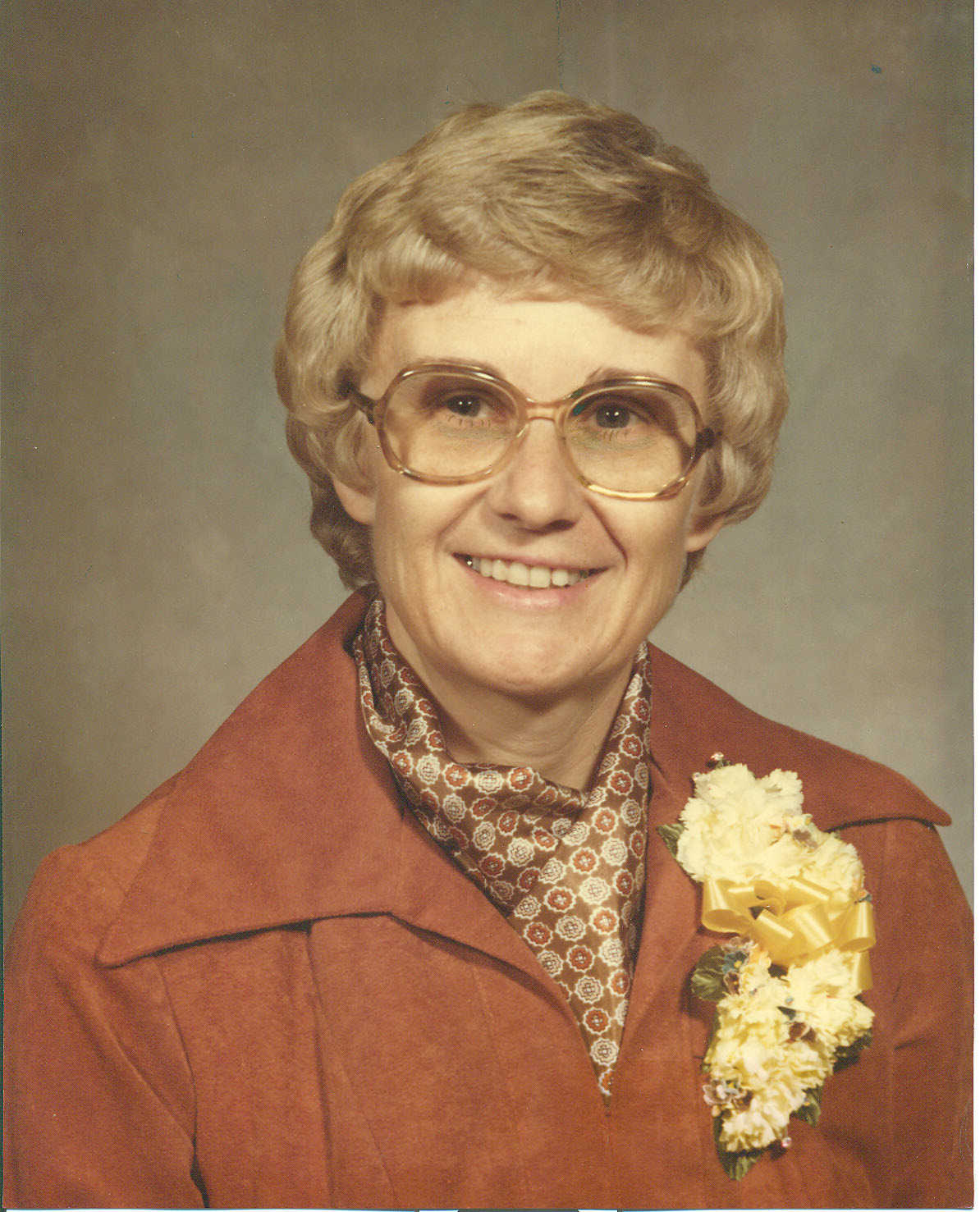
Connie Claussen
Even after Title IX passed, says Claussen “it took several years for it really to have an effect on most athletic programs,” and then only with some prodding. In the case of UNO the Chancellor’s and Mayor’s Commissions on the Status of Women brought pressure. Even the U.S. Office of Civil Rights got involved at the behest of parents Mary Ellen Drickey and Howard Rudloff.
“What sticks out in my mind is that in our old gym they had hours set aside for when the women could come in,” says Higgins. “You think about that now and it just sounds ludicrous but that’s just what it was. The women could come in I believe Sunday and Wednesday nights because God forbid they sweat or show any effort.”
Peru State College basketball coach Maurtice Ivy excelled at the high school, collegiate and pro levels but when she was learning the game as a youth in the 1970s there was no exposure to girls or women’s hoops.
“I didn’t really see women playing, and so the person I watched play and I kind of emulated my game after was Dr. J.”

Mauritce Ivy getting her Husker jersey retired, ©huskers.com
As an Omaha youth Ivy and other inner city girls developed their skills as Hawkettes, the state’s first select basketball team run by the late Forrest Roper. Richard Nared’s Midwest Striders track program impacted generations of girls, including Ivy and her younger sister Mallery, who set several state records. The sisters’ father was among the first local coaches to offer girls the opportunity to play football.
Fastpitch whiz Ron Osborn organized a statewide club softball association as a forum for girls to play in and as a showcase to convince schools they should start their own softball teams.
Today, girls club teams are everywhere.
Grassroots pioneers worked independently of Title IX to bring about change. Ivy thinks of them and graduates like herself as “soldiers” in the women’s athletics movement.
But there’s no mistaking Title IX, whose enforcement has been upheld in countless legal findings, is the bedrock equal opportunity protection upon which girls and women’s athletics rests. By compelling schools receiving federal assistance to uphold gender equity it’s propelled the explosion of women going to college and the exponential growth of girls and women’s athletics. It’s meant a dramatic increase in the infrastructures supporting female student-athletes and a proportionate increase in the number of participants.
“You went from nothing to everything,” is how former UNO and Creighton athletic director and now UNO associate athletic director Don Leahy describes its impact.

Don Leahy
“To me, it standardized and normalized athletics,” says Higgins. “Now it’s just expected.”
Institutions found not complying with Title IX are forced to take corrective action under penalty of court-ordered monetary damages.
Nebraska’s been a battleground for some notable Title IX actions, including a 1995 lawsuit brought by Naomi Friston against the Minden Public School District for scheduling girls games at off times compared to boys’ games. Creighton University graduate Kristen Galles, who successfully represented the Friston case, is now one of the nation’s leading Title IX and gender equity attorneys.
Some school districts, colleges, universities and states were more progressive than others early on. For example, where Iowa embraced girls high school athletics decades before Title IX neighboring Nebraska dragged its feet.
Yori, an Iowa girls athletics legend, says, “I feel like I grew up in almost the perfect place during my era to be a female athlete because Iowa was ahead of its time in regards to the support of girls athletics.” She says the late Iowa Girls Athletics Association president, E. Wayne Cooley, “found ways to place girl athletes on a pedestal.”
Not so much in Nebraska.
“When I crossed the river from Iowa to Nebraska during the early 1980s,” Yori says, “I saw a really different climate for girls athletics here. There was definitely a difference in the commitment level. I mean, there just weren’t opportunities. It’s been great to see how much progress we’ve made in Nebraska and now the two states are on level playing fields in my mind.”
At the collegiate level some Nebraska institutions did take the lead, including John F. Kennedy College in Wahoo and Midland University in Fremont, both of which built dominant women’s athletic programs in the ’70s. Recently retired Midland basketball coach Joanne Bracker was an inaugural member of the Women’s Basketball Hall of Fame.
Under Claussen UNO won the 1975 AIAW Women’s College World Series, one of several national titles won by UNO women’s teams. Claussen and CU’s Higgins helped grow college softball, serving on AIAW and NCAA committees and leading their respective schools in hosting more than a dozen CWS championships, which Higgins says was “huge” in legitimizing women’s sports here and beyond.
The late Omaha Softball Association guru Carl Kelly and College World Series Inc. chairman Jack Diesing Sr., along with corporate donors, helped sponsor the women’s tournament.
The start of the 1980s saw NU women’s sports emerge. The volleyball program began its run of excellence under Terry Pettit. Gary Pepin’s track program shined with superstar Merlene Ottey. Angela Beck’s basketball program reached new heights with Maurtice Ivy. NU softball began making noise.

By the early ’90s, a full complement of women’s sports was in place wherever you looked, whether big public schools like NU, smaller private schools like CU or then-Division II UNO.
None of it would have happened without activists pressing the cause of female student athletes. Along the way Title IX and its supporters met resistance, including court challenges.
“I think there’s a lot of women and men who made a huge difference for the young women of this generation,” says Yori. “Connie Claussen and Mary Higgins were very much advocates for change. There were a lot of battles fought – in offices, in meeting rooms, and even legally in courtrooms. There were people that got fired for voicing their opinions and became the sacrificial lambs because of that. There were a lot of people who didn’t want change and didn’t want to give women the opportunity they are now being given.
“You know, we still need to fight for it, but there’s not such a gap as there was.”
Higgins says the trailblazers of modern women’s athletics were “people who just had a burning passion to make this happen. It consumed me, I know it consumed my colleagues. It’s like, ‘We’ll do whatever it takes. We’ll figure it out, we’ll find a way.”
Parents played roles, too, as coaches, administrators, boosters.
“I do think dads and their concern for their daughters had a major impact, and that was absolutely the case at Creighton,” says Higgins. “It wasn’t Title IX telling Creighton they had to do it. Title IX was happening at the same time but our then-assistant athletic director, the late Dan Offenburger, kind of led the charge. He coached our very first softball team. He didn’t have time to do it, we didn’t have any money, we didn’t even have a shoestring. But he got it going because it was the right thing to do. Plus, he had three daughters and he was motivated to create opportunities for them.
“I’m sure there are stories like that all over.”
As near as UNO, where Don Leahy says he supported women’s athletics not only because “I thought it had to be done” but because “I had a daughter who played sports.” There were also a wife and mother to answer to at home.
Leahy says the coaches he worked with at UNO and Creighton “fought diligently for their programs but at the same time they maintained a common sense that made it possible for this thing to develop. We talked and we gradually worked through these things and I think that made a big difference.”
“This stuff did not come easy,” says Del Weber, who approved the early road map for women’s athletics at UNO laid out by Leahy and Claussen and the gender equity program that they and former athletic director Bob Danenhauer devised.
Ramping up meant serious dollars. Leahy says when it became clear accommodating women’s athletics was a new reality “the first thing that came up was – how are we going to pay for this?”

Bruce Rasmussen
Current Creighton athletic director Bruce Rasmussen, who coached CU’s women’s basketball team, recalls, “We didn’t have enough resources to properly compete just with our mens’ programs and now we had the burden of essentially doubling our athletic department. It was, ‘How do we balance what we can do with what we should do?’ And there was a lot of stress across the country. Women’s athletics completely changed the dynamics of universities and how were they going to support a full athletic department. So there was a lot of tension and trauma going on.”
“And funding it is not just a matter of we’re going to give them x number of dollars,” says Rasmussen, “but it’s facilities, it’s staffing, it’s scholarships, recruiting, traveling, equipment…”
At Creighton as anywhere, says Rasmussen, “we’re asked to provide not only an athletic program but also to be fiscally responsible as a department and as a program. So when it comes to asking for more money, especially when you’re running at a deficit, there’s certainly friction. I think factions of the faculty felt every dollar that went to athletics was a dollar out of their pocket.”
By the ’90s, girls and women’s sports were a given. By the 2000s, they’re as much a part of the culture as boys and men’s sports. Some professional women’s sports leagues flourish. Icons have even emerged: Pat Summit, Lisa Leslie, Florence Griffith-Joyner, the Williams sisters, Jackie Joyner-Kersee, Brittney Griner.
“To turn that around was a seismic shift,” says Higgins.
“In a short time things really have come a long way,” says Claussen, who hastens to add, “But it took a long time to get” the opportunity.
Once spare media coverage has increased to the point that it’s commonplace if still a trickle of what males get.
“Hopefully we’ll continue getting more and more and that’s where the NCAA plays a big part in getting those television contracts,” says Claussen. “All that’s going to help increase the interest.”
The sustainability of athletic programs is an increasingly difficult proposition for schools struggling to keep pace with peers in a competitive arena of ever rising costs.
“At some point women’s athletics has to generate enough money to pay for itself because until it does we’re not going to get where we need to be,” says Rasmussen. “In men’s basketball we wouldn’t have the budget or spend the money on salaries we do if weren’t generating that, and we’ve got to move to the point where on the women’s side we’re generating realistic revenues. And the key to that is having generations of females who played sports, understand the value of sports and are willing to make a commitment to those sports.
“We don’t exist as an athletic department without people making a commitment to us.”
Creighton’s state-of-the-art athletic center and arena for volleyball and women’s basketball resulted from multi-million dollar gifts by donors Wayne and Eileen Ryan and David Sokol. Rasmussen says having coached women’s sports helps him effectively make the case for them when he asks for support.
In 1986 Claussen inaugurated the UNO Women’s Walk, now the Claussen-Leahy Run/Walk, which has raised $4 million-plus for women’s athletics.
NU’s men’s and women programs have some of the best facilities in the U.S. thanks to mega donations.
The strong sisterhood of girls and women’s sports that exists today is built on decades of sacrifice and perseverance. Ivy wants her athletes to know the history. It’s why she says she tells them about “who paved some of the way and the different struggles people had to endure so that we can have.” Yori does the same with her players because she wants them to know “where we come from as a sport.”
“There were groundbreakers and pioneers before us who made a huge impact on the opportunities young people have today,” Yori says. “Women of previous generations were not given opportunities and so it’s neat to see when they are given opportunities how much they can take advantage of that.”
“Why was it ever different?” asked Leahy. Why indeed.
Related articles
- From the series Out to Win: The Roots of Greatness – Black Women Make Their Mark in Athletics (leoadambiga.wordpress.com)
- Sports of The Times: Title IX Has Not Given Black Female Athletes Equal Opportunity (nytimes.com)
- From ESPN’s celebration of Title IX’s 40th: (womenshoopsblog.wordpress.com)
- Don’t call us tomboys anymore (nbcsports.msnbc.com)
- Title IX turns 40 (dailykos.com)
Entrepreneur, strategist and nation builder Taylor Keen
March 13, 2012
7 comments
Fascinating profile subjects abound everywhere I turn. Often times though I feel constrained to impart just how compelling a person’s story is by the limited space editors grant me. The subject of this of this profile, Taylor Keen, is a case in point. The 500 to 600 words allotted me to tell his story can only provide a hint of the complexity and nuance that attend his life and career journey. It’s a delightful writing challenge to be sure. All I can hope is that I leave you the reader with an engaging glimpse of the man and a thirst to know more.
Entrepreneur, strategist and nation builder Taylor Keen
©by Leo Adam Biga
Soon to appear in Omaha Magazine
As the son of prominent, college-educated Native American parents who found success in and out of traditional circles, Creighton University‘s Taylor Keen says he grew up with the expectation “you had to walk in both worlds.”
He hails from northeast Oklahoma, where his late attorney father, Ralph F. Keen, was a conservative big wheel in Cherokee nation politics. His liberal Omaha Indian mother, Octa Keen, is a veteran nursing professional. He credits her for his being well-versed in traditional dances, songs and prayer ceremonies.
He successfully navigates “dual worlds” at Creighton as director of the Native American Center and as executive director of the Halo Institute, a business incubator. He’s also managing partner of his own consulting firm. Talon Strategy, which provides clients competitive intelligence and strategic facilitation solutions.
Off-campus, he maintains ceremonial duties as a member of the Omaha Hethuska Warriors. He previously did economic development consulting for the Omaha and Cherokee nations and served a stint on the Cherokee National Council.
He joined Creighton in 2008 in the wake of a tribal political controversy that pitted him against fellow Cherokee nation elected leaders. The issue involved the descendants of slaves held by the Cherokee in earlier times. Keen, who had eyes on becoming chief, says he “committed political suicide” when he took an unpopular stance and advocated these descendants enjoy the same rights as all native Cherokees.
It wasn’t the first time Keen survived personal upset. When his parents divorced he and his siblings bounced back and forth between Oklahoma and Omaha. With deep roots in each place, Keen calls both home.
Even from his earliest dealings with the outside world he says he was always aware “I was very different from other people,” adding, “That was a crucial life lesson. Identity for all of us as human beings is where it begins and ends.” He says his own “strong sense of identity” has helped him thrive.
He graduated from Millard North and ventured east to attend a private boarding school in Massachusetts to improve his chances of getting into an Ivy League institution. His plan worked when Dartmouth accepted him. He also studied at Harvard University’s Kennedy School of Government and Harvard Business School. A paper he wrote attracted the attention of Metropolitan Fiber Systems, a spin-off of Peter Kiewit and Sons. “I was hired as a graduate intern at a very exciting time, working for all these powerful executives at a fresh young startup. I was hooked,” he says. “I returned the next summer and they sent me overseas.”
He remained with the firm after it was bought by World Com and then landed at Level 3 Communications, though it proved a short stay.
Swept up in the dot com-technology-telecom boom, he tried his hand at his own online business and though he says “it failed miserably,” he adds, “I learned a ton. I think all entrepreneurs learn more from their mistakes than from their successes.
My class at Harvard Business School, whether we like it or not, will be forever remembered as the dot com class. I believe 80 percent of us at least had some association with dot coms.”
Encouraged in the belief that his true calling lay in teaching, he’s found the right fit at Creighton. There he combines two of his favorite things by easing the path of Natives in higher education and by helping emerging businesses prepare themselves for angel investors .
“Creighton’s been very good to me,” he says. “It has very much let me play towards my passions and my strengths.”
Related articles
- Nick and Brook Hudson, Their YP Match Made in Heaven Yields a Bevy of Creative-Cultural-Style Results – from Omaha Fashion Week to La Fleur Academy to Masstige Beauty and Beyond (leoadambiga.wordpress.com)
Walter Reed: Former hidden child survives Holocaust to fight Nazis as American GI
February 19, 2012
2 comments
About nine years ago I was given the opportunity to meet and profile Walter Reed, whose story of escaping the Final Solution as a Hidden Child in his native Belgium and then going on to fight the Nazis as an American GI a few years later would make a good book or movie. Here is a sampling of his remarkable story now, more or less as it appeared in The Reader (www.thereader.com). You’ll find many more of my Holocaust survival and rescue stories on this blog.
Walter Reed: From out of the past – Former hidden child survives Holocaust to fight Nazis as American GI
©by Leo Adam Biga
Originally published in The Reader (www.thereader.com)
Imagine this: The time is May 1945. The place, Germany. The crushing Allied offensive has broken the Nazi war machine. You’re 21, a naturalized American GI from Bavaria. You’re a Jew fighting “the goddamned Krauts” that drove you from your own homeland. Five years before, amid anti-Jewish fervor erupting into ethnic cleansing, you were sent away by your parents to a boys’ refugee home in Brussels, Belgium. Eventually, you were harbored with 100 other Jewish boys and girls in a series of safe houses. You are among 90 from the group to survive the Holocaust.
Relatives who emigrated to America finagle you a visa and, in 1941, you go live with them in New York. You abandon your heritage and change your name. Within two years you’re drafted into the U.S. Army. At first, you’re a grunt in the field, but then your fluency in German gets you reassigned to military intelligence, attached to Patton’s 95th Division, interrogating German POWs. If this were a movie, you’d be the avenging Jewish angel meeting out justice, but you don’t. “The whole mental attitude was not, Hey, I’m a Jew, I’m going to get you Nazi bastard,” said Walter Reed, whose story this is. “I had no idea of revenging my parents. We were really more concerned about our survival and getting the information we needed.”
By war’s end, you’re in a 7th Army unit rooting out hardcore Nazis from German institutions. You don’t know it yet, but your parents and two younger brothers have not made it out alive. You borrow a jeep to go to your village. Your family and all the other Jews are gone. You demand answers from the cowed Gentiles, some you know to be Nazi sympathizers. You intend no harm, but you want them scared.
“I wasn’t the little Jewish boy anymore,” said Reed. “Now, they saw this American staff sergeant with a steel helmet on and with a carbine over his shoulder. At that point, we were the conquerors and those bastards better knuckle under or else. I asked, What happened to my family and to the other Jewish people? They told me they were sent to the east into a labor camp. That’s about all I could find out.”
It is only later you learn they were rounded-up, hauled away in wagons, and sent to Izbica, a holding camp for the Sobidor and Belzec death camps, one or the other of which your family was killed in, along with scores of friends and neighbors.
Walter Reed, now 79, is among a group of survivors known as the Children of La Hille, a French chateau that gave sanctuary to he and his fellow wartime refugees. A resident of Wilmette, Il., Reed and his story have an Omaha tie. After the war, he graduated from the prestigious University of Missouri School of Journalism and it was as a fund raising-public relations professional he first came to Omaha in the mid-1950s when he led successful capital drives at Creighton University for a new student center and library. “Part of me is in those buildings,” he said.
More recently, he began corresponding with Omahan Ben Nachman, who brings Shoah stories to light as a board member with the local Hidden Heroes of the Holocaust Foundation. A friend of Nachman’s — Swiss scholar and author Theo Tschuy — led him to accounts of La Hille and those contacts led him to Reed. In Reed, Nachman found a man who, after years of burying his past, now embraces his survivor heritage. With Reed’s help, Tschuy, the author of Dangerous Diplomacy: The Story of Carl Lutz and His Rescue of 62,000 Jews, is researching what will be the first full English language hardcover telling of the children’s odyssey.
On an April 30 through May 2 Hidden Heroes-sponsored visit to Nebraska, Reed shared the story of he and his comrades, about half of whom are still alive, in presentations at Dana College in Blair, Neb. and at Omaha’s Beth El Synagogue and Field Club, where Reed, a Rotary Club member, addressed fellow Rotarians. A dapper man, Reed regales listeners in the dulcet tones of a newsman, which is how he approaches the subject.
“I’m a journalist by training. All I want is the facts,” he said, adding he’s accumulated deportation and arrest records of his family, along with anecdotal accounts of his family’s exile. “I’m simply overwhelmed by the wealth of information that exists and that’s still coming out. In the last 10 years I’ve found out an awful lot of what happened. I don’t have any great details, but I have vignettes. So, my feeling when I find out new things is, Hey, that’s terrific, and not, Oh, I can’t handle it. None of that. Long, long ago I got over all the trauma many survivors feel to their death. I vowed this stuff would never disadvantage me.”
As he’s pieced things together, a compelling story has emerged of how a network of adults did right amid wrong. It’s a story Nachman and Reed are eager for a wider public to know. “It shows how a dedicated group of people, most of whom were not Jewish, coordinated their actions to prevent the Nazis from getting at these Jewish children,” said Nachman, who paved the way for the upcoming publication of a book by a La Hille survivor. “They chose to do so without promise of any reward but out of sheer humanitarian concern. It’s a story tinged in tragedy because the children did lose their families, but one filled with hope because most of the children survived to lead productive lives.”
 |
| Walter Reed as a child in Germany, circled at top left |
It was 1939 when Reed made the fateful journey that forever separated him from his parents and brothers. Born Werner Rindsberg in the rural Bavarian village of Mainstockheim, Reed was the oldest son of a second-generation winemaker-wine merchant father and hausfrau mother. His was among a few dozen Jewish families in the village, long a haven for Jews who paid local land barons a special tax in return for protection from the anti-Semitic populace. Reed said Jews enjoyed unbothered lives there until 1931-1932, when Nazism began taking hold.
“I was aware of the growing menace and danger when I was about 8 or 9 years old. I recall constant conversations between my parents and their Jewish peers about Hitler. The Nazis marched up and down our main street with their swastika flags and their torches at night, singing their songs. This was a very close-knit community of about 1,000 inhabitants and you knew which kid had joined the Hitler Youth and whose dad was a son-of-a-bitch Nazi. Pretty soon, the kids began to chase us in the street and throw stones at us and call us dirty names. Then, the first (anti-Jewish) decrees came out about 1934 and increasingly got stricter.”
Pogroms of intimidation began in earnest in the mid-1930s. Reed remembers his next door neighbor, a prominent Jewish entrepreneur, taken away to Dachau by authorities “to scare the hell out of him. It saved his life, too,” he said, “because that hastened his decision to get the hell out of Germany. This stuff was going on in other towns and villages where I had relatives. In those places, including where my mother’s brothers and sisters lived, the local Nazis were more rabid and…they hassled the Jews so much they left, and it saved their lives.”
Things intensified in November 1938 when, in retaliation for the assassination of a German diplomat by an expatriate Polish Jew outraged by the mistreatment of his people, the Nazis unleashed a terror campaign now known as Kristallnacht (Night of Broken Glass). Roving gangs of brown-shirted thugs attacked and detained Jewish males, vandalizing, looting, burning property in their wake. Reed, then 14, and his father were dragged from their home and thrown into a truck with other captives. As the truck rumbled off, Reed recalls “thinking they were going to take us down to the river and shoot us or beat the hell out of us.” The boys among the prisoners were confined in the jail of a nearby town while the men were taken to Dachau. Reed was freed after three nights and his father after several weeks.
 |
| The barn near Toulouse, France, where Walter Reed stayed as part of a children’s rescue colony |
In that way time has of bridging differences, Reed’s recent search for answers led him to a group of school kids in Gunzenhausen, a Bavarian town whose Jewish inhabitants met the same fate as those in his birthplace. The kids, whose grandparents presumably sanctioned the genocide as perpetrators or condoned it as silent witnesses, have studied the war and its atrocities. Reed began corresponding with them and then last year he and his wife Jean visited them. He spoke to the class, and to two others in another Bavarian town, and found the students a receptive audience.
“Frankly,” he said, “I find these encounters very worthwhile and uplifting. I was told by the teachers and principals it was quite a moving experience for the students to come face-to-face with history. My visit is now on the web site created by one class. On it, the students say they were especially moved by my stated conviction that the most important lesson of these events is to hold oneself responsible for preventing a repetition anywhere in the world and that each of us must bear that responsibility.”
When his father returned from Dachau, Reed recalls, “He looked awful. Emaciated. He wasn’t the same man. When we asked him what it was like he just said he’s not going to talk about it.” It was in this climate Reed’s parents decided to send him away. He does not recollect discussions about leaving but added, “I recently found a letter my father wrote to somebody saying, ‘I finally persuaded Werner to leave,’ so I must have been reluctant to go.”
A question that’s dogged Reed is why his parents didn’t get out or why they didn’t send his brothers off. It’s only lately he’s discovered, via family letters he inherited, his folks tried.
“Those letters tell a story,” he said. “They tell about their efforts to try and get a visa to America. My dad traveled to the American consulate in Stuttgart and waited with all the other people trying to get out. They gave my parents a very high number on the waiting list, meaning they were way down on the queue. There are anguished letters from my father to relatives referencing their attempts to get my brothers out, but that was long after it was too late. In no way am I castigating my parents for making the wrong decision, but they could have sent my brothers (then 11 and 13) because in that home in Brussels we had boys as young as 5 and 6 whose parents sent them.”
 |
| Walter Reed, third from right in the front row, at the chateau in La Hille, France, where a smaller group of children were transferred from the barn near |
Home Speyer, in the Brussels suburb of Anderlecht, is where Reed’s journey to freedom began in June 1939. Sponsored by the city and afforded assistance by a Jewish women’s aid society, the home was a designated refugee site in the Kinder transport program that set aside safe havens in England, The Netherlands and Belgium for a quota of displaced German-Austrian children. Where the transport had international backing and like rescue efforts had the tacit approval of German-occupied host countries, others were illegal and operated underground. Reed said the only precautions demanded of the La Hille kids were a ban on speaking German, lest their origins betray them as non-French, and a rule they always be accompanied outside camp grounds by adult staff. Despite living relatively in the open, the children and their rescuers faced constant danger of denouncement.
The boys at Home Speyer, like the girls at a mirror institution whose fates would soon be mingled with theirs, arrived at different times and from different spots but all shared a similar plight: they were homeless orphans-to-be awaiting an uncertain future. Reed doesn’t recall traveling there, except for changing trains in Cologne, but does recall life there. “For a young boy from a small Bavarian farm village,” he said, “Brussels was an exciting city with its large buildings, department stores, parks and museums. We made excursions into the beautiful Belgian countryside. And there was no more anti-Semitic persecution.”
This idyll ended in May 1940 when German forces invaded Belgium. Reed said the director of the girls home informed the boys’ home director she’d secured space on a southbound freight train for both contingents of children.
“We packed what we could carry and took the streetcar to the train station,” he notes. “Late that night two of the freight cars were filled by the 100 boys and girls as the train began its journey to France.”
Adult counselors from the homes came with them. The escape was timely, as the German army reached Brussels two days later. En route to their unknown destination, Reed said the roads were choked with refugees fleeing the German advance. Unloaded at a station near Toulouse, the children were trucked to the village of Seyre, where a two-story stone barn belonging to the de Capele family quartered them the next several months. It appears, Reed said, the de Capeles had ties to the Red Cross, as the children’s homes did, which may explain why that barn was chosen to house refugees.
“It lacked everything as a place to live or sleep,” he said. “No beds, no mattresses, no running water, no sanitary facilities, no cooking equipment. Food was scarce, Pretty soon we ran out of clothes and shoes. Everything was rationed. A lot of us had boils, sores and lice.”
 |
| Walter Reed with a close friend who would perish not long thereafter |
With 100 kids under tow in primitive, cramped conditions, the small staff struggled. “They were trying to manage this rambunctious group of kids, who played and fought and caused mischief. The older kids, myself included, were deputized to sort of manage things. We taught classes out in the open. We worked on nearby farms in the hilly, rolling countryside, cutting brush…digging potatoes. For compensation we got food to bring back. It was like summer camp, except it was no picnic,” he said. “We all grew up fast. We learned about survival, self-reliance and cooperation for the common good.”
It was not all bad. First amours bloomed and fast friendships formed. Reed struck up a romance with Ruth Schuetz Usrad, whose younger sister Betty was also in camp. He also found a best friend in Walter Strauss.
The barn’s occupants were pushed to their limits by “the harsh winter of 1940,” Reed said. They got some relief when the group’s Belgian director, Alex Frank, got the Swiss Children’s Aid Society, then aligned with the Swiss Red Cross, to put Maurice and Elinor Dubois in charge of the Seyre camp, which they soon supplied with bedding, furniture and Swiss powdered milk and cheese.
With the Nazi noose tightening in the spring of 1941 the Dubois relocated the children to an even more remote site — the abandoned 15th century Chateau La Hille, near Foix in the Ariege Province — where, Reed said, “they were less likely to be detected.” It was here the children remained until either, like Reed, they got papers to leave or, like others, they dispersed and either hid or fled across the border. Some 20 children came to the states with the aid of a Quaker society.
As chronicled in various published stories, Reed said that in 1942, a year after he left, 40 of the children, including his girlfriend Ruth, were arrested by French militia and imprisoned at nearby Le Vernet. Inmates there were routinely transported to the death camps and this would have been the children’s fate if not for the intervention of Roseli Naef, a Swiss Red Cross worker and the then La Hille director, who bicycled to Le Vernet to plead with the commandant for their release. When her entreaties fell on deaf ears, she alerted Maurice Dubois, who bluffed Vichy authorities by threatening the withdrawal of all Swiss aid to French children if the group was not freed.
The officials gave in and the children spared. Reed said he has copies of records documenting Naef’s termination by the Swiss Red Cross for her role as a rescuer of Jews, the kind of punitive disapproval the Swiss were known to employ with other rescuers, such as diplomat Carl Lutz.
In getting out when he did, Reed realizes he “was one of the lucky ones,” adding, “Others had to use more extraordinary means to escape, like my friend Walter Strauss. He tried escaping across the Swiss border with four others. They were caught. He was sent back and was later arrested and killed in Auschwitz.” Ruth left La Hille and led a hidden life in southern France, joining the French Underground. She reportedly had many narrow escapes before fleeing across the Pyrenees into Spain and then Israel, where she helped found a kibbutz and worked as a nurse.
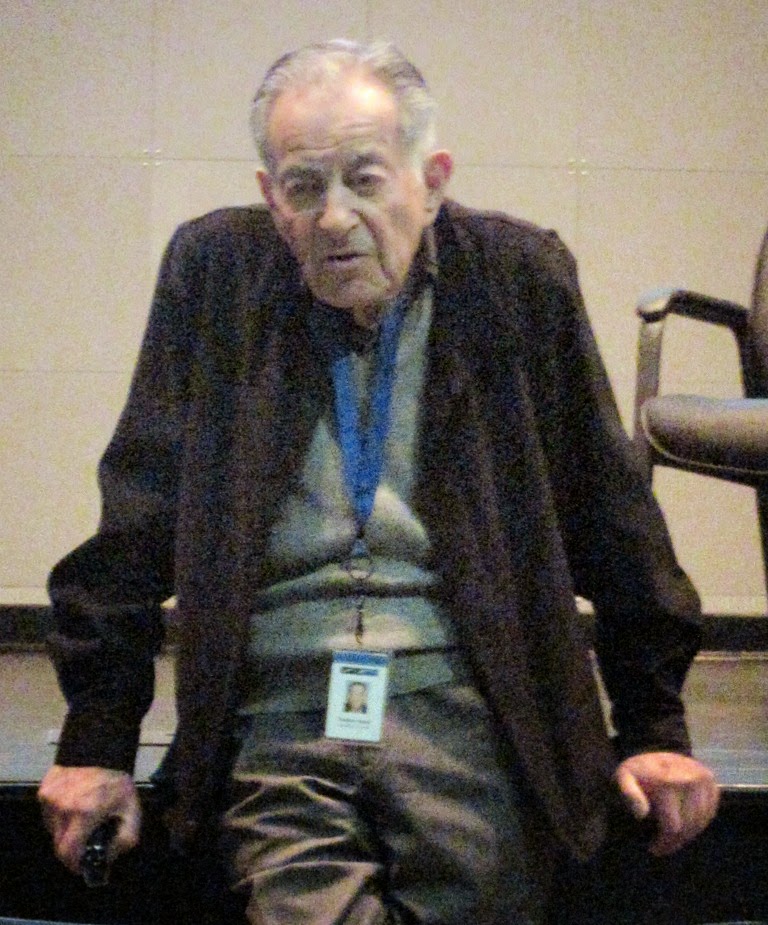
Walter Reed during one of his many public speaking apperances
It was at a 1997 reunion of Seyre-La Hille children in France that Reed saw Ruth and his former companions for the first time in 50-plus years. Keen on not being a “captive” of his past, he’d dropped all links to his childhood, including his Jewish identity and name. Other than his wife, no one in his immediate family or among his friends knew his survivor’s tale, not even his three sons.
For Reed, the reunion came soon after he first revealed his “camouflaged” past for the Survivors of the Shoah Visual History project. Then, when his turn came to tell his biography before a Rotary Club audience, he asked himself — “Do I step out of my closet or do I keep hiding from my past?” Opting to “go through with it,” he shared his story and “everything flowed from there.” After attending the ‘97 La Hille reunion, Reed and his wife hosted a gathering for survivors in Chicago and another in France in 2000.
On the whole, the survivors fared well after the war. Two Seyre-La Hille couples married. A pair enjoyed music careers in Europe — one as a teacher and the other as a performer. Nine of the adult camp directors-counselors have been honored for their rescue efforts as Righteous Among the Nations by Yad Vashem in Israel. Reed has visited many of the sites and principals involved in this conspiracy of hearts. The Chateau La Hill is still a haven, only now instead of harboring refugees as a rustic hideout it shelters tourists as a trendy bed-and-breakfast.
For Reed, taking ownership of his past has brought him full circle.
“Even though our lives have taken many different paths all over the globe, nearly all my surviving companions feel a strong bond with each other. Many have strong ties to the places and persons that gave us refuge during those dangerous and turbulent years of our youth. I think a lot of things happened then that shaped me as a whole. It inculcated in me certain attributes I still have — of taking responsibility and running things.”
Above all, he said, the experience taught him “to resist oppression and discrimination,” something he and his wife do as parents of a child with cerebral palsy. “For me, recrimination and anger are not a suitable response. It’s important we strive for reconciliation and understanding. Then we live the legacy.”
Related articles
- Art Trumps Hate: ‘Brundinar’ Children’s Opera Survives as Defiant Testament from the Holocaust (leoadambiga.wordpress.com)
- David Kaufmann: A Holocaust Rescuer from Afar (leoadambiga.wordpress.com)
Nick and Brook Hudson, Their YP Match Made in Heaven Yields a Bevy of Creative-Cultural-Style Results – from Omaha Fashion Week to La Fleur Academy to Masstige Beauty and Beyond
February 4, 2012
11 comments
Every city has its dynamic young professionals who help shape or in some cases help reset the creative-cultural-style bar, and that is most definitely the case with Nick and Brook Hudson of Omaha. They are a much-admired couple who embody the having-it-all ethos in their personal and professional lives. Their contributions to Omaha’s emerging aesthetic covers fashion, beauty, social entrepreneurship, education, and night life. Nick’s Nomad Lounge became THE high-end night spot in the Old Market. The Halo Institute he co-founded with Creighton University has now been absorbed into that school’s College of Business, where Brook was the marketing director. He co-founded Omaha Fashion Week and now he and Brook together are taking it to new heights. The same holds true for Omaha Fashion Magazine. And now the couple is coalescing OFW’s support for the burgeoning Omaha fashion scene with the new Omaha Fashion Institute, which you’ll be reading more about here in the coming months. Nick also has his beauty (Masstige Beauty) and social networking (Xuba) businesses and Brook has her mentoring program/finishing school, La Fleur Academy. There are a lot of moving parts in their life and work and all their activity touches a wide range of people and organizations here and beyond. You’ll find other stories on this blog about some of the things they’re involved in, including Omaha Fashion Week, an event growing so fast that it’s gaining some regional and national attention. There’s also a profile here about Nick. I am sure to be revisiting their story again down the road as they engage in new endeavors and adventures.

Nick and Brook Hudson, Their YP Match Made in Heaven Yields a Bevy of Creative-Cultural Results – from Omaha Fashion Week to La Fleur Academy to Masstige Beauty and Beyond
©by Leo Adam Biga
A version of this article was published in Metro Magazine
As fabulous Omaha young professional couples go, Brook and Nick Hudson are stars.
The former Brook Matthews won the 2004 Miss Nebraska crown. The Blair native and University of Arkansas graduate completed her MBA in 2010 at Creighton University, where she’s marketing director in the College of Business. She was honored as the school’s graduate woman of the year and the Omaha Jaycees have named her an Outstanding Young Omahan.
She volunteers with the American Heart Association, the Omaha YMCA and Junior League of Omaha. Her passion for etiquette and self-improvement led her to launch La Fleur Academy, a mentoring program for empowering girls and young women to tap their inner beauty and potential through the social graces.
“I love to see the difference I can make when I work one-on-one with girls.” she said.” It’s one of my favorite things to do.”
Advising her on La Fleur is hubby Nick, a business development and strategic marketing veteran of international beauty brand companies. He owns Nomad Lounge in the Old Market and founded Omaha Fashion Week. OFW grew out of Nomad, which doubles as cool entertainment venue and creatives hang out. Nomad showcases talent through meet-and-greets, exhibitions and performances.
The native Brit’s entrepreneurial instincts led him, in partnership with Creighton, to form the Halo Institute, a nonprofit incubator for nurturing start-up companies with a social entrepreneurship spirit. He’s now pursuing a new for-profit venture, Xuba, that seeks to leverage social networking sites with commercial opportunities.

Just as Nick consults La Fleur, Brook lends her marketing expertise to OFW and its goal to be a sustainable support system for the local design community.
Teamwork is a defining characteristic of this couple’s relationship.
“Our encouragement of each other in our endeavors really is what drives a lot of success,” said Brook. “We rely on each other, and we spend a lot of time talking and brainstorming and coming up with ideas.”
“We have really good complementary skill sets,” Nick said.
Their openness to being inspired by one another helped bring them together.
“We realized we are more than the sum of our parts, and I think that’s where we have an opportunity to make an even bigger impact in the community than we did as individuals,” said Brook. “We both feel confident we’re capable and intelligent and able to make a difference. It energizes us to be able to employ all of those talents for the betterment of our community. I think that’s what keeps us going.”
Said Nick, “Most people have different kinds of hobbies, but I think for me my hobby, my passion is I just love helping people create things and achieve things, and I think Brook and I are similar in that.” As Brook puts it, “The whole idea is building other people up and helping them achieve their dreams.”
“I’m not the best at doing certain things myself, but I’m quite good at encouraging other people to do things, and that’s just really satisfying,” said Nick.

Paying it forward is “a great reward,” said Brook, adding, “People have limitless opportunities — the only limits in life are the ones we place on ourselves — and I think Nick and I are all about helping people see past those self-imposed limits.” It’s no different than how they push each other. It’s why she calls Nick her “chief go-to mind” when she needs to run an idea by someone. He does the same with her.
“I’m learning so much from my best friend and from my soulmate because Brook is probably the best person at telling me where I need to improve and what I need to work and what I need to think about better or what can we do better,” said Nick.
“I appreciate him so much for encouraging me and my dreams — I don’t think I could do it all without him,” said Brook. “Nick’s the dreamer and I’m the realist. When I need to think bigger I call Nick and when Nick needs to be brought down to reality he calls me. It’s a beautiful thing. We’re good at giving each other tough love and encouragement when it’s needed. Not a lot of couples can communicate as openly as we do.”
A shared interest in social entrepreneurship helps.
“I think it’s just integral to the spirit of the young professional and what’s important to us. We want to be connected to something greater than ourselves and we want to collaborate to solve problems,” she said. “Omaha’s in an interesting place in its evolution because there will very soon be a big shift in power and wealth in the community and we’re all sitting back wondering, Well, who’s going to be the next Warren Buffet or next big corporate titan in Omaha? Looking around, it could be any one of us. It’s a great time to be a young professional in Omaha.”
“It’s pretty amazing what groups of young professionals are doing around Omaha — I’m really impressed,” said Nick. “I think there’s still so much more to do. I’m still just learning what the potential is and how we can do things.”
With Nomad, Halo, Fashion Week and La Fleur, the couple are actively engaged in helping people achieve their dreams.
Related articles
- Living the Dream: Cinema Maven Rachel Jacobson – the Woman Behind Film Streams (leoadambiga.wordpress.com)
- Omaha Film Festival Celebrates Seven Years of Growing the Local Film Culture (leoadambiga.wordpress.com)
- Omaha Fashion Past (leoadambiga.wordpress.com)
- Nancy Bounds, A Timeless Arbiter of Fashion Beauty, Glamour, Poise (leoadambiga.wordpress.com)
- Art as Revolution: Brigitte McQueen’s Union for Contemporary Art Reimagines What’s Possible in North Omaha (leoadambiga.wordpress.com)
- The Mastercraft Revival: A Building Dedicated to Craftsmanship Finds New Life as a Creatives Den (leoadambiga.wordpress.com)
Doing time on death row: Creighton University theater gives life to “Dead Man Walking”
January 10, 2012
1 comment
I don’t go to a lot of theater, but I go to enough to have a good sense for what good theater looks and sounds like, and one of the better amateur productions I’ve ever seen was the Creighton University staging of the Tim Robbins play, Dead Man Walking, from some years ago. It’s hard to go wrong with this gripping material, but then again I’ve seen enough strong source material mishandled that I know anything can be done badly. This was a case of fully realizing a play’s potential. The play, like the movie Robbin wrote and directed, is based on the book by Sister Helen Prejean about her transformative experience counseling a death row inmate that basically began what’s turned into her nationwide crusade against capital punishment. I see now that Dead Man Walking has been adapted into an opera as well, which doesn’t surprise me because the dramatic moments and thematic concerns and emotional upheavals in the story certainly lend themselves to such expressive treatment. I hope the opera is staged one day where I live, Omaha, which is also the home to Creighton University, a Jesuit school with a fine reputation for its professional colleges. Its liberal arts offerings, including theater, ethics, social entrepreneurship, and journalism, are quite strong, too.
Doing time on death row: Creighton University theater gives life to “Dead Man Walking”
©by Leo Adam Biga
Originally published in The Reader (www.thereader.com)
To kill or not to kill? That question hovers over every moment of Dead Man Walking, the new Tim Robbins play that covers similar ground as the actor-filmmaker’s acclaimed 1996 film of the same name. In this meditation on the death penalty, the ramifications of taking one life for another is considered. Do we have the right to? Is it justice or revenge? Can execution ever be meted out fairly?
The play, making its Omaha premiere in a Creighton University main stage production opening this weekend, forces viewers to confront a subject most would rather not contemplate. And the humanistic way it presents this struggle ensures that it goes beyond being mere polemics or abstraction. It is high drama truthfully distilled in the very real conflict of a convicted murderer’s life hanging in the balance. Will ending his life compensate for the lives he took? Does he deserve to die? Did his victims? The dilemma only grows deeper when the killer shows remorse. Too late it turns out. No matter what side you’re on before the play, you won’t come out of it unaffected after witnessing a night of theater in which an execution by lethal injection is enacted before your very eyes.
“It’s very riveting. I mean, we’re going to execute somebody on stage,” said the show’s director Alan Klem, CU assistant professor of theater. “I hope to leave the audience with the same feeling I had after reading the play, and that is — I can’t ignore this. I think what the playwright is trying to get across is that we can’t take a passive view point on this issue. It’s better to take a strong stance, one way or the other, than to say, ‘It doesn’t concern me.’ It does concern us. Basically, we’re shedding light on executions, which are carried out at midnight when people are asleep. Why do do it then? Because the state doesn’t want you to know what it’s like. Death row is a terrible, terrible place. We’re trying to recreate that feeling the best we can that this is a terrible, terrible place.”
After the final curtain on opening night, a panel discussion on the death penalty follows. The panel includes Creighton law professor Christine Wiseman, a vocal death penalty opponent who, in 1995, exhausted the appeals process on behalf of Texas death row inmate Billy Conn Gardner. Serious questions were raised about his arrest, trial and murder conviction, but not enough to stop his execution.
What better forum for this discussion than a Jesuit institution with its historical social justice mission? At Robbins’ behest, a draft of the unpublished play has been offered to select, mostly Jesuit, colleges and universities to be performed during the 2004-2005 academic year. It’s part of his Dead Man Walking School Theatre Project, whose intent is to elicit dialogue on capital punishment, an ugly reality usually shrouded in the dark of night, far away from public scrutiny.
Creighton is among only a few school’s mounting a production of Dead Man this year. The school’s Department of Fine and Performing arts is staging its version over seven nights in February and March. Show dates and times are: Thursday through Saturday, February 24 through 26, at 7:30 p.m.; Sunday, February 27 at 2 p.m.; and Thursday through Saturday, March 3 through 6, at 7:30 p.m. The show’s on-campus venue is the Lied Education Center for the Arts at 24th and Cass.
Both the play and movie are based on the best-selling book by Sister Helen Prejean, whose real life story recounts her 1980s experience as spiritual advisor to Angola State Prison (La.) death row inmate Patrick Sonnier. He was ultimately put to death. In her book and in Robbins’ adaptations, the one constant is a convicted killer awaits his reckoning via a lethal injection date. Alone, with no prayer of his sentence being commuted, he makes a desperate plea for help, A naive but caring nun answers the call — setting in motion events neither seems prepared to handle.
Just as there’s no doubt where the protagonist, Prejean, stands on the issue, it’s clear Robbins vehemently opposes the death penalty, but to his credit, he doesn’t allow his drama to turn political diatribe. “It tries to give both sides of the issue,” Klem said. “It’s important it not come off as a sermon.” Indeed, a reading of the play reveals a balanced work delineating how people find moral, Biblical mandates for or against execution. While the troubling and divisive themes are ever-present, the core conflict is the tug-of-war between Prejean and her soon-to-be-put-to-death charge, Matthew Poncelot. It is a struggle between her unconditional love and his unrepentant heart. Between her search for the truth and his denial of it.
The conflict is also an internal one, within the mind of Prejean, whose self-reflective stream of consciousness drives and defines the action. She becomes our witness, our guide and our narrator to the events that unfold. She even “preaches to the audience, trying to open their eyes,” said the actress playing her, CU senior Jeanne Tiehen. “But she doesn’t come down on them. It’s more like, ‘Listen to this story.’ It’s all about awakening the discussion about capital punishment.”
At times, we’re privileged to hear Prejean’s innermost misgivings. She’s plagued too by the harsh but righteous anger of the victims’ parents and the cynical disapproval of the victims’ themselves, who remind us of promising young lives violently cut short. The insistent voices and haunting figures receive expressionistic treatment by Klem, who with CU theater coordinator and technical director Bill Van Deest, has come up with a striking set dominated by a depressive death row cell block below, where the condemned fret and wait, and a surrealistic catwalk above, from where the dead look down. All is black save for the rust-toned bars and handrails. Adding context are stark, projected images on an overhead screen. Together with the disturbing, fated presence of Poncelot, a sneering, conniving hate-monger bursting with pent-up anger, fear and regret, it becomes an existential space.
At first, Poncelot tries playing Prejean the way he has everyone else. After all, she comes to the prison and criminal justice system as an innocent. When he sees she has, as Klem calls it, “backbone,” he begins to respect her. Before she knows it, she finds herself in the uncomfortable position of being an advocate and confessor for a monster. Along the way, she makes enemies. But she cannot turn back.
In the eyes of Tiehen, a CU senior theater arts major whose experience researching, rehearsing and performing the role is her thesis project, Prejean is like Alice in the rabbit hole. “Once she falls, she just keeps going and going, and what I like about this script is that as soon as she gets a grasp of one thing, all of a sudden she’s dealt a whole new layer of challenges, and it’s overwhelming. There’s plenty of points in the play when she goes, ‘What am I doing here?’ It’s kind of like she’s propelled along by events. It gives you a real sense for how this thing steamrolled. There’s not a moment’s rest. And there is no getting off for her.”
So, why does Prejean stay the course? “She sees this person who needs help and when he turns to her for it, she can’t turn away from that,” Tiehen said. “She feels a responsibility for this guy’s soul. For his well-being. For his life.” Klem said, “She becomes not only a tower of strength for him, but also the conscience for him.”
Poncelot is played by CU senior Rusty Perry, a regular at the Millennium Theater, He feels the condemned man finally opens up to Prejean out of “his trust” in her. “She sort of pulls it out of him. When he first meets with her, he blows smoke in her face. He doesn’t feel she deserves any more consideration than anyone else. Yet she still cares for him,” he said. “He’s like one of the strays she took in as a child. It’s his first experience of love — of someone caring for his life.”
For Tiehen, a veteran of such CU productions as Tom Stoppard’s The Real Inspector Hound and Beth Henley’s Crimes of the Heart, Prejean is a woman to admire and a character to covet. “She’s an amazing person. Her involvement in the movement just happened, and rather than running away from it — she embraced it. You don’t find many female characters like her that are intelligent and strong, and still warm and compassionate.” She said playing a public figure in Prejean, now an icon in the fight to abolish the death penalty, is “daunting. Here is this woman who’s become such a strong face and force in the movement…and how do I still make her somebody that’s approachable and not just a figurehead?” The key, she said, is expressing her “compassion and her faith something good will come out of this.”
Then there’s the fact that at the time of these events, Prejean was an unknown navigating her way through a crazy system that, once its wheels were set in motion to put someone to death, it could not be stopped. “She’s kind of the Everyman in the situation,” Tiehen said. “She’s scared. She’s frustrated. She gets angry. She’s not someone who’s just pious, tempered and passive all the time.” She’s real.
Tackling a part and a piece as heavy as this, Tiehen said, is taxing. “It’s extremely challenging. It’s demanding a lot of me, and all of us. But it’s been very educational to chronicle the journey of this process. It’s a huge opportunity.”
Klem said cast and crew have tried keeping things light in rehearsal. “It’s not an easy play to do. But even as heavy as it is, you’ve still got to have fun doing it.” Aside from the potent themes, he said its cinematic structure — with short, impressionist scenes and quick transitions — makes it “difficult to stage.”
In a play filled with “religious connotations” that pose Old Testament eye-for-an-eye arguments versus New Testament turn-the-other-cheek admonitions, “there is a communion going on,” Klem said. “It’s almost like a liturgy in a sense.” Amen.
Related articles
- Man on death row for 21 years has murder conviction overturned (thegrio.com)
- Delaware to hear final mercy appeal for death row inmate abused as child (guardian.co.uk)
- Neb. Supreme Ct. rules against death row inmate (mysanantonio.com)
- Death row American’s lawyer calls for compassion from Iran (cnn.com)
- Execution date sought for Oklahoma death row inmate who killed his wife (newsok.com)


 Leo Adam Biga's My Inside Stories