Archive
Keeper of the Flame: Poet Laureate and Pulitzer Prize winner Ted Kooser

Ted Kooser was already well into his term as U.S. Poet Laureate and had recently been awarded the Pulitzer Prize when I wrote two stories about him. This is the first. It appeared in the New Horizons, and it ‘s based on an interview I did with him at his home in Garland, Neb. Whenever I interview and profile a writer, particularly one as skilled as Kooser, I feel added pressure to get things right. He helped make me feel comfortable with his amiable, homespun way, although I never once forgot I was speaking to a master. The subsequent piece I did on him is also posted on this site.
Keeper of the Flame: Poet Laureate and Pulitzer Prize winner Ted Kooser
©by Leo Adam Biga
Originally published in the New Horizons
Forget for the moment Ted Kooser is the reigning U.S. Poet Laureate or a 2005 Pulitzer Prize winner. Imagine he’s one of those quixotic Nebraska figures you read about. A bespectacled, bookish fellow living on a spread in the middle of nowhere, dutifully plying his well-honed craft in near obscurity for many years. Only, fame has lately found this venerable artist, who despite his recent celebrity and the rounds of interviews and public appearances it brings, still maintains his long-held schedule of writing each morning at 4:30. Away from the hurly-burly grind, the writer’s life unfolds in quiet, well-measured paces at his acreage home recessed below a dirt road outside Garland, Neb. There, the placid Kooser, an actual rebel at heart, pens acclaimed poetry about the extraordinariness of ordinary things.
Once you get off I-80 onto US 34, it’s all sky and field. Wild flowers, weeds and tall grasses encroach on the shoulders and provide variety to the patches of corn and soy bean sprawled flat to the horizon. The occasional farm house looms up in stark relief, shielded by a wind break of trees. The power lines strung between wooden poles every-so-many-yards are guideposts to what civilization lies out here.
Kooser’s off-the-beaten-track, tucked-away place is just the sort of retreat you’d envision for an intellectual whose finely rendered thoughts and words require the concentration only solitude can provide. More than that, this sanctuary is situated right in the thicket of the every day life he celebrates, which the title of his book, Local Wonders, so aptly captures. In his elegies to nature, to ritual, to work, and to all things taken for granted, his close observations and precise descriptions elevate the seemingly prosaic to high art or a state of grace.
The acreage he shares with his wife Kathy Rutledge includes a modest house, a red barn, a corn crib, a gazebo he built and a series of tin-roofed sheds variously containing a shop for his handyman work, an artist’s studio for his painting and a reading salon for raiding bookcases brimming with volumes of poetry and literature.
The pond at the bottom of the property is stocked with bluegill and bass.
His dogs are the first to greet you. Their insistent barking is what passes for an alarm system in these rural digs. Kooser, 66, comes out of the house to greet his visitors, looking just like his picture. He’s a small, exact man with a large head and an Alfred E. Newman face that is honest, wise and ironic. He has the reserved, amiable, put-on-no-airs manner of a native Midwesterner, which the Ames-Iowa born and raised Kooser most certainly is.
Comfortably and crisply outfitted in blue jeans, white shirt and brown shoes, he leads us to his shed-turned-library and slides into a chair to talk poetry in his cracklebarrel manner. A pot-bellied stove divides the single-room structure. The first thing you note is how he doesn’t play off the lofty honors and titles that have come his way the last two years. He is down to earth. Sitting with him on that June afternoon you almost forget he’s this country’s preeminent poet. That is until he begins talking about the form, his answers revealing the inner workings of a genuine American original and master.
Kooser, who teaches a graduate-level tutorial class in poetry at the University of Nebraska-Lincoln, patiently responds to his visitors’ questions like the generous teacher he is. His well-articulated passion for his medium and for his work, a quality that makes him a superb advocate for his art, are evident throughout a two-hour conversation that ranges from the nature of poetry to his own creative process.

So, what is poetry?
“I like to think it is the record of a discovery. And the discovery can either be something in your environment or something you discover in the process of writing, like in new language. You basically record that discovery and then give it to the reader. And then the reader discovers something from it,” he said. “There’s a kind of kaleidoscope called a taleidoscope. It doesn’t have the glass chips on the end. It has a lens and I turn it on you and however ordinary the thing is it becomes quite magical because of the mirrors. And that’s the device of the poem. The poet turns it on something and makes it special and gives it — the image — to the reader.”
There is a tradition in poetry, he said, of examining even the smallest thing in meticulous detail, thereby ennobling the subject to some aesthetic-philosophical-spiritual height. It’s one of the distinguishing features of his own work.
“The short lyric poem very often addresses one thing and looks at it very carefully. That’s very common. I guess I’m well known for writing poems about very ordinary things. There’s a poem in my latest book about a spiral notebook. Every drug store in the state has a pile of them. Nothing more ordinary than that. I’ve written poems about leaky faucets and about the sound a furnace makes when it comes on and the reflections in a door knob. They’re all celebrations in some sense. Praise” for the beauty and even the divine bound up in the ordinary.
His Henry David Thoreau-like existence, complete with his own Walden’s Pond, feeds his muse and gives him a never-ending gallery to ponder and to convey.
“I like it out here. I like being removed from town. I like it because it’s quiet. For instance, I have a poem in my book Weather Central about sitting here and watching a Great Blue Heron out here on the pond. And there are many poems like that. There’s another one in that same book called A Hatch of Flies about being down in the barn one morning very early in the spring and seeing a whole bunch of flies that had recently hatched behind a window.”
The rhythms of country living complement his unhurried approach to life and work. He waits for inspiration to come in its own good time. When an idea surfaces, he extracts all he can from it by finding purity in the music and meaning of language. Words become notes, chords and lyrics in a kind of song raised on high.
“I never really have an idea for a poem,” he said. “I’ll stumble upon something and it kind of triggers a little something and then I just sort of follow it and see where it goes. I always carry a little notebook. If I see something during the course of the day I want to write about, I make a note of it.”
Another element identifying Kooser’s work is the precision of his language and his exhaustion of every possible metaphor in describing something. The rigor of poetry and of distilling subjects and words down to their truest essence appeals to him.
“I think there’s a kind of polish on my metaphors. I’m extremely careful and precise in the way I use comparisons. I wrote about that in my Poetry Repair Manual. How you really work with a metaphor. You just don’t throw it in a poem and let it go. You develop it and take everything out of it you can. With a poem, once it’s finished or it’s as finished as best as I can finish it, there isn’t anything that can be moved around. You can’t substitute a word for its pseudonym or its synonym. You can’t change a punctuation mark or anything like that without diminishing the effect,” he said. “Whereas, with prose, you can move a word around or change the sentence structure and it really doesn’t have that much of an effect on the overall piece. I like the fact poetry has to be that orderly and that close to perfect. I tend to be a kind of orderly type guy.”
Getting his work as close to perfection as possible takes much time and effort.
“I spend a lot of time revising my poems and trying to get them just right. A short poem will go through as many as 30 or 40 revisions before it’s done. Easily. I’m always trying to make the poems look as if they’re incredibly simple when they’re finished. I want them to look as if I just dashed them off. That takes revision itself. I’m always revising away from difficulty toward clarity and simplicity.”
So, how does he know when a poem is done?
“I think what happens is eventually you sort of abandon the poem. There’s nothing more you can do to make it better. You just give up. Rarely do you get one you think is really perfect. But that blush of success doesn’t usually last very long.”
A serious poet since his late teens, Kooser has refined his style and technique over a half-century of experimentation and dogged work.
“We learn art by imitation — painters, musicians, writers, everybody — by imitating others. So, the more widely you read, the more opportunities there are to imitate different forms and different approaches, and I tried everything I suppose,” he said. “You learn from the bad, unsuccessful poems as much as you learn from the good ones. You see where they fail. You see where they succeed. I’ve written the most formal of forms — sonnets and sestinas and ballads and so on, just trying them out, as you’d try on a suit of clothes.”
“I’ve come to my current style, which feels very natural to me,” through this process of trial and error and searching for a singular voice and meter and tone. “Somebody glancing at it would say, ‘Well, this is free verse.’ But it really is not free verse at all. I take a tremendous amount of care thinking about the number of syllables and accents in the lines. I might not have three accents in every lines, but the only reason I wouldn’t add another accent to a line of two is that it would seem excessive or redundant in a way.
“So, I never let the form dominate the poem. It’s all sort of one thing. And I think poems proceed from someplace and then they find their own form as they’re written. You let them develop. You let them fill their own form.”
Being open to the permutations and rhythms of any given poem is essential and Kooser said his routine of predawn writing, which he got in the habit of while working a regular office job, feeds his creativity and receptivity. “It’s a very good time for me to write. It’s quiet. You mind is refreshed. I’m a poet very much devoted to metaphor and rather complex associations,” he said, “and they tend to rise up at that time of day. I think what happens is as you come out of sleep your mind is trying make connections and sometimes some really marvelous metaphors will arise. By the end of the day, your head is all full of newspaper junk and stuff.”
All that sounds highly romantic, but the reality and discipline of writing every day is far from idyllic. Yet that’s what it takes to become an artist, which reminds Kooser of a story that, not surprisingly, he tells through metaphor.
“A friend of mine had an uncle who was the tri-state horse shoe pitching champion three years running and I asked — ‘How’d he get so good at it? — and my friend said, ‘Son, you’ve got to pitch a hundred shoes a day.’ And that’s really what you have to do to get good at anything. And I tell my students that, too: ‘You’ve got to be in there pitching those hundred shoes every day.’ Often times, in the process of writing, the really good things happen. That’s why you have to write every day. You have to be there, as the hunters say, ‘when the geese come flying in.’”
As most writers do, Kooser came to his art as an eager reader. He grew up in a Cold War-era home where books were abundant. He became a fixture at the local public library in Ames. His mother, who had some college and was a voracious reader, encouraged young Ted. But what really drove him, more than the Robert Louis Stevenson books he devoured, was his sense of being an outsider. He was a puny kid who didn’t mesh with the cliques at school. But in writing he found something of his own. A key book in his early formation as an aspiring writer was Robert McCloskey’s novel Lentil.
“It’s about a boy in a small town who doesn’t fit it very well. He’s not an athlete. He can’t sing. Then he teaches himself to play the harmonica. When a very important person from the town returns home, the band is all assembled at the depot, the banners are all hung out and a parade is planned down main street. But the guest has an enemy who gets up on the depot roof with a lemon, and when the band gets ready to play, he slurps this lemon and the band can’t blow their horns. But Lentil can play his harmonica and by saving the day he gets to ride with the special guest in the parade. The last line of the poem is, ‘So you never know what will happen when you learn to play the harmonica. And that really is a seminal story for me. I identified with that kid. And this poetry business is really like the harmonica. This was my thing to do. And so, for me, the lesson was, You never know what will happen when you learn to write poetry.”
Besides writing, Kooser was “into hot rods.” He built one car himself and built another one with a friend. It was inevitable he would combine both passions.
“I was writing these Robert Service-type ballads about auto races. I wrote a long one about a race and some of my friends sent it to a slick teen magazine called Dig. It was nothing I would have ever done myself. I never was one to really put myself forward in any way. But they sent it in, and it was published, much to my surprise.”

Between the buzz of his first published story, the strokes his teachers gave him and the emerging Beat Poetry scene he embraced, Kooser was sold on the idea of being a poet despite and, indeed, because of the fact it was so far afield from his proletarian roots. Making his mark and defying convention appealed to the non-conformist in Kooser. It was his way of standing apart and being cool.
“I wanted to be a poet right from the time I was 17 or 18. That was really my driving force. It was the idea of being different and interesting. I wanted to be on the outside looking in. It had a lot to do with girls, frankly. I came from an extremely plain, ordinary, middle class background and I wanted to set myself apart from that. Who knows how that works psychologically? My mother was very devoted to me and had very conventional ideas, and it may have been my attempt to separate myself from her. And to this day, when I become sort of reabsorbed into the establishment, as if I had ascended in class to some other level, I feel slightly uncomfortable and rebellious. I think that to be successful as an artist you have to be on the outside of the general order — observing it.”
In his wife, Kathy Rutledge, whom he met in the ‘70s, he’s found a kindred spirit. A child of the ‘60s, she was caught up in the fervor of the times. Now the editor of the Lincoln Journal Star, she shares his love of writing and is his gentle reader.
“She helps me with my writing. She’s a very good reader of my work. She’s a brilliant woman. She knows terms for the English language I don’t understand.”
He finds it ironic a pair of iconoclasts have ended up in such mainstream waters. She as a daily newspaper editor and he as “a celebrated poet” speaking to Kiwanis and Rotary Club meetings and giving college commencement addresses.
Besides his poetry and his insurance job, which he retired from a few years ago, Kooser’s been on the periphery of the academic circle. He’s taught night classes for years at the University of Nebraska-Lincoln, where he earned his master’s.
Growing up in a college town, he gravitated almost as a matter of course to local Iowa State University, where he studied architecture before the math did him in. His literary aspirations led him into an English program that earned him a high school teaching certificate. He taught one year before moving onto UNL for grad studies. He was drawn by the presence of former U.S. Poet Laureate and Pulitzer Prize-winner Karl Shapiro, under whom he studied. When Kooser spent more time hanging out with Shapiro than working on his thesis, he lost his grad assistantship and was forced to take a real job. He entered the insurance game as a stop-gap and ended up making it a second career. It was all a means to an end, however.
“I worked 35 years in the life insurance business, but it was only to support myself to write. It was an OK job and I performed well enough that they kept promoting me. But writing was the important thing to me and I did it every morning, day in and day out. Writing was always with me. I’ve never not been writing.”
While his 9 to 5 job gave him scant satisfaction beyond making ends meet, it proved useful in providing the general, non-academic audience for his work he sought.
“The people I worked with influenced my poetry,” he said. “We all write toward a perceived community, I think, and I was writing for people in that kind of a setting. I had a secretary in the last years I was there, a young woman who’d read poems in high school but had no higher education, and I often showed her my work. I’d say, ‘Did it make any sense to you?’ and she’d say, ‘No, it didn’t.’ And I’d go home and work on it, until it did because I wanted that kind of audience. I would not refer to anything that would drive anybody to stop in the middle of the poem to go look it up in the encyclopedia. The experience of the poem shouldn’t be interrupted like that. I have a very broad general audience. I get mail from readers every day.”
A less obvious benefit of working as a medical underwriter, which saw Kooser reading medical reports filled with people’s illnesses, was gleaning “a keen sense of mortality.” “Poetry, to really work,” he said, “has to have the shadow of mortality carried with it, because that darkness is what makes the affirmation of life flower.”
These days, Kooser is working hard to help poetry bloom in America, where he feels “it’s really thriving” between the literary-academic, cowboy, hip hop and spoken word poets. “It’s so important to do a good job as Poet Laureate, as far as extending the reach of poetry, that I’ve largely set my own writing aside for now.” His post, which he sees as “a public relations job for the sponsoring Library of Congress and for poetry,” has him promoting the art form as a speaker, judge and columnist. His syndicated Everyday Poetry column is perhaps his most visible outreach program. He’s considering doing an anthology of poems about American folklore. He’s also collaborating with educators to distill their ideas for teaching poetry into a public forum, such as a website. “The teachers are really on the front line here. They’re the people who make or break poetry,” he said.
Then, as if reassuring his visitors he’s no elitist, he excuses himself with, “I’ve got to run up to the house — I’ve got a pheasant in the oven.” Yes, even the Poet Laureate must eat.
Related Articles
- Author Wins National Poetry Award (nebraskapress.typepad.com)
- Poetry Pairing | August 19, 2010 (learning.blogs.nytimes.com)
- Poet Laureate Announced: William S. Merwin Named 17th U.S. Poet Laureate (huffingtonpost.com)
- “Librarian of Congress James H. Billington today announced the appointment of WS Merwin as the Library’s 17th Poet Laureate Consultant in Poetry for 2010-2011.” and related posts (resourceshelf.com)
- Off the Shelf: Valentines by Ted Kooser (nebraskapress.typepad.com)
- Poetry Pairing | March 31, 2011 (learning.blogs.nytimes.com)
- After Years, Ted Kooser (objetsdevertu.wordpress.com)
- Billy Collins “Introduction to Poetry” (thenightlypoem.com)
RIP Preston Love Sr., 1921-2004, He Played at Everything
This is one of the last stories I wrote about Omaha jazz and blues legend Preston Love. It’s a tribute piece written in the days following his 2004 death. Trying to sum up someone as complex and multi-talented as Preston was no easy task. But I think after reading this you will have a fair appreciation for him and what was important to him. The piece originally appeared in The Reader (www.thereader.com). I actually ended up writing about him two more times, once on the occasion of the opening of the Loves Jazz & Arts Center, which is named in his honor and located in the hub of North Omaha‘s old jazz scene, and then again when profiling his daughter Laura Love, a singer–musician he fathered out of wedlock. You can find my other Preston Love stories along with my Laura Love story on this blog site.
©by Leo Adam Biga
Originally published in The Reader (www.thereader,com)
Lead alto sax player with Basie in the 1940s. Territory band leader in the ‘50s. Arranger, sideman, band leader for Motown headliners in the ‘60s. Studio session player. Recording artist. Music columnist. Radio host. Teacher, lecturer, author.
Until his passing from cancer at age 82, the voluble, playful, irrepressible, ingenious Preston Love wore all these hats and more during a long, versatile career. Around here, he may be best remembered for the easy way he performed at countless venues or the nostalgic, by-turns cantankerous tone of his Love Notes column or the adoring tributes and scalding rebukes he issued as host of his own jazz radio programs. Others might recall the crusading zeal he brought to his roles as college instructor, lecturer and artist-in-residence in spreading the gospel of jazz.
His curt dismissal of some local jazz musicians made him an egoist in some corners. In Europe, he was accorded the respect and adulation he never got at home. Yet, despite feeling unappeciated here, he often championed Omaha. It took the publication of his 1997 autobiography to make his resident jazz legend status resonate beyond mere courtesy to genuine recognition of his talents and credits.
For his well-received book, A Thousand Honey Creeks Later, My Life in Music from Basie to Motown (Wesleyan Press), Love drew on an uncanny memory to look back on a life and career spanning an enormous swath of American history and culture. It was a project he labored on for some 25 years and even though he still had a lot of living left in him, it served then, as it does now, as an apt summing-up and capstone for an uncommon man and his unusual path. It’s a bold, funny, smart, brutally frank work filled with the rich anecdotes of a born storyteller.
“You know how most people who write their life story have ghost writers? Well, he wrote his book. Every word,” says his son, Richie Love, with pride and awe.
-

Artist: Preston Love
Label: KENT
Orig. Released: 1969
Catalog No.: LPKENT540
Condition: Sealed-Reissue
Format: LPRetail Price: $ 8.99 (1 available)
The ability, with no formal training, to master writing, music and other pursuits was what Billy Melton calls his late friend’s “God-given talents. Preston just picked up everything. He had a photographic memory. He was remarkable.” Richie Love says his father’s huge curiosity and appetite for life was part of “a drive to excel” that came from being the youngest of nine in a poor, single-parent house so run down it was jokingly called the” Love Mansion.” Young Preston taught himself to play the sax, abandoning a promising career in the boxing ring for the bandstand, where the prodigy’s gift for sight reading became his forte. “Any kind of music you put in front of him, he played it,” says former Love pianist Roy Givens.
Whether indulging in food and drink, friends and family, leisure or work, Richie Love says his father lived large. “Everything he did was larger than life. He did everything with a passion. Music. Fishing. Cooking. He was just so interesting. He was an all-around person. People loved him. People flocked to him.”
“He was just a big man all the way around,” says Juanita Morrow, a lifelong friend and fishing companion who experienced his generosity when she and her late husband, Edward, fell ill and Love made frequent visits to their home, bringing them groceries. “I’ll remember him as a very dear friend. He never let my husband and I down. No matter where he went on tour…he always sent letters and pictures.”
Frank McCants, another old chum from back in the day, says even after making it big with Basie that Love “never got the big head. He stayed regular.” Melton says Love would return from the road looking for a good time. “Preston made the big bucks and when he came to town he’d look us up…and that’s when the partying would begin. We let our hair down.” On those rare occasions when the blues overtook Love, Melton says, “music was the antidote. He really loved it.”
Although he hated being apart from his wife Betty, who survives him, Love savored “the itinerant life.” Givens recalls how he made life on tour a little more enjoyable: “He was a very serious musician, but he was a joker. He kept you laughing a lot because of the things he would say and do.” Traveling by bus, the spontaneous Love often heeded the sportsman’s call en route to a gig. “He loved to hunt and he loved to fish,” Givens says, “and on the bus we had he carried his shot gun and his fishing rod. If we went across any water, he’d stop the bus and say, ‘I’m just going to see what I can catch in 15 or 20 minutes.’ He’d throw in a line. When passing by a field, if he’d see a pheasant or a rabbit, he’d stop and shoot at it out the windows. If he hit anything, he’d skin it. If he caught anything, he’d put it on ice in a cooler. A lot of times we were almost late getting to the job because he would be catching fish and he didn’t want to leave. The guys would just laugh.”
A consummate showman, Love burned with stage presence between his insouciant smile and his patter between sets that combined jive, scat and stand up. Richetta Wilson, who sang with various Love bands, recalls his ebullience. “He would talk more than he would play sometimes. He was so funny and talented. The best person you could ever want to work with.” Billy Melton recalls Love teasing audience members from the bandstand. “Almost everybody that came in the door he’d know by name and he’d call them out. He was always joking, but he could take it, too. He didn’t care what you said about him.”
Then there was his serious side. Love coaxed a smooth, sweet, plaintive tone from the sax developed over a lifetime of listening and jamming in joints like McGill’s Blue Room on north 24th Street. As a student of music, he voiced learned, militant diatribes against “the corruption of our music.” As he saw the once serious Omaha jazz scene abandon its indigenous roots, he used his newspaper columns, radio shows and college classrooms as forums for haranguing local purveyors and performers of what he considered pale imitations of the real thing.
Calling much of the white bread jazz presented here “spurious” and “synthetic,” he decried the music’s most authentic interpreters being passed over in favor of less talented, often times white, players. “My people gave this great art form for posterity and I’m not going to watch my people and our music sold down the road,” he said once. “I will fight for my people’s music and its presentation.”
He delivered his eloquent, evangelical musings in free-flowing rants that were equal parts improvisational riff, poetry slam and pulpit preaching, his mellifluous voice rising and falling, quickening and slowing in rhythmic concert with his emotions.
Love’s guardianship for the music may live on if the planned Love Jazz-Cultural Arts Center dedicated to him on 24th Street ever opens, which organizers say could happen by the end of 2004. The center’s driving force, Omaha City Councilman Frank Brown, hopes the facility can showcase the Love legacy, including his many well-reviewed recordings. “I want visitors to know here is a person who was great and touched greatness and was part of that rich jazz history,” Brown says. “People like that just don’t come along every day. And I want kids to walk away with the feeling they too can achieve like he did.” Richie Love says he wants people to know his dad was “a great man.”
Center board members plan displaying items from the mass of memorabilia the late artist collected in his collaborations with what one reviewer of a reissued Love album called a “Who’s Who of American Musicians.” The star-studded roster of artists he worked with ranged from Count Basie, Lucky Millinder and Earl Hines to Wynonie Harris, Billie Holiday and Jimmy Rushing to Aretha Franklin, The Four Tops, The Temptations, The Supremes, Smokey Robinson and the Miracles, Ray Charles, Marvin Gaye, Issac Hayes and Stevie Wonder.
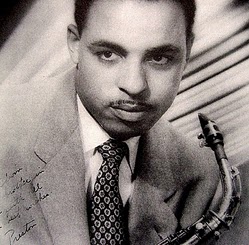
Richie Love is sorting through the materials, including hundreds of photos, in an effort to decide what the family will donate to the center. Many photos picture Love with the Motown artists he worked with during his decade (1962 to 1972) in California. He moved his family there at the urging of friend Johnny Otis, the blues great with whom he often collaborated. Love worked as an L.A. session player and sideman and, later, as the leader of Motown’s west coast backup band, an ensemble that backed many of the label’s artists performing there.
For Richie, and siblings Norman and Portia, the L.A. years were golden. Richie recalls the high times that ensued whenever his father parked the Motown tour bus outside their rented house on West 29th Place. “The kids from the neighborhood would see that bus and we’d all get on it. I’d sit in the driver’s seat and act like I was driving and they’d be in the back singing like they were Motown. It was just the greatest.” Other times, stars arrived in style at the Love home. “We’d look out the window and see a limo coming and say, ‘Oh-oh, who’s it going to be this time?’ I think Dad liked to surprise us. It was always somebody different.” Some visitors, like Gladys Knight or Jimmy Rushing, became live-in guests, passing the time swapping stories and playing Tonk, a popular card game among blacks. “My brother, sister and I would sit in the front room and watch and listen while they were having a ball, laughing and talking all night. We’d get up in the morning, and they’d still be there.” Then there were the times when the boys accompanied their father to television tapings or live concerts and got to hang backstage with the show’s stars, including Stevie Wonder. “Oh, it was the coolest,” Richie says.
|
Having a dad who’s a kid at heart meant impulsive trips to the beach, swimming pools, fishing holes, music gigs. Sitting up with him all hours of the night as he made “elaborate dinners” – from gourmet to barbecue – and “told these great stories,” Richie says. “He was a great father…he turned us on to so many things in life.”
By all accounts, Love was a good teacher as well. Whether holding court at the Omaha Star, where he was advertising director, or from the bandstand, he shared his expertise. “He helped musicians reach their potential,” says Roy Givens. “After listening to you play, he could tell you what your weaknesses were…He would pull you aside and tell you to work on them. I know he made me a better musician.”
Melton says Love often spoke of a desire “to pass his knowledge on.” To see the results of that teaching, Givens says, one has only to look at Love’s children. “They are all exceptional musicians, and that right there’s an accomplishment.” Richie is an instrumentalist, composer and studio whiz. Norman, who resides in Denver, is widely regarded as an improvisational giant. Portia is a jazz vocalist. All performed with their father on live and recorded gigs.
If nothing else, Preston Love endured. He survived fads and changing musical tastes. He adapted from the big band swing era to the pop, soul, rhythm and blues refrains of Motown. He rose above the neglect and disdain he felt in his own hometown and kept right on playing and speaking his mind. Always, he kept his youthful enthusiasm. The eternal hipster. “I refuse to be an ancient fossil or an anachronism,” Love told an interviewer in 1997. “I am eternally vital. I am energetic, indefatigable. It’s just my credo and the way I am as a person.”
Even into his early 80s, Love could still swing. Omaha percussionist Gary Foster, who played alongside him and produced CDs featuring him, marveled at his skill and vitality. “He had a very pure, soulful sound that just isn’t heard anymore. It’s that Midwestern, Kansas City thing. He was part of that past when it was real — when the music was first coming and new. He had that still.” He says Love was not about “coasting on what he’d done in the past,” adding: “To him, that just wasn’t good enough. He still wanted to produce. He was still hungry. In the studio, he was like, ‘What are we doing today? Where are going to take the music today?’”
Love’s musical chops were such that, at only 22, he earned an audition with Basie during an appearance of the Count’s fabled band at Omaha’s Dreamland Ballroom. In the same room he grew up worshiping at the feet of his musical idol, Basie sax great Earle Warren, Love won a seat in the band as a replacement for none other than the departing Warren. “Preston Love was part of this lineage of great lead alto saxophone players. With Basie, he took over for one of the great lead alto saxophone players…and he performed that role with distinction,” Foster says.
Love once said, “Everything in my life would be an anticlimax because I realized my dream.” That dream was making it to the top with Basie. Luckily for us, he didn’t stop there. Now, he leaves behind a legacy rich in music and in Love.
Related Articles
- Leon Breeden, Jazz Educator, Dies at 88 (nytimes.com)
- International Jazz Day (beliefnet.com)
- Enchantress “LadyMac” Gets Down (leoadambiga.wordpress.com)
- Big Bad Buddy Miles (leoadambiga.wordpress.com)
- Once More With Feeling, Loves Jazz & Arts Center Back from Hiatus (leoadambiga.wordpress.com)
- Back in the Day, Native Omaha Days is Reunion, Homecoming, Heritage Celebration and Party All in One (leoadambiga.wordpress.com)
- A Rich Music History Long Untold is Revealed and Celebrated at the Omaha Black Music Hall of Fame (leoadambiga.wordpress.com)
- Arno Lucas, Serious Sidekick (leoadambiga.wordpress.com)
- The Ties that Bind, One Family’s Celebration of Native Omaha Days (leoadambiga.wordpress.com)
“Omaha Blues” and “Preston Love’s Omaha Bar-B-Q”: Two scorching instrumental blues journeys by Omaha music Llgend Preston Love

Image by Affendaddy via Flickr
This next story is actually adapted from a press release that the late Omaha jazzman and blues artist, Preston Love Sr., commissioned me to write to help promote a new CD he was releasing. I include it here as another element of putting the arc of his life and career in proper perspective.
“Omaha Blues” and “Preston Love’s Omaha Bar-B-Q’” Two scorching instrumental blues journeys by Omaha music legend Preston Love
©by Leo Adam Biga
Adapted from a press release I wrote for Preston promoting a new CD
At age 80, legendary Omaha jazz and blues musician Preston Love is enjoying the kind of renaissance few artists survive to see. It began with the 1997 publication of his autobiography, A Thousand Honey Creeks Later (Wesleyan University Press), which earned rave reviews in such prestigious pages as the New York Times Book Review. Next, came a steady stream of re-released albums on CD featuring a much younger Love playing in such distinguished company as the Count Basie and Lucky Millinder bands, just two of the classic groups he played with during this indigenous American music’s Heyday.
Now, there is the unlikely release of two albums, produced 30 years apart, each with the name Omaha in them – Omaha Blues and Preston Love’s Omaha Bar-B-Q – and each showcasing Love at his silky smooth lead alto saxophone playing best. Love has always been faithful to his hometown of Omaha where, as a kid, he first got hooked on jazz and blues by hanging on every note performed by his idols at the near northside clubs he later played too. He still makes his home in Omaha, where he lives with his wife Betty.
“What a unique thing to have two albums out with the name Omaha in them and to have them selling like hotcakes all over the country,” Love said. “What a thrill.”
Beyond the rare confluence of Omaha in their titles, the two releases cast an equally rare spotlight on an artist at two different periods in his career as a jazz-blues interpreter. A brand new release, the Omaha Blues CD presents the ever vibrant Love performing the music of his life, including a mix of standards by the likes of Duke Ellington and Count Basie and a selection of original Love tunes, including the soulful title track.
Produced by Gary Foster at Omaha’s Ware House Productions studio and distributed by North Country Distributors, Omaha Blues has received high praise from what is commonly referred to as The Bible of jazz and blues magazines for the way Love and his band perform everything from slow ballads to hot swinging numbers. Special praise is reserved for Love’s music-making.

Gregg Ottinger, a reviewer with Jazz Ambassador Magazine in Kansas City, writes that the ensemble heard on the record “is particularly good and provides an excellent surrounding for Mr. Love’s strong sound. But the highlight of the CD is Mr. Love’s playing. This is a man who is full of music – eight decades of it – and it’s still strong and fresh. It’s a joy to hear it released on this recording.” Jack Sohmer in Jazz Times describes Love as “still a masterly saxophonist,” adding, “The proof is here that Love has not lost a beat…” And Robert Spencer in Cadence writes, “Preston Love has a slippery, slithery tone that slides through the blues real easy and rings all the changes on a dime with a fine exuberance. Preston Love plays this music with superlative commitment and yes, love. Great fun.”
Producer Gary Foster, the drummer on this recording and a regular percussionist with Love’s working band, said he was drawn to the project because it provided an opportunity to bring the man he considers his mentor to the forefront, a position unfamiliar to this venerable artist who for decades toiled in relative obscurity as a highly respected if not starring sideman, session musician, contractor and band leader.
Also a flutist, Love was a fixture in the reed section of many bands and made a name for himself with his ability to sight read. In addition to playing with Basie and Millinder, he headed-up his own territory bands and led Motown’s west coast band.
“I’m really happy I was able to present Preston Love just doing what he does best and doing it as well as he can. I think in the past Preston deferred to what producers wanted and a lot of times he ended up in the background,” said Foster, who refers to Love’s many studio and live collaborations with legendary artists — ranging from Ray Charles and Aretha Franklin to longtime friend and rhythm and blues great Johnny Otis. During these gigs, Love almost always played a supporting role. But, as Foster and others see it, Love is more than deserving of his own limelight because he is a consummate artist in his own right and the genuine article to boot.
“Preston Love is part of this lineage of great lead alto saxophone players. With Basie, he took over for one of the great lead alto saxophone players — Earl Warren — and he performed that role with distinction. He did a great job,” Foster said.
The way Foster sees it, Love is still making sweet sounds some half-a-century later. “He’s got a very pure, soulful sound that just isn’t heard anymore. It’s that Midwestern, Kansas City thing. He’s part of that past when it was real — when the music was first coming and new. He’s got that still.” Despite the fact Foster has played alongside Love for years he is still amazed that a man of his age remains as sharp and vital and curious as he is. “I’m half his age and I watch this guy night after night constantly trying to improve himself. He’s 80 years old and he’s still worried about being good enough. He’s never satisfied. It’s an inspiration. That’s what I aspire to be as an artist — just constantly trying to be better.”
Foster said Love is not about “coasting on what he’s done in the past,” adding: “To him, that’s just not good enough. He still wants to produce. He’s still hungry. In the studio, he’s like, ‘What are we doing today? Where are going to take the music today?’”
The idea of resting on his laurels is anathema to Love, who dismisses the notion he is some “moldy fig” or stick in the mud. Indeed, Love feels his playing has never been better. “I reached my peak on my instruments later in life,” he said. “I wasn’t interested that much in a career as a soloist early on, but as I became more interested in that I was able to accomplish more at a time in life when most guys deteriorate. I refuse to be an ancient fossil or an anachronism. I am eternally vital. I am energetic, indefatigable. It’s just my credo and the way I am. I play my instruments as modern as anybody alive and better than I’ve ever played them. It’s helped that my health has been good too.”
For Love, Omaha Blues was a blast to make because he was working with his longtime band members Orville Johnson (piano), Nate Mickels (bass) and Foster (drums), along with his daughter Portia Love, an assured vocalist and frequent collaborator. Also heard on the disc are guitarist Jon Hudenstein, pianist Bill Erickson, bassist John Kotchain and vocalist Ansar Muhammad. Of his fellow musicians, Love said, “The guys are just miraculous on this. We didn’t get technical or anything. We just banged it out and I think we did a good job.” Love also lends his smoky voice to a few tunes.
Originally produced on Kent Records and now being re-released by Ace Records of Great Britain, Preston Love’s Omaha Bar-B-Q represents Love at a time and place in his career when he was working with some of the music industry’s strongest talents. “These were top players and all dear friends of mine. I hired them a lot for the Motown band,” Love said. “We had James Brown’s drummer and Ike and Tina Turner’s sax player. We had my dear friend Johnny Otis, who produced the album. Johnny also brought in his son, Shuggie, then a 15 year-old prodigy on the guitar.”

The recording features several different artists, but most notably Shuggie, now enjoying a revival of his own. “He played the greatest blues solos on guitar on that album that will ever be done,” Love said. “He’s a genius.” In keeping with the album’s Omaha and eating themes, the tracks feature a number of Love-penned tunes named after favorite soul food staples, including Chitlin Blues. Released in 1970, the album fared well in Europe, where, Love said, “it made me a pretty big name.” The musician has performed in Europe several times and he is preparing to play France later this year.
Not only a performing and recording artist, Love is also a noted jazz-blues columnist and historian. For years, he hosted a popular jazz program on local public radio, a forum he used as a combination stage, classroom and pulpit in presenting classic jazz in its proper aesthetic-cultural-historical context. He is clearly not done making his passionate, sometimes prickly voice heard either. From his brand new CD to classic reissues of old LPs to area gigs his band plays, his music-making continues enthralling and enchanting old and new listeners alike. With his first book, A Thousand Honey Creeks Later, now going into its second printing, Love is already planning to write another book on his eventful life inside and outside music.
NOTES: After a highly successful run at L & N Seafood in One Pacific Place, Preston Love and his band now jam Friday and Saturday nights at Tamam, 1009 Farnam-on-the-Mall, an Old Market restaurant specializing in Middle Eastern cuisine;
Love was recently a featured performer at the August 3 Blues, Jazz and Gospel Festival on the Metropolitan Community College Fort Omaha campus; Omaha Blues can be found at area record and music stores, including Homer’s. Preston Love’s Omaha Bar-B-Q will soon be available.
Related Articles
- Harlem Jazz Museum Acquires Trove By Greats (harlemworldblog.wordpress.com)
- National Jazz Museum Acquires Savory Collection (nytimes.com)
- He Keeps Discovering Who He Is (online.wsj.com)
- Gene Conners obituary (guardian.co.uk)
- Omaha Arts-Culture Scene All Grown Up and Looking Fabulous (leoadambiga.wordpress.com)
- Tyler Owen – Man of MAHA (leoadambiga.wordpress.com)
- Once More With Feeling, Loves Jazz & Arts Center Back from Hiatus (leoadambiga.wordpress.com)
- Big Bad Buddy Miles (leoadambiga.wordpress.com)
- Enchantress “LadyMac” Gets Down (leoadambiga.wordpress.com)
- Back in the Day, Native Omaha Days is Reunion, Homecoming, Heritage Celebration and Party All in One (leoadambiga.wordpress.com)
- Luigi’s Legacy, The Late Omaha Jazz Artist Luigi Waites Fondly Remembered (leoadambiga.wordpress.com)
- A Rich Music History Long Untold is Revealed and Celebrated at the Omaha Black Music Hall of Fame (leoadambiga.wordpress.com)
- Arno Lucas, Serious Sidekick (leoadambiga.wordpress.com)
Preston Love: His voice will not be stilled
This is one of those foundational stories I did on Omaha jazz and blues legend Preston Love. Together with my other stories on him I give you a good sense for who this passionate man was and what he was about. The piece originally appeared in The Reader (www.thereader.com). I should mention that Love’s autobiography, which is referenced in the story, was well-reviewed by the New York Times and other major national publications. Preston always wanted to leave a legacy behind, and his book, “A Thousand Honey Creeks Later,” is a fine one. The very cool Loves Jazz & Arts Center in the heart of North Omaha’s historic jazz district is named in honor of him. More stories by me about Preston Love can be found on this blog site. I also feature a profile I did on his daughter, singer-songwriter-guitarist Laura Love.

Preston Love: His voice will not be stilled
©by Leo Adam Biga
Originally published in The Reader
One name in Omaha is synonymous with traditional jazz and blues — Preston Love Sr., the native son musician most famous for playing lead alto saxophone with the legendary Count Basie in the 1940s.
The ebullient Love, still a mean sax player at 75, fiercely champions jazz and blues as rich, expressive, singularly African-American art forms and cultural inheritances. This direct inheritor and accomplished interpreter of the music feels bound to preserve it, to protect its faithful presentation and to rail against its misrepresentation.
He has long been an outspoken critic of others appropriating the music from its black roots and reinventing it as something it’s not. Over the years he’s voiced his opinion on this and many other topics as a performer, columnist, radio host, lecturer and oft-quoted music authority. Since 1972 his Omaha World-Herald “Love Notes” column has offered candid insights into the art and business sides of music.
From 1971 until early 1996 he hosted radio programs devoted to jazz. The most recent aired on KIOS-FM, whose general manager, Will Perry, describes Love’s on-air persona: “He was fearless. He was not afraid to give his opinion, especially about what he felt was the inequality black musicians have endured in Omaha, and how black music has been taken over by white promoters and artists. Some listeners got really angry.”
With the scheduled fall publication of his autobiography “A Thousand Honey Creeks Later,” by Wesleyan University Press in Middletown, Conn., he will finally have a forum large enough to contain his fervor.
“It’s written in protest,” Love said during a recent interview at the Omaha Star, where he’s advertising manager. “I’m an angry man. I started my autobiography to a large degree in dissatisfaction with what has transpired in America in the music business and, of course, with the racial thing that’s still very prevalent. Blacks have almost been eliminated from their own art because the people presenting it know nothing about it. We’ve seen our jazz become nonexistent. Suddenly, the image no longer is black. Nearly all the people playing rhythm and blues, blues and jazz in Omaha are white. That’s unreal. False. Fraudulent.
“They’re passing it off as something it isn’t. It’s spurious jazz. Synthetic. Third-rate. Others are going to play our music, and in many cases play it very well. We don’t own any exclusivity on it. But it’s still black music, and all the great styles, all the great developments, have been black, whether they want to admit it or not. So why shouldn’t we protect our art?”
When Love gets on a roll like this, his intense speaking style belongs both to the bandstand and the pulpit. His dulcet voice carries the rhythmic inflection and intonation of an improvisational riff and the bravura of an evangelical sermon, rising in a brimstone tirade one moment and falling to a confessional whisper the next. Suzanna Tamminen, acting director of Wesleyan University Press, says, “One of the wonderful things about Preston’s book is that it’s really like listening to him talk. A lot of other publishers had asked him to cut parts out, but he felt he had things to say and didn’t want to have to change a lot of that. So we’ve tried to have his voice come through, and I think it does.”
Love pours out his discontent over what’s happened to the music in the second half of the book. Love, who’s taught courses at the University of Nebraska at Omaha on the history of jazz and the social implications of black music, says he “most certainly” sees himself as a teacher and his book as an educational document.
In his introduction to the book, George Lipsitz, an ethnic historian at the University of California-San Diego and a Wesleyan contributing editor, compares Love to the elders of the Yoruba people in West Africa” “According to tradition, elders among the Yoruba…teach younger generations how to make music, to dance, and create visual art, because they believe that artistic activity teaches us how to recognize ‘significant’ communications. Preston Love…is a man who has used the tools open to him to make great dreams come true, to experience things that others might have considered beyond his grasp.
“He is a writer who comes to us in the style of the Yoruba elders, as someone who has learned to discern the significance in things that have happened to him, and who is willing to pass along his gift, and his vision to the rest of us. His dramatic, humorous and compelling story is significant because it uses the lessons of the past to prepare is for the struggle of the future. It is up to us to pay attention and learn from his wisdom.”
Some may disagree with Love’s views, but as KIOS Perry points out, “All they can do is argue from books. None of them were there. None of them have gone through what’s he gone through. They have nothing to compare it with.” Perry says Love brings a first-hand “historical perspective” to the subject that cannot be easily dismissed.
Those who share Love’s experience and knowledge, including rhythm and blues great and longtime friend, Johnny Otis, agree with him. “Those of us who came though an earlier era are dismayed,” Otis said by phone from his home in Sebastopol, Calif., “because things have regressed artistically in our field. Preston is constantly trying to make young people understand, so they’ll do a little investigation and get more artistry in their entertainment. He’s dedicated to getting that message out.”
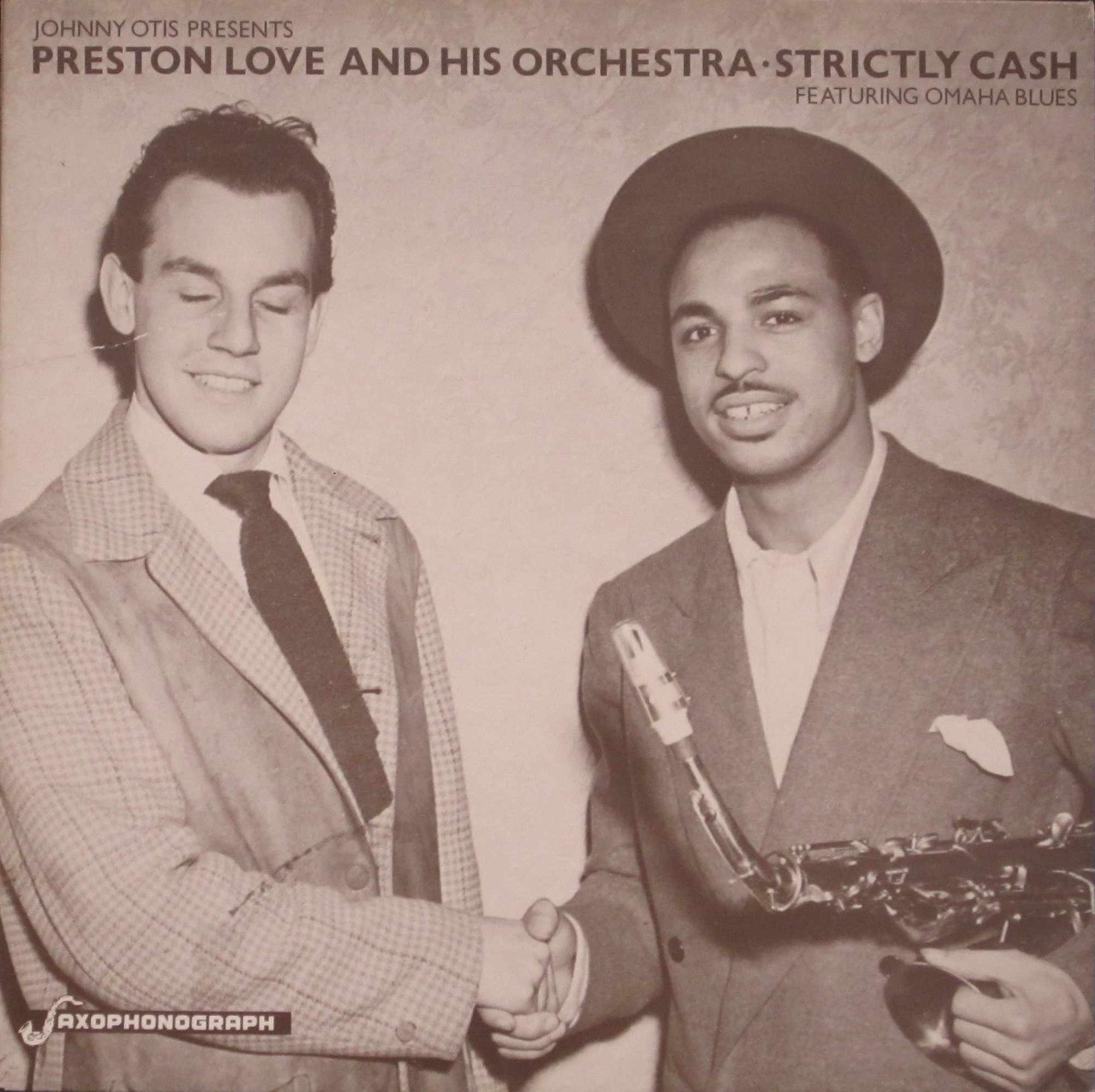
But Love’s book is far more than a polemic. It’s a remarkable life story whose sheer dramatic arc is daunting. It traces his deep kinship with jazz all the way back to his childhood, when his self-described “fanaticism” developed, when he haunted then flourishing North 24th Street’s popular jazz joints to glimpse the music legends who played there.
He grew up the youngest of nine in a ramshackle house in North Omaha. Love’s mother, Mexie, was widowed when he was an infant. Music was always part of his growing up. He listened to his music idols, especially Count Basie and Basie’s lead alto sax man, Earle Warren on the family radio and phonograph. He taught himself to play the sax brought home by his brother “Dude.” He learned, verbatim, Warren’s solos by listening to recordings over and over again. By his med-teens he was touring with pre-war territory bands, playing his first professional gig in 1936 at the Aeroplane Inn in Honey Creek, Iowa (hence the title of his book).
At Omaha’s Dreamland Ballroom he saw his idols in person, imagining himself on the bandstand too — hair coiffured and suit pressed — the very embodiment of black success. “We’d go to see the glamour of Duke Ellington and Louis Armstrong. We aspired to escape the drabness and anonymity of our own town by going into show business,” Love recalls. “I dreamed of someday making it…of going to New York to play the Cotton Club and of playing the Grand Terrace in Chicago.”
He encountered both racism and kindness touring America. The road suited him and his wife Betty, whom he married in 1941.
The couple’s first child, Preston Jr., was born 54 years ago and the family grew to include three more off-spring: Norman and Richie, who are musicians, and Portia, who sings with her father’s band.
Life was good and Love, who eventually formed his own band, enjoyed great success in the ’50s. Then things went sour. Faced with financial setbacks, he moved his family to Los Angeles in 1962, where he worked a series of jobs outside music. His career rebounded when he found work as a studio musician and later as Motown’s west coast band leader in the late ’60s, collaborating with such icons as Aretha Franklin, Ray Charles and Stevie Wonder. He returned to Omaha in 1972, only to find his music largely forgotten and his community in decline. While often feeling unappreciated in his hometown, he basked in the glow of triumphant overseas tours, prestigious jazz festival performances and, more recently, reissues of classic recordings. Today, he’s an elder statesman, historian and watchdog.

To grasp just how much the music means to him, and how much it saddens him to see it lost or mutilated, you have to know that the once booming North 24th Street he so loved is now a wasteland. That the music once heard from every street corner, bar, restaurant, and club has been silenced altogether or replaced by discordant new sounds.
The hurt is especially acute for Love because he remembers well when Omaha was a major jazz center, supporting many big bands and clubs and drawing premier musicians from around the region. It was a launching ground for him and many others.
“This was like the Triple A of baseball for black music,” he says. “The next stop was the big leagues.”
He vividly recalls jazz giants playing the Dreamland and the pride they instilled: “All of the great black geniuses of my time played that ballroom — Duke Ellington, Count Basie, Earl “Father” Hines, Louis Armstrong, Dizzy Gillespie, Charlie Parker. Jazz was all black then, number one, and here were people you read about in magazines and heard on radio coast-to-coast, and admired and worshipped, and now you were standing two feet from them and could talk to them and hear their artistry.”
Love regrets many young blacks are uninformed about this vital part of their heritage. “If I were to be remembered for some contribution,” he says, “it would be to remind people that what’s going on today with the black youth and their rap and all that bull has nothing to do with their history. It’s a renunciation of their true music — blues, rhythm and blues and jazz. You couldn’t get the average young black person today to listen to a record by anyone but one of the new funk or rap players. It’s getting to be where black people in their 20s and 30s feel that way, too.”
He says “the power structure” running the music business in cities like Omaha plays on this malaise, marketing pale reproductions of jazz and blues more palatable to today’s less discriminating audiences:
“Everything’s controlled from out west and downtown in our music. It’s based on personalities, politics and cronyism. Even though it’s often a very poor imitation of the original, it passes well enough not only for whites, but for black too. The power structure has the ability to change the meaning of everything and compromise truth. It’s a disservice to this art and to this city. Every old jazz friend of mine who comes here says the same thing” ‘What happened to your hometown, Preston?'”
Love says his son Norman, a saxophonist living in Denver, largely left Omaha out of frustration — unable to find steady gigs despite overwhelming talent. Love says black musicians have been essentially shut out certain gigs because of their race.

He believes several local musicians and presenters inappropriately use the jazz label. “The implication is that these guys might be fine jazz players. It’s an arrogance on the part of people who really don’t have the gift to perform it and don’t have the credibility to present it. What I’m saying is not an ego trip. It’s irrefutable. It is, at least, a professional opinion.”
It’s on points like these Love elicits the most ire because they are, arguably, matters of taste. For example, Love complains the city’s main jazz presenters don’t book enough black performers and the people booking the events are unqualified. When it’s pointed out to him that half the acts featured in a major jazz series the past two years have been black and the series’ booker is Juilliard-trained, he dismisses these facts because, in his view, the performers “haven’t been much” and the booking agent’s classical credentials carry little weight in jazz circles.
He acknowledges limited opportunities extend even to North Omaha. “We have no place to play in our own neighborhood,” he says. “The club owners here, in most cases, really can’t afford it, but even if they could they don’t know anything about it. So we’ve been thrown to the wolves by our own people.”
Bill Ritchie, an Omaha Symphony bass player and leader of his own mainstream jazz quartet, agrees that many local jazz players don’t measure up and rues the fact there are too few jazz venues. The classically-trained Ritchie, 43, who is white, says the boundaries of jazz, rightly or wrongly, have been blurred: “There’s so much crossover, so much fusion of jazz and rock and pop today, that it’s hard to say where to draw the line. Preston obviously feels he’s one to draw the line. I might go a little further on that line than someone like Preston, because he comes from a different era than I do, and somebody younger than me might even stretch that line a little bit further.”
For Love and like-minded musicians, however, you either have the gift for jazz or you don’t.
Orville Johnson, 67, a keyboardist with Love’s band, says jazz and the blues flow from a deep, intrinsic experience common to most African-Americans. “It’s a cultural thing,” Johnson says. “Jazz is sort of the sum total of life experiences. It’s the same with the blues. There’s a thread that runs clear through it, and it’s a matter of life experience that’s particular to black people in America.
“If a person hasn’t lived that life, it’s unlikely they’ll be able to express themselves musically that way. It’s a sum total of what musicians frequently describe as ‘the dues that we’ve paid.’ It doesn’t have much anything to do with technique. It’s a matter of being able to express in musical terms your experience. A university-educated white student who’s been raised perhaps in a middle-class white neighborhood and never known hunger or the frustration of living in a racial society, usually isn’t able to play and get the same feeling. And that includes a young black person who hasn’t known nearly the hardship that people of my generation or Preston’s generation has known.”
It’s the same message Love delivers in lectures. Like Johnson, Love feels jazz is an expression of the black soul: “To hear the harmony of those black musicians, with that sorrowful, plaintive thing that only blacks have. That pain in their playing. That blue note. That’s what jazz is,” he says. “The Benny Goodmans and those guys never got it. They were tremendous instrumentalists in their own way. But that indefinable, elusive blue note — that’s black, and a lot of blacks don’t get it.”
The two men doubt if many of the younger persons billing themselves as jazz and blues musicians today have more than a superficial knowledge of these art forms. “Take the plantation songs that were the forerunners of the blues,” Johnson says. “Many of the things they said were not literal. When they sung about an ‘evil woman.’ frequently that was a reference to a slave master…not to a woman at all. There’s pretty much a code involved there. When you study it as I’ve done and Preston’s done, that’s what you discover.”
He and Love feel their music is diluted and distorted by university music departments, where jazz is taught in sterile isolation from its rich street and club origins.
Love bristles at the notion he’s a “moldy fig,” the term Boppers coined to describe older musicians mired in the past and resistant to change.
“As far as being a moldy fig, that’s bullshit. I’m as alert and aware of what’s going on in music now as I was 60 years ago,” he says. “I hear quite a few young guys today who I admire. I’m still capable of great idol worship. I am eternally vital. I play my instruments as modern as anybody alive…and better than I’ve ever played them.”
And like the Yoruba elders, he looks to the past to inform and invigorate the present:
“When you muddy the water or disturb the trend or tell the truth even, you make people angry, because they’d rather leave the status quo as it is. A lot of musicians around her will say privately to me the same things, but they’re afraid to say them publicly. But I’m not afraid of the repercussions. I will fight for my people’s music and its preservation.”
Related Articles
- Harlem Jazz Museum Acquires Trove By Greats (harlemworldblog.wordpress.com)
- National Jazz Museum Acquires Savory Collection (nytimes.com)
- Gene Conners obituary (guardian.co.uk)
- Cicily Janus: Moments Captured, A Moment Passed: Jazz Photographer Herman Leonard (1923 – 8/14/2010) (huffingtonpost.com)
- Omaha Native Steve Marantz Looks Back at the City’s ’68 Racial Divide Through the Prism of Hoops in His New Book, ‘The Rhythm Boys of Omaha Central’ (leoadambiga.wordpress.com)
- Omaha Arts-Culture Scene All Grown Up and Looking Fabulous (leoadambiga.wordpress.com)
- Canceled FX Boxing Show, ‘Lights Out,’ May Still Springboard Omahan Holt McCallany’s Career (leoadambiga.wordpress.com)
Preston Love’s Voice Will Not Be Stilled (short version)
The following story about fabled Omaha jazz man Preston Love Sr., who died in 2004, originally appeared in American Visions magazine. The piece was culled together from a couple earlier stories I had written about Love, both of which can be found on this site: “Mr. Saturday Night “and a much longer version of “Preston Love’s Voice Will Not Be Stilled.” There are yet more Love stories on the blog. He was forever fascinating.
|

Preston Love’s Voice Will Not Be Stilled (short version)
©By Leo Adam Biga
Originally published in American Visions
While Kansas City and Chicago were the undisputed centers for the Midwest’s burgeoning jazz scene in the 1920s and ’30s, Omaha, Neb., was a key launching pad for musicians of the time. “It was like the Triple A of baseball for black music,” recalls Omaha native and Count Basie alumnus Preston Love. “The next stop was the big leagues.”
The flutist-saxophonist grew up the youngest of nine children in a ramshackle house, jokingly called “the mansion,” in a predominantly black North Omaha neighborhood. He listened to his idols (especially Earle Warren) on the family radio and phonograph, taught himself to play the sax his brother “Dude” had brought home, and learned Warren’s solos note for note, laying recordings over and over again.

At Omaha’s fabled but now defunct Dreamland Ballroom, he saw his idols in person, imagining himself on the bandstand, too–the very embodiment of black success. “All of the great black geniuses of my time played that ballroom–Count Basic, Earl Fatha Hines, Dizzy Gillespie, Charlie Parker,” he recalls. “We’d get to see the glamour of Duke Ellington and Louis Armstrong‘ Jazz was all-black then, and here were people you read about in magazines and heard on radio coast to coast and admired and worshipped, and now you were standing 2 feet from them and could talk to them and hear their artistry. I dreamed of someday making it …, of going to New York to play the Cotton Club and of playing the Grand Terrace in Chicago.”
With Warren as his inspiration, Love made himself an acccomplished player. “I had the natural gift for sound–a good tone, which is important. Some people never have it. I was self-motivated. No one had to make me practice. And being good at mathematics, I was able to read music with the very least instruction.” His first paying gig came in 1936, at age 15, as a last-minute fill-in on drums with Warren Webb and His Spiders at the Aeroplane Inn in Honey Creek, Iowa. Soon, he was touring with prewar territory bands.
His breakthrough came in 1943, when Warren recommended Love as his replacement in the Basie band. Love auditioned at the Dreamland and won the job. It was his entry into the big time. “I was ready,” he says. “I knew I belonged.” It was the first of two tours of duty with Basie. In storybook fashion, Love played the very sites where his dreams were first inspired: the Dreamland and the famous, glittering big city clubs he’d envisioned.
Love enjoyed the spotlight, playing with Basie and the bands of Lucky Millinder, Lloyd Hunter, Nat Towles and Johnny Otis. “Touring was fun,” he says. “You played the top ballrooms, you dressed beautifully, you stayed in fine hotels. Big crowds. Autographs. It was glamorous.” The road suited him and his wife, Betty, whom he had married in 1941. And it still does. “The itinerant thing is what I love. The checking in the hotels and motels. The newness of each town. The geography of this country. The South, with those black restaurants with that flavorful, wonderful food and those colorful hotels. It’s my culture, my people,” he rhapsodizes.
Life was good, and Love, who formed his own band, enjoyed fat times in the ’50s. Then things went sour. Faced with financial setbacks, he moved his family to Los Angeles in 1962, where he worked a series of jobs outside of music. His career rebounded when he found work as a studio musician and as Motown Record Corporation‘s West Coast backup band leader.
He returned to Omaha in 1972, only to find the once booming North 24th Street he so loved a wasteland and the music once heard from every street corner, bar, restaurant and club silenced altogether or replaced by discordant new sounds.

Today, the 76-year-old who earned rave reviews playing prestigious jazz festivals (Monterey Montreaux, Berlin); toured Europe to acclaim; cut thousands of recordings; worked with everyone from Basie and Billie Holiday to Aretha Franklin, Ray Charles and Stevie Wonder; and taught university courses on the history of jazz and the social implications of black music–and who still earns applause at the trendy Bistro supper club in Omaha with his richly textured tone and sweetly bended notes–has written his autobiography. While A Thousand Honey Creeks Later (Wesleyan University Press, 1997) recounts a lifetime of itinerant musicianship, it also serves as a passionate defense of jazz and the blues as rich, expressive, singularly African-American art forms and cultural inheritances.
“It’s written in protest,” Love explains. “I’m an angry man. I started my autobiography to a large degree in dissatisfaction with what has transpired in America in the music business and, of course, with the racial thing that’s still very prevalent. Blacks have almost been eliminated from their own art because the people presenting it know nothing about it. We’ve seen our jazz become nonexistent. Suddenly, the image is no longer black. Nearly all the people playing rhythm and blues, blues and jazz … are white. That’s unreal. False. Fraudulent.”
When Love gets on a roll like this, his intense speaking style belongs both to the bandstand and to the pulpit. His dulcet voice carries the rhythmic inflection and intonation of an improvisational riff and the bravura of an evangelical sermon, rising in a brimstone tirade one moment and falling to a confessional whisper the next.
While Love concedes the music is free for anyone to assimilate, he demands that reverence be paid to its origins. In his mind, jazz is separate from fusion and other hybrid musical styles that incorporate jazz elements. For Love, either you have the gift for jazz or you don’t. All the studying, technique and best intentions in the world won’t cut it, without the gift. And while he doesn’t assert that only blacks can excel at jazz, he always returns to the fact that it is, at its core, indigenous black music, an expression of soul: “To hear the harmony of those black musicians, with that sorrowful, plaintive thing that only blacks have. That pain in their playing. That blue note. That’s what jazz is. The Benny Goodmans and those guys never got it. They were tremendous instrumentalists in their own way, but that indefinable, elusive blue note–that’s black.”
Love feels that the music is diluted and distorted by university music departments, where jazz is taught in sterile isolation from its rich street and club origins, and he bristles at the notion that he’s a “moldy fig,” the term boppers coined to describe older musicians mired in the past and resistant to change.
“As far as being a moldy fig, that’s bull—-,” he says. “I’m as alert and aware of what’s going on in music now as I was 60 years ago. I hear quite a few young guys today who I admire. I’m still capable of great idol worship. I am eternally vital. I play my instruments as modern as anybody alive … and better than I’ve ever played them.”
Related Articles
- No one captured the passion and spontaneity of jazz like photographer Herman Leonard. (slate.com)
- A Jazz Colossus Steps Out (online.wsj.com)
- Minton’s closes, Great Night in Harlem (harlemworldblog.wordpress.com)
The Smooth Jazz Stylings of Mr. Saturday Night, Preston Love Sr.
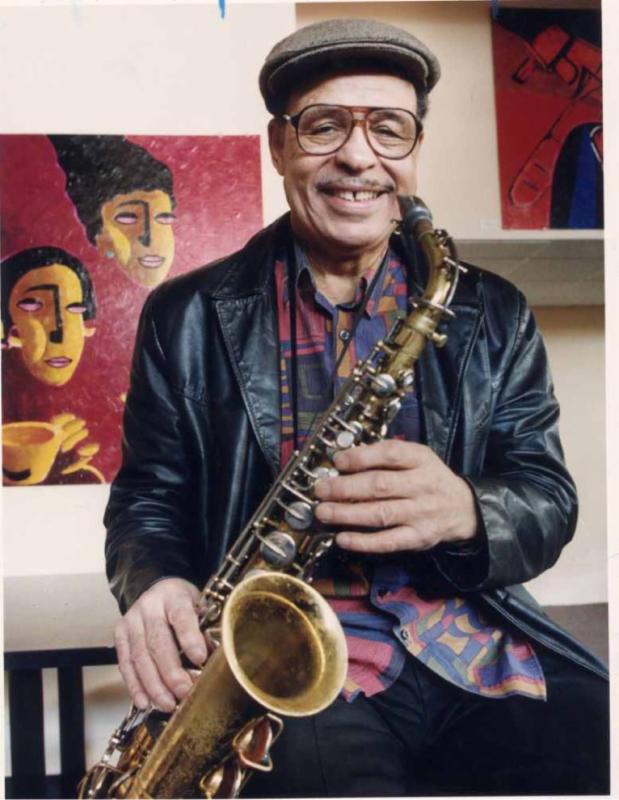
An unforgettable person came into my life in the late 1990s in the form of the late Preston Love Sr. He was an old-line jazz and blues player and band leader who was the self-appointed historian and protector of a musical legacy, his own and that of other African American musicians, that he felt did not receive its full due. Love was a live-life-to-its-fullest, larger-than-life figure whose way with words almost matched his musicianship. As I began reporting on aspects of Omaha’s African American community, he became a valuable source for me. He led me to some fascinating individuals and stories, including his good friend Billy Melton, who in turn became my good friend. But there was no one else who could compare to Preston and his irrepressible spirit.
I ended up writing five stories about Preston. The one that follows is probably my favorite of the bunch, at least in terms of it capturing the essence of the man as I came to know him. The piece originally appeared in the New Horizons. Aspects of this piece and another that I wrote for The Reader, which you can also find on this site, ended up informing a profile on Preston I did for a now defunct national magazine, American Visions. Links to that American Visions story can still be found on The Web. I fondly remember how touched I was listening to the rhapsodic praise Preston had for my writing in messages he left on my answering machine after the first few stories were published. After basking in his praise I would call him back to thank him, and he would go off again on a riff of adulation that boosted my ego to no end.
I believe he responded so strongly to my work because I really did get him and his story. Also, I really captured his voice and pesonality. And this man who craved validation and recognition appreciated my giving him his due.
Near the end of his life Preston hired me to write some PR copy for a new CD release, and I approached the job as I would writing an article. I’ve posted that, too.
The last story I wrote about Preston was bittersweet because it was an in memoriam piece written shortly after his death. It was a chance to put this complex man and his singular career in perspective one more time as a kind of tribute to him. A few years after his death I got to interview and write about a daughter of his he had out of wedlock, Laura Love, who is a fine musician herself. Her story can also be found on this site.
The Smooth Jazz Stylings of Mr. Saturday Night, Preston Love Sr.,
©by Leo Adam Biga
Originally published in the New Horizons
An early January evening at the Bistro finds diners luxuriating in the richly textured tone and sweetly bended notes of flutist-saxophonist Preston Love, Sr., the eternal Omaha hipster who headlines with his band at the Old Market supper club Friday and Saturday nights.
By eleven, the crowd’s thinned out, but the 75-year-old Love jams on, holding the night owls there with his masterful playing and magnetic personality. His tight four-piece ensemble expertly interprets classic jazz, swing and blues tunes Love helped immortalize as a Golden Era lead alto sax player and band leader.
Love lives for moments like these, when his band really grooves and the crowd really digs it: “There’s no fulfillment…like playing in a great musical environment,” he said. “It’s spiritual. It’s everything. Anything less than that is unacceptable. If you strike that responsive chord in an audience, they’ll get it too – with that beat and that feeling and that rhythm. Those vibes are in turn transmitted to the band, and inspire the band.”
His passion for music is shared by his wife Betty, 73, the couple’s daughter, Portia, who sings with her father’s band Saturdays at the Bistro and sons, Norman and Richie, who are musicians, and Preston Jr.
While the Bistro’s another of the countless gigs Love’s had since 1936 and the repertoire includes standards he’s played time and again, he brings a spontaneity to performing that’s pure magic. For him, music never gets tired, never grows old. More than a livelihood, it’s his means of self-expression. His life. His calling.
Music has sustained him, if not always financially, than creatively during an amazingly varied career that’s seen him: Play as a sideman for top territory bands in the late ‘30s and early ‘40s; star as a lead alto saxophonist with the great Count Basie Orchestra and other name acts of the ‘40s; lead his own highly successful Omaha touring troupe in the ‘50s; and head the celebrated west coast Motown band in the ‘60s and early ‘70s.
He’s earned rave reviews playing prestigious jazz festivals (Monterey, Montreux, Berlin). Toured Europe to great acclaim. Cut thousands of recordings, including classics re-released today as part of anthology series. Worked with a who’s-who list of stars as a studio musician and band leader, from Billie Holiday to Aretha Franklin and Ray Charles to Stevie Wonder. Performed on network television and radio. Played such legendary live music haunts as the Savoy and Apollo Theater.
After 61 years in the business, Love knows how to work a room, any room, with aplomb. Whether rapping with the audience in his slightly barbed, anecdotal way or soaring on one of his fluid sax solos, this vibrant man and consummate musician is totally at home on stage. Music keeps him youthful. Truly, he’s no “moldy fig,” the term boppers coined to describe musicians out-of-step with the times.
“As far as being a ‘moldy fig’…that’ll never happen. And if it does, then I’ll quit. I refuse to be an ancient fossil or an anachronism,” said Love. “I am eternally vital. I am energetic, indefatigable, It’s just my credo and the way I am as a person. I play my instruments as modern as anybody alive and…better than I’ve ever played them.”
Acclaimed rhythm and blues artist and longtime friend, Johnny Otis, concurs, saying of Love: “He has impeccable musicianship. He has a beautiful tone, especially on solo ballads, which is rare today, if it exists at all. He’s one of the leading lead alto sax players of our era.”
Otis, who lives in Sebastopol, Calif., is white. Love is black. The fact they’ve been close friends since 1941 shouldn’t take people aback, they say, but it does. “Racism is woven so deeply into the fabric of our country that people are surprised that a black and a white can be brothers,” Otis said. “That’s life in these United States.”

Love’s let-it-all-hang-out performing persona is matched by the tell-it-like-it-is style he employs as a recognized music authority who demands jazz and the blues be viewed as significant, distinctly African-American art forms. He feels much of the live jazz and blues presented locally is “spurious” and “synthetic” because its most authentic interpreters – blacks – are largely excluded in favor of whites.
“My people gave this great art form for posterity and I’m not going to watch my people and our music sold down the road,” he said. “I will fight for my people’s music and its presentation.”
Otis admires Love’s outspokenness. “He’s dedicated to getting that message out. He’s persistent. He’s sure he’s right, and I know he’s right.”
Love’s candor can ruffle feathers, but he presses on anyway. “No man’s a prophet in his hometown,” Love said. “Sometimes you have to be abrasive and caustic to get your point over.”
Orville Johnson, Love’s keyboardist, values Love’s tenacity in setting the record straight. “He’s a man that I admire quite a bit because of his ethics and honesty.”
Love has championed black music as a columnist with the Omaha World-Herald, host of his own radio programs and guest lecturer, teacher and artist-in-residence at colleges and universities.
With the scheduled fall publication of his autobiography, “A Thousand Honey Creeks Later,” by Wesleyan University Press, Love will have his largest forum yet. Love began the book in 1965 while living in Los Angeles (where he moved his family in 1962 during a lean period), and revised it through a succession of editors and publishers. He sees it as a career capstone.
“It’s my story and it’s my legacy to my progeny,” he said. “They’ll know what I’m like and about by the way I said things, if nothing more.”

He started the book at the urging of a friend, who typed the manuscript from his handwritten scrawl. After Love and his family returned to Omaha in 1972, he “totally rewrote” it, adding chapters on his Motown years (1966-1972) and on Omaha. “I did a lot of it at that desk in there,” he said, indicating his cubbyhole office at the Omaha Star, where he is advertising manager. Helping him shape the book over the years has been noted jazz authority Stanley Dance and, more recently, Wesleyan contributing editor George Lipsitz, who wrote its glowing introduction.
Love long ago rejected the idea of a ghost writer. “It’s no longer you then,” he said. “Even if I wasn’t articulate enough or didn’t have the literary background to write it, I wanted to reflect Preston. And it sure and the hell does, for better or worse.” As a veteran writer and avid reader, he does feel on solid ground as an author. He said ideas for the book consumed him. “All the time, ideas raged in my brain. And now I’ve said ‘em, and according to Wesleyan, I’ve said them very well.”
An outside reviewer commissioned by Wesleyan described Love’s book as more “than an account of a musician’s career,” but also an important document on “African-American social history, the history of the music business and institutional racism in American popular culture.”
Love is flattered by the praise. “I’m very proud of it,” he said. “Before the editorial staff acts on your book, they always bring in an outside reader, and what that person has to say has a big bearing on what’s going to happen. It had a big bearing on the contract I signed several weeks ago.”
Love feels his far-flung experience has uniquely qualified him to tell his story against the backdrop of the black music scene in America. “The fact that mine’s been a different, unlikely and multifaceted career is why publishers became interested in my book.”
To appreciate just how full a life he’s led and how far he’s come, one must look back to his start. He grew up the youngest of Mexie and Thomas Love’s nine children in a “dilapidated” house, jokingly called “the mansion,” at 1610 North 28th Street. His auto mechanic father died in Love’s infancy. Although poor in possessions, the family was rich in love.
“My mother did the best she could,” he recalls. “There was no welfare in those days. No ADC. This brave little woman went out and did day work for 40 cents an hour, and we survived. There were no luxuries. “But it was a loving, wonderful atmosphere. Our house was the center of that area. Naturally, guys courted my sweet, beautiful sisters and girls pursued my gorgeous brothers.”
He was steeped in music from a young age. He heard the period’s great black performers on the family radio and phonograph and hung-out on then teeming North 24th Street to catch a glimpse, and an autograph or two, of visiting artists playing the fabled Dreamland Ballroom and staying at nearby rooming houses and hotels.
“Twenty-fourth street was the total hub of the black neighborhood here. This street abounded with great players of this art form.”
By his teens, he was old enough to see his idols perform at the Orpheum and Dreamland. He recalls the Dreamland with great affection:
“All of the great black geniuses of my time played that ballroom. Jazz was all black then, number one, and here were people you admired and worshiped, and now you were standing two feet from them and could talk to them and hear their artistry. To hear the harmony of those black musicians, with that sorrowful, plaintive thing that only blacks have. That pain in their playing. That indefinable, elusive blue note. That’s what jazz is.”

He’d rush home after a night there to play the sax his brother “Dude” had saved up for and bought. “Dude” eventually joined a touring band and passed the sax onto his brothers. Love taught himself to play, picking up pointers from veteran musicians and from the masters whose recordings he listened to “over and over again.”
He began seeing music as a way out. “There was no escape for blacks from poverty and obscurity except through show business,” Love said. “I’d listen to the radio’s late night coast-to-coast broadcasts of those great bands and I’d go to sleep and just dream of going to New York to play the Cotton Club and dream of playing the Grand Terrace in Chicago. I dreamed of someday making it – and I did make it. Everything else in my life would be anticlimactic, because I realized my dream.”
He traces the spark for his dream and its fulfillment to an August night in 1938 at the Dreamland, when, at 17, he met his main idol – Earle Warren – Basie’s lead alto sax man. Warren later became Love’s mentor.
“That was the beginning of my total dedication and my fanaticism for this thing called jazz. He was the whole inspiration for my life.”
With Warren as his inspiration, Love made himself an accomplished musician. “I had the natural gift for sound – a good tone – which is important. Some people never have it. I was self-motivated. No one had to make me practice. I did it all on my own. And being good at mathematics, I was able to read music with the very least instruction.”
His ability to sight read was rare among blacks then and became his “forte.” His first paying gig came in 1936, at 15, as a last-minute fill-in on drums with Warren Webb and His Spiders at the Aeroplane Inn in Honey Creek, Iowa. The North High graduate eventually played scores of other small towns just like Honey Creek, hence the title of his book.
His breakthrough came in 1943, when Warren recommended Love as his replacement in the Basie band. Love auditioned at the Dreamland and won the job. It was his entry into the big time. “I was ready,” he said. “I knew I belonged.” It was the first of two tours of duty with Basie. In storybook fashion, Love returned to play the very sites where his dreams were first fired – the Dreamland and Orpheum. He went on to play many of the famous, glittering big city clubs he’d envisioned.
Love enjoyed the spotlight playing with Basie and the bands of Lucky Millinder, Lloyd Hunter, Nat Towles and Johnny Otis. “Touring was fun,” he said. “You played the top ballrooms, you dressed beautifully, you stayed in finer hotels. Big crowds. Autographs. It was glamorous.” Life on the road agreed with he and Betty, whom he married in 1941. “The itinerant thing is what I love. The checking in the hotels and motels. The newness of each town. The geography of this country. The South, with those black restaurants with that flavorful, wonderful food and those colorful hotels. It was my culture, my people.”
His book vividly describes it all. Including the difficulties of being black in America and the reversals of fortune he’s experienced. He has some harsh things to say about Omaha, where he’s witnessed the Dreamland’s, demise, North 24th Street’s decline and the black music scene dry up.
He’s left his hometown many times, but has always come back. Back to where his dream first took flight and came true. Back to the mistress – music – that still holds him enthralled. To be our conscience, guide, our inspiration.
That January night at the Bistro, a beaming Love, gold horn slung over one shoulder, tells his audience, “I love this. I look forward coming to work. Preston Love’s an alto player, and you want to hear him play alto, right? Listen to this.” Supplying the downbeat, he fills the room with the golden strain of “Mr. Saturday Night.” Play on, Mr. Saturday Night, play on.
Related Articles
- Swinging the Paddle With a Jazz Beat (cityroom.blogs.nytimes.com)
- Popcast: Seattle Jazz and Ade Blackburn of the British Band Clinic (artsbeat.blogs.nytimes.com)
- Ralph A. Miriello: Wynton Marsalis and Eric Clapton Play the Blues (huffingtonpost.com)
- Music Review: Jazz Evangelists Borrow Some of Stevie Wonder’s Cool (nytimes.com)
John and Pegge Hlavacek’s globe-trotting adventures as foreign correspondents
This is a story about an amazing couple, John and Pegge Hlavacek, I met only a few years ago, decades removed from their adventures as globe-trotting foreign correspondents. Their fascinating stories are from way before my time but they are timeless because they personally speak to adventure, romance, intrigue, news, and history that they were there to experience and witness for themselves. Their life together was like something from a movie or a play or a book. John has published a series of memoirs written by himself and by his late wife Pegge that document much of their intrepid adventures. As my article notes, they don’t make couples like this anymore. The piece originally appeared in the New Horizons.

John and Pegge Hlavacek’s globe-trotting adventures as foreign correspondents
©by Leo Adam Biga
Originally published in the New Horizons
Prior to meeting, John and Pegge Hlavacek were young, intrepid reporters filing stories from news making capitals around the world. Then, when fate brought them together in Asia in 1951, they forged a life together that fed their mutual curiosity and hunger for adventure. It was all so Bogey and Bacall. Two dashing Americans falling in love in post-colonial India and the promise of its new democracy.
He was a breezy foreign correspondent. She, a posh former reporter-turned-public affairs officer. After marrying in Bombay and honeymooning in Rome, their whirlwind life took on all the intrigue and romance of a movie as they trailed after news from one exotic port of call to another. There was travel to fantastic spots. Hong Kong, Delhi, Darjeeling, the North Pole. Interviews with compelling world figures. Nehru, Indira Gandhi, the Dalai Lama. Memorable sights. The Taj. The Himalayas. Meeting visiting Chinese and Soviet premieres. Visiting palaces, temples, ruins, museums. Haggling in crowded bazaars. Rushing to catch trains, planes, boats, ferries. And, always, hurrying to meet deadlines and beat the competition.
Just like they broke the mold with Bogey and Bacall, they don’t make couples like the Hlavaceks anymore. What a match they made. He with his boyish enthusiasm, rakish charm and rugged good looks. She with her fresh, feisty, unspoiled spirit and down home wile. As exciting and enchanting a lifestyle as they led, what made it more storybook was that when Pegge met John, she was a widowed mother of fraternal twins she had with her first husband, who was killed in China. Gallant John took on the instant family and he Pegge soon added three children of their own.

The Hlavaceks’ years chasing stories and kids are told in two new books authored by Pegge, Diapers on a Dateline and Alias Pegge Parker, a pair of great reads written in her clean, colorful prose style. She actually wrote the manuscripts in the 1960s, but when she could not find publishers she put them away. After being stricken with Alzheimer’s a few years ago, John, who still cares for her at their Rockbrook area home in Omaha, unboxed the pages, read them again, and impressed, sent them off to an editor friend, who agreed they deserved a life in print. John then got them published via iUniverse, a vanity press in Lincoln, Neb.
Now 86, Hlavacek is proud of his wife’s work and glad, after all these years, to have finally seen her accounts of their rich lives on bookshelves. “She is a much better writer than I am,” he said. “Pegge has the gift of putting down in words a picture. She’s an excellent writer. I’m just a journeyman.” In a reflective mood these days, he’s writing his own memoirs from the diaries he kept and the letters he wrote during his early years overseas. In conversation, this unadorned man blithely recalls one fascinating chapter after another of his and Pegge’s foreign adventures, leaving the listener, if not himself, awed by the sheer magnitude of their stimulating lives.
A native of LaGrange, Illinois and a graduate of Carleton College (Minn.), where he was a star athlete, Hlavacek originally came to the Far East in 1939 to teach English in Chinese mission schools. He went on a fellowship from the Carleton-in-China exchange program, which his football teammates signed him up for while he recovered from appendicitis. The way it all came about, he said, is indicative of “how accidental my whole life is.” It was not the last time his life took a major detour as the result of some seemingly random act. Not a religious man, he chalks up all these events to “serendipity,” saying: “I’ve got a little star following me around. All of my life, nothing’s been planned. It just happened.”
Going to the other side of the world then was far from routine. “My folks were not too thrilled with the idea of my going,” he said. “In 1939…all they knew about China was famine and disease, and they thought they would never see me again. It was like going off to war.” War came soon enough.
In Peking, he took intensive language courses. By the end of his stay at the mission schools, where his status as the only American made him “a celebrity,” he spoke passable Chinese. On holidays, he traveled widely in-country and also got his first glimpses of India and Pakistan, visiting Rangoon, Calcutta, Agra, Dehli, Peshawar, the Khyber Pass and Kashmir. The first of two schools he taught in was comfortably outfitted. “We had a cook and a bearer and a valet.” At the second, situated on an old temple site, life was more “primitive,” he said. “I just had a little room for my office and another room for my bed. We had vegetable oil lamps.” He enjoyed his time over there. “I liked the Chinese. I got along with them very well. I had a ball.”
With the outbreak of WWII, he felt compelled to help the beleaguered native populace and, so, he signed on with the International Red Cross. He “fell in” with a group of Welshmen driving medical supplies over the Burma Road, a “rugged” job, as daunting for the red tape as the conditions. “Every time we went out, we had to get permits from the local officials to show where we were going and what we were doing,” he said. “Much of the road was mountainous, with switchback turns. Trucks had accidents. They got stuck in mud. Springs broke. Batteries died. But, fortunately, none of the people I was with ever got killed.”
He saw flashes of the war from places like Chintang and Chungking. “Japanese bombers would go over us, heading for Chengtu. One time, I was fortunate to survive a bombing raid,” he said.” We were down in a hotel dugout when a bomb landed on the front of us and another on the back of us. There was a lot of explosions.” After his Red Cross duty ended, he applied his language skills to the U.S. military attache as a decoder and interpreter, helping track troop movements.
In another example of the way things have fallen into place for Hlavacek, he was in a Chungking hotel one “cold, dreary, wet night” in February 1943 when he struck up a conversation with John Morris, eastern manager for the United Press news service. Hlavacek recreates the scene: “We had lots to drink and we were sobering up in the morning in front of a big fireplace when I said, ‘Mr. Morris, what does it take to be a United Press correspondent?’ He said, ‘What have you done?’ And I told him, ‘I’ve taught English and I speak Chinese.’ ‘You’re hired,’ he said. Thus, without a shred of newspapering experience, Hlavacek talked his way into a foreign correspondent’s job he made his life’s work the next 25 years.
One of his early assignments overseas saw him covering the American 14th Air Force commanded by Major General Claire Chennault. “I got a big scoop. I was the only American journalist when they evacuated the city of Heng Yang. The Japanese were coming down from Changsha. I was in the last jeep leaving the city.” On their way out, U.S. forces destroyed key installations to spoil the invaders’ advance, and by joining-in the patriotic Hlavacek found himself part of the story. “We blew up an airfield. We threw grenades into buildings to make them burn up,” he said. “It was a great story and I sent it in and they (UP editors) killed it. It never got published. You see, we had censorship at that time.” But his actions were recognized when he received a citation from Gen. Chennault for aiding the military.
It was not the last time Hlavacek aided those in need. His wife writes about a 1955 episode in which he and another journalist pulled wounded Indian protesters to safety after Portuguese troops fired on them. It was all in the line of duty, he said.
After Heng Yang, Hlavacek fell ill. Recuperating back in the states, he got a baptism-by-fire on the UP’s New York night cable desk. Sent back abroad, he rose through the ranks to bureau chief in Bombay, getting news from London by Morse code, editing and printing it off and then sending it out to papers via bicyclists. His territory extended across all of India and into Pakistan, Afghanistan and Ceylon. He employed stringers, but also reported, snapped pics and, later, shot TV footage himself, often doing all three on one story. “I got to know how to do all this just by doing it,” he said of his self-taught news career. It helped, he said, “to be nosey.”
He was there for the press conference announcing the partition of India. He lived through the Bombay riots of 1946 and ‘47. He once walked two hours with Mahatma Gandhi. He saw Nehru’s rise to and fall from grace and power. Everywhere he went, the big affable American was known for his good humor and winning way with kids. Besides a few scrapes with rebels, including being imprisoned in Nepal, and some bouts of dysentery, he emerged from Asia unscathed. The bachelor lived and breathed news in his UP post, which saw him cover everything from riots to celebrations and untouchables to heads of state, but nothing prepared him for the dark-haired American girl who stole his heart.

A native of Harrisburg, Pa., the former Margaret Lyons displayed an early aptitude for spinning tales and seizing opportunities, like the time, at age 17, she convinced the publisher of the Harrisburg Telegraph to start a youth column, Teen Topics, which she wrote while still a high school student. She wrote under the pen name Pegge Parker, which remained her non de plume the rest of her writing life. The column proved so popular that when she decided to try her luck in Washington, D.C., the publisher kept it as a regular feature. In the nation’s capital, Pegge landed a night reporting job with the Washington Times Herald, where she became a pet of its owner, Cissi Patterson, who liked the way she took the measure of congresswoman Clare Booth Luce in a piece. Plucky Peg’s wartime reporting from the homefront included first-hand features she did on maneuvers with the Tenth Armored Division and the Paratroop School in Fort Benning, Ga., complete with pics of “the Amazon girl” atop a Sherman tank and harnessed in a control tower chute.
One of the biggest exclusives she scored was an interview with Margaret Mitchell, who had retreated from public life after the sensation of her book, Gone With the Wind, and the mega-hit movie made from it.
Soon, however the beltway beat’s political wrangling and society finagling grew tiresome for Pegge. Her restlessness peaked so much that, in 1943, she got as far away from Washington as possible by taking a reporting job with the Daily News Miner in Fairbanks, Alaska. The great white wilderness, then not long removed from its untamed gold rush days, proved a rich news source for the young journalist, who met its salty characters, viewed its rough-hewn beauty and traveled to its remotest regions, even venturing to the Aleutian Islands and the North Pole. One of her stories, about a lottery awarding a gaudy cash prize to anyone guessing the exact time the ice breaks on a river, was published in the Readers Digest. Years later, Pegge said of her time in Alaska, “I loved every minute of it.”
Wanderlust called again in 1949 when, without knowing a word of the language, much less a single solitary soul, she embarked for China. She went, minus even a reporting gig, on pure blind faith things would work out. They did, too. The New York Daily News picked up the stories she filed from the Great Wall, Shanghai, Peking and the frontier mountain regions. Even though he didn’t know her yet, Hlavacek appreciates the spunk she exhibited then as “the girl on the go. Where I just kind of went along with things,” he said, “she went out and pursued them.”
It was in China she met and married her first love, Doug Mackiernan, an American scientist serving as an American vice consul in a distant and politically sensitive part of China. She bore him fraternal twins. When Communist-fired tensions rose there, she and the twins went to live in America, where Pegge got the news he’d gone missing. Weeks passed before it was confirmed he was killed by Tibetan border guards while fleeing China. At the time, the Chinese publicly accused Mackiernan of being a spy, allegations Pegge and U.S. officials refuted. Years later, it was revealed MacKiernan had indeed been a CIA agent.
Grief-stricken, she accepted her husband’s old post. Leaving the twins in the care of his parents in Boston, she went off to serve as a vice consul in Lahore, Pakistan before ending up a public affairs officer in Karachi. It was in Pakistan she met John. Despite a testy first encounter, the news hounds knew they’d found their match.
“We didn’t like each other at first. You have to understand, she was working for the government and I was a reporter, and there’s a natural antipathy there,” he said. Then there was the way he upbraided her for leaving her children at home while she went gallivanting about Asia. She explains in Diapers on a Dateline how, at first, she was enraged at his impudence. Then, she felt guilty, because she knew he was right. Finally, she was fascinated by this man who took such interest in reuniting a mother and her children. The die was cast. Their Bombay marriage took place in 1952 in the chapel of St. Xavier’s College, presided over by a friend of Hlavacek’s who was a Spanish Jesuit priest.
Headstrong personalities are bound to clash, and while John and Pegge have enjoyed 51 years of marital harmony, there’ve been times they’ve butted heads. “We’ve had our fights,” he said. “We’re both competitive.”
Raising five kids largely in a downtown Bombay hotel, with the family’s suite also serving as an office to Papa John, who was often away on assignment, the Hlavaceks somehow made it all work. Pegge ran things while he was gone, the ever-present typewriter strewn with diapers and toys. As if not hard enough making ends meet with seven mouths to feed, 11 counting the family’s bearer, driver, cook and their beloved aiha (nanny), Tai Bhai, the UP’s chintzy pay and shoestring budgets made matters worse. Pegge writes humorously about her obsession with shopping for bargain trinkets and relics from the wallas (peddlers-merchants) she could never refuse. The couple’s many homes have been adorned with the artifacts and just plain junk they’ve acquired over the years.
What hardships the family endured, they will tell you, were more than made up for by the enriching experiences they shared among themselves and with the world.
The Hlavaceks broke some of their biggest news stories in India. John befriended Tenzing Norgay, head sherpa on Sir Edmund Hillary’s historic Everest ascent, and told his tale for the first time in a UP story syndicated around the world. When John learned famed Italian filmmaker Roberto Rossillini, then married to Ingrid Bergman, was having an illicit tryst with a much younger married woman, he enlisted Pegge to get the scandalous goods, and she did. Pegge also made a splash when she co-authored a story with Nehru’s sister about the Indian prime minister.

When the rival Associated Press cut into UP’s India market, John lost his job in 1957. With things looking bleak he then received — “out of the blue” — the Council of Foreign Relations’ Murrow Fellowship at Columbia University, a windfall, he said, “which saved our bacon.” The family lived a year in New York. Hankering to be where the action was in the Cold War, he studied Russian for an expected Eastern bloc assignment, but instead he and Pegge followed their nose for news to the Caribbean and the region’s growing political strife. The family lived in Jamaica, a haven for the rich, the famous and the infamous.
From their hillside bungalow near San San as their island base, John fed radio and TV reports to NBC News and he and Pegge filed stories for Time-Life. They did pieces on exiled dictators Juan Peron and Zeldivar Batista, who despaired to the Hlavaceks, “They call me a murderer,” and John nabbed a world beat exclusive on the assassination of Rafael Trujilla. On a lighter note, the couple cultivated stories on famed composers Rodgers and Hammerstein, fading matinee idol Errol Flynn, evangelist Billy Graham and James Bond author Ian Fleming and they hobnobbed with the vacationing Kennedys and Johnsons and Princess Margaret.
With Castro’s ascent to power in Cuba, John went there as NBC’s primary correspondent, getting jailed and deported once for pressing too hard on a story. He interviewed all of Castro’s cabinet, but never “got to” the leader himself.
By 1964, Hlavacek’s network contract was up and his search for a news gig brought him and his family to Omaha’s then-NBC affiliate, KMTV, for whom he became a news analyst and roving correspondent. In a rare move for a local station, then news director Mark Gautier and general manager Owen Sadler let Hlavacek, with Pegge at his side, go far afield for news gathering sojourns, including trips to Vietnam, Africa and Europe. His Vietnam dispatches from the battlefront, which profiled ordinary GIs from the heartland, proved popular. He was a one-man crew, too — reporting, writing and filming. Between his field reports and analysis, he was part of a serious era in local TV news that’s long gone. “Well, it’s all fun and games now. Mark Gautier was a strict newsman. He didn’t believe in the happy talk that’s all the rage now,” said Hlavacek, who marvels at the instant news allowed by today’s digital-satellite technology and “the big production” TV makes of things.
Pegge’s pen was busy, too, as she wrote columns for the Sun Newspapers and Council Bluffs Nonpareil, among other publications, and hosted a radio show.
In the ‘70s, Hlavacek, a Democrat, scratched an itch to run for public office, losing a Congressional bid before winning a seat on the Omaha City Council. By showing his political colors, he found his journalism career closed. “Nobody would hire me,” he said. Still needing to earn a buck and looking to stay put in Omaha, where the family had put down roots, he started a travel agency, TV Travel, that capitalized on his and Pegge’s globetrotting expertise. After selling the business in 1983, he and Pegge remained in Omaha but continued hopscotching the world for pleasure, including several trips to China, where they visited old haunts and new sites.
Their grown children, all Westside High grads, are doing well. Two are doctors. One’s an airline pilot. Another’s in e-commerce. And still another’s an author.
Now, John’s days revolve around Pegge and memories of their high times. He takes her to an adult day care, after which they go to the Swanson branch library, where they pore over newsapapers. “We’re news junkies,” he said. “She’s at her best in the morning. She knows who I am and everything else. But at night she’s not quite sure whether she’s in Harrisburg or in Omaha. It’s rather discouraging…this terrible disease. I don’t know how many more years we’ve got.”
Rummaging through a lifetime of mementos at their home, everything he comes across evokes a story from their halcyon days as reporters. “I’ve got lots of stories,” he said.
Related Articles
- ‘I’m always looking for trouble’: Why Dom Joly heads for the planet’s more difficult destinations (independent.co.uk)
- On the road with China’s Foreign Ministry (theworld.org)
- Women at war: Profiling the female foreign correspondents in Iraq (blogs.journalism.co.uk)
- Foreign Correspondents Worry About Limited Access Following McChrystal Article, Gates Order (huffingtonpost.com)
- Can journalists ever be heroes? (independent.co.uk)
Howard Rosenberg’s much-traveled news career

Image via Wikipedia
I am a sucker for stories about fellow Omahans who have left this place and made successes of themselves on a national scale. One such subject is Howard Rosenberg, a much-honored newsman whose career in investigative journalism has seen him break major stories over the past three decades or more. I did this profile on him for the Jewish Press in Omaha and I share it here because Rosenberg’s life and career add up to a good yarn that I think a general readership will find interesting. You be the judge.
Howard Rosenberg’s much-traveled news career
©by Leo Adam Biga
Originally published in the Jewish Press
The pursuit of a hot story brought ABC news producer Howard Rosenberg from the network’s Washington, D.C. bureau to his hometown of Omaha in mid-September. He was on the trail of Supreme Court Justice Clarence Thomas, an avid Husker football fan who attended the September 15 Nebraska-Southern Cal football game.
Thomas’ wife, Ginni, is a native Nebraska and a University of Nebraska-Lincoln grad.
While in state Thomas was interviewed by ABC News legal correspondent Jan Crawford Greenburg. Rosenberg produced that segment as well as other recent interviews Greenburg conducted with Thomas, who’s plugging his autobiography, My Grandfather’s Son. The Thomas segments produced by Rosenberg ran October 1 on Good Morning America, World News Tonight with Charles Gibson and Nightline.
Growing up in Omaha, Rosenberg and his family attended Beth Israel Synagogue. His late parents were Monroe and Pearl Rosenberg. His two siblings, Marilyn Tripp and Maynard Rosenberg, reside in Omaha.
A veteran print and television journalist, Rosenberg’s been on the hunt for news since entering the U.S. Navy in 1972. He went in on the promise his nascent journalism skills, first developed at Omaha Central High School, would find good use in the service. They did. He edited a service magazine and freelanced.
For much of his news career he’s done investigative reporting, perhaps the highest calling for a journalist. It’s a mission he takes quite seriously. He said while “there’s a solitary aspect” to the research “there’s also an excitement to it; that you’re on the chase and you’re really searching for something and you’re looking for that moment, for that document, for that bit of information that’s going to make a difference. It’s very satisfying in that regard.”
He’s uncovered some major wrongdoings in his time, from top secret documents revealing illegal U.S. government-sponsored human experiments to tapes implicating key players in the Iran-Contra arms-for-hostages operation.
After more than 30 years in the business, including a long stint at CBS, he remains remarkably unjaded, especially given he’s spent much of that time in Washington, D.C. He possesses the healthy skepticism necessary to do his job, but not the cynicism you might expect. At 55, he retains the same faith in his profession — and the difference it can make in people’s lives — that he did when he first got into it.
“The end result and the objective is to help people understand something or learn something they didn’t know before,” he said. “There’s a concept in Judaism, that sort of underpins the ethos of the faith, of tikkun olam, which means repair the world. And anytime you meet a young journalist they generally all have the same sort of idealism — that they’re going to go out and change the world.
“I think of it very much as a calling and something that is a useful career for people like us to do because I think in some small measure you accomplish a minor repair by stitching up a hole of knowledge on something that’s important.”
His repairs have come for many prestigious news groups. He’s written pieces for Mother Jones, The New Republic, The Progressive, Parade, The Washington Post and The New York Times. He’s produced in-depth segments for the CBS Evening News, 60 Minutes, ABC World News Tonight, Primetime Live and Nightline. None of it might have happened, though, without his hitch in the Navy. He was 21 and unsure what to do with his life. All he had going for him was an ability to write. The Navy gave him a focus to perfect his craft.
“Navy recruiters were so anxious to get someone who could write a declarative sentence, which I could, they guaranteed me I could be a Navy journalist,” Rosenberg said from the Regency Marriott he stayed in during his recent visit. “They also gave me the rank of E3 out of boot camp, which meant I made more than my fellow recruits, which was fine with me.”
His reason for joining the Navy, rather than another branch of service, was quirky.
“Truth? I don’t like to wear ties and with a Navy uniform you don’t have to wear a tie. It’s as simple as that,” he said, smiling broadly.
He had enlisted in the service after “a very undistinguished academic career” at UNL, where he piled up lots of credits in creative writing and journalism, but came away with little else to show for his time there.
The Navy “was a fantastic turn of events for me,” he said, “because it gave me time to mature and I worked in a very interesting job.” The experience gave him a training ground to “hone” his skills for his subsequent news career.
After his honorable discharge he studied journalism at George Washington University, an elite private college in the nation’s capitol. “I could never have afforded to go,” he said, “without my Uncle Sugar paying the tab.”
The 1976 honors grad soon landed his first big break — as an associate editor of the late muckraker, Jack Anderson, in Washington, D.C., where Rosenberg’s been based his entire career. He, his wife and their two sons live in Chevy Place, Md.
Before Rosenberg ever went to work for Anderson, he’d been told he was cut from the same prickly mold as the crusading news hound.
“There was a lieutenant — one of the last commanders I worked for in the particular (Navy) division I was in — who saw me as somewhat of an iconoclast. I was a bit of a troublemaker, And one day this lieutenant said to me, ‘You know, Rosenberg, you’re kind of a (epithet) and you ought to go work for that other (epithet) — Jack Anderson.’ And I said, ‘Oh, that’s not a bad idea,’ and so I did.”
Rosenberg joined a group of idealistic journalists flush with power-of-the-press ambitions in the wake of Woodward-Bernstein’s expose of the Watergate cover up.
Jack Anderson
“Jack had at that point won a Pulitzer Prize and he had a staff of young turks who were all in their 20s, many of whom went onto careers in journalism,” he said. Besides Rosenberg and the lofty credits he’s since accrued, there were: Howard Kurtz, now a Washington Post reporter; Brit Hume, an ABC correspondent; Gary Cohen, a Pulitzer-winner with the Baltimore Sun and now an L.A. Times reporter; and Hal Burton, part of the Pulitzer-team at the Seattle Times.
“A lot of good journalists came out of there,” Rosenberg said. “It was a great place to work. I was 25 years old and I had a press credential that got me into press conferences at the White House, where I would go and ask questions of the President of the United States. It was very exciting.”
In Anderson, Rosenberg found “very much a mentor.”
“He was a Mormon, so he was very paternal. You know, ‘We’re all a big family.’ We played together, we worked together. I learned a lot,” Rosenberg said.
Looking back, the Omahan was fated to be a writer and a storyteller, which is how he ultimately thinks of himself.
“I had an interest not just in journalism but in writing, much of which was encouraged both by my late mother and by a teacher I had at Omaha Central High School named John Joseph Francis Keenan. He was just an inspirational teacher.”
The late Keenan preceded Rosenberg in the school’s hall of fame, whose distinguished ranks include many notables in the fields of arts and sciences. Rosenberg was accepted to the hall in 2005.
Rosenberg’s mother, the former Pearl Schneider, was a Central grad herself. Her inclinations sparked his own passions. “She was a great fan of moviedom and I loved to go to movies. She took me to movies when I was a child,” he recalled. What fascinated him most weren’t the actors but the stories. Somebody had to write the scenarios, after all, and thus began a lifelong interest in screen writing. “I always liked that aspect of the medium and thought a lot about it,” he said.
Rosenberg wrote a book, Atomic Soldiers (1980), “hoping it would become a movie.” It did. The book details how American servicemen were recklessly exposed to harmful levels of radiation during Cold War atomic weapons tests. It relied in part on classified documents he obtained through the Freedom of Information Act. It took a lot of digging, a lot of persistence. With docs in hand he felt emboldened, as his old boss Jack Anderson used to say, that “now the story can be told…”
“I was very interested in what happened to these soldiers,” he said. “The story of the atomic tests on soldiers had never really been told in the mass media since the time it happened…and then it was cast in a very controlled way by the federal government because it was all part of a Cold War propaganda strategy.”

Atomic Soldiers began as a magazine article but the more research he did the more he realized it was a subject that demanded a more thorough telling. The process of going from page to screen took longer than he imagined. Nine years to be exact. He said it took so long because the ultra-conservative political climate then was not receptive to learning that American servicemen were used as human guinea pigs by their own country in tests that compromised their health. The soldiers were not told of the risks they faced. His book’s subtitle says it all: American Victims of Nuclear Experiments. “A lot of political ground had to be covered. There was not a lot of interest in taking on that subject anywhere,” he said. “It was a very difficult movie to get made.”
Screenwriter Tom Cook (China Syndrome) eventually adapted the book for a 19889 TNT cable movie called Nightbreakers starring Martin Sheen and Emilio Estevez. The film version pleased Rosenberg.
“I thought it was wonderful,” he said. “You know how authors always say, ‘Ah, they butchered my book.’ I didn’t feel that way at all. I mean, Tom (Cook) wrote a fictionalized teleplay and it was its own work of art…his own artistic vision of the story and the best way to tell the story. It was like a dream come true in the sense that here was a story I had written that was made into a movie. My only regret was that my mother didn’t live to see it.”
As often happened in his career, one project led to another. His book research got him onto another story he then developed into a cover expose for Mother Jones, which in turn first brought him to the attention of network TV news.
“The article in Mother Jones grew out of a minor, sort of sidebar I learned about in writing my book,” he said. “It was about these children who were taken to a chamber” at a federal cancer care center in Oak Ridge, Tenn. “and (unwittingly) exposed to total body irradiation in an effort to cure them of various forms of blood malignancies — leukemia and so forth. These human experiments were conducted on behalf of NASA and the old Atomic Energy Commission” from 1957 to 1974 and “used nuclear sources on children.” The article suggested some of the children were denied conventional therapy in favor of the radical radiation treatment. “Every one of them died,” Rosenberg said of the young patients.
He can still hardly believe what horrors the children suffered in the name of science. The more he dug, the more it resembled Frankenstein or, more chilling yet, the Nazi medical experiments of World War II.
“It was almost like science fiction,” he said. “The more I Iearned about it it seemed like something out of someone’s imagination. Not to disparage him, but one of the physicians who ran this clinic had a deformity…a hunch back.”
Rosenberg was so struck by the story he revisited it 12 years later — this time as producer of a 60 Minutes segment. “I was able, through a source I had, to get into the chamber” where the experiments were done. The space was now a storage room. “I took back a woman who had lived in that chamber with her child while he was being irradiated, so she was irradiated, too.” The woman he brought to the site of so much grief was the mother of Dwayne Sexton, who died at age 6.
The Mother Jones story “got a lot attention. All three networks did stories on their nightly news broadcasts about this story I had written,” he said. New opportunities soon presented themselves. One came from the Center for Investigative Reporting, which approached Rosenberg and colleague Howard Kohn to open a Washington bureau. The two journalists, collaborators on Rolling Stone and Outside Magazine pieces, directed a year-long project on nuclear arms policy. By this time Rosenberg had become identified as an expert on the topic.
“I learned a lot about nuclear weapons — how they’re made, what effects they have, who the people are designing them, what the national security plans and implications of having a nuclear arsenal are. It was all part of my research.”
Thus, he said, he got “pigeonholed…every time somebody wanted to know something about nuclear weapons or nuclear weapons policy or testing, they’d say, ‘Well, let’s go to the guy that wrote that book.’”
His specialization paid dividends when the networks came calling.
“A certain light went on and I started asking myself, Well, why not cut out out the middle man? And that was really kind of one of those seminal moments where you sort of figure things out and say, This could be a really stimulating way to go — to combine my limited skills as a writer with my interest in visual media,” he said.
For his first forays into TV he still kept one foot in the print world, filing stories for both magazines and the networks.
“In those days the networks were interested in expanding their reach into investigative reporting,” he said. “But there weren’t a lot of people in television who were familiar with the kind of rigorous and mind-numbing work you have to do in investigative reporting. There was a fellow who worked at the time for the CBS Evening News who had an idea to go to people who were doing investigative reporting and form partnerships with them.”

The way it worked was a publication like Mother Jones and a network like CBS would work cooperatively on select projects, combining resources to break stories at the same time. The idea appealed to Rosenberg as it introduced him to the way television news is done, got his foot in the door at the networks, netted his stories bigger audiences and compensated him better than before.
“It was fine with me because investigative reporting is not just tedious and labor intensive, it’s time intensive,” he said, “and so you spend an awful lot of time for a relatively modest return in terms of financial renumeration.”
He began at CBS, then the most respected name in TV news. Icons abounded. Walter Cronkite, Dan Rather, Don Hewitt, Morley Safer, Mike Wallace.
“It was really a very heady place with just a storied history,” he said. “There were just a lot of wonderful reporters there. George Herman, Robert Shackney. All these legendary names. People with great pipes, great voices.”
He began by working directly for Rather, who’d just taken over the anchor slot, from Cronkite, on the CBS Evening News. Rosenberg was one of the producers of the taped segment that preceded Rather’s famously contentious 1988 interview with then-candidate George Bush. He eventually moved over to 60 Minutes. He found working for the original news magazine, “a very, very rewarding experience.” His mentor was its creator and executive producer, Don Hewitt.
“I learned a lot from Don Hewitt, whose mandate was, ‘Tell me a story.’ Some people describe 60 Minutes as formulaic and mean it as a disparagement, but at the same time it is a formula that works in terms of storytelling. It has its limitations, as all of us as storytellers do. It is in some ways very black and white. You’re got your good guy and your bad guy and there’s not a lot of gray.
“There’s a certain pattern of the process that’s in some ways quite predictable. But at the same time it’s very comfortable.”
He worked on too many stories he liked, including several included among Classic 60 Minutes, to easily name his favorites. “The truth is usually the story I’m working on is the one that I like the best,” he said.
Pressed, he cited the story about the human experimentation at Oak Ridge. “That’s one of the most fascinating stories I’ve ever worked on,” he said. “I was very proud of that. The first story I ever did for 60 Minutes, called ‘The World’s Biggest Shopping Spree,’ was sort of a tour of these giant warehouses that covered hundreds of acres of Defense Department supplies in storage since the Korean War.
That’s one of my favorites.”
Then there was Olliegate.
“It was only a minute and 30 seconds, but it had quite an impact,” he said, referring “to the story of the security system outside of then-Colonel Oliver North’s house that ended up getting him indicted and sort of unraveled the entire criminal enterprise. All of the people involved in that (Iran-Contra operation run by North) were indicted under federal conspiracy charges.”
All the convictions were overturned on appeal, he added.
Other Rosenberg segments for 60 Minutes range from the controversial “Confessions of a Tobacco Lobbyist” to “The Letter,” a two-part probe of jury-tampering during the O.J. Simpson murder trial.
In’ 97 he left CBS for “a better offer” from ABC. The new post allowed him more time at home with his family. Not long into his ABC tenure he found himself in the awkward position of investigating former friends and colleagues at CBS. Rather had come under fire over a 60 Minutes report that offered documents purportedly showing President George W. Bush shucked a portion of his National Guard service.
Rosenberg said, “It was actually quite ironic in the sense that I ended up not just reporting on it but discovering the information that ended up unraveling the entire cover up by CBS” — hence known as Memogate. “I found two document examiners who had been consulted by 60 Minutes and by Dan Rather’s producer. They warned CBS the documents could not be authenticated. I also visited with the nation’s finest expert on typewriters. He said very explicitly it was impossible for any typewriter of that particular vintage to have created a superscript ‘th’ in the way it appeared in the documents. That was only possible in the computer age.”
“It was a joyless scoop,” said Rosenberg, as the fallout from the ABC report “ultimately led I think to Rather’s fall. I have a lot of personal affection and admiration for him. He is a person of great personal courage and great integrity.”
The two men have since met and spoken about the affair “and to his credit,” Rosenberg said, Rather “did not hold it against me because he understood himself as a journalist that the ultimate arbiter of what we do is the truth.”
Nightline assignments keep Rosenberg on the move. In the past year alone he’s been to: Guantanamo Bay, Cuba; Afghanistan; Lebanon and China. He’s produced segments featuring the first network TV interviews with the Chief Justice of the Supreme Court and coverage of the recent Minneapolis bridge collapse.
His ABC credits also include: writing/producing the hour-long specials, “Rumsfeld’s Rules of War” and “9/11: Moment of Crisis;” co-writing/co-producing the hour-long reports, “The Hunt for Osama bin Laden,” “Attack on the USS Cole,” “American Terrorist: In His Own Words” and a special Nightline edition, “The Lost Convoy” — the story of the Army’s 507th Maintenance Company ambushed in Iraq.
He’s often asked, what does a producer do? His answer: “Whatever you have to do to put the light in the box.” Any news segment, he said, is a team effort and “I can’t say enough about how important each part of the team is to the process, from the editors and audio engineers to the graphic artists to the producer to the correspondent. To the guy you hire to stand there at the entrance to the hotel with a flak jacket on and a semi-automatic rifle to make sure nobody comes in.”
“The collaborative nature of television is what I find most exciting and satisfying because unlike the solitary tedium of investigative reporting, you’re part of a team and there’s a real team spirit, especially in a show like Nightline. And especially when news is breaking or when you’re in a war zone, it’s just such an enveloping feeling. People bring different strengths and skills to the process.”
Ultimately Rosenberg is a journalist because of his undying “curiosity,” the same quality, he said, “that makes for any good journalist and makes this a great career for people who are interested in learning. When I talk to young people and they ask me about journalism I say…it’s a great career for people with short attention spans and…for people who like to go to school. What you do is you learn everything you can possibly learn about something and then you have a final exam, which in this case is you write your story or produce your segment. And then you forget about it and go on to the next thing. It’s like you’re a student all the time.”
It all sometimes seems too good to be true.
“I just feel so fortunate I want to pinch myself and say how lucky I am. Wow. And I’m getting paid to do this,” he said.
Related Articles
- How Journalists Can Incorporate Computational Thinking into Their Work (poynter.org)
- A Look Back At the Last 5 Years in Blogging (mashable.com)
- Carl Bernstein: The “Golden Age” of Investigative Journalism Never Existed (bigthink.com)
- Julian Assange: The “60 Minutes” Interview (cbsnews.com)
Otis Twelve’s Radio Days
Most any town has a radio DJ who rules the roost through the sheer force of his/her personality, and in my hometown of Omaha, Neb. Otis Twelve has been a popular host for three decades. A mark of his appeal is his ability to attract and hold audiences across the spectrum of rock, pop, talk, and, most recently, classical radio. Smart, acerbic, and fun, he seduces you with his voice, his wit, his charm, but also challenges you with his somewhat eccentric and often irreverent take on things. He is also a fine writer who’s won numerous prizes for his fiction. The following story originally appeared in the City Weekly, a publication long since ended.
Otis Twelve’s Radio Days
©by Leo Adam Biga
Originally published in the City Weekly (www.omahacityweekly.com)
Otis Twelve is pushing 60 but he’s lost none of his youthful satiric bite. He’s long embodied the cool, irreverent, long-haired rock jock in Omaha, only he’s on public radio these days as drive-time morning host for KVNO 90.7 FM. That’s far from the Firesign Theatre-inspired comedy bits he did with longtime DJ partner Diver Dan Doomey (Jim Celer). Kooky characters, silly plots, barbed banter, dead-on parodies.
Influenced by Frisco’s free form KSAN and Lenny Bruce’s anything-is-fair-game call-outs, minus the profanity, glib Doug Wesselmann became Omaha’s top ‘70s-’80s radio personality as Otis Twelve. He “arrived” with the Ogden Edsl Wahalia Blues Ensemble Mondo Bizzario Band, a music-sketch comedy group Diver contributed to. The pair teamed as a standup act. That led to their gig as Omaha’s original shock jocks on KQ-98. Instead of Howard Stern crudity they practiced mature humor mixed with slapstick and dark, surrealist takes on sacrosanct icons. Otis rues “the schoolyard” throwdowns that often pass as adult humor today.
It all began in the late ‘60s at Creighton University’s KOCU, where as students the duo did a show, “Revolution,” that, Otis said, “drove the Jesuits crazy. We played music nobody (locally) was playing. The bootleg, uncensored version of ‘Suzy Q.’ We’d throw in little weird electronic bits, including stuff by our own totally made up band, Electric Bathwater. It was just a blast. Father (Roswell) Williams would come down the basement of Wareham Hall, listen for about 5-10 seconds, then his face would blanch, his mouth sag open and he’d run back up the stairs in terror.”
CU officials threatened to yank the underground provocateurs off the air “but, Otis said, “they couldn’t figure out quite why or how. They just couldn’t come up with a reason. We didn’t use bad words. A lot of things we couched by saying, ‘Of course, this would be absurd to think this.’”
He lived the counter culture experience he projected, “thoroughly partaking of the ‘60s.” His anti-war protest activities even earned him an FBI file. His thirst for experience took him to the San Francisco Bay area, where he indulged in the whole Haight Ashbury, Berkeley, Big Sur, Grateful Dead hippie scene.
He toured with the Ogden Edsl junk band, even moving to L.A., where the group and its cult tunes, “Dead Puppies” and “Kinko the Clown” were staples on the Dr. Demento show. Then came stints at KQ-98, where he and Diver hosted “Midnight Mondo,” and Z-92, where the duo ruled the roost. Those were the days.
“Radio was different then,” he said. “Radio was, Hey, let’s put on a show. It wasn’t consultants telling you what worked. We didn’t need anybody in research to tell us that if the Kinks put out a good song to play it. It was from the gut, let’s have some fun, let’s entertain some people, let’s play some good music. That’s what radio was. There are only hints of that still going now. The River is the closest thing to real radio left here.”
As FM lost its edge, going the way of corporate-engineered culture, he balked at the increasingly automated, homogenized, bland radio that emerged.
He left Z-92, which unsuccessfully sued him, in a if-you-can’t-beat-’em-join-’em funk for KFAB, the AM tradition-bound monolith that represented the antithesis of his style. Going to the other side was a kind of sell-out, except he had duties — a home, a wife, three kids. After that foray into full-service, mainstream radio he gave FM classic rock one last shot at CD-105, whose offer he couldn’t refuse.
“Really my last best experience in radio,” he called it.
After 9/11 things grew restrictive. He said for-profit radio became a vehicle for “jingoistic patriotism.”
“When they start telling you what to say, it’s time to go,” he said. “That gets real old real fast. So for good or bad radio was not for me anymore.”
In reality, he went against the tide all his years in the biz.
“There were always fights and arguments over bits somebody thought crossed the line,” he said. “We always got in trouble for poking fun at-offending advertisers and government officials. Once, to placate a sponsor, we were suspended three days. It was always my opinion that unless you cross a line every once in awhile you’re not doing your job. You gotta always be working on the line.”
He left CD-105 in 2002 for a new life as a full-time fiction writer.
Recasting himself in the image of the expatriate author, he moved to Walnut, Iowa, pop. 983. Always a talented scribe and voracious reader, he soon made a splash in the literary world with his wry, incisive, absurdist work inspired by the Beat writers and Terry Southern. His resolutely American nouveau noir fiction has made its greatest mark in Great Britain, where four of his novels have been short-listed for the British Crime Writers Association Debut Dagger Award, one of them winning it. The island’s Lit Idol award netted him much press, plus a British literary agent.
Back home, his short fiction’s appeared in the prestigious North American Review and placed highly in the Kurt Vonnegut Fiction Prize competition. He also won a $10,000 prize in an essay writing contest. But none of his novels has found a publisher yet and neither his nor anyone’s short fiction ever exactly pays the bills. Not surprisingly, this iconoclast refuses to follow conventions in his novels.
Writers, especially stubborn ones, “can always use a day job,” he said.
So, when in 2006 he saw KVNO was hiring he wrote the station to say he’d like a shot. Why?
“I was real interested in the challenge to see if I could fit into yet another wildly different format in my career,” he said.

Doug Wesselmann, aka Otis Twelve
Otis made clear he doesn’t believe in genuflecting to classical composers-performers. “Music is music. It should have a sense of joy. It shouldn’t be treated with too much reverence. It should be respected like you would respect any music. But, you know, Franz Liszt was as wild on tour in his young days as Mick Jagger. I mean, they were pop stars, too, with scandals and quirks and drugs and then great art…great music. They were human beings. I think it makes the music more real when you put it in context and try to make it relatable. I don’t overdue it. I don’t do skits, I have no opinions on anything. It’s a lighter touch.”
Examples of that deft touch can be heard weekday mornings from 6 to 10. On a March broadcast he riffed:
“6:23…Yes, it’s high maintenance music. It’s Clara’s husband, Robert Schumann. She had all the kids at home, a busy career as a composer and performer herself, and her husband kept throwing himself into the river over and over again. He was –high maintenance…”
He finds “obscure connections or odd angles” to put a dry humorous spin on the dusty classical canon. He engages in witty repartee with news director Cheril Lee.
With KVNO “willing to,” as Otis said, “let me give it a try” he went on the air November 12, 2006. What began as an experiment has turned into a permanent gig.
A recent visit to KVNO found him comfortably ensconced in the classical world, where he knows he’s an outsider even 16 months into his high brow makeover. Whatever probation hidebound listeners initially put him on, including a small dissident group of sticks-in-the-mud who complained about his flippant tone and egregious mistakes, he’s seemingly now accepted. He knows the score.
“I remain a dilettante,” he said, “so I try to give everything from the point of view of a dilettante. We have some real expert listeners but I would guess the bulk of listeners would be more like me. I’ve always liked classical music — I just didn’t know much about it. Now I know how much I don’t know.”
He’s won over some converts, including die-hard rockers.
“I have some friends who’ve started listening to the station and it surprises them how it works for them and how interesting it can be. It’s great fun to listen because the players are real virtuosos. You don’t have to have a degree in music history to know good is good. And the variety — people don’t think of this as variety but there’s 400 years of music and there’s different takes on it. There may be 20 recordings of a certain sonata. We have a vast library.”
Classical’s not so different than rock. It has its standards. Take Sorcerer’s Apprentice, for example. “This is like Stairway to Heaven or Firebird. Everybody knows this one,” he said. It has its own version of pop, too, ala Leroy Anderson’s “Bugler’s Holiday” or most anything by Mozart. “Lighter stuff,” Otis calls it.
Any barriers he can topple to make the music more accessible he does. His goal, he said, “is to give people permission to realize it’s not snob music — it’s music.”
He realizes he’s at KVNO not for “any credibility” he possesses as a musicologist but for his personality. “It’s still radio and some of that knows no boundaries,” he said. “You try to be friendly…welcoming. That part’s always been enjoyable to me. Radio is very one to one. My goodness, you’re with people when they’re alone in their car, in the shower. You wake them up bedside, while they’re standing in the kitchen in their bathrobe making toast.”
KVNO allows him to be himself.
“They’ve told me what they want me to do and they kind of let me do my approach, and that’s nice,” he said. “In that sense it’s like the old times. They don’t tell me what to say or necessarily how to say it. We make it fit.”
Radio suits this laidback free spirit, who comes to work unshaved, unkempt, in T-shirt, jeans and loafers.
This later model Otis is not a pale imitation of his by-the-seat-of-your-pants rock self but given the format and the audience he serves he’s less devil-may-care now. No scathing comments, no naughty improv sketches, no Space Commander Whack, no Mean Farmer, no Lance Stallion. It’s Otis on Prozac. This Baby Boomer’s literally come home to nest. He and wife Debbie — Dagmar to listeners — moved back to Omaha in ‘07. He leaves his rebel persona at home for nostalgic mindwalks.
Ah, but the knowing wink and nod come through loud and clear in his familiar bass voice laced with whimsy, sarcasm and irony.
Getting to the studio around 3:30-4 a.m. his ritual before airtime “is to pull all the music, set up the announcements and research whatever composers or works I have for the day, check email, drink coffee and try to wake up.”
The solitude is appealing. “I really like it. There’s no rush hour, there’s no parking problem, the girl at the convenient mart always knows your name. I even get free coffee sometimes. I get out of here pretty close to 10 and the day’s mine. That’s why these hours are good for me. It leaves time to write. The danger is you get isolated.” All in all, he’s content. “I like doing this. The staff here is the best. Everybody’s been great helping me — when not giggling at my pronunciations. In some ways I’m happier than I’ve ever been between bouts of sheer despair, but that’s normal.”
He calls “serendipitous” his 30-year ride in radio.
“I never studied radio, which I think is probably a good thing. I’ve had a lot of fun, met some cool people and got to do some neat things…”
Related Articles
- The Life of a Chicago DJ (chicagonow.com)
- Tony Cennamo, 76; shaped jazz tastes for a generation as DJ at WBUR (boston.com)
- The Future’s So Bright (keeppublicradiopublic.com)
- College Radio Day…A Celebration Of Creative Collaboration Throughout The USA (thecollegeradiozone.com)
- Litniks Unite! The Downtown Omaha Lit Fest Brings Writers, Artists and Readers Together in Celebration of the Written Word (leoadambiga.wordpress.com)
Slaying dragons: Author Richard Dooling’s sharp satire cuts deep and quick

Image via Wikipedia
Rick Dooling is yet another immensely talented Nebraska author, one who left here but came back and continues to reside here. His work exhibits great range, but at its core is a sharp wit and a facility for making complex subjects compelling and relatable. His books include White Man’s Grave, which was nominated for the National Book Award, Critical Care, Brain Storm, and his latest, Rapture for the Geeks. He’s also a great guy. This is the first of a few stories I’ve written about him, and it is by the far the most in-depth. It orignally appeared in The Reader (www.thereader.com). Look for more of my Dooling stories to be added to the site. I strongly recommend anything by Rick, who also writes essays on societal-cultural matters for the New York Times and other leading publications.
One of Rick’s books, Critical Care, was made into a feature film by the same title directed by Sidney Lumet. Rick was working with filmmaker Alan Pakula on another big screen adaptation when Pakula was killed in a freak highway accident. Since this article appeared, Rick has collaborated with Stephen King on the television series Kingdom Hospital and adapted King’s short story Dolan’s Cadillac for a feature film by the same name. He’s currently producing-writing a TV pilot.
Slaying dragons: Author Richard Dooling’s sharp satire cuts deep and quick
©by Leo Adam Biga
Originally appeared in The Reader (www.thereader.com)
Since 1992 Omaha native Richard Dooling has gone from being just another frustrated writer to a literary star, creating a body of work distinguished for its dizzying array of ideas, sharp satirical assault on cherished dogma and sheer mastery of language. In three acclaimed novels — Critical Care, White Man’s Grave, Brain Storm — this writer-provocateur skewers American mores, trends, fads and sacred cows, reserving his most cutting remarks for two fields he once worked in, the law and health care. Easy targets, yes, but Dooling doesn’t settle for tired old broadsides or cloying jokes worn thin. Instead, he uses the hubris and cynicism endemic in the law and medicine as a prism for critically examining issues and raising questions that vex us all.
Dooling, who would make a great teacher, doesn’t presume to provide answers so much as prod us to think about how once basic human yearnings and immutable beliefs are foiled in this world of modern ambiguity and conditional ethics. His work is funny, dramatic, analytical and literary. The attorney-cum-author uses his knack for research to glean telling details that, as in building a good case, lend added weight to his tales.
“I do a lot of research,” he says. “You’ve got to get your facts straight, and then you can do anything you want with them later.”
From 1987 to 1991 he was an associate (specializing in employment
discrimination law) with St. Louis’ largest firm, and before that a respiratory therapist in the intensive care unit at Clarkson Hospital. From working in the legal-medical arenas to holding odd jobs as a cab driver, house painter and psyche ward attendant (“to share some of those patients’ vivid delusional systems is an interesting experience”) to traveling across Europe and Africa, Dooling has a deep well of living to drawn on for his fiction. His stories feature naive white middle-class professionals, all animated extensions of himself, enmeshed in fever-pitch moral dilemmas not patently resolved by the end. Like a lawyer, he argues both sides of an issue in his narratives.
In addition to his novels he has penned a well-received volume of essays (Blue Streak) defending the use of offensive language and op-ed pieces for major publications that poke fun at the latest excesses on the social-cultural front, including a rip-roaring send-up of the President’s imbroglio with Miss Monica. He is currently writing screen adaptations of two of his novels for planned feature films.
In person, Dooling exhibits the same penetrating wit as his prose, although he seems too normal to be the voice behind the scathing black humor he relishes. Married with four children, he is a practicing Catholic. His wife, Kristin, is converting to the faith. The family drives from their southwest Omaha home to worship at a near north side church. Dooling writes from an office in the Indian Hills business district.

If ever a wolf, albeit an intellectual one, in sheep’s clothing it is the 44-year-old author. He has the jowly, post-cherubic face of an altar boy (he was one) flirting with middle-age debauchery. Look closely and his hail fellow-well met facade reveals a gleam in the eye and curl of the lip that betray the bemused, wry gaze of a born agitator who likes pricking the mendacity he sees all around him.
Why satire? “More than anything, I like to make people laugh,” he says. “I don’t want cheap laughs. I want you to discover something new about yourself you didn’t understand before. What interests me as a writer is people on the threshold struggling to organize the flawed parts of themselves into a good person.”
What sets him off on a satirical jag? “Hypocrisy. That’s probably the first thing that provokes me. Somebody saying one thing and doing something else,” he says. “When law and medicine pretend to be helping patients or clients and really it’s raw self-interest, than that’s satirical material. Medicine and law are perfect targets for satire just because they exercise so much control in our lives, and people resent it in a way. You want to bring down the high and mighty and make them just like everybody else. Satire is the great leveler.”
He especially likes deflating any pretensions litigation is a sedate reasoned process for resolving disputes. “It’s combat. It’s a contest and just because it’s essentially bloodless doesn’t make it any less violent. I’m not a big fan of litigation. I think it should be avoided at all costs.”
The looming monster of political correctness is among the trends raising Dooling’s hackles these days. “Because, again, it’s a hypocrisy of a kind,” he says. “The claim is you want diversity in everything, but the central paradox of political correctness is that proponents demand diversity in everything except thought. You have to think the same way as they do or else you’re the enemy. And also the notion you can control people’s thoughts by changing their language just repels me. As a writer, language is the most important thing in your life, and when people start telling you what you should say or not say, it makes you want to say exactly what they don’t want to hear. It makes you want to rebel.”
In a recent Wall Street Journal op-ed he ridiculed attempts at removing certain offensive words from Merriam-Webster dictionaries. One of those petitioning for the excision of hateful language, Kathryn Williams of Flint, Michigan, defended her position by saying, ‘If the word is not there, you can’t use it.” In response, Dooling wrote, “Following…Ms. Williams’s reasoning, we could also remedy the drug problem if we simply removed the words cocaine and heroin from our nation’s dictionaries, for then junkies would be unable to use them. How nice if ancient hatreds could be remedied with a little word surgery, a logos-ectomy to remove offensive words and the hateful thoughts lurking behind them.”
If it weren’t for his dead-on observations, Dooling could easily come off as a smart aleck who is clever with words but short on substance. He is, however, that rarest of commodities: A Swiftian satirist whose barbed, elegantly phrased comments are both funny and thought-provoking. Even when his points are made with dark humor, he avoids sounding contemptuous because he infuses his work with glints of his charming guile and frames his skepticism within a moral context. It makes perfect sense when you learn he grew up in a middle-class Catholic family of nine children and is the product of Jesuit educators. His father was an insurance claims adjustor. His mother, a nurse.
If nothing else, he’s proof “it’s possible to be Catholic and still be satirical,” he says, unloosing his hyena cackle laugh. Growing up in the Bemis Park area, he graduated from St. Cecilia Grade School and received his Jesuit “indoctrination” at Creighton Prep and later at St. Louis University, where he earned his bachelor’s in English and art history and his law degree. He credits the Jesuits for instilling in him “a disciplined approach to any field of knowledge.” Even a quick read of his work reveals both a complete grasp of a subject and a deft handling of it.
An avid reader since childhood, his love for writing began at Prep. There, a priest got him in the habit of keeping a vocabulary notebook, which he still maintains today. His ardor grew deeper in college, where he won a short story contest. “That was a big deal,” he says. “I just assumed I was going to be a writer by that time. That I was going to graduate and be getting published left and right.” It didn’t quite work out that way. He graduated, all right, supporting himself with day jobs while completing a novel and short stories, but “nothing was getting published.”
Frustrated, and desiring a change of scenery, he saved up for a year-long trip overseas. His 1982 travels across Europe and Africa served as the writer’s requisite expatriate adventure abroad. “I just had a feeling I wanted to see something besides this,” he says of America, “because this is an artificial world compared to the rest of the world.”
He wrote while away and returned with Critical Care partially completed and the idea for White Man’s Grave in embryo.
His seven-month stay in the West African nation of Sierra Leone, where he visited a friend working in the Peace Corps, “changed” Dooling and his take on America. “Somebody said, You don’t travel to see foreign countries, you travel to see your own country as a foreign country. That’s what I think a lot of writers have in the back of their minds when they travel. It just shakes everything up,” he says. “All of your assumptions about how life is lived are subverted. In the Third World people eat out of a bowl with their hands and squatting on a floor. No electricity, no running water. Everything you’ve arranged your life around back here is gone. It’s a valuable experience, especially for a young person. It’s very healthy.”
When he returned to the vulgar excess of the U.S. the dislocation was so intense that home seemed unreal, like a garish nightmare. He used his experience as the jumping-off point for a New Yorker-published short story, Bush Pigs. “Everything here looks obscene when you come back. It’s overpowering. Bush Pigs tells exactly what it’s like. It’s about a Peace Corps volunteer who comes back home after three years..and in the course of 24 hours has a psychotic breakdown, and it’s funny. It’s kind of a cult favorite among Peace Corps volunteers because they all feel a bit unsettled when they come home.”
In Dooling’s case he was unhinged, broke, and hungry for a new challenge, so he applied and was accepted to law school. Why the law?
“I knew that I liked to read and write and I thought if I went to law school I could at least make my living reading and writing.”
Preparing briefs and motions became his forte. Despite disparaging the law now, he says he enjoyed the profession and would return to it should his writing career falter. Fat chance.
Writing in his spare time, he finished Critical Care and, after years of trying to get somebody interested, finally sold it — to William Morrow — and upon its 1992 publication found himself both published and celebrated.
His long struggle should be a lesson in perseverance. “I always urge young writers to, as soon as they can, write a novel, even it it doesn’t get published, just so you get used to thinking that way. Send out a chapter with a query letter to 20 or 30 agents. You’ll get rejected, by all of them usually, but you might just get one or two who’ll say, ’Let me see the whole book.’ To be able to write a novel you have to have supreme self-confidence.”
His overstuffed office is evidence he saves “everything” he writes and will rummage through boxes and cabinets full of files to “plunder stuff.”
With the success of Critical Care he faced the decision of spending another four or five years shaping White Man’s Grave in between his law duties or quitting the practice to write full-time. He had a family. A mortgage. In the end he gave up a secure career for the mercurial world of writing, promptly moving his family from St. Louis to Omaha. “Realistically, I just didn’t feel I would be able to serve clients with all the time my writing career entailed, so I decided to take the plunge.” Besides, the compulsion to write was overwhelming. “I didn’t really have a choice. It’s not something I really have any control over. I don’t recommend people become writers unless they can’t help it.”
Similarly, he describes his penchant for satire as “an impulse” he cannot suppress, like being nervous or shy. “It’s not something I intentionally do. It just happens. I can start out writing seriously…and before I get half way through I start getting this risible impulse to tear down or make fun of, and it turns into satire.” If he can ascribe his inspiration to anything, it’s “the kindred spirits” he found reading such satirists as Joseph Heller, Tom Wolfe and Kurt Vonnegut in college.
But as anyone who writes seriously can attest, the process has less to do with heeding one’s muse than with tirelessly learning the craft. “When you’re young and read good writing you don’t realize why you like it better…you just do,” he notes. “But then the older you get, and especially if you’re growing as a writer, you come to realize that most really good writing is good because of the labor involved, not because of inspiration. It’s about taking out all the unnecessary words and making sure it’s in the active voice and all that, so that by the time the reader reads it they don’t even notice what happened or why it’s so appealing.”
That’s not to say he discounts the contributions of the unconscious: “It’s very important. I find when I am stuck on a bigger project it is because I’m not dreaming about it at night. I find when I’m really into a big project, like the end of a novel or the end of a screenplay, I pretty much dream about it all night and write about it all day.” When things are really flowing, and words just fill the page, he goes into “a kind of trance.” He says when ideas come to him in his sleep he’ll awaken and rush to get them down on paper, otherwise fearing “they won’t be there in the morning, they’ll be some ghost of what they were.”
Dooling, who composes on a computer, has no fixed writing routine. “Totally irregular. I’ll write for three weeks and then not write at all for two. When I am working, I might write 12 hours a day or I might get up in the middle of the night. You just live to be able to do it.” When stuck, he’ll move on to another project or occupy himself reading, e-mailing, filing, et cetera.
A fact of life for any published writer is working with editors. Dooling relies on editors to tell him “things you can’t tell yourself. A good editor kind of steers you. I couldn’t live without one.” If he can be faulted for anything, it’s losing the urgency of his stories amid too many ideas and too much word play. He admits a “weakness with plots.”
To date, his fiction has been informed by his experience and leavened with his imagination. He echoes what other authors have long been advising would-be scribes: Write about what you know.
“I always try to encourage young writers, especially, to try and personalize everything first and then hope that you take it up to the next level of art where it appeals to everyone. That’s what art is — when you take a particular experience and render it in such a way that other people read it and say, ‘Oh, I felt like that.’ You establish a relationship with your reader that way. I think the easiest way to get in trouble or to become cliche, and young writers do this a lot, is to base an emotional passage on some TV or movie image of emotion instead of an immediate thing from real life.”
Dooling mined the human misery he saw as a respiratory therapist, along with the savage humor he and his health care cohorts used as a coping strategy, as the basis for Critical Care . Its protagonist is Peter Werner Ernst, a young doctor stuck in a medical, legal, moral, ethical quagmire involving a dying man with two daughters warring over his life and will. Pressured from all sides, Ernst wavers whether to keep the man alive or allow him to die. Meanwhile, vegetative patients on the edge of hereafter confront the limbo of their life and eternal destiny.

Anyone that’s spent any time in a hospital will identify with this portrait of medical practitioners who view family as the enemy and regard patients as nicknames and numbers, like Orca, the Beached Female or, more cryptically, Bed Five.
The book’s opening passage sets the tone: “Dr. Peter Werner Ernst was the Internal Medicine Resident…presiding over the Ninth Floor Intensive Care Unit…Each pod in the octagonal Death Lab contained a naked, dying person…High in the corner of each pod, a color TV was mounted…The hanging televisions were obviously designed by an architect or a hospital administrator who knew almost nothing about ICU patients. When was the last time somebody had seen one of these stiffs sitting up in bed watching a ball game? Instead of their lives flashing before their eyes, these patients died slow deaths listening to American car commercials, the 2.9 percent financing, the unbelievable buyer protection plans.”
Sarcasm amidst mortality is hardly new. Dooling, though, elevates the death watch and end game of the ICU to new heights, cutting closer to the truth with humor than somber platitudes and hoary dramatics can do.
“What really fascinated me,” he says, “was the defense mechanism of dark humor. There’s this impulse you have to make the patient not human. Otherwise, you’re there all day long saying, ‘Oh, here’s a human being dying right in front of my eyes.’ Well, you can’t even function then, so there’s this tendency to make light of the situation, which enables you to carry on. It’s not an admirable thing, but it was fascinating to me how it works.”
As Ernst digs himself deeper and deeper in the mess, he begins doubting his own omniscience. At one point Dooling speculates on the question in the back of Ernst’s mind: Where is God in the midst of all this human suffering? Dooling’s wickedly funny answer begins:
“In college he (Ernst) had read that God was dead. In medical school, he learned that God was not dead. He was just very sick. God was probably pronounced dead prematurely. Instead of dying or being found murdered, God may have just slipped into a coma or had an attack of transient global amnesia (TGA), during which time He simply forgot He was God and left the universe to its own devices. Instead of announcing his debility to the world, maybe God just went into seclusion, the way ailing Russian premieres do…In the meantime, planet Earth fell apart. Things look bad for the world, but why jump to conclusions and pronounce God dead, when he probably just needs to be transferred to a crackerjack ICU equipped with the proper medical technology? Once God gets to feeling better He can go back to thinking of Himself as a doctor, in much the same way that doctors think of themselves as God.”
In White Man’s Grave Dooling draws on his African sojourn to explore the conflict arising when neurotic American culture meets mystical Sierra Leone culture. A character sums up the conflict with: “Back in America, demons inhabit the mind. Here, they inhabit the bush.” At first struck by the differences between the two worlds, Dooling became intrigued with the similarities after starting law school, particularly the parallels between the law and witchcraft.
“I encountered the phenomenon of bad medicine (hale) there, what we call witchcraft here. If you have an enemy and you want to seek revenge on him, but you can’t do it by, say, hitting him with a stick or something, then you go and you put a swear on him. If he hears about it, he’ll go and put a counterswear on you. Then you each have a witch person working on your behalf in the same way we hire lawyers here to resolve our intractable disputes. The impulse to litigate the lawsuit is to destroy the other person — not physically — but to destroy their life, to take all their money, to ruin their name. The same sort of thing with witchcraft. When I got a front row seat in the process called litigation I realized litigants hated each other every bit as much as villagers who decide to consult a witch.”
Like the ritual and gobbledygook that accompany a swear, he says, “the law is very much incantation. It really is.”
In Grave, an obsessive American lawyer, Randall Killigan, is a warrior-wizard whose fierce bearing and awesome power strike fear in opponents’ hearts. His well-ordered world unravels however when his son, Michael, a Peace Corps volunteer, goes missing in Sierra Leone and a totem-like bundle sent from Africa causes disturbing events/visions.
The novel, a 1994 National Book Award finalist, follows the dual odyssey of Randall, who battles combatants he can’t comprehend, and of Boone Westfall, a friend of Michael’s who goes to Africa in search of him. Michael’s disappearance, rumored to be linked to witches or rebels or both, brings the blundering Westfall in contact with things he can’t grasp. As the two disparate worlds merge, a surreal adventure unfolds that finds protagonists seeking remedies based in faith, myth, fact.
Like Westfall, Dooling arrived in Sierra Leone woefully ignorant of the place. Beset by violence in recent years, the nation was peaceful when Dooling visited but plagued by corruption and poverty. And like Westfall he was appalled by the sickness he found, dismayed by the stock villagers put in sorcery, weakened by malaria and dysentery and, yet, still charmed by the people’s unfailing generosity and the landscape’s stark beauty.
Grave offers many views of Sierra Leone, ranging from the cynical to the rapturous. In Aruna Sisay and Michael Killigan, Dooling gives us Westerners fluent in native languages and customs who upbraid Westfall, a typical poo-mui (white person) for his ethnocentrism. The model for Sisay and Killigan was Dooling’s friend, Michael O’Neill, who spoke like a native, owned the respect of village elders and disabused Dooling of his prejudices.
After the book’s publication, some real life events ended up mirroring fictionalized ones when O’Neill, like Killigan, was captured and held by rebels and was the target of apparent witchcraft.
While never branded a witch, as Westfall is in the book, Dooling did come under suspicion for breaking various taboos. “As a writer and reader I was used to spending time alone,” he says, “and anybody who keeps spending time alone is a little suspect because it’s such a social place. And the more I asked about bad medicine the more suspicious they became, like, ‘You must have a reason to be asking these questions. You must want to use some witchcraft.’ I was never accused of witchcraft — nothing close to it — but it was easy to imagine.”
Another form of black magic — brain research — next drew Dooling’s attention and resulted in his latest novel, Brain Storm, published last spring by Random House. Specifically, he became fascinated with how new insights are challenging “the assumption that something’s in control of your brain besides your brain. Everybody calls it something different,” he says. “In psychology, it’s ego. In the law, free will. In religion, the soul. But the more we learn about the brain the question becomes, Is your mind anything more than your brain? Is consciousness just cellular activity or do you have a soul? So then I started thinking about dramatizing this somehow.”
He investigated how the latest brain findings might color a basic tenet of the law — intent — in a criminal case. The possibilities intrigued him. “Let’s say you come home one night and suddenly, totally out of character, you start swearing and being violent to your mom or wife or whoever, and a week later you go on a rampage. And let’s say it’s found a huge tumor is pressing on the part of your brain that makes you violent. Think about that trial. How much are you responsible? It doesn’t seem like a very complicated question if you stay with the older technologies, but it does the more you use today’s enhanced measures of brain metabolism. If blood flow is reduced to certain parts of the brain — the frontal lobes for instance, which exercise self-control — it might explain why someone has such a terrible temper. Does he get punished the same as everyone else?
“Free will is a fundamental assumption in the law and if neuroscience keeps going in the direction that it’s going, they’re going to collide.”
That’s precisely what happens in Brain Storm . Set in the near future, the book follows attorney Joe Watson preparing his first criminal defense case. His defendant is a virulent white racist, James Whitlow, accused of murdering a black man and facing execution under a hate crime statute. In a Faustian bargain Watson teams with Rachel Palmquist, a neuroscientist temptress, to build a defense even he doesn’t believe that posits a cyst caused Whitlow’s hate-tinged violence. As Watson presses for a reduced count, Palmquist pursues surgically-repairing Whitlow’s hate-filled brain.
Palmquist sums up Whitlow with the chilling appraisal “he’s a big mouse with an advanced brain” that’s “malfunctioned” and needs repair. Short of repair, she disdains execution as “a waste of money” and instead advocates “vivisecting” him and his ilk “like guinea pigs, if necessary, to find out why they short-circuited. Killing only puts them out of their misery.”
Watson, a nerd more at home in cyberspace than a courtroom, is a conflicted Catholic in turmoil over: Defending a client he detests yet feels is being railroaded by hate-crime hysteria; his superior’s desire to have him plead Whitlow out; his partner’s specious ethics; and his own guilty attraction to Palmquist, who tests his marital fidelity and shakes his faith.
For the record, Dooling is, like Watson, “just trying to function in a world of science while believing that you have a soul and free will.” He says Brain Storm is in part a cautionary tale reminding us that perhaps the reach of brain scanning technology “exceeds our grasp” of what human consciousness is or is not when applied to the law, religion and the like.
Dooling’s caustic, rather cinematic novels are proving attractive to Hollywood. Critical Care was made into a feature by Sidney Lumet. Dooling was working on an adaptation of Brain Storm with noted producer-director Alan J. Pakula, but after the filmmaker’s recent death is unsure where it sits. He is adapting White Man’s Grave for Quentin Tarantino’s producing partner, Lawrence Bender. A newcomer to screenplay writing, Dooling says, “It’s harder than I expected. You’re constantly compressing, throwing things out…selecting crucial plot points from your book and visualizing them into short visual images. I’m just learning how to do it.”
He is undecided what his next project will be. “I have ideas and so on, but I’m not sure if I will do another novel, an original screenplay or what.” A dream project he’d like to see realized is the publication of his collected short stories. Meanwhile, what’s catching his satirist’s eye? “Genetics. Especially with the announcement they’re going to be growing human stem cells in cow eggs. Are we going to have cows with human heads or what? This is pretty scary stuff. That’s the fun part.”
Related Articles
- The Book Market Stares At Ubiquity (avc.com)
- Jack London: Not just the voice of the wild (independent.co.uk)
- Anis Shivani: Anis Shivani:17 Literary Journals That Might Survive The Internet (PHOTOS) (huffingtonpost.com)
- Books of The Times: Rick Moody’s ‘Four Fingers of Death’ Dips Into Absurd (nytimes.com)


 Leo Adam Biga's My Inside Stories