Archive
Sun reflection: Revisiting the Omaha Sun’s Pulitzer Prize-winning expose of Boys Town
I remember when the Omaha Sun Newspapers’ investigative report of Boys Town’s finances came out in 1972 my very Catholic mother and my similarly persuaded maternal aunts took it as a low down, dirty attack against “our Boys Town.” The Father Flanagan established youth care center has always been synonymous with the Catholic Church or at least seen as a Catholic institution, which in fact it has been for its entire life, always with a Catholic priest at its head and traditionally with the local archdiocese and archbishop as its ultimate authority. The story‘s major revelation was that Boys Town still portrayed itself as a poor, humble, perpetually in debt, and on the verge of closing home for boys when in fact it had accumulated a vast fortune through a systematic fundraising apparatus that kept right on churning out teary letters asking for donations — by the tens of million a year –and taking in millions of dollars above and beyond what it cost to operate the place. Boys Town did not share this bounty with anyone and didn’t want anyone to know about it. There’s no doubt the story spurred changes at Boys Town, just as there’s no doubt Boys Town is a very different organization today than it was then — now boasting multiple locations around the country and doing business in a very transparent manner. As for the weekly Sun, which was owned by Warren Buffett at the time, it went out of business a little more than a decade after winning the Pulitzer Prize for the Boys Town investigative report. The following piece I wrote for The Reader (www.thereader.com) takes a look at that report and, in effect, the story behind the story.
NOTE: Also on this blog see my profile of Stan Lipsey titled “Buffett’s Newspaper Man.” Lipsey is back in Omaha for the 2011 Berkshire Hathaway shareholders confab and for an exhibition of his photography at KANEKO. He’s also participating in a panel discussion at KANEKO about a life of creativity in business. For more on KANEKO, see my story titled “Open Minds.”
Of course, Warren Buffett and Berkshire are much in the news these days because of the scandal involving David Sokol, the once heir apparent to Buffett as head of Berkshire.

Warren Buffett, left, and Stan Lipsey at the Omaha Sun in the 1970s.
Sun reflection: Revisiting the Omaha Sun’s Pulitzer Prize-winning expose of Boys Town
©by Leo Adam Biga
As seen in the The Reader (www.thereader.com)
When readers picked up their March 30, 1972 issue of the weekly Sun Newspaper, they could hardly believe their eyes.
The small but enterprising paper with multiple neighborhood editions had called out a venerable Omaha institution, Boys Town, in crusading journalistic fashion terms. No crime was alleged, but rather the violation of a public trust.
A front page headline asked accusingly, “Whatever happened to Father Flanagan’s dream?” That was followed by the stark declaration, “Boys Town: 700 boys with $209 million.” Thus the Sun set the incredulous tone and exploited the shocking results of a special eight-page report inside provocatively titled, “Boys Town, America’s wealthiest city?”
The subhead, “Give an account of thy stewardship,” was a Biblical admonition for a quasi-Catholic organization that cried poverty in syrupy mass donation appeals each Christmas, while hoarding a fortune no one was supposed to know about or, if they did, question.
Some movers and shakers were prominent characters in the story and in the story behind the story. Sun owner Warren Buffett pointed to the records that revealed Boys Town’s “hidden” assets. Publisher Stan Lipsey supported the investigation. Managing editor Paul Williams masterminded and ran it.
The power behind Boys Town lay with Monsignor Nicholas Wegner and Omaha Archbishop Daniel Sheehan. Aged civic-social leaders comprised a rubber-stamp board.
Pleas for money continued even as fortunes swelled. Making matters worse, Boys Town did little with its wealth after a 1948 building project. It shelved new initiatives and rejected best practices, effectively standing still, stuck in time.
The Sun implied Boys Town betrayed Flanagan’s mission by staying mired in outdated attitudes and methods. Buffett would later write, “We reported the extraordinary contrast between decreasing services and mounting wealth.”
The story won the Sun seven national awards, including a 1973 Pulitzer Prize for local investigative specialized reporting, the same year the Washington Post’s Watergate series took the Pulitzer for Public Service. The papers earlier swapped in the same categories at the national journalism society, Sigma Delta Chi, awards.
More importantly, the Sun’s probing coverage compelled an organization that after Flanagan’s death in 1948 behaved like an imperious empire, paralyzed in what Williams termed “institutional inertia,” to enact long overdue reforms.
Today’s Boys Town hardly resembles that fossilized institution. Its entire methodology of youth care has been transformed. Boys Town is now recognized as a national leader in parenting and child speech-hearing impairment research and treatment.
The Sun was the liberal, plucky alternative to the conservative, timid Omaha World-Herald. Under Williams, the paper previously won awards for covering Omaha environmental issues and Omaha Transit Company irregularities. Boys Town, however, was a bigger target. While the report did the Sun no harm financially, the paper lost its edge when Williams left a couple years later. In 1980, Buffett sold it to a Chicago publisher. After an anti-trust suit against the World-Herald, the Sun disbanded in 1983.
Nearly 40 years since the story shook Boys Town’s foundation, The Reader spoke to key players who worked on the project.
Doug Smith, the youngest, least experienced member of the reporting team Williams assembled, says the irascible editor was the driving force behind “Project B.”
“Paul wanted that big recognition, he wanted that big prize … and he really went after it.
“I think he knew this was going to be the biggest story of his career, or not. I thought, maybe we all thought — he’s obsessed with this thing. When we got the announcement we won the Pulitzer one of the guys said, ‘Ahab has his whale.’ Paul was a great leader on this project. He did bring it home.”
“The story was really there for the taking by somebody with energy and enterprise, and that’s what Paul Williams had,” says Randy Brown, hired as associate managing editor just as the Sun launched the investigation. “He was the brains.”
As the team dug into the reality behind the carefully cultivated Boys Town facade, it became clear the wary institution was paranoid for a reason.
“I felt the story was really justified,” says Smith.
He and his colleagues knew the heart-tugging letters Boys Town sent out suggesting the boys would go hungry without donations were pure hokum.
“I’d say an unethical appeal considering they were sitting on a lot of money,” he says.
Team member Wes Iversen, the Sun business editor, was dismayed Boys Town made it appear “as though the wolf were at the door when they had a big pile of money they were doing nothing with.”
In the end, Boys Town was its own worst enemy.
“It was a case of they had lost their way, their mission,” says Smith. “It was the story of an American institution that had gone off track.”
When Smith asked Boys Town post office officials how much mail went through to try and gauge the scope of fundraising efforts, a reluctant staffer was quoted saying: “The reason they won’t let me give out the amount of postal receipts is because people will get everything misconstrued.”
It turned out up to 50 million appeal letters went out per year. The volume suggested a cash cow system returning huge revenues.
Boys Town officials repeatedly made ill-advised statements that came back to haunt them. In classic investigative fashion Smith and photographer Len Cook burst in on its secret direct mail apparatus, housed in a downtown building, to find 125 women typing the appeal letters and a flustered fundraising director trying to hush it up.
The Sun quoted the director as saying, “Please don’t mention this in your article. It’s so easy for the public to get the wrong idea. People will think we’re rich.”
Smith recalls Boys Town as remarkably unsavvy then in handling press inquiries. “At that time they were not equipped to handle this kind of assault by journalists,” he says.
Ironically, Flanagan had been a genius at promotion. He invited Hollywood to make two feature films on Boys Town. He cooperated with newsreels, he did national radio broadcasts, he toured the home’s band and football team nationwide, he made speaking appearances across the country and he welcomed celebrities to the campus.
By the early ’‘70s the cautious Wegner isolated Boys Town, making it an island cut-off from the world.
Bulldog reporter Mick Rood interviewed Wegner and caught him in several untruths, including the assertion Boys Town was in debt. Even when confronted by the facts, Wegner and, in a separate interview, Sheehan indicated the fundraising would continue unabated. Business as usual. The arrogant dismissal of serious questions, such as when would enough money be enough, made everything Boys Town said suspect.
“When you as a reporter or newspaper discover that,” says Rood, “that makes you want to dig. It makes you forget for a little while that the poor monsignor was in very poor health, it makes you forget that some people wouldn’t like the story because people don’t need to be deceived like that. That’s the motivation right there.”
“I didn’t know quite what to think of it because the numbers were enormous,” says Brown. “It was jaw dropping.”
Iversen says it was “a money machine.”
Until those documents were secured, the team had only been able to speculate about Boy’s Town’s riches. With the hard numbers in hand, all was exposed.
“This was the whole kit and caboodle,” says Rood.
The surviving team members readily credit Buffett with giving them the golden egg that pushed the project over the top.
“Without that it would have been a good story, but not a Pulitzer story,” says Lipsey.

Omaha Sun Newspapers newsroom ©Provided by Randy Brown
Buffet also helped the Sun analyze the Boys Town treasure chest.
“I worked with Warren compiling the numbers, making sure they added up, getting all the details straight, ready for publication,” says Brown. “And he insisted on double checking everything. We knew we were taking on an institution that’s beloved in the community and he didn’t want any mistakes — not 25 cents in the wrong column.”
Rood says Williams was methodical planning assignments and supervising their execution: “He made very thorough outlines … very detailed things, so we were all well aware of what we were supposed to be doing. It was also a way to make you accountable. I mean, if it was written down there you better have done it. There was no excuse. You had to have made that call you said you were going to make.
“We worked separately most all of the time. We had periodic meetings to compare notes. It was a very disciplined operation — one you wouldn’t expect from such a small paper. He was the best editor I ever worked for, ever will work for, and a good friend.”
Brown says, “everything was reread and reedited,” adding, “It was a grind.”
Iversen recalls months of slogging away, interspersed by occasional euphoria.
“A lot of it is just hard, heavy-duty grunt work,” he says. “At that time we had no easy way to check things. It’s just a lot of legwork, a lot of looking things up in books in libraries and county offices and you name it, running around checking various places and trying to piece things together. At times it could seem like drudgery, at other times when we would get a major insight everybody would say, Ah-ha, now we see where this is headed and we’ve made a breakthrough here.
“It was really heady times.”
Some intrigue did attend the story. Though the stakes were much different from the Post’s Watergate coverage, the Sun had its own Deep Throat in Claude Organ, a reform-minded Boys Town board member. Buffett met with Dr. Organ about the project and the surgeon-educator steered the Sun in the right direction.
“Everything was closely held,” says Rood. “We were more than sworn to secrecy.”

Warren Buffett
During the investigation’s last few weeks Williams took the precaution of the team working out of his home’s basement rec room for fear of losing the story to the Herald. Rood says a defensive Boys Town came to suspect the story was more than the routine historical piece the Sun painted it as. When the report broke, no one at Boys Town was prepared for its all-encompassing depth. The expose laid Boys Town bare.
Much more could have been published, team members say.
The Sun did many follow-ups over the next year and beyond as Boys Town changed its administration and board, opened the campus to consultants, replaced its warehousing of youth with a home-family model and developed new facilities and programs.
In 1974 a desperate Boys Town, still reeling from the fallout from the story, which went national and spawned new stories, hired Omaha PR man Bill Ramsey to help repair its tarnished image. It took time, but things turned around by the late 1970s-early 1980s.
Current Boys Town spokesperson Kara Neuverth says the institution did act on the reported misalignment of net worth and youth services:
“We listened to that feedback regarding some fund raising practices. What I can tell you about this organization today is that we are transparent and we pride ourselves on our experience. For an organization to remain at the forefront it must adjust its practices to stakeholder input, changing times, and new knowledge — just as we did 40 years ago. That is the lesson learned.”
The Sun investigative team scattered to the far winds. The shared Pulitzer opened doors for Rood, Iversen, Brown and Smith. Paul Williams left to teach at Ohio State. He also co-founded IRE, Investigative Reporters and Editors, and wrote a book before his untimely death. Publisher Stan Lipsey went on to head the Buffalo News for Buffett.
The story solidified Buffet’s long-held interest in newspapers — he soon acquired a major share of the Washington Post — and confirmed for him their vital role in a free society. In a letter to Berkshire Hathaway shareholders he wrote the Sun’s achievement “vividly illustrated that size need not be equated with significance in publishing.”
The Changing Face of Boys Town and its Finances
The following sidebar appears in the print edition of The Reader but not in the Web edition:
©by Leo Adam Biga
In 1972 you had to be a member of the Boys Town inner circle to see its balance sheet. Or, as in the case of the Sun Newspapers, you had to know about a new and therefore obscure tax form filing that required nonprofits to report their financials. Even then, it took the Sun time and expense to obtain the public records, documents and figures Boys Town dearly wanted to suppress.
Today, due in part to the Sun’s disclosures of Boys Town’s worth, the law requires nonprofits to be much more transparent about their assets. The same information the Sun had to go to some lengths to get 40 years ago, anyone with access to a computer can easily and freely obtain today with a few keystrokes or mouse clicks.
In 2009, Boys Town, which now has a national reach, reported $1 billion in assets, $810 million in the Father Flanagan’s Fund for Needy Children (the institution’s endowment) and $122 million in liabilities for a net worth of $903 million. Five to six percent of the endowment supports annual operations.
Boys Town reports nearly 90 percent of every dollar received is spent on child care.
Charity Navigator awarded it a four-star rating for sound fiscal management. Boys Town’s accountability has earned it recognition as a Better Business Bureau Wise Giving Alliance accredited charity. These are all signs of how the organization does business very differently now compared to when the Sun rattled its cage.
Related Articles
- Omaha, NE- and you thought St. Louis was cold… (craftycreek.wordpress.com)
- LA Times wins Pulitzer for exposing big salaries (msnbc.msn.com)
- Breaking News Pulitzer Not Awarded For The First Time (huffingtonpost.com)
- ProPublica makes history with web-based Pulitzer Prize win (guardian.co.uk)
- Berkshire’s Sokol broke law, report says (business.financialpost.com)
- Buffett releases details of former exec’s actions (seattlepi.com)
- Where Hope Lives, Hope Center for Kids in North Omaha (leoadambiga.wordpress.com)
- Native Omaha Days: A Black is Beautiful Celebration, Now, and All the Days Gone By (leoadambiga.wordpress.com)
- Back in the Day, Native Omaha Days is Reunion, Homecoming, Heritage Celebration and Party All in One (leoadambiga.wordpress.com)
- Native Omahans Take Stock of the African-American Experience in Their Hometown (leoadambiga.wordpress.com)
- Great Plains Theatre Conference Grows in New Directions (leoadambiga.wordpress.com)
Omaha Symphony Maestro Thomas Wilkins and His Ever-Seeking Musical Journey
This is a cover-length story for The Reader (www.thereader.com) that profiles Omaha Symphony Orchestra music director Thomas Wilkins, who is also a conductor with the Hollywood Bowl Orchestra and recently ended a decade-long tenure with the Detroit Symphony Orchestra. Wilkins is a poised, still, yet passionate presence at the podium. Away from the stage, he’s a gentle, sensitive soul with a ready smile and an authentic interest in communicating his love of music. I very much enjoyed meeting him and consider it a privilege tell some of his journey through life and music.

Omaha Symphony Maestro Thomas Wilkins and His Ever-Seeking Musical Journey
©by Leo Adam Biga
Published in The Reader (www.thereader.com)
Omaha Symphony Orchestra music director Thomas Wilkins was first inspired to be a conductor at age 8 during a Virginia Symphony Orchestra pops performance in his hometown of Norfolk (Va.). Right from the opening rendition of “The Star Spangled Banner” he was mesmerized by how the conductor shaped the music.
“I came home that day and I don’t know who I said it to, maybe to my mother, but certainly to myself, and certainly during the concert: ‘That’s what I want to do when I grow up.’ It’s interesting that that was before I had really started an instrument.”
Raised by a single mom on welfare in the projects of the Jim Crow South, the concert marked Wilkins’ introduction to something outside the gospel, blues and jazz he was steeped in. His mother played organ at storefront black churches. Black music filled the air where he lived. Even though classical music spoke to him at some inner core level, he remained immersed in his roots. He jammed with cats, black and white, from different musical strains. Some, like the Wooten brothers, went on to make their marks in the business just as he did.
“We all grew up together and hung out together. Many of my friends were not involved in classical music but they were still serious musicians. I was blessed with a little bit of talent as a young kid and so those players tend to gravitate towards each other,” he says. “We would share music on the weekends with each other. I would play for them Tchaikovsky and they would play for me Miles Davis, so all of our worlds were being expanded together.”
For Wilkins, classical music became a gateway to a new life, opening unimagined vistas, such as completing graduate studies at the prestigious New England Conservatory (NEC) in Boston, Mass.
Today, he’s one of perhaps 10 African-American conductors of major orchestras in the country. In addition to his Omaha post, he’s principal guest conductor of the Hollywood Bowl Orchestra. High in demand as a guest conductor, he’s led the Dallas Symphony, the Houston Symphony, the Cleveland Orchestra, the Philadelphia Orchestra, the Boston Symphony, the National Symphony (D.C.) and the Atlanta Symphony.
He was the Detroit Symphony’s resident conductor for a decade.
Among the mentors in his life is the renowned James DePreist, director of conducting and orchestral studies at the Juilliard School and laureate music director of the Oregon Symphony. Wilkins attended a conducting seminar that DePriest, the preeminent African-American conductor, taught in Oregon.
“It was great to be able to see him because he looked like me,” says Wilkins, “but then when I got to meet him and I really got the chance to see him and his life with the orchestra, his relationship with the orchestra, it really sort of informed a lot of my own music directorship — how to treat musicians, how to be involved in the community. I mean, we walked into a restaurant one day and the patrons applauded him. Here was a guy totally involved in the life of his community, and I thought, Man, that’s a big thing.”
Richard Pittman is another influential figure. Then teacher of orchestra conducting at NEC, Pittman challenged the budding maestro to get by on more than a winning personality and conducting flair, qualities the artist has always possessed. A crossroads for Wilkins occurred when he auditioned for graduate school.
“I came to my graduate school audition with a lot of arm waving experience and being a leader of people. I had the great fortune of being a student conductor of every ensemble I was in since junior high school. What I hadn’t worked on were really important ear training skills. When I went to take my conducting portion of the audition the orchestra applauded. I was pleasant, I could wave my arms, I was very coordinated, very clear. But when it came to the musical skills test on piano, et cetera — my mother couldn’t afford piano lessons — all of that stuff was just horrible.”
Wilkins found his chance at earning a coveted appointment in jeopardy.
In the interview portion with Pittman, Wilkins says, “He told me, ‘You’re very charming. I believe you could get any orchestra to do anything you wanted them to do.’ But then he held up my skills test and just shook his head and said, ‘I don’t know if I’m going to take you or not. If I were to judge you based on your conducting alone I know I would save one of these three spots for you without even seeing the others. But I’m going to have to think about it.’”
Wilkins then recalls hearing “the words that changed my life” when told: “‘If I do take you you’re going to have work your butt off because if you don’t I will not hesitate to kick you out. I don’t want you to be a charlatan, I want you to be a person of musical and intellectual integrity.’” In short, Wilkins says, Pittman “demanded I be more than charming.”
It was a rude awakening for a charismatic young man who wanted nothing else but to conduct since childhood. Here he was, he says, “standing on the doorstep of one of the world’s great music conservatories only to be told, “You have not worked hard enough.” Pittman did accept Wilkins into the program and by his second year the protege was Pittman’s graduate assistant. He worked hard.
“Every morning I was at the front door of New England Conservatory at 7 o’clock, two hours of piano, ear training, solfege.”
He credits Pittman with pushing him at that crucial time in his life.
“He basically shaped my musical integrity, my hunger to learn, really in a sense my moral integrity, how I treat human beings, how I treat orchestra players. So much of that was crafted by him.”
The experience confirmed for Wilkins that he would not be deterred or discouraged. He would not give into what colleague Wynton Marsalis calls the “inner competitor” — that doubting voice within. Wilkins made a conscious decision to quell it.
“And you know what, you have to make that decision every day,” he says.
The poised, restrained presence Wilkins strikes at the podium today is one he’s arrived at after years deconstructing his conducting technique. Less is more. After stints with the Richmond (Va.) Symphony and Florida (Tampa Bay) Orchestra, he joined the Detroit Symphony in 2000 and the Omaha Symphony in 2005.

The fact he’s come so far in a realm so far removed from the cultural norm of a poor Southern black is never lost on him. It’s why he states unequivocally, “Music saved my life as a young boy.” He says part of the blessed mystery of music is that it’s “both life changing and life affirming.” He offers himself as exhibit A: “It’s that mystery of why it can affect a young boy born to a single mother on welfare in a housing project in Norfolk Va. It’s the mystery of why that could completely alter the course of my life.”
Too often, he feels, categories segment people along racial-cultural lines, thereby making some music unavailable to certain populations. It’s why he’s taken an active role as a music mentor and educator. Whether advising young black conductors and composers seeking his counsel or leading concerts for minority children or seniors, he enjoys expanding the classical stream.
“Fortunately I had the power of music as a driving force in my life,” he says, “but it’s still important I think to see people who look like you. And it doesn’t mean we have to create any sort of artificial vehicle or route to get there, it just means there has to be access.”
Before new audiences are invested in the music, they must be invited to participate.
“They have to know this is our music, too,” he says, “because it’s everybody’s music. Black people have always been involved in classical music. There were a few blacks from Europe during slavery times who were free and wealthy, they traveled the world, they were huge opera buffs, and in some cases they owned slaves. It was not unusual to see slaves at opera performances or to hear them walk into a booth singing arias.
“It’s just silly to believe we only live in the jazz world or in the rap world.”
Wilkins, who taught music at North Park University in Chicago, where he met his wife, Sheri-Lee, says it’s important students learn the classical canon extends beyond Western Europe.
“One of the great things about music education is that it really gives kids of all races a broader perspective of what the world looks like because the music that we’re involved with comes from so many different places and so many different cultures,” he says.
Wilkins adores American music. He champions the work of, among others, William Grant Still, a pioneering African-American composer and conductor. Pieces by Still and fellow American composers Samuel Barber, Leonard Bernstein and Andre Previn will be featured in Omaha Symphony masterworks concerts, American Beauty, Wilkins conducts Jan. 21-22 at the Holland Performing Arts Center.
“I have long held the belief in this country that in classical music we (America) operate sort of with some weird unfounded second-class citizenship. So the minute we start to bring Americanism into the classical scene we get all weird about it, like it’s cute or it’s catchy or it’s just something for now, when in reality Western European composers always brought their culture into their classical music because they wanted their music to have mass appeal.
“There’s a whole school of nationalism in classical music, with composers writing music of their soil and their people, so they brought folk music and folk dances into their classical music. Yet in this country we considered that high art and people like Bernstein and Gershwin and Copland as not.”
He’s unapologetic about embracing American classical works.
“You know if jazz or rock ‘n’ roll find its way into classical compositions we have to come up with some fancy word to say, ‘Oh, its just a synthesis of American jazz.’ Well, OK, fine. It’s still great music. I am as excited about the classical music of Duke Ellington as I am about the classical music of Beethoven.”
Wilkins notes that Still, whose Symphony No. 1 (Afro-American) will be performed in American Beauty, is an “easy go-to” for conductors looking to feature black composers since the number of black classical composers is comparatively small. He says Still deserves more than obligatory emblem status.
“The more I got to know about William Grant Still the more he became an inspiration. He had a very distinguished career when you factor in the time period in which he operated and being the first black composer to have a symphony both commissioned and performed by a major orchestra and the first black music director to conduct a major orchestra. He also worked in Hollywood. He always found a way of making a living in this business, to have some sort of artistic output and creative outlet.”
What Wilkins most admires about Still is that he wrote about the American experience.
“He’s writing music about his culture, both black culture and American culture, and doing it early. At a time when others were writing essentially European music, Still’s writing contemporary American music, and so I come to Still with great respect because I am a huge proponent of American orchestras being American orchestras. Certainly we have this great Western European tradition we want to uphold and keep, but there’s also this very American music by American composers.”
Wilkins designed the American Beauty program to reflect this rich indigenous stew, ranging from Still’s symphony with its homage to blues, spirituals and gospel to Bernstein’s gritty On the Waterfront Symphonic Suite.
“That’s one of my favorite programs of the season,” Wilkins says, “because of its Americanism and because it covers the gamut of both the European tradition and the American tradition.”
He calls Previn’s Honey and Rue “stunning.” He’s particularly struck by a gospel-like a cappella movement with text by Toni Morrison.
Barber’s Knoxville, Summer 1915 is evocative of Americana. The soaring music accompanies prose by James Agee that has a woman recounting a summer idyll. The great soprano Leontyne Price once said about the piece: “As a Southerner it expresses everything I know about my roots and about my mama and father and my hometown. You can smell the South.” As a native Southerner himself, Wilkins concurs, yet he sees more universal truths in it as well, saying the pictures the music and words paint run through “the text of experiences we all have.” He says the setting doesn’t have to be the South, but that the work does take him back to lazy summer nights laying on a blanket in the backyard, wondering about the grown up word just beyond his reach.
Guest soprano Kisma Jordan will interpret this sweet remembrance of things past.
Wilkins says, “There’s this one line at the end about all these grownups who’ve been in her life nurturing her, but she says they did not nor will not ever tell me who I am.” Wilkins says the work took on new meaning for him after he became a father. He and Sheri-Lee are parents of twin, musically-gifted daughters, Nicole and Erica.
“I thought about the significance and the poignancy of us growing our children up so we can launch them,” says Wilkins, “but allowing them to be both an extension of us and who they discover they are. But they have to discover who they are themselves, themselves. One of our rites of passage in life is getting to a stage of finally figuring out who we are.
“I think about myself growing up a BOW (born-out-of-wedlock) kid and not knowing the whole family,” he says, “and how even to this day I’m envious of sons who’ve had great relationships with their fathers because I never really had that. I don’t even know who taught me how to tie a tie, and that saddens me, and yet in my life I want to give my children all the things I didn’t have. Every parent says that, but the thing I want to give them foremost is a father who loves their mother. That sort of explains why that text in the Barber for me personally is so poignant.”

Wilkins insists that despite always being an oddity as a black classical conductor “it’s never ever disheartening.” He adds, “Someone asked me once about obstacles and I said, ‘You know when you join the army the first thing you do is go through the obstacle course. The purpose of the obstacle course is not to make you weaker, it’s to make you stronger, so I think I never really considered obstacles to be obstacles to success, only opportunities for me to grow more.”
A key to his makeup, he says, is that “I have always been interested in what I don’t know. I am a natural born learner. My wife makes fun of my because I am probably the only person in the world who keeps a highlighter in the bathroom. I just love learning — that’s kind of been my thing the whole time.”
All of which leads back to music’s enigmatic nature.
“I think part of my journey is, I get the how about music and it’s impact, but I don’t understand the why, and I think I am constantly trying to figure out the why. I understand the whole notion of the Harmony of the Spheres. The soothing tones or various harmonies we learn in our culture mean a certain thing. A major harmony as opposed to a minor harmony evokes a certain emotion in us. I get all of that, but I don’t know why. I mean, other than the fact I think it’s a gift from God.
“Someone asked James Taylor where his inspiration comes from and he said, ‘I don’t think I ever make up songs, I think I’m just the first guy that gets to hear them.’ So I think all of it is a gift.”
Wilkins is reminded of a quote attributed to Beethoven whose meaning roughly translates to: “Music knows us, though we know it not.”

Success has not made Wilkins any less eager to learn or any less appreciative of his privileged gift. He’s wise enough now to realize what he doesn’t know. Staying humble and vulnerable helps keep him grounded.
“About once every six weeks I still feel like I’m a failure and I’m confronted with the amount of stuff I don’t know. The response can be, OK, I am 54, I’ll just coast for another 15 years. Or the response can be, This is a golden opportunity to get stronger in an area where you’re possibly weak.”
His yearning and hunger continue driving him.
“Thankfully it doesn’t go away,” he says, “and I think that’s called the essence of life — always doing battle with your inner competitor.”
He says his role as music director is “first and foremost about the music,” adding, “But I also want to walk away having left the orchestra and audience as better human beings.” Yes, he wants his orchestra to reach greater musical heights, but he also wants his players to conduct themselves as “artists and servants to the music” and to “appreciate the greatness of this music and how fortunate we are to be a part of this music.”
Part of the process is connecting with the community.
“I also want us to never lose contact with the lives of every day people. I want us to come alongside that single mother raising a kid and grab the kid by the other hand and say, ‘We’re going to help you walk through this.’ All we’ve got is music but it’s music that inspires. That’ll end up translating into many other things.
“When I do a children’s concert I’m not trying to grow future musicians, I’m trying to grow people that want to change the world, so my education concerts are less about music and more about life.”
His next family concert is Wild About Nature at 2 p.m. on Jan. 16 at the Holland. Wilkins will lead the symphony in “kid-friendly classics” as images by nature photographer Thomas Mangelsen are projected on a big screen.
Pre-concert lobby activities include an instrument petting zoo and a homemade instrument workshop. Children can also create instruments at a Jan. 15 Omaha Children’s Museum event. At the conclusion of Sunday’s concert, Wilkins will invite children to bring their creations on stage and he will then conduct this homemade instrument band.
For tickets to this program and to American Beauty, call 342-3560 or visit http://www.omahasymphony.org.
Related Articles
- Detroit Symphony Orchestra reports $8.8M deficit (pbpulse.com)
- Critic’s Notebook: Orchestra Arrives on Big Screen (nytimes.com)
- At the Symphony: pre-Classical classics, and a rising violin star (seattletimes.nwsource.com)
- Classical music news: How much do top symphony orchestra CEO’s get paid? Is ASCAP biased in favor of describing member composers as “adventurous”? The New York Philharmonic cancels summer parks concerts. And how do you write down sounds? (welltempered.wordpress.com)
Open Invitation: Rev. Tom Fangman engages all who seek or need at Sacred Heart Catholic Church
In an era when Catholic priests are too often in the news for the wrong reasons it’s a pleasure to write about one who is highly respected by the church and by the community. The following article for Metro Magazine (www.spiritofomaha.com) about Rev. Tom Fangman is not the first I’ve written about this priest or the parish he pastors, Sacred Heart, in a largely African-American neighborhood in Omaha, Neb. But while those earlier pieces, which can be found on this blog by the way, deal with the rip-roaring Sunday service he presides over, complete with a gospel choir and band, and the multi-million dollar restoration of the church, this latest story focuses on him and his calling as a priest. He’s a sweet, gentle man who has managed the difficult task of not only keeping his parish church, school, and social service center alive but thriving in a district beset by profound poverty and high crime and an area hit harder than most by the recession. His winning ways with people from all walks of life, whether CEOs or parents just struggling to get by, is what makes him so good at what he does.

Open Invitation: Rev. Tom Fangman engages all who seek or need at Sacred Heart Catholic Church
©by Leo Adam Biga
Originally published in Metro Magazine (www.spiritofomaha.com)
When Rev. Tom Fangman arrived as pastor at Sacred Heart Catholic Church in 1998, the northeast Omaha parish was already known for its humanitarian embrace.
If anything, though, this hometown cleric with a gentle, jovial demeanor has broadened and deepened the caring community he guides there by forever reaching out to others. Gladly receiving all, he asks people to give, aware that service to others heeds our better angels.
“I’ve always been a people-person,” he said from the cozy living room of the rectory he resides in behind the church. “I find so much joy being around people. I’ve just been blessed with good people in my life. Before I came here Sacred Heart was known as a very welcoming community, a place where people of all different backgrounds could go and feel a part of, a place where they feel they belonged. I am most proud that we’ve carried on in that same spirit. I know it’s a community, I know it’s a community that cares. We’ve maintained that charism.
“We’ve also been a parish that has always had a strong conviction towards social justice and serving the needs of others and providing for the poor. We are that place and we are a place that I know for certain impacts the community. We’re helping lots of young people. I’m really proud of what what we’ve maintained in continuing to do for kids.”
On a frigid Saturday morning in November, there was Fr. Tom doling out donuts, muffins and thank-yous to delivery drivers picking up Thanksgiving gift pouches for the parish’s twice-annual holiday food distribution. A record 330-some families in need received a turkey, plus all the fixings, for Thanksgiving. The operation, which runs with friendly, relaxed precision out of the parish’s Heart Ministry Center (HMC), is repeated for Christmas.
For the weekend chiller, the affable padre stood outside, bundled from head to foot, meeting and greeting volunteers, an easy conviviality and respect between the priest and his flock. Typically, he downplays his part, instead praising the large team that makes this compassionate response a reality.
“Being the pastor here is just kind of like orchestrating,” he said. “It’s recognizing people’s goodness and gifts and inviting them to offer themselves. If people are offered an invitation, they’re going to go with it. The things that happen here are because there are lots of really good people. They’re willing to get involved and to give of themselves.
“There’s lots of things I love about being a priest but one of the most exciting is when people become aware of God’s presence in their life, and no two stories are ever the same. Every person has their own journey and own ways that are revealed to them.”

He said he’s come to view his ministry as inviting people to give, whether their time, talent or treasure, in order to be of service to others. He said he’s often teased that he has a way about him that makes it impossible for anyone to say no.
“Well, there are people who have said no to me, but I’ve just kind of learned that shouldn’t stop you,” he said. “You go to the next place, you find the next person. I believe in the goodness of people. I also have high expectations of what people can do, and sometimes they really need that invitation to show that.”
Located at 2218 Binney Street, Sacred Heart serves the most poverty stricken area of the city through three nonprofit arms Fangman oversees. The most visible of these is the church, which originally opened at another site clear back in 1890.
The present stone, late-Gothic Revival church that stands today opened in 1902. Through Fangman’s leadership the parish was able to find the funds and in-kind contributions necessary for the building to undergo a $3.3 million restoration in 2009. He announced the capital campaign to fund the project in 2008. After making the case, folks responded, and within a year all pledges were secured.
More than a picture-postcard Old World edifice made new again, the church is a well-attended gathering place that draws worshipers, just as Sacred Heart counts parishioners, from all over the metro. The hospitality there is evident in the way newcomers are greeted. The Sunday 10:30 a.m. Mass is famous for its spirited celebration, complete with a rousing gospel choir and band. The animated “sign of peace” ritual includes hand shakes, salutations, hugs, kisses, as many folks circulate from pew to pew engaging each other. The fellowship resumes after Mass ends.
As a parish priest, Fangman is more than a spiritual figurehead. He’s a flesh-and-blood confessor, advisor, counselor, confidante, friend, leader, fundraiser and CEO. He serves his flock in macro and micro ways. He’s there at the most public and private, joyous and sad occasions. Hundreds of photographs of people in his life adorn every smooth surface in his kitchen, a reflection of how many he impacts and how many touch him.
“Being a parish priest lets you be involved in lots of peoples lives, from womb to tomb,” he said. “People say to me, ‘How can you be around so much sadness and death?’ I don’t know how to answer that but one thing I do know is that holiness is there in the midst of it, because that’s where love is.”
He fills multiple roles in the course of any given week: saying several Masses; hearing confessions; presiding, on average, over at least one wedding or funeral; visiting the sick; preparing couples for marriage; attending board meetings; calling on donors; and crafting his homilies.
He feels good about a lot of things that go on at Sacred Heart.
“I feel like we have a really great thing to sell, and I’m sold, I believe in what we’re doing and I’ll talk to anybody about that,” he said.
A shining example he never tires of touting is Sacred Heart Elementary School, a K-8 institution serving a predominantly African-American, non-Catholic student population. The school’s financial sustainability and operations are supported by the nonprofit CUES or Christian Urban Education Service, comprised of an “established board” of Omaha movers and shakers. Fangman is its executive director.
He said students at the small private school consistently test above average and that faculty and staff rigorously prepare students to succeed, adding that 98 percent graduate high school within four years. Mentors are assigned every student, all of whom receive work and life skills training.
Whether it’s the school, the church, or the center, he said, Sacred Heart is concerned with “addressing the whole person — body, mind and spirit.” Nothing satisfies him more than seeing the results come-full-circle in an each one, teach one way: “I get to see the goodness of people who want to make a difference, and then I get to see who receives from that goodness, and then what they do with that. Ultimately our goal is to give people opportunities. Sacred Heart is about opportunities.”
He said, “This young lady came up to me to say she grew up down the street from Sacred Heart, attended school here nine years, went to Duchesne Academy, then St. Louis University. She worked at First National Bank and she wanted to be a mentor here. To me that spoke pretty loudly about what we’re able to do, which is giving kids the opportunity to make it in life, to grow and discover what they have to offer. I want to see that continue on. I want to see those opportunities always given.”
The parish responds to social service/ human needs through Heart Ministry Center, home to the area’s only self-select pantry. Thousands receive free food, clothing, health care and other services from HMC each year. In 2002 Fangman consolidated its services on campus, raising $650,000 to build a new building.
Sacred Heart’s mission requires big money. The center operates on a $360,000 budget. The school budget is $1.3 million. Running the church/parish costs $500,000.
“That’s $2 million you have to somehow come up with,” said Fangman, adding that to secure that kind of commitment requires reaching into all areas of Omaha.
Three major fundraisers are held yearly. Holy Smokes is a pre-Labor Day bash benefiting HMC. It features barbecue, refreshments and live music. The Gathering is a sit-down dinner in support of the school. The Sacred Heart Open is a croquet tournament, battle-of-the-bands and barbecue to assist the church/parish. Two of the events began under Fangman’s watch and all three, he said, are well supported.
Thirteen years into his post, Fangman’s overdue for a transfer, but he doesn’t sense his work at Sacred Heart is finished yet.
“If I felt like we had done everything we were supposed to do, then I would feel like it’s probably time to try something new and different, but I feel like we’re on the verge of some really vital things happening.”
Whatever happens, he said, “I want to feel like I know I tried to make this a better place. I want to continue trying to get the right people in the right spots.”
To do the right thing.
Related Articles
- Social Change Chicago Style (Guest Voice) (themoderatevoice.com)
- A mission to promote health and wellness (seattletimes.nwsource.com)
- Omaha’s St. Peter Catholic Church Revival Based on Restoring the Sacred (leoadambiga.wordpress.com)
Rebecca Herskovitz forges an art family at Kent Bellows Studio and Center for Visual Arts
I did this story a couple years ago for the Jewish Press about Rebecca Herskovitz and her work as education coordinator at the Kent Bellows Studio and Center for Visual Arts in Omaha. She’s no longer with that organization but she’s still very much a part of the Omaha art scene, and the studio center where she did work is in the news because it recently had its grand opening and because work by its namesake, the late great American realist visual artist, Kent Bellows, is featured in an exhibition this fall at the Joslyn Art Museum. Check out my other articles about Bellows, his legacy, and the studio center on this blog site.

Rebecca Herskovitz forges an art family at Kent Bellows Studio and Center for Visual Arts
©by Leo Adam Biga
Originally published in the Jewish Press
If the art world has missionaries than Rebecca Herskovitz has found her calling as an art educator helping young people explore their creative potential.
She doesn’t look much older than the kids she works with at the new Kent Bellows Studio and Center for Visual Arts, 3303 Leavenworth St., where she’s education coordinator. She came to Omaha from San Francisco a year ago to fill the post and after months of planning she launched the center’s first after school classes in early September with 21 students.
Two 16-week semesters are offered per year.
The education program matches students from metro area high schools with professional working artists in classic apprentice-style mentoring relationships.
The center, whose classes are being held at the Bemis Center for Contemporary Arts in the Old Market until the center’s permanent home undergoes renovation, is named after the late Omaha realist Kent Bellows. The noted Bellows, the subject of a future Joslyn Art Museum retrospective, was well-known for supporting young artists. His studio space on Leavenworth serves as the administrative base for the Kent Bellows Foundation and mentorship program.
Omaha native Anne Meysenburg, a University of Nebraska at Omaha grad, is executive director of the Bellows foundation and the Studio/Center for Visual Arts.
The studio where the iconoclastic Bellows lived and worked will eventually host classes and gallery shows once the interior is renovated. Largely preserved the way the artist left it, the studio will also be an archive for scholars. For now, field trips bring the kids on site to the Bellows space,. Everything from his eclectic personal belongings to elaborate backdrops he made to sayings he scribbled on walls adorn the converted storefront studio. It’s sacred ground for communion/inspiration.
“You feel like this is a place where something very special has been happening,” Herskovitz said there recently, “and to emulate that place of creativity and to be inhabiting it is absolutely contagious. It will be exciting to teach classes upstairs where those installations are and where the shrine that Kent made is. You can just feel it’s a place where magic was taking place. For kids to walk in there every day will be an enchanting thing. I’m very excited about that.”
Meanwhile, Miss Becca, as she calls herself, leads her young charges in the bowels of the Bemis building at 724 So. 10th St. The basement’s formerly blank walls and exposed pipes-vents have been transformed into dynamic spaces for hanging art made by students and their mentors. She encourages students to make the environment their own — a living, evolving expression of themselves.
“I want them to take ownership over those spaces and I believe in the art space becoming to a certain extent an art piece itself over time. You just want a space that feels alive.”
With just the right amount of evangelical zeal, Herskovitz is the Pied Piper for this new arts program whose mission is to live up to the standards of its legendary namesake and his fierce creative independence. An independent thinker herself, the Bellows position allows her to design programs from scratch that give students outside-the-box opportunities for artistic growth.
“I think I was ready to do something a little bit different — that allowed me to write my own curriculum,” said Herskovitz, who was teaching visual art at a special ed school in San Mateo, Calif. and making her own art before arriving in Omaha.
“When I’m making art and when I’m teaching it’s kind of the same feeling. It’s the feeling of when you have a calling — when everything else kind of fades away and you feel excited and don’t want to think about anything else, almost to the extent where you forget to think about other things and two hours pass and you realize you haven’t moved from the same position.”
Prior to San Francisco, the Newton, Mass. native taught art at a public high school (in Worcester) while earning her master’s in education. When she read about the Bellows opportunity she knew it was the right niche for her.
“I really gravitated towards the mission, which is so linked to creativity, and that really fit with my own teaching philosophy,” she said. “And then I just really loved the idea of a new arts organization just getting started. It’s a really special thing to be part of making a place that you would have wanted to be in when you were in high school. I wish there had been a program like this for students interested in the visual arts. And as a teacher I wish I had been in an area where there was a program like this for me to recommend my students to.”
She said breaking away from the prescribed confines of public school educational approaches is what the Bellows project is all about. It’s liberating for Herskovitz and her students to not be driven by the kind of test score mentality and conventional thinking that she said results in “very limiting” curriculum in the public schools. Instead of “putting up obstacles to people having innovative thought,” she said, the Bellows model Is “founded on the idea of finding and nurturing those individual creative sparks in young people.”
Unlike a public school setting, where she said kids are apt to “get lost” in large classes, the small Bellows program ensures “individual attention.” “The student-teacher ratio is extremely close and that’s vital. That’s what’s going to allow us to give something to different to kids than what they can normally receive.”
The task of selling this new program to high school art teachers, who’ve become her best recruiters, proved difficult at first. Herskovitz received few replies to an e-mail she sent teachers over the summer announcing the program. She finally got the captive audience she craved when invited to make a presentation to teachers during an OPS professional development day.
“It took a little while to explain what we’re doing and it took teachers a little while to realize this is something really new and really different,” she said.
Before long, she was invited to classrooms to make her pitch directly to students, who she said quickly recognized the program’s benefits. More than 50 applied. She was prepared to start the program with 12, but, she said, “we had so many fantastic applicants that we’re above and beyond that with 21 kids.” A whole new class was conceived to accommodate the larger than expected numbers.
As anticipated, a large number of students are from Omaha Central, whose downtown location is mere blocks from both the Bemis and the Bellows studio. Other schools represented include Bryan, Burke, Westside, Duchesne and Council Bluffs Abraham Lincoln. She feels students will come from a wider geographic area once the program offers transportation.
A goal for a diverse student mix has been met.
“We wanted our program’s demographics to look like OPS’ demographics and we match up perfectly with that,” she said. “My vision of a really healthy classroom is one where there is a lot of heterogeneity of all things — in terms of learning styles, ethnicities, ages and the neighborhoods they come from.”
What does she look for in prospective students?
“We’re just looking for a creative energy and kind of a passion for trying new things and wanting to have a role in their own education. We’re not looking for past experience. We’re not looking for some particular skill-set.”
The selection process involves an essay and an interview. She makes a point of meeting applicants’ parents or guardians.
“I think parent support is a huge deal.”
She encourages parents to visit the site “to know where they’re kids are going to be hanging out.”
Herskovitz enjoys being on the ground floor of something different and she senses students and parents do, too.
“I think it’s a completely new take on arts education,” she said. “This is a place where you get to feel safe. This is your creative family, your artistic community. We’re continuing what Kent showed all of us — this very powerful form of teaching, which is the mentoring relationship. I hope our mentors push students to find their own footsteps.”
She believes the mentoring component is what distinguishes the Bellows program from other enrichment programs.
“It’s a program that takes place after school but it’s not a typical after school program,” she said. “Students are having the opportunity to work with professional artists in very close ratios one-on-one, where the emphasis in really on creative thinking and problem solving, and I think that focus is really different from a lot of other programs.
“I think the most powerful learning experiences happen when you’re able to have a mentor who stays with you and I think what allows teenagers to really open up is knowing that adult is going to be with them for as long as they want them to be. And our program is built so we can continue those relationships for as long as the student wants to be there participating in it.”
The art educator spent a fair share of her time in Omaha the past year steeping herself in the local art scene, casting her eye for potential mentors among the area’s deep pool of working artists. Her first crop of mentors represents a cross-section of Omaha’s best and brightest. There’s Mexico native Claudia Alvarez, a ceramicist, longtime art instructor and former Bemis resident artist. There’s Omaha native Bill Hoover, a painter, writer and musician who also works with kids at Liberty Elementary School. There’s Jeff King, a graffiti, street-inspired painter whose work incorporates text. King conducts art workshops with kids at Norris Junior High. And there’s painter Caolan O’Loughlin, an Irish emigre who’s done curatorial-consulting work for the Bellows and who has a teaching background.
Herskovitz completes the Bellows mentoring staff. Guest artists also make presentations-demonstrations. Bemis curator Hesse McGraw contributes to some classes. Herskovitz has students utilize the Bemis as a kind of living laboratory and resource center by studying-critiquing the art displayed in its galleries, poring over books in the well-stocked art library and visiting resident artists’ studios.
“The Bemis has been very generous,” she said in making its facilities available.
It may be a temporary home, but the Bemis couldn’t be a better fit. “It just matches up so well with our mission,” she said. “I can’t imagine a better set-up than to have art students immersed in a contemporary arts center where professional international artists are living and working.”
Even when the Bellows studio is in use she foresees the Bemis continuing to play a role in the program. It adds another layer of experience and can help the program accommodate more students in the future.
The historic Old Market and its rich social-cultural milieu becomes another venue for art stimuli. Mentors also bring students to their own studios and to the studios of other artists throughout the city and they make gallery visits together.
Herskovitz said she and her fellow mentors seek to deconstruct assumptions about education by finding teachable moments in all kinds of situations or settings.
“I think there’s a huge myth that you can’t teach art and I think it’s because of the way people think about teaching. They think of it as training or instilling this knowledge when really it’s more about facilitating thinking.”
What she’s in the process of trying to build is an environment where “young people become a learning community and bounce ideas off one another,” she said. “There’s a way to do that and with my curriculum that’s what we’re aiming to do. It’s structured within that to meet the individual needs of students.”
Sometimes, students work with mentors in workshop fashion on specific techniques or tasks, she said, and other times they break off to work on their own individual projects. Teachers move around the room, sharing observations and comments with students. Whenever possible, students interact with one another.
“Equal to what you see is what I hope you feel — that this is a place where these students feel really comfortable and can be themselves,” she said. “My goal is to create an art learning family. This is their chance, if they want to be someone different than they are in school, to be different when they’re here. If they need a different type of learning environment I hope this can provide that for them.”
She’s devised a sequence of programs/classes to engage students of varying abilities and interests.
“The artist-in-residence program is for older kids who are more advanced and are really ready to have more independent studio time and to meet one-on-one with a professional mentor. The studio thesis class is meant for 9th and 10th graders who feel themselves being pulled by the arts and are still kind of finding their voice. That’s more of a small group setting where kids can talk to each other and mentor each other along with the teacher.”
The gallery internship program provides students opportunities for organizing-curating-marketing student-mentor exhibitions. The program’s first exhibit, Versa Vice: Reflections of an Underground Society, opens Friday, Dec. 19 at the Bemis Underground. This showcase will reflect the work students have been making in class and the collaborative projects they’ve participated in with fellow students and mentors.
Ideally, Herskovitz said students will participate in several if not all of the program’s classes, progressing from beginner to advanced sessions, along the way getting exposed to different mentors and their varied philosophies, techniques, styles.
Although she didn’t have anything like the Bellows program in her upbringing, Herskovitz had her art-loving family.
“Both of my grandparents on my dad’s side were very involved in the arts community. Growing up I would be set free to make art projects,” she said.
It was in high school her own passion for art bloomed and that’s one reason why she enjoys working with that age group. “I got very involved and inspired. I just couldn’t stop doing it.” Her dual passion for teaching began about the same time when she taught in an after school program.
She said even though her therapist parents, younger brother and extended family “don’t always understand my art, they have been so supportive. I feel really lucky for that.”
Before accepting the Bellows job Herskovitz researched Omaha’s arts community and she came away impressed. Now that she’s here carrying the banner for an arts organization bearing the name of an Omaha art icon she has an even deeper appreciation for things.
“Now being part of it it’s really wonderful to know these different organizations and different figures. I think maybe because of Omaha’s size you really can know people in the arts community and you really can make relationships. In San Francisco that was much harder. There wasn’t that sense of a supportive community. It was still kind of strangers operating in their own spheres.”
Omaha’s small-town-in-the-big-city character is just what Herskovitz has been searching for in forming an art family away from home.
“I love being here.”
Applications and inquiries may be made by calling 707-3979 or emailing Rebecca@kentbellows.org. Check out the web site at www.kentbellows.org.
Related Articles
- Art Lesson plans for Gifted Students (brighthub.com)
- Debate rages over arts curriculum (theage.com.au)
- Omaha Arts-Culture Scene All Grown Up and Looking Fabulous (leoadambiga.wordpress.com)
Kent Bellows Legacy Lives On
The following article appeared a few years ago in The Reader (www.thereader.com) announcing plans for the Kent Bellows Studio and Center for Visual Arts named in honor of the late great American realist visual artist. That artist’s work is the focus of a current exhibition at the Joslyn Art Museum in Omaha, where Bellows made his home, and the studio center where Bellows created many of his pieces is now open to the public. As my article mentions, Bellows was known for his generosity towards young people with a passion for art, and the studio center pays forward the encouragement he provided young people by offering a mentoring program for high school students with a penchant for making art or pursuing art studies. Students are paired off with professional working artists in mentoring relationships that give young people an intimate, real-life experience in the art world. Students and their mentors collaborate on some projects and students work independently on others, and now that the studio center is complete, this creative community expresses itself in the very digs where Bellows himself worked and mentored. See more of my stories related to Bellows and the studio center on this blog site.

Kent Bellows Legacy Lives On
©by Leo Adam Biga
Originally published in The Reader (www.thereader.com)
When renowned Omaha visual artist Kent Bellows died suddenly in 2005, his family didn’t know what to do with his studio, where remnants of his career and life were everywhere.
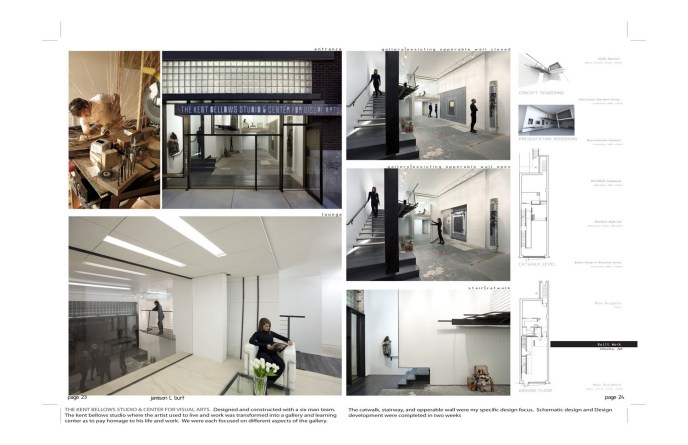
The studio was stuffed with his life: eclectic stashes of books and CDs, mosaics of cut-out images, wall scribbling, monster figures, art supplies and his signature parka hanging on a hook. After Bellows living and working there 16 years, the two-story studio, at 33rd and Leavenworth streets, became a multi-planed art piece in itself. It’s survived as tableaux of his stilled creativity, not unlike one of the wall sets he built for his hyper-realistic work.
Bellows’ family knew the circa-1915 brick building contained artifacts that should be preserved, not packed away or thrown out. The site, which used to be the Mermaid Lounge, was imbued with the legacy of someone who encouraged others, especially young visual artists and musicians. Family and friends deliberated how best to honor his memory.
Griess, her sister Debra Wesselmann and other Bellows family members formed The Kent Bellows Foundation in 2007 and envisioned the nonprofit as an arts education haven with a strong mentoring component. It will serve area youths, ages 14 to 18, grades 9 through 12, with artist-in-residence, studio thesis and gallery internship programs/classes. Board members include artist Keith Jacobshagen, designer Cedric Hartman, art educator Dan Siedell and composer Peter Buffett. Now, after two years of planning, the Leavenworth studio is due to become the Kent Bellows Studio and Center for Visual Arts. The Kent Bellows Foundation announced plans for the new arts organization on-site at a recent open house attended by friends of the late artist. If enough support is found, site renovations could begin this summer and the center could open by early 2009.
“We couldn’t make any rash decisions about it, it was just too important,” said his sister Robin Griess. “So fortunately we hesitated.”
$725,000 in renovations are needed to fix a leaky roof, replace mold-infested walls, make the structure handicap accessible, add a museum-grade HVAC system and construct multi-use gallery, studio, classroom and office spaces. The foundation is looking for public and private donors to help.
Working visual artists will act as mentors, offering students real life lessons on being a professional artist (did someone say this?) and helping them learn to create a studio space, network and market, build a portfolio and deal with galleries.
A close student-mentor ratio will ensure highly individualized instruction (who said this?). Bellows Education Coordinator Rebecca Herskovitz wants to create a comfortable, nurturing environment, she said, where students can be themselves and take ownership over these spaces.
“My goal is to create an art learning family,” Herskovitz said.
The Foundation has broad goals. Partnerships with local arts organizations will provide students more educational opportunities. Lesson plans and resources will be made available to art educators. A scholarship and stipend fund will assist students electing to study art in college.
“It’s a completely new take on arts education,” said Bellows Executive Director Anne Meysenburg.
Early on, the family determined art education as the focus. The specific mentoring mission evolved with input by Bluestem Interactive strategic planners. (We need some attribution in this paragraph, too. Who said these things?)
“When the mentorship idea came to us it made such sense because that’s who Kent was and to mesh that with his legacy and with this inspiring space was just the perfect idea,” Griess said. “We always kept in mind, ‘What would Kent want?'”
She said Bellows was “this wonderful big brother” to not only her and her sister but to many others.
“Whatever your thing was he would just celebrate it,” she said.
When he did break from his meticulous work, Griess said, the studio was a vibrant spot where he showed pieces, discussed ideas and jammed with musicians. Creativity was always in play. She hopes students can soon tap into the spirit bound there.
“To emulate that place of creativity and to inhabit it is absolutely contagious,” Herskovitz said. “You can just feel it’s a place where magic was happening. For kids to walk in there every day will be an enchanting thing.”
Randy Brown Architects’ design will alter and open up the studio, though portions will be preserved as Bellows left them; notably the south rear space where his easel still stands and his hand-sharpened pencils lay ready. The upper floor is home to undisturbed set pieces and backdrops. These expressions of Bellows will be conserved, pending funds, by the Ford Conservation Center in Omaha. (Who said this?)
“The ultimate goal,” Meysenburg said, “is to inspire and to ignite the creative spark in the artistic youth of this community.”
The job of documenting Bellows’ prolific original works continues. Researchers are working to create a comprehensive catalogue raisonne of Bellows’ work as Joslyn Art Museum prepares a fall 2009 Bellows retrospective.
Griess called the search a treasure hunt: some previously undiscovered works have turned up, and other notable pieces are still missing in action.
It’s all part of ensuring the Bellows legacy.
“We feel a heavy responsibility about doing this right,” Wesselmann said.
Mentoring programs start this September in yet-to-be-named art facilities, and the foundation has some potential site leads. The foundation is currently recruiting students and staff for its first 16-week semester.
Related Articles
- Debate rages over arts curriculum (theage.com.au)
- Getting Back to the Phantom Skill – NYTimes.com (opinionator.blogs.nytimes.com)
- Expressive Drawing Class for Youth offered at Lincoln Street Center for Arts and Education (thevalleyvoice.org)
St. Peter Claver Cristo Rey High: A school where dreams matriculate
Three years ago I did this story for The Reader (www.thereader.com) on the first Cristo Rey high school in Omaha. It’s a school where the students, mostly inner city Hispanic and African-American kids from families of little means, are required to work an office job to help defray the cost of tuition. The job is also an important learning avenue, exposing students to environments and experiences they would likely otherwise not see and helping them develop skills they likely otherwise wouldn’t feel compelled to cultivate. My story focuses on two students in the school’s inaugural freshman class, a Hispanic named Daniel and an African-American named Treasure. Although each tried to downplay it, their attending the school meant a great deal to them and their families. I may revisit the story of these two young people and their school next spring, when Daniel and Treasure, both of whom are doing quite well in the classroom and at the work site I am told, are set to graduate.
UPDATE: As updates go, this one is decidedly sad: In early February the Catholic Archdiocese of Omaha announced that St. Peter Claver Cristo Rey High School will close at the end of the 2010-2011 school year due to the school incurring a $7 million deficit in its brief four-year history. It seems the school was never really able to gain enough traction, in terms of numbers of students enrolled. There was a high turnover of students who could not or would not follow the school’s strict standards. Ultimately though the recession of the last three years may have dealt the biggest blow because the school could not find or maintain enough jobs with local employers for its students to work once the economy sagged, thus severely cutting into the revenues the school needed to operate. Without those jobs, which defrayed the cost of tuition, some families simply could not afford what it cost for their children to attend. The more financial burden the school and the archdiocese took on to cover the gap and the shorter the school came to meeting its enrollment projections the more untenable the situation became. I will be filing a story in the spring that revisits the stories of Daniel and Treasure — who were part of the school’s first freshmen class and will now be part of its first and last senior class. With the impending closing it becomes a poignant, bittersweet story for all concerned, but it doesn’t diminish the quality educational experience students experienced.
St. Peter Claver Cristo Rey High: A school where dreams matriculate
©by Leo Adam Biga
Originally published in The Reader (www.thereader.com)
Few school startups have attracted the attention of St. Peter Claver Cristo Rey. From the time plans for the new Catholic high school in south Omaha were first announced in 2005 through the end of its first academic year next week, the institution’s captured public imagination and media notice.
Claver’s housed in the former St. Mary’s school building at 36th and Q Streets, within walking distance of the historic stockyards site, Hispanic eateries and markets and Metropolitan Community College’s south campus. The Salvation Army‘s Kroc Center is going up down the road where the Wilson packing plant used to stand.

That the school’s elicited so much response is largely due to its membership in the national Cristo Rey Network, a branded nonprofit educational association based in Chicago. 60 Minutes profiled it. The private CR urban schools model gives disadvantaged inner city children a Catholic, college prepatory education and requires they work a paid internship in white collar Corporate America.
Wages earned help defray students’ tuition and provide schools a revenue stream. Member schools share 10 mission effectiveness standards. Staff from CR schools around the nation attend in-service workshops.
Cristo Rey’s pairing of high academics with real life work experiences is why the network’s grown from one to 19 schools in less than a decade. Three more will open their doors next fall. The model appeals to families who otherwise can’t afford a private school, much less expect their kids to work paid internships. Communities are also desperate for alternatives to America’s public education system, where resources for urban schools lag behind their suburban counterparts. Students of color in inner city public schools struggle, fail or drop out at higher than average rates. Relatively few go on to college, much less complete it, and most lack employability skills beyond low paying customer service jobs.
So when something new comes along to offer hope people jump at it. That’s what the Mayorga Alvarez and the Anderson families did. The Omaha working class families, one Hispanic and one African American, fit the demographic profile the school targets. Claver’s kids mostly come from poor Hispanic or black households qualifying for the federal free or reduced lunch program.
Some whites, black Africans and Native Americans also attend. CR schools typically serve small enrollments. Claver’s no exception with 67 students.
The Mayorga Alvarez family and the Anderson family saw the school as a gateway they couldn’t pass up. After year one their views haven’t changed. Each family sends a child there. Daniel Mayorga Alvarez and Treasure Anderson are both honor roll students.
Claver internship director Jim Pogge said it’s easy to see how much this means to families. “I participate in almost all of the application interviews and the hope in the parents’ eyes is evident.”
Families also find appealing the prospect of being in on the ground floor of a new kind of school, a theme embodied by the Claver team nickname, Trailblazers. A sign in front of the school reads, “Become a Trailblazer.” A symbol and legacy in one.
“We call ourselves Trailblazers for all kinds of different reasons,” Pogge said. “This is a trailblazing school, the students are trailblazers in their own lives.”
Daniel Mayorga Alvarez said, “We’re kind of proud we’re the first class. I guess it makes us feel more special.” Among the downsides, he said, is that Claver “doesn’t offer all the classes I wanted.”
School president Rev. Jim Keiter said Claver’s expanding its courses and staff, hiring full-time music, art and reading teachers for next fall and adding CAD drafting, culinary arts and Microsoft certification classes as early as spring ’09.

Fr. Jim Keiter
Christopher Anderson made his daughter, Treasure, among Claver’s initial enrollees last summer. He liked the idea of her being in a school “totally different than what she’s been used to. The structure, the dress, the work ethic. I mean, I wish I could have gone to a school like this. And then you get to thinking she’s going to be part of the first class,” he said, beaming.
Each Claver student works a full-time shift once a week, plus one extra day per month. The school day runs from 7:50 a.m. to 3:55 p.m. Most students stay after school an hour or two. On work days, a student reports to school, is taken by cab to his/her 8:30 a.m. to 4:30 p.m. job and then returned to school. It might be 6 before they get home.
The curriculum includes a mandatory business class addressing office skills and etiquette. Students apply classroom lessons to the workplace. Back at school they share on-the-job experiences with fellow interns. Pogge works closely with the 22 employer partners in Claver’s Hire-4-Ed program. Student job performance is reviewed and graded. Pogge said, “It’s real. They can get fired.” That’s happened. In those cases students get retrained for new jobs.
“All of our students have to work in order to make this thing work. They have to be employable. The work component actually drives the school,” he said.
Claver sets the tone in the summer with a mandatory three-week long boot camp orientation that introduces students to school-workplace expectations.
When kids can’t or won’t meet expectations they’re asked to leave Claver. A number have been expelled.
“We have a very rigorous academic program. I mean, it’s college prep. There’s no deviation. It’s very linear in its focus. We also have this work component that’s very demanding. These kids have to perform but not everyone’s up to that task. Personally, I have kids this age and I wonder how they would do,” Pogge said.
On the whole, he said, the work study program’s met expectations. “We have had bumps, but we have had far more successes. As of February, 82 percent of our students received ‘Good’ or ‘Outstanding’ job performance ratings.”
Students who do well on the job invariably gain confidence and maturity.
“We see it in changed behaviors here at school,” Pogge said. “They’re all of a sudden more focused, engaged. They communicate more effectively. They’re kind of coming out of their shell.”
Signs that Treasure’s growing up have surfaced since she started at Claver.
“She’s pretty mature. She missed a day of work, which they’re required to make up, and she made the arrangements without me asking her,” Anderson said.
Parents also like the strict dress code. Many students don’t. At Claver’s summer boot camp last August boys loosened or removed their required neck ties and girls pushed the envelope with revealing outfits. Staff reminders and reprimands were common.
Maria and Rodolfo Mayorga Alvarez made Daniel, their youngest child, an early enrollee. A bright boy with a sweet, outgoing personality, he previously attended public schools in south Omaha, where he, his two older brothers and his folks live in a snug bungalow within sight of Rosenblatt Stadium.
His Mexican immigrant parents work blue collar jobs. Their formal education is limited, as is their English. Daniel serves as interpreter. Translating for his mom, he said: “She wanted me to go to a school that was a different environment, a whole new experience. She says the work I’m doing and the interactions I’m having and the skills I’m learning will be really helpful to me in the future.”
His mother’s noticed a change in him now that he comports himself like a little man. “She says I try to correct myself more. She sees me setting more goals for myself. She likes how the school is more disciplined.”
Daniel enjoys being in a brand new school with few students and much diversity.
“It’s like you’re starting all over with a clean slate. You get to know a whole new group of people. You probably get closer to people because you’re going through the same thing…you get stronger relationships,” he said. “In this school you get to know different types of people. You get diverse friends. We’re all scattered. We’re from north Omaha, south Omaha, southeast Omaha. Everybody’s got their own story — where they live, how they grew up.”
He finds Claver more taxing than what’s he’s used to. “I put a bunch more effort into this school,” he said. “It’s hard to keep up a B or A. I come home tired.”
Treasure also finds Claver challenging. She said, “It’s not always easy or fun to get good grades but you have to. I’ve had to learn how to balance school and work. I’ve got responsibilities both ways.”
She and Daniel are keenly aware that “it looks good on a resume” to have a college prep diploma and professional internship among their credits.
Treasure’s native Omaha Baptist family has a history of Catholic education. Her dad and aunts attended Blessed Sacrament. Her aunts then went on to Dominican High. Treasure went a year at Sacred Heart, where her two younger siblings now attend.
Although she mostly attended public schools Treasure’s one year at Sacred Heart gave her an inkling of what to expect at Claver, where weekly Mass and daily religious instruction are the rule. In the end, she said, “it’s still kids. We get along, we don’t get along. It’s high school.”
Most of her friends now attend Marian, a school too pricey for her dad to afford. “I surely couldn’t,” he said. All her Claver tuition’s paid by her job earnings.
A shy, inquisitive girl with a big spirit, Treasure lives with her two younger siblings, her father and his girl friend in a big house on Florence Boulevard in North O. Her older sisters live on their own. The family attends Morningstar Baptist Church.
Her dad is separated from her mom, whom she sees regularly. Chris works at Walgreens. He’s battled kidney disease for 14 years. Last summer both kidneys were removed. He’s now awaiting a transplant. A grown step-daughter may be a match.
Claver Admissions Director Anita Farwell said Treasure hasn’t let her father’s illness stand in her way.
“I love how she keeps her mind focused. She’s not distracted. No excuses. She loves her father. She wants to succeed not only for him but also for herself. He’s a terrific man and he’s built it in her as well.”
Treasure has strong role models. One of her half sisters is in college and another’s gone back. An aunt’s in the Army. Her parents both have some college. Now Treasure’s a model for her little brother and sister. Twelve-year-old Tera and 7-year-old Trey Christopher can’t wait to join her at Claver. Anderson’s already determined they’ll be future Trailblazers.

Reporting to a job adds a new dynamic for Treasure and Daniel. They work in guest services at Immanuel Medical Center, where several Claver students intern. They variously escort patients/family members, answer the phone and do clerical tasks.
“It can be boring but it’s preparing us and that’s what we need,” Treasure said. “We’re not always going to like it but it’s the real world. It does help me with my communication and organizational skills. It’s helped me open up a little to people.”
Pogge said students get to see new worlds.
“These kids are now going into buildings they normally just drive by. Now they’re part of the process,” he said. “They’re exposed to jobs, professions they may have never thought of before, and they can transfer skills from one job or industry to another. Communication skills, attention-to-detail, punctuality, stick-toitiveness.”
The work’s not always cut-and-dried, either. In Immanuel’s Diagnostics and Procedures areas the interns interact with strangers — adult patients or loved ones. Worry is etched on people’s faces. Daniel said many of those he escorts remark on how young he is and a conversation inevitably ensues about the school. Staff say having Claver kids in this role disarms people, putting them more at ease. Daniel views it as a life skills learning experience.
“As you talk to them you get to know them and to know a whole different story. You feel so sorry for them and you want to do everything to help them,” he said. “I really do like helping people. That’s probably the most satisfying.”
Once, a woman broke down and cried in the arms of Treasure, who consoled her.
“I had to be there for her, I guess,” she said. “I just couldn’t leave her there. She was going through some hard times. Her husband wasn’t going to live. I’m not the best people person but I did learn I have to suck it up and just be there for people in order to help them.”
The incident reminded her of her father’s precarious condition.
“If my dad just died one day who would be there for me? You gotta give in order to receive. So I try my best.”
“She doesn’t like to talk about it but I’m a realist, I know on any given day,” said Anderson, his voice trailing off. “So I always tell her, You know if something was to happen to me you would kind of be the glue to hold them together,” he said, referring to her younger siblings. “If your sister or brother were doing something wrong you’d say, What would Daddy say? I’ve raised her enough now that she knows what I expect of her and them. We talk about real things.”
Same for the Mayorga Alvarez family. They were due to make their next pilgrimage to Mexico this summer but tight finances postponed those plans. His parents don’t hide the fact it’s a struggle these days.
“When Mom’s right about to finish all the bills, to pay the school off, this off, that off, then all of a sudden something breaks down and we have something else to pay,” he said. “We always have this conversation. We feel we’re right about to hit the point when we’re living free and then something else happens. We’ll probably use the vacation money to pay off the truck so next year we’ll be a little more debt free.”
If the Mayorga Alvarez family don’t make it across the border this year it’ll mark only the second time in Daniel’s memory they haven’t. Their faith sees them through hard times. On Sundays the family attends St. Agnes or Our Lady of Guadalupe churches, whose congregations are filled with aspiring, upwardly mobile young families just like them.
The family’s hopes of moving up are pinned on Daniel’s shoulders, an academic star who envisions a medical career, perhaps as a doctor. He’s already found he far prefers office work to the roofing jobs he went on with his father and brothers.
“This is way better than that. I’d rather exhaust myself mentally,” he said.
Conversely, his brother Jesus was a less than stellar high school student who’s now looking for work. His other brother, Renne, a South High sophomore, is not excited by school but does plan on college. The brothers feel while Claver may not be for them, it’s right for Daniel.
“I think it’s good because it teaches the kids how to be responsible,” said Renne, who works at a Hy-Vee. “It gives them a taste of life — of how it’s going to be.”
Daniel said his mother often expresses her fondest desires for her boys.
“She wants us to become kind of independent, finish school, get good jobs, become better people. Even though both my parents work it’s still not enough to pay for everything. She wants us to do our part and to find our own way.”
Maria Mayorga Alvarez said she dreams of the ranchero she grew up on in a small, isolated village in central Mexico. Life was simple but happy there. She loves visiting home. She sees then how far she’s come. She hopes once her boys move on they’ll return to the family’s Omaha home and appreciate how far they’ve progressed.
Rodolfo Mayorga Alvarez’s poured his heart, soul and sweat into improving the small house. When his boys leave home they carry his and Maria’s dreams for better tomorrows.
Farwell admires how Daniel’s parents “have raised him to, ‘Do your best son.’ He loves them and he’s so thankful for what they’ve done for him. That is one of the motivating factors for him to do his best.”
Maria and Rodolfo Mayorga Alvarez and Christopher Anderson harbor the classic dream that their children do better than them. Their dreams are bound up in the promise of a school whose Catholic priest namesake tended to black Africans taken off slave ships in Colombia, South America. Claver reaches out to at-risk kids with a step ladder to success. Students, though, must make the climb themselves.
“All we’re really doing here is cracking open the door. It’s up to them to walk through it, run through it, and many of them are sprinting through it,” Pogge said.
As symbols go, what could be more dramatic than a school, with all its promise for new life, situated next to a burial ground, where dreams go to die? The east and south sides of Claver look out over St. Mary’s Catholic Cemetery. Just beyond the cemetery South O’s booming economy is evident.
It’s not only kids and families inspired by the opportunities the school affords but teachers, administrators and corporate internship partners as well. Pogge said businesses see the connection between profit and opportunity.
“The corporate response has been outstanding. These companies have a real need for this clerical work to be done. Why not give our students a chance to perform and develop? Every decision maker I have met has told me they want to have a hand in developing the future workforce of this city,” he said. “These students will either be a part of that workforce or will fade away from it. If they fade away from it, then everybody loses. If they are actively engaged at a young age, then the future is very bright indeed.
“These companies believe these students have real and tremendous potential.”
Educators and employers want to be part of a journey that propels young people forward — past the traditional barriers in their path. As the Claver mantra says, “to serve those who desire it the most but can afford it the least.”
“It’s inspiring and humbling and exciting,” Pogge said, “It just makes absolute sense to give people a vision of what they can become, and that’s what this school is all about. It’s so tangible. It’s very real.”
“Our kids come from poverty and it’s really hard for them to see the consequences of getting an education or not getting an education and what it means to their future success or failure,” said Claver Principal Leigh McKeehan. “But when you expose them to careers then they can start putting two and two together and create a plan for their lives.”
The needs of Claver students are great. About half arrive below grade level, some two-three grades below in reading and math. While this first year was comprised solely of a freshmen class, some 16-17-year-olds were in the ranks of otherwise 14-year-olds. The older kids dropped out of schools at one time or another and desired what Keiter termed “a fresh start.”
Farwell said some kids come from single parent homes and others from homes where grandparents or guardians raise them. Kids may have moved several times.
“They’re 14 and they have gone through so much in life, they’ve seen so much,” she said, “and we’re trying to give them stability. We want them to know they can succeed. It doesn’t matter what their past has been. Go forward.”
“They can do it,” said Pogge, who refers to the entire staff as having “a calling” to this mission. Daniel said the staff’s dedication to “go the extra mile” is noticed.
Farwell said two of the school’s biggest selling points are its negotiated tuition and the transportation provided students to and from school (bus) and work (cab).
Interest is high. But the application-registration process can be daunting for Spanish speaking newcomers. Many parents work on hourly production lines and can’t easily arrange or afford missing work to fill out forms or go through school interviews. Claver’s simplified things by reducing the number of forms and expanding its hours — making admissions more of a one-stop process. Most Claver staffers speak some Spanish. A few, like Farwell and McKeehan, are fluent, which they say helps build trust.
Then there are the school’s high academic and accountability standards, which extend to students and parents signing a contract. Farwell said many parents expressing interest in the school the first year weren’t aware of its college prep rigor but adds that inquiries today seem more informed. That should mean fewer mismatches between the school and students and, thus, fewer expulsions.
As Keiter said he’s come to realize, “we can’t be the savior school for all students and families. Not every school is meant for every student.” He’s expelled 11 kids since August. Others withdrew after recognizing Claver was not for them. The attrition’s cut deep into the rolls of an already small student body.
When registration closed last summer Claver counted 106 students. Only 95 actually showed for the boot camp. By the time the school year began that number fell to 86. Enrollment now stands at 67.
Back in August Keiter already wrestled with “the savior complex.” One early morning he assembled the students at St. Mary’s Church across the parking lot and tearfully addressed them from the foot of the altar.
“Yesterday was probably one of the hardest days I’ve ever had. I removed four students from this school for behavior.”
He talked about the need to follow directions, make good choices and work together for the common good. Using the bad apple analogy, he said one or two rotten ones can spoil the whole bunch. Removing the students, he said, was “for the good of all of you.” He pledged he’d make more hard decisions as necessary.
“We have only one chance to set the bar and create the reputation of the school, and we want that reputation to be a school that is safe and a great learning environment preparing all our students for college and work,” he said.
Two of Daniel’s friends were expelled. “It was because of the dress code,” Daniel said. “I think for some of them it opened up their eyes. They’re going to come back next year hopefully. Their parents want to enroll them.” The dress code’s been enough of an issue that Claver’s introducing uniforms next year.
Casualties are inevitable.
“We are giving some second chances and they are excelling,” Keiter said. “That is what it is about, but for the whole to excel we will at times have to remove students who are not accepting or not wanting to accept this new way of learning at school and work. If they are disruptive, et cetera, it is not fair to those who are working hard to succeed.”
He said the school’s “being more diligent” about keeping standards high and not diluting them for the sake of “wanting to help or ‘save’ one. We have to be honest about who our school can serve best, not for our betterment but for each student’s betterment.”
Farwell’s actively recruiting freshmen and sophomores for next school year. Applications and acceptances are ahead of last year. June 12 and July 10 All Admissions days are planned. The boot camp’s being revamped to include a several nights retreat away from school that promotes relationship building.
Meanwhile, the school’s secured $5 million in its $7 million capital campaign and has renderings for a planned physical expansion.
Keiter said the strength of CR schools is their “outside the box” approach of being neither tuition nor philanthropy driven but enrollment and jobs driven. Aside from that bottom line, dreams most drive what goes on there. The long hours and stringent rules are not popular with kids but the ones that stay, like Treasure and Daniel, sense a higher purpose at work. They know how much is riding on this for their folks.
When Treasure omplains how hard it is her dad reminds her, “That’s the reason we chose the school — you’re getting more out of it.” Chris Anderson added, “Me and a couple other parents talk all the time about what a great opportunity it is. I could not be any happier. She’s excelling. I have faith in her and in the school.”
Related Articles
- Another Harlem Shining Star (harlemworldblog.wordpress.com)
- You: Progress slows in closing achievement gaps in D.C. schools (washingtonpost.com)
- Cristo Rey: Part of the Solution for Education Today (prnewswire.com)
- School for poor kids would make them work for tuition (thestar.com)
Related Articles
- Cristo Rey: Part of the Solution for Education Today (prnewswire.com)
- School for poor kids would make them work for tuition (thestar.com)
Strong, Smart and Bold, A Girls Inc. Success Story

Shardea Gallion, ©photo Girls Inc. Omaha
The following story I did for The Reader (www.thereader.com) appeared as its go-getter subject was on the verge of womanhood, nearing her high school graduation and looking ahead to college. Shardea Gallion has lived up to the promise she showed as a star member of the Girls Inc. or Girls Incorporated club in Omaha, where she grew up and where she became the poster girl for the mentoring, youth development program’s Strong, Smart and Bold slogan.
I spoke with her last year and I’m pleased to report she’s well on her way to achieving her goal of a media career, studying film and television at the University of Nebraska-Lincoln and working on video projects outside of class. Like many of the girls served by the nationwide nonprofit Girls Inc., Shardea comes from a disadvantaged background, but with support and guidance she’s gone far to to position herself for a life and career that might have seen improbable a decade or so ago. I have a feeling I will be writing about Shardea again some day, and this time she will be a professional film or television director/producer/writer. You go, girl!
©by Leo Adam Biga
Originally published in The Reader (www.thereader.com)
“Strong, smart and bold” is the Girls Inc motto but it may as well be the personal creed of Shardea Gallion, an Omaha girls club member since age 5. In a life full of tests, Gallion, 17, has shown a resilience, intelligence, moxie and what she calls “old spirit” that belie her age and make her dream of a broadcast journalism career plausible. Already the host of her own cable television show — Those in Power — on Cox Communication’s community access channel, this poised hip-hop teen from The Hood makes like a young Oprah conversing with local movers-and-shakers on topics ranging from police-community relations to reparations for black Americans.
Besides holding her own with adults, the devout black Baptist excels at mostly white, middle-class Catholic Marian High School, where she’s a senior honors student, features page editor for the school paper and leader on multicultural-diversity committees. She also volunteers for her church, the YMCA and Girls Inc. In 2002 she was one of eight recipients of the national Girls Inc $2,500 college scholarship award and in 2000 was among 40 school-age girls chosen from 1,000 applicants to participate in the Eleanor Roosevelt Girls Leadership Workshop in Val-Kill, NY. An upcoming issue of Black Enterprise Magazine will profile her.
Two recent stories she penned for her school paper, The Network, hint at her audaciousness. In one, she asked non-Catholic Marian students to reveal what it’s like being a minority there. In tackling the story she defied administrators, explaining, “I want them to understand that, yes, there are other voices at Marian and my voice as a Baptist is just as important as those other students’ who are Catholic.” The other story explored the implications of teens getting hitched. “I hear a lot of talk about girls designing their wedding dresses and picking out their rings and I’m like, ‘This is ridiculous — you don’t even have your college picked out.’ I just wanted to send a message to girls that maybe you should wait and think about it.” Gallion, who said she “doesn’t want to throw away my dreams” by starting a family right out of school is herself the product of a young union.
One of six kids born to a teenage single mother, she endured a chaotic first five years before she, her sister and four brothers were taken in by their maternal grandparents. Ultimately, she and her siblings were placed in foster homes. She is still troubled by the fact they were adopted by separate families. “That’s when I was kind of crushed forever,” said Gallion, who’s been in counseling over the severing. “I never understood why we were separated or why my sister couldn’t join me.” She’s tried putting it behind her. “I know I can’t dwell on being separated because that would have just bring me down.”
Regarding her mother, whom she’s seldom seen since the split, Gallion chooses her words carefully. “I didn’t always have that solid foundation…of someone that was going to be there no matter what. At school, everything was fine, but the thing that gave me the greatest trouble was home life. When things are not OK at home, you’re not OK inside. I guess I always had to rely on myself. My mother was rather young. She has regrets. She does wish things would have played out differently.”
Through it all, the one constant in Gallion’s life has been Girls Inc, a sanctuary and activity center for a largely poor black membership. Located in the former Clifton Hill School building at 45th and Maple, the club is where a young Gallion found the stability and direction she lacked outside its red brick walls. “Girls Inc takes into consideration that all parents don’t teach their children everything they should know, so it steps in and is another mother to the girls here, and that’s exactly what it’s been to me,” Gallion said. “It’s helped me through all the times in my life. When situations come along where I’m the only female or I’m the only minority, I am constantly reminded that I am strong, smart and bold — no matter what.”
The girls club is where Gallion found a flesh-and-blood parental figure in Angela Garland, Girls Inc program director. Better known as Miss Angie, this cool, posh black woman was a confidante and mentor to Gallion before assuming guardianship over her three years ago. In Gallion, Garland saw “a very talented” girl who had “to grow up fast” and “take on adult responsibilities” and who, without the right support, might go the wrong way. “There were a lot of things going on in her home — teenage angst and all the rest — and I just kept thinking, ‘Oh, surely somebody will step in,’ and when that didn’t happen I told her she could stay with me. I honestly thought it would be temporary…that things would kind of work out.” When no one else filled the void, Garland made it official by becoming her legal guardian. Living together has taken some adjustment on both their parts.
For Gallion, it meant the woman she never heard a cross word from and whom she idolized as “independent” and “gorgeous” was now Mom. “She’s someone I really looked up to, not that I don’t now, but since taking on a parental role for me I have to look at things a little bit differently,” Gallion said. “I know it was a transition for her to go from me being Miss Angie at Girls Inc to being the parent at home that had guidelines and expectations,” said Garland. “We would go round and round about, you know, ‘Get off the telephone’ or ‘Turn the television off — get your homework done.’ One time, I just had to say, ‘Look, this is my house, this is not Girls Inc — do it because I say so.’ These are things she had never heard before growing up.” Amen, Gallion said. “There were so many things that were so foreign to me. I never had to study. She helped me discipline myself.” When Gardner married, Gallion had to adapt again. “I’ve never been in a household where there was a mom and dad — a husband and wife — and so that’s been an eye-opener.”
Gallion felt self-imposed pressure “to be this perfect person” for Miss Angie. “For a long time I was discouraged,” she said, “because I was doing things for others. The only reason I kept going is because people invested a lot in me. But Miss Angie lightened my burden when she told me I really don’t owe her much except to be the best person I can be. That made things so much easier. I realize she’s taken on a huge role and I do not want to let her down, but now I do things for me first.”
Sometimes Gallion tried so hard to please her guardian that Garland finally told her, “‘Honey, just be a kid — you’ll be grown up soon enough.’” Garland’s only wish for her young charge is for to reach her potential. “All I want is for Shardea to be the best she can be. I always encourage her to dig deeper and to not limit her options.” The experience of shaping a young life has been transforming for the 20-something professional. “It was a tremendous shift for me because when Shardea first came to live with me I was in graduate school and it was like I was an instant parent. But she’s really been a blessing to me. I think she’s made me more passionate about my job and a true advocate for kids. She’s made me respect parenting and she’s helped to kind of give me a new perspective — that there’s more to life than going to work and having things. I realize how blessed I am to be able to pay it forward and say, ‘Now, you go do it.’”

Girls Inc. Omaha
Often taken for older than she is, Gallion has some mature goals. “I plan to get into journalism but, from there, branch out. My ultimate goal is to work with people.” Among the colleges she’s considering is the University of Missouri in Columbia and its prestigious journalism school. Those around Gallion fully expect her to reach her goals. “Her passion is going to get her where she wants to go,” said Marsha Kalkowski, a journalism instructor at Marian. “She’s one of the most enthusiastic student journalists we’ve had here. I see her in front of a camera and I see her making a positive difference in the community.”
Gallion began hosting Those in Power, a project of the Edmonson Youth Outreach YMCA, at the tender age of 14. “Well, at Girls Inc you learn you just gotta take chances and jump in, and so that’s what I did,” she said of her precocious TV debut. She views the program as part of her education. “Once I get involved in a topic I don’t want to learn it just for the show,” she said, “I want to actually know about it so I can carry on a conversation and sound half-way intelligent. I always feel I don’t know enough and I just keep striving to learn as much as I can.”
With college on the near horizon, Gallion is focusing now on her studies and on applying for various scholarships. When things are more settled, she plans reconnecting with her blood roots. “My biological family can never replace Miss Angies’s family — I feel like that’s my family now — but I just want to know who they are. I don’t want to close the door on that. You never know what could become of it. It’s just not a huge priority right now. I feel like I have to get on with my life.”
Related Articles
- Share your career passion and inspire greater Indianapolis girls! (socialactions.net)
- Tabby Biddle: Why Mentoring Young Women and Girls is Important (huffingtonpost.com)
- Crenshaw High Kids Struggle And Succeed, Despite Post-Traumatic Stress (huffingtonpost.com)
- Inspire Greater Indianapolis Girls! (socialactions.net)
- Omaha Native Steve Marantz Looks Back at the City’s ’68 Racial Divide Through the Prism of Hoops in His New Book, ‘The Rhythm Boys of Omaha Central’ (leoadambiga.wordpress.com)
- Tyler Owen – Man of MAHA (leoadambiga.wordpress.com)
- Super Saturday with Girls Inc: Perseverance, Believing in Yourself and Girly Pushups (womentalksports.com)
- Walking Behind to Freedom, A Musical Theater Examination of Race (leoadambiga.wordpress.com)
- Back in the Day, Native Omaha Days is Reunion, Homecoming, Heritage Celebration and Party All in One (leoadambiga.wordpress.com)
South Omaha’s Jim Ramirez: A Man of the People

Image via Wikipedia
The name Jim Ramirez was vaguely familiar to me. I knew he was a highly respected figure in Omaha. I finally caught up with him a couple years ago for this profile. As this blog site will reflect between now and the end of the year, I have begin doing more and more writing and reporting on Omaha’s Latino and Hispanic community, and I will be posting more and more of these stories here. Ramirez has one of those pull-up-from-the-bootstraps life stories that rightly serves as an inspirational example to others. My story originally appeared in the New Horizons.
South Omaha’s Jim Ramirez: A Man of the People
©by Leo Adam Biga
Originally published in the New Horizons
Moving from the kill floor of a packing house to the halls of academia, Jim Ramirez appreciates just how far he’s journeyed. Along the way he’s learned some hard and valuable lessons. That life’s not fair. That self-empowerment means taking control of your own destiny. That no one can put a limit on your capabilities but yourself. That giving back to your community is its own best reward.
For 40 years he’s used his experience to give people the tools they need for success. As a Latino, his focus is on kids from his culture, one he has deep ties to. A former Nebraska Hispanic Man of the Year and grand marshall of Omaha’s Cinco de Mayo parade, Ramirez supports his people as advocate, facilitator, community board member and bridge builder – bringing diverse people together to address problems and realize dreams.

When he was young Hispanics had little say politically or otherwise. “We did not have a voice, just as I didn’t have a voice. As I got more education I got more of a voice,” he said. He’s glad Hispanics showed up in force at recent public hearings in Fremont, Neb. to express opposition to punitive measures the city considered enacting against illegal immigrants and their employers. As Hispanics become better informed and educated, he said, the more they’re heard.
“I believe that education is power and power is money.”
This son of Mexican immigrants grew up in an era when kids with Spanish surnames were expected to fill the same blue collar jobs their folks worked. His dad Mike gutted cattle at Nebraska Beef. His mom Josephine sliced bacon at Armour. Aunts and uncles worked as packers, too.
His family was among thousands that supplied the army of workers employed by Omaha’s once immense packing industry, which formed at the turn of the last century alongside the giant livestock yards that operated in South Omaha.

The packing plants, led by the Big Four of Armour, Swift, Wilson and Cudahy and many smaller meat processors and food manufacturers, thrived for generations, offering Hispanics and blacks some of the best paying jobs then open to minorities.
With that background Ramirez “didn’t give it a thought” that as the oldest of four children he would follow his parents in the hole. “I didn’t know any better,” he said. That’s just the way it was then. Never mind the fact he was a bright student. If you went to South High, as he did, you were generally not considered college material, regardless of your abilities or aspirations. You were defined, as the school nickname reads, a Packer. Societal-educational norms deemed you unsuited for anything else, denying opportunities and crushing hopes.
“In those days counselors didn’t counsel us to go here or there or to prepare for this or that,” he said. “If you were from South Omaha and particularly if you were Mexican (or black) you were going to end up in the packing house, which is where I ended up. Or on the railroad.”
He put in 14 years on the kill floor at Nebraska Beef. He began washing carcasses for a $1.59 an hour.
“After being skinned and split we washed ‘em off. Then they were wrapped in a shroud and pinned — that’s how they get their shape,” he said.
He would likely have remained there if not for mentors who encouraged him to attend college. His first aborted try at higher ed came at the urging of his South High Spanish instructor Alice Giiter. She saw enough potential in him to recommend he apply at Northwestern near Chicago. It was too much of a stretch in his mind.
“When I graduated the best I could do to satisfy Miss Giiter was enroll full-time at then-Omaha University,” he said. “By then I had decided I wanted to be a coach and an elementary teacher.”

Coaching was a natural fit for Ramirez, who though small in size was a top athlete. “That was my life,” he said. He played competitive basketball into his 30s and fastpitch softball well beyond that. The Nebraska Machine fastpitch softball squad he played shortstop on and managed was dominant. Its star pitcher was Ramirez’s son Jim Jr., who was good enough to be invited to train with the U.S. national team in Colorado Springs, Colo. for the Pan Am Games.
Ramirez coached CYO ball for several parishes. He also officiated hoops and football contests, working everything from the Pee Wee leagues to state college games. “I loved it,” he said.
Strangely, he never played organized sports at South. He explained few Hispanics and blacks went out for school teams then — discouraged by quotas and attitudes that made clear they were unwanted. Today, the predominantly Latino Packer soccer team is “the glory of the school.”
Back then, however, discrimination was wide-spread and often overt. After one semester at the university he said a clearly biased education professor dissuaded him with an insult: “Ramirez, I think you ought to change your major — there aren’t too many of YOU people in teaching.” The comment would merit suspension or dismissal today and prompt a complaint by Ramirez. But he was a teenager then and the older educator represented an authority figure he deferred to.
“Young and dumb. What the hell did I know about institutional racism at the time,” Ramirez said. “So I didn’t go back the next semester.”
Instead he returned to the kill floor. He didn’t tell anyone what had happened. “Nobody knew. It was something I just carried inside of me for years,” he said.
He’d never stepped foot inside the plant his father worked in until the day he started there. Everything about the place was an eye-opener. The harsh conditions. The rough-edged men. Their smoking, drinking, fighting, carousing. A more than mile-long stretch of Q Street featured bars, pool halls and gambling joints. As a boy he shined shoes inside Joe’s Pool Hall. Whorehouses were nearby. All in service of the livestock and packing trade.
“Oh, God, those were some wild days. The packing houses were thriving. It was very colorful and culturally diverse,” he said.
He learned every job on the kill floor, eventually becoming foreman. That meant the young Ramirez supervised his father and other grizzled men twice his age and size. His most harrowing job was as a knocker, which entailed swinging a 5-pound sledgehammer between the eyes of cows.
“Every now and then you’d hit a cow and think it was dead and then it’d get up and start running all over the kill floor, guys scattering because they’re all carrying razor-sharp knives, and here’s this crazy, half-dazed cow on the loose,” he said. “To this day I can’t kill a fly or a mouse.”
The worst job was his dad’s — gutter.
“Sometimes we’d kill old cows and some of them had cancerous stomachs and you’d go and rip open the front of the belly and, whoosh, your face would be full of puss,” he said. “That happened probably once or twice a week. You didn’t know what you were getting into when you opened that beef.”
In truth, every job on the kill floor was a nightmare.
“I wish I had a nickel for every cut I got I on my hands and on my legs from working there. It was dangerous. It was brutal. This was before OHSA in a small, non-union plant. Very primitive. Drive the cows in, hit ‘em in the head, hang ‘em up by the hind legs, rip their throat till they die. Ihen lay ‘em on the ground, rip ‘em open, skin ‘em, hang ‘em up again and gut ‘em. You’re walking in blood ankle deep.”
He hadn’t intended on working there long but, he said, “I stayed and stayed and stayed and stayed,” and before he knew it years had passed.
“Once you start getting that nice paycheck,” he said, “it’s hard to say, ‘Well, I’d rather go to college.’” Still, some did try. “As a UNO counselor I ran into many South Omaha kids that didn’t survive because of the lack of preparation. It was always Plan B for them to go to college…” They’d invariably drop-out.
The prospect of being at Nebraska Beef until he was a broken down old man got him thinking about his future.
“I was beginning to learn a little something. I would look at Dad and say to myself, I don’t want to be here when I get his age. Because he was up in age already.”
He finally went back to school at the insistence of social worker Alyce Wilson, who ran a southside community center called the Woodson Center. After getting on at Nebraska Beef he worked part-time at the center, where he was able to fulfill his desire to work with kids in athletics. Wilson suggested a field of study she thought he’d be a natural at — social work. He couldn’t grasp what that entailed until informing him she was a social worker. Sociology became his major and for six years he worked for the Boys Club — first in North Omaha and then in South O.
The more Ramirez studied the more he saw injustice around him and the more he wanted to make a difference.
“I started to see the world through clear glasses instead of the rose-colored glasses I grew up on. My eyes were really opened to racism and how it still exists to this day, only more subtly.”

It took years of night classes but he got his bachelor’s degree in sociology in ‘71, whereupon he entered the education field. He added a masters in guidance and counseling from UNO in ‘74 and his Ph.D. from UNL in adult and continuing education in ‘84, all achieved while attending night school. He believes he was the first Omaha Hispanic to earn a doctorate. His folks lived to see him do it. “We had a big bash at Our Lady of Guadalupe Hall. The whole community celebrated,” he said.
Along the way he dedicated his life to being an advocate for minority students — bound and determined to ensure Hispanic kids get a fair shake.
“I was motivated by what the system had done to me — telling me I couldn’t be because of what I was. I thought this is bullshit because some of our kids want to be doctors or lawyers or engineers or whatever but they’re steered this other way where there’s no chance. I just told myself that as long as I’m alive I’m never going to let that happen to another young student.”
His careers as a Boys Clubs unit director, as a University of Nebraska at Omaha instructor/counselor and, later, as a Omaha Public Schools human/community relations specialist put him in contact with thousands of students over the years.
Although now semi-retired from the district, he continues looking out for the interests of minority students today at age 74. He’s an advisor, a resource, a friend and a liaison for many. He’s launched both a minority student support group at UNO and a minority student recognition program at OPS.
Below: The document pictured below is a statement of purpose issued by the Chancellor’s Advisory Committee on Mexican-American Affairs that jim Ramirez served on.
 As OPS Minority Activities Committee chair he’s still involved in the district’s recognition program. He’s pleased that Hispanic students’ standardized test scores are on the rise in OPS and he enjoys feting high achieving kids and their parents.
“The leadership I see in our youth is astounding,” he said.
In stark contrast to when he was a teen, South High now has a Latino Leaders student organization and a Spanish liaison. He’s a South High Hall of Fame inductee.
He’s assisted scores of undocumented immigrant families navigate the educational system by helping register their children in school. A decade ago Ramirez and others began lobbying the Nebraska Legislature to allow undocumented students to qualify for in-state tuition in the University of Nebraska system.
He once brought bus loads of students to Lincoln to tell their stories. Maria Olvera was among them. The Central High grad was an honors student but her lack of a social security number nearly denied her the chance at a college education. It took Ramirez’s intervention to get her into UNO and to stay there when her nonresidency status was discovered. She had to be reclassified a foreign student despite having lived in Nebraska for several years. Financially, it’s a struggle.
It was only in 2006 the law changed to make illegals, who still can’t receive federal financial aid, eligible for instate tuition; few such students could afford the much higher nonresident rates. Ramirez supports a dormant bill in Congress, the Dream Act, that would make such students legal permanent residents after two years in college. Minus such protections he fears many will lose any hope of college.
Ramirez is widely known as someone people in the community can call 24/7 about immigration questions/issues. If he doesn’t know the answer he’ll know who does.
Aware how vital it is that students of color have counselors and teachers who look like them, something he never had in public school, he helped found a minority intern program at UNO to increase the number of minority educators.
“Five of my former students at UNO became interns with OPS and have done well,” he said like a proud papa. “I brought them all on board.”
For 20-plus years he’s actively recruited new Hispanic teachers where they’re most plentiful — in the Southwest. Each spring he makes a circuit through Texas and New Mexico at teacher fairs to try and lure new education grads here.
“I’ve gotten probably about 15 teachers out of there to come to Omaha,” he said. “It’s very competitive because they don’t want to leave the Sun Belt. They’re very close to their families and we don’t pay worth a damn.”
He said districts in other states not only pay higher starting salaries they offer singing bonuses. “We don’t offer anything like that. So it’s hard,” he said. “I consider myself a good salesman to Hispanic teachers because I sell them on the opportunity to move up and become an administrator.”
This fall three of his recruits are in new administrative posts in OPS: Robert Aranda, Bryan Middle School principal; Ruben Cano, Norris Middle School assistant principal; and Rony Ortega, South High School assistant principal. Ortega is just one of many Latino staffers at the school today.
“We’ve come a long ways from when I graduated from South,” Ramirez said. “We couldn’t become janitors.” Much less teachers or principals.
Ramirez looks to fill gaps impacting Hispanic student achievement. Some years ago he and the former Chicano Awareness Center — now called the Latino Center of the Midlands — approached South High about having volunteer Hispanic counselors there. Ramirez was among the first. “Sometimes the traditional counselors overlook our kids for whatever reason,” he said. After resistance, the school provided a room, a phone and access to students.
“We sent out letters inviting parents and their kids to meet with us because we wanted to work with their sons and daughters to prepare them for college or to improve their status academically,” he said. “That grew and grew and grew and was institutionalized by the Chicano Awareness Center and the district. Some of us were housed in the center.”
Eventually paid counselors were put in place, with the center sponsoring tours of area universities as a way of acclimating or orienting kids to college life. Hispanic college students now host those visits.
“And today there are Hispanic counselors at South, Central and Bryan,” he said.
His impassioned concern for fair treatment landed him on the City of Omaha’s Human Relations Board under Mayor Gene Leahy, who was a friend. He’s remained involved with the board through several administrations. He counts as friends a number of past mayors as well as current Mayor Mike Fahey.
He still has the ear of decision-makers as a University of Nebraska President’s Advisory Committee member and as an OPS consultant. In his self-described “watchdog” role he monitors how the university and the district address minority student needs and talks to chancellors, superintendents, lawmakers and other movers-and-shakers about policies and legislation affecting minority students.
All the while, as he’ sgone from just plain Ramirez to Mr. Ramirez to Dr. Ramirez, he’s kept in mind what happened to him as a student back in the ‘50s. “God, if they’re doing that to me,” he said he thought, there’s no telling what they’re doing to others. “And they’re still doing it,” he said. Most kids attending inner city schools today, particularly Hispanics and blacks, come from blue collar backgrounds where college is not a first choice.
That’s why, he said, “as I moved up the ladder in terms of contacts with chancellors-principals I made sure that they knew what my concerns were — the way our kids are treated in our high schools and, now, middle schools.”
“I’ve been blessed to be in a position to say to the presidents of UNO-UNL, ‘There’s something wrong here. You don’t have enough minority faculty. You don’t do enough to recruit students of color.’ And they pretty much listen,” he said.
From its inception in 1972 he’s also served on an advisory committee for UNO’s minority scholarship Goodrich Program, which has produced more than 1,150 graduates, including some of Omaha’s most distinguished Hispanic leaders. He asks pointed questions of program officials to make sure students are being well served. It’s all part of holding institutions and programs accountable.
“Do you recruit the same at South High School as you do at North or Central? How many Hispanic applicants did you get? How many did you interview? How many did you accept? Those are the kinds of questions I’ve been asking for 30 years in looking after my kids,” he said.
From Ramirez’s POV the Goodrich Program came about as “a result of UNO beginning to smell the coffee” in terms of reaching out to more “nontraditional students of color who are in financial need and academically maybe not as strong. It has just been a tremendous program because of the support parcels that are in it with faculty, with counseling and with study groups. It has produced some of our best Hispanic graduates.”
Little escapes his attention. For example, a recently announced UNL scholarship program targeting minority graduates of North High has him asking, “How about those kids in South Omaha? So sometime in the next few months I’ll get to talk to Jim Milliken (UNL president) and Harvey Perlman (UNL chancellor) and say, ‘Is this experimental at North High and are you going to expand it to South High?’” He always looks out for his constituency.
None of this would have happened if he hadn’t stepped outside the traditional role prescribed for him. He feels fate had a hand in his refusal to be limited or confined by some preconceived idea of what he should or could be.
“It’s a blessing in that respect because if I had stayed in the packing house I would never had been in a position to talk to Harvey Perlman or Jim Milliken or John Christensen (UNO chancellor). As an advisor on an advisory committee I have a little clout because I’ll call a damned press conference in a heartbeat to address something that is just wrong. I haven’t, because fortunately the universities have taken care of that issue.”
In a sense, every day’s been a blessing since suffering life-threatening injuries in a car accident as a teen. He broke his back and a leg. He skull was fractured. He was given the last rites. Seen in this light, even the kill floor was a gift.
He often draws on his own experience as a packing house worker who beat the odds and defied the stereotypes to find a way out.
“All of us counselors at UNO taught a one-credit class called Academics and Career Development. It’s a required course for anyone who enrolls at the university and checks the little box marked ‘undeclared.’ I taught probably three or four sessions. One of the first things I told students is, ‘What I don’t want you to do is break my record. I don’t want you take longer than 18 years to get a degree.’ Their eyes opened up then. And to this day kids will see me and they’ll say, ‘I remember what you told the first day of school.’ That sticks in their mind.”
He emphasized with students then and still does today that if he could make it through college, they can, too. He lets them know he overcame every supposed strike against him. That despite being from a blue collar immigrant family and working a full-time job and raising a family he managed getting three degrees while taking night classes. That’s why he doesn’t brook any excuses.
“That’s how I push my personal experience into this,” he said. “By telling them, ‘You’re 30-some years old now and you’re not one foot in the grave. There’s still time for you to salvage something.’ I remember a new widow from over in Iowa that took one of my evening classes. She started taking courses at UNO to try to survive with an education. She never got anything lower than an A. She graduated in engineering and is now with a big engineering firm in town.”
Ramirez, who divorced in 1979, is the father of three grown children.
He said older, nontraditional students “were my best students because they were taking care of business. There was not all this craziness in their mind about partying and doing stuff like that.” Ramirez may be an extreme example but he was the prototypical serious older student who kept his nose to the grindstone.
There’s another side of Ramirez though — one that loves mariachi music and Latino culture-art. In 1990 he co-founded the South Omaha Arts Institute or Casa de la Cultura, a nonprofit that began with a youth mariachi band, Estrellitas de Omaha, he helped support under the direction of Rosemary Flores. The Institute is home to music and dance touring groups and conducts classes in various arts disciplines.

In 1993 Ramirez assisted Magdalena Garcia in launching El Museo Latino in the Livestock Exchange Building. He still serves on the board of the museum, now housed in the old Polish Home. One of only 11 Latino museums in the U.S., it displays touring art exhibits, hosts lectures and classes and presents performances by its own “CHOMARI” Ballet Folklorico Mexicano troupe and by visiting artists.
By shepherding these two organizations Ramirez has helped enrich the dynamic new South Omaha that’s emerged the last two decades. This largely immigrant-led revitalization of the South 24th Street business district has turned “a ghost town into a thriving Little Mexico,” he said. Improvements go well beyond that festive strip to encompass Metropolitan Community College’s south campus, the renovated South YMCA, the new South Omaha Branch Library and the under construction Kroc Center and South High stadium projects.
Ramirez is enjoying this renaissance and not even recent open heart surgery can prevent him from keeping a hand in things. He could have left Omaha long ago but he’s committed to making his hometown a better place.
“I’ve been offered jobs everywhere because of my education, but I have stayed here. I never got too far from my roots.”
Even if he ever does retire he’ll always be the underdog’s champion.
“I’ve told people over and over and over that as long as I’m pumping blood if I see an inequity with our students I’ll act. I won’t fade away into the sunset.”
There’s no time to rest when you’re a man of the people.
Related Articles
- Hispanic Sets Agenda for Unions (nytimes.com)
- English-speaking Latinos turn to Spanish TV (pbpulse.com)
- For region’s Latinos, enough is enough (timesunion.com)
- El Museo Latino in Omaha Opened as the First Latino Art and History Museum and Cultural Center in the Midwest (leoadambiga.wordpress.com)
- OLLAS, the Office of Latino and Latin American Studies at the University of Nebraska at Omaha, A Melting Pot of Latino/Latin American Concerns (leoadambiga.wordpress.com)
- Walking Behind to Freedom, A Musical Theater Examination of Race (leoadambiga.wordpress.com)
- Native American Survival Strategies Shared Through Theater and Testimony (leoadambiga.wordpress.com)
- Coming to America: The Immigrant-Refugee Mosaic Unfolds in New Ways and in Old Ways In Omaha (leoadambiga.wordpress.com)
- Featured Great Plains Theatre Conference Playwright Caridad Svich Explore Bicultural Themes (leoadambiga.wordpress.com)
- Omaha Address by Cuban Archbishop Jaime Ortega Sounds Hopeful Message that Repression in Cuba is Lifting (leoadambiga.wordpress.com)
- Community and Coffee at Omaha’s Perk Avenue Cafe (leoadambiga.wordpress.com)
Brotherhood of the Ring, Omaha’s CW Boxing Club
Brotherhood of the Ring, Omaha’s CW Boxing Club
©by Leo Adam Biga
A version of this story was originally published in the Omaha Weekly
It owns a rep as perhaps the toughest, most competitive boxing gym in town. Its junior and amateur fighters shine at local tournaments. It is the training ground for many of the area’s top prizefighters. It routinely matches young pugs with grizzled veterans in an effort to raise the level of beginners. Its members are primarily African-American, but include whites, Hispanics and Asians too.
It is a sanctuary for some and a springboard for others. It is a place filled with colorful ringside characters straight out of a Damon Runyon yarn. It is the CW Boxing Club at 1510 Cass Street, and its take-no-prisoners approach and chip-on-the-shoulder attitude makes it the envy and the outcast of the fractious Omaha boxing community.
Rivalries are strong on the Omaha boxing scene. Every gym has its own stable of fighters, its own turf and its own image to maintain and sometimes when conflicts erupt stupid things are said. When a fighter leaves one gym for another, he may be called disloyal or the other gym may be accused of stealing him away.
In the case of the CW, there is a perception that it caters only to blacks, which even a quick survey of its training roster soon dispels. Disparaging things are also said about the character of the fighters who train there, but in reality it is far from the wild-and-woolly den of thugs that some rival boxing coaches portray it as. Instead, the CW, which gets its name from founder and director Carl Washington, features a no-nonsense, professional environment where serious fighters work intensely under the watchful eyes of experienced trainers Midge Minor, Larry Littlejohn and Chucky Brizendine.
The gym itself is only one part of what Washington, who coached the club’s talented first crop of fighters to national prominence in the late 1970s and early 1980s, calls the CW Youth Resource Center. The center offers near north side youth a venue for making music, working out, hanging out and performing community service projects. According to Washington, the gym’s fighters often get booed or jeered at local competitions because of racism and because the CW’s history of success breeds jealousy. He said his club has nearly boycotted area Golden Gloves events due to the ill treatment he believes his fighters receive.

Every gym has its own vibe, and the insistent tone of the CW is set-off by the throbbing bass rhythms and the grating harsh lyrics of rap music blaring from a boom box that plays incessantly in the background. Unlike the foul language of the music, however, there is little profanity heard in the gym, whose walls are plastered not only with the usual boxing posters but emblazoned with a detailed list of rules (which include no spitting on the well-scuffed hardwood floor and no horse playing) and printed mantras that express the philosophy of the place: Lead with Speed, Follow with Power; Only the Strong Survive; and If You Want to Box, Train — If You Want to Win, Train Harder. It is a place where if you can hold your own, you earn respect, but that respect is always tinged with the tension of proving you belong or, if really brazen, proving you’re the top dog.
The gym is a study in contrasts. Take the way that Minor, a four-time Midwest Golden Gloves champion who got his training start at the noted Olympic Gym in Los Angeles, deals with fighters. He is a taskmaster when one of his guys needs pushing and a buddy when one of them needs a pat on the back.
As 13-year-old junior fighter Rosendo Robles prepares to enter the ring one night for some sparring, Minor fastens the headgear and laces the gloves of this angelic, wide-eyed youth with the attentive tenderness of a father helping his son. “Am I going three rounds?” the boy eagerly asks Minor. “If you’ve got three rounds in you,” his smiling coach replies, rubbing the boy’s shoulders. “I’m going to try and get comfortable with my jab first, and then when I get comfortable, I’m going to work on throwing combinations,” the lad tells Minor, his big eyes looking for approval. “That’s right. Your jab sets everything up. It sets up combinations,” Minor tells him in a way that confers the approval Robles seeks. “But I don’t want to see you in there jumping around wasting energy like a little Easter bunny.” Robles grins at his coach’s funny remonstration.
Meanwhile, as this gentle interlude plays out, a rapper performing on a CD explicitly describes various sex acts. The contradiction does not seem to faze anyone, not even born-again Christian Servando Perales, a professional fighter who found religion during a stint in federal prison. To take the contrast even further Minor has the little boy, Robles, spar with the grown man, Perales, in an attempt “to elevate” the kid’s abilities.
Throwing his youngest fighters in with the wolves is one of many ways in which the CW veers from business-as-usual in its training methods. Washington, who began the gym’s tradition of working young fighters with their more experienced counterparts, said, “The reason boxers from Nebraska usually come home after the first round of a national tournament is they don’t have the experience of fighting the skilled fighters you find on the east and west coasts. Guys have to know how to slip punches. You have to work around guys at a certain level or you’ll always be coming home early.” Minor follows the Washington formula with the C.W. crew: “I work all my guys. That’s how they learn,” he said. “Every once in a while I have to elevate them to see where they’re at. I work my fighters a little different than they (other gyms) do. I don’t breed nothing but winners.”
In Robles, Minor sees a kid with “a lot of promise. He wants to learn, That’s what I like about him.” The youth is following in the footsteps of his father and grandfather, both of whom boxed in their native Mexico. “My grandpa wants me to carry on with the tradition,” Robles said.
He has dreams of his own, too. “As soon as I can, I want to go to the Olympic Games, and if I do good there I’m thinking of a professional career when I get older.” As for training with adults, he appreciates the tricks of the trade he picks up from such savvy fighters. “I feel comfortable training with them because I learn from them in the ring. I like to learn new techniques. Sparring with these older guys is getting me prepared for bigger guys. Like with Servando (Perales), he puts pressure on me and I work on getting him off me. When I get done sparring I ask, ‘What’d you see wrong in me?’ and they tell me.” He also likes the attention his coach gives him. “I really like Midge. He shows interest in me. He says I’m his little project. That he’s going to build me up.”
Minor’s final words to Robles that night are, “Don’t be intimidated. Every chance you get you try and knock his ass off.” It is all well-supervised, with the adult Perales acting as a kind of moving punching bag — keeping his gloves open at all times to ensure he does not in any way injure the youth, whose father watches the action from ringside, yelling pointers to his son in Spanish.
During the three-round sparring session, Minor, leaning against the corner ropes from atop the ring apron, alternately shouts instructions to Robles with a sharp, disapproving edge in his voice and offers encouragement with a soft, approving tone. “You’ve got to move in closer. That’s the only way you’re gonna reach him,” he tells Robles, who is dwarfed by his sparring partner. “There you go, cut the ring off. Remember what I told you — if you miss with one hand, you lead with the other. Double jab. Stick — don’t wait on him. There you go. Shorten your hook up…too wide. Good hook.”
Robles, a surprisingly skilled little punching dynamo, is spent after the first round, but Minor denies him water. “You tellin’ me you’re tired? Like I care. You don’t need water yet. Show me you need some water.” After a rousing showing in rounds two and three, Minor lets his protege drink all he wants. As a soaked Robles climbs out of the ring, the chiseled Brezendine catches his eye and says, “If you keep fightin’ like that, you’ll be a world champion some day.” The boy’s eyes light up. “Really, Chucky?” “Certainly, Sando.”

Dreams of glory and chances at redemption are all over the gym. Take the story of Servando Perales, for example. The Omaha native showed tremendous promise as a junior competitor. Fighting for Kenny Wingo out of the Downtown Boxing Club, he won a National Silver Gloves title at 10 and captured second-place in the same competition at 14 in addition to winning a slew of city, state and regional championships. Then, just when Perales was on the verge of really making a name for himself in the sport, the bright, handsome young man got sidetracked by drugs, alcohol and gang-related mischief.
For Perales, the reunion with his buddy behind bars was a life-saving one that went well beyond mere chance. “I was like a walking time bomb. I had no peace in my life. No joy, No nothin’. I was really a heartless heart. I wouldn’t open up to anyone other than somebody that I trusted and knew from my barrio. And I’m just so grateful for Francisco being there in my path. God put him there for that reason.” Today, Perales does volunteer work with Granados and his Overcomers in Christ ministry in south Omaha, where they counsel kids to stay away from the drug and gang culture they got caught up in. Perales, who works full-time as a maintenance supervisor at Sapp Brothers, is married with three sons. A fourth son is being raised by his ex and her husband.
In an unusual move, Perales, who had not fought in several years, turned pro only months after his 1997 release from prison. He was 26 and out of shape, but hungry to rededicate himself to a sport he viewed as an expression of his new found faith. “Boxing is the only way for me to say to kids, Hey, this is where I was then, and now look at me today, when I have Christ within me. I believe Christianity and boxing are a lot alike. As a Christian you’re always under attack by the Devil. He knows your weaknesses. It takes a lot of discipline to stay strong. Just like with boxing, you can’t get comfortable. You’ve got to continue training. Besides, boxing is just something I’ve loved all my life. I’ve come up short of some victories, but my real victory has been beating drugs and alcohol.”

Servando Perales
When Perales decided to enter the pro ranks he shopped around for a gym to begin his comeback at and decided on the CW.
“It’s the toughest gym in Omaha. Everybody said, ‘If you can make it at the C.W., you can make it anywhere because here, when you spar, you don’t just spar — you go to war. Basically, it’s a test to see what you’re capable of. I came down here and I got my butt kicked the first three times until I got my timing and my punch back. It took me awhile.”
Regarded as a mediocre pro, Perales is 11-5 and has no real prospects of making a mark, although he is widely admired for his heart. At age 30 he knows his fighting days are numbered, but his sheer determination keeps him going, sometimes to his own detriment. “In a fight I lost in Las Vegas I was a bloody mess, but I wouldn’t quit. I’ve got too much heart. I came out in the 6th and final round and I almost knocked the guy out I was that determined to win, even though my nose was broken, my eyes were closed and my face was bloody.” He has vowed to his wife he will quit rather than endure that type of punishment again.
Once Omaha’s “Great White Hope” — heavyweight Dickie Ryan may soon be facing a crossroads of his own. The battle-scarred 33-year-old, a solid contender a few years ago, is one of the most successful local pros since Ron Stander, but after 56 bouts (his record is 51-5) and countless thousands of rounds sparring his best fighting days are surely well behind him. Like so many men of the ring, he is unwilling to admit he may be past his prime and should, for his own good, hang-up the gloves.
“Everyone says, ‘When you gonna retire?’ I don’t know. I still feel like I’m in good shape. I still like fighting. I’m still trying to develop the best skills I can bring out in me. I don’t think I’ve done that yet, but I’m working on it,” he said. “I’ve been a pro since I was 19. I’m glad I’ve carried on this long because I turned pro the same time as a lot of other guys but I’m the only one still around after all these years, which is special. I wish it could last forever, but unfortunately nothing lasts forever.”
Ask him if he worries about the risk of permanent head injury, and he shrugs off the question with, “If I get brain damage or whatever, than that was my choice. I made it. Just like Dale Earnhardt made his choice and died doing what he loved doing. I have a friend that has Parkinson’s and the doctors think it was caused from boxing. I don’t know. Who knows? Boxing’s been around forever, though. Even if it was banned there’d still be underground boxing, and I’d probably be the first one there, you know, because that’s how I make part of my living.”

Dick Ryan
Ryan has a passion for what might be called the Brotherhood of the Ring that he and other fighters share and it is this bond forged from sweat and courage and discipline that helps explain why he toils on. “We get these big muscle guys coming in the gym. These tough guys who knock everybody out on the street. They say, ‘I wanna box.’ We say, ‘Okay,’ and they box a couple days and we never see them back. I don’t know what it is, but it takes a special person. I won’t say it takes a tough person, but it takes a certain type of person to sacrifice your body the way we do. It really is hard. In boxing you can’t have a big ego because right when you think you’re all that somebody’s gonna knock you on your ass. And that’s the truth. If you’ve got an ego going into boxing, you’ll be humbled afterwards.”
According to Ryan, there is a camaraderie in the gym, any gym, that transcends race or religion or age. “It’s one of the only places you can go where there’s no racism at all. It’s neat. Everybody gets along. I never try hurtin’ no one in the gym. I can work with anybody. I can work with a guy that’s 150 pounds and I can work with a guy who’s 250 pounds. I can work with kids just coming up. I’ll help ‘em out. And hopefully by working with me they’re going to get better and then eventually they’re going to be good sparring partners. I’m helping them out and they’re helping me out. It works both ways.”
In a long career that’s seen him be a marquee sparring partner (for the likes of Lennox Lewis and Tommy Morrison) if seldom a main event draw, Ryan has trained at gyms across the country. He could train anywhere in Omaha, but the CW is where he’s gone to work the past eight years.
“I’ve been to Gleason’s Gym in New York and a lot of other big gyms and this (the CW) is as good as any gym around. Me and my manager, Mouse Strauss, seen that Midge (Minor) and Larry (Littlejohn) here were really good coaches and Mouse felt it would be good for me to come here. There’s a chemistry between me and my trainer Midge. He’s just a straight-up guy. He’s not the type of trainer to go, ‘You’ve got to kick his butt’ or ‘You’ve got to do this or do that.’ He’s just got a way of telling me to stay focused. He’s not afraid to cuss me out, though. He’s shows no favoritism.”
After 14 years of grinding out early morning runs and long nights hitting the bags and absorbing poundings as a much sought-after sparring partner Ryan said he stays motivated by the chance for a shot at the title or a big payday — even as remote as that possibility is now.
“I think a lot of it is just knowing in the back of your mind that, Hey, I’ve got to keep going because they might call me for that big fight and I’ve got to be ready.’ Before a fight I don’t have any fear at all because I know I’m in shape and ready to go.”
The closest he came to realizing his dream was when he upset Brian Nielsen in dramatic fashion before a hostile crowd in Denmark in 1999. In what was supposed to have been a tune-up bout for the Dane before an expected match-up with Mike Tyson, Ryan rallied late and knocked out Nielsen in the 10th and final round. Ryan said he was given the match with only two weeks notice but, as usual, was in peak condition. However, the victory did not earn Ryan any title shot but instead a rematch with Nielsen, which he lost.
Ryan, who describes himself as “mellow” even on the eve of bouts, is almost embarrassed to say that, apart from his work in the ring, he is not much of a fight fan. “Not really. I don’t go to the fights around here because I don’t like to see friends of mine get hit. It seems kind of weird, but that’s just how I am. I wish I wasn’t like that, but I am. I’d never encourage anyone else to fight. That’s just my opinion. Boxing’s been great for me. I’ve made a few bucks. It’s a good side job.”
The reality for pros fighting out of Omaha, a burg way off-the-beaten track in the boxing world, is that they must work regular jobs to support their pugilistic dreams. When not engaging in the Sweet Science, for example. Ryan is a meter reader for the Omaha Public Power District.
Featherweight Mike Juarez, another CW regular, is a part-time parcel handler at United Parcel Service. “If you’re in Omaha you’ve got to work a job. There’s no sponsorship around here like there is in big fight towns,” said Juarez, 31, who has compiled a 25-9 record during a 12-year pro career that has seen him fight and lose to several contenders and former world champions. The compactly-built Juarez has been something of a boxing vagabond over the years, including stops in Indianapolis and Vegas. After experiencing some hard knocks on the road, he’s returned to his Omaha roots.
“It’s pretty rough out there, you know? It’s a mean game. I didn’t get the fights. I went broke. I really wasn’t ready for the type of (mercenary) atmosphere that I put myself in. There’s nothin’ like being home around guys that I know,” he said while skipping rope one evening at the C.W. He feels the high-caliber training he gets at the Omaha gym sets it apart. “Midge Minor is a professional coach. He knows his stuff. He’s been in boxing forever,” he said. Like Dickie Ryan, Juarez is pushing the upper limits of his boxing career. He said the decision to retire will “depend on how long I can stay winning. There’s no money in it for losers, you know.”
In keeping with the CW’s belief that young fighters need pushing to reach the next level, Juarez often spars with amateurs much younger than him and possessing far less experience. Two of his regular partners are 20-year-old RayShawn Abram and 19-year-old Kevin Nauden, a pair of brash, promising fighters who, along with a third young phenom, Bernard Davis, are looking to make their marks as pros in the very near future. “I’m fast, I’m strong and nobody my size is going to touch me. I don’t lack for confidence,” said Abram, a 112-pounder sporting two gold front teeth. “I’m looking to win a national championship this year.”

He was introduced to the sport after being caught fighting in school by an administrator, who brought him down to the CW to get his hostility channeled inside the ring. In Midge Minor he has found a confidante and mentor. “I sometimes get in with the wrong crowd and I sometimes talk to him about it and he keeps me out of trouble. He also helped me get through the time my grandma died. I can call him anytime.”
Nauden and Abram feel they benefit from going against older foes when sparring, but there is no any doubt who is boss inside the ropes. “They’ve got that grown man strength that we ain’t got yet,” Nauden said. “When I first came here and I hit some of the pros with a hard shot, they let me know this ain’t gonna be goin’ on for long. They ain’t gonna hurt you or nothin, but they’ll tap you and let you know they could.”
While Abram won his weight class (as did the CW’s Bernard Davis at 125 pounds) in the recent Midwest Golden Gloves tourney at Harvey’s Casino and is prepping for the national gloves in Reno. Nev., Nauden lost. As for their future plans, the young men are weighing pro offers and, if the money is right, may end their amateur careers later this year and sign contracts to enter the prizefighting arena. They intend to stay under the training arm of Minor and company.
Whether Nauden and Abram ever make any real money in the fight game, they epitomize what the coaches and trainers at the CW strive to do — get the most out of their fighters.
“It’s like a challenge to me to see how I can develop somebody,” Minor said. “I don’t try to change their style. I just try to better the style they’ve got.” He said he can be blunt with fighters, but they seem to respond to his straight shooting. “If I see a bum, I call ‘em a bum. I’m kind of mean to ‘em. but they work for me, though. They perform for me.” Larry Littlejohn is also known as a hard-driving sort. “We do demand quite a bit of you if you’re going to stay in this gym. This is not the place to be down here joking around. We don’t want those guys. We work hard. We want to win,” Littlejohn said.
CW amateur fighter Shabia Bahati said that when Littlejohn shows up “there’s no cutting corners on your workout,” adding, “He keeps us honest. He’ll put us to the test.”
Bahati, a Midwest Golden Gloves runner up at heavyweight, has trained at other gyms in town and he said the C.W. is not for the faint of heart or the frivolous. “It’s real competitive down here. You’ve got to be on your toes when you come and spar. There’s no play time. They take the boxing down here serious.” Jacqui (Red) Spikes is another amateur fighter who has found the CW more rigorous than other gyms. “I was at a different gym and the training was soft there. Here, it’s all business. There are no wimps down here. It’s got the best pros and amateurs in town. They get the most out of you.”
Related Articles
- Golden Gloves…& golden heart (nydailynews.com)
- Gildardo Garcia finds redemption in ring and in life (denverpost.com)
- Strode king of the ring (denverpost.com)
- Canceled FX Boxing Show, ‘Lights Out,’ May Still Springboard Omahan Holt McCallany’s Career (leoadambiga.wordpress.com)
A Mentoring We Will Go

Image by rogercarr via Flickr
Mentoring programs, whether community or school-based , along with mentoring done more informally, on one’s own, offer effective ways for reaching at-risk youth. The following story I did for The Reader (www.thereader.com) about 10 or 12 years ago profiles some mentoring efforts in my hometown of Omaha. I cannot recall much about the assignment other than the passion and commitment of the people involved as mentors to make a difference in young people‘s lives.
A Mentoring We Will Go
©by Leo Adam Biga
Originally published in The Reader (www.thereader.com)
A sweltering June night in the inner city finds a rag-tag basketball game under way in the Adams Park Community Center gymnasium. Here, in this hot house of testosterone, a lone female watches from the sidelines, itching, like the men around her, for a chance to play.
Maurtice Ivy is a tall, poised woman of 31. She mingles easily with the crowd. A righteous sister perfectly accepted as one of the guys. And why not? She grew up a tomboy among them and is a bona fide player to boot. The former Central High School all-state performer was a collegiate basketball star with the Lady Huskers and played professionally long before TV discovered the women’s game.
This night, like so many before, she’s brought along a young man she regards as a son, Rickey Loftin. The lean, hard-bodied 16-year-old harbors big-time hoop dreams of his own. The junior-to-be at South High School is anxious to strut his stuff. When the pair finally do take the court, she feeds him the rock again and again, highlighted by a slick one-handed bounce pass from the top of the key to a driving Rickey in the lane. Count it. These two anticipate each other’s moves and moods more than mere teammates do. More like soulmates.
It’s that way off the court, too, where Ivy mentors Rickey. In that capacity she serves as friend, counsel, guide, nag and personal coach.
After the gym clears out she “fusses at” him about his showboating and points out a flaw in his shooting technique. He listens good-naturedly and adjusts his shot. “That’s it,” she says approvingly.

Maurtice Ivy
The pair first met when she coached an Omaha Housing Authority team he played on. They hit it right off, and three years later they’re nearly inseparable. She attends all his athletic and school events. She helped pay for a black college tour he attended in May and is looking to enroll him in summer basketball camps where he’ll be exposed to better coaching and competition. She’s been there for him at every turn, including a tragedy.
“A couple years ago Rickey called me up one morning and asked me to come get him,” Ivy recalls. “I was wondering why he wasn’t in school and he said, ‘My dad was shot and killed last night. The only person I want to be around right now is you.’ I was speechless. It took everything in me not to break down and cry. At that point, I hadn’t realized how I had impacted him as a coach. And I just felt like that God was placing him in my life for a reason, and I needed to pick up the ball and be as positive as I could be.
“Rickey was hurting and he really didn’t know how to deal with that. Since then, I’ve really played a role in his life. I just try to be a strong support system for him. Our relationship has truly grown over the years.”
Ivy is among thousands of adults in the Omaha metropolitan area who maintain a one-to-one mentoring relationship with an at-risk youth. What follows is an exploration of different mentoring relationships and how these relationships follow certain familiar patterns, yet retain their own individual dynamic. Of how mentoring brings adults, kids and resources together in often surprising ways. Of how good mentoring isn’t a magic elixer or quick fix, but an investment of time that pays off slowly but surely.
Who are mentors? They’re individuals lending the benefit of their experience to a younger person struggling to reach his/her potential. They can be parents, teachers, coaches, professionals, laborers or anyone with a commitment to making a difference in the life of a child.
Some, like Ivy, mentor on their own — as an extension of their life and work. Others do it through the growing number of formal mentoring programs offered by schools, community service agencies and corporations. For example, adults from all walks of life mentor students in Tom Osborne’s school-based Teammates program, currently serving the Lincoln Public Schools and now gearing to go statewide.
This surge in mentoring is part of a larger movement in which clearinghouse organizations like the National Mentoring Partnership provide training materials and funding referrals in support of local efforts. Several Omahans involved in mentoring, including Hanson, were delegates at a 1997 Presidential summit that examined the most effective ways adults can serve America’s youth. The summit launched the Colin Powell-led volunteer initiative, America’s Promise, a catalyst for linking adults with kids in positive, community-building ways like mentoring.
A Method to Mentoring
The needs of a specific community often dictate the shape mentoring takes. The Chicano Awareness Center’s Family Mentoring Project serves first-generation Hispanic-American families in south Omaha, meaning mentors like Maria Chavez must be a “big sister” to Diana Gonzalez, 12, as well as a bilingual liaison to the girl’s parents, Aman and Maria, as they deal with language, immigration, job, education and social service issues. Joe Edmonson’s Youth Outreach Program, housed in north Omaha’s Fontenelle Park Pavillion, gives kids the safety, discipline and nurturing the area’s gang-ridden streets do not. Edmonson builds kids’ minds and bodies via athletic, multi-media and recreation activities.
Programs generally try striking a balance between structure and spontaneity. The US West-sponsored Monarch Connection, matching employees with McMillan Magnet School students, awards achievement badges to kids completing community service projects with their mentors, and encourages participants to spend other leisure time together.
Some programs strive to be part of youths’ lives from elementary school through college, others target a shorter time frame. Scholarship and other financial aid is sometimes provided as an incentive for children to excel. To qualify for aid, kids must usually honor a signed agreement detailing certain standards of personal behavior and school performance.
Whatever its face, however, mentoring is seen by practitioners as one proven, prevention-based approach to the widespread problems facing America’s youth, although supporters agree it’s no panacea, much less substitute for quality parenting or professional counseling.
“I think in today’s society parents aren’t always there, and not necessarily because they don’t care or they’re bad. Economically, a lot of parents are put in positions where they have to work two or three jobs or opposite shifts. Part of the fabric of the family is missing. A lot of kids nowadays don’t learn at home about manners and etiquette, and about consequences and encouragement and those kinds of things,” says AOK’s
Michael Hanson. “Often we hear from teachers or case workers that a kid’s parents are gone all day. The key is we need to do a better job of linking kids to the adult world in a way that makes sense to them.
“I think mentoring is being recognized as something that’s happened for a long time, but it just wasn’t called that, and now we’re formalizing it and trying to add some structure to it. That’s why I think its powerful. It’s the basis for everything we do as social animals. We form relationships, and a mentor is a special kind of relationship. If we look back in our own lives we all had someone who helped us see something in ourselves we couldn’t see or helped us make a decision we might not have made.”
Hanson says today’s mentoring efforts attempt “to artificially recreate something that happens naturally” for most youths, but that doesn’t for others. Without mentoring, he feels, kids fall through the cracks. That’s why programs like AOK work with school counselors and social service experts to identify youths who could most benefit from a mentor. Typically, it’s a bright student underachieving due to personal/family difficulties.
Doing the Right Thing
Mentoring is also a form of community activism. Of citizen helping citizen. Of giving back. Although Maurtice Ivy works in west Omaha (at Career Design), she still resides and takes an active role in the near north side community she grew up in, coaching youth athletic teams, sponsoring a 3-on-3 basketball tournament and mentoring kids like Rickey. “As a young community leader it’s my obligation to try and make a pathway to make things better,” she says. “It’s all about trying to do the right thing. And it’s just remarkable how receptive kids are when they know you’re sincere and doing everything you can do to try and help them.”
She has seen the difference mentoring’s made for Rickey. Thanks in part to her tutelage, he’s harnessed his mental and physical gifts and become a top scholar-athlete with lofty dreams for the future. He can’t imagine life without her.
“We have like a bond between each other,” he says. “She’s helped me not only with my physical skills on the basketball court, but mentally too by helping me keep my focus in the game and on school. She inspires me to keep getting good grades. She’s made me see how I can get a scholarship to college. I’d like maybe to be an engineer or an accountant. She’s like my second mom. I feel comfortable calling her my step-mom.”
Ivy, single and childless, doesn’t pretend to be Rickey’s mother. Mentors sometimes tread a fine line between being a friend and usurping the parental role. When Ivy started working with Rickey, she sensed his mother, a single working parent of three, viewed her as a threat. “I can understand that,” Ivy says, “and I didn’t want it to be that way, so I would back off, but then I’d be there for him when he needed me. I told her basically, ‘View me as an extension of you.’ She’s done a wonderful job with him. His mom is now a lot more supportive of what I’m doing in his life. I just try to give him direction. I try to place him around individuals and resources that can give him the assistance he needs. I see the impact I’ve made in his life and that is truly the most rewarding thing. When I see him excelling, I feel joy. ‘There’s my boy!’”
In return, Rickey looks up to Ivy. “She’s a black independent woman. No one can force her to do anything she doesn’t want to. She’s athletic. She’s working on graduate school now. She gives me advice on anything I need to talk about. I feel like I can always depend on her,” he says.
Reaching Out and Giving In
Trust must be present before a mentoring bond can be cemented. Getting there involves a feeling-out process. It can be a daunting task reaching sullen kids who are already wary of adults. According to Hanson, “A lot times mentors are more scared of the relationship than kids are because it’s a big responsibility. And if they feel they’re not doing a good enough job or don’t know what to expect in terms of working with a young person, they’ll give up.”
Jeff Russell had two AOK mentors give up on him in junior high before being paired with a third, David Vana. Already burned twice, Jeff held back. “I was really hesitant about getting involved with another because I figured he wasn’t going to stick around for very long anyway,” Jeff, now 20, says.
Vana, an Inacom business analyst, felt the young man’s reluctance. “He didn’t have a whole lot of faith in the program based on his experiences with his first two mentors, so I think he was a little cautious before he warmed up to me. I think the previous mentors tried to push him, and with Jeff it just didn’t work because he had a tendency to rebel. Before I started giving him advice and stuff, I wanted him to trust me and accept me. I didn’t want to come down too hard on him, so we started doing things together like going to hockey games and we got comfortable with each other.”

Before Vana came into his life, Jeff was a juvenile delinquent in the making. After the death of his mother upon entering 5th grade, Jeff, who never knew his father, was raised by an aunt and uncle. Things were fine at home, but he was failing high school and hanging with a bad crowd, so counselors recommended him for mentoring. “The friends I had were not exactly…going anywhere. In fact, they’re still not anywhere,” he says. “One of them is in jail for murder. Another one has many drug convictions. Another one can’t hold a job. I was very fortunate to get out of it when I did.”
Upon first meeting Jeff, Vana was struck by his fatalistic attitude. “When I asked about college, he said, and I’ll never forget it, ‘People like me don’t go to college.’ That’s when I focused on building his self-esteem and confidence. He made a lot of progress. Jeff definitely is a success story.”
Jeff credits Vana and Vana’s wife Noreen for helping him turn things around. “They’ve been very influential in my life. Whenever I’d have a question — school-related, work-related, anything — I’d call and we’d talk. They’ve been there for me a lot. They really took time out for me.” With their help he applied himself, raising his GPA from 0.32 to 3.20 and graduating on time. Currently taking a break from his studies at Metro Community College, where he’s working toward an associate’s degree in horticulture, Jeff oversees a gardening crew at a private estate and hopes to one day have his own landscaping business/nursery. AOK is paying his college tuition.
When he looks back to where he was headed — a likely drop-out — he sees how far he’s come and where he yet aspires to go. “I could have very easily followed that path. I still could revert back to that path, but I just have to remind myself of my goals. This program showed me that if I do what I should do, I can actually get someplace in my life.”
Trial and Error
Even when mentoring works, there are still power struggles, communication gaps, unrealistic expectations and bumpy spots along the way. “You can’t just pull two people’s names out of a hat — a mentor and a mentee — and expect their personalities to mesh perfectly,” says Vana. “It’s important to remember every kid is different. You can’t apply some mentoring template to every relationship. If it isn’t working, recognize that and make a new match.”
Bad matches do occur. They’re bound to, since aside from a screening/interview process, pairings are based on instinct and educated guesses. “With some, there’s no chemistry there. Others walk a fine line, with neither side willing to get real close or comfortable. But there’s been some extremely good matches too,” says Roz Moyer, US West manager of Community Affairs/ Employee Relations and Monarch Connection director. She says when things don’t click or mentors quit, affected youth are reassigned until a solid match takes hold. The challenge then becomes regaining the child’s trust. It can take time.
Moyer says mentors often have a sense of failure even when the match succeeds and the child thrives. “I think part of that is the kids don’t run up and say, ‘Thank you, you did such a good job.’ I tell the mentors not to expect them to do that. You’ll see it in other ways — in the success they have in school or by a good word every once in a while. You just have to know you’re doing a good job.”
Monarch mentor Linda Verner, a US West Finance executive, has at times doubted the job she’s done with former McMillan and current North High student Carrie Laney, 15, whom she’s mentored since 1996. Verner says, “I really wasn’t sure how much I had to contribute.”
Carrie, though, is certain of Verner’s impact. “I went through a lot of family and school problems the last couple years and Linda gave me a lot of good advice. I can talk about a lot more things with her than I can with my parents. She’s always told me she’s proud of me. She boosted my self-esteem so I would believe in myself and strive to get good grades, and I did.” Carrie plans attending college, with a goal of becoming a pediatrician.
Verner says if mentors just stick with it, good things happen. “I did not understand how much I would get out of it. Part of it is the enjoyment of setting goals with a young person and then getting them accomplished and feeling like you’ve contributed a little bit something.”
Because mentoring doesn’t follow a formula, sponsors offer support when things come a cropper. “Mentors can get discouraged,” Hanson says. “The challenge is tempering their expectations, but at the same time maintaining a level of enthusiasm that will help keep them there for the long haul. We can help prepare them for the fact kids are not going to fall down on their knees and thank you for saving them. They may not even acknowledge you at all. I mean, some of the kids we work with really need a lot of social skills. We have to teach kids how to look a person in the eye, shake their hand and greet them.”
Since mentoring only works if both parties are active participants,sponsors stress why each person shares responsibility for the relationship.
“Both the mentor and the mentee have to have a willingness to forge ahead. Neither one can give up on making that connection and forming that relationship. As a mentor you have got to be dedicated enough to overcome obstacles and focus on that kid. As a kid you’ve got to be as committed as the mentor in attending all the functions and doing all the things needed to make this thing go,” says Moyer. “We tell the kids right off, ‘We cannot change your life. You have to change your life. We can help you. We can guide you. We can open some doors. But you have to be the one who makes the changes.”
“We do group activities so that we can see kids and mentors interact,” Hanson says. “The kid may only say five words to his mentor, and you can see the adult is getting frustrated. The mentor may come to me and say, ‘Gee, I’m just not making any progress. This kid doesn’t like me. I don’t know what to do.’ Yet, if the mentor quits coming to the meetings, the first thing the kid will do is say, ‘Where’s my mentor?’ They’ll know when you’re gone.”
New Beginnings
Karnell Perkins felt betrayed after his first three mentors gave up on him. His family was in disarray. School was a bust. Things looked bleak for the black north Omaha native before he finally connected with AOK mentors Mike and Judy Thesing, a white suburban Omaha couple who practically adopted him. It all started when Thesing, president of America First Financial Advisors, was recruited by America First Cos. head, Michael Yanney, to mentor kids at McMillan Junior High (now McMillan Magnet School) in Yanney’s Kids (the forerunner of AOK). Eventually, Thesing was assigned Karnell, by then a struggling Burke High student reeling from an increasingly chaotic home life and three unsuccessful matches.

Michael Yanney
“Before I met them I was bounced around from mentor to mentor,” Karnell says. “When I finally got Mike and Judy, they were different than the average mentor who sees their kids every once in a while for lunch or a movie or helping with their homework. But Mike and Judy, for sure, go above and beyond. They’ve meant a lot to me.”
But as the problems in Karnell’s family deepened, he was in danger of flunking out of school. “His unwed mother was on the fringe of being in trouble with the law for numerous reasons. There was never any role modeling or anybody who really cared what he was doing or how he was doing. There was never any money or transportation. He was the oldest of three boys and he felt responsible for his brothers. He worked after school, so school was the last thing he focused on,” Thesing explains.
That’s when Karnell’s mentors dramatically intervened in his life. “My wife and I took him by the ears and made him live with us the latter part of his senior year. We put together a program he was to abide by in order to get through school. We made sure he had transportation and that his academic requirements were fulfilled before he could go do anything else. It was a disciplinary and structural change for him, but I think he realized at that point that we really cared and were willing to do whatever it took to make sure he had every opportunity to be successful.”
The change in environment was profound, and so were the changes in Karnell. “I went from one culture in north Omaha to a totally different culture in west Omaha, but race was never an issue. Mike and Judy let me know there’s a better way of life than what I had. They gave me stability. They kind of became like mom and dad.”
There was a period of adjustment, however. “At first things were a little chilly, but as time went on and we did stuff together and he got to know us, things just evolved,” Thesing says. There’ve been road bumps since, like the time Karnell, now a University of Nebraska-Lincoln student, sloughed off in his studies and was placed on academic probation. He soon felt the wrath of the intense, goal-oriented Thesing. Karnell, who describes himself as “laidback,” says Thesing’s constant “do-it-now” prodding got old. “Sometimes I was like, ‘Hey dude, chill out.’ But I do know he’s trying to help me accomplish good things. If I didn’t have him I think I’d be a slacker.”
Thesing says working through such differences is worth the end result. “It can be pretty frustrating, but if you can get past those barriers and develop a real solid relationship, the reward is you’ll be making a difference in someone’s life.” He’s seen the change: “I’ve always been proud of Karnell, but I’ve seen him mature quite a lot. Now he realizes the value of an education, the value of hard work and the value of discipline. By most measures, especially given his background, he’s doing outstanding.”
Karnell, 21, pulled his grades up enough to not only graduate high school, but earn a full college scholarship — courtesy of AOK. The finance major is on pace to graduate from UNL next year, which will mark a family milestone. “No one in my family has ever graduated college,” he notes. “Now, it’s like I’ve set a standard for my brothers. William and Langston are planning to go too. That makes me feel really good.”
Having seen the ups and downs of mentoring, he feels an adult must first earn a child’s confidence before being called a friend: “You need a person who’s sincere. You can’t be fake. You have to sincerely care about kids and want to help out, even if you don’t have all the answers. You have to seriously lead by example. And you have to want to do it from the heart.”
Thesing agrees, adding: “These kids just need someone that cares about them. A lot of them have gone through their whole life without anyone really caring. Throwing money at these things is not really the answer. It’s got to be a genuine commitment of time. Kids need your time more than anything else, and the earlier you get involved the better.”
He expects to remain a part of Karnell’s life for as long as he’s around. “I see it as a lifetime commitment. I look at him as a son almost.” The Thesings have, in fact, gained partial custody of Karnell’s youngest brother, Langston, 10, who now lives with them.
“He really likes being there,” Karnell says. “Every night I go to sleep I thank God for Mike and Judy…and all the people who’ve helped us out. Their hearts are so big.”
Related Articles
- Youth Mentors Needed in Greater S.E. DC! (socialactions.net)
- Mentors discover the power (seattletimes.nwsource.com)
- Programs in Detroit, beyond seek minority mentors (thegrio.com)
- First lady urges more people in US to mentor youth (seattletimes.nwsource.com)
- Been mentored? Pass it forward! (studenttransitionissues.wordpress.com)
- Women Mentoring Women (rejoicingrebecca.com)
- Even Mentors Need Mentoring (togetheragainstviolence.wordpress.com)


 Leo Adam Biga's My Inside Stories